How to Control Japanese Beetles in Your Garden and Lawn
Control Japanese beetles with a step-by-step IPM plan: identify damage, protect high-value plants, skip risky traps, and check lawns before treating grubs.
Japanese beetle control works best when you decide which life stage is causing the damage. Adults chew leaves and flowers; the white grubs that develop in soil feed on turfgrass roots. Hand-picking or covering a prized plant can help with adults, while a damaged lawn needs a separate check before you consider grub control. A treatment for one problem will not reliably prevent the other.
Start with the least disruptive method that can protect the plant you care about. For most home gardens, that means confirming the beetle, removing adults from small or valuable plants, and resisting the urge to spray the whole yard or hang a lure trap beside the damage. If the lawn is also struggling, inspect it independently rather than assuming every brown patch came from the same insect.
Start by confirming the beetle and the damage
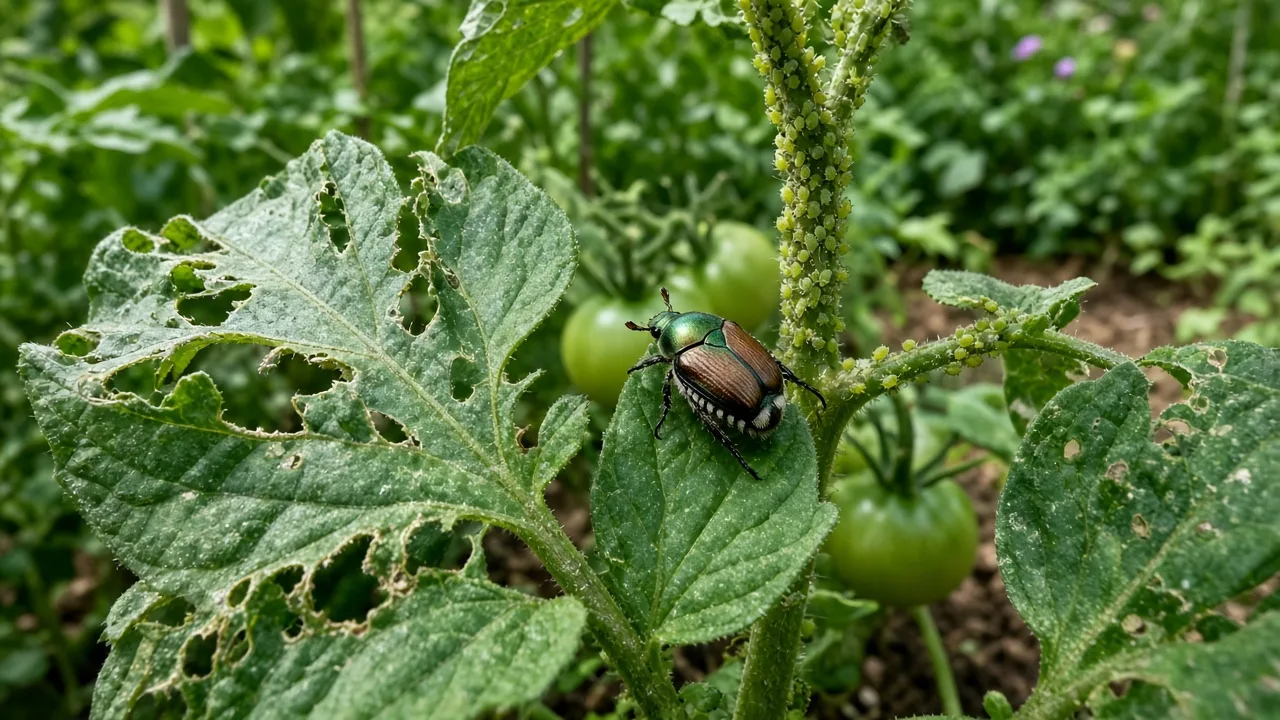
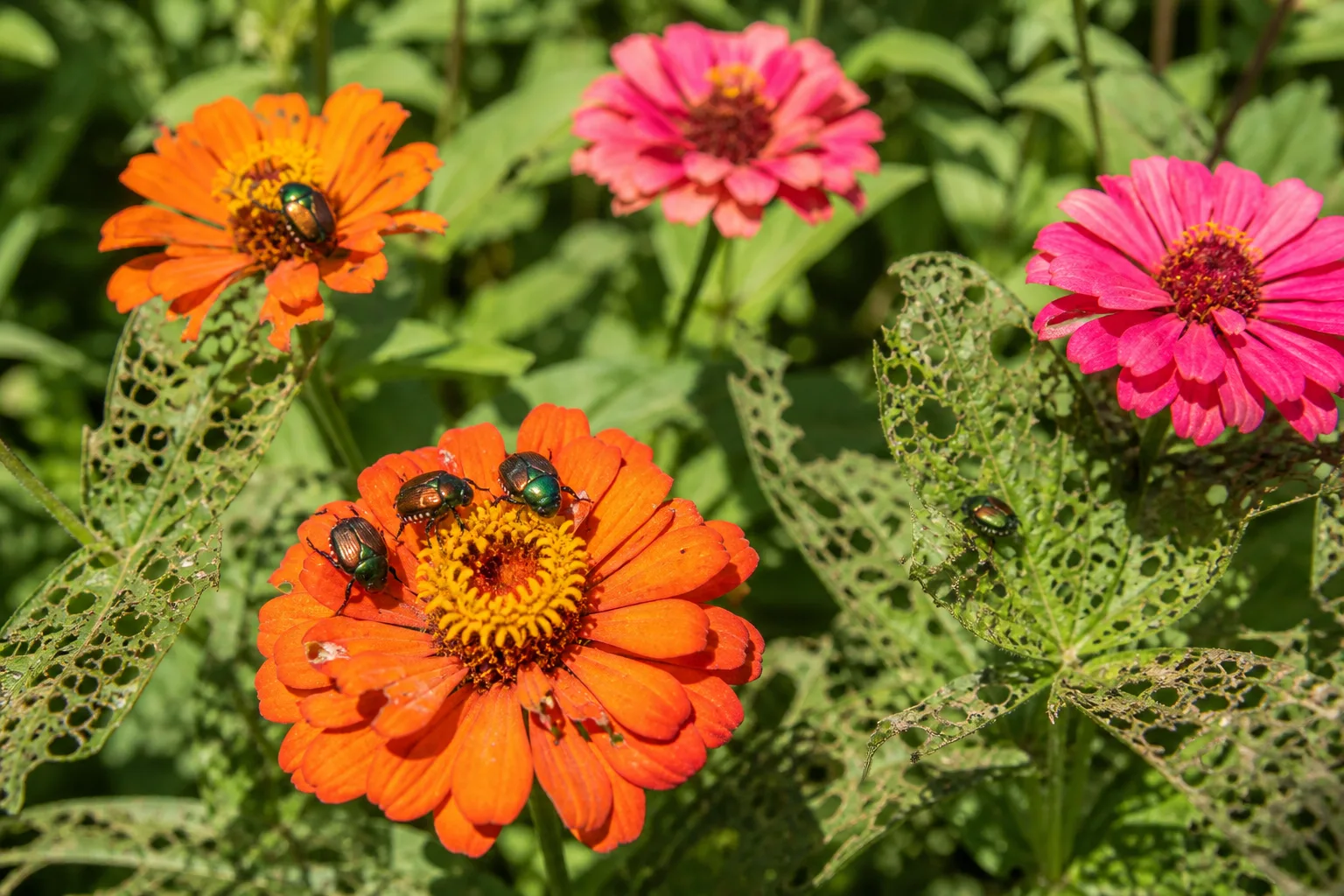
An adult Japanese beetle is about half an inch long, with a metallic green head and thorax and coppery-brown wing covers. Look for small white hair tufts along the sides of the abdomen and a tuft at its end; those details help separate it from other shiny beetles. USDA APHIS’s identification page and UW–Madison Extension’s Japanese beetle guide provide photos and distinguishing features.
The familiar adult injury is skeletonizing: beetles eat the soft tissue between leaf veins, leaving a lace-like pattern. They also feed on flowers and fruit, and multiple adults often gather on sunlit foliage. A few holes alone do not confirm Japanese beetles; look for the insect itself, fresh feeding, and the characteristic pattern before treating.
Separate adult feeding from grub injury
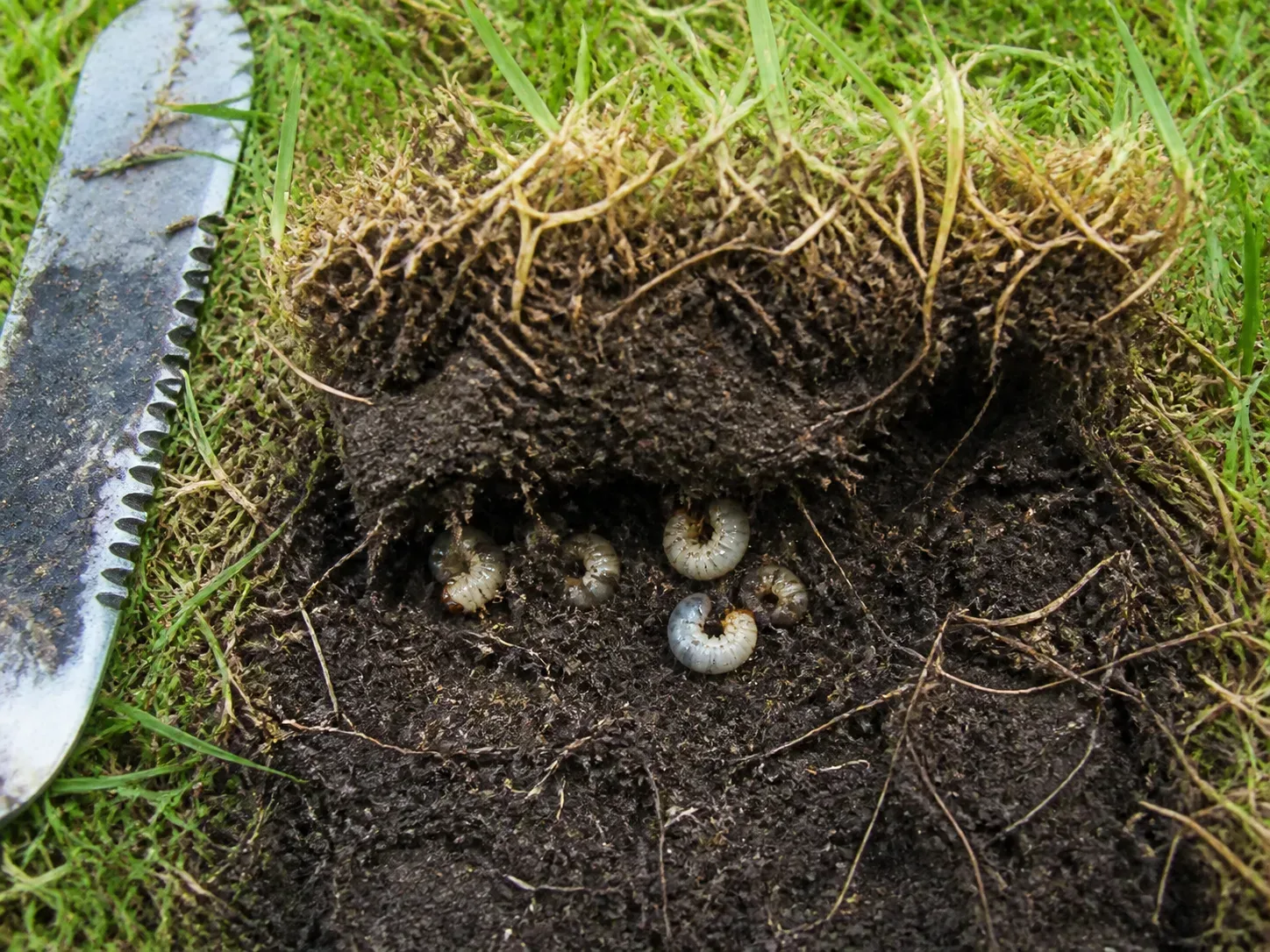
Adult beetles feed above ground on leaves, flowers, and fruit. Their larvae—white grubs—live in soil and feed on grass roots, so a grub problem can show up as irregular pale or brown turf that feels loose underfoot and can lift more easily than healthy sod. Animals digging in the lawn may be searching for grubs, but digging by itself does not identify the insect.
The life cycle is usually one generation a year, but dates vary with climate, latitude, soil, and weather. In Wisconsin, adults commonly emerge around late June or early July and can be present into September; another region may run earlier or later. Eggs hatch in summer, young grubs feed near the root zone, and mature grubs move deeper as soil cools. Use local Extension timing rather than treating a calendar date as universal. UW–Madison Extension describes the stages and their regional timing.
A grub dug from turf is not automatically a Japanese beetle. Several scarab beetles produce similar C-shaped white grubs, and they differ in how much damage they cause and when they are active. If the species matters for the control decision, take a sample or clear photo to your county Extension office instead of relying on color alone.
Match the response to the plant, pest stage, and level of damage
A small rose, a newly planted shrub, a ripening raspberry patch, and an established shade tree do not need the same response. Decide first whether feeding is increasing, whether the plant can tolerate losing some foliage, and whether flowers or edible parts are present. Then choose a control that addresses the target stage without exposing more of the garden than necessary.
If just a few beetles are feeding, begin with hand removal. If a small crop or ornamental is being hit repeatedly, add a physical barrier before the beetles become numerous. If a mature tree has cosmetic leaf damage but remains vigorous, observation and good basic care may be safer than coating a tall canopy with insecticide.
Hand-pick adults while they are sluggish
For a small infestation, hand-picking is simple and targeted. Go out in the cool morning, hold a container of soapy water beneath the cluster, and tap or brush the beetles into it. They are less active in cool conditions and often drop when disturbed; this avoids spraying foliage or flowers. Gardener’s Supply’s practical control guide also recommends morning collection, while UW–Madison Extension includes hand-picking among its options for smaller plants.
Repeat the sweep every day or two while adults are feeding heavily. Check the tops of leaves, flowers, and the upper canopy where the first clusters may form; remove beetles before they accumulate and continue feeding. A hand vacuum can collect beetles on sturdy plants, but empty it into soapy water outdoors and do not leave live beetles in a bag where they can escape.
If you grow edible crops, keep the collection container away from harvest baskets and rinse produce according to normal food-safety practice. Do not use a homemade dish-soap spray as a shortcut: detergents can injure foliage, and contact sprays have to hit the beetle directly. A bucket below the plant is more controlled and does not leave a film on leaves, flowers, or fruit.
Use mesh to protect small, high-value plants
Fine insect netting or screen can block beetles from small shrubs, raised-bed crops, and individual fruiting plants. UW–Madison Extension recommends nylon insect screen with mesh no larger than one-quarter inch for smaller plants during the regional adult-flight period. Support the mesh above the foliage when possible, and anchor every edge at the soil so beetles cannot walk underneath.
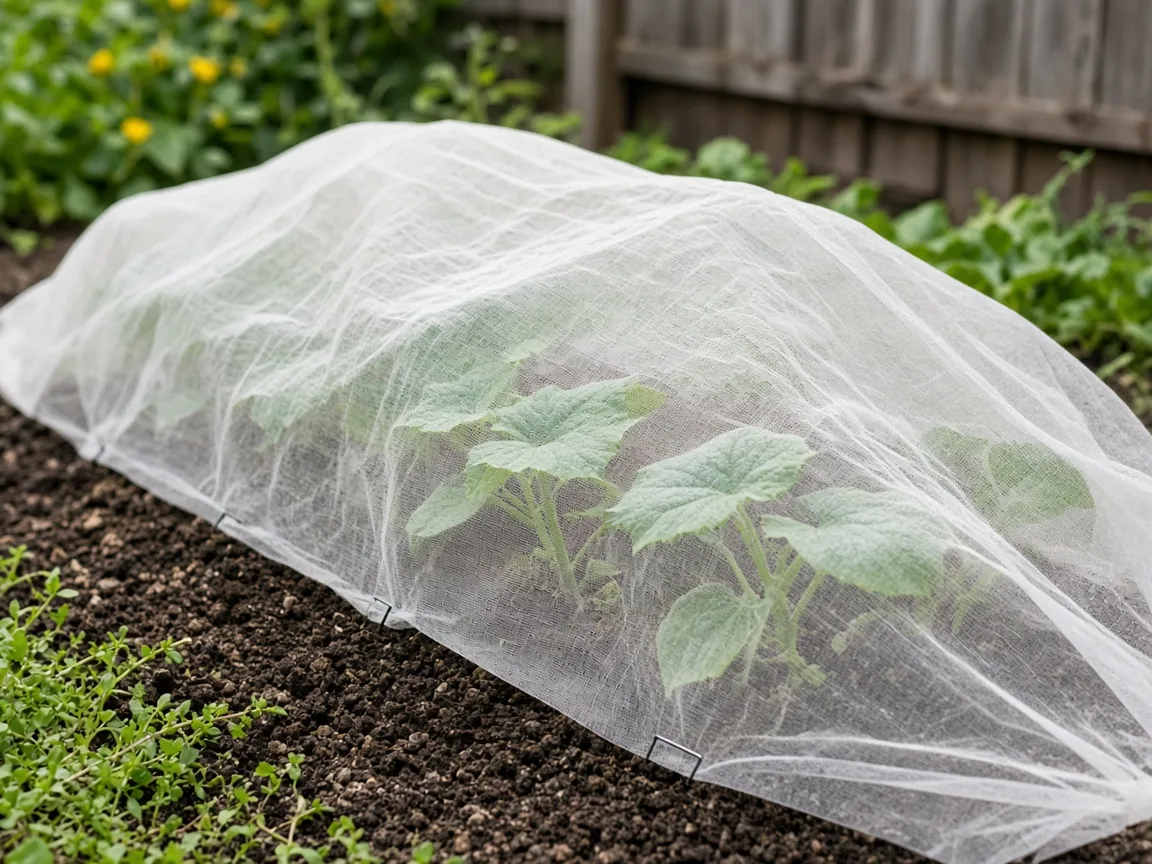
Put the cover on before beetles begin feeding, then inspect inside it every few days. A cover installed over beetles can trap them with the plant, so remove any insects first. Do not leave a pollinator-dependent crop sealed during bloom without a plan: the barrier can also block bees and other pollinators. For vegetables that need pollination, uncover flowers at a suitable time, hand-pollinate where practical, or rely on repeated hand-picking during bloom.
Mesh is most useful where the plant is small enough to cover completely. It is not a practical solution for a mature tree or a large landscape bed, and hot weather can build up beneath an unsuitable cover. Check plant temperature and moisture, remove the screen if it causes heat stress, and keep it from rubbing tender growth.
Treat Japanese beetle traps as a special-case tool
A lure trap is not a reliable “set it and forget it” answer for a small yard. The scent and visual lure bring adults toward the trap, but some beetles may land on nearby plants instead. UW–Madison Extension does not recommend pheromone traps as a control for home landscapes, and University of Missouri IPM notes that the results of mass trapping depend on trap design, number, placement, and setting.
That distinction matters: a perimeter trapping program used by a farm is not the same as one bag hung beside a rose. In Missouri research, a purpose-built mass-trapping arrangement was deployed outside crop plantings; the article cautions that a single residential trap may be inadequate and that a multi-trap program takes maintenance. For a typical home garden, spend that time removing adults or protecting a priority plant instead. The University of Missouri’s organic-management review explains why trap results are context-dependent.
If you already own a trap, place it well away from the plants you are trying to protect and follow local Extension advice. Empty it as directed, keep it out of reach of children and pets, and do not treat a heavy catch as evidence that your plants are protected. A trap can help show that beetles are present; it does not prove that it reduced injury in the garden.
Choose a landscape that can tolerate some feeding
Japanese beetles feed on many plants, but they favor some species more than others. Roses, grapes, lindens, birches, crabapples, and several fruit crops can attract noticeable feeding; arborvitae, boxwood, dogwood, fir, holly, juniper, lilac, magnolia, and many conifers tend to be less favored. These are less susceptible choices, not repellents: beetles can still feed on them, and plant preference varies with location and available food. The UW–Madison list and Gardener’s Path’s discussion of host selection can help you build a planting plan without promising immunity.
You do not need to remove a rose or fruit tree you value. Instead, avoid concentrating every highly favored plant in one exposed block, and mix vulnerable specimens with plants that usually receive less feeding. When replacing a plant that has suffered repeated severe defoliation, consider whether a less susceptible species could serve the same landscape role.
Established trees and shrubs can often tolerate moderate, short-lived feeding and leaf loss. Keep trees watered appropriately during drought, maintain mulch without piling it against the trunk, and avoid adding extra nitrogen in hopes of forcing a flush of replacement foliage. Repeated severe defoliation can add stress, especially to a young, recently transplanted, or already weakened tree; consult a certified arborist when a large tree has sustained serious damage for several seasons.
Check for lawn grubs before treating turf
Brown patches are a clue, not a diagnosis. Drought, disease, compacted soil, dog urine, and other root-feeding grubs can produce similar symptoms. Japanese beetle adults on your roses do not prove that the lawn contains a damaging population of Japanese beetle grubs, and lawn treatment will not stop adults from flying in from somewhere else.
Look for turf that pulls back with little resistance, roots that have been eaten away, and grubs in the soil just below the grass. A healthy lawn can hold some grubs without showing meaningful injury, while drought-stressed turf can suffer at a lower population. The right action depends on grass condition, soil moisture, species, weather, and how the lawn is used—not on the mere presence of one grub. UW–Madison Extension notes that many white grubs are beneficial scavengers and that most Wisconsin turf does not need grub treatment; robust grass can tolerate some feeding. Its white-grub control guide explains why treatment should follow demonstrated injury rather than a few grubs in the soil.
Sample several spots, not just a brown patch
Use a spade to cut and lift a small square of sod at the edge of a symptomatic area, where living and damaged grass meet. Loosen the soil and count the grubs in a measured area; check a second or third spot because populations are uneven. Note whether roots are clipped and whether the sod has separated from the soil rather than assuming the grub count alone tells the whole story.
Do not borrow a universal threshold from a product label, a neighbor, or an article written for a different region. Extension recommendations vary with grub species, turf type, local conditions, and the value of the lawn. If you are close to a treatment threshold or unsure what you found, send the sample and location details to a local Extension office before applying a pesticide.
Decide whether grub control is justified
If turf is healthy and the grubs are sparse, leaving them alone may be the best choice. If animals are tearing up the lawn, confirm what is feeding below ground before trying to solve the visible digging with pesticide; some wildlife damage can continue even after grub numbers fall. Repair watering, mowing, and soil problems that are weakening the grass, and reassess the turf before committing to a treatment.
When a local Extension recommendation indicates that treatment is warranted, timing and product type matter. Preventive products are generally applied around adult egg-laying, while curative products target grubs already present and are most effective against smaller larvae. As a regional example, UW–Madison’s current timing table lists June–July for preventive Japanese beetle grub control and August–October for curative control, with the early part of the curative window better for smaller grubs; those dates are not a national schedule. Mature grubs, dry soil, or a late application can make a product less effective, so follow the exact label and local Extension timing rather than repeating a treatment because the lawn still looks brown.
A lawn treatment is not a future adult shield. Beetles fly, so reducing grubs on your property may lower the number that emerge from that soil without preventing adults from arriving from neighboring lawns, parks, or fields. Think of grub treatment as a response to a verified turf problem—not an automatic way to protect roses next summer.
Understand biological controls and their limits
Beneficial nematodes and milky spore are aimed at grubs below ground, not at adults chewing leaves. Nematode species, soil temperature, soil moisture, product storage, and application timing all affect performance; the package should name the organism and give exact directions. Apply only a product labeled for the site and target, and keep soil conditions within its instructions so live organisms have a chance to reach the grubs.
Milky spore is a bacterium that Japanese beetle grubs must ingest. University of Missouri IPM describes it as a possible grub-management option but stresses the need to manage expectations: reducing beetles emerging from one treated yard does not prevent adults flying in from untreated areas. More recent UW–Madison guidance on white grubs says biological products often provide limited and highly variable control compared with chemical options, and reports that recent university research has not found milky spore effective for white grub control. Treat it as an uncertain, slow option—not an instant rescue or a guaranteed barrier lasting a fixed number of years.
Biological controls can fit a longer-term plan, particularly where a homeowner wants to minimize conventional insecticides and can follow site-specific directions. They are not a reason to skip diagnosis, and neither nematodes nor milky spore will protect foliage from adults already feeding. Compare the product’s target, the time needed, and the expected benefit with the cost and care required before buying it.
Use pesticides only when the label and target fit
For adults, UW–Madison Extension notes that several insecticides can protect foliage, but it also warns that broad-spectrum products can kill pollinators and predators. Insecticidal soaps and horticultural oils have limited effectiveness on Japanese beetles; a product being “natural,” “organic,” or neem-based does not by itself show that it will control this beetle safely or well. Check the active ingredient and target pest on the label, not just the front-panel marketing.
If serious ongoing injury makes a pesticide worth considering, choose a product specifically labeled for Japanese beetles and the plant or crop you intend to treat. Read the entire label for application site, rate, protective equipment, weather, re-entry interval, harvest interval, and pollinator restrictions. Never increase a rate, mix ingredients that the label does not allow, spray a plant not listed for use, or apply to a waterway or a surface that can drain into one.
A broad spray may leave residues or affect insects that were not feeding on your plants. A contact product also needs to reach the beetle; it will not reliably protect new growth if beetles arrive later. Use the smallest labeled treatment area, monitor what happens, and stop when fresh feeding is no longer increasing rather than following an automatic weekly spray schedule.
Protect pollinators and edible crops
Japanese beetles often feed on flowers, which puts control decisions close to bees and other flower visitors. Do not spray open blooms or actively foraging pollinators; where the product label allows, applications after pollinator activity has ended can reduce direct contact, but evening timing does not make a hazardous product harmless. Keep spray drift away from flowering weeds, neighboring gardens, ponds, and streams, and do not treat on a windy day.
On fruit and vegetables, confirm that the label explicitly allows use on that crop and observe the preharvest interval. Wash hands and tools after application, store products in their original labeled containers, and observe any directions for keeping people and pets off the treated area. If the label is unclear, do not guess—ask your local Extension service or the product’s manufacturer before treating.
Follow a seasonal control plan
Spring and early summer
Use spring to decide which plants need protection, repair screens, and learn the adult beetle’s local emergence window from your Extension service. Avoid treating a lawn solely because it had a few beetles the previous summer; first ask whether the lawn actually had a damaging grub population. If turf grub products are appropriate in your area, distinguish preventive products from those intended for small grubs and follow the label’s timing.
During adult activity
When the first beetles appear, verify their identity and note which plants are receiving fresh injury. Hand-pick in cool morning hours, cover small priority plants before feeding builds, and photograph damage every few days so you can see whether the response is working. If one established ornamental has minor injury and continues growing, leave it alone and conserve beneficial insects instead of escalating automatically.
Avoid placing a lure trap beside roses, grapes, or vegetables. If damage grows despite hand removal and mesh, review the crop’s tolerance and consider a labeled adult control only after weighing its likely benefit against exposure to pollinators, edible produce, and other insects. Adult activity is seasonal; a calendar’s date is less useful than beetle presence and local Extension timing.
Late summer and fall
If the lawn has irregular brown patches, sample the turf and count grubs before choosing a control. Young grubs are easier to reach and generally the better target for a treatment labeled for active larvae; later in the season they move deeper as soil cools. Follow regional Extension guidance on the window, irrigate only as the product label directs, and do not assume that an adult-control spray will reach larvae in the soil. In Wisconsin, for instance, the curative window varies by grub species and the UW–Madison timing table cautions that products work best against smaller grubs near the start of that window.
Once adult feeding stops, remove only plant material that is dead or diseased; do not strip healthy leaves or prune a tree heavily to erase cosmetic damage. Record which plants were hit hardest and adjust next year’s barrier or planting plan. In states where Japanese beetles are subject to eradication or quarantine programs, use the state agriculture department’s reporting and movement guidance; for example, the Oregon Department of Agriculture’s Japanese beetle program asks residents in affected areas to follow local directions about plant material and detections.
Conclusion
For most home gardens, the best first move is to confirm Japanese beetles and remove the adults from the plants that matter. Add secured insect mesh for small crops or ornamentals, avoid setting a lure trap next to vulnerable plants, and let a healthy established tree tolerate modest feeding when it is not at risk.
Treat the lawn as a separate problem: look for root injury, sample several areas, and follow local thresholds before using any grub control. Biological products and pesticides can fit certain situations, but their timing, label, and non-target effects matter. A targeted plan will not stop every beetle from flying in, but it can limit avoidable injury without turning the whole garden into a treatment zone.