Does Bleach Kill Ants? Safety, Limits & Better Fixes
Does bleach kill ants? Direct contact can kill exposed workers, but it will not end a colony. Get safer indoor steps, bait guidance, and chemical warnings.
A few ants appear on the counter, and the bottle under the sink looks like the fastest answer. Bleach may kill an ant that is directly exposed to it, but that does not make household bleach a safe or effective ant treatment. It cannot be relied on to reach the hidden workers, queen, or brood that keep a colony going, and spraying or pouring it creates avoidable risks indoors and outdoors.
The useful distinction is contact kill versus colony control. A dead ant on a counter is a short-term result; a reliable plan removes what is attracting ants, blocks their route, and—if necessary—uses an ant bait whose label covers the place and pest. For an indoor trail, ordinary soap and water plus careful bait placement is a better starting point than bleach. Outside, leave bleach out of the yard entirely.
The Quick Answer
Yes, direct exposure to bleach can kill individual ants, but no, household bleach should not be used to control an infestation. A small Purdue University entomology study tested several cleaning products, including a Clorox product, on exposed odorous house ants in a lab; it found high mortality after direct application. That result does not show that bleach kills a whole colony, works on every ant species, or is safe to spray around a home or garden.
Bleach is formulated and labeled for particular cleaning or disinfecting uses, not automatically for killing insects. The National Pesticide Information Center (NPIC) explains that a general-purpose bleach cleaner has no pest-killing directions unless the product is labeled for that pesticide use; a bleach product registered as a surface disinfectant is still limited to the uses on its own label. That is why a product’s familiar smell or strength is not a substitute for ant-control directions.
For most household trails, start by wiping up crumbs, syrup, grease, or pet-food residue and tracking where the ants enter. If they keep returning, use a properly labeled bait where the ants are traveling and leave it undisturbed long enough for foragers to carry it back. If the ants are in a garden bed, ask first whether they are actually harming a plant; killing every outdoor ant is usually unnecessary.
What Direct Contact Can Do—and What It Cannot
What a small lab study does and does not show
The Purdue Entomology capstone study is useful because it measured the direct-contact effect rather than relying on a household myth. The student tested six cleaners on workers from one species, the odorous house ant (Tapinoma sessile), by applying the products directly to small groups in petri dishes. In that setup, all six cleaners produced complete mortality among the exposed ants within 30 minutes.
That is a narrow laboratory result, not a home-use test or an EPA-approved instruction. The experiment used workers, not an entire nest; it did not establish an effective outdoor dose, measure risk to children or pets, test runoff, or demonstrate that a colony’s queen and brood would be reached. It also cannot tell you that every product sold as bleach has the same formulation or effect. The sound conclusion is simply that a concentrated cleaner can kill some ants it directly contacts—not that it is a suitable insecticide.
The same capstone’s residual tests reinforce the limitation. When cleaner residue had aged for a day, it was much less effective than direct application, and the student concluded that cleaners gave temporary results rather than reliable control. That is the outcome homeowners care about: ants can return from another route or a nest beyond the treated spot even if the visible trail stops briefly. A contact effect is not the same thing as lasting control.
Why killing visible workers is not colony control
Most ants seen on a counter or floor are foraging workers. Their job is to find food or water and bring it back to a nest, which may be outdoors, beneath paving, inside a wall void, or in damp wood. The colony includes a queen and immature ants out of sight. A surface cleaner can only affect the ants it reaches; it is not carried through the colony as food.
A slow-acting bait works differently. The University of California Statewide IPM Program explains that workers feed on bait and return it to the nest, where it can be shared with other colony members. That process takes time, but it addresses the source more directly than repeatedly wiping or spraying workers. If ants keep appearing at the same spot, think “find the route and colony” rather than “use a stronger cleaner.”
Why Bleach Is a Poor Ant Treatment
Bleach is a blunt cleaner, not a precision ant-control tool. A splashed surface may expose some foragers, but it will not tell you where they entered, what food drew them in, or whether a colony is nesting in a wall. It also makes a mess of the treatment sequence: you may erase the trail that would help you follow ants to their entry point, while leaving the food source and nest untouched.
There is a second practical problem: household cleaner labels are not ant-control labels. EPA pesticide rules rely on the product label to specify where and how a pesticide may be used. EPA explains that labels are part of the registration process and provide safety directions intended to reduce harm to people and the environment (EPA pesticide labeling requirements). NPIC further distinguishes a general cleaning bleach from a bleach product registered for a specific disinfecting use. If the label does not list ants and the location you intend to treat, do not turn that product into an improvised ant spray.
Bleach can also discolor fabric, damage some finishes, irritate skin and eyes, and create dangerous fumes if it contacts an incompatible cleaner. Those risks buy little when the best indoor first moves—cleaning food residue, sealing a gap, and placing a labeled bait—are more targeted. If there is a genuinely hazardous nest, a licensed pest professional can identify the species and choose a method suited to that location instead of having you experiment with a caustic cleaner.
Is It Safe to Use Bleach for Ants?
Skin, eye, breathing, and surface risks
Do not spray, pour, or wipe bleach onto ants as pest control. The purpose of household bleach is specific cleaning or disinfection according to its own bottle directions. It is not made safer for insect use just because it is already at home or because someone suggests diluting it; dilution does not add ant-control instructions or prove that the mix is effective.
The CDC’s bleach guidance says to follow the manufacturer’s instructions, use good ventilation indoors, and check whether protective equipment such as gloves or eye protection is required. Poison Control notes that bleach contains sodium hypochlorite and that exposure can cause irritation or injury, with more serious effects possible if concentrated product is swallowed. There is no reason to introduce those hazards to kill a few ants when soap and water can remove food residue and a bait can target a colony.
Keep cleaning bleach in its original, closed container and stored out of reach of children. Do not transfer it to an unlabeled spray bottle, and do not leave an improvised bleach solution on a kitchen counter, floor, or pet area. If you need to disinfect a surface for a separate hygiene reason, follow the product label exactly; that is a different task from treating ants. On food-contact surfaces, do not assume a general cleaner is appropriate—use only a product whose label gives directions for that surface and use.
The mixing rule: never combine bleach with other products
Never mix bleach with any other cleaner or disinfectant. That includes ammonia-containing glass cleaners and acidic products such as vinegar, toilet-bowl cleaners, or some rust removers. Mixing can release dangerous vapors: bleach with ammonia can produce chloramines, while bleach with an acid can release chlorine gas. The CDC and Poison Control both warn against mixing household chemicals with bleach.
Do not create a “stronger” homemade ant spray by combining bleach with dish soap, vinegar, alcohol, ammonia, or a commercial cleaner. Even when a particular combination does not produce an obvious reaction, mixing products can change their behavior and may expose you to fumes or splashes. Use one cleaning product at a time, exactly as its label says, and keep bleach out of the ant-control plan altogether.
If you already used a different cleaner on the trail, do not add bleach on top of it. Let the area air out according to the product’s directions, remove food contamination using the appropriate safe cleaning steps, and choose a labeled bait later if ants persist. A bait station should never sit in a puddle of cleaner or on a surface recently treated with a strong-smelling product; cleaners and sprays can deter ants from feeding.
Why You Should Never Use Bleach Outdoors for Ants
Do not pour bleach on an ant mound, spray it into a crack in a garden bed, or use it as a yard perimeter treatment. There is no practical reason to soak soil with a household cleaner to address workers at the surface, and a treatment that misses the deeper nest may leave the colony active. Outdoor soil, leaves, mulch, stone, pets, and people are not controlled application sites for an improvised bleach treatment.
Runoff is a particular concern. EPA’s sodium and calcium hypochlorite fact sheet reports that these chemicals are highly toxic to freshwater fish and very highly toxic to freshwater invertebrates. That assessment is not a recommendation to apply bleach to soil; it is a reason to keep it from drains, streams, ponds, and other water. Maryland Extension also cautions that chlorine bleach can harm landscape plants if it reaches foliage (Ask Extension).
The broader garden answer is usually to tolerate ants unless you have a specific problem to solve. The Royal Horticultural Society describes ants as part of garden ecosystems: they prey on other invertebrates, move soil, and sometimes protect aphids for their honeydew. Epic Gardening’s garden-ant guide likewise cautions that broad sprays are indiscriminate and suggests reserving control for a real problem. For an outdoor nest that poses a stinging or crop risk, identify the species and use a product labeled for that ant and site, or ask a local extension service for region-specific advice.
What to Do Instead When Ants Are Indoors
Step 1: Remove food and water, then trace the route
Start by putting away the attractant rather than chasing every worker. Close sugar, syrup, fruit, bread, and pet food in sealed containers; rinse sticky bottles and cans before recycling; wipe up crumbs, grease, and spills; empty the kitchen bin if it contains food scraps. Repair drips under sinks and do not leave a pet bowl or damp sponge beside an active trail. The University of Maryland Extension’s indoor ant guidance notes that ants often enter from outdoor colonies in search of food odors and may leave when no food is available.
Watch the trail long enough to see where it begins and ends. Check window frames, door thresholds, pipes, cabinet gaps, and the point where a utility line enters the wall. A few scouts may be temporary, while a steady line moving from a crack to food points to a repeat route. Avoid spraying first: tracking the route gives you a place to clean, monitor, and later seal.
Step 2: Clean the trail without disturbing a bait station
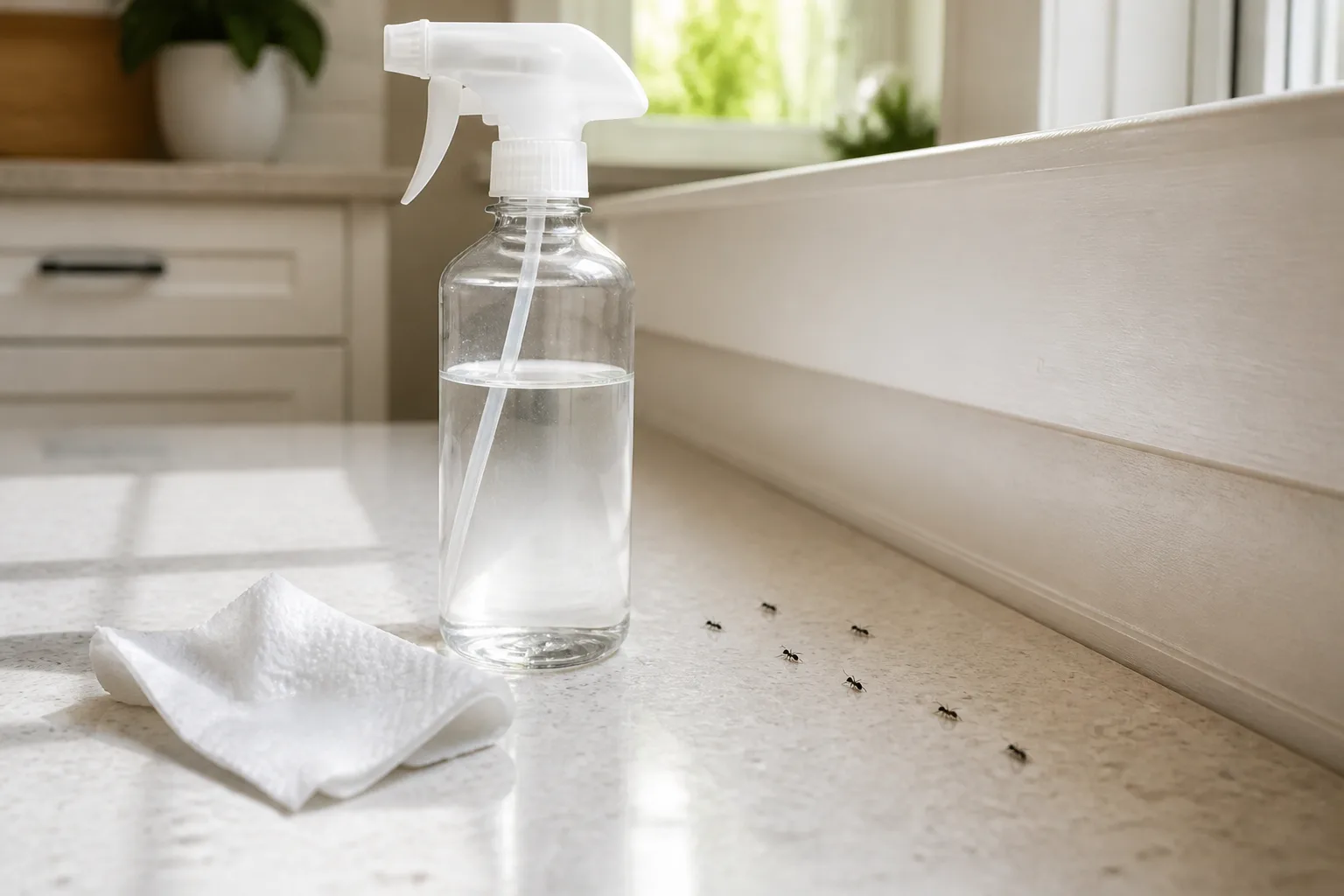
If no bait is in place, remove the ants and wipe the trail with ordinary soap and water, then dry the surface. This removes food residue and can disrupt the trail without adding a caustic chemical. UC IPM specifically notes that soapy water can remove ant scent trails on indoor surfaces. On stone, painted wood, or a delicate finish, follow the surface maker’s cleaning advice and test an inconspicuous spot rather than using bleach as a shortcut.
There is one important exception: once ants are feeding at a bait, do not wipe up the active trail or clean right around the station. Workers need access to the bait and a route back to the nest. University of Kentucky Entomology warns that cleaners and other insecticides near bait can deter ants from feeding. Clean the surrounding kitchen, but leave the short approach to the bait undisturbed while it is working.
Step 3: Use a labeled bait and give it time
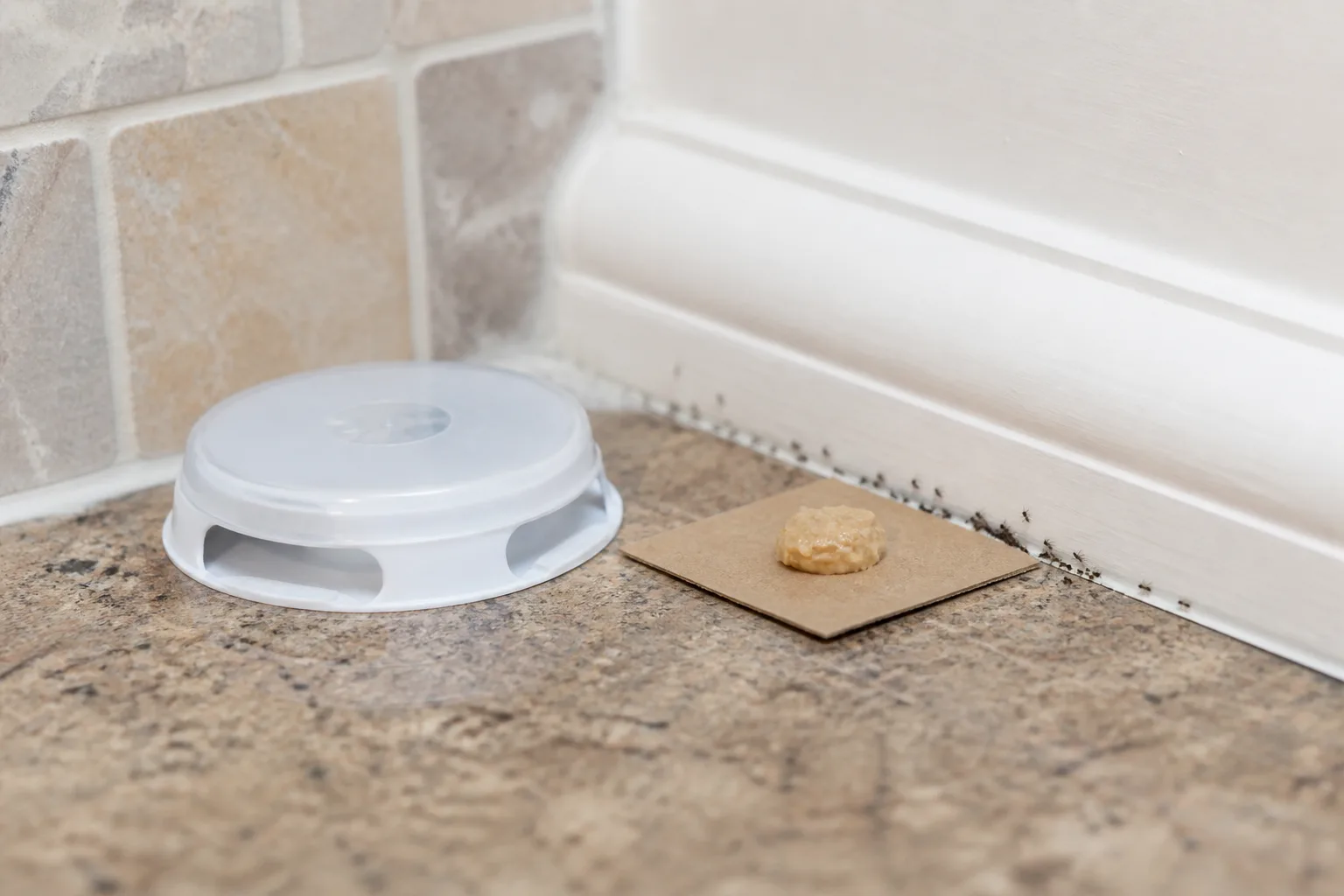
Choose a ready-to-use ant bait whose label covers indoor use and the ant or situation at hand. Place it near the route, but away from children, pets, and food-preparation surfaces; follow the package directions for placement, replacement, and disposal. Some baits use sweet food, while others use protein or grease, and ant preferences change. If workers pass one type by, a different label-directed bait formulation may be more attractive; do not add pantry ingredients or bleach to the bait.
Expect a delay. Baits are designed to be carried back and shared, so activity can look unchanged or briefly busier before it declines. The University of Maryland Extension notes that a bait may take 24 to 48 hours or longer; UC IPM notes that complete control can take several weeks or more, depending on species, bait acceptance, and colony size. Keep the station fresh as directed, and do not spray, bleach, or wipe the trail that leads to it.
If you rent or share walls, coordinate with building management before placing products in shared areas. In apartments, ant colonies may be in wall voids or common spaces that one resident cannot reach. Treating a few visible workers with bleach can hide the activity briefly without changing the source; a building-wide baiting or exclusion plan may be needed.
Step 4: Seal the route after activity stops
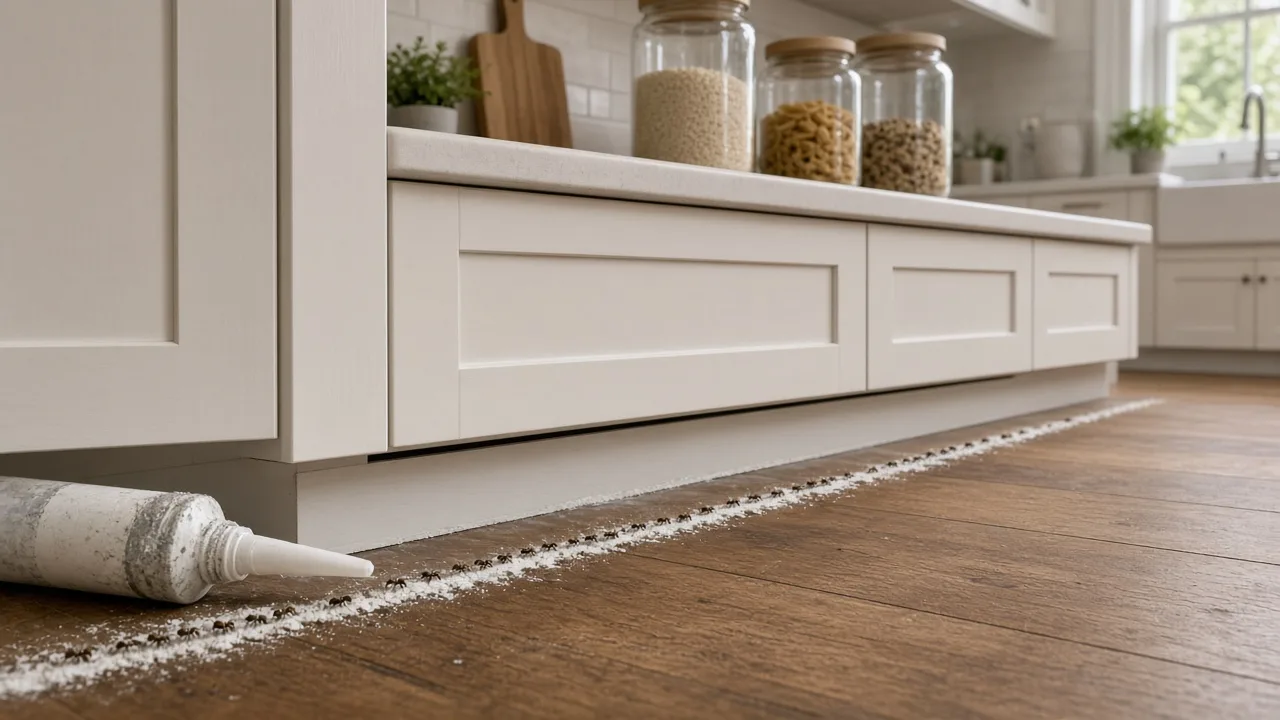
Once ants are no longer feeding and you have confirmed that the trail has gone quiet, seal small gaps around windows, pipe penetrations, baseboards, or door trim with an appropriate caulk or weatherstripping. Do not trap an active nest inside a wall by sealing the only visible opening before you understand where the ants are coming from. UC IPM recommends locating entry points and caulking openings as part of exclusion; the order matters because bait needs a usable route while foragers are still taking it.
Keep checking the same area for a few days and maintain the food-and-water cleanup. A sealed crack will not help much if ants can enter through a different gap or if a persistent indoor nest has access to moisture. If trails return from several locations, take a photo, note the timing and route, and use that information to choose a next step rather than escalating to repeated sprays.
How to Handle Ants in a Garden Without Bleach
Check for aphids and real plant damage first
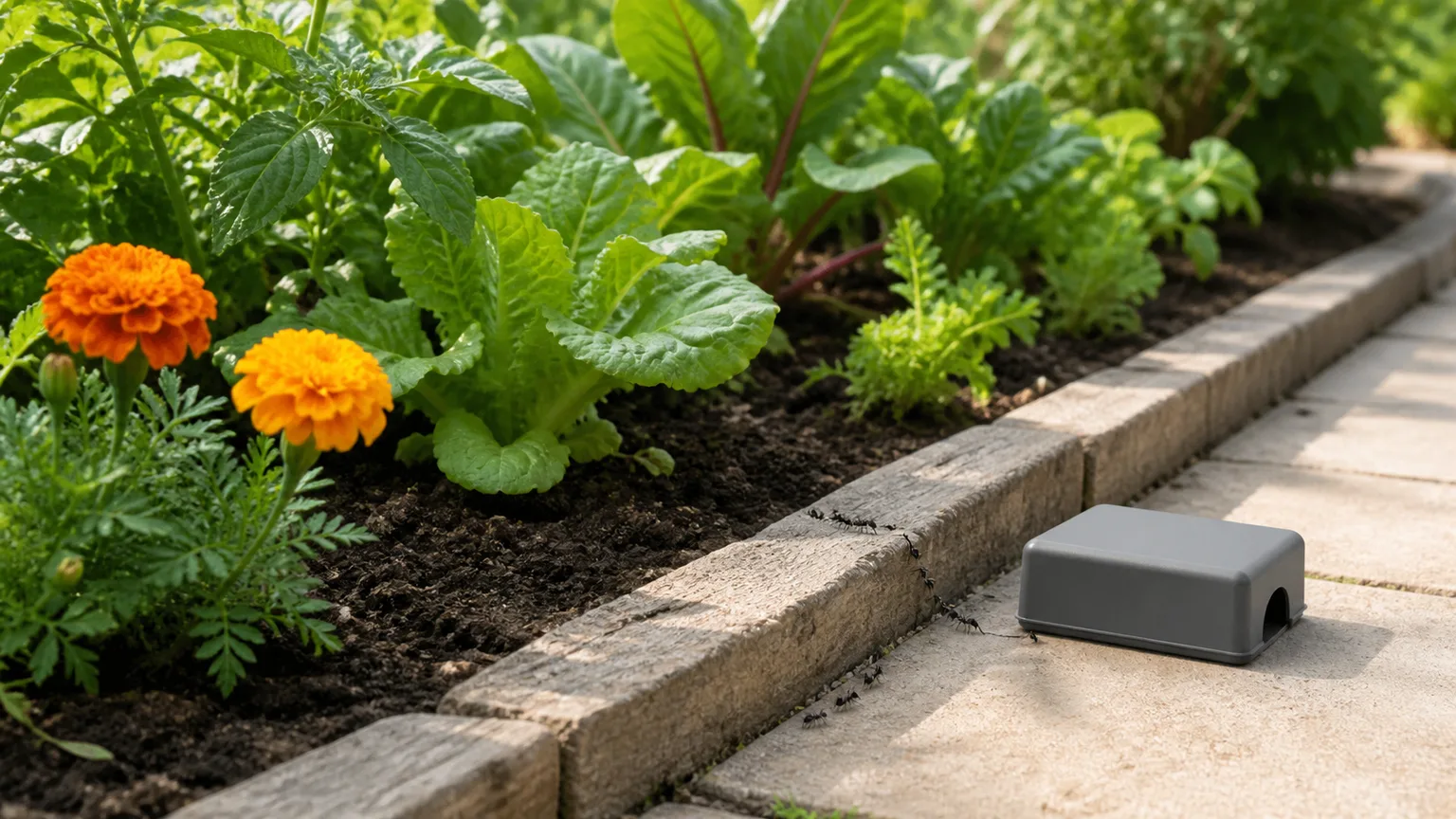
Ants on a plant are often following honeydew from aphids, soft scale, mealybugs, or whiteflies rather than eating the plant itself. Follow the ants up the stem and inspect new growth, leaf undersides, and leaf joints for clusters of sap-feeding insects or sticky residue. RHS notes that ants may protect aphids from predators to keep access to honeydew, while also doing little direct damage to most plants. If you find aphids, manage the aphids first: on sturdy plants, a strong stream of water can dislodge them without drenching the garden in a caustic cleaner.
A few ants in a flower bed or on a healthy shrub usually do not call for control. Ants can help recycle organic matter, prey on other insects, and aerate soil; their mounds may be messy without being dangerous. The UC IPM ant guide says it is unrealistic and impractical to eliminate all ants from an outdoor area, so focus on exclusion from buildings or valuable plants and on removing their food and water sources.
Consider treatment only when a specific species is stinging people, ants are disturbing roots or seedlings, or an ant–aphid relationship is contributing to plant injury. Even then, never use household bleach on the soil, leaves, edible crops, or mound. Use only a pesticide whose current label permits the exact pest and application site, keep it away from pollinators and water as the label directs, and contact a local extension office if you cannot identify the ant. If the ants are harmless and the plant is healthy, leave them be.
When to Call a Pest Professional
Call a qualified pest professional when ants keep returning despite sanitation and a correctly placed bait, when they are emerging from wall voids or electrical openings, or when you cannot place bait safely because a child or pet can reach the area. A professional can distinguish a surface-foraging colony from one nesting inside a structure and select a labeled treatment appropriate to that site. If ants are in a multi-unit building, report the issue to the property manager so routes and shared walls can be inspected together.
Large carpenter ants, piles of coarse wood debris, repeated indoor sightings, or winged ants emerging indoors deserve a closer look. Carpenter ants excavate galleries in wood and may be associated with damp, decayed areas; they are different from small nuisance ants crossing a counter. Colorado State University Extension advises checking for moisture problems and locating the nest, while University of Minnesota Extension notes that hidden nests can make control difficult. Bleach on the visible trail will not repair a leak, find a satellite colony, or assess wood damage.
Treat stinging ants with extra caution. Do not put a hand, foot, or tool into an unknown mound to see what happens, and do not pour bleach onto it. Keep children and pets away, photograph the mound from a safe distance, and consult local extension or pest management for species-specific guidance. For severe allergic symptoms after a sting, seek emergency medical help.
What to Do After a Bleach Exposure
If bleach gets into someone’s eyes, start rinsing immediately with plenty of room-temperature water and remove contact lenses if easy to do. Poison Control’s first-aid guidance advises flushing exposed eyes for 15 to 20 minutes and contacting Poison Control for specific advice. If bleach gets on skin, remove contaminated clothing and rinse the area with running water; for inhaled fumes, move to fresh air and ventilate the area only if you can do so without re-entering a dangerous space.
In the United States, call Poison Control at 1-800-222-1222 or use its webPOISONCONTROL tool for tailored advice after a concerning exposure. Call emergency services if someone has trouble breathing, collapses, has a seizure, or cannot be awakened. If bleach was mixed with another cleaner and fumes are present, leave the area immediately rather than trying to neutralize the mixture. Do not induce vomiting after a swallow; follow the poison center’s guidance and keep the product container available so experts can identify it.
These steps are for an accidental exposure, not a reason to keep bleach at hand for pest control. If a small amount was used to clean a surface for a separate labeled purpose, let the area air out as directed and keep people and pets away until it is safe to return. For ants, switch to the lower-risk sequence: remove attractants, clean with soap and water, bait when needed, and close entry points after activity stops.
Conclusion
Bleach can kill some ants it directly contacts, but it is not a safe way to control an ant colony. Lab evidence is limited to a small test of exposed workers; it does not demonstrate that household bleach reaches a nest or prevents new ants from arriving. Do not spray it indoors, pour it outdoors, or mix it with any other cleaner.
For a kitchen trail, remove food and water, clean the surface with ordinary soap and water, and use a properly labeled bait if ants keep returning. For a garden, check for aphids or genuine plant injury before taking action, and leave harmless colonies alone. If the nest is hidden, stinging, or damaging wood, ask a pest professional to identify it and choose a treatment labeled for that job.



