Does Vanilla Extract Repel Mosquitoes? The Truth
Does vanilla extract repel mosquitoes? Learn why it is unreliable, what the CDC recommends, and how to reduce mosquitoes around your home safely.

Vanilla extract is a pleasant-smelling kitchen ingredient, but it is not a dependable mosquito repellent. A splash mixed with water may change the odor around your skin for a short time, and that can make one person notice fewer landings in one setting. It does not provide the predictable, labeled protection you need for a hike, a child’s evening outdoors, a high-mosquito yard, or any situation where avoiding bites matters because of mosquito-borne disease.
The practical answer is simple: do not use vanilla extract as your main protection plan. If you are dealing with a few mosquitoes on a patio, combine source reduction, a fan, clothing, screens, and a repellent with an evaluated active ingredient. The CDC recommends EPA-registered insect repellents, and that advice matters because the product’s label tells you which insects it protects against, how long it lasts, and how to apply it.
The short answer: not dependable protection
Vanilla extract may mask some of the odors mosquitoes use while locating a host, but “masking” and “repelling” are different jobs. A masking scent briefly competes with your normal odor plume; a true repellent changes mosquito behavior enough to reduce landings for a stated period under the conditions on its label. Vanilla extract has no standard mosquito-protection time, no consistent concentration for this use, and no label telling you that it prevents bites.
That does not mean every anecdote is imaginary. Wind, temperature, mosquito species, clothing, sweat, the number of insects nearby, and simple chance all change how many mosquitoes land on a person. If someone sprays a sweet-smelling mixture and gets fewer bites for half an hour, that is an observation—not proof that the same mixture will protect another person through a humid evening.
The strongest conclusion from the available guidance is therefore cautious: vanilla might provide a fleeting odor effect, but its performance is too inconsistent and short-lived to substitute for an evaluated repellent. The Cleveland Clinic’s physician-reviewed explanation reaches the same practical endpoint: do not count on vanilla to prevent bites or protect you from infections.
How mosquitoes find a person
Female mosquitoes do not follow one magical scent. They use several cues in sequence, including carbon dioxide from breathing, body heat, moisture, movement, and skin odors. The blend varies with the person and the environment, which helps explain why a household remedy can seem successful one night and useless the next.
Mosquitoes also do not need to fly straight toward you from a great distance for a kitchen ingredient to fail. A mosquito resting in vegetation beside a deck may already be close. Once air currents carry your breath and skin odor through the yard, changing one part of that signal does not remove the other cues. A sweet scent can become background noise rather than a barrier.
What vanilla could do, in theory
Pure vanilla extract contains aromatic compounds, including vanillin, and its strong odor may temporarily compete with some human odors. That is the reasonable explanation behind the hack. It is not the same as demonstrating a reliable repellency effect on people in real outdoor conditions.
The distinction is especially important for essential oils and plant extracts. A living plant may smell strongly when a leaf is crushed, but a container of basil, lavender, lemongrass, or marigolds is not releasing a controlled dose around every person sitting at a table. Penn State Extension states that living plants do not contain enough essential oil to repel mosquitoes effectively; the oil generally has to be extracted and concentrated, and even then the result depends on formulation and application.
Garden media often presents aromatic plants as part of a mosquito-resistant patio. The Old Farmer’s Almanac’s plant guide is useful for understanding the popular planting list, but plant placement should be treated as a garden and sensory choice, not as a substitute for personal protection. A pot of lavender can be beautiful and fragrant without creating an invisible mosquito-free perimeter.
Why vanilla extract falls short outdoors
The main failure is not that vanilla has no odor. It is that odor alone is a weak and poorly controlled delivery system. To protect exposed skin, a repellent must stay at a useful concentration across arms, legs, ankles, neck, and other likely landing sites while you move, sweat, brush against plants, and sit in changing air.
Concentration, coverage, weather, and reapplication
The viral recipe usually uses vanilla extract diluted with water. That makes a simple spray, but it does not create a tested repellent formula. Water can dilute the odor; heat and airflow can disperse it; sweat and rain can remove it; clothing leaves large areas untreated; and spraying a little on one wrist does not cover the rest of the body.
Claims that vanilla lasts about 30 to 45 minutes should be read as anecdotal timing, not a safety interval. The actual duration will change with temperature, humidity, wind, activity, the product used, and mosquito pressure. Reapplying every half hour is inconvenient, expensive if you are using real extract, and still does not turn it into a registered mosquito repellent.
There is another practical problem: vanilla is a food flavoring, not a purpose-built outdoor skin product. A label for baking does not establish its performance on mosquitoes, compatibility with sunscreen, or suitability for repeated application to children. If you need a product to work for a known window of time, choose one whose label states the active ingredient and directions instead of trying to infer protection from smell.
Is vanilla extract safe to put on skin?
“Food-grade” and “safe as a mosquito repellent” are not interchangeable. A food ingredient is assessed for its intended use in food, while a product applied repeatedly to skin has different exposure, irritation, allergy, and eye-contact considerations. Vanilla extract also commonly contains alcohol and other ingredients that can sting irritated skin or eyes.
If you decide to try a small amount as a scent experiment, keep it away from your eyes, lips, cuts, eczema, and broken skin, and stop if you notice burning, rash, swelling, or worsening itch. A patch test can reduce the chance of an obvious reaction, but it cannot prove the mixture will repel mosquitoes or remain safe after repeated full-body use. Do not spray it into the air around a baby or treat it as a child-safe alternative simply because it is found in a pantry.
Children, pregnancy, pets, and the “natural” label
For children, physical barriers are often the easiest first layer: loose long sleeves and pants, a stroller or carrier net, repaired screens, and a fan on a patio. For a labeled topical product, follow the age limits and application directions exactly. The CDC says EPA-registered repellents can be used as directed, including by pregnant and breastfeeding people, but it also says not to use oil of lemon eucalyptus or PMD products on children under 3.
Never apply permethrin products directly to skin. Permethrin is for treating clothing and gear when the product label allows it; the CDC specifically separates permethrin-treated clothing from topical repellents. Keep any repellent, vanilla mixture, essential oil, or candle away from a child’s mouth and eyes, and wash treated skin when the product directions call for it.
Pets add another reason not to improvise. A vanilla scent is not a reliable animal repellent, and concentrated essential oils can be hazardous if licked or swallowed. If your goal is to protect a dog or cat, ask a veterinarian for species-appropriate flea, tick, and mosquito guidance rather than putting a household scent on the animal.
Choose an evidence-based personal repellent
For exposed skin or clothing, look for an EPA registration number and an active ingredient named on the label. The EPA’s repellent guidance and search tool let you compare protection time, active ingredient, and product type. Registration does not mean every product is identical; it means the product has been evaluated for the uses and directions on its label.
The right choice depends on the activity. Someone sitting on a screened porch may need less coverage than someone gardening in brush. A short evening dog walk, a multi-hour hike, and travel to an area with mosquito-borne disease are different risk situations. Choose the lowest level and shortest duration that fit the exposure, then reapply only as directed rather than by guesswork.
DEET, picaridin, and IR3535
DEET is a long-established effective repellent. Picaridin, also called icaridin outside the United States, is another widely used option and is often preferred by people who dislike the odor or feel of DEET. IR3535 is also an EPA-registered active ingredient used in repellents. Concentration and formulation affect protection time, so the percentage alone is not a complete comparison; read the individual label.
Apply topical repellent to exposed skin and the outside of clothing only when the directions allow it. Do not put it under clothing, in the eyes or mouth, or on a child’s hands. If sunscreen is also needed, apply sunscreen first and repellent second, as the CDC’s bite-prevention instructions advise.
Oil of lemon eucalyptus and PMD
Oil of lemon eucalyptus (OLE) and para-menthane-diol (PMD) are plant-derived or plant-associated options that appear on the CDC’s list of EPA-registered repellent active ingredients. They are not the same thing as a lemon eucalyptus tree, a bottle of essential oil, or a homemade infusion. Use only a formulated product whose label covers mosquito protection.
OLE and PMD are not for children under 3. Even for older users, follow the label, avoid eyes and irritated skin, and do not assume that “natural” means non-irritating or risk-free. A product may be plant-derived and still require careful storage, application, and reapplication.
Stop mosquito breeding sites at the source
Personal repellent protects the person wearing it. Source reduction reduces the number of mosquitoes being produced nearby, which is why it should happen before experimenting with smells. Mosquitoes need water to develop, and the most productive breeding site may be an ordinary object you walk past every day.
The weekly tip-and-toss audit
Set a recurring weekly reminder to walk the property after rain and inspect anything that can hold water. Empty and scrub flowerpot saucers, children’s toys, buckets, watering cans, wheelbarrows, overturned lids, tarps, pet bowls, clogged gutters, and low spots where containers settle. Turn items upside down, cover them tightly, discard what you do not need, or store them under shelter.
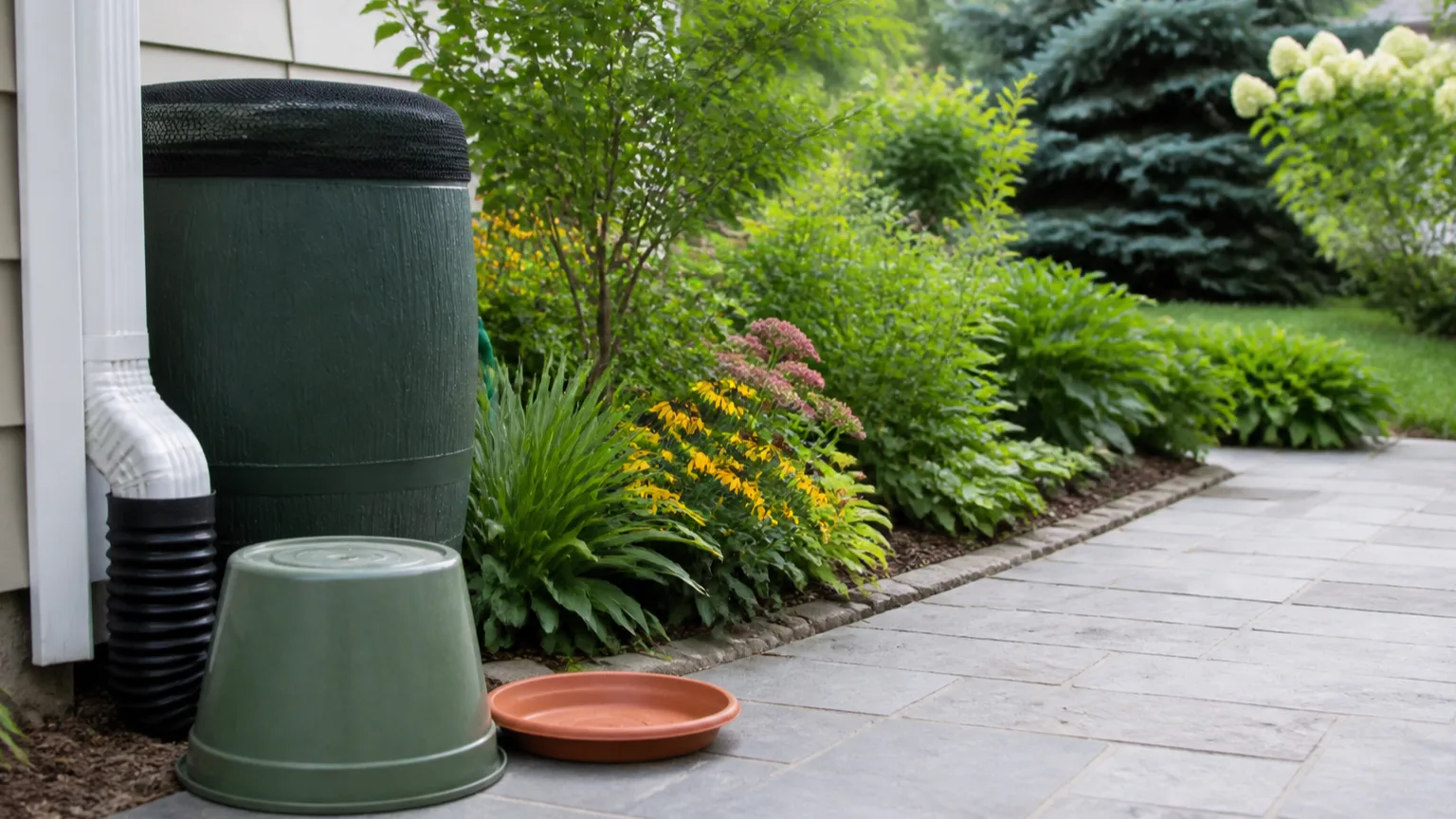
The weekly cadence is not arbitrary. Depending on species and conditions, eggs can hatch quickly and larvae can develop in a matter of days. The University of Georgia’s mosquito-control guidance calls diligent elimination of standing water the most important and effective residential practice, while NC State describes controlling mosquitoes at the larval stage as the most effective strategy for reducing backyard populations.
Look beyond your own patio. A neighboring yard, shared alley, roof drain, construction site, or public catch basin may keep replenishing adult mosquitoes. You cannot empty someone else’s container, but you can report persistent public water sources to a local mosquito-control program or health department and focus your own property on the sources you can change.
Water you cannot drain or cover
Some water features, rain barrels, drainage ditches, and ornamental ponds cannot be emptied every week. First ask whether the water can be covered with a secure, mosquito-excluding mesh or kept moving with a properly maintained pump. A moving surface is less suitable for many mosquitoes than still water, though it is not permission to ignore the basin or its edges.
For water that remains and is labeled for treatment, a mosquito larvicide containing Bacillus thuringiensis israelensis (Bti) may be appropriate. Bti targets mosquito larvae when they ingest it; it is not a fog that protects your skin and it does not solve adult mosquitoes flying in from elsewhere. Use only a product labeled for that water body, follow the rate and replacement schedule, and do not treat drinking water unless the label specifically permits it.
University guidance explains the logic well: UGA Extension notes that Bti products are aimed at larvae and that label directions are legally controlling. K-State Research and Extension likewise recommends mosquito dunks or bits for water that cannot be changed, while emphasizing that topical repellents and larvicides solve different problems.
Make a patio harder for mosquitoes to reach
Once breeding sites are under control, reduce the chance that adult mosquitoes can land on you. Move seating away from dense, damp vegetation when possible, keep doors closed, repair window and door screens, and use air conditioning or screened rooms indoors. These measures have a useful advantage: they do not leave pesticide residue on flowering plants or wash into waterways.
Fans, clothing, screens, and timing
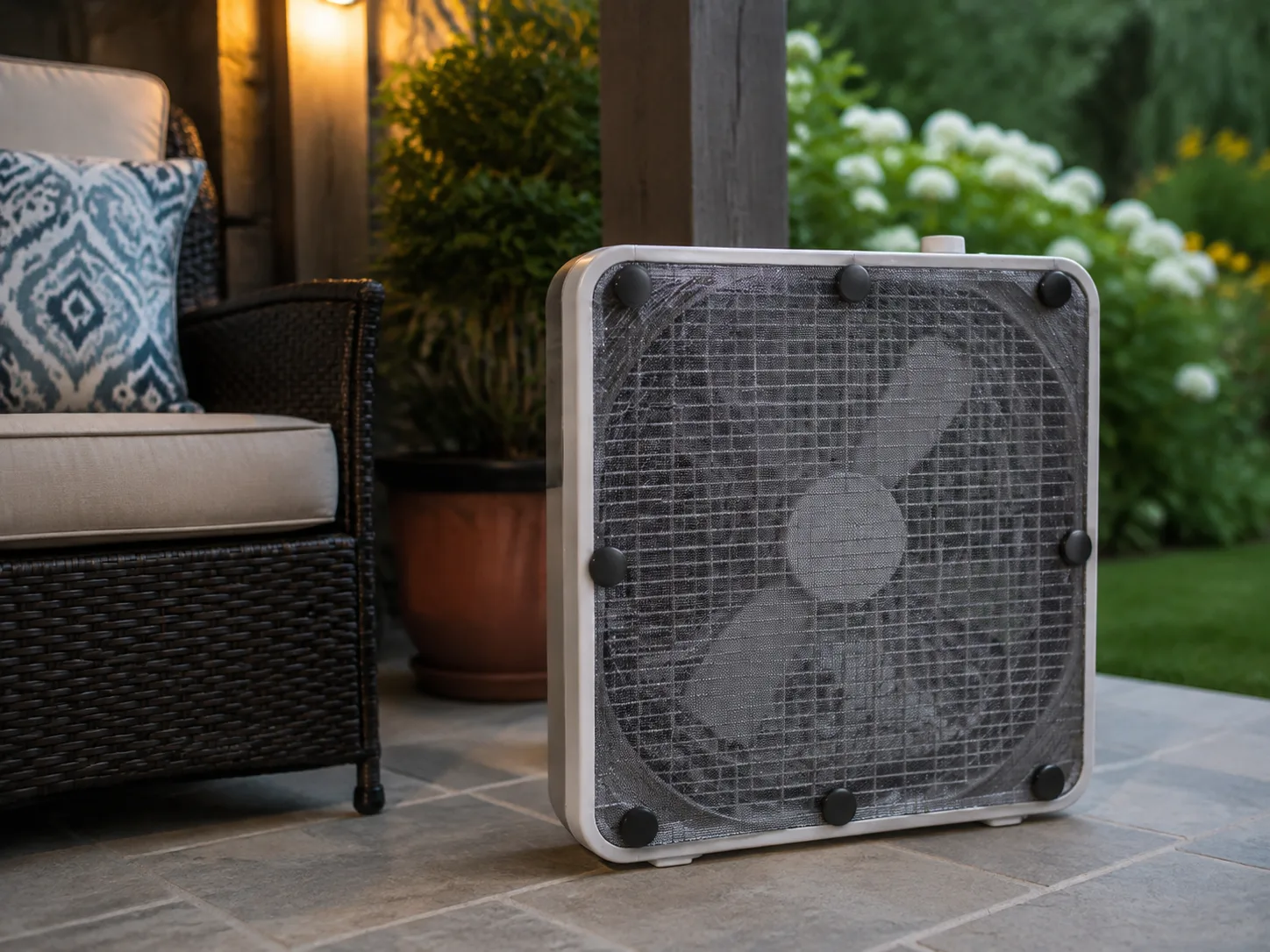
A steady outdoor fan aimed across the seating area can help because mosquitoes are weak fliers and the moving air disrupts their approach. A fan is not a whole-yard treatment, but it is a sensible, low-residue tool for a table, porch, or stroller. Place it so the airflow crosses the space where people sit, rather than pointing it harmlessly into an empty corner.
Wear loose, light-colored clothing that covers arms and legs when practical. Tuck pants into socks in tall grass, avoid brushing through dense vegetation, and check ankles and cuffs after gardening. Many mosquitoes bite during both day and night, so “only go out at dusk” is not a complete rule; species, shade, weather, and local conditions matter. The CDC’s prevention guidance accordingly emphasizes protection at all times rather than relying on a single safe hour.
If you use a citronella candle or repellent emitter, treat it as a small-area comfort measure, not a guarantee. Wind can carry the scent away, and a candle cannot protect an uncovered person walking through the yard. Keep flames away from fabric and dry vegetation, never leave them unattended, and do not use scent products as a reason to skip labeled skin protection.
Do plants, citronella, and essential oils work?
Plants can contribute to a comfortable garden, but a living plant is not a topical repellent. The plant must produce and release enough volatile compounds in the exact place where people are sitting, and most do not. Crushing leaves may release a stronger odor briefly, but rubbing plant material onto skin can cause irritation and still lacks a reliable protection time.

This is where practical gardening advice and public-health advice need to be kept separate. Homes & Gardens’ coverage of vanilla and scent-based methods reflects why the hack stays popular: a strong fragrance can seem more pleasant than conventional spray. But its own expert comments also acknowledge short duration, expense, possible skin reactions, and the inability of a scent to handle an infestation. Use plants for beauty, fragrance, pollinators, herbs, or habitat; use a labeled repellent for predictable bite protection.
Essential oils require even more caution. “Natural” oils can be concentrated, irritating, allergenic, unsafe around pets, and unevenly mixed in water. Do not assume that a candle, diffuser, bracelet, patch, or homemade spray has the same efficacy as a registered product containing a related active ingredient. If a product makes a mosquito-protection claim, look for the label and EPA registration number; if it does not, treat the claim as unverified.
When to bring in professional help
Call a qualified pest or mosquito-control professional when biting remains heavy after you remove obvious water sources, when mosquitoes are entering from inaccessible property, or when a local health department has issued a disease-related alert. A professional should inspect for breeding and resting sites, identify the likely mosquito problem, explain the treatment area, and tell you how to protect people, pets, pollinators, ponds, and edible crops.
Be cautious about routine, broad spraying as the automatic answer. Adult mosquitoes are mobile and difficult to reach, while broad-spectrum insecticides can affect bees, butterflies, aquatic organisms, and other non-target insects. Penn State Extension recommends integrated mosquito management and warns that unnecessary residential spraying can harm waterways and beneficial organisms. Ask what evidence justifies treatment, what product and active ingredient will be used, how long people and pets must stay away, and how the plan addresses larvae rather than repeatedly treating only flying adults.
If the problem is inside, first check screens, doors, plumbing penetrations, damp basements, houseplant saucers, and other sources of indoor moisture or entry. Persistent indoor mosquitoes may require a more specific inspection than a patio spray. Do not fog a room or apply outdoor pesticide indoors unless the product label explicitly permits that use.
A practical mosquito plan for tonight
If you want a clear sequence, use this order:
- Empty every small water holder. Check saucers, toys, buckets, tarps, gutters, drains, and anything hidden behind furniture or garden tools.
- Repair the boundary. Close doors, mend screens, and move seating away from dense vegetation and damp shade.
- Create airflow. Aim a fan across the patio table or porch seating area.
- Cover skin. Put on loose long sleeves, long pants, and shoes, especially for gardening or walking through grass.
- Choose a labeled repellent if exposure warrants it. Match the active ingredient and protection time to the activity, follow the age directions, and reapply only as the label instructs.
- Check the same area again after rain. Add a weekly reminder so the first cleanup becomes a control habit.
That sequence is more reliable than starting with a vanilla spray because it addresses the mosquito at several points: where it develops, how it enters, how it reaches you, and how you protect exposed skin. If you still see larvae in water that cannot be removed, read the larvicide label or ask local extension or mosquito-control staff about an appropriate Bti product.
Conclusion
Vanilla extract is not a dependable mosquito repellent. It may briefly alter the odor around your skin, but it has no standardized protection time and should not be trusted for bite or disease prevention. Food-grade, natural, or pleasant-smelling does not automatically mean tested, long-lasting, or suitable for repeated application to a child, pet, or full body.
Start with the measures that compound: tip and toss standing water every week, repair screens, run a fan where people gather, wear covering clothing, and use an EPA-registered repellent when you need predictable protection. Reserve larvicides for water that cannot be removed and follow the label exactly. When the biting pressure stays high or disease risk is a concern, involve local mosquito-control authorities or a qualified professional rather than escalating an improvised kitchen remedy.