10 Best Drought-Tolerant Lawn Grasses
Compare 10 drought-tolerant lawn grasses by climate, shade, traffic, mowing, and water needs so you can choose a lawn that survives dry spells.
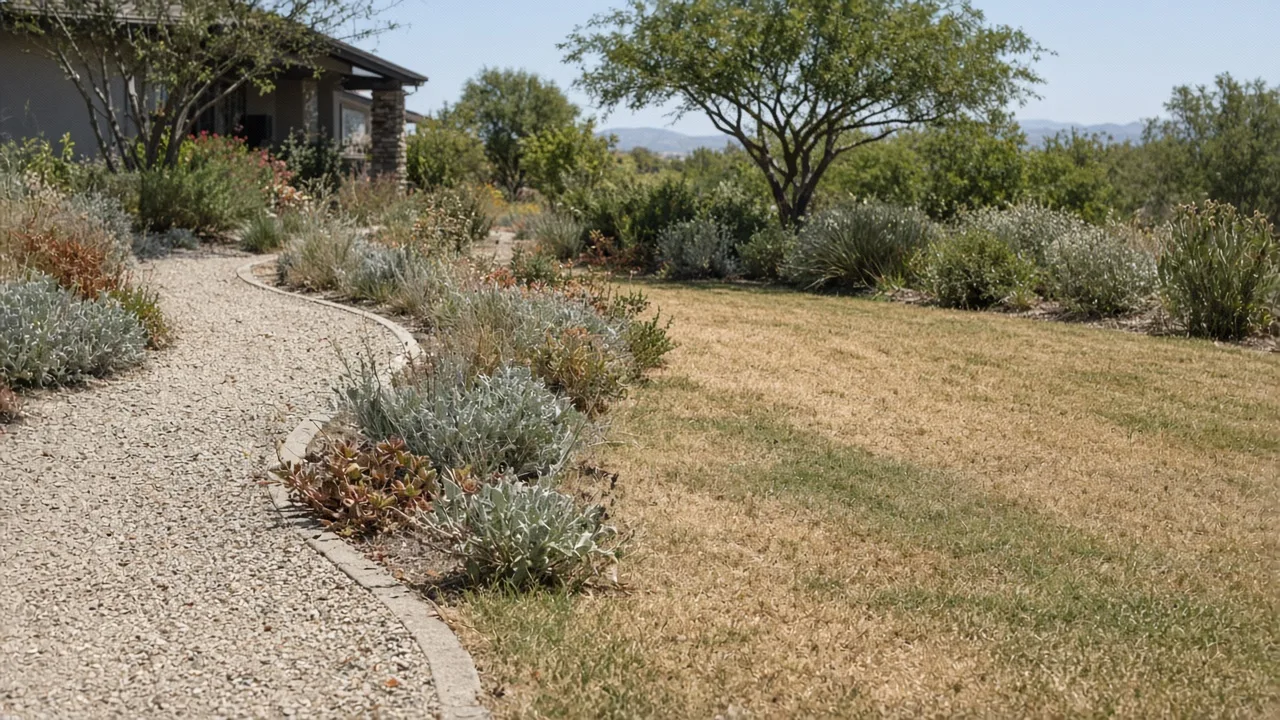
The best drought-tolerant lawn grass is not one species for every yard. A sunny lawn in a hot summer climate has a different best choice from a shaded northern lawn, and a play lawn has different needs from a low-mow front-yard patch.
The ten grasses below are useful because they cover those different jobs. Some save water by growing efficiently in heat, some survive by going dormant, some repair damage with rhizomes or stolons, and some simply need less fertilizer and mowing. The right choice is the one that fits your growing season, soil, sun, traffic, and willingness to accept seasonal browning.
What “drought tolerant” actually means for a lawn
Drought tolerance is a bundle of traits, not a promise that grass will stay green without water. A grass can use water efficiently, grow a deep root system, reduce growth during a dry spell, go dormant, or spread back into thin patches after rain. Those traits help it survive; they do not eliminate the water needed to establish a new lawn or maintain green growth during prolonged heat.
That distinction matters when comparing seed-bag claims. A dormant bermudagrass lawn may look brown but remain alive, while a green lawn maintained with shallow daily irrigation may have a weak root system that fails as soon as the timer stops. New Mexico State University Extension places climate adaptation and traffic tolerance among the most important selection factors, alongside water use and maintenance needs in its turfgrass selection guidance.
Think of the goal as more living turf per unit of water, not a permanently emerald carpet. A drought-tolerant lawn still needs good soil contact during establishment, irrigation that reaches the roots, and mowing that leaves enough leaf area to shade the soil.
Start with warm-season or cool-season grass
Warm-season grasses trade winter color for summer efficiency
Warm-season grasses grow most actively when temperatures are high. Bermudagrass, buffalograss, zoysiagrass, St. Augustinegrass, centipedegrass, and bahiagrass generally use water more efficiently during hot weather than cool-season turf, but most turn tan or straw-colored after cold weather or extended drought.
That seasonal dormancy is not a defect if you planned for it. It becomes a problem when a household expects a warm-season lawn to stay green through a cool winter, or when dormant turf is used as a play surface and repeatedly crushed by traffic before it can regrow.
Cool-season grasses trade summer water for shoulder-season color
Tall fescue, fine fescue, Kentucky bluegrass, and perennial ryegrass grow best during cooler periods. They can give northern and transition-zone lawns useful spring and fall color, but their summer water demand can rise just when rainfall becomes unreliable. Tall fescue is the strongest general-purpose drought choice in this group; the other three are more conditional.
The boundary is not a simple map line. Elevation, winter lows, summer nights, soil, and local water restrictions can change the recommendation. The NMSU guide notes that warm-season turf can save water in arid conditions but may be dormant for months, while cool-season grass can remain usable in colder areas when irrigation is available.
Ten drought-tolerant grasses at a glance
| Grass | Season | Best fit | Main limitation |
|---|---|---|---|
| Tall fescue | Cool | Transition zones, traffic, some shade | Needs summer irrigation to stay green; bunching growth may thin |
| Fine fescue | Cool | Cool climates, light traffic, shade | Slow recovery and poor fit for hard play |
| Kentucky bluegrass | Cool | Cold climates needing self-repair | More water-hungry than fescues; summer dormancy risk |
| Perennial ryegrass | Cool | Fast establishment and cool-season color | Usually needs more water and does not self-repair well |
| Bermudagrass | Warm | Full sun, heat, traffic, fast recovery | Weak shade tolerance and aggressive spread |
| Buffalograss | Warm | Full sun, low-water, low-mow areas | Slow establishment, lower density, limited traffic tolerance |
| Zoysiagrass | Warm | Dense turf, heat, moderate shade, wear | Slow to establish and slow to recover from damage |
| St. Augustinegrass | Warm | Warm humid areas with filtered shade | Drought tolerance depends strongly on cultivar and irrigation |
| Centipedegrass | Warm | Low-fertility acidic soil and light traffic | Poor heavy-traffic recovery and sensitive establishment |
| Bahiagrass | Warm | Sandy, infertile soil and utility areas | Coarse, open appearance and conspicuous seedheads |
The table is a starting point, not a ranking from “best” to “worst.” A grass that is excellent in full sun can be a poor buy for a tree-shaded yard, and a grass that survives drought may still be the wrong surface for children, dogs, or frequent games.
1. Tall fescue: the dependable cool-season choice
Tall fescue is the safest first look for a drought-tolerant lawn in a cool-season or transition climate. It is a bunch-type grass with a substantial root system, tolerates heat better than many cool-season competitors, and has the texture and wear tolerance most homeowners expect from a conventional lawn. NC State Extension describes it as heat- and drought-tolerant for a cool-season species, while also warning that summer stress can thin the clumps and require reseeding.
Choose a turf-type tall fescue blend rather than assuming every tall fescue seed is equal. Improved blends can offer better density, color, shade tolerance, and stress performance than old forage-style types. The NC State tall fescue profile is a useful reminder that selecting an adapted cultivar and clean seed is part of the drought strategy, not a minor purchasing detail.
Tall fescue is a good compromise when you need a lawn that handles some shade and foot traffic but cannot accept warm-season winter dormancy. Its trade-off is maintenance: it grows quickly, does not spread to fill bare spots, and may need fall overseeding or repair after a brutal summer. Keep it taller during heat; NC State’s maintenance calendar gives a summer mowing target around 3½ inches and advises watering to wet the soil several inches deep.
2. Fine fescue: low-input grass for lighter traffic and shade
Fine fescue is a group rather than a single species. Creeping red fescue, Chewings fescue, hard fescue, and sheep fescue bring fine blades, relatively low fertility needs, and useful shade tolerance to cool-season lawns. They are especially valuable where the lawn is more of a quiet groundcover than a sports field.
Fine fescue can be a smart water-saving choice for a cool, lightly used yard with sandy or lean soil. It is less convincing where children run, dogs turn sharply, or bare patches must repair quickly. Sheep fescue and hard fescue can also look clumpy or meadow-like when left unmown, which is an advantage for a naturalistic area and a drawback if you want a perfectly uniform carpet.
Treat “fine fescue blend” as a site-specific tool, not a magic seed label. A practical editorial comparison from Livingetc highlights the low-input appeal of blends, but the result still depends on regional adaptation, establishment moisture, and how much traffic the lawn receives.
3 and 4. Kentucky bluegrass and perennial ryegrass: conditional choices
Kentucky bluegrass earns a place on this list because it spreads by rhizomes, repairs wear, and can be improved by choosing newer cultivars bred for lower water use. It is not the first grass I would choose for a severe water restriction, though. It generally needs more summer moisture than tall fescue or a warm-season turf, and it may go dormant during prolonged heat unless the soil and irrigation are excellent.
Perennial ryegrass establishes quickly and gives a cool-season lawn attractive color, making it useful for quick cover or a blend. It is less forgiving as a drought strategy because it lacks the rhizomatous repair system of Kentucky bluegrass and can demand regular water in hot weather. Use it when fast germination or winter color matters more than the lowest possible irrigation, or as a measured component of a climate-appropriate blend.
For either grass, do not confuse “recovers after rain” with “uses little water.” A rhizome can repair a damaged patch, but the plant still needs enough moisture to produce leaves and roots. If your main goal is reducing irrigation, start with a site that favors tall fescue, fine fescue, or warm-season turf before trying to force Kentucky bluegrass or ryegrass into a dry climate.
5. Bermudagrass: best for hot, sunny, active lawns
Bermudagrass is the leading choice when the lawn gets intense sun, summer heat, and hard use. It spreads with both stolons above ground and rhizomes below ground, so it can close thin spots quickly when actively growing. NC State Extension describes it as highly tolerant of heat, drought, and salt, with strong wear tolerance and rapid recovery.
The price of that resilience is a narrow site fit. Bermudagrass performs poorly in shade, goes dormant in cool weather, and can creep into beds and borders. Its aggressive growth is helpful when you want fast repair and frustrating when you want crisp garden edges; plan edging and bed barriers before installation rather than after runners appear.
Bermuda is often the best answer for a sunny play lawn in a hot region, especially when you can accept winter brown. It also responds quickly when rain or irrigation returns. Bob Vila’s drought-grass comparison lists bermudagrass among the most drought-resistant warm-season options, but its water-saving benefit depends on full sun, healthy roots, and not mowing the turf into a short, stressed mat.
6. Buffalograss: the low-water native-style option
Buffalograss is a warm-season prairie grass with one of the strongest low-water reputations for sunny, semi-arid lawns. It can survive on much less water than a conventionally lush turf when established, and improved cultivars are denser and more lawn-like than older forage selections. It is a natural candidate for a low-mow front yard, broad utility space, or lawn where some seasonal tan is acceptable.
Do not choose buffalograss for a heavily used play surface without checking the cultivar and your expectations. It establishes slowly, can thin under competition from weeds, and often looks more open and softly textured than bermudagrass or zoysia. NMSU notes that buffalograss is more drought-tolerant but not as dense as traditional lawn grasses, which is exactly the trade-off many water-wise homeowners need to see before they buy.
Keep it taller and avoid treating brown summer turf as a failure. Buffalograss is most convincing where the homeowner values water savings and a natural appearance over a dark green, closely cut carpet. Full sun is essential; shade and persistent wetness push it outside its comfort zone.
7. Zoysiagrass: dense turf with slower recovery
Zoysiagrass forms dense, wear-resistant turf through stolons and rhizomes. It is a strong middle ground for homeowners who want a more carpet-like lawn than buffalograss but more heat and drought tolerance than many cool-season grasses. It usually handles some light or filtered shade better than bermudagrass, although “shade tolerant” still means bright, limited shade rather than a lawn beneath a dense evergreen canopy.
The catch is speed. Zoysia can take a long time to establish from plugs or sod and can be slow to recover after traffic damage, even though the mature turf is tough. NC State’s Zoysiagrass profile emphasizes its dense, wear-resistant growth and the importance of choosing a cultivar adapted to the local region.
Choose zoysia when you want a durable, dense warm-season surface and can wait for it to fill in. Choose bermudagrass instead when fast recovery from heavy use is more important, or buffalograss when minimum irrigation matters more than density and color.
8, 9, and 10. St. Augustinegrass, centipedegrass, and bahiagrass
St. Augustinegrass is a useful warm-climate choice when filtered shade is the deciding factor. It makes a coarse, dense lawn through stolons and can perform well in humid subtropical settings, but it is not the universal drought winner its warm-season label might suggest. The cultivar, soil, disease pressure, and irrigation schedule matter; a shaded St. Augustine lawn may be the right compromise even if a sunny bermuda lawn would use water more efficiently.
Centipedegrass fits low-fertility, acidic soil and light-traffic lawns in the Southeast. It grows slowly and can require less mowing and feeding than more vigorous turf, but it does not like hard wear or careless establishment. Its “low maintenance” reputation should not be read as “no water”: a newly seeded centipede lawn needs a consistently moist seedbed until roots develop, then a less frequent, deeper routine.
Bahiagrass is a practical utility grass for sandy or infertile soil, especially where a coarse, open lawn is acceptable. Its extensive roots help it persist through dry periods, and it is often more forgiving of low fertility than finer turf. The trade-offs are visible seedheads, a less manicured texture, and weaker shade performance. It is often a better fit for a large, low-input area than for a formal front lawn.
For these three, local availability and cultivar information are important. UF/IFAS explains that warm-season grasses differ in whether they are best established from seed, sod, sprigs, or plugs and that high-quality planting material and soil preparation strongly influence the result in its Florida lawn establishment guide.
Choose by climate, sunlight, traffic, and appearance
Start with the growing season, then eliminate grasses that fail your sunlight and use requirements. This four-question filter is more useful than choosing by a single drought-tolerance label:
- When must the lawn be green? Choose warm-season turf if summer performance and lower hot-weather water use matter most; choose cool-season turf if winter and spring color are essential.
- How much direct sun reaches the soil? Full sun opens the door to bermudagrass and buffalograss. Filtered shade favors tall fescue, fine fescue, zoysia, or sometimes St. Augustinegrass. Dense shade may need a non-turf solution.
- How hard will the lawn be used? Bermudagrass recovers fastest. Zoysia and tall fescue tolerate wear but recover differently. Fine fescue, buffalograss, centipedegrass, and bahiagrass are better for lighter use or a more natural surface.
- What does “low water” mean to you? If you mean less irrigation while keeping green color, choose a well-adapted turf and maintain roots. If you mean survival through long restrictions, choose a grass that can go dormant and accept brown periods, or reduce the turf area.
Do not buy seed before inspecting the site. A simple afternoon shade check, a soil texture check, and a realistic note about pets and play can prevent the most expensive lawn mistake: installing a species that can only survive with constant correction.
Establish the lawn without wasting water
The most drought-tolerant mature grass can fail during its first weeks. Seed needs a moist surface until it germinates, while sod needs close soil contact and enough water to root. That temporary establishment demand is why replacing a lawn during a restriction often makes little sense, even if the final species is low-water.
For seeded grass, prepare and level the soil first, then distribute seed evenly and cover it lightly. UF/IFAS recommends keeping a seeded bed moist but not saturated, using gentle irrigation that does not wash seed away, and reducing frequency as seedlings root so each watering reaches more of the root zone. A new lawn needs a different schedule from an established lawn; copying an adult turf schedule onto seed is a common cause of failure.
Sod, sprigs, and plugs each change the trade-off between speed, cost, and water. Sod gives immediate cover but can dry rapidly at seams; sprigs cost less but need close monitoring; plugs are less vulnerable to drying than tiny seedlings but take longer to knit together. Install during the grass’s active growing season and follow local extension timing instead of relying on a generic calendar.
Make any grass more drought tolerant
Species selection helps, but management determines whether the lawn actually uses that advantage. A poorly watered bermudagrass lawn can waste water, while a well-rooted tall fescue lawn can tolerate a surprisingly long gap between irrigation events.
Water the root zone and measure the system
Water when the lawn shows early stress rather than running the same timer every day. Folded blades, a blue-gray cast, or footprints that remain visible can signal that the turf is losing water faster than it replaces it. Do not wait for every blade to turn brown, but do not irrigate simply because the calendar says Tuesday.
When you water, apply enough to wet the active root zone, then let the surface dry somewhat before watering again. Sandy soil, compacted clay, slope, wind, shade, temperature, and recent rain all change the interval. UF/IFAS advises early-morning irrigation and warns that light, frequent watering encourages shallow roots; its watering guidance also recommends checking how evenly the system applies water.
Measure instead of guessing at runtime. Place straight-sided cans across one sprinkler zone, run the system for a known period, and compare the depths. NMSU’s catch-can irrigation audit explains how to identify dry zones, overspray, clogged heads, and uneven application. If one part of the lawn receives half as much water as another, increasing the timer only overwaters the healthy area while the dry patch still fails.
Mow high and reduce stress
Keep enough leaf surface to shade the soil. A higher mowing height slows evaporation and protects the crown, while scalping exposes soil to sun and makes a dry spell more damaging. Remove no more than one-third of the blade height in a single cut, and use a sharp blade so the cut ends do not shred and dry out.
During severe drought, mow less often and avoid cutting turf that is already wilted or dormant unless height creates a genuine hazard. Keep heavy traffic off stressed grass because footsteps compact the soil and break crowns that cannot quickly replace lost tissue. Leaving fine clippings on the lawn can return nutrients and a small amount of surface cover; do not leave thick piles that mat and shade the turf.
Improve soil and feed only when needed.
Roots cannot use water that cannot enter the soil. Core aeration can help compacted, high-traffic areas, but it is not a yearly ritual for every lawn; use it where a screwdriver stops easily or water ponds instead of soaking in. Improve organic matter before planting when a soil test or site condition supports that change, and correct drainage problems rather than trying to water through them.
Avoid high-nitrogen feeding during heat and drought. A flush of soft leaf growth increases water demand and can make the lawn look temporarily greener while leaving the root system less prepared for stress. Fertilize according to the grass’s active season and a soil test where possible, then let mowing height, root depth, and irrigation uniformity do more of the conservation work.
Dormancy, brown grass, and the point when turf is the wrong answer
Brown is not automatically dead. Warm-season grasses commonly lose color in cold weather, and many drought-tolerant grasses can slow or stop growth to protect their crowns during a dry period. Dormant turf should be treated as fragile: avoid unnecessary traffic, do not scalp it, and follow local guidance about minimal “survival watering” if the drought is prolonged.
To test a suspicious patch, look for a pattern rather than a color alone. Green tissue at the crown, flexible runners, and gradual recovery after appropriate moisture point toward dormancy; a brittle crown, eroded soil, persistent bare center, or a sharply localized patch suggests compaction, disease, pests, poor irrigation coverage, or actual death. Fix the cause before reseeding, or the replacement grass will fail in the same spot.
There is also a point where turf is the wrong answer. Deep shade, steep runoff, tiny disconnected lawn strips, and areas that are never used can be better served by mulch, permeable hardscape, native groundcovers, or a designed low-water planting. Keeping a smaller, healthier patch of grass can save more water than replacing a large struggling lawn with a different species and hoping the label solves a site problem.
Conclusion
For a hot, sunny, high-traffic lawn, start with bermudagrass; consider zoysiagrass if you value density and can accept slower recovery. For a low-water, lower-traffic lawn with a natural look, buffalograss is a strong candidate. In cool or transition climates, begin with turf-type tall fescue, then consider fine fescue where shade and low input matter more than play.
Kentucky bluegrass, perennial ryegrass, St. Augustinegrass, centipedegrass, and bahiagrass can all be useful, but each needs a more specific reason to win the site. Before buying seed or sod, match season to climate, sunlight to species, traffic to recovery speed, and your color expectations to dormancy. Then measure the irrigation, mow high, and build soil and roots so the grass you choose can actually behave as drought tolerant.



