13 Drought-Tolerant Shade Plants for Hot Summers
Find drought-tolerant shade plants for tree beds, dry borders, and hot summers, plus watering, mulch, mature size, and invasive-spreader cautions.
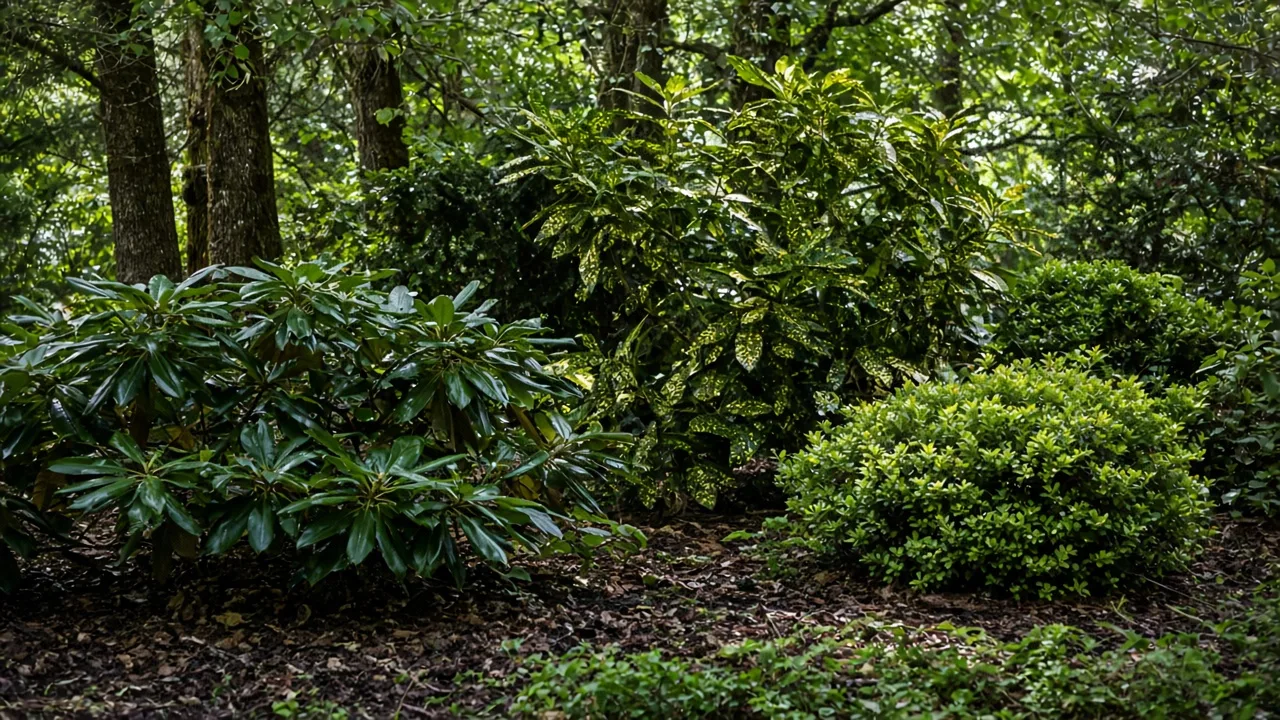
Dry shade is the hardest place to choose plants from a generic garden list. A spot beneath a mature tree may look protected from heat, yet the canopy intercepts rain and the roots compete for every drop that reaches the soil. The answer is not simply a plant labeled “shade.” It is a plant matched to the amount of light, the kind of dryness, its mature size, and the water you can provide while it establishes.
The 13 choices below include foliage plants, groundcovers, perennials, and shrubs. Some are strong candidates for genuinely dry shade; others tolerate short dry spells but look better with occasional deep watering. Utah State University Extension notes that few plants truly prefer dry shade, and the Missouri Botanical Garden’s dry-shade guide cautions that even tolerant plants should not be expected to survive extended drought without water.
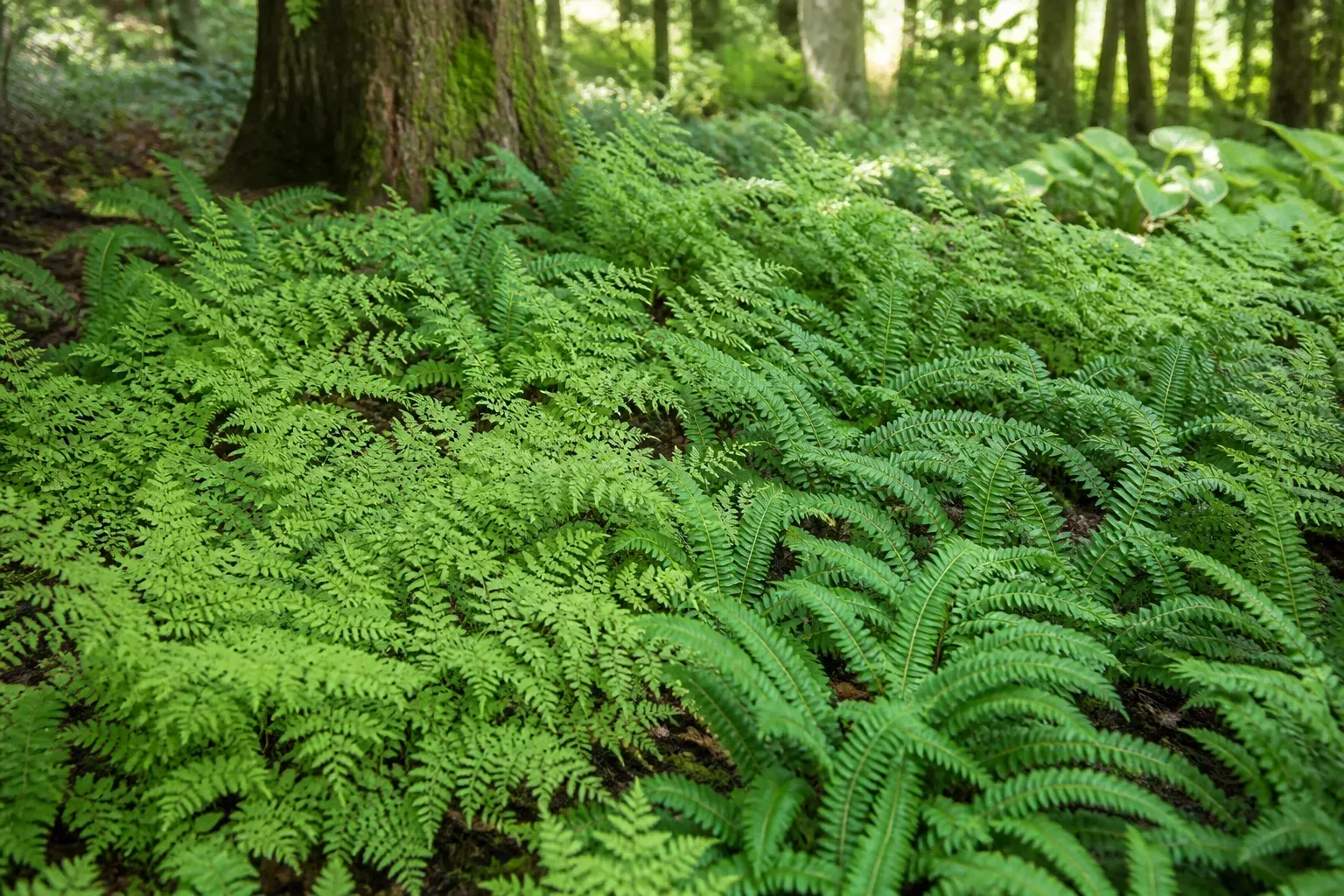
Dry Shade Is a Growing Condition, Not a Light Label
Shade describes light. Drought describes water availability. They overlap, but they are not the same thing. Light or open shade may receive several hours of indirect brightness and a little direct sun. Dappled shade moves as leaves and branches move. Moderate shade may receive only a couple of hours of midsummer sun, while deep or heavy shade receives very little direct light. The RHS guide to shade gardening also separates shade cast by buildings from shade beneath trees, because a building can block light without stealing water from the root zone.
Tree shade is often dry because of interception and root competition, not because shade itself evaporates more water. A mature tree can capture rainfall on its leaves, then use much of the water that passes through. The soil may be full of fine roots, difficult to dig, and quick to dry again after irrigation.
That is why a plant with broad, thin leaves may look happy in a moist woodland but collapse in a dry tree bed. Conversely, a plant adapted to drought and full sun may need more light than a dark corner provides. The best candidates can reduce water loss, slow growth during stress, or recover from a short dry period.
Choose by Moisture, Mature Size, and Summer Job
Use this table as a starting filter, not a promise that every plant will thrive in every dry garden. “Dry shade” means the soil dries faster than you want between meaningful rains, not that roots are permanently dust-dry. Containers, reflected heat, sandy soil, and new beds need more attention than an established woodland border.
| Plant | Best fit | Summer behavior | Watch-out |
|---|---|---|---|
| Hellebore | Partial to deep shade | Holds leathery foliage; flowers in cool seasons | Needs drainage and may look ragged after severe heat |
| Coral bells | Bright or dappled shade | Colorful foliage with moderate water demand | Shallow crowns dislike both drought and wet soil |
| ‘Brilliance’ autumn fern | Dappled to deep shade | Keeps texture; tolerates brief drought once established | Protect from drying wind; may naturalize in some regions |
| Douglas iris | Partial shade with some light | Evergreen clumps and late-spring flowers | Not a choice for the darkest tree hollow |
| Periwinkle | Contained shady groundcover | Dense, evergreen mat | Aggressive and invasive in some areas |
| Spotted dead nettle | Dry edge or partial shade | Silver foliage and spring flowers | Spreads; keep it within a defined boundary |
| Hosta | Dappled or moderate shade | Bold leaves, but prefers even moisture | Large leaves show heat and drought stress quickly |
| Fragrant sumac | Open to partial shade | Woody, spreading structure; often very resilient | Give it room to spread |
| Cast iron plant | Warm, partial to deep shade | Slow evergreen foliage | Outdoor range is limited by cold |
| Columbine | Dappled shade with some spring light | Flowers in spring; foliage may fade in heat | Needs more moisture under thirsty trees |
| California coffeeberry | Large western understory site | Evergreen shrub once established | Too large for many small beds |
| Bear’s breeches | Mild-climate partial shade | Dramatic leaves and tall flower spikes | Needs establishment water and ample space |
| Mondo grass | Partial to full shade | Neat evergreen clumps | Water new divisions and check cultivar behavior |
The RHS dry-shade planting advice recommends plants naturally suited to the condition, along with organic matter and mulch that reduce surface evaporation. It also emphasizes monitoring new plants. The selection below follows that rule.
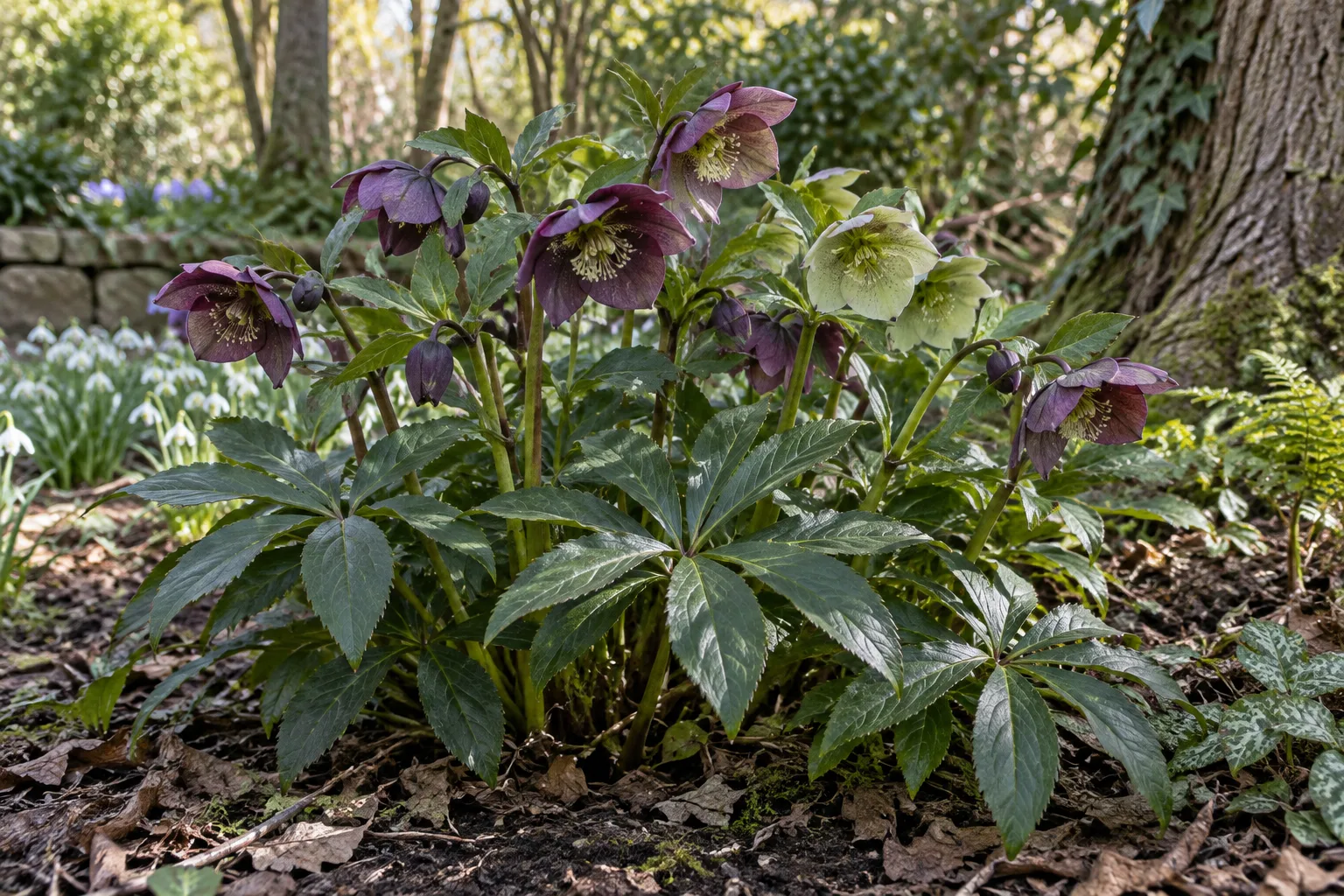
1. Hellebore: Leathery Foliage for Four-Season Structure
Hellebores (Helleborus spp.) are among the best all-around choices for a shady bed that dries between rains. Their thick, leathery leaves are less quick to collapse than soft, broad foliage, and many selections remain evergreen or semi-evergreen through winter. Depending on species and cultivar, they are commonly grown across roughly Zones 4–9, with flowers appearing from late winter into spring when much of the shade garden is still quiet.
Plant hellebores where the soil drains freely but still contains organic matter. They prefer partial to deep shade, though morning light or bright dappled light usually gives better flowering than a completely dark corner. A hellebore can handle a dry interval after its roots are established, but that does not make a newly planted division or nursery pot drought proof. Water the root ball thoroughly during its first growing season, especially if the bed sits beneath a large tree.
Expect the foliage to look less polished after an unusually hot, dry summer. Remove only truly damaged leaves after the worst stress passes; heavy cleanup during peak heat can remove useful photosynthetic tissue. For safety around children or pets, identify the exact selection and check local plant-safety guidance before planting.
2. Coral Bells: Colorful Leaves for Bright Dry Shade
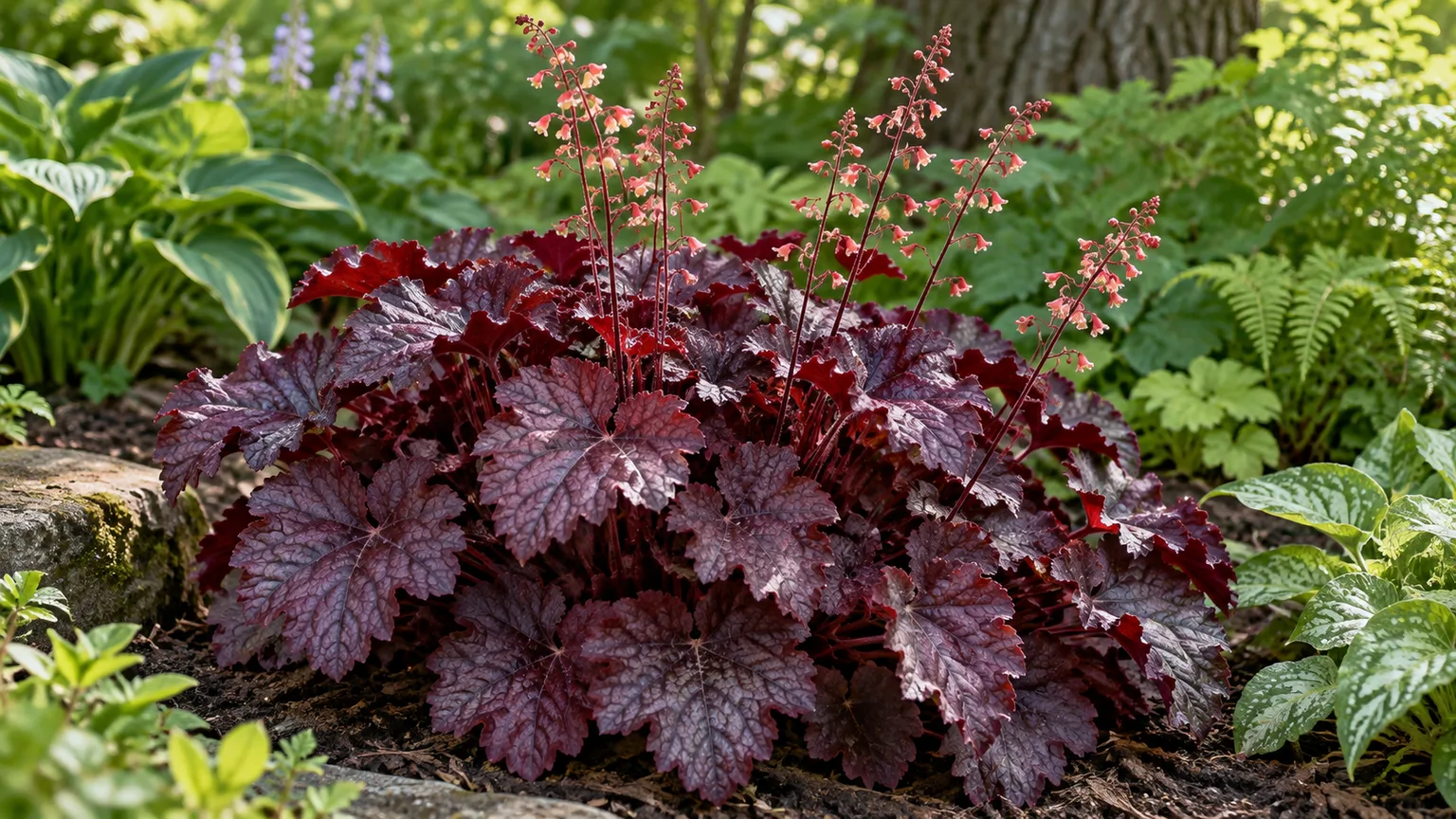
Coral bells (Heuchera spp.) bring foliage color to the places where flowers are unreliable. Lime, silver, bronze, burgundy, and near-black cultivars can brighten dappled shade without demanding full sun. They are generally hardy across a broad range, often about Zones 4–9 depending on the selection, and their small flower wands are a bonus rather than the main event.
Choose a site with bright shade, morning light, or filtered light if your summer is hot. Coral bells can cope with a moderately dry root zone once established, particularly when a mulch layer slows evaporation, but their shallow crowns are unforgiving of extremes. A plant that is bone-dry for weeks may scorch or thin out, while one planted in stagnant wet soil can rot. Set the crown at the soil surface rather than burying it under mulch.
Use coral bells along a dry border, beneath a high-canopied tree, or where a hose can reach during a heat wave. Keep highly ruffled or pale cultivars in the more protected part of the site, and treat leaf color as a secondary feature in exposed dry shade.
3. ‘Brilliance’ Autumn Fern: Coppery New Fronds
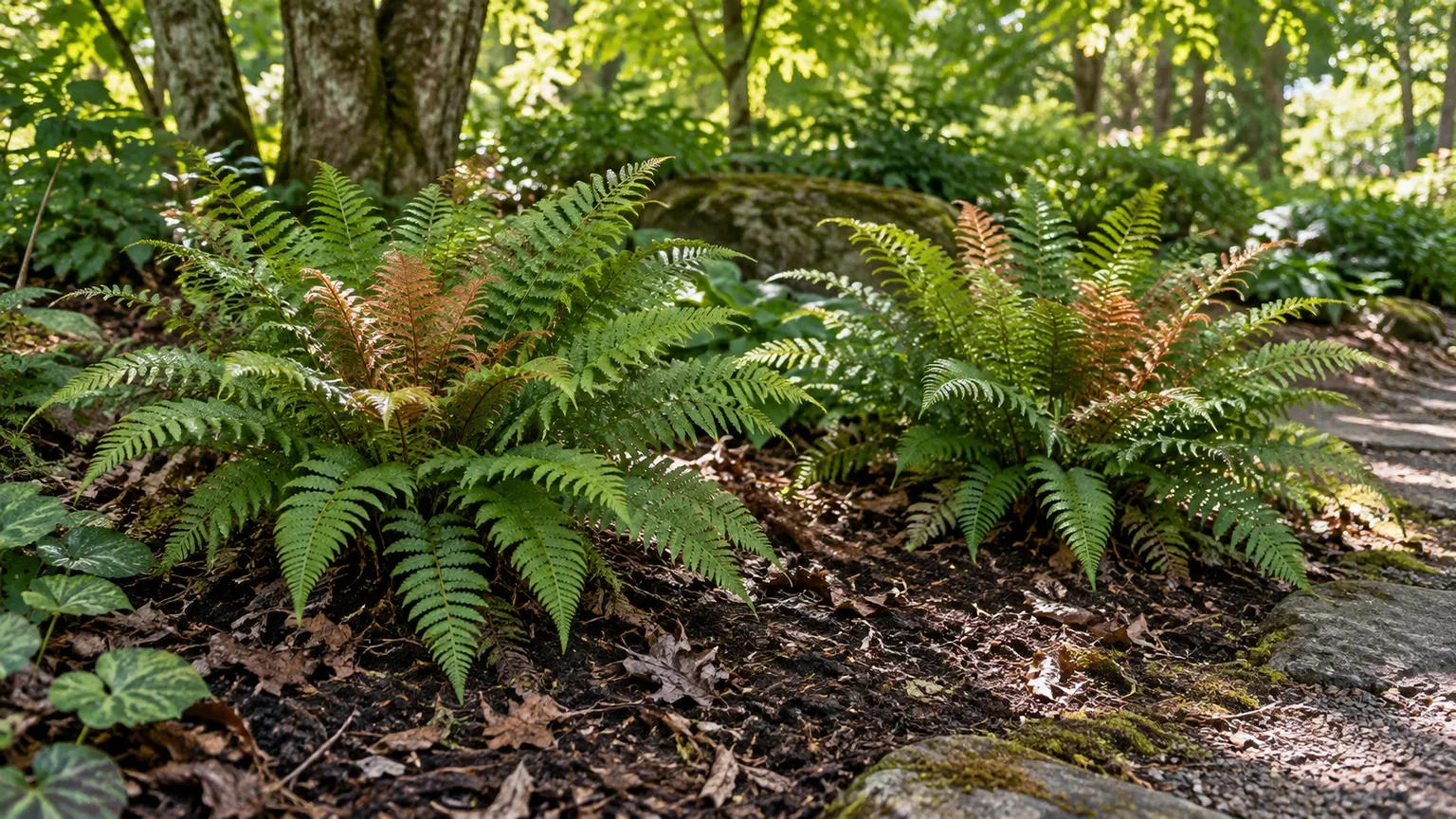
‘Brilliance’ autumn fern (Dryopteris erythrosora) earns its place for foliage rather than flowers. New fronds emerge coppery pink to orange before maturing green, giving a shady bed a brief seasonal flash. The clumping fern reaches roughly 2 feet tall and can spread gradually to about 3 feet wide, so it works as a textural middle layer rather than a tiny edging plant.
This fern prefers acidic, organic-rich soil that stays evenly moist, but NC State Extension’s plant profile records that fully established plants tolerate brief drought. That is a useful but limited claim. It means the fern may recover from a missed watering or a short dry spell; it does not mean a newly planted fern belongs in a neglected, powder-dry root zone. Dappled to deep shade is safer than hot afternoon exposure, and a wind-sheltered position prevents fronds from drying at the edges.
Keep the fern where tree competition is moderate and occasional deep watering is possible. NC State also notes that it may naturalize in some areas and become problematic, so check regional recommendations before planting large numbers or allowing it to spread beyond the bed.
4. Douglas Iris: An Evergreen Pacific Coast Iris
Douglas iris (Iris douglasiana) is a smart option for climates where Pacific Coast plants are at home. It forms tidy evergreen clumps, commonly reaching around 2 to 2.5 feet, and produces purple or lavender-blue flowers in late spring. The RHS plant profile lists full sun to partial shade and notes that this iris tolerates slightly drier and more alkaline soils than many other Pacific Coast irises.
Give it some light. Douglas iris suits the bright side of a tree bed, an east-facing border, or the open edge of a woodland planting, not a dark hollow under a dense canopy. Well-drained soil matters more than a narrow pH target; a soggy crown is a bigger problem than ordinary summer dryness.
Water new divisions or nursery plants regularly until they root into the surrounding soil. Once established, the evergreen clump can carry a dry period better than a moisture-loving iris, but flower quantity and foliage quality still depend on the site. Remove old flower stems after bloom and leave healthy leaves in place to build the rhizome for the next season.
5. Periwinkle: Tough Groundcover With a Big Caveat
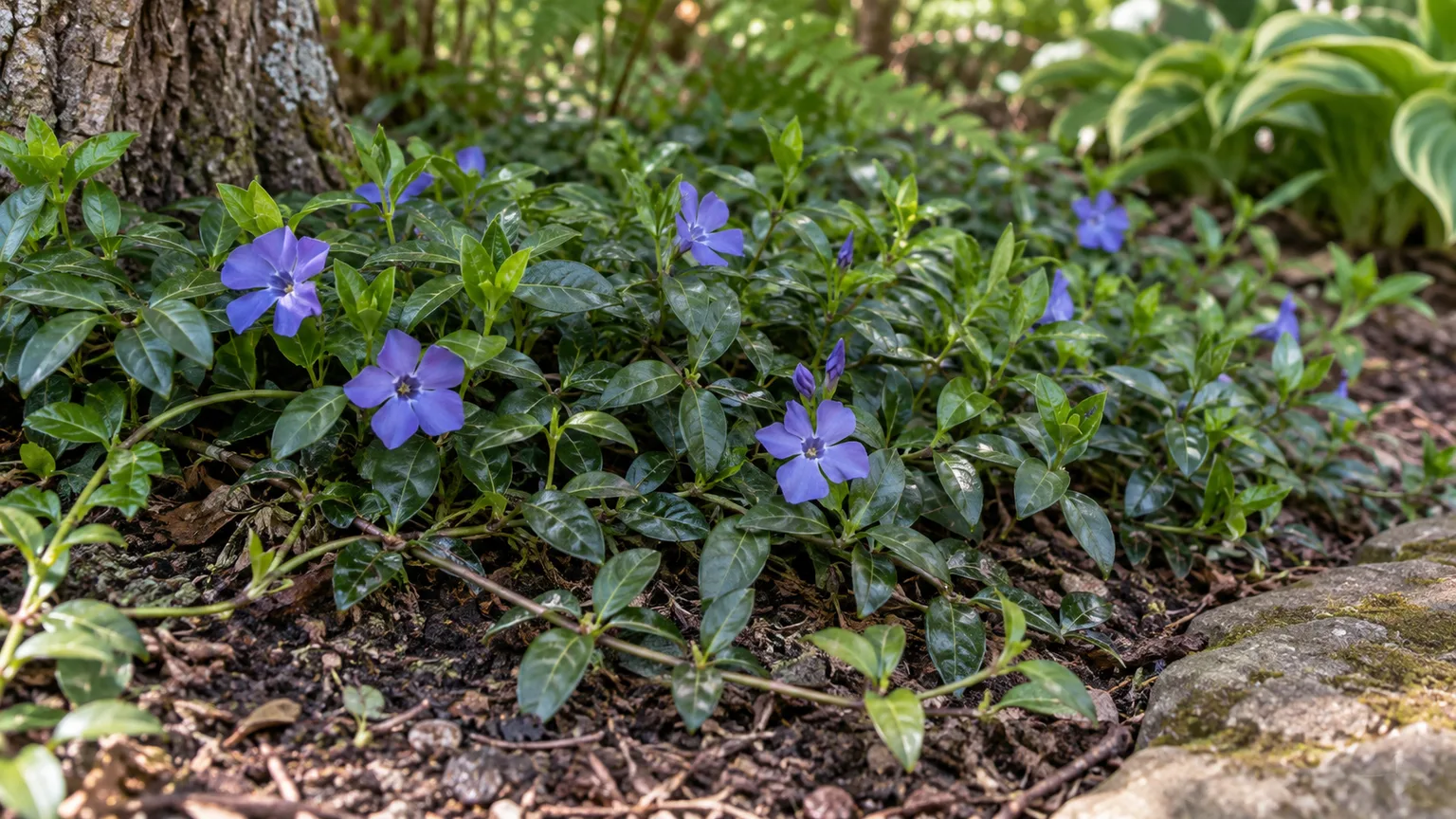
Periwinkle (Vinca minor) is tough in exactly the way that makes it useful and risky. It forms a low, evergreen mat, tolerates heat and near-full shade, and produces blue to lavender flowers in spring. At roughly 3–6 inches tall, it can cover soil beneath shrubs where taller plants would struggle.
The problem is spread. NC State Extension describes its rapid growth, rooting at nodes, dense mat formation, and aggressive behavior; it is considered invasive or unwanted in some regions. That makes periwinkle a conditional choice, not a universal recommendation for low-water groundcover. Check your state or local invasive-plant list before buying it, and never use it where runners can escape into a natural area.
If it is permitted, contain it with a physical edge, inspect runners each season, and keep clippings out of woodland margins. It still needs water while filling in; an established mat reduces bare-soil evaporation but cannot compensate for a root zone that never receives moisture. Consider locally native groundcovers first.
6. Spotted Dead Nettle: Silver Leaves for a Dry Edge
Spotted dead nettle (Lamium maculatum) is useful when a dry shady border needs a low, bright carpet rather than another dark green mound. Its silver-marked leaves catch available light, and pink, purple, or white flowers appear in spring and early summer. It is generally happiest in partial to full shade with well-drained soil, and established plants can manage short dry intervals better than many soft-leaved woodland perennials.
Put it on the edge of the planting rather than in the center of a bed you want to remain formally contained. Stems root as they travel, and the plant can spread beyond its allotted space. The Savvy Gardening dry-shade suggestions also treat it as a practical shade option while recognizing that spreaders need management. Check local guidance, especially if your garden borders a natural area.
Lamium is a good filler for a bed with occasional supplemental water, not a substitute for site preparation. Keep the crown out of standing water, refresh mulch before summer, and trim wandering stems after flowering. If it thins during drought, cut back after the soil has been rehydrated.
7. Hosta: Bold Texture When the Bed Is Not Bone-Dry
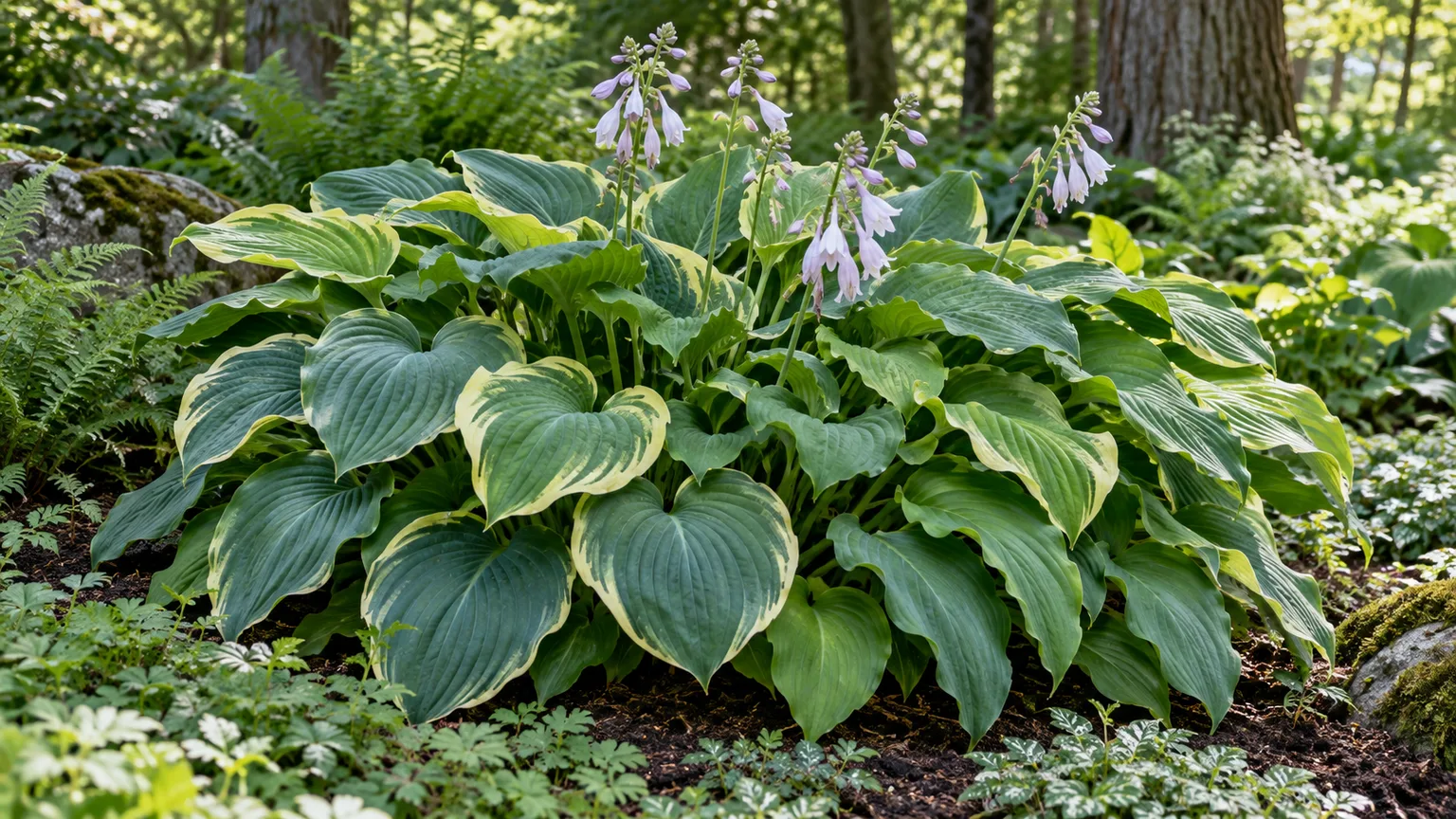
Hostas (Hosta spp.) are often included in dry-shade lists because established clumps can survive a short period without irrigation. Their large, ribbed leaves create a strong textural anchor, and blue, green, gold, and variegated forms make a layered border easy to design. They are commonly hardy across roughly Zones 3–9, depending on the cultivar.
But hosta is not a true no-water plant. It prefers soil that stays evenly moist, especially while producing leaves in spring and early summer. A mature clump under a high-canopied tree may cope with a missed watering, while a newly planted hosta beneath thirsty surface roots can wilt quickly. In prolonged heat, leaf margins may brown and the canopy may look tired even when the plant survives.
Use hostas where you can water deeply when necessary. Choose thicker-leaved cultivars, mulch around but not over the crown, and avoid reflected afternoon heat. Utah State University Extension includes hosta among plants tested for dry shade, supporting “tolerates with care,” not “thrives without water.”
8. Fragrant Sumac: A Spreading Native Shrub
Fragrant sumac (Rhus aromatica), especially the low ‘Gro-Low’ type, is one of the strongest choices here for a dry, open woodland edge. The trifoliate leaves release a citrus-like scent when brushed, and the plant can offer yellow flowers, red berries, and fall color. ‘Gro-Low’ commonly reaches about 2–3 feet tall and spreads 3–6 feet wide, making it useful for erosion control and broad understory coverage rather than a small foundation pocket.
It handles full sun to partial shade and is far more forgiving of dry soil than a moisture-dependent perennial. Utah State University Extension lists ‘Gro-Low’ fragrant sumac among plants tested for dry shade. Give it room to run, and use several plants as a low shrub layer instead of trying to keep one squeezed into a tiny hole.
Water the root ball consistently during establishment, then taper toward deep, occasional irrigation during prolonged drought. The practical issue with this spreading shrub is mature width and pruning, so check the final spread before planting near paths or small borders.
9. Cast Iron Plant: Slow, Glossy, and Warm-Climate Tough
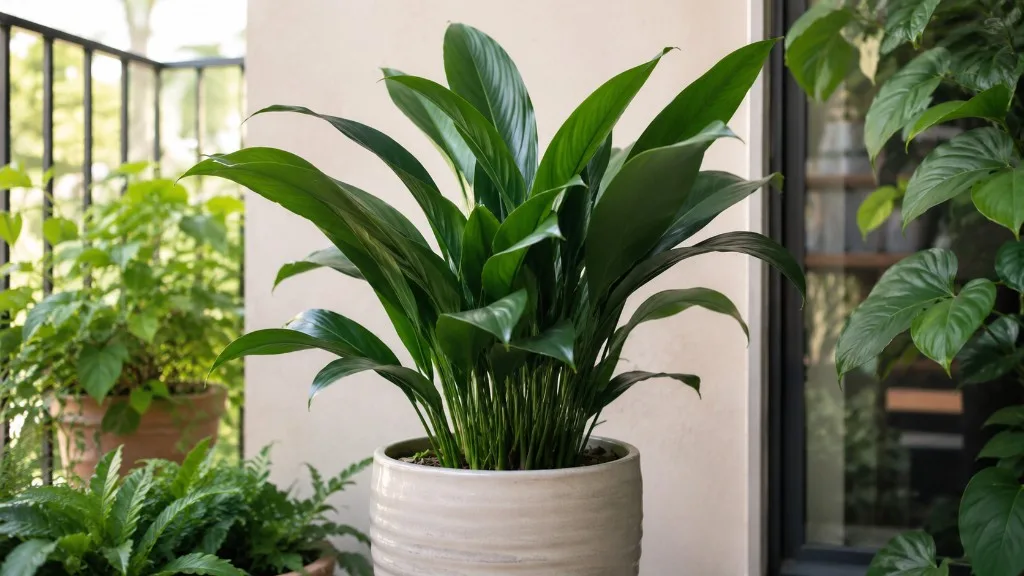
Cast iron plant (Aspidistra elatior) is a warm-climate foliage specialist for partial to deep shade. Its long, glossy leaves rise from a slow-growing clump and keep a dark corner looking intentional without flowers or frequent trimming. It is usually grown outdoors in roughly Zones 8–10, while colder regions treat it as a container plant that can be sheltered indoors.
The thick foliage and slow pace make it more forgiving of an occasional missed watering than many thin-leaved shade plants. Still, “cast iron” is a reputation, not a care plan. Newly planted divisions need regular watering, and an established clump in a pot can dry much faster than one in the ground. Water during extended hot weather, then let excess drain away; constantly saturated soil is as unhelpful as a dry root ball.
Use it beneath a porch roof, along a north-facing wall, or in a protected evergreen bed. It will not provide rapid coverage, but its slow growth is an advantage when you want a stable clump that needs little cutting back.
10. Columbine: Spring Flowers, Summer Foliage
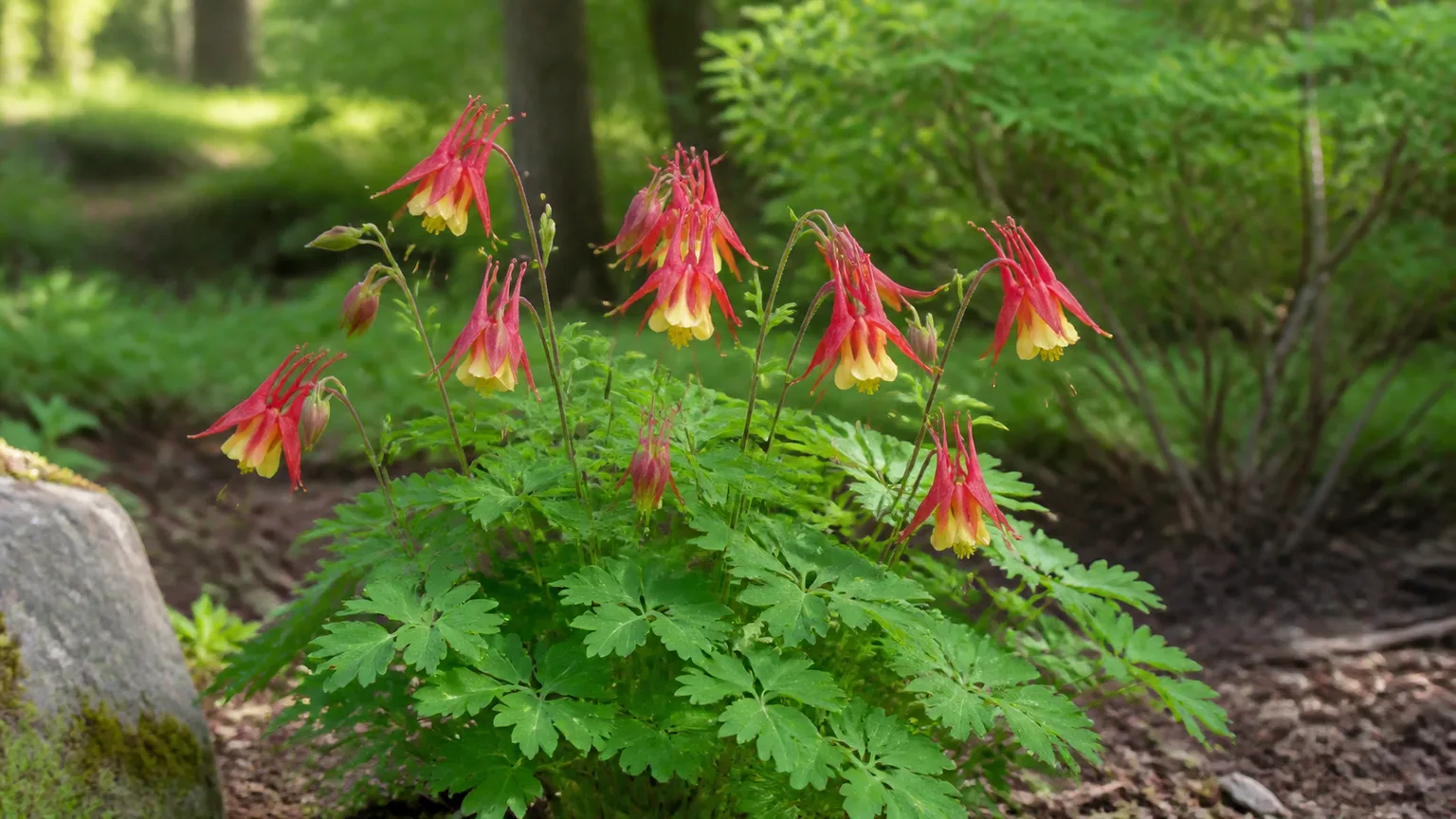
Columbine (Aquilegia spp.) adds dangling, spurred flowers to a dry-shade garden in spring. Many forms reach about 2 feet, tolerate full sun to partial shade, and return reliably across a broad temperate range, often around Zones 3–8 or 9 depending on the species. Their flowers can bring hummingbirds and early-season movement to a bed otherwise designed around foliage.
Columbine is best described as drought tolerant after establishment for short periods, not as a desert plant for the darkest tree roots. It performs well in dappled shade where spring light supports flowering and the soil is not exhausted by a dense root mat. During hot summer weather, the foliage may decline or go semi-dormant after flowering; that is a normal seasonal response, not always a watering failure.
Allow some seed heads to mature if you want seedlings, and remove spent foliage only when it is clearly declining or diseased. Place columbine near occasional irrigation rather than at the farthest edge of a tree’s root competition. The Utah State University dry-shade plant list includes it as a tested option.
11. California Coffeeberry: A Western Understory Shrub
California coffeeberry is commonly sold as Rhamnus californica and is also treated in current references as Frangula californica. It is a western North American evergreen shrub for a larger planting than the average perennial bed. Depending on the selection, it can reach about 6–8 feet or more, with small flowers followed by berries that ripen from green through red to dark tones.
The Waterwise Gardening Santa Barbara plant profile describes coffeeberry as a California native that tolerates sun or partial shade, a range of soils, and drought once established. That makes it particularly useful for a dry western understory or the back of a broad native planting. It is not a compact filler for beneath a window.
Give a new shrub regular, deep watering while its roots expand. After establishment, occasional deep irrigation during a long, hot drought is more useful than frequent shallow sprinkles. Mulch over the root zone, keep it away from the stem, and verify winter hardiness outside its native range.
12. Bear’s Breeches: Dramatic Leaves for Mild Climates
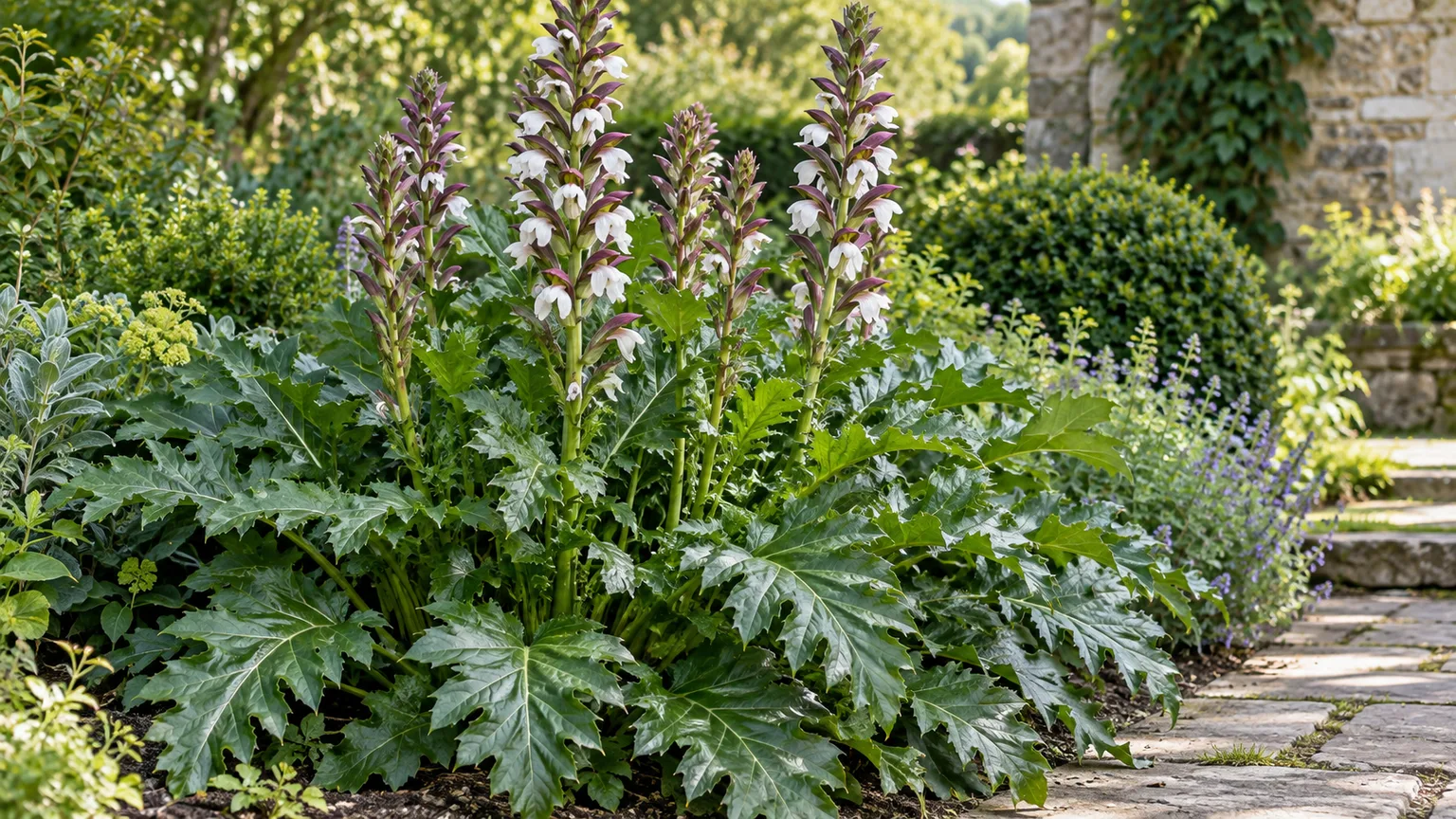
Bear’s breeches (Acanthus mollis) is for gardeners who want drama in a mild-climate shade bed. Its large, glossy, deeply lobed leaves make a bold clump, and tall flower spikes rise in late spring or early summer. It can reach roughly 3–6 feet tall and needs the same amount of elbow room that its foliage suggests. Epic Gardening’s dry-shade plant guide lists it for partial shade and well-drained soil in about Zones 7–10.
This plant handles a bright, sheltered dry-shade position better than a dark, root-packed hole. It needs consistent moisture during establishment, and hot weather can wilt or scorch the large leaves. Give it morning light or open shade, draining compost-enriched soil, and room away from a walkway.
Treat it as a structural perennial with seasonal limits. If the foliage collapses during extreme heat, do not immediately pile on fertilizer or water several times a day. Check the soil, water deeply if it is dry, and wait for cooler conditions before removing damaged leaves. It is a handsome choice where its size and climate range fit, but it is not the lowest-water plant in this group.
13. Mondo Grass: Neat Evergreen Clumps
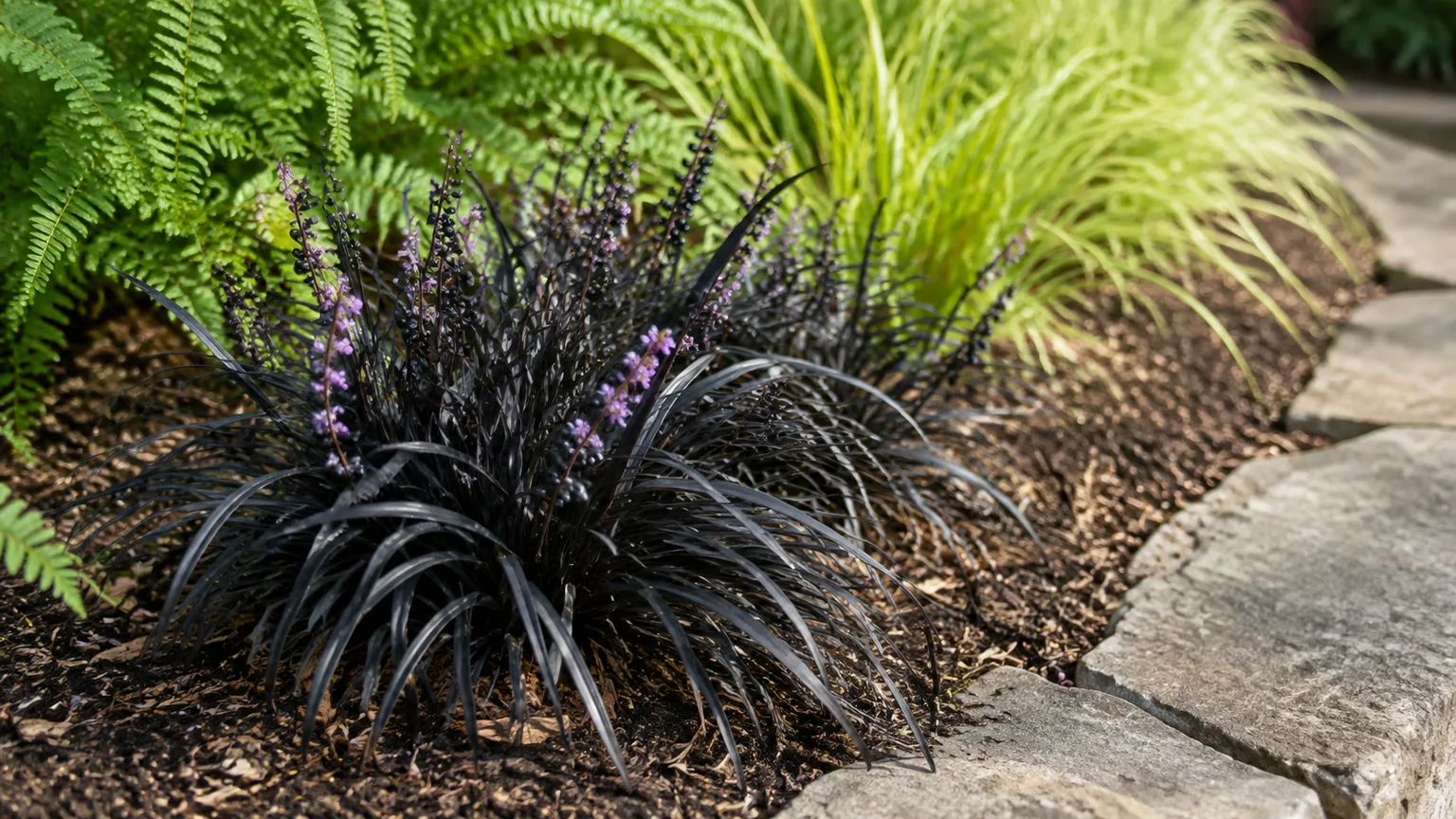
Mondo grass (Ophiopogon japonicus) gives a dry-shade border a clean, grasslike edge. Its narrow evergreen leaves form low clumps, and small flowers or berries may appear close to the foliage. It commonly suits partial to full shade in warm temperate climates, often around Zones 7–10, and works along paths, beneath shrubs, or as a calm transition between larger perennials.
Mondo grass prefers fertile, well-drained soil and appreciates water while it fills in. Once established, the clumps are fairly resilient, but new divisions can fail if they are planted into dry soil and then ignored. Space them according to the cultivar’s mature width so air can move between clumps while they establish; overplanting a thirsty tree bed only creates more competition.
Use it for definition, not instant coverage. Watch how a particular cultivar behaves in your region, especially if you are considering a spreading form. A dark-leaved mondo selection can add contrast, while green forms blend more quietly with ferns and shrubs. The goal is a stable evergreen base that needs less intervention after the first season, not a plant that never needs water.
Prepare the Site Before You Plant
Even the toughest selection struggles if the planting hole is compacted, waterlogged, or disconnected from the surrounding soil. Start by watching the site for a full day. Note where morning light reaches, where rain lands, where a roof or canopy sheds water, and where the soil remains dusty after nearby areas are damp. Dig a small test hole away from major roots to see whether water drains slowly or disappears immediately.
Under a mature tree, avoid turning the whole bed with a shovel. Cutting large roots damages the tree and can create an unstable planting site. Instead, plant between major roots, use small individual holes, and top-dress with a thin layer of compost or leaf mold. Organic matter improves structure over time, but burying a tree’s root flare or building a deep new soil layer against the trunk creates a different set of problems.
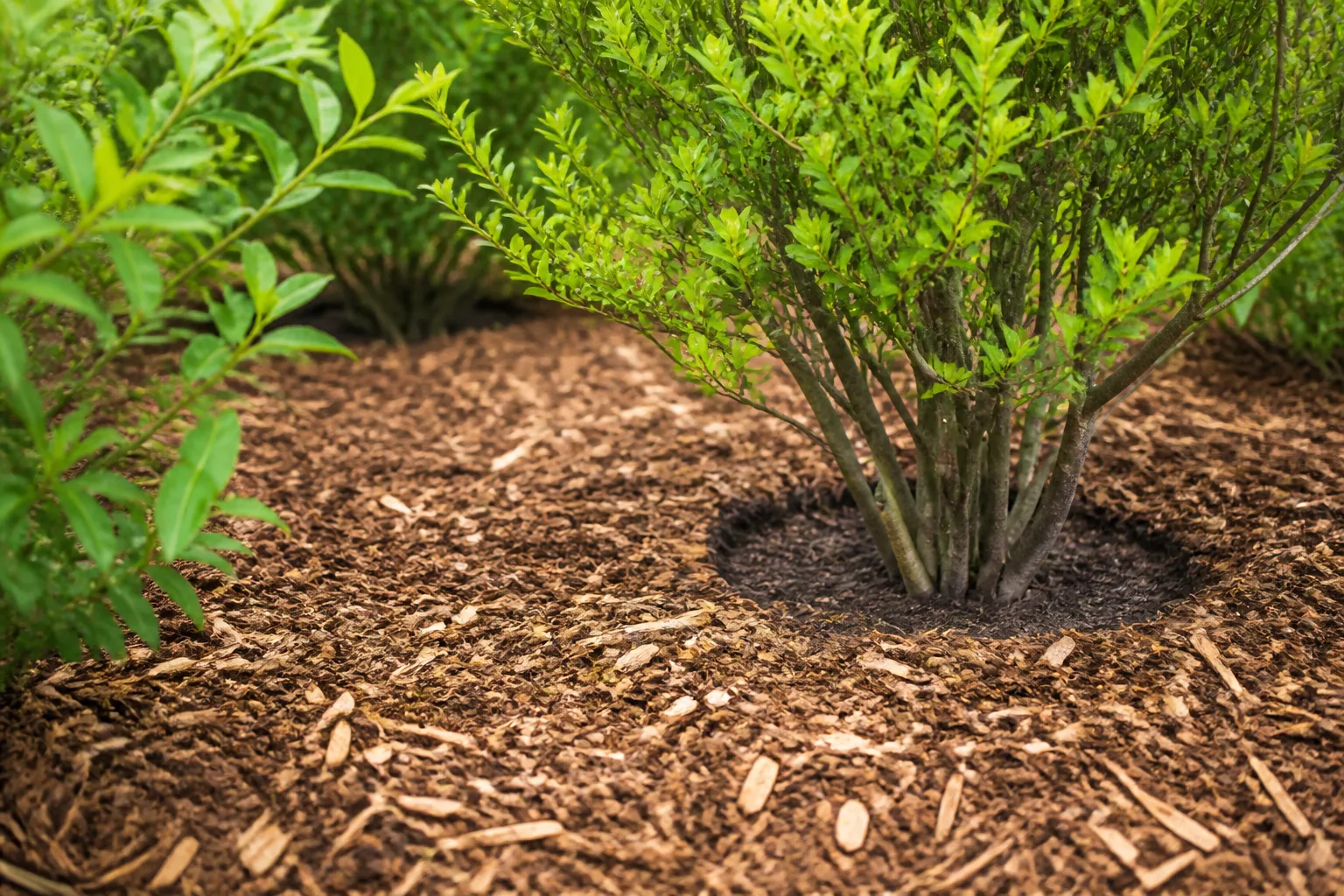
Spread about 2–3 inches of organic mulch over the soil surface, keeping it away from crowns, stems, and the tree trunk. Mulch slows evaporation, moderates soil temperature, suppresses weeds, and reduces the competition from a flush of thirsty volunteer plants. It will not make an unsuitable plant suitable, and a thick wet blanket over a crown can encourage rot.
Water new plants on a regular check-and-respond rhythm during their first growing season. Apply water slowly at the root zone so it wets the nursery root ball and the surrounding soil rather than running off the surface. Check the soil with a finger or hand trowel a few inches down before repeating the watering. As roots expand, lengthen the interval between waterings while soaking more broadly; daily surface sprinkles encourage shallow roots.
Fall or early spring planting can give roots more time to settle before the harshest summer conditions, depending on your climate. In a hot region, avoid installing a large batch of new plants just before a forecast heat wave. Group plants with similar moisture needs, leave space for their mature widths, and put the most water-demanding choices where a hose or drip line can reach them easily.
Troubleshoot a Dry-Shade Bed During a Heat Wave
When a shade plant wilts, do not assume it needs water immediately. Check the soil first. A plant beneath a tree can wilt in a hot afternoon even when the upper surface looks damp, while a plant beside an eave can be dry several inches down. If the soil is dry around the root ball, water early in the day and apply it slowly enough to soak the full root zone. If the soil is saturated, pause irrigation and investigate drainage; repeated watering in oxygen-poor soil can lead to root problems.
Use the plant’s overnight response as a clue. Leaves that droop briefly in afternoon heat but recover by morning may be responding to normal water loss. Persistent wilt at dawn, crispy margins, a shrinking crown, or leaves that remain limp after the soil is moist indicates more serious stress. Newly planted plants, containers, and plants beneath dense tree canopies deserve attention before mature shrubs in open shade.
Sun scorch and drought damage can look similar. Bleached or brown tissue on the exposed side of a plant points toward heat or reflected light, while general limpness and dry soil point toward root-zone stress. Move a container to brighter shade, add temporary afternoon protection where practical, or improve the plant’s placement after the weather moderates.
During a heat wave, hold fertilizer and avoid hard pruning. Extra salts can stress dry roots, and removing a large amount of foliage reduces the plant’s ability to make energy for recovery. Remove only broken or diseased tissue, refresh a thin mulch layer, and resume normal feeding or shaping after new growth resumes. For a spreading groundcover, postpone major thinning until temperatures ease so exposed soil does not heat and dry even faster.
Conclusion
The best drought-tolerant shade plant matches the exact kind of dry shade you have. For a thirsty tree bed, start with hellebore, coral bells, Douglas iris where there is enough light, fragrant sumac for roomier sites, cast iron plant in warm climates, or mondo grass for a low evergreen edge. Add hosta, columbine, autumn fern, dead nettle, or bear’s breeches where occasional deep watering is possible.
Treat periwinkle as a carefully contained, locally appropriate option rather than a default groundcover. Check mature dimensions before planting coffeeberry or fragrant sumac. Most importantly, give every new plant a thoughtful first season: prepare the surface, protect the root zone with mulch, water deeply when the soil is dry, and watch it through the first hot spell. The result will be a shade garden that uses less water because it is well matched to the site—not because the plants were promised more resilience than they actually have.