Eastern White Pine Identification and Care
Learn how to identify and grow eastern white pine, choose a suitable site, establish a young tree, and recognize weevil damage and blister rust.
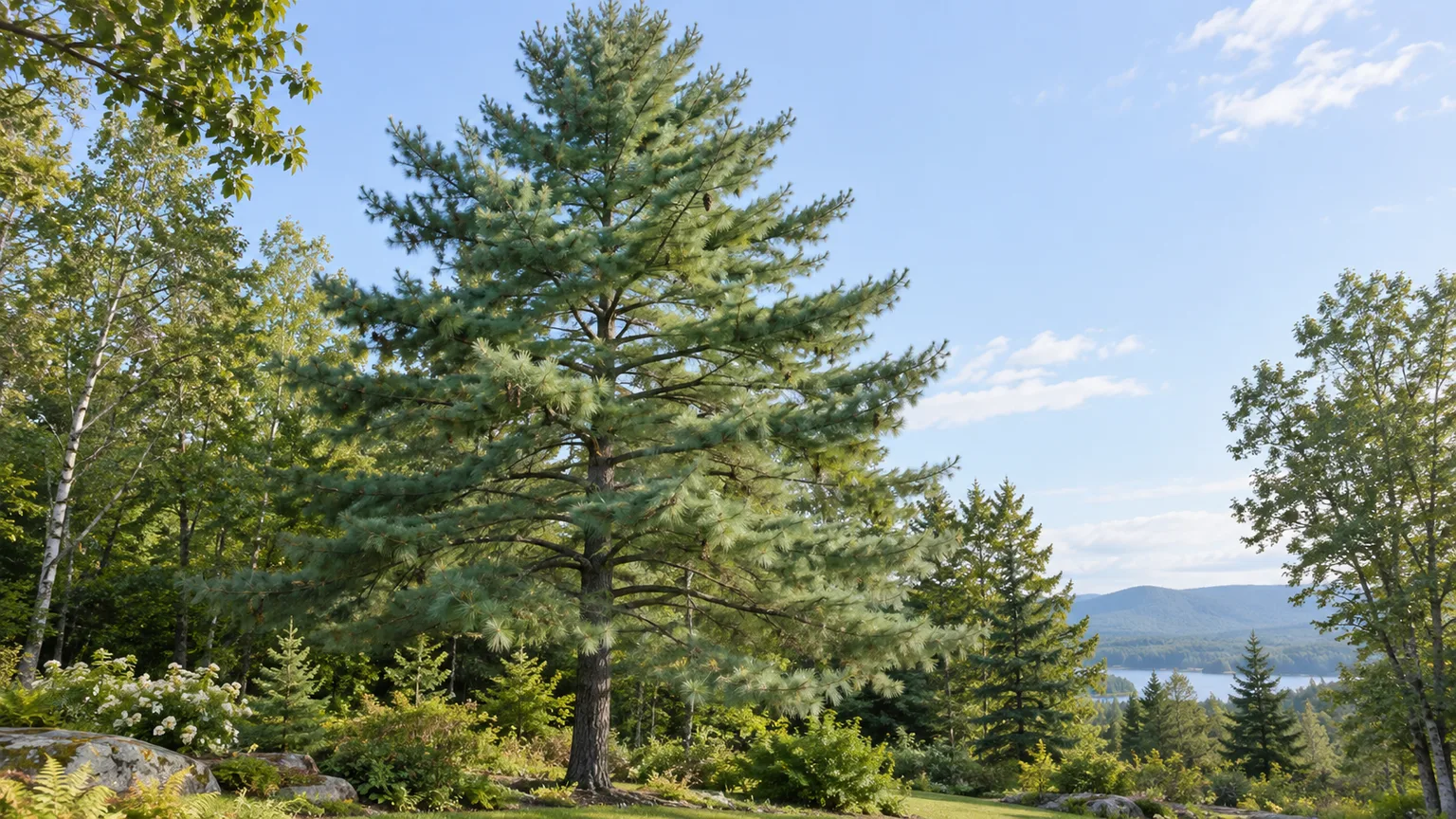
Eastern white pine (Pinus strobus) is easiest to recognize by its soft needles grouped five to a bundle. The tree can become a very large, fast-growing evergreen, so the most important care decision is made before planting: make sure the site can accommodate its future height and width, and that it is not exposed to chronic heat, poor drainage, road salt, or excessive wind.
In a suitable cool-to-moderate climate with room to develop, eastern white pine makes a graceful shade tree, woodland-edge specimen, or broad evergreen screen. It is less forgiving in a cramped urban yard or hot, dry site. This guide covers the field marks to check, the conditions that help it thrive, the right way to establish a young tree, and how to respond to two important problems: white pine weevil and white pine blister rust.
How to identify an eastern white pine
Start with a twig rather than the overall silhouette. A young eastern white pine may look like many other pyramidal evergreens, but the needle bundles and mature cones narrow the identification quickly. If you can safely reach a low branch, count the needles in a fascicle—the small sheath at the base of a bundle—then compare the cone and bark as supporting clues.
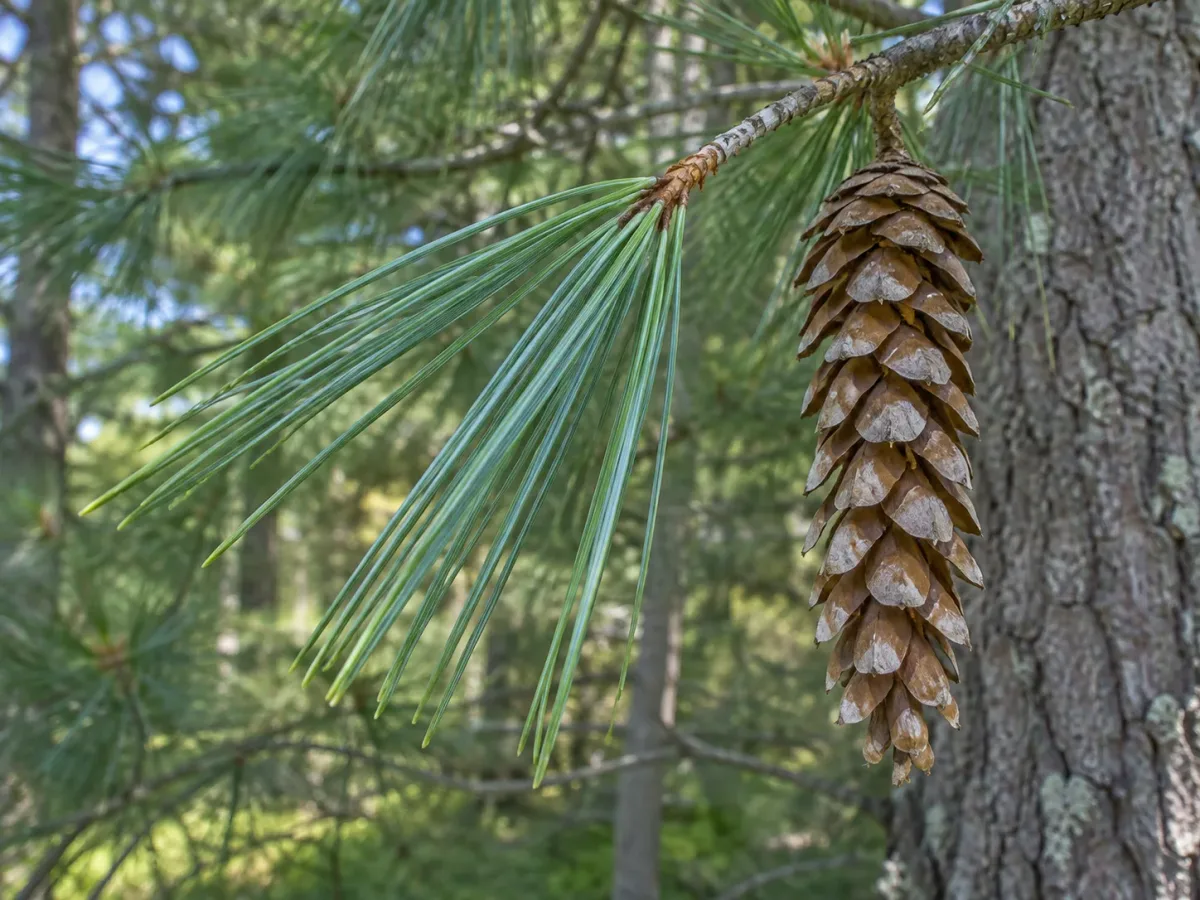
Count the needles and inspect the cones
Eastern white pine needles occur in fascicles of five. They are slender, flexible, and generally soft to the touch, with a blue-green cast; an individual needle is often about 3 to 5 inches long. The five-needle pattern is the fastest way to distinguish it from common two- and three-needle pines. Look closely at several bundles because wind, age, or a damaged twig can make a count on one branch misleading. NC State Extension describes the species’ needles as bluish green, soft, and pliable, and its plant profile lists five needles per bundle. NC State Extension
The cones are long, narrow, and pendulous, commonly around 4 to 8 inches long. They hang from short stalks and have thin scales without the sharp prickles found on some pine cones. Mature cones turn brown, but they do not all appear on young nursery trees; it can take several years before a tree begins producing them. A cone is useful confirmation, but the five-needle bundle is more dependable when inspecting a young specimen.
Read the bark, crown, and seasonal growth
Young trunks have relatively smooth greenish-gray bark. As the tree ages, the bark becomes darker and more deeply furrowed, with long ridges and fissures; a mature trunk does not look like a smooth, pale ornamental birch. The crown also changes with age. A young tree usually has a pointed, pyramidal outline and whorled branches, while an older tree develops a broader, more irregular crown with layered horizontal limbs.
Do not use a single needle’s yellowing as an identification or disease test. Pines shed older needles as part of normal renewal, and eastern white pine keeps its newer growth while older interior needles eventually drop. A whole shoot browning, a dead terminal leader, a canker, or rapid change across multiple branches is more concerning than scattered old needles near the interior. Pair the symptoms with season, location on the tree, and recent weather before deciding that a pest or disease is present.
Where eastern white pine grows naturally
Eastern white pine is native to eastern North America, from parts of Canada through the northeastern United States and south along the Appalachian region. It grows in a range of woodland settings, including sandy or rocky soils, but natural occurrence does not mean every yard is a good match. Forest trees often benefit from cooler air, surrounding canopy, and deep rooting space that a paved, exposed site cannot provide.
NC State Extension lists it for USDA Hardiness Zones 3a through 8b and notes that it prefers full sun, moist well-drained soil, and a cool, humid climate. The zone range is a starting screen for winter lows, not a guarantee of success in a hot summer or a salt-laden streetscape. Conditions can differ sharply within the same zone: a sheltered northern slope may suit the tree better than a sunny, wind-scoured driveway border. NC State Extension
Decide whether it fits your landscape
Before buying, picture the tree at its mature size instead of the size printed on the nursery pot. NC State describes landscape specimens commonly reaching roughly 50 to 80 feet tall and 20 to 40 feet wide, though the ultimate form depends on climate, soil, and whether it grows alone or among other trees. In a small garden, those dimensions can block light, overwhelm nearby plantings, and eventually conflict with roofs, wires, or walks.
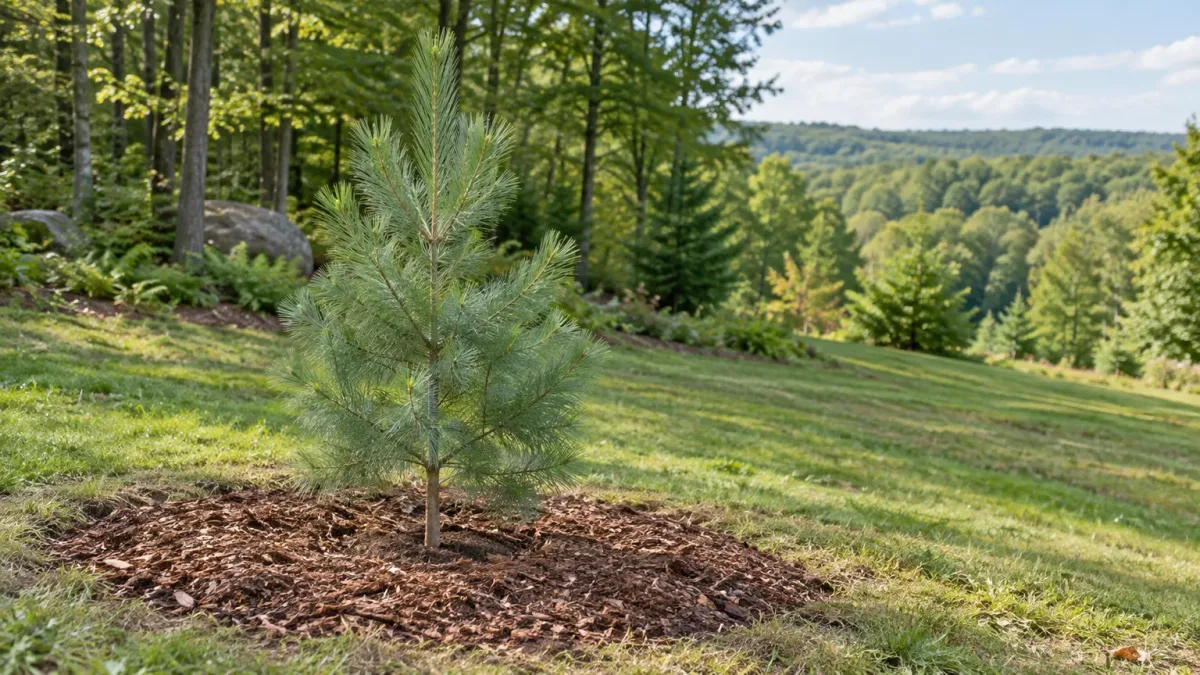
Plan for its mature height and spread
Use the expected canopy width—not the sapling’s current branches—to judge spacing. Allow room for the lower limbs to extend and for the tree to grow without constant shearing. Check the location of overhead utility lines, underground services, septic systems, nearby buildings, and mature neighboring trees before digging. Where power lines cross the only available planting space, select a smaller species rather than planning to top the pine later.
Eastern white pine can serve as a specimen, windbreak, or informal screen on a large property, but repeated close spacing changes the result: trees compete for light and airflow, and lower branches may thin. It is also prone to wind damage, so avoid a highly exposed site where the tree will be battered by prevailing winds. NC State Extension flags the species as highly flammable; in wildfire-prone areas, follow local defensible-space guidance and do not treat an evergreen screen as automatically safe near a home.
Match light, soil, and climate
In cooler parts of its range, choose a site with several hours of direct sun and open light for strong, balanced growth. In warmer regions, afternoon shade may reduce heat stress, but deep shade can leave the crown thin and the tree leaning toward light. The balance depends on local climate and exposure: a hot reflected wall or south-facing pavement can make a nominally sunny site harsher than its light measurement suggests. Gardenia’s species profile similarly describes a preference for sun with some afternoon shade in hotter summer areas. Gardenia
Aim for soil that stays moderately moist but drains after rain. Acidic soil is preferred; NC State lists pH below 6.0 and good drainage, while its species description notes sandy loam as a favorable condition. Avoid a low spot that stays saturated, compacted construction fill, and alkaline soil where growth may be poor. If you do not know the pH, test the soil before adding amendments. Do not assume pine needles will quickly acidify a problem site enough to correct it.
The tree tolerates a variety of textures, but it does not like the combination of root-zone compaction and standing water. If rain remains pooled the day after storms, address drainage or choose a different location before planting. Road salt and salt spray are additional reasons to avoid roadside and driveway edges. Air pollutants and urban heat can compound those stresses, so a tree that grows well on a cool estate or woodland margin may struggle beside a busy, paved street.
How to plant an eastern white pine
Planting in early fall or spring gives a young tree time to establish roots before a hot, dry summer or frozen ground. In regions with harsh winters, follow local nursery and Extension timing advice. Choose a healthy container-grown or balled-and-burlapped tree with green, flexible needles, a straight central leader, and no resinous wounds or dark cankers on the stem. Inspect the root ball for circling roots; a severely root-bound specimen is harder to correct as it grows.
Choose sound nursery stock and planting time
Water the root ball before planting so it is evenly moist. Dig a hole wider than the root mass but no deeper than its height. The goal is not to bury the entire root ball under loosened soil; settling can sink a deeply planted tree further and keep the root collar wet. Gardenia recommends a hole about twice the root ball’s width, and NC State notes the species’ need for good drainage. Gardenia NC State Extension
If the soil is compacted, loosen a broad area around the hole rather than making a small pocket filled with rich amendment. A sharply different backfill can hold water like a basin or discourage roots from moving outward. In most home plantings, backfill with the excavated soil, break up large clods, and firm it gently to remove large air gaps without packing it hard.
Set the root flare at the right depth
Find the root flare—the point where the trunk widens into the first structural roots—and keep it at or slightly above the finished soil grade. Remove burlap, twine, and any container carefully according to the material and nursery instructions; loosen circling roots when feasible without tearing apart the root ball. Backfill, water slowly to settle soil, and check that the trunk base has not sunk below grade.
Spread a shallow, broad mulch ring over the root zone to moderate soil temperature and reduce weed competition. Keep mulch several inches away from the trunk; a mulch volcano traps moisture against the bark and can hide the root flare. There is no need to build a raised berm around the trunk. If the site requires a deep raised bed simply to keep roots above water, choose a better-drained spot or a species adapted to wetter conditions.
Water and mulch through establishment
A new tree needs regular checks because its root ball can dry while the surrounding soil still feels damp. During the first growing seasons, water deeply when the soil around the root ball begins to dry; adjust for rainfall, temperature, soil texture, and planting method. Do not water by calendar alone. Sandy soil may need more frequent checks, while clay soil stays wet longer and can suffocate roots if watered repeatedly without drying.
Direct water to the root zone rather than spraying the canopy. A slow soak encourages moisture to reach the full root ball; a brief sprinkle wets only the surface. After watering, probe the soil several inches down near the ball and just outside it. If it is still moist, wait. If it is dry at root depth, water again. As roots expand and the tree establishes, reduce supplemental watering, but do not assume a mature pine is immune to prolonged drought. Epic Gardening’s general pine-growing coverage also emphasizes that growth varies with species and conditions rather than following a fixed annual rate. Epic Gardening
Keep the mulch ring wide enough to reduce grass competition, extending it gradually as the tree grows. Replenish only as the layer thins; excess depth can reduce air exchange and keep bark wet. Do not add fertilizer automatically at planting. If growth remains weak after checking drainage, root depth, light, and watering, test the soil and consult a local Extension service before choosing a nutrient treatment.
Prune for a strong, natural form
Eastern white pine usually needs little routine pruning beyond removing dead, broken, or diseased branches. Make clean cuts just outside the branch collar rather than flush with the trunk or leaving a long stub. For larger limbs or work above ground level, hire a qualified arborist; falling branches and climbing a mature tree are not safe homeowner jobs.
Preserve the central leader, the tree’s main upright stem. Topping removes the natural crown and often triggers weak, awkward regrowth instead of controlling mature size. If a young leader is broken or damaged, select a healthy upright lateral near the break and guide it into the leader role while removing competing upright shoots gradually. Prune during dry weather when possible, and avoid removing too much live foliage at once. For suspected blister-rust cankers, follow the disease-specific guidance below rather than treating every brown branch as ordinary deadwood.
Choose a cultivar for a smaller landscape
If you love the soft blue-green needles but lack room for the full species, look at a named cultivar. ‘Nana’ is a dwarf, slow-growing form; ‘Sea Urchin’ is compact with blue needles; ‘Pendula’ has distinctly drooping branches and needs support or training when young to achieve a chosen shape; ‘Fastigiata’ is upright and narrower than the species. Cultivar size still varies with age and growing conditions, so confirm the mature dimensions from the nursery and check that the plant is the cultivar you requested. NC State lists these forms and traits in its plant profile. NC State Extension
A dwarf cultivar is not simply a full-size tree that has been pruned short. It has a different growth habit, but it still needs suitable soil, light, and enough room for its eventual width. Ask whether the plant is grafted, how quickly it grows, and how its shape is maintained. If you need a narrow evergreen screen beside a house, compare several regionally adapted species instead of assuming a columnar cultivar will solve every space problem.
Recognize pests, disease, and site stress
Before treating a declining pine, identify the pattern. Browning concentrated on one exposed side can point to salt, wind, or sun; thinning through the crown may follow drought, root stress, or shade; a curled terminal leader suggests weevil injury; and a swollen, resinous canker with yellow-orange spores raises concern for blister rust. These clues are not a laboratory diagnosis. Photograph symptoms, note when they started, and contact a county Extension office or diagnostic clinic when the cause is uncertain.
White pine weevil and a crooked leader
White pine weevil attacks the terminal leader of young eastern white pines. Adults feed and lay eggs near the top shoot; resin droplets in spring can be an early clue. Later, the new leader may wilt and bend into a shepherd’s crook as larvae feed beneath the bark. The tree is not necessarily killed, but a replacement side branch may take over and leave a permanently crooked or forked trunk. Penn State Extension describes the life cycle and damage timing in detail. Penn State Extension
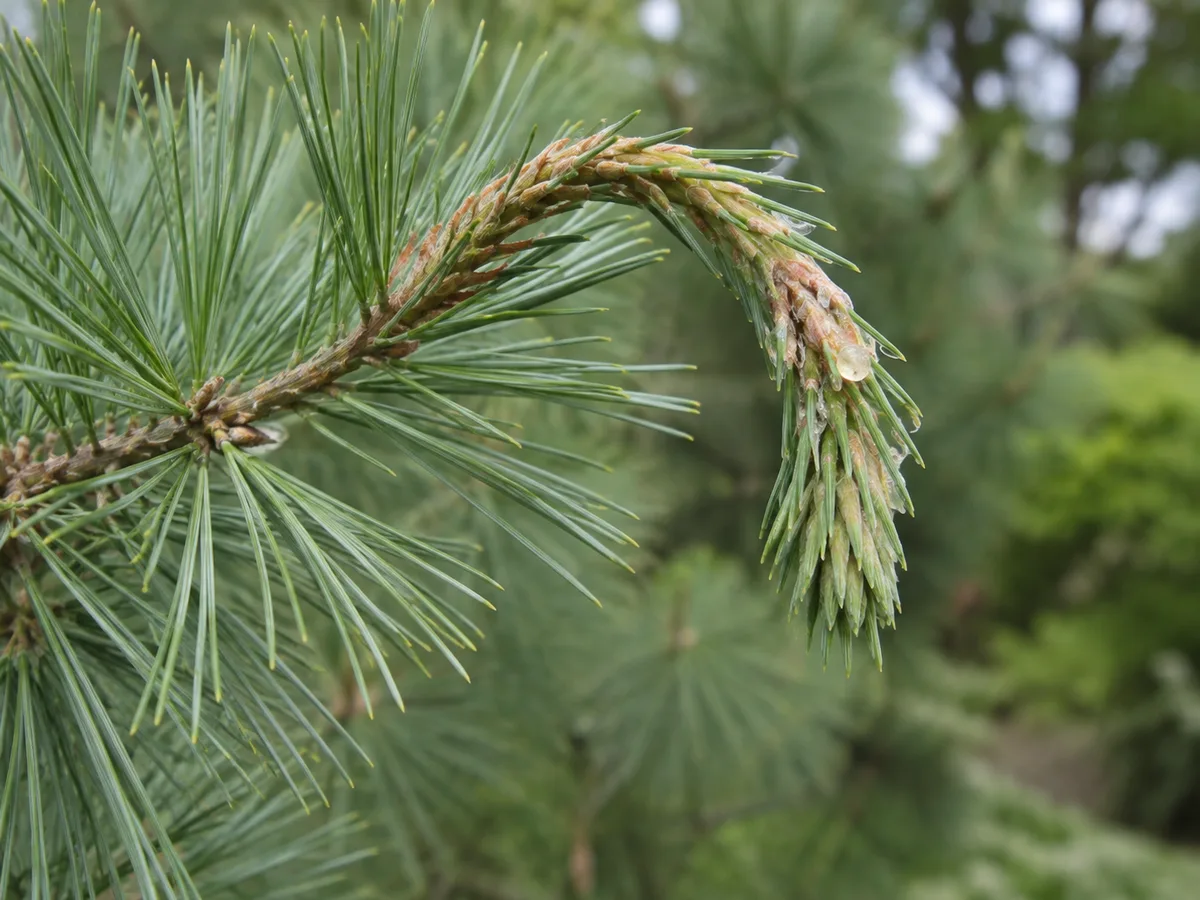
White pine weevil injury can bend and kill the terminal leader of a young tree.
Inspect small trees from spring into summer, especially those with exposed leaders. If a leader has clearly died from an attack, cut it below the damaged section before larvae complete development, then retain one healthy, upright lateral to become the new leader. Avoid indiscriminate pesticide spraying: product choice and timing depend on local registration and the pest’s life stage, and treatment on a tall tree is not a casual DIY task. If you see fresh resin but cannot confirm the cause, ask Extension before treating.
White pine blister rust and Ribes hosts
White pine blister rust is caused by Cronartium ribicola, a fungus that moves between five-needle pines and plants in the genus Ribes, which includes currants and gooseberries. The disease can begin as yellow or brown needle spots and progress into branch or trunk cankers with resinous, blistered margins and orange spore structures. When a canker girdles the trunk, the tree above it dies; there is no cure for a trunk canker. Wisconsin Extension explains the host cycle and symptoms, and advises that a branch canker may sometimes be removed if it is well away from the trunk. University of Wisconsin–Madison Extension
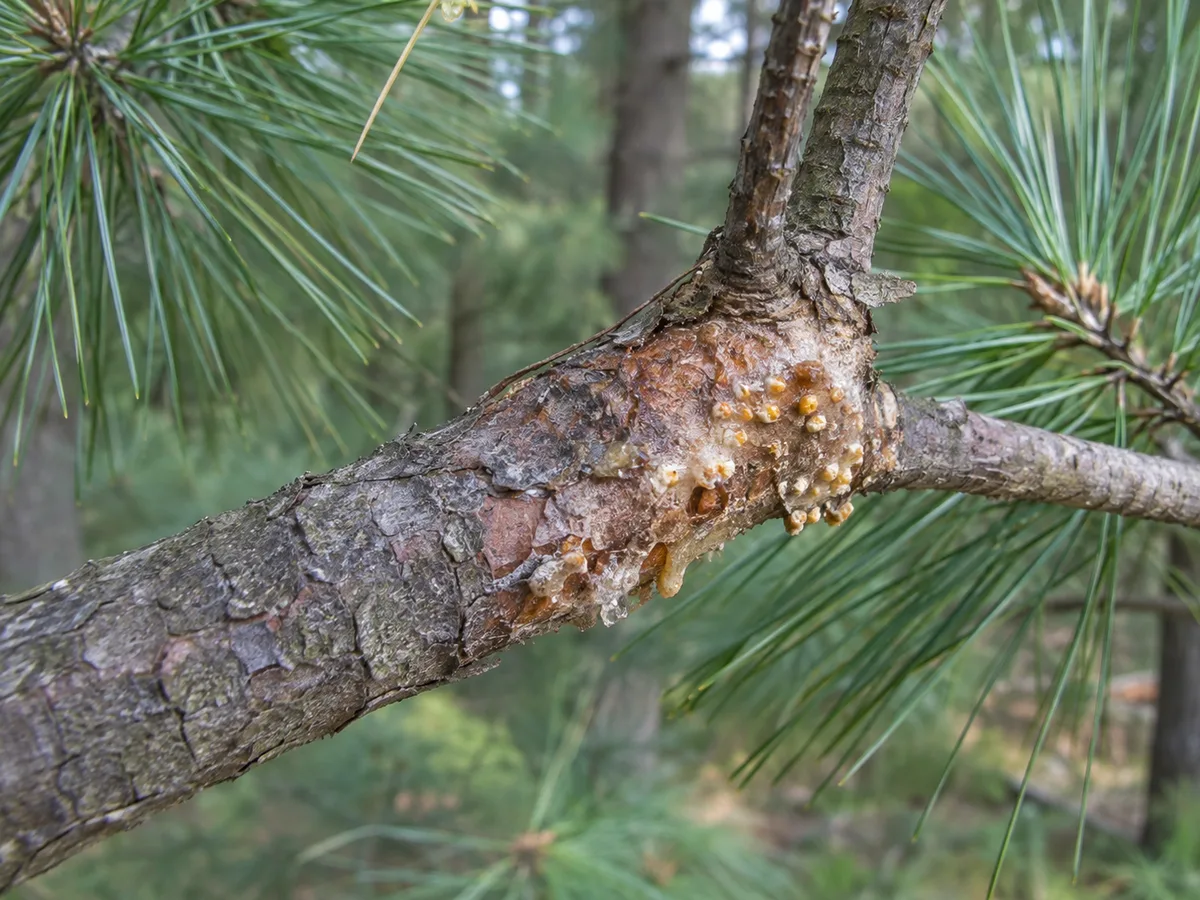
Blister rust cankers may produce yellow-orange spores; confirm uncertain symptoms through local Extension.
Keep the tree’s foliage from staying wet for long periods: avoid dense, crowded planting and overhead irrigation that repeatedly wets needles. Currants and gooseberries nearby can increase risk, but host-distance guidance depends on region and local disease pressure. Wisconsin Extension notes that removing Ribes within 200 feet can reduce incidence in its regional context; do not treat that distance as a universal guarantee. If you see a canker on a major limb or trunk, get a local diagnosis promptly. Follow an Extension or arborist’s instructions for removal rather than pruning blindly into trunk tissue.
Salt, heat, wind, and other causes of browning
Eastern white pine’s soft needles can brown after road-salt splash or salty runoff, often first on the roadside-facing or lower branches. Do not plant it where snow piles carry deicing salts into the root zone. Heat and drought may cause dull color, premature needle loss, and weak new growth; compaction and waterlogging can cause similar decline by damaging roots. Make the site correction that matches the pattern instead of adding fertilizer to a stressed tree.
Strong wind can break branches or desiccate exposed foliage, while a crowded, shaded crown may thin from lack of light. Young trees may also be browsed by deer. A temporary, properly sized fence or trunk guard can protect a small specimen, but check it as the trunk expands and remove it before it constricts growth. NC State Extension notes both wind susceptibility and salt intolerance, which is why these are planting-site issues as much as aftercare issues. NC State Extension
Conclusion
The clearest field mark for eastern white pine is five soft, blue-green needles per bundle, backed up by long, narrow hanging cones and bark that darkens and furrows with age. Growing one successfully depends less on fertilizer or frequent pruning than on getting the site right: cool enough summers, well-drained acidic soil, modest moisture during establishment, low salt exposure, and room for a 50- to 80-foot tree with a broad crown.
If a large evergreen suits the property, plant it at the correct depth, keep the root zone evenly moist while it establishes, and inspect young leaders and branches for changes. If the landscape is too small, too hot, or too exposed, choose a compact cultivar or another evergreen before planting. That early decision is the simplest way to enjoy the tree’s graceful form without asking it to thrive where it does not fit.