Will Epsom Salt Make Grass Greener? The Real Answer
Epsom salt is not a universal lawn fertilizer. See how to diagnose yellow grass, read a soil test, avoid salt damage, and build thicker turf safely.
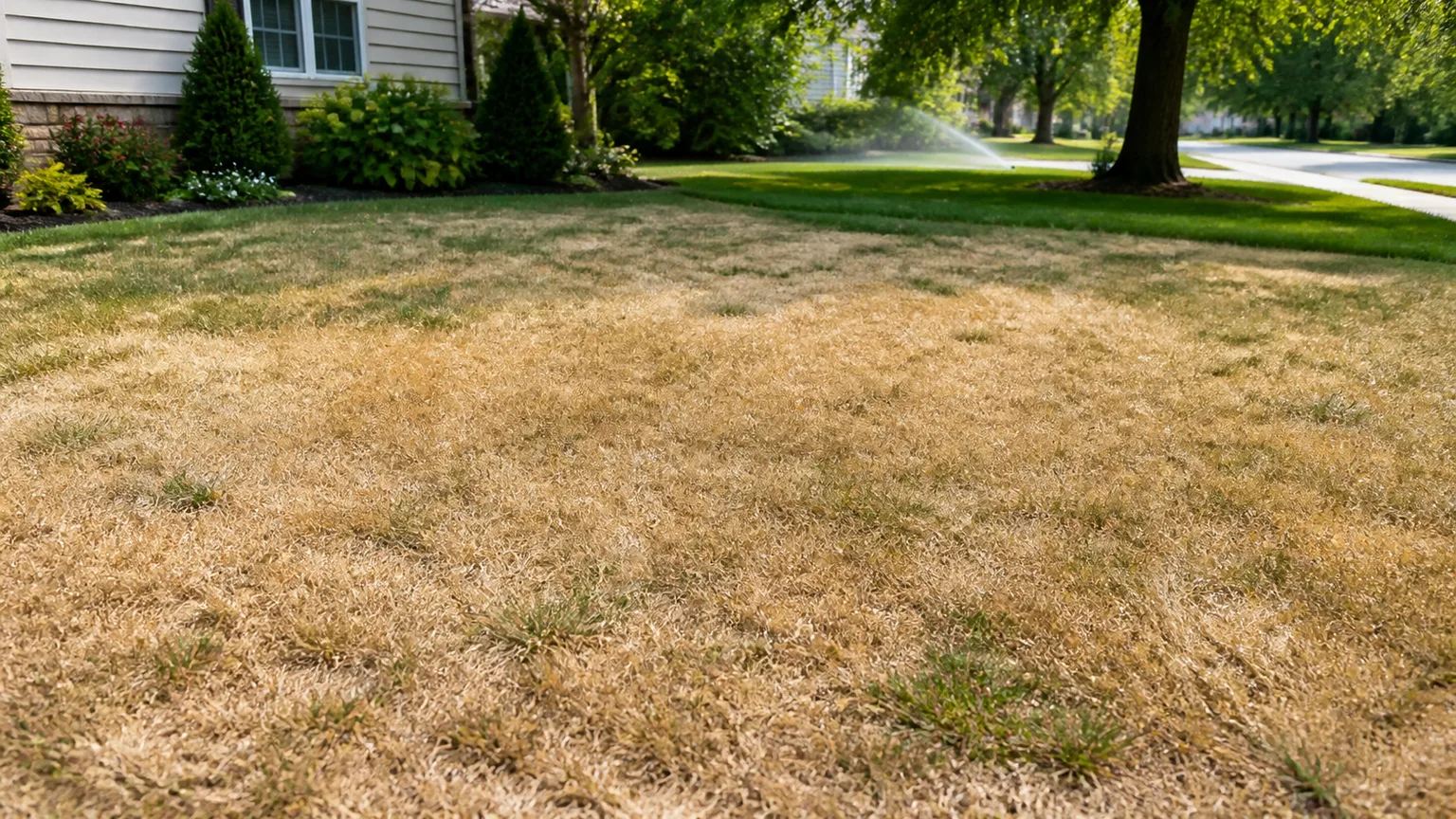
If your grass looks pale or thin, Epsom salt is an appealing shortcut: it is inexpensive, familiar, and easy to sprinkle. The trouble is that Epsom salt for grass only makes sense when the soil or turf is actually short of magnesium or sulfur. A yellow lawn with a watering, mowing, drainage, iron, nitrogen, shade, or disease problem will not become healthy because you added magnesium sulfate.
The more useful lawn-pro answer is diagnostic. Test the soil, identify whether the issue is color or density, and fix the limiting factor first. That approach may lead to Epsom salt in a narrow situation, but it more often leads to better watering, a higher mowing height, corrected fertility, improved drainage, or reseeding.
The short answer: only a confirmed deficiency makes Epsom salt useful
Epsom salt is magnesium sulfate (MgSO4). It supplies magnesium and sulfur, two plant nutrients involved in important processes, but it does not supply the nitrogen, phosphorus, potassium, or iron that commonly influence lawn color and growth. A laboratory soil test is the practical way to find out whether magnesium or sulfur is low enough to justify adding either nutrient.
If the test shows adequate magnesium, spreading Epsom salt is unlikely to make the lawn greener and can create a new salt or nutrient-balance problem. Purdue Extension warns that applying too much fertilizer can harm plants, waste money, and pollute the environment; its general soil-testing guidance is a good reason to stop treating a lawn by guesswork. Purdue Extension’s soil-testing guidance also explains that pH and nutrient status affect what the soil can provide.
If the report confirms a deficiency, Epsom salt may be one possible magnesium-and-sulfur source, but the report still matters. The right material depends on pH, the amount needed, the grass species, the test laboratory’s recommendation, and the product label. A viral kitchen measurement is not a universal lawn rate.
What Epsom salt adds to a lawn
Magnesium is the central atom in chlorophyll, so a plant that cannot access enough magnesium can lose some of its green color and perform less efficiently. Sulfur also supports plant growth and protein formation. That explains why magnesium sulfate can help a deficient plant; it does not prove that every green lawn needs more of it.
The compound is highly soluble, which can make a confirmed deficiency respond relatively quickly when the application is correct. Solubility is also the reason to be careful: a soluble salt can move with irrigation or rain, concentrate in the root zone if repeatedly applied, and leave the lawn with more of a nutrient than it can use.
Gardening Know How describes Epsom salt as magnesium sulfate and notes that its usefulness depends on what the soil is missing, especially in light or leached soils. Its overview of Epsom salt lawn care is useful context, but its existence should not be read as a recommendation to copy a fixed recipe onto an untested lawn.
Why magnesium can influence color
Color is a photosynthesis story, but it is not a single-nutrient diagnosis. Magnesium deficiency can reduce chlorophyll production, while low nitrogen can limit new growth, unavailable iron can cause chlorosis, and drought can make a lawn look dull before the soil test changes. Compacted roots, poor drainage, and high or low pH can also block access to nutrients that are present in the soil.
That is why visual diagnosis is weak on turf. Grass blades are small, mowed frequently, and often exposed to several stresses at once. If the entire lawn is evenly light green, think about fertility, grass type, mowing, or dormancy; if irregular areas follow sprinkler coverage, slopes, shade, foot traffic, or wet spots, investigate those patterns before reaching for an amendment.
Why lawn thickness is a separate problem
Epsom salt cannot create missing grass plants. It may help existing turf grow better when a confirmed magnesium or sulfur deficiency is limiting it, but a thin lawn usually has a density problem: too much shade, repeated traffic, shallow roots, drought, scalping, poor soil contact, thatch, pests, disease, or a grass species that does not suit the site.
Color and density can also move in opposite directions. A heavy nitrogen feeding can make a lawn look bright green while growth stays weak, water-hungry, and disease-prone; a well-rooted lawn can remain a little less vivid during heat while being more resilient. If you want a thicker lawn, correct the site and add suitable seed or sod where plants are genuinely missing.
Test before you add anything
The first useful purchase is a soil test, not a bag of Epsom salt. A meaningful lawn test can report pH and plant-available nutrients such as phosphorus, potassium, calcium, magnesium, and sulfur, depending on the laboratory package. Utah State University Extension describes soil testing as a way to identify both deficiencies and excesses, including high salts, high pH, low organic matter, and poor drainage.
Choose a laboratory that accepts samples for lawns and tell it the sample is for turfgrass. A garden test and a lawn test may have different recommendations, and a report is only useful when the crop or grass type is identified. Penn State Extension’s soil-testing instructions explain what a soil test measures and how the results guide lime and fertilizer decisions.
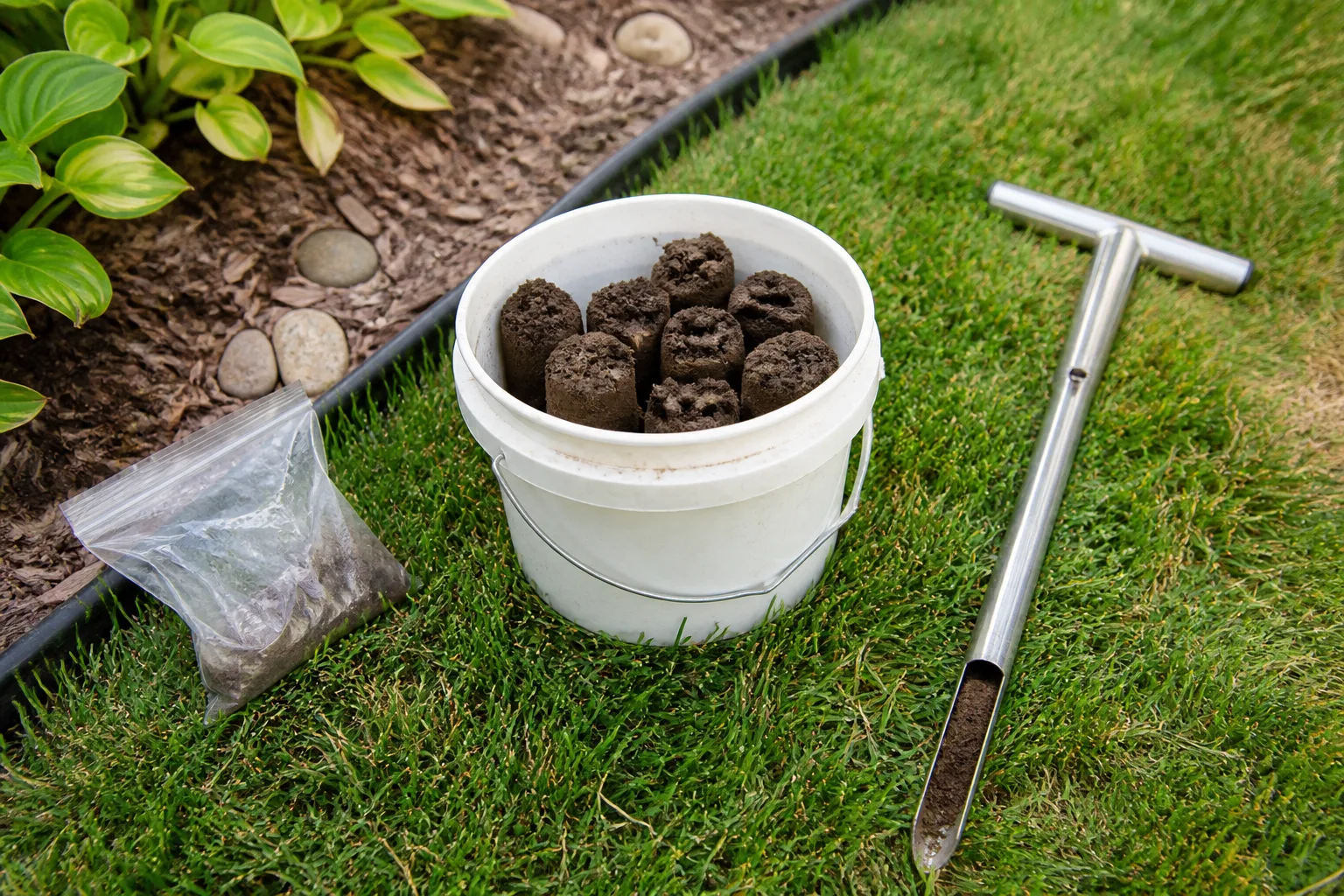
How to collect a useful lawn sample
Collect one representative sample from one problem area rather than mixing the front lawn, a shady corner, and a healthy strip together. If the areas behave differently, submit separate samples; otherwise the average can hide the deficiency or excess you are trying to find.
For a general lawn sample, use this sequence:
- Remove surface debris, fertilizer granules, and thick thatch from each sampling spot.
- Take a narrow core or slice about 4 inches deep, which is the lawn depth Penn State recommends for sampling.
- Gather cores from 8 to 10 random locations in the same turf zone.
- Mix the cores in a clean plastic bucket, break up clumps, and remove stones, roots, and visible debris.
- Fill the laboratory container, label the area and grass type, and follow that lab’s submission and payment instructions.
Do not sample immediately after fertilizing, liming, or applying Epsom salt. Those products can temporarily distort the result. If you already spread an amendment, tell the lab what you used and when; the lab or local extension office can help you decide whether to wait before sampling.
How to read the report
Start with the recommendation, not the number you wish were low. If magnesium is adequate, cross Epsom salt off the list. If magnesium is low but pH is also low, the laboratory may recommend a material that supplies magnesium while addressing acidity, such as a suitable liming product; do not substitute Epsom salt simply because it is in the cupboard.
If the soil test shows high pH, the solution is not automatically “more magnesium.” High pH can make iron and other nutrients less available, while repeated salt additions do not repair compaction, drainage, shade, or a mismatched grass species. If the report is confusing, send it to the lab that ran the analysis or your county extension office rather than interpreting a single number in isolation.
Purdue recommends testing pH and nutrient status on a regular cycle and sooner when problems appear. Its guidance suggests roughly every three to five years for routine testing, while Penn State gives more frequent intervals for sandy soils and recommends testing when a growing-season problem develops. The exact schedule matters less than using a current report before making a targeted amendment.
Match the symptom to the cause
Before treating yellow or thin grass, map the problem. Walk the lawn after mowing and after irrigation, compare sunny and shaded sections, and look for repeating shapes. The pattern often tells you more than the color alone.
| What you notice | More useful first question | Better first action |
|---|---|---|
| Even pale green across actively growing turf | Is fertility or mowing removing too much leaf tissue? | Soil test, check mowing height, review fertilizer history |
| Pale grass along a driveway, foundation, or high-pH fill | Could iron be unavailable? | Test pH and nutrients; correct the cause rather than adding Epsom salt |
| Brown or straw-colored areas under tree cover or during heat | Is the grass dormant, shaded, or drought-stressed? | Check soil moisture, species, shade, and irrigation coverage |
| Rings, puddles, or persistently wet patches | Is water staying in the root zone? | Correct drainage and compaction before adding nutrients |
| Thin paths, bare spots, or compacted soil | Is traffic or soil density preventing roots and seed from establishing? | Reduce traffic, core-aerate at the right time, and overseed if appropriate |
When drainage or compaction is the culprit
Roots need both water and air. A soggy root zone can starve roots of oxygen, while compacted soil can prevent water and nutrients from moving into the profile. In either case, Epsom salt is treating the least important part of the problem.
Push a screwdriver or soil probe into the lawn when the soil is moist but not saturated. If it stops abruptly in a hard layer, or if water sits on the surface after ordinary irrigation, investigate compaction, heavy clay, grading, thatch, or a leaking sprinkler. Core aeration can help compacted turf when the grass is actively growing and the soil is at the right moisture, but running an aerator over saturated clay can make the structure worse.
USU Extension notes that excess moisture, salinity, and inefficient roots can interfere with nutrient availability. That is a useful reminder that a nutrient can be present and still fail to reach the grass. Fix the root environment first, then retest or reassess before adding a soluble salt.
When iron or nitrogen is the culprit
Epsom salt is not an iron product. If the soil test or a professional diagnosis points to iron chlorosis, use a turf product that actually supplies iron and follow its label; do not expect magnesium sulfate to provide it. University of Illinois Extension’s iron-chlorosis guidance explains that high pH, compacted soil, poor drainage, and other conditions can make iron unavailable even when total iron is present.
Iron products can green grass without supplying the major nutrients that support sustained growth. Lawn Love’s practical guide to adding iron to a lawn recommends confirming the need with a soil test and distinguishes liquid and granular products. Keep the distinction clear: iron can improve color, but it does not automatically thicken a sparse lawn. When a soil test or diagnosis points to iron need—not magnesium—choose a turf product that actually supplies iron (liquid or granular iron, or an iron-containing organic fertilizer labeled for lawns) rather than defaulting to Epsom salt.
Nitrogen is another common source of pale growth, but adding it blindly can create fast, soft growth, more mowing, or disease pressure. Use the soil report, your grass type, season, recent fertilizer history, and local extension recommendations to choose the rate. If the lawn is dormant because of heat or cold, fertilizing for color may not solve the underlying seasonal response.
Do not borrow garden myths either. Blossom-end rot on tomatoes is a calcium-transport problem often tied to uneven watering and root stress; magnesium sulfate does not fix it. Treat lawn color and garden fruit disorders as separate diagnoses, each guided by symptoms and a soil test rather than a kitchen-cabinet cure.
If the test confirms a magnesium or sulfur deficiency
A confirmed deficiency is the narrow case where Epsom salt may be reasonable. Even then, use the soil-test recommendation as the starting point and choose a product intended for turf or soil amendment. If the lab recommends a different magnesium source or a combined correction, follow that recommendation instead.
Do not stack Epsom salt with a complete fertilizer, lime, iron, compost, and a soil conditioner in the same weekend. Multiple products make it impossible to tell what helped, and they can push several nutrients above the useful range. Make one targeted change, water according to the label, and observe the lawn through a normal growth window before deciding whether another treatment is needed.
How to apply without burning the turf
There is no single safe rate for every lawn. Product concentration, soil texture, grass species, weather, irrigation, and the size of the deficiency all change the answer. If the label does not give a turf rate, ask the testing laboratory or extension office for a recommendation instead of converting a garden recipe into a lawn treatment.
If a professional recommendation does call for magnesium sulfate, reduce risk by following these boundaries:
- Do not apply to drought-stressed, heat-stressed, dormant, or visibly wilted turf unless the product label and a professional recommendation specifically support it.
- Measure the product and lawn area accurately; do not scatter handfuls until the grass looks “salty.”
- Keep granules off driveways, sidewalks, drains, ponds, and planting beds where runoff can carry soluble salts.
- Water it in exactly as directed, but do not use extra irrigation to force a high rate through compacted or poorly drained soil.
- Keep pets and children off the treated area until the label’s re-entry guidance is met.
- Do not repeat on a calendar schedule; retest or reassess before adding more.
Stop if the grass develops scorched tips, crusty deposits, worsening yellow patches, or runoff toward a waterway. A soluble amendment should be easy to account for in your lawn records: note the date, rate, weather, area treated, and result.
Five reliable ways to thicken and green a lawn
Most lawns respond more consistently to a maintenance sequence than to an untested mineral. Start with the factor that is easiest to verify, then move toward renovation only if the site still cannot support dense turf.
Mow high enough to protect roots
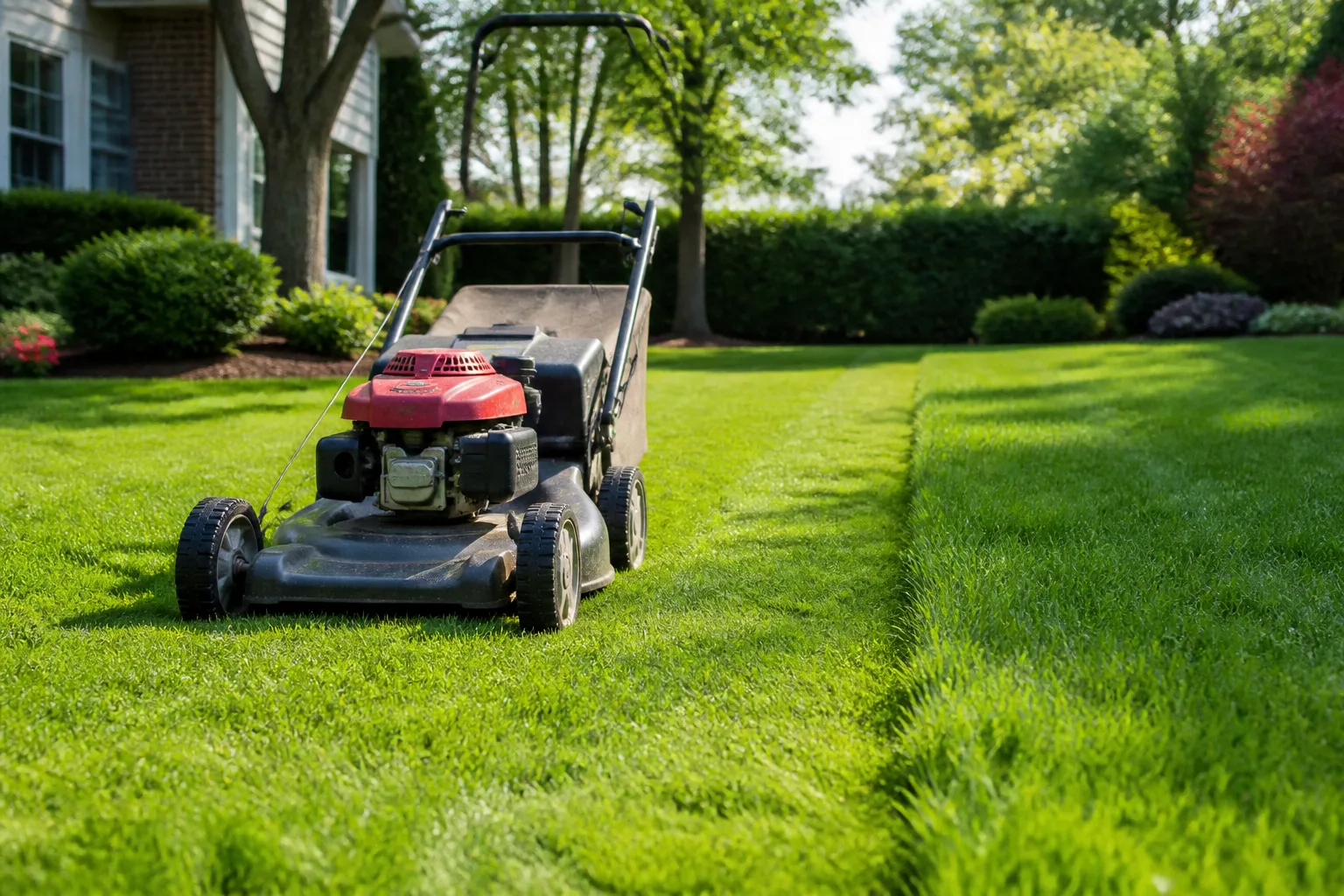
Scalping removes the leaf area the plant uses to make energy and exposes the soil surface to heat and weed-seed germination. Penn State Extension describes the one-third rule as a useful boundary and reports that increasing mowing height can reduce weed pressure, increase root depth, and help turf tolerate heat and drought. It also recommends keeping blades sharp and returning clippings when they are not clumped.
Set the mower higher during stressful weather rather than trying to create a golf-course finish. The correct height depends on the grass species, but removing no more than one-third of the blade at a time is a safer starting point than cutting whenever the lawn looks long. If you have been mowing very short, raise the deck gradually and give the grass time to rebuild leaf area.
Water deeply and measure the output
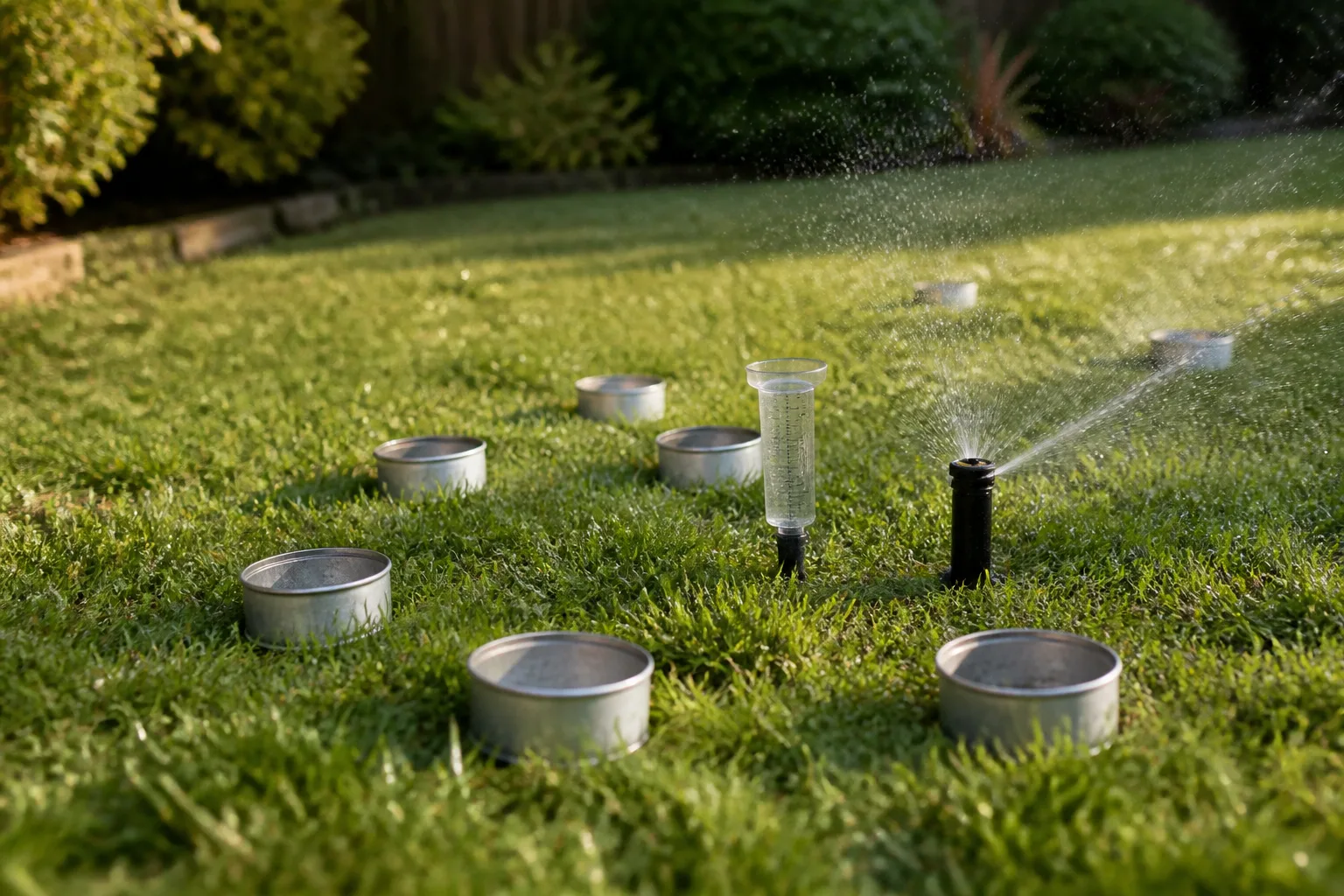
A lawn can be brown after watering because the sprinkler misses it, the soil repels water, the root zone is compacted, or the grass is being watered too lightly and too often. Runoff from a slope is not the same as water reaching the roots. Measure irrigation with straight-sided cans or gauges placed across the lawn, then adjust the cycle so coverage is reasonably uniform.
Water in the morning when practical, and let the root zone begin to dry before irrigating again rather than following a rigid daily timer. Combine rainfall and irrigation, and adjust for grass type, soil, shade, heat, and local restrictions. Lawn Guru’s lawn-watering guidance is useful for the practical principle that irrigation time varies by system; measuring output is more dependable than copying a neighbor’s minutes.
Feed according to the test and grass type
Fertilizer should answer a demonstrated need. A soil report can prevent you from adding phosphorus or potassium that the lawn already has, while a seasonal plan helps match nitrogen to the grass’s growth pattern. Never treat “green” as the only success measure: a lawn that grows rapidly but develops shallow roots or disease is not moving in the right direction.
Use a spreader calibrated to the product, sweep granules off hard surfaces, and avoid overlapping passes. If you are correcting magnesium or sulfur, use the amendment the test recommends; if you are correcting iron, use iron; if you are correcting nitrogen, use a complete lawn program suited to the turf. Epsom salt is a nutrient source, not a substitute for a balanced lawn-fertility plan.
Improve soil air, light, and competition
Dense turf needs a site where roots can breathe and leaves can receive enough light. Thin strips beneath trees may not be fixable with fertilizer if the grass species is not shade tolerant. Heavy foot traffic can keep the soil compacted, while thick thatch or a shallow topsoil layer can block seed-to-soil contact.
Core-aerate compacted soil when the grass is actively growing, correct drainage or grading problems, and manage traffic during establishment. Prune or remove vegetation only when it is safe and appropriate; do not damage valuable trees to force a lawn into deep shade. If the site is persistently too shady or dry, a groundcover, mulch bed, or better-adapted grass may be more successful than repeated amendments.
For truly bare areas, overseed or patch with a grass species and cultivar suited to the site. Prepare the surface, provide seed-to-soil contact, keep the seedbed evenly moist until germination, and protect it from traffic. A new plant is what makes a lawn thicker; Epsom salt cannot replace that step.
When Epsom salt is the wrong fix
Skip Epsom salt when you have not tested the soil, when the report shows adequate magnesium and sulfur, or when the problem clearly follows poor irrigation, shade, traffic, drainage, disease, or mowing. Skip it as a pH cure as well: the amendment does not replace a liming recommendation or a correction for alkaline soil.
Be especially cautious with a lawn beside a pond, storm drain, stream, or shallow well. Magnesium and sulfate are not harmless simply because the product is sold for baths or labeled natural. Repeated soluble-salt applications can move off-site or change the balance around roots, and a stressed lawn is the wrong place to experiment with high rates.
The common online rates are another warning sign. One article may suggest a foliar spray, another a dry application, and another a recurring soil drench. When recommendations disagree and none is tied to your soil report, grass type, product label, and weather, the responsible answer is to pause and test—not to choose the biggest dose.
Conclusion
Epsom salt can make a lawn greener in the limited situation where magnesium or sulfur deficiency is genuinely holding the turf back. It does not make every lawn thicker, it does not supply iron or nitrogen, and it cannot repair poor drainage, shallow watering, scalping, shade, compaction, or missing grass plants.
Start with a representative soil test, read the report as a whole, and make one targeted correction. Then protect the result with higher mowing, measured deep watering, grass-appropriate fertility, better root-zone conditions, and reseeding where density is missing. That is slower than scattering a household salt, but it is far more likely to give you a lawn that is green because it is healthy—not merely green for a week.



