Fruit Tree Winter Care: An Orchard-to-Backyard Guide
An orchard-minded winter plan for apples, pears, peaches, plums, and cherries, with clear advice on pruning, vole guards, mulch, water, and soil.
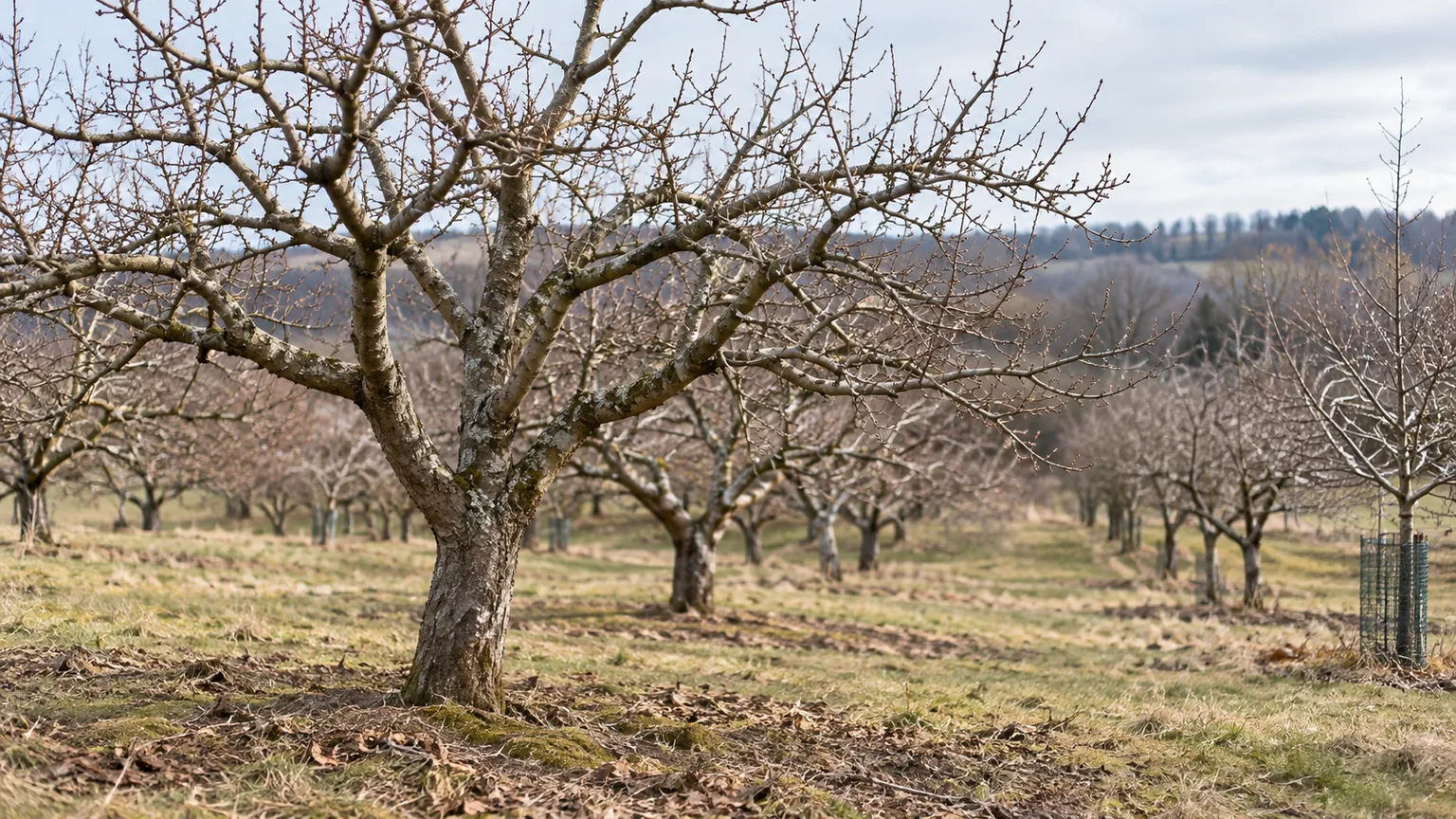
Winter gives you a clear view of a fruit tree’s structure, but dormancy does not make every tree a pruning project. The most useful routine is to inspect first, protect vulnerable trunks and roots, clean up disease sources where they matter, and prune only when the species and weather make it appropriate. Apples, pears, peaches, plums, and cherries do not all follow the same calendar.
For a small home orchard, focus on five things: look for animal damage, keep the trunk base visible, remove fruit or leaves linked to recurring disease, make modest species-appropriate cuts, and use soil tests rather than guessing at amendments. If your trees are healthy and established, winter care may mostly mean monitoring and planning—not doing more work.
What winter care can—and cannot—do
Winter care is about reducing avoidable stress and setting up sound spring growth. You can protect young bark, limit some overwintering disease sources, remove a dangerous broken limb, and improve a crowded canopy when the tree is fully dormant and the species can be pruned then. You cannot make an unhealthy tree productive in one dormant season, reverse root damage with mulch, or guarantee a crop by cutting more wood.
The right amount of work depends on the tree’s age, species, rootstock, training shape, local climate, and last year’s growth. A newly planted tree may need a guard and reliable moisture more than structural pruning. A mature apple may need selective thinning, while a plum may be better left alone until its safer pruning window. Start with the tree in front of you, not a generic winter checklist.
Start with a winter tree walk-through
Walk each tree after leaf fall and again after major storms. Look from the trunk outward: check the root flare, bark, branch unions, canopy outline, and soil surface. Note which branches are dead, rubbing, crossing through the center, hanging low, or newly broken; then decide whether any cut is urgent or can wait for a species-appropriate pruning window.
Check the ground for gnawed bark, vole runways, burrow openings, dropped or shriveled fruit, standing water, and grass or mulch touching the trunk. Mark a tree that performed poorly last year, but do not assume the cause was winter injury. Poor fruiting can come from shade, pollination gaps, late frost, biennial bearing, excessive vigor, drought, disease, or a tree that has not yet reached bearing age.
Read bark, buds, and canopy before making cuts
Dormant buds are firm and closed; swelling buds signal that growth is getting closer. That cue helps you schedule pruning, but it is not a universal “cut now” signal: species and training systems differ. Also check bark for fresh chewing, cracks, sunken patches, or a tight wrap cutting into the trunk. A little lichen on bark is not itself a diagnosis of disease, and pruning every branch with surface growth is not a winter-care plan.
Take a few photos from the same angle each winter. They make it easier to see whether the canopy is becoming more crowded, whether a guard needs to be adjusted, or whether a branch problem is actually getting worse. For a single tree, that simple record is often more useful than trying to remember how it looked before leaves hid the structure.
Protect young trunks from mice, voles, rabbits, and deer
Young trees have thin bark and a small trunk circumference, so chewing can remove a large share of the living tissue. Voles may feed at or below the soil line and beneath snow; rabbits usually browse above ground, while deer can reach higher shoots and rub trunks. Penn State Extension’s orchard vole guide notes that vole injury is often most severe in winter, when other food is scarce, and that snow cover can let meadow voles feed higher on trunks than expected.
Fit a guard before snow arrives if animals have been active nearby. A mesh cylinder or purpose-made tree guard should surround the trunk without rubbing it, leave room for several years of growth, and extend above the height animals can reach—including the expected snow line. For vole protection, Penn State describes hardware cloth with small openings set several inches into the soil and extending above anticipated snow depth; the exact height and installation depend on local snow and animal pressure. Check the guard during winter and loosen or enlarge it as the trunk grows.
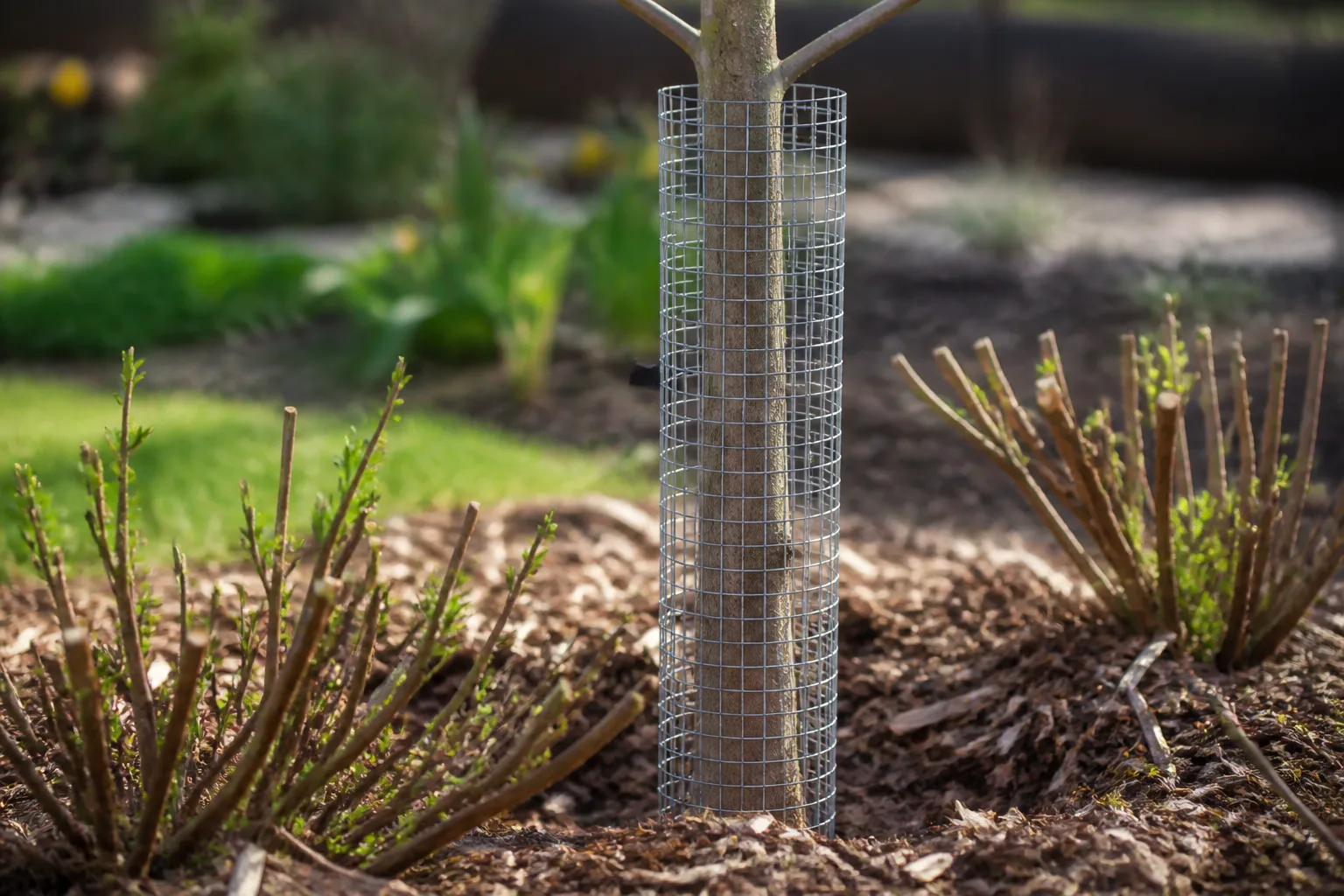
Match the guard to the animal and expected snow depth
A loose plastic spiral may be convenient against rabbit chewing, but it is not a substitute for a vole barrier that reaches below ground. A trunk sleeve can also trap moisture or hide damage if it stays on too long or fits tightly, so follow its maker’s directions and inspect beneath it periodically. Where deer are the problem, a short trunk wrap will not protect the crown; a properly sized cage or fence is more dependable than expecting a young tree to outgrow browsing.
Do not rely on scent repellents as the only protection when bark damage would kill the tree. If you use any repellent or pesticide, choose a product labeled for that site and crop, follow its current directions, and keep it away from edible portions unless the label allows use. In a small yard, a correctly placed physical barrier plus monitoring is usually the simpler first step.
Manage the orchard floor without creating rodent cover
Grass and dense thatch right against trunks give voles food and cover close to the bark. Penn State Extension’s orchard vole guide recommends keeping ground cover low and maintaining a vegetation-free zone around trunks in orchard settings; it also warns against allowing mulch, prunings, or decaying vegetation to pile at tree bases. In a home orchard, mow or trim carefully, remove tangled clippings, and keep the trunk area visible enough to inspect.
This does not mean scalping the entire orchard or removing every plant between trees. A low, managed cover can support soil structure and access, while a clear ring around each trunk makes it harder for rodents to hide at the point of greatest risk. If you use wood chips or other mulch, keep the material away from the bark and avoid leaving a thick thatch layer under it. Pick up windfalls and mummified fruit rather than letting them accumulate beneath the canopy.
Remove diseased leaves and fruit selectively
Sanitation matters most when a tree has a history of a disease that survives in fallen material. Apple scab is a clear example: Penn State Extension’s apple scab review explains that the fungus overwinters in infected apple leaves on the ground and releases spores as spring approaches. If scab was a recurring problem, remove infected leaves or shred them thoroughly so they break down faster; collect and dispose of severely diseased debris according to local guidance. This reduces one source of inoculum, but it does not replace resistant cultivars, good airflow, or a locally appropriate disease-management plan.
If your apple trees were clean, there is no need to treat every fallen leaf as hazardous waste. Healthy leaf litter can decompose and return organic matter to the soil. Remove fruit mummies, diseased twigs, and obvious problem material; leave sound leaves where they do not smother grass, block access, or create rodent shelter. Keep the distinction clear: targeted sanitation is useful, while indiscriminate cleanup adds work without solving a diagnosed problem.
Prune by species and dormancy, not by calendar alone
The main reason to prune a deciduous fruit tree in dormancy is visibility: without leaves, you can see its framework and identify crossing or damaged wood. But “winter” spans a long period, and a warm spell does not mean every species is ready for a major cut. Prune on a dry day when the tree is dormant and the forecast does not call for an immediate severe freeze; delay if wood is wet, the tree is stressed, or you are unsure of its type.
BBC Gardeners’ World Magazine’s winter-pruning guide also frames winter pruning around the needs of individual plants, noting that some woody plants belong in a different season. That is a useful rule for a mixed orchard: identify each tree before you schedule the saw, and do not infer timing from the fact that its neighbor is leafless.
Apples and pears need a light, open framework
Established free-standing apples and pears are commonly pruned during dormancy, after leaf fall and before bud break. The RHS winter-pruning guide for apples and pears recommends maintaining a well-spaced, open crown for light and airflow and notes that routine winter pruning should remove about 10–20 percent of the canopy; the right amount still depends on vigor and the tree’s current structure. The goal is not to expose the center by stripping every branch, but to keep a balanced framework and enough fruiting wood for the next crop.
Young apple and pear trees are a separate case. Their early pruning establishes scaffold branches, so follow the planting and training system rather than applying the mature-tree routine. Likewise, cordons, espaliers, fans, and other restricted forms may need summer pruning as well as winter work. If you cannot identify the training form or cultivar, remove only clearly dead, broken, or diseased wood and get a local pruning reference before reshaping the tree.
Stone fruit needs its own timing
Do not transfer the apple schedule to plums, cherries, peaches, or apricots. Stone-fruit timing varies by species, cultivar, climate, and disease pressure; for example, the RHS plum-pruning guide advises pruning plums in early spring or midsummer rather than winter to reduce the risk of silver leaf disease. Some regions have different recommendations, so use your local extension service’s guidance for the exact species and local conditions.
For peaches and nectarines, check a regional guide for the window that balances cold injury and disease risk; their fruiting wood and renewal needs differ from apples. Cherry and plum trees may also have particular disease concerns around pruning cuts. If a stone-fruit tree needs an immediate safety cut after a storm, remove the broken hazard cleanly, then leave routine shaping until the recommended season. A few weeks’ wait is usually better than making a large cut at the wrong time.
Make clean cuts without over-pruning
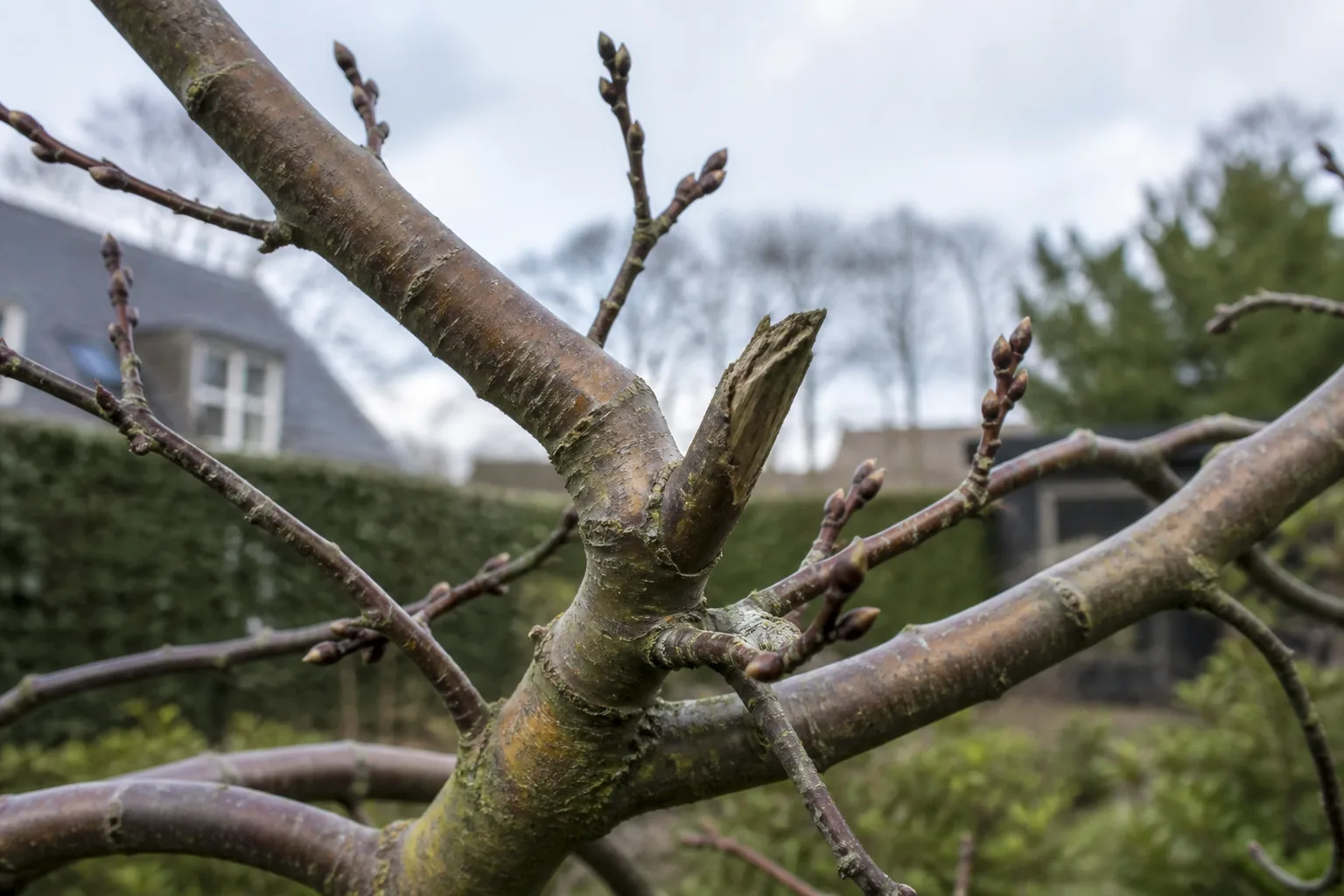
Begin with dead, damaged, diseased, and crossing branches. Remove a branch at its natural collar rather than cutting flush against the trunk or leaving a long stub. For a small branch, make a clean cut just outside the branch collar; for a heavy limb, use a three-cut method so its weight does not tear bark as it falls. Sharp bypass pruners, loppers, and a pruning saw each have a limit—do not twist a small tool through wood it cannot cut cleanly.
Next, open a little space where branches rub or grow inward, and remove vigorous upright water sprouts only when they interfere with the tree’s structure. Keep well-placed laterals and fruiting spurs. A common mistake is to remove too much of the top because a tree looks tall; that can trigger a flush of upright growth and create more shade and pruning work. If the tree needs major size reduction, spread renovation over several years or ask a qualified arborist or fruit-tree specialist to assess it.
Before cutting a large branch, trace it to its attachment and identify the branch collar—the slight swelling where the branch meets the trunk or a larger limb. A clean cut just beyond that collar preserves the tree’s natural wound response better than a flush cut. Avoid removing the central leader of a tree trained to one, and avoid shortening every branch tip: both choices can change the shape and vigor you were trying to improve.
Use a three-cut sequence on a heavy limb: make a small undercut a short distance out from the collar, make a second cut farther out to remove the branch’s weight, then remove the remaining stub just outside the collar. That prevents the falling limb from peeling bark down the trunk. If the branch is overhead, too thick for your saw, or beyond safe ladder reach, stop and hire help rather than improvising from a ladder.
Mulch roots while keeping the trunk clear
Organic mulch can moderate soil temperature, conserve moisture, and reduce competition from grass, but depth and placement matter. Penn State Extension’s tree-mulching guidance advises a layer around 2–4 inches for landscape trees, using less for poorly drained soil or fine-textured material, and keeping mulch off the trunk so the root flare remains visible. Spread it over as much of the root zone as is practical; do not pile it into a cone or “volcano” against the bark.
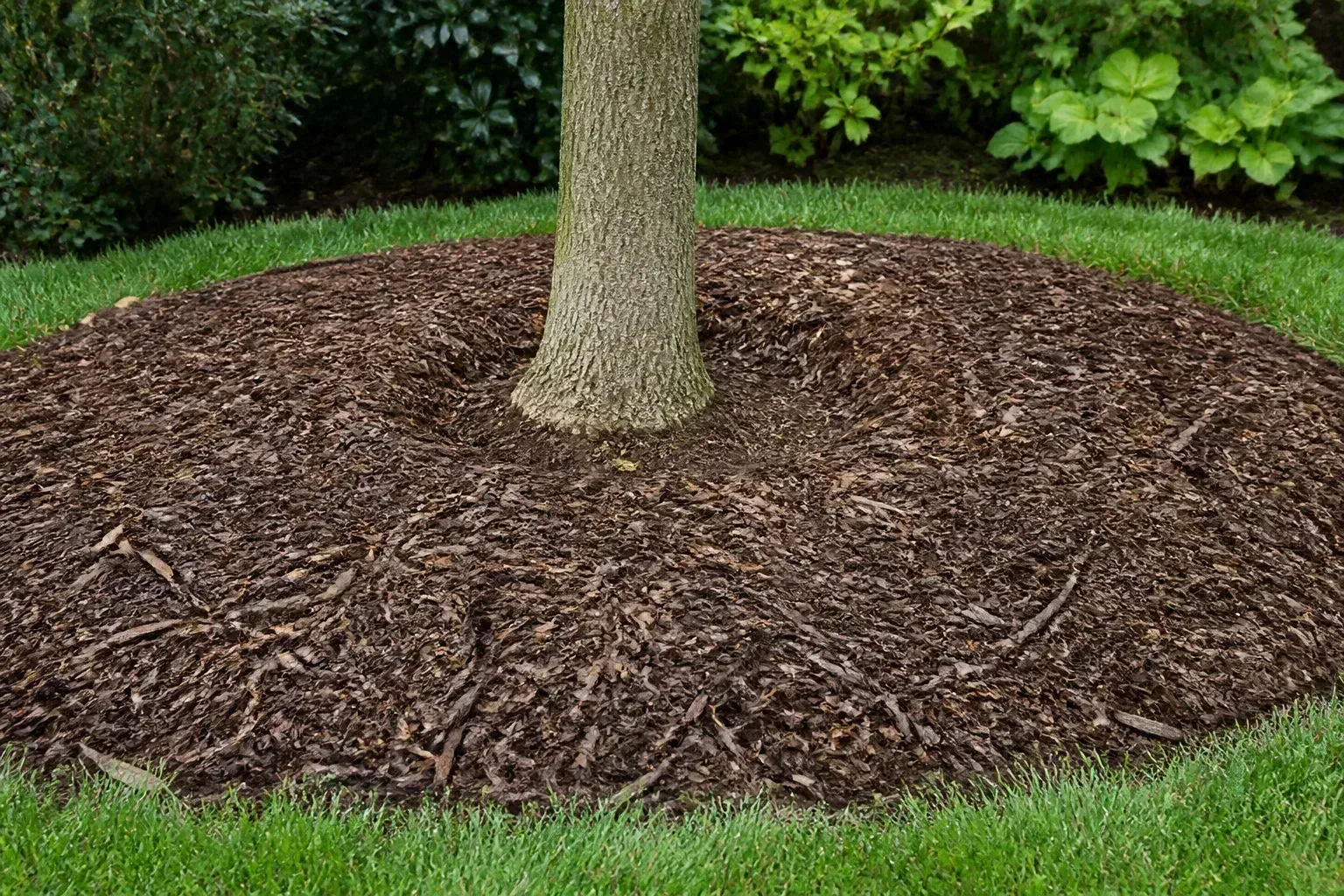
For fruit trees, balance that root-zone benefit against vole habitat. Keep a visible, low-cover ring at the trunk and make sure no mulch touches the bark; the cleared area may be wider where voles are common. Do not add a fresh layer automatically each year. Measure what is already there, pull back material that has drifted onto the trunk, and top up only where the layer has thinned.
Water during dry winter spells
Dormant trees still need living roots, but winter watering is conditional. If rain or snow has kept the soil moist, additional water is unnecessary. If the soil is dry during a prolonged mild spell and is not frozen or waterlogged, give the root zone a slow, deep soak before the ground freezes again. Raintree Nursery’s winter-care notes for orchards likewise frame pre-freeze watering around low rainfall and dry soil, rather than as a fixed monthly task.
Avoid frequent shallow watering, which wets only the surface, and avoid saturating heavy soil that drains poorly. Container trees need closer checks because their potting mix can dry faster and the root ball is more exposed to cold than roots in the ground. Water early enough in the day for excess to drain, and never leave a pot standing in a saucer of ice or water.
To check an in-ground tree, move mulch aside and feel the soil several inches below the surface in more than one spot near the outer canopy. If it is cool and lightly moist, wait; if it is powder-dry and rainfall has been scarce, water slowly over the root zone rather than pouring against the trunk. A frozen surface or a saturated planting hole is a reason to pause, not to add more water.
Test soil before adding lime or fertilizer
Winter is a useful time to plan a soil test and collect samples when the ground is workable. Follow the laboratory’s sampling instructions, take soil from several spots in the root zone, and keep samples from different beds or orchard blocks separate if their conditions differ. A test can tell you whether pH or nutrient levels call for an amendment; it cannot diagnose every root or disease problem.
Do not add lime because a neighbor’s apples responded well to it, or spread a high-nitrogen fertilizer because the tree had a light crop. Too much nitrogen can push vegetative growth at the expense of a balanced canopy and may delay hardening in regions with cold winters. Wait for the soil report and your local fruit-tree recommendations, then apply only what the report calls for at the right season. If a tree is weak, check drainage, light, trunk injury, and root competition before assuming it needs feeding.
Plan for snow, freeze, and sunscald protection
After a storm, inspect young trees for split limbs, bent leaders, guards pressed into bark, and snow packed above a guard. If snow is loose and heavy on a small branch, brush it away gently from below without shaking the tree. Do not strike icy limbs: brittle wood can snap, and knocking ice off can create more injury than waiting for a thaw. Prune a torn limb only when you can make a safe, clean cut from stable ground.
Young or thin-barked trunks may also be vulnerable to sunscald where bright winter sun warms bark and a sharp temperature drop follows. Use a breathable, purpose-made trunk wrap only where local conditions or past injury justify it, fit it loosely, inspect beneath it, and remove or adjust it according to the product instructions. A wrap is not a universal requirement, and it cannot correct poor planting depth, a damaged trunk, or a site with repeated frost pockets.
Decide when a tree needs repair, renovation, or removal
A broken limb, trunk girdling, and progressive dieback are different problems. Small dead twigs can often wait for routine pruning; a cracked limb over a path, driveway, or play area needs prompt attention from a professional if it cannot be reached safely. If bark has been chewed most of the way around a young trunk, document the injury and ask a local extension office or arborist whether the tree can recover. Do not assume wound paint will restore missing bark.
Low fruit production alone is not a reason to remove a tree in winter. Check its age, flowering, pollination partner, sun exposure, late-frost history, vigor, and pruning pattern first. A mature, crowded tree may be renovated gradually; a dead, structurally unsafe, or severely diseased tree may need removal, but confirm the diagnosis before you disturb a tree that could still recover. If trees are simply crowded, compare the cost of removal with the long-term light and access the remaining trees would gain.
Adjust care for containers and mild-winter climates
In-ground roots have more insulation than roots in a pot, so container fruit trees can need extra protection even when the same cultivar is hardy in the ground. Move a dormant deciduous tree to a sheltered, unheated place if the pot is exposed to severe cold, insulate the container, and keep the root ball from drying out. Do not move a tree into a heated living room simply to protect it; warm indoor conditions can disrupt dormancy and encourage weak growth.
In a mild-winter region, the calendar may not deliver a long, obvious dormant period. Use leaf drop, bud stage, and local chill requirements as cues, and choose varieties suited to your climate. In warm climates, deciduous fruit trees may not behave like apples in colder regions, and citrus or evergreen fruit trees have different needs altogether. Check species-specific advice before wrapping, pruning, or withholding water based on a cold-climate routine.
A winter-to-spring orchard checklist
Before the ground freezes, check moisture, install or inspect young-tree guards, clear windfalls, and finish any species-appropriate fall sanitation. During dormancy, walk the orchard after storms, keep mulch away from trunks, monitor vole signs, and make only the pruning cuts that match each tree’s species and training form. Record which trees need a soil test, a pollination partner, or a closer disease inspection once growth resumes.
As spring approaches, recheck guards for rubbing and height, remove any winter wrap according to its directions, and finish apple or pear pruning before buds open if that is the recommended window in your area. Leave stone-fruit pruning for its own locally advised season. Keep a brief record of cuts, weather injury, flowering, and harvest; it helps you avoid repeating a treatment that did not solve the problem and makes next winter’s decisions faster.
Keep the notes simple: tree name or location, dates of pruning, unusual weather, visible disease, and whether the guard stayed clear of the bark. After bloom, add whether flowers set fruit and whether nearby compatible varieties bloomed at the same time. A short record can separate an actual winter problem from poor pollination, late frost, or an alternate-bearing year.
Conclusion
The best winter routine is selective: protect vulnerable trunks, keep the orchard floor inspectable, remove disease-linked debris, and prune only when the species and weather make it a sound choice. Apples and pears often benefit from dormant-season structural pruning, while plums and other stone fruits may need a different window. Use local guidance where climate and disease risk change the answer.
For each tree, ask three questions before reaching for a tool: Is there damage that needs attention now? Is this species safe to prune in this season? Will the job solve a real problem? When the answers are clear, winter work stays focused—and the tree can enter spring with its bark, roots, and useful branches intact.



