6 February Pruning Mistakes and How to Avoid Them
February pruning can help or hurt. Use this practical guide to match timing to bloom wood, protect branch collars, choose tools, and repair mistakes.
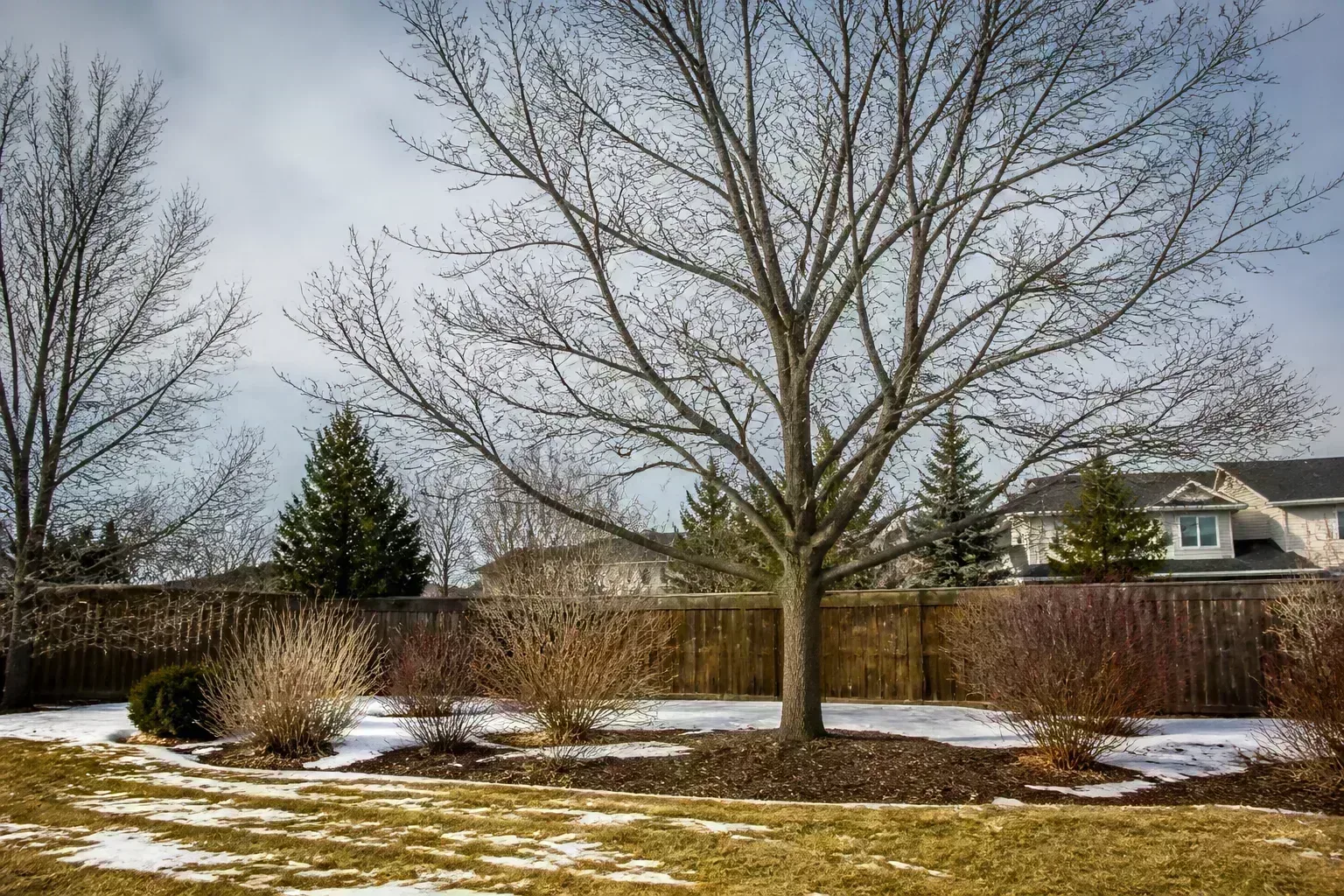
February is a useful pruning month in many cold-winter gardens, but it is not a permission slip to cut every leafless plant. A dormant apple tree, a panicle hydrangea, and a lilac may all look like bare collections of branches; biologically, they are carrying very different plans for spring.
The safest approach is to make February pruning a short decision process: identify the plant, decide why you are cutting, check whether it is dormant, then remove the least amount of live wood that solves the problem. That sequence protects flower buds, stored energy, branch structure, and your own safety.
The February pruning test: plant first, calendar second
Late winter is often a good window for deciduous trees and shrubs because the structure is visible and the plant has not yet invested in a full flush of leaves. Empress of Dirt describes the useful window as roughly four to six weeks before spring thaw, but that window moves with climate and species; February in a mild coastal garden is not the same as February in a late-freezing mountain garden. Empress of Dirt’s late-winter pruning guide is a helpful seasonal reference, but your plant’s buds and local forecast still get the final vote.
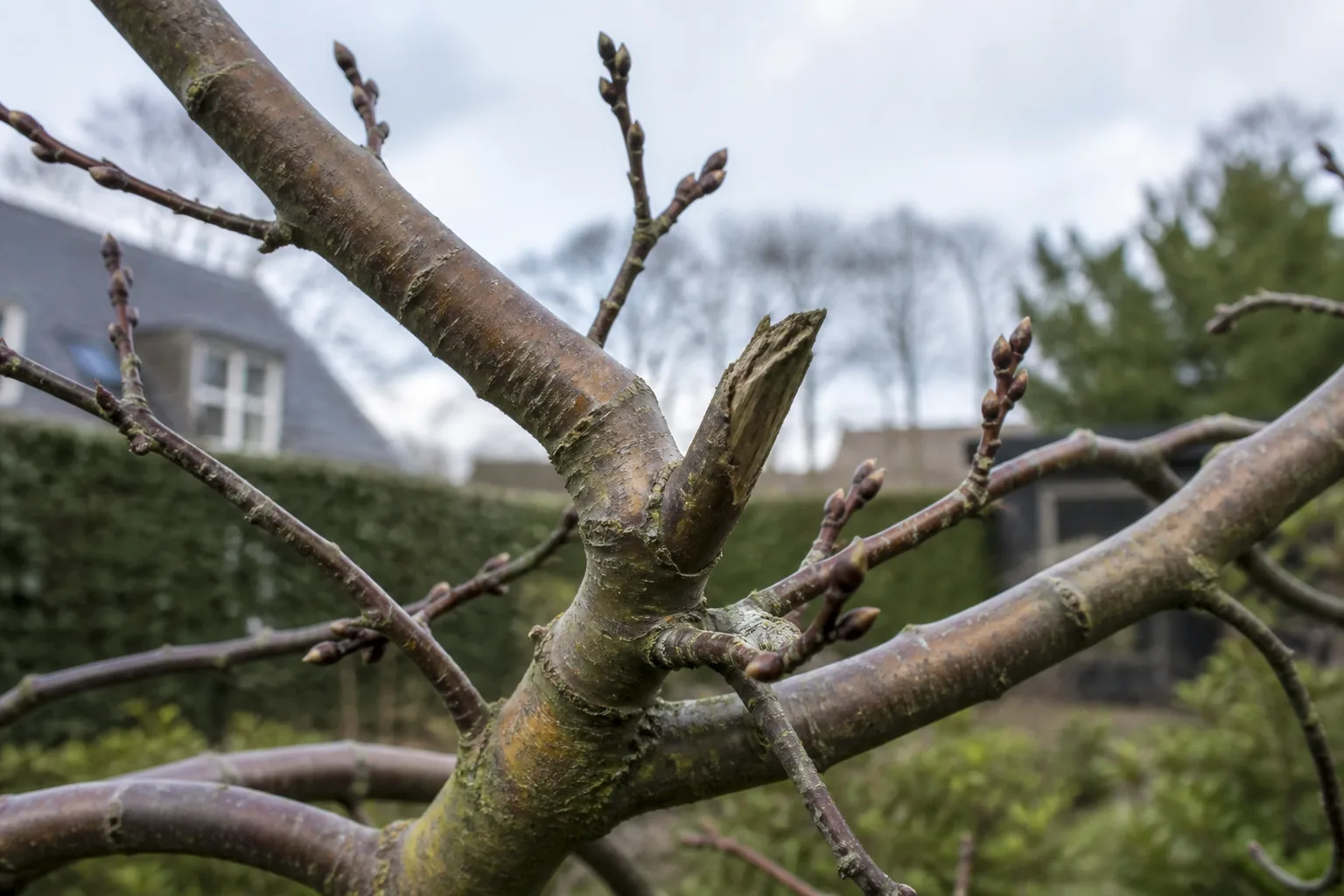
Before making a cut, ask four questions. What is the plant? What am I trying to change? Is the plant dormant? Will the next few days be dry and free from a hard freeze? If you cannot answer the first question, postpone live-wood pruning and identify the plant; a generic winter rule cannot resolve cultivar-level exceptions.
Identify the plant and its bloom wood
The most useful identification is not just a common name. Note whether the plant is a deciduous tree, an evergreen, a cane-forming shrub, a grafted ornamental, or a fruiting plant, then find out whether it blooms on old wood or new wood. Old wood means stems produced during the previous growing season; new wood means growth produced during the current season.
That distinction changes the consequence of a February cut. A spring-flowering lilac has already placed much of its flower display on last year’s twigs, while a summer-flowering butterfly bush or panicle hydrangea will produce its important flowering shoots after the pruning window. If a label or reliable plant profile is unavailable, make only sanitation cuts until you can verify the habit.
Check dormancy, soil, and weather before cutting
Dormancy is a plant condition, not a date. A leafless tree with tight buds may still be dormant; a tree with swelling buds, unfolding leaves, or active new growth is moving out of that window. In warmer regions, February may already be too late for some plants even though the calendar says winter.
Choose a dry day when branches are not wet and the ground is firm enough to stand on without compacting saturated soil. A dry, above-freezing window is a practical target, but do not prune just before a hard freeze or during a stormy period when cut branches and falling tools become harder to control. If the only urgent work is a broken limb hanging over a walkway, make the area safe from the ground and call for help rather than forcing a full pruning session.
Mistake 1: Pruning toward a shape instead of a purpose
The first mistake happens before the blades touch wood: deciding that a plant needs to look tidier, smaller, or more symmetrical without naming the problem. Pruning is a tool for a purpose—removing a hazard, improving clearance, correcting a weak structure, opening a congested canopy, renewing old shrub stems, or improving fruit and flower production—not a seasonal haircut that every plant must receive.
Penn State Extension’s tree-pruning framework frames pruning around structure, risk, clearance, health, density, restoration, and size management. That matters because the same cut can be sensible for one objective and damaging for another: removing a low branch for a walkway is different from thinning a canopy until only foliage at the branch ends remains.
Use a three-pass inspection before you cut
Start with a sanitation pass. Mark dead, broken, diseased, cracked, hanging, or rubbing branches, and look for suckers at the base and water sprouts inside the crown. Do not begin shaping until you have decided which of those pieces truly need to come out.
Next make a structure pass. Look for branches that cross, rub, grow inward, compete with a central leader, or attach at a weak, narrow angle. Step back and view a tree from all sides; a branch that looks wrong from the patio may be the one that balances the crown from the street.
Finish with a purpose pass. If the plant is healthy and the only goal is to make it shorter, stop and reconsider. A shrub that is permanently too large for its space may need a smaller cultivar or replacement, and a mature tree that has outgrown a roofline usually needs a qualified tree professional rather than a homeowner’s ladder and pole saw.
Mistake 2: Cutting spring-flowering shrubs before they bloom
February is exactly when many gardeners can see the branch structure of lilac, forsythia, weigela, deutzia, quince, early spirea, azalea, and some viburnums. It is also when those stems may be holding the flower buds that will open in the next few weeks. Cutting them now can produce a healthy-looking shrub with a disappointing spring display.
Colorado State University Extension explains the pattern clearly: spring-flowering shrubs generally bloom on one-year-old wood, while summer-flowering shrubs bloom on new growth produced earlier in the current season. Its list includes lilac and forsythia among old-wood bloomers and butterfly bush, potentilla, Japanese spirea, smooth hydrangea, and panicle hydrangea among common new-wood bloomers. CSU Extension’s guide to pruning flowering shrubs is useful when a plant’s bloom habit is uncertain.
| Plant habit | What the buds are using | February decision |
|---|---|---|
| Old-wood bloomer | Last year’s stems | Remove only dead or hazardous wood; do major pruning right after flowering. |
| New-wood bloomer | Stems that grow this season | Prune while dormant if the plant and climate are suitable. |
| Evergreen or marginally hardy plant | Live foliage and stems exposed to cold | Avoid hard winter cuts; wait for active spring growth unless damage is urgent. |
| Fruit tree | Species-specific buds and fruiting wood | Use the cultivar’s dormant-pruning guidance; do not assume every stone fruit has the same safe window. |
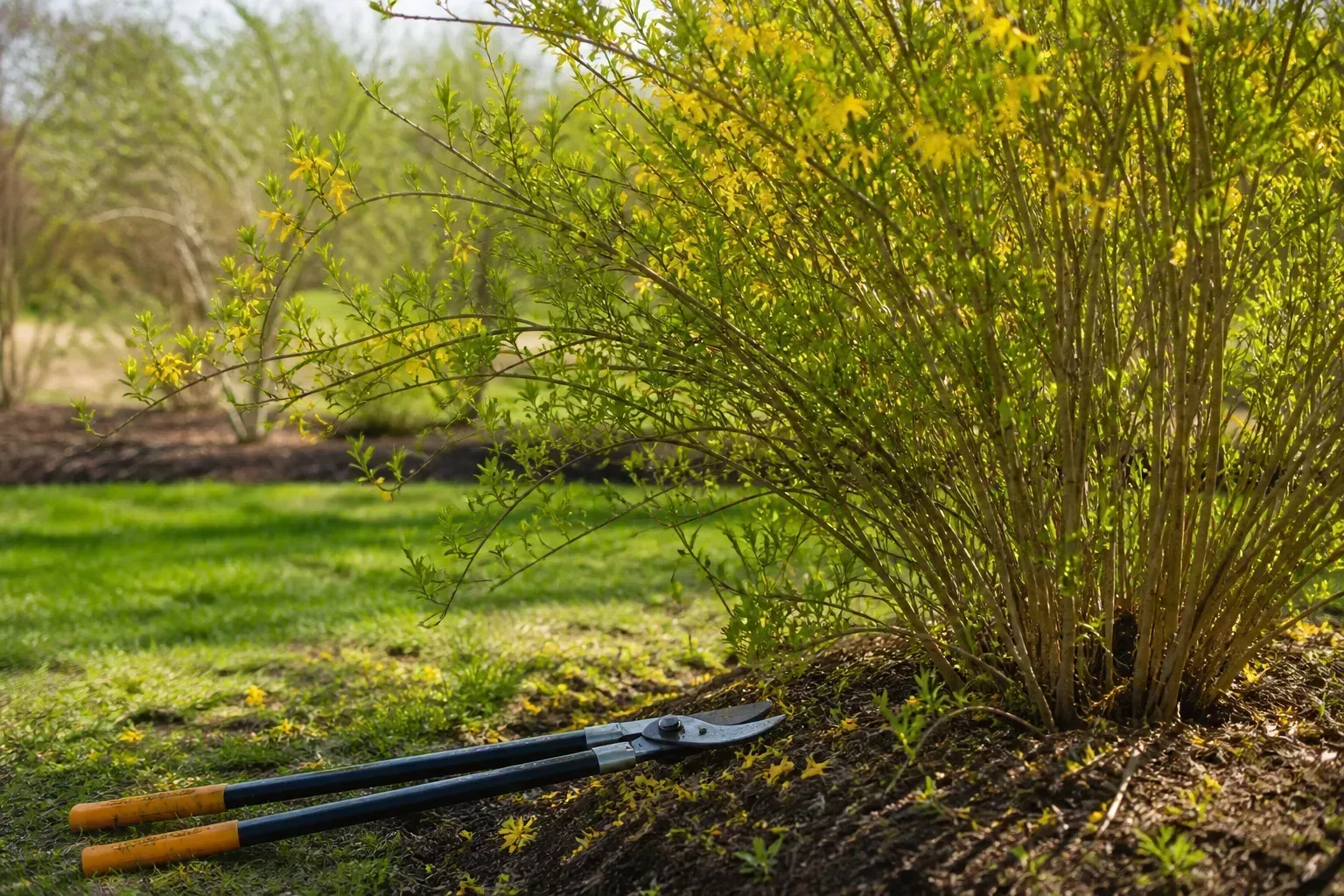
The better rule is prune spring bloomers immediately after their flowers fade, when you can remove older, unproductive stems and still give new shoots time to form next year’s buds. If a lilac has a dead or storm-broken branch in February, remove that branch; losing one damaged stem is not the same as shearing away the entire flowering framework.
There is one important exception to the “never cut before bloom” idea: health and safety can outrank this year’s flowers. A diseased branch that threatens the rest of the shrub, a split limb, or a branch that is already failing should not be preserved just to protect a display. Make the smallest appropriate cut, clean tools before moving to another plant, and accept that the shrub may bloom less this season.
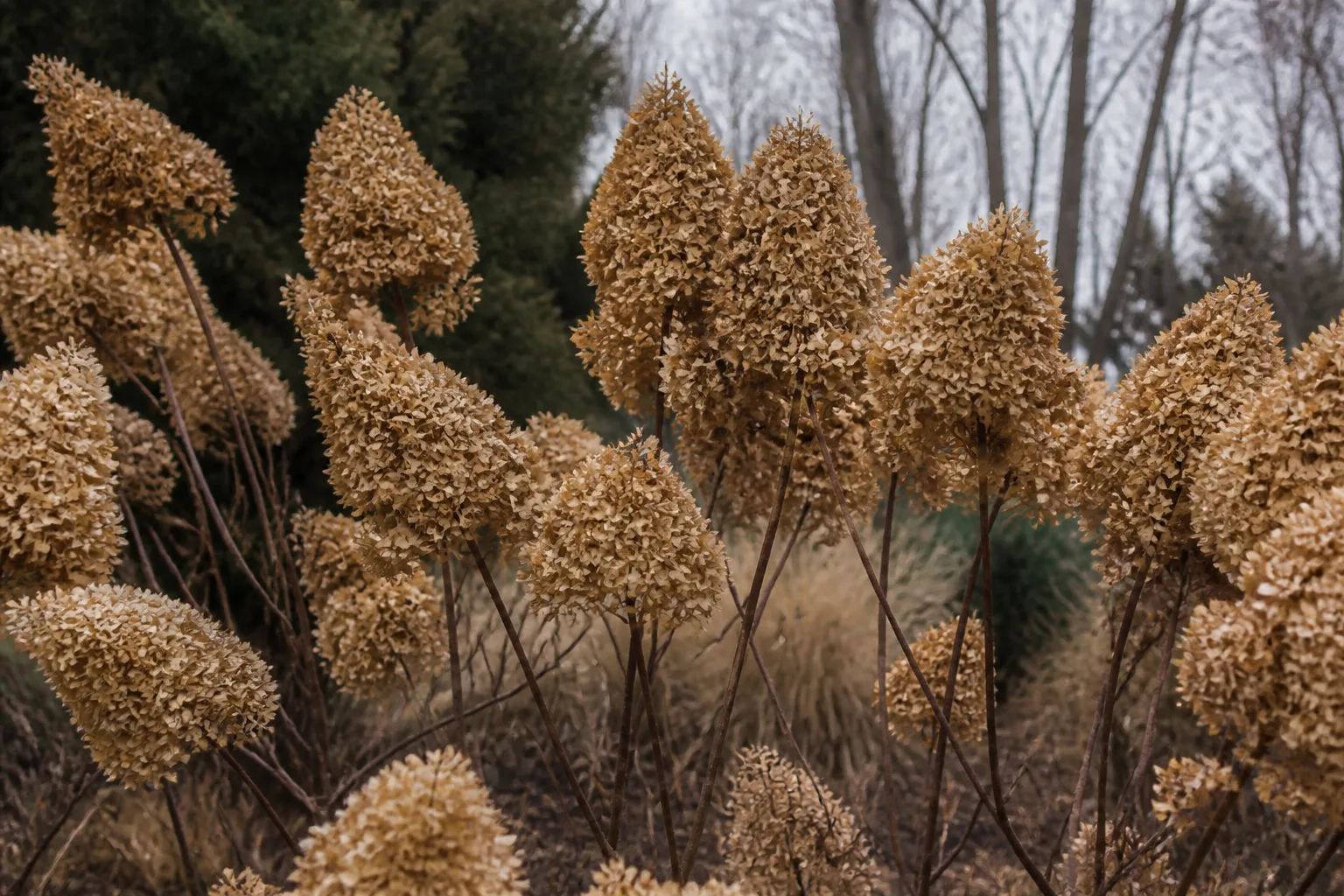
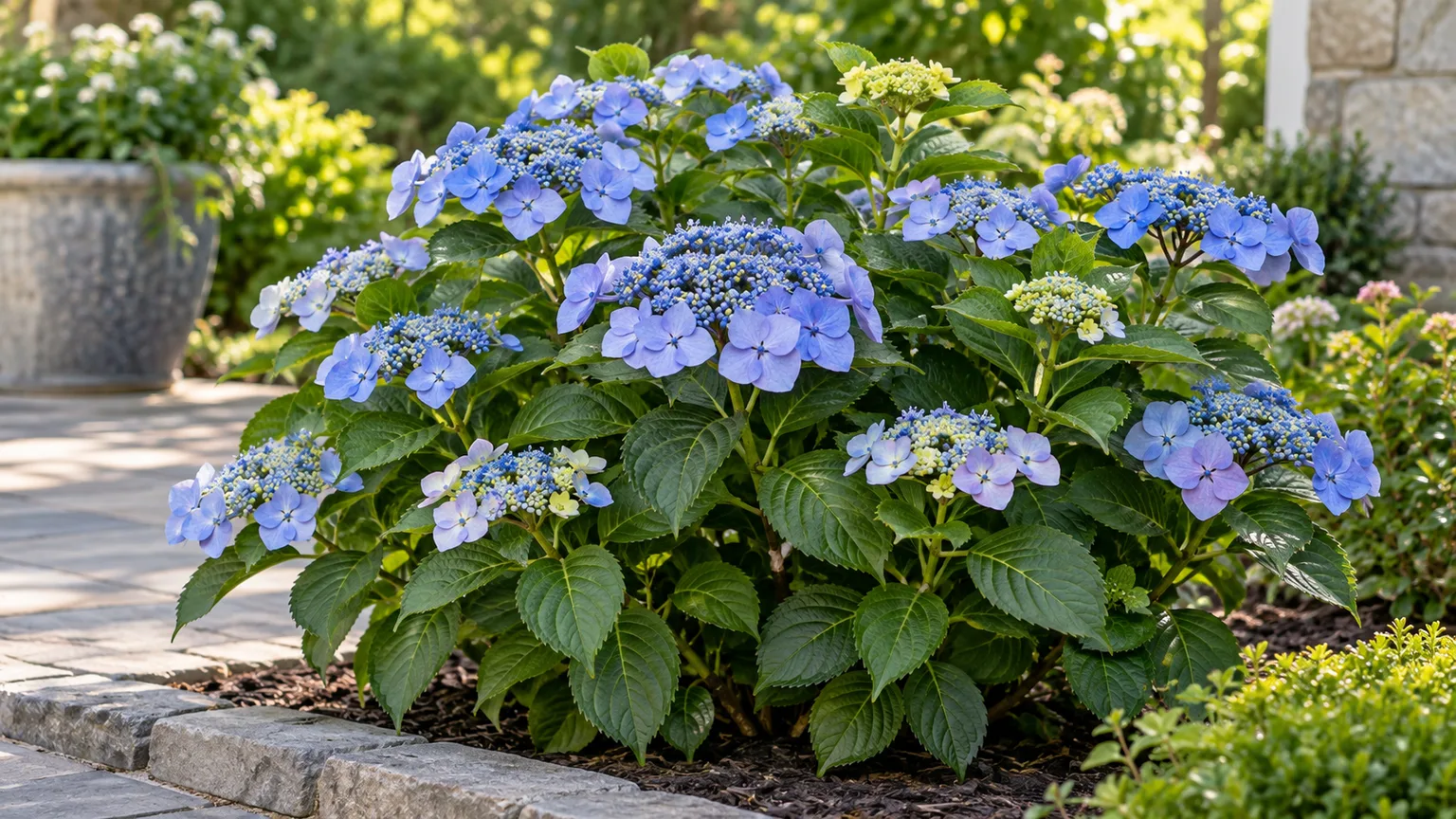
Hydrangeas are a common source of confusion because panicle and smooth hydrangeas flower on new wood, while bigleaf and oakleaf hydrangeas usually flower on old wood. Treating every hydrangea alike is a fast way to remove next summer’s buds from a bigleaf plant while under-pruning a panicle type that could have handled a dormant reduction.
Mistake 3: Using dirty, dull, or mismatched tools
A clean cut begins with a tool that can make one. Dull blades crush and tear bark, while dried sap and rust make it harder to control the cut. The damage is not only cosmetic: a ragged wound takes longer to close and a dirty blade can move spores or bacteria from a diseased branch to healthy wood.
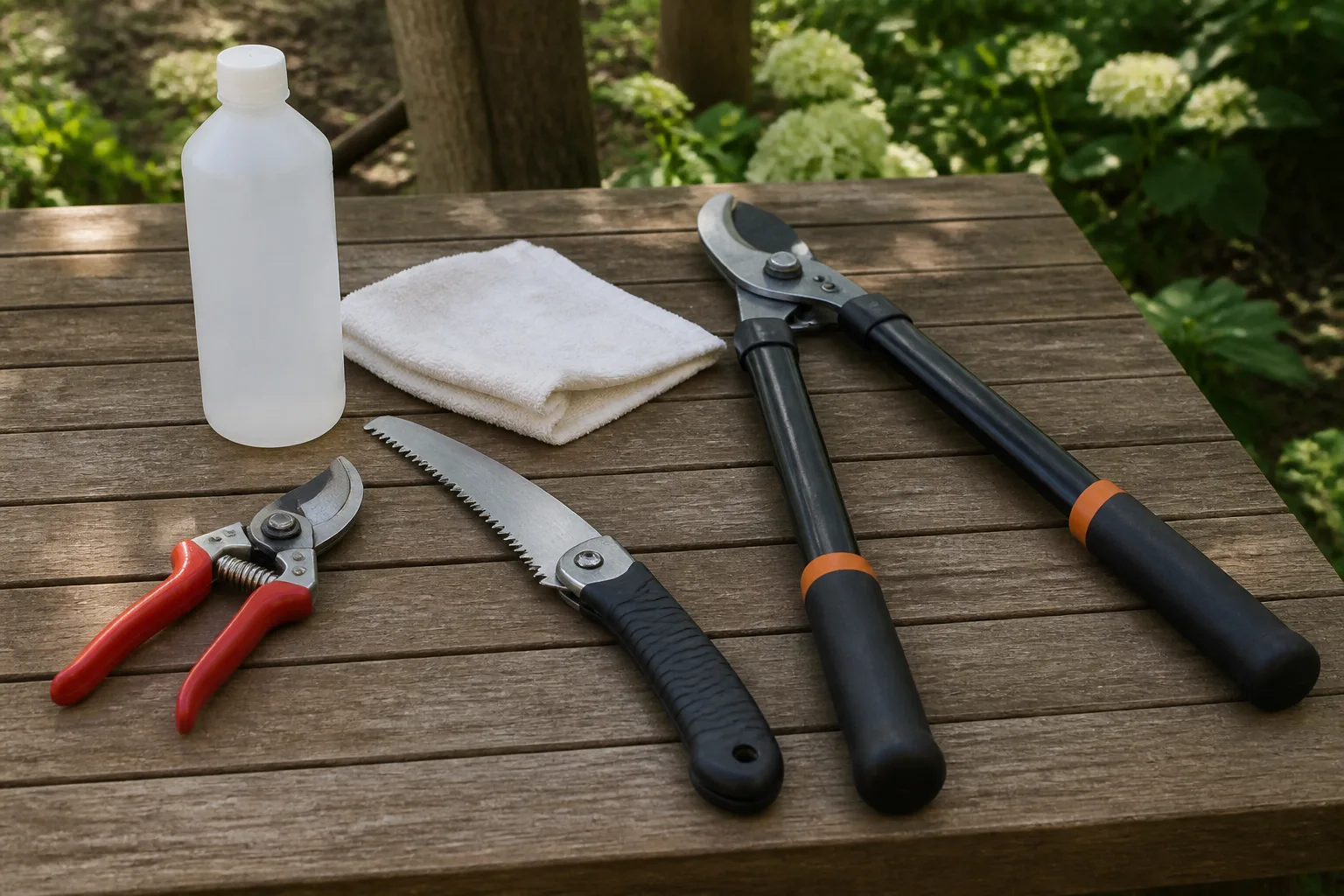
Use bypass pruners for small live twigs, loppers for thicker stems that you can reach safely from the ground, and a pruning saw for branches too large for loppers. An anvil pruner can be useful for some dead, hard wood, but it is a poor choice for green stems if it crushes the tissue below the blade. If you have to squeeze with your full strength, the tool is too small, dull, or wrong for the job.
Match the tool to the branch and disinfect between plants
Before you start, brush soil and debris from the blades, remove sap, check that the cutting surfaces meet cleanly, and lightly oil the hinge after cleaning. Keep a disinfectant and a clean cloth with you, particularly when you are removing visibly diseased wood or moving between unrelated plants.
There is no need to turn every cut into a laboratory procedure on a healthy hedge, but sanitation becomes important when cankers, dieback, blackened wood, or other disease symptoms are present. Make the diseased cut back to healthy-looking wood, then disinfect the blades before touching a healthy branch or a second plant. Dispose of suspicious diseased material according to local guidance instead of shredding it into mulch.
Do not prune wet foliage or branches simply because you finally have a free afternoon. Homes & Gardens’ pruning guidance also emphasizes clean, sharp tools, the “three Ds” of damaged, dead, and diseased growth, and the danger of pruning at a bad seasonal moment. Homes & Gardens’ practical pruning-mistake guide is useful background, but plant-specific disease guidance should take priority when the diagnosis is uncertain.
Mistake 4: Making flush cuts or leaving stubs
Two opposite-looking cuts create two different problems. A flush cut is made tight against the trunk or parent branch, removing the swollen branch collar; a stub cut leaves a dead length of branch sticking out beyond the point where it should have been removed. Neither is the target for normal branch removal.
Penn State Extension’s cut-placement guide describes the branch collar as the swelling where a smaller branch meets the parent stem. That area contains a branch protection zone that helps the tree compartmentalize decay and close the wound with new wood. Cutting into it enlarges the injury; leaving a stub preserves dead wood that can decay backward toward the trunk.
Make a branch-removal cut outside the collar
Find the branch bark ridge, if visible, on the upper side of the union, then identify the collar’s swollen edge underneath or around the base. The final cut should follow the angle of that union and sit just outside the collar, leaving the collar intact without leaving a peg of branch behind.
For a branch more than about an inch thick, use a three-cut method. Make an undercut a short distance from the trunk, make a top cut farther out to remove most of the limb’s weight, then make the final cut outside the collar. This keeps the branch from tearing bark as it falls and lets you control a heavy limb in sections.
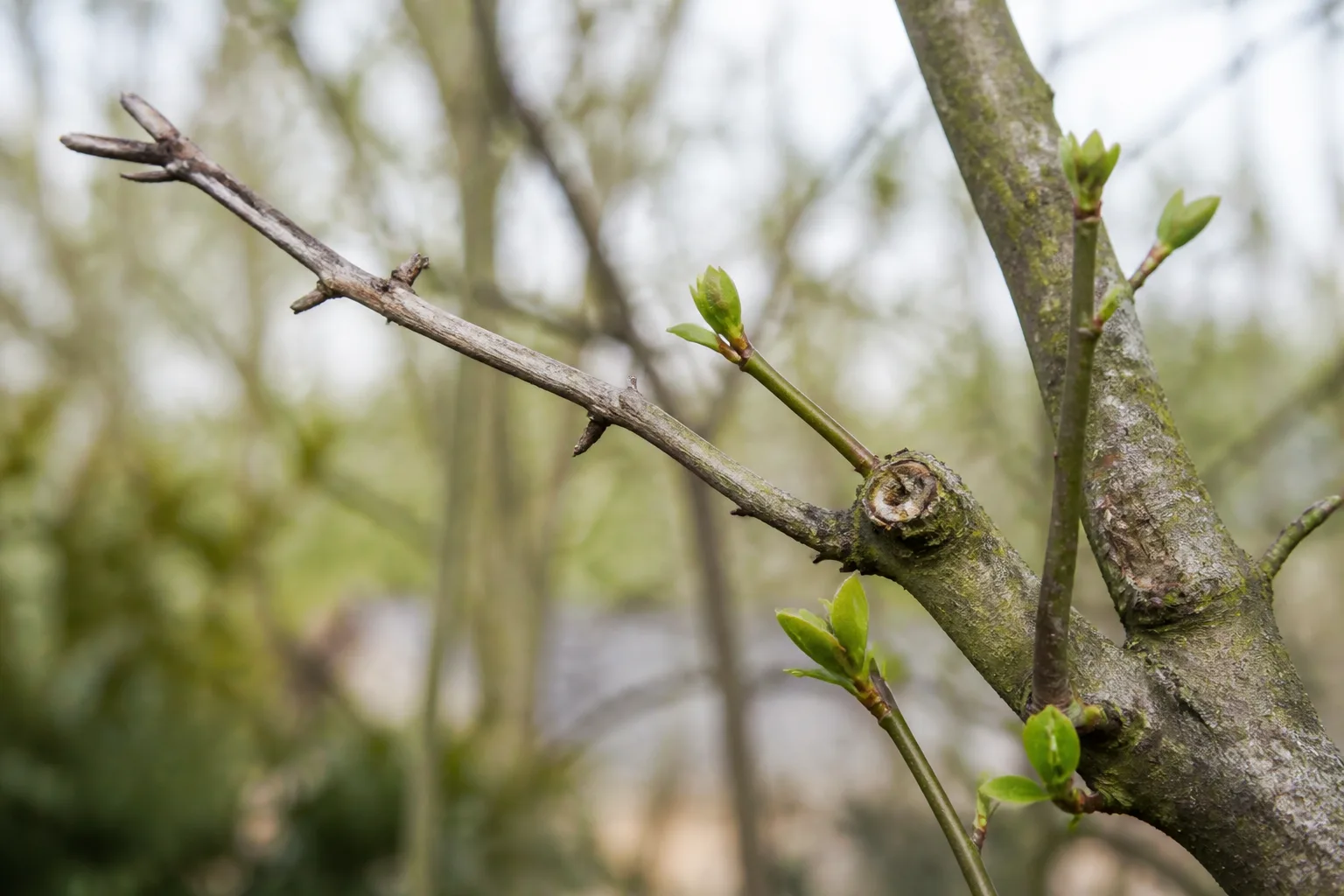
Do not paint or tar a routine pruning wound unless a qualified professional or a specific local plant-health recommendation tells you to do so. Penn State Extension advises keeping cuts small, clean, and smooth and allowing the tree’s own closure process to work. The goal is not to make a cut look sealed from the outside; it is to preserve the living protection zone around it.
Use a reduction cut only when a strong lateral remains.
When removing an entire branch would create too much clearance or change the structure, a reduction cut shortens the branch back to a suitable side branch. That lateral should be large enough to take over the branch’s growth—Penn State Extension uses roughly one-third to one-half of the parent branch’s diameter as a practical guide.
Do not shorten a large branch to a tiny twig just because that twig points in the direction you like. The small lateral cannot carry the same flow of energy or close the larger wound effectively, so the result behaves like a heading cut: weak regrowth, excessive water sprouts, and poor structure. If there is no strong lateral, make a different plan or get expert advice.
Mistake 5: Topping or shearing a tree to make it smaller
Topping is the removal of large portions of a tree’s crown at arbitrary points, often to lower height or clear a view. It may make the tree look smaller on the day of the job, but it replaces a natural crown with large wounds, weakly attached sprouts, and an unstable outline that soon grows back.
A topped tree has lost a large amount of leaf-producing surface and stored energy. Penn State Extension notes that topping encourages numerous water sprouts, increases susceptibility to decay, insects, and disease, and makes the tree more vulnerable to storm damage. Those sprouts can grow quickly, so topping often fails at the original goal of long-term size control as well as harming the tree’s form.
Shearing is not the same operation, but repeated shearing can create a similar trap in shrubs. The outer shell gets dense while the interior and base become shaded and woody. For a hedge, keep the base slightly wider than the top so light reaches lower growth; for an informal shrub, make selective cuts back into the plant instead of creating a hard line around its perimeter.
Know when the job belongs to an arborist
Do not climb a tree, use a chainsaw from a ladder, or work near power lines as a weekend extension of February gardening. Penn State Extension recommends qualified professionals for climbing, power tools, structural correction, and work near electrified lines; it also advises looking for an ISA Certified Arborist, insurance, written scope, and pruning language that specifies removal or reduction cuts rather than topping.
Call for professional help when a branch is large enough to damage a roof or person, when the tree is near a line, when the trunk or a major union is cracked, when storm damage has created hanging limbs, or when you cannot predict where a cut branch will fall. A small shrub you can inspect from the ground is one job; a mature tree over a house is another.
If the goal is simply to reduce a tree that has outgrown its site, ask whether a qualified arborist can use staged reduction cuts to suitable laterals. If the tree cannot be kept at the desired size without removing its natural crown, replacement with a better-sized species may be the honest long-term solution.
Mistake 6: Over-pruning a stressed plant
February makes plants look forgiving because bare stems give you a clear view. That is deceptive. A tree or shrub weakened by drought, waterlogged roots, pests, disease, transplant shock, mechanical damage, or a severe previous pruning may not have the reserves to recover from a large set of new wounds.
Every removed live branch takes away leaves that make carbohydrates and wood that stores them. Removing too much at once can trigger a flush of weak growth while reducing the plant’s ability to close wounds and defend itself. The familiar one-third rule is a guardrail, not a target: stay at or below roughly one-third of healthy live growth for a typical shrub unless you are following a species-specific renovation plan, and be more conservative with mature or stressed trees.
Run the three Ds before shaping
Start by removing only damaged, dead, and diseased material. That sanitation work can be more valuable than cosmetic shaping, and it gives you time to reassess the plant before taking more live wood. A dead branch should be traced back to healthy tissue or its point of attachment; a diseased branch should be cut according to the plant’s disease guidance, not merely clipped at the first ugly spot.
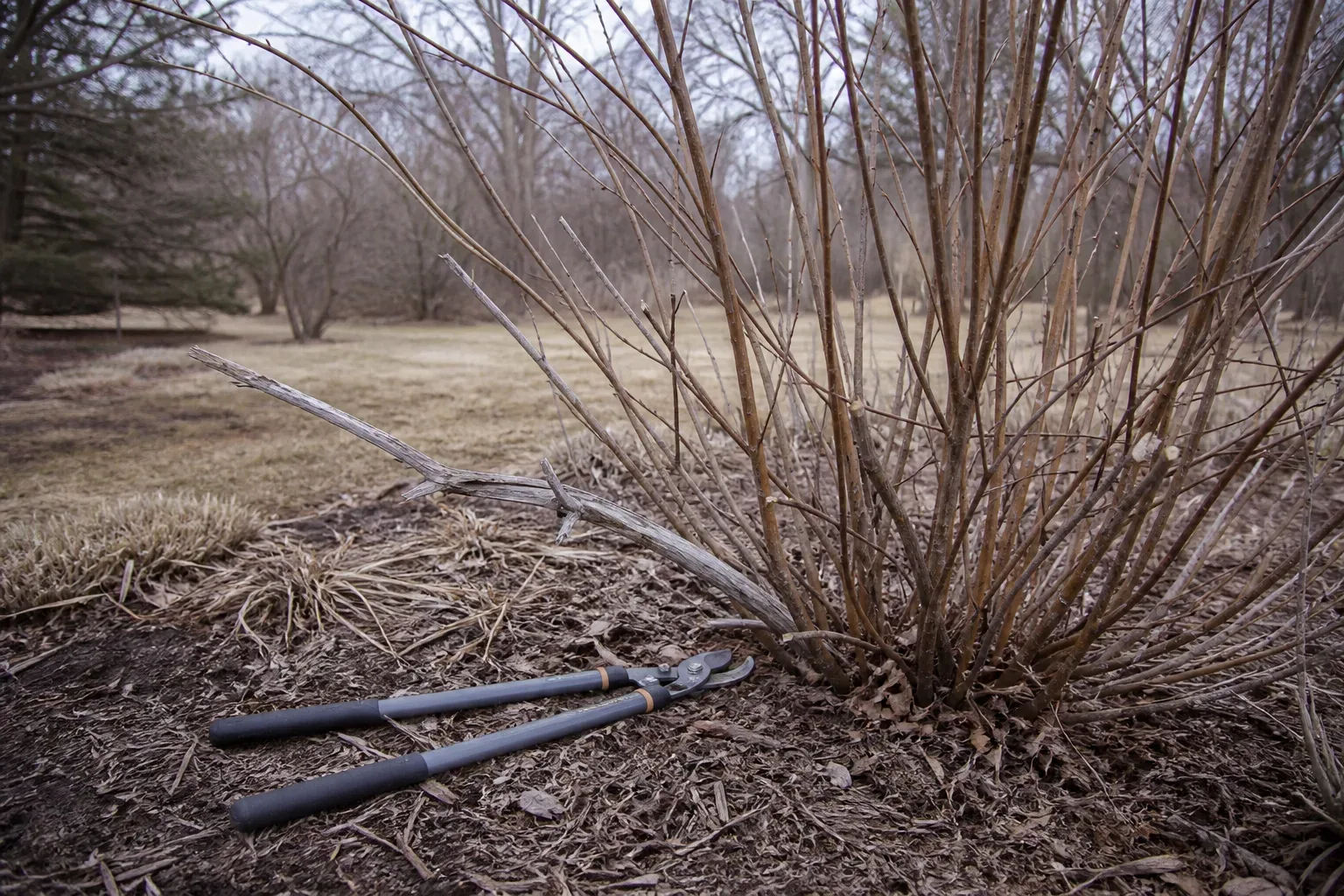
Then stop and watch the response. If the plant is weak, do not add fertilizer or hard pruning simply to force recovery; correct the underlying moisture, root, pest, or site problem first. A shrub with a few crossing twigs may need only those twigs removed, while a declining tree with extensive dieback needs diagnosis rather than a larger haircut.
What can you prune in February?
The answer depends on climate, species, and purpose, but the following groups are reasonable starting points for a dormant-garden inspection. Use them as categories, not as a substitute for the plant’s own pruning guidance.
Good candidates when dormant
Deciduous plants that flower on new wood are often the clearest February candidates. This can include panicle and smooth hydrangeas, butterfly bush, summer-flowering spirea, potentilla, rose of Sharon, some roses, and selected fruit trees. Apples and pears are often easier to assess while leafless, and many gardeners use dormancy to correct crossing wood, water sprouts, and crowded scaffold branches.
Dead, broken, diseased, and hazardous wood is a separate category and may need attention even when the plant is an old-wood bloomer. Remove it conservatively, preserve the branch collar on trees, disinfect between plants when disease is suspected, and do not turn a sanitation cut into a full renovation by momentum.
If a shrub has become old and woody, consider whether selective thinning is appropriate. Colorado State University Extension describes annual thinning as removing about one-third of the oldest wood at the base, while rejuvenation pruning can cut certain multi-stemmed shrubs to the ground in early spring. Those are different operations with different risks: rejuvenation can sacrifice a spring-flowering season, fail on shrubs with large woody bases or weak roots, and be inappropriate for a shrub that has a tree-like trunk or a grafted cultivar.
Plants to postpone or treat lightly
Wait until after flowering for lilac, forsythia, weigela, flowering quince, deutzia, many viburnums, azalea, rhododendron, and other spring-flowering shrubs unless a health or safety problem overrides the display. Be especially careful with bigleaf and oakleaf hydrangeas, which may hold next season’s buds on existing wood.
Treat evergreen trees and shrubs cautiously in winter because exposed cut surfaces and shortened stems can be more vulnerable to cold injury. Also verify timing for peach, plum, apricot, almond, and cherry relatives in your region; disease pressure and local extension advice can make a general dormant-window rule unsafe for some stone fruits.
Sap flow is another reason to adjust expectations, not necessarily a reason to panic. Maple, birch, walnut, elm, and some other trees may drip after late-winter cuts; the dripping can look alarming but is not automatically evidence that the tree is dying. If appearance matters or the species has a special disease-timing issue, choose a different window based on local guidance.
If you already made a bad cut, do this next
Do not keep cutting to make the damage look symmetrical. First identify what happened: a flush cut, a stub, a torn branch, a wrong-season cut on an old-wood bloomer, a too-small lateral, or an excessive reduction. The repair depends on the error, and another impulsive cut often creates a second wound without fixing the first.
For a torn branch, remove loose material cleanly from the ground if you can do so safely, following the branch collar rather than shaving the trunk smooth. For a small stub, wait until you can clearly see the attachment and make one correct removal cut; do not repeatedly nibble at the collar. For a bad reduction, leave the remaining branch alone until you can select a suitable lateral or have an arborist assess it.
If you pruned a spring bloomer too early, the plant may simply have fewer flowers this year. Water it normally for the season, avoid a second hard cut, and prune immediately after the remaining flowers fade so the plant can rebuild its flowering framework. If you removed a large portion of a healthy tree, prioritize steady care and inspection rather than trying to stimulate it with more cuts or unrequested treatments.
Use this compact checklist before your next February session:
- Name the plant or postpone live-wood pruning.
- Decide whether the job is sanitation, structure, clearance, renewal, or appearance.
- Check old wood versus new wood.
- Confirm the plant is dormant and the forecast gives you a dry, calm window.
- Start with damaged, dead, diseased, crossing, and hazardous growth.
- Use a sharp tool that matches the branch size.
- Preserve the branch collar; do not leave a stub.
- Keep live-wood removal conservative and step back after every few cuts.
- Stay on the ground and keep away from utility lines.
- Stop when the job becomes structural, overhead, or uncertain.
Conclusion
The best February pruning is usually selective, deliberate, and a little less dramatic than the gardener first imagined. Remove what is dead, broken, diseased, rubbing, or unsafe; prune new-wood plants while dormant when the weather and local timing cooperate; and leave spring-flowering shrubs alone until their flowers fade.
Sharp tools and correct cut placement protect the plant, but restraint protects it even more. If the task involves topping, a large limb, a ladder, storm damage, or power lines, hand it to a qualified arborist. A tree that keeps its natural structure—and a shrub that keeps its flower buds—will reward the decision to make fewer, better cuts.