Do Fake Wasp Nests Work? Timing, Limits, and Safety
Do fake wasp nests work? Learn which wasps they may deter, when to hang a decoy, how to make one, and how to respond to an active nest safely in your yard.
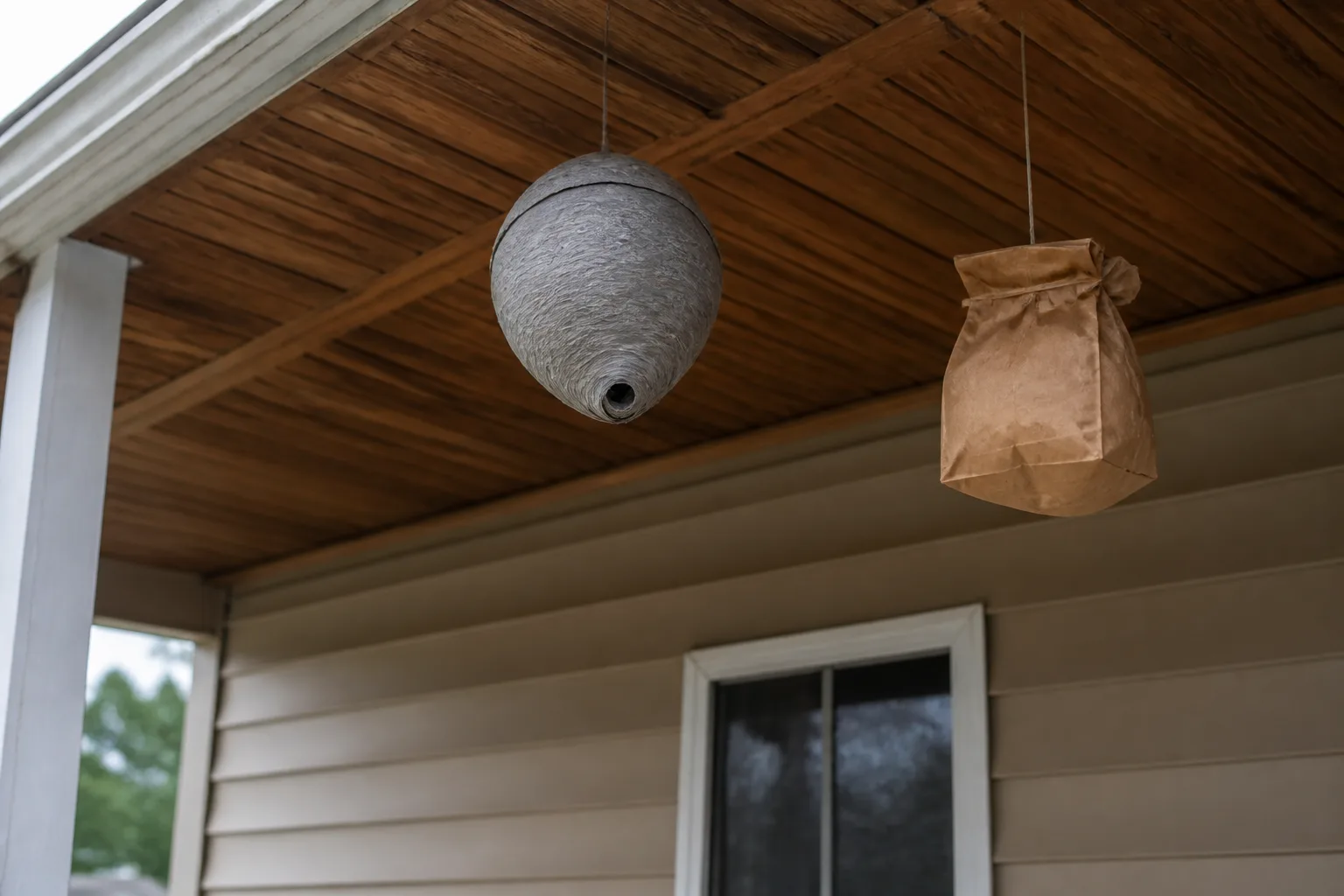
A fake wasp nest is worth trying only as a low-cost prevention experiment, not as a guaranteed repellent. The idea has a reasonable biological basis: some social wasps avoid competing colonies when they scout for a place to build. But current extension guidance says there is no clear evidence that a paper-bag or purchased decoy reliably prevents paper wasps or yellowjackets from nesting, and real colonies can build close together (Penn State Extension).
That distinction changes what you should do. Hang a decoy before local nest-building begins if you want to test it, but do not wait for it to solve an active nest, do not assume it works on every stinging insect, and do not hang one beside a real colony. The dependable parts of wasp prevention are still species identification, food and trash management, exclusion after the colony is gone, and a cautious response to nests in high-traffic places.
The short answer: try a decoy only as early prevention
If you have no visible nest and want to discourage paper wasps from using an eave, porch ceiling, pergola, or shed, a fake nest is a reasonable harmless add-on. It costs little, requires no insecticide, and is easy to remove if it fades or attracts curiosity. Treat the result as anecdotal unless you are comparing similar locations and recording what actually happens.
If wasps are already flying in and out of a nest, a decoy is the wrong tool. It will not make an established colony relocate, stop workers from defending their entrance, or remove a nest hidden in a wall, roof, tree cavity, or underground burrow. The first question is not “Which fake nest should I buy?” but “Am I seeing nest scouts, foragers, or defenders?”
Foragers can be annoying around fruit, soda, meat, pet food, and garbage without nesting close to your patio. Penn State Extension notes that wasps and yellowjackets away from their nest are generally less defensive, while a colony near a walkway, door, play area, or business entrance creates a different risk calculation. A decoy may address future nesting; it does not address a food source or an active colony.
The honest test is therefore simple: if you hang a decoy and nothing nests there, you still cannot know whether the bag caused the result. Weather, nest-site availability, nearby food, queen survival, species, and normal year-to-year variation may all explain the quiet spot. That does not make the experiment useless; it means you should judge it by low cost and low risk, not by a promise of protection.
| What you observe | What it most likely means | Best next move |
|---|---|---|
| One or two wasps passing through | Foraging or scouting is possible; no colony is confirmed | Hang a decoy early if you want, then remove food and watch from a distance |
| Wasps carry fibers to an eave | Aerial nest construction may be starting | Keep people away and decide quickly whether the site is safe to tolerate |
| Steady traffic into soil or a wall crack | A ground or cavity nest is possible | Do not poke or seal it; arrange identification or professional help |
| Wasps defend a visible nest | The colony is established | Stop treating the decoy as a solution and use a safety-first response |
What a fake nest is supposed to signal
A commercial decoy or crumpled paper bag imitates the rough shape of a papery aerial nest. The theory is that a queen or foundress scouting for a site sees the shape and decides the sheltered spot is already occupied, then moves on to a less competitive location.
That is a behavioral hypothesis, not a chemical force field. A paper bag has no alarm pheromone, no workers, no brood, and no growth. It can only offer a visual cue, and a wasp may ignore that cue if the site has better shelter, warmth, food, or a familiar nesting surface.
Territorial behavior is real; the deterrent is not proven
The underlying behavior is not imaginary. Social wasps form colonies, defend their nests, and compete for suitable nesting conditions. NC State University describes paper wasps as using sheltered overhangs, yellowjackets as usually nesting in underground cavities, and hornets as building above ground (NC State University). Those differences matter because a decoy that looks like an aerial paper nest cannot imitate an underground yellowjacket entrance.
The leap from “wasps defend territories” to “a fake nest prevents nesting” is where confidence should stop. Penn State’s current stinging-insect guidance calls decoy nests a common but unproven recommendation and notes that two established bald-faced hornet nests can occupy the same tree. In practical terms, a decoy might be ignored, tolerated, or occasionally helpful; there is not enough evidence to promise a repeatable result.
Which wasps a fake nest might—or might not—affect
Start with the nest site, not the insect’s color. Black-and-yellow markings do not tell you whether the insect is a paper wasp, yellowjacket, hornet, or a harmless lookalike, and the name “hornet” is used loosely in everyday conversation.
Aerial paper wasps are different from ground nesters
Paper wasps commonly attach a small, open-comb nest under an eave, porch roof, railing, or other protected overhang. That is the closest match for a decoy: a visible papery object in the sort of sheltered place a foundress might inspect. A decoy has its best theoretical fit here, especially before a queen has attached a real nest.
Yellowjackets are a weaker match. University of Minnesota Extension notes that yellowjackets can nest in buildings, trees, shrubs, and the ground, and that some become especially noticeable around overripe fruit late in the season (University of Minnesota Extension). If workers disappear into a hole in lawn soil, a pavement crack, a wall void, or the base of a structure, a hanging bag is not addressing their nest site.
Bald-faced hornets also build enclosed aerial nests, but a decoy that resembles one does not guarantee a response. Their colonies can become defensive when the nest is disturbed. Never move a fake nest closer to an active one to “reinforce the message”; that simply puts you nearer the danger.
Solitary wasps, bees, and carpenter bees are a separate case
Most wasp species are not the large social colonies people picture. Solitary wasps may nest in soil, hollow stems, mud cells, or small cavities and generally do not defend a shared colony in the same way. A fake aerial nest is not a useful tool for managing them, and many solitary wasps are valuable predators of caterpillars, aphids, flies, or spiders.
The same caution applies to bees and carpenter bees. A carpenter bee boring into untreated wood is responding to a nesting substrate, not avoiding a rival wasp colony. A fake nest will not repair the wood or stop a bee from using a suitable hole. BBC Gardeners’ World Magazine’s wildlife guide also emphasizes that wasps are diverse and that many provide pollination and garden pest control (BBC Gardeners’ World Magazine).
Use a quick decision rule before you hang one
Use this three-part rule: no nest, early season, low risk means a decoy is reasonable to test; visible nest or nest entrance means assess from a distance; high-risk location or vulnerable person means get professional help rather than experimenting.
No nest means prevention; an existing nest means assessment
If you see one or two wasps passing through, watch where they go from a distance of at least several yards. Are they carrying wood fibers toward an eave, or are they repeatedly landing on a drink, fruit tree, grill, or trash lid? Building material suggests nesting activity; repeated visits to food suggest foraging. Do not follow a wasp to its nest by walking under the eave or poking into shrubs.
If there is no nest and the location is a porch or covered patio, hang the decoy where it is visible and protected from rain. If a nest is already attached, leave the decoy down. It cannot lower the colony’s population, and placing another object near the nest can prompt the very disturbance that causes defensive behavior.
How to make a paper-bag decoy
The simplest fake wasp nest uses a brown paper grocery or lunch bag, lightweight stuffing, string, and tape. You are trying to create a dull gray-brown, roughly oval or teardrop shape that hangs naturally—not a perfect craft project and not a heavy object that can fall in wind.
Give it a lightweight, weather-protected shape
Loosely fill the bag with crumpled paper, clean packing paper, or another lightweight filler. Twist or fold the open end closed, secure it with tape, and tie on a loop of string. If the paper is very smooth and bright, gently wrinkle the surface; a little irregularity looks more like layered paper than a new shopping bag.
Keep the decoy dry under an eave or porch roof. Do not coat it with pesticide, oils, sugar, or sticky bait. Those additions do not make the object a better visual signal and can expose children, pets, birds, or beneficial insects to unnecessary residues. Replace the bag when it becomes waterlogged, torn, or so faded that it no longer resembles anything.
A purchased fabric decoy may last longer, but durability is not proof of efficacy. The useful buying criteria are weather resistance, secure attachment, and a shape that fits the kind of aerial nest in your region—not a promise that it will clear a yard of wasps.
Do not repurpose a found nest unless you can verify that it is completely abandoned and can handle it without approaching live insects. A faded paper bag is replaceable; a real nest can hide a queen, workers, or other stinging insects even when the outside looks quiet. For most homeowners, a clean homemade decoy is the safer choice because it removes the question of whether the object itself is occupied.
Timing and placement that give the experiment its best chance
Timing matters because a decoy can only influence nest-site selection. It is not a reset button after workers, brood, and a defended entrance are established.
Hang it before queens choose a nesting site
In temperate regions, social wasp colonies are founded in spring by mated females that overwintered and then begin scouting. The exact calendar shifts with latitude, elevation, and weather, so use local insect activity as your cue: put the decoy up before you see fresh comb or regular construction traffic, often in late winter or early spring in warmer regions and later in colder regions.
Gardening Know How also frames spring as the time to make changes before nests become established, while warning that the method is for nest-dwelling insects and not ground nesters (Gardening Know How). That practical timing is sensible, but it should not be read as proof that the bag works.
Choose a visible, sheltered spot near the structure you want to protect: under a porch roof, beside a pergola beam, or beneath an eave. Keep it away from the main path through a doorway, children’s play equipment, outdoor dining seats, and places where a falling string could snag someone. One decoy is a test for one small area, not a perimeter alarm for an entire property.
Placement should also follow the insect’s likely route. A decoy hidden behind dense foliage or tucked into a dark corner is difficult for a scouting queen to notice, while one dangling over a chair can become a nuisance of its own. Check the cord after storms, keep the bottom of the bag from brushing people as they walk, and remove it before severe weather if the attachment could tear loose.
What to do alongside the decoy
A fake nest is most useful when it sits inside a basic prevention plan. You are trying to make the target area less rewarding and less convenient, so a scouting queen has fewer reasons to stay and foraging workers have fewer reasons to hover around your chair.
Remove food, water, and sheltered attractants, then monitor
Close trash-can lids fully and rinse sticky residue from the rim. Cover meat, fruit, sweet drinks, and pet food while they are outdoors; clean spills promptly; pick up fallen fruit; and keep compost and recycling contained. Wasps often show up because the yard is offering an easy meal, not because they have chosen the nearby porch as a nest site.
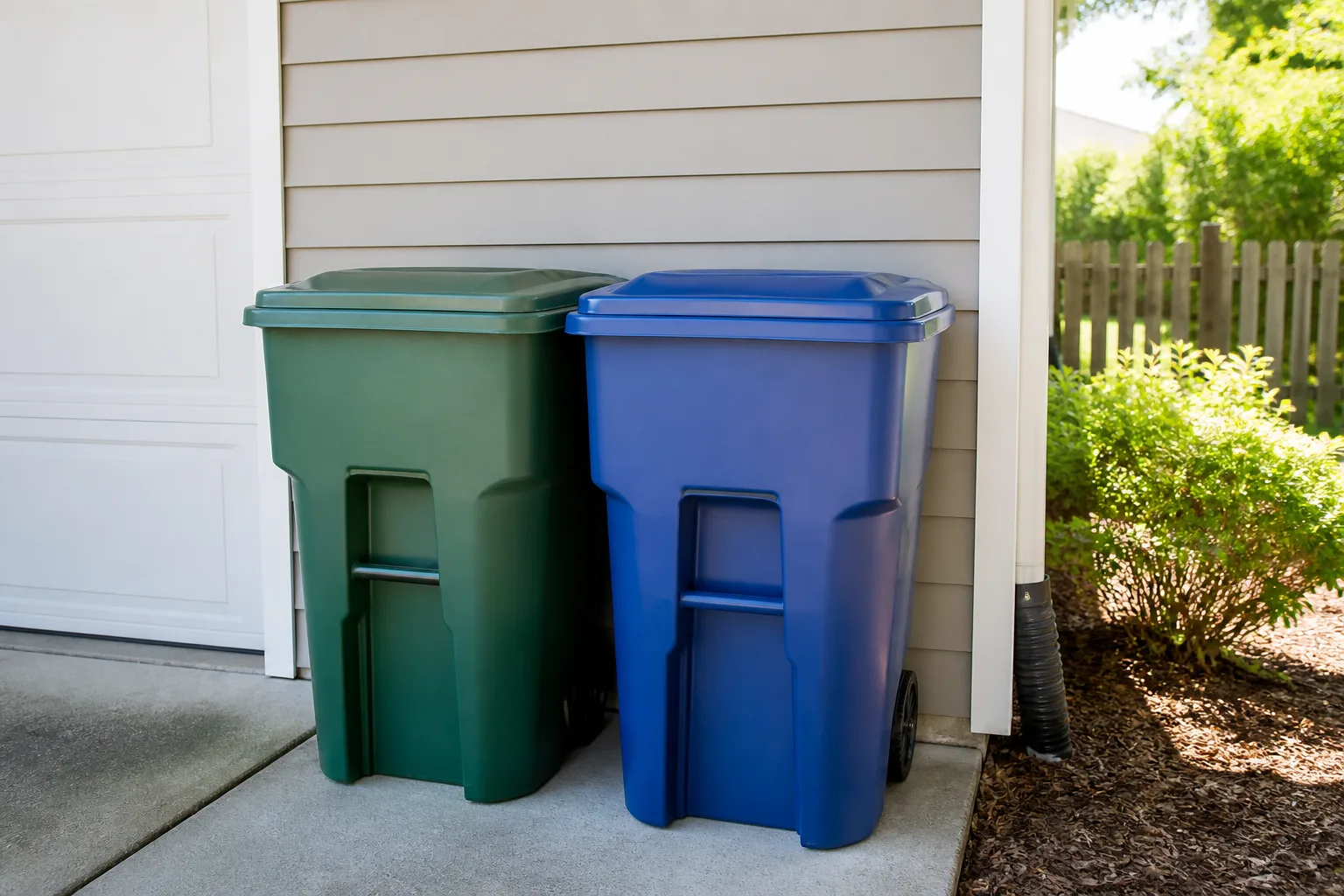
Check gutters, dripping faucets, birdbaths, pet bowls, and leaky hoses for standing water or damp edges. Do not remove every flower that attracts wasps—wasps are predators and pollinators—but consider moving highly visited blooms or overripe fruit farther from the table where people eat. The goal is distance and separation, not an insect-free garden.
Monitor for two weeks from a safe distance. Record the location, time of day, number of wasps, whether they carry nesting material, and whether activity follows food or fruit. If construction starts beside the decoy, the result is clear: the decoy did not prevent nesting at that site, and you should stop treating it as a solution.
Use the monitoring period to learn the rhythm of the problem. A burst of wasps around ripe grapes in late summer points to a food source; a steady line into a soffit points to a nest; and a few insects around shallow flowers may simply reflect normal pollination and pest hunting. That distinction keeps you from destroying beneficial insects or applying a pesticide to a problem a closed trash lid would have solved.
How to identify an active nest and choose a response
An active nest has a repeatable flight path. Wasps enter and leave one opening, carry fibers or prey, or cluster on the nest surface. A few insects crossing the yard do not prove a nearby colony; Penn State Extension recommends first deciding whether insects are nesting or simply using food, water, or other resources in the area (Penn State Extension).
Make observations in daylight when you can see the flight path, but do not stand directly beneath the roofline or beside the entrance. Use binoculars from a protected doorway if needed, note the nest’s approximate height and location, and leave identification to a professional when the shape is hidden or the traffic is heavy. A photograph taken from a safe distance can help an extension office or pest professional, but never move closer just to get a sharper image.
Separate open combs, enclosed nests, and underground entrances
Open comb under an overhang: This is often a paper-wasp nest. A very small nest in a low-risk location may be monitored, especially late in the season when the annual colony is declining. If it is beside a door, in a play area, or at face height, the risk of accidental contact may outweigh the benefit of leaving it.
Enclosed gray nest under a roof, branch, or wall edge: This may be a bald-faced hornet or another aerial yellowjacket. Size, location, and defensive behavior matter more than the label. Do not climb a ladder or tap the envelope to identify it; step back and arrange professional evaluation if people must pass nearby.
Small hole with steady traffic in soil, mulch, pavement, or a wall: Treat it as a ground or cavity nest until identified. A hanging decoy is irrelevant to that entrance, and sealing it while active can force insects to find a new route—potentially into a building. Penn State specifically warns against sealing active entrances in walls or the ground.
Safety rules and the professional threshold
Never remove or spray an active nest if you have a known sting allergy, if you cannot keep children and pets away, or if the nest requires a ladder, roof access, crawling into a void, or digging. Also choose a professional when the colony is large, inside a wall or ceiling, near an entrance, under a deck, or in a place where retreat is difficult.
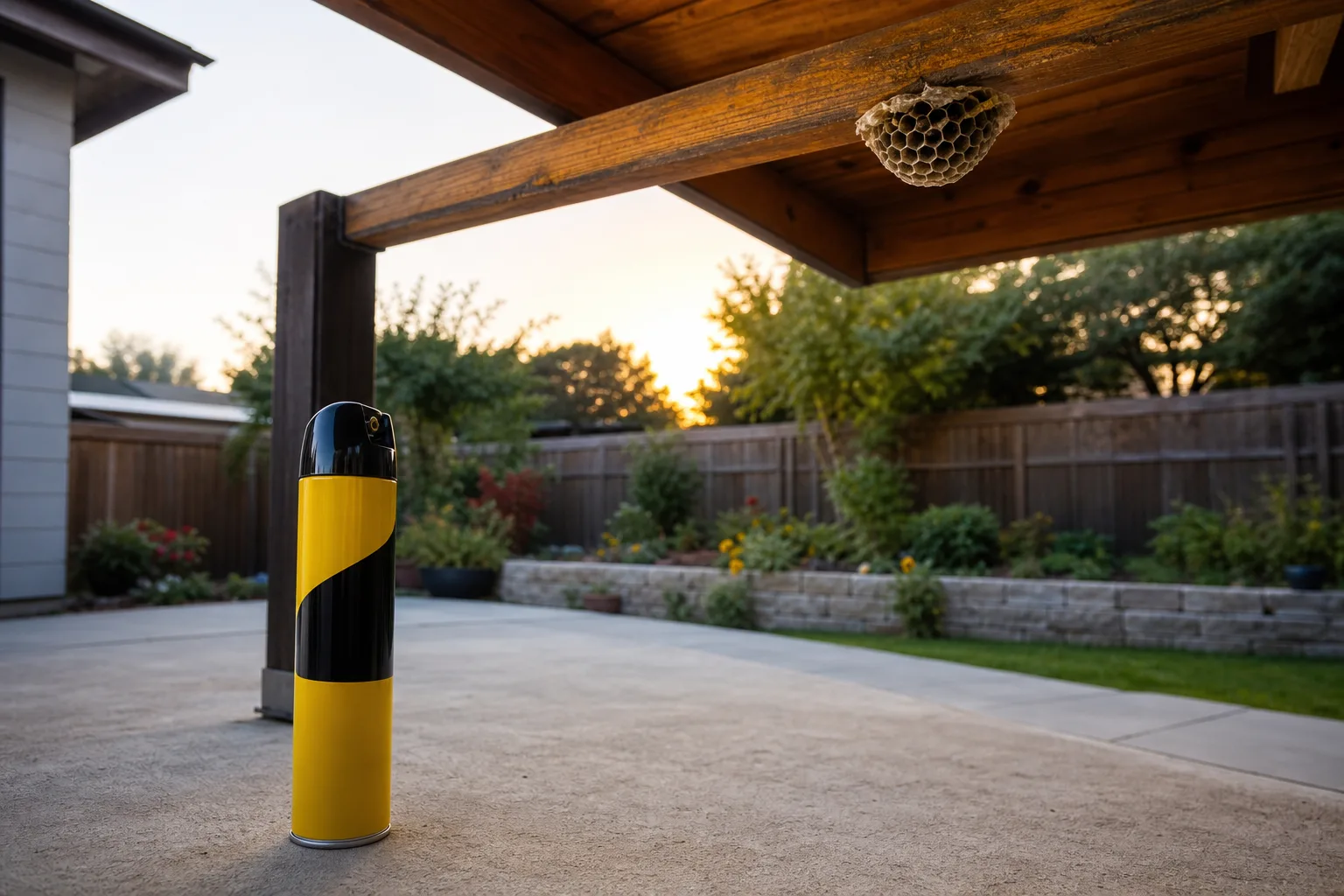
If you decide a small, exposed nest in a genuinely low-risk place must be treated, use only a product registered and labeled for that purpose, follow the label’s distance and protective-equipment directions, and plan an unobstructed retreat. Do not use gasoline, fire, boiling water, or an improvised chemical mixture. Penn State’s updated guidance emphasizes that the safest option for many colonies is a qualified pest-management professional, especially when the nest is enclosed or hard to reach.
Wasps also deserve a little restraint. Social wasps defend the nest much more strongly than they defend a flower or a discarded drink, and many species provide pest control by carrying caterpillars and flies to their young. If a nest is out of the way and no one is at unusual risk, watching from a distance until the colony naturally declines may be the most environmentally responsible choice.
That option is not the same as ignoring a dangerous nest. It is a deliberate choice for a nest that is isolated from daily traffic, cannot be bumped by a mower or ladder, and is not inside a structure. Recheck the area after storms, during yard work, and as the colony grows; a tolerable nest in May may become a poor fit beside a frequently used door in August.
Common mistakes that make wasp problems worse
Hanging a decoy after the nest is established. A paper bag cannot evict a colony. Move your effort to identification, attractant reduction, monitoring, or professional control.
Assuming every wasp reacts to an aerial nest. Ground-nesting yellowjackets, solitary wasps, carpenter bees, and insects using wall voids are not solved by a hanging object.
Putting the fake nest beside a real nest. This increases the chance that you will disturb defenders and may give you false confidence because the decoy is visible while the real problem is hidden.
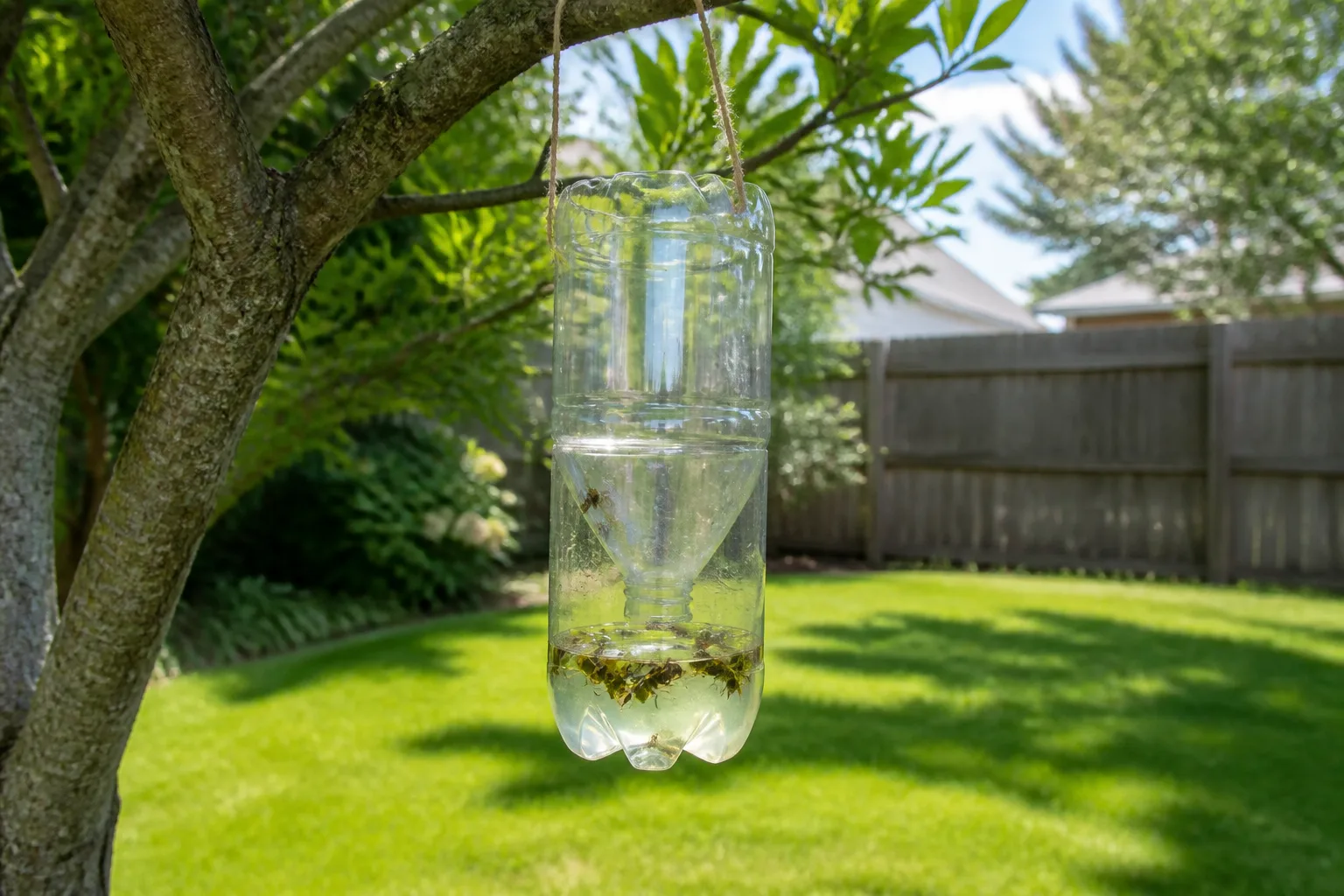
Using food bait next to people. Sugar, meat, fallen fruit, and open trash attract foragers. If you use a trap for yellowjackets, place it well away from seating and food, maintain it according to its instructions, and understand that it may thin workers without eliminating the colony.
Sealing holes while insects are active. A blocked entrance can push wasps into a wall, ceiling, room, or another exit. Seal structural openings only after the colony is gone and the cavity has been dealt with appropriately.
Chasing a single wasp with a spray bottle. Swatting, trapping, or crushing a wasp against skin can increase sting risk. Close food, move indoors calmly, and let a forager leave rather than turning a passing insect into a defensive encounter.
Conclusion: treat a fake nest as a low-risk test, not a guarantee
Fake wasp nests may help discourage a scouting paper wasp from choosing one small, sheltered location, but the evidence is too weak to call them a reliable defense. Penn State Extension’s current guidance is the more useful reality check: territorial behavior exists, yet colonies can nest close together and no clear evidence shows that a paper bag consistently prevents them.
If you want to try one, hang a lightweight decoy before local spring nesting, keep it dry and visible, and pair it with tight trash lids, covered food, fallen-fruit cleanup, and a short monitoring period. If a real nest appears, stop experimenting and choose the response based on its species, location, size, season, and the people who must use that space. A decoy can be a small preventive nudge; it is never a substitute for safe nest management.



