19 Best Flowering Ground Covers for Sun and Shade Gardens
Compare 19 flowering ground covers by sun, shade, soil, bloom season, and spread. Find a realistic match for your yard and avoid common invasive-plant mistakes.
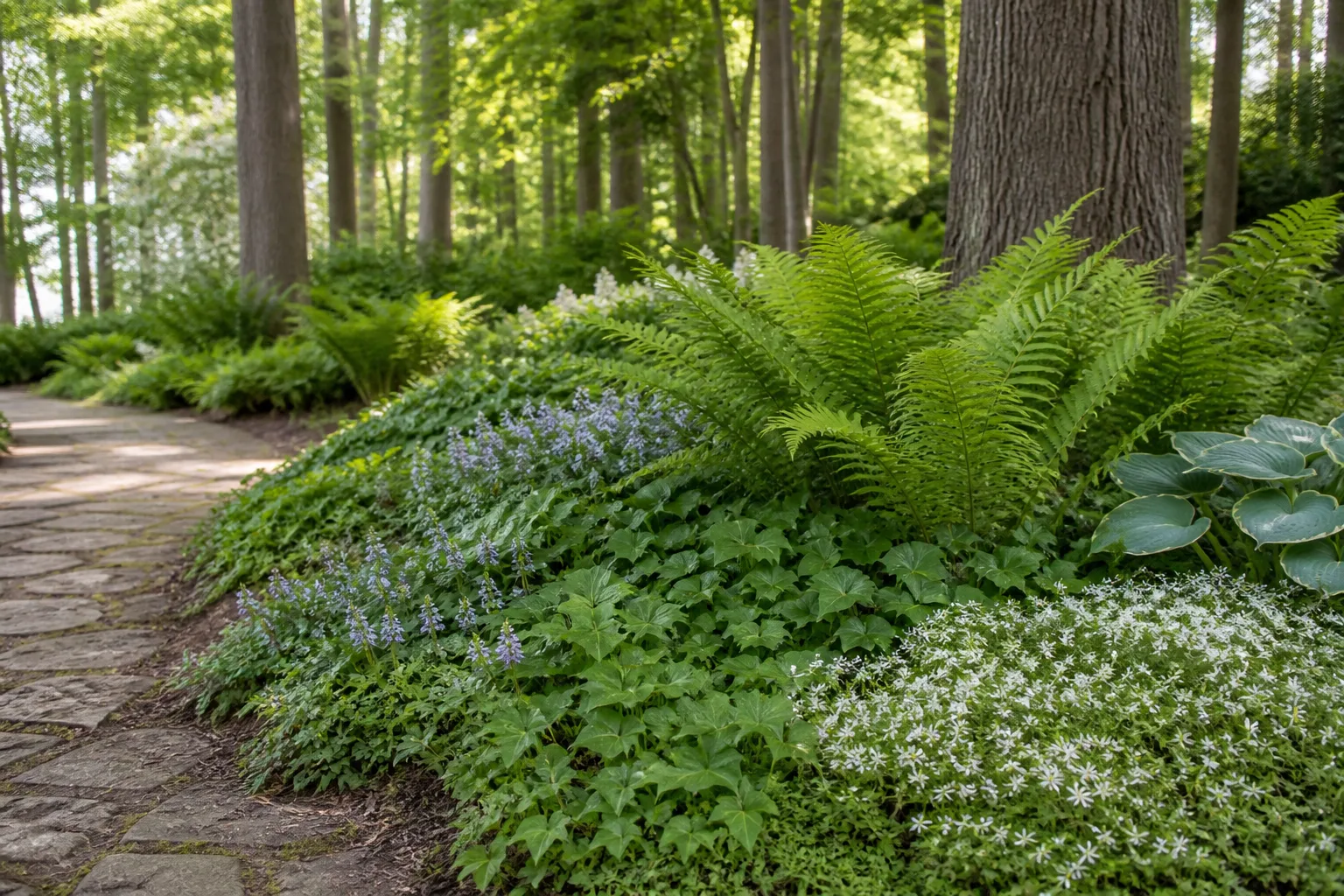
A flowering ground cover is a low-growing plant or group of plants that spreads across soil, softens edges, and adds seasonal flowers. The best one is not simply the fastest spreader: it must fit the light, moisture, winter conditions, and amount of maintenance you can provide. A plant that knits together beautifully in a sunny gravel garden may rot in heavy clay or thin out beneath a thirsty tree.
Use the table as a first filter, then read the notes before buying. A “ground cover” can be a dense mat, a colony of runners, or a row of clumps; each behaves differently around paths, shrubs, and property lines.
| Your site or goal | Start with | Main tradeoff |
|---|---|---|
| Hot, sunny, sharply drained spot | Creeping thyme, moss phlox, or hardy ice plant | None likes persistently wet soil; ice plant can fail in wet winters |
| Dry, dappled shade beneath trees | Hosta or Allegheny pachysandra | Tree roots compete for water; establishment may be slow |
| Moist woodland edge | Woodland phlox, foamflower, or wild strawberry | These are not choices for baking, unwatered slopes |
| Low mat with spring flowers | Moss phlox, candytuft, or barren strawberry | Most spring carpets have a shorter flower show |
| Longer summer color in full sun | Thyme or ice plant | The right choice depends on drainage and winter wet |
| A naturalized native planting in the eastern or central U.S. | Woodland phlox, foamflower, wild violet, or wild strawberry | Check local native ranges and give spreading plants room |
Make the site decision before you choose
Flower color is easy to fall for at a nursery; light and drainage determine whether the plant survives. Spend a few days observing the area, especially if a tree or building casts moving shade. The Illinois Extension ground-cover guide recommends selecting for the site first—sun or shade, clay or sand, moist or dry—so a plant can thrive without heroic care.
Measure light, including tree shade
“Full sun” generally means several hours of direct sun, but the timing matters. Afternoon sun on a south-facing wall is hotter and more drying than the same number of hours of gentle morning sun. In warm, humid regions, a plant rated for full sun farther north may appreciate afternoon shade; in cool climates, too much shade can reduce flower production.
Tree shade has another complication: mature roots intercept water and leave less room for planting. A north-facing bed under a roof overhang may be both shady and unusually dry. Small plugs or divisions disturb fewer roots than digging large holes, but you still need to water while plants establish.
USDA hardiness zones help screen plants for winter cold, not for every climate factor. The USDA Plant Hardiness Zone Map is based on average annual extreme minimum winter temperature. Summer heat, humidity, rainfall, wind, snow cover, and winter drainage can still decide whether a ground cover succeeds; the ice plant, for example, may handle summer drought yet struggle in a wet winter.
Check soil moisture and drainage
After a soaking rain, does water disappear within hours, or does the area stay slick and saturated? Dry-site mats such as creeping thyme, candytuft, and sedums need air around their roots. Woodland species such as foamflower and woodland phlox prefer more consistent moisture, but they still need well-drained soil rather than a permanently flooded planting hole.
Do not “fix” every site by adding a little sand or compost to each planting hole. A small amended pocket in dense clay can hold water like a bowl. Improve drainage across the whole planting area, choose a species that accepts the soil you have, or build a raised, freely draining bed where that is practical.
The 19 best flowering ground covers, by garden condition
The options below are grouped by the sites they suit, not ranked from best to worst. Several native species are regional—“native” is not a nationwide endorsement—and several nonnative plants are useful ornamentals when their spread is contained. Treat mature width as a planning tool, not a promise that every plant will fill at the same speed in your yard.
Sunny, dry, or rocky spots
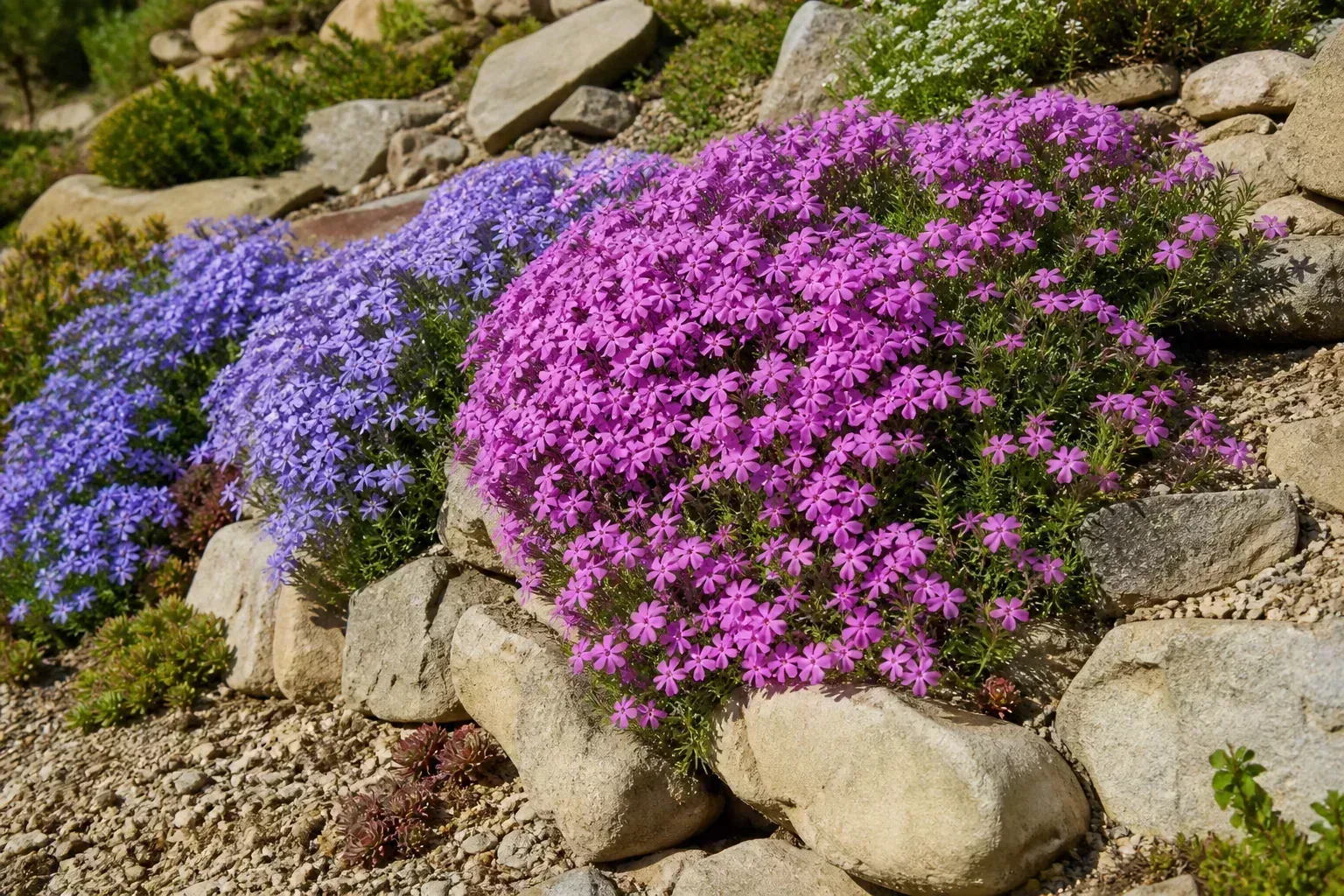
1. Moss phlox (Phlox subulata) is the spring carpet for a sunny, well-drained slope, rock garden, or wall edge. It is a North American native in parts of the east and central regions, and its evergreen-to-semi-evergreen needles carry pink, white, lavender, or purple flowers in spring. The NC State Extension Plant Toolbox describes a mat that can reach about 2 to 3 feet wide; older clumps may thin in the middle, so divide or replant the edge instead of expecting one patch to remain perfect forever. Give it sun and drainage, not soggy clay.
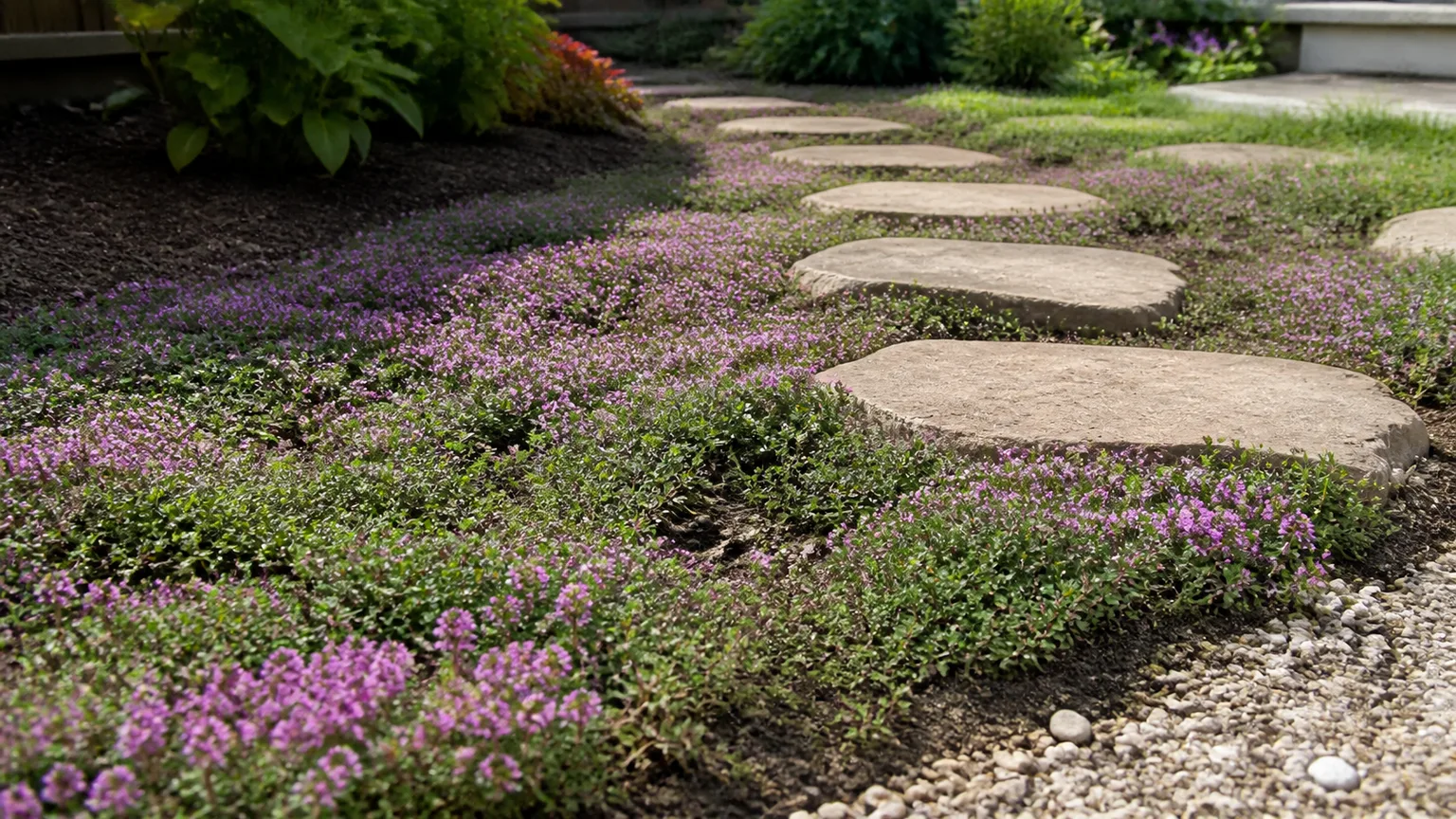
2. Creeping thyme (Thymus praecox) is a better match for hot, lean soil between stepping stones or beside a path. Tiny pinkish-purple flowers appear over fragrant foliage, and established plants tolerate light, occasional foot traffic—not a shortcut used every day. NC State Extension stresses full sun and well-drained soil; persistent wetness is a more serious threat than ordinary dry spells. Do not treat every creeping thyme cultivar as a kitchen herb.
3. Evergreen candytuft (Iberis sempervirens) forms a tidy, low mound with a striking white spring display and dark leaves that can stay green through mild winters. Use it for the front of a sunny border, a stone wall, or a well-drained bank rather than a damp hollow. After flowering, a light trim keeps the plant compact and encourages branching; avoid cutting into old woody growth. Its evergreen effect is climate-dependent, and cold-winter sites may see foliage damage.
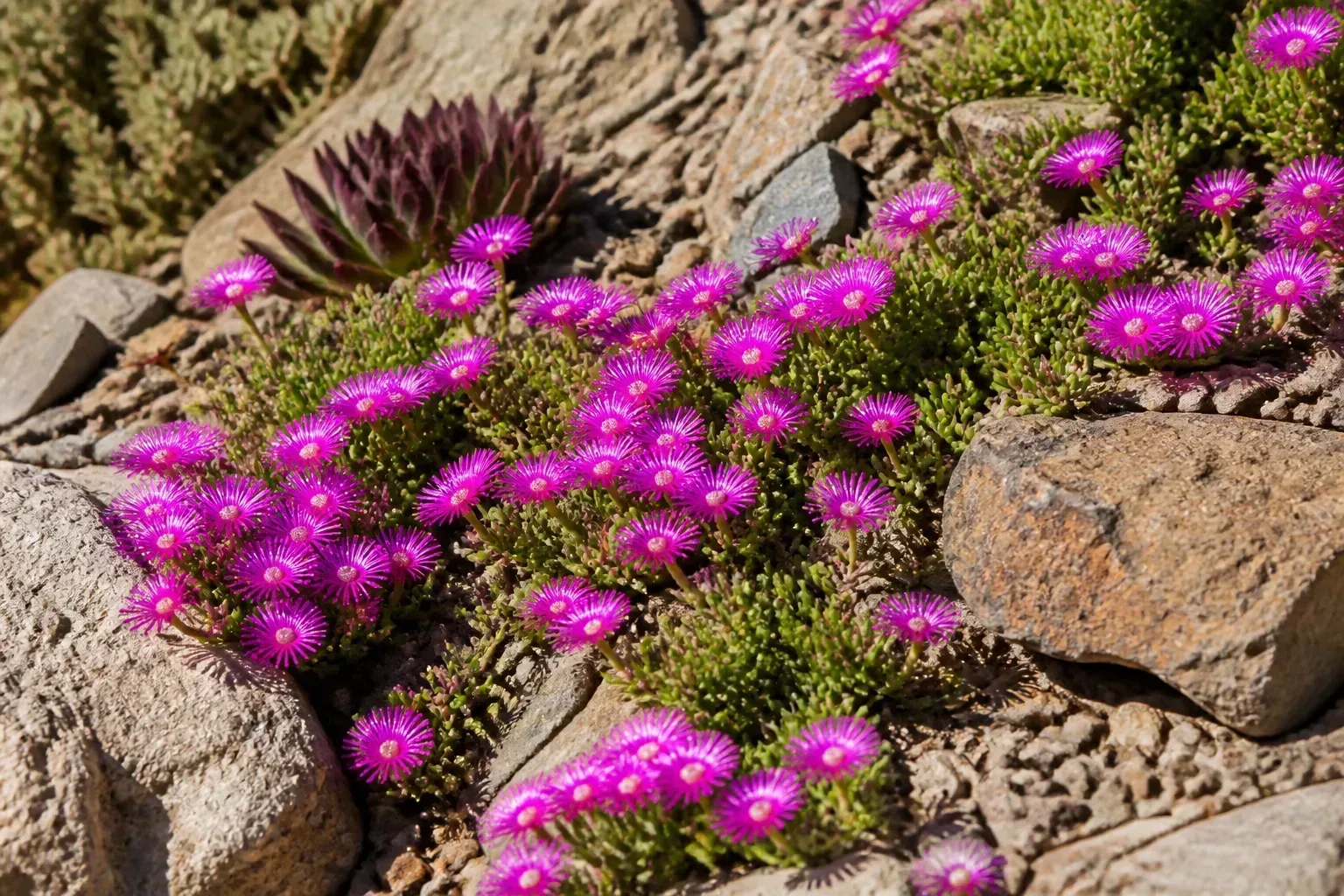
4. Hardy ice plant (Delosperma cooperi) offers some of the longest color in this list: vivid pink-purple, daisy-like blooms can continue through summer and into fall in a suitable climate. It is a succulent mat for full sun, hot exposures, gravelly soil, and rock walls. The NC State profile cautions against heavy soil and poor drainage and notes that wet winter conditions can hinder its return. If your region has cold, rainy winters, choose another plant for year-round cover or test a small patch first.
5. Basket-of-gold (Aurinia saxatilis) lights up a rocky edge with a dense flush of yellow flowers in spring. Its silvery foliage is useful after bloom, but it is happiest in sun and lean, sharply drained soil, and it can struggle in hot, humid summers. NC State Extension notes that plants may be short-lived and can struggle above Zone 7; that makes it a better fit for cooler summers than for a humid Gulf Coast garden.
6. Snow-in-summer (Cerastium tomentosum) makes a silver, woolly mat and a white early-summer flower show on dry sunny banks and gravelly borders. It spreads by underground runners and can self-seed if you leave spent blooms; NC State Extension also warns that it can be weedy in cooler-summer climates and may leave dead patches. Use it where a spreading mat is welcome and boundaries are easy to maintain, not where you need a traffic-tolerant lawn.
7. Dragon’s Blood stonecrop (Phedimus spurius ‘Dragon’s Blood’, often sold as Sedum spurium) combines red-tinged leaves with small pink-red flowers in summer. It belongs in a sunny, dry, well-drained spot where a low mat can spill between stones; it is not a substitute for a showy long-blooming perennial. Give it room to spread, keep irrigation modest once established, and avoid a wet bed. Extension recommendations for stonecrops consistently favor full sun and dry, free-draining soil.
8. Angelina stonecrop (Petrosedum rupestre ‘Angelina’, formerly Sedum rupestre) is chosen as much for its chartreuse foliage—often turning orange or red in cold weather—as for its yellow summer flowers. It spreads rapidly, roots from fallen pieces, and works well along a sunny wall or in a rock garden. NC State Extension advises good drainage; leaves can detach easily, so remove pieces from beds where you do not want new plants.
Shade and woodland settings
9. Woodland phlox (Phlox divaricata) provides fragrant lavender-blue flowers in spring and can naturalize in the eastern North American woodland conditions it prefers. It likes partial to full shade, humus-rich soil, and even moisture; unlike moss phlox, it is not a dry rock-garden plant. Its leafy stems can root as they spread, but the colony is looser than a formal, weed-blocking carpet. NC State Extension recommends it for native and woodland gardens; use it among hostas, ferns, and spring bulbs rather than expecting it to eliminate weeds on its own.
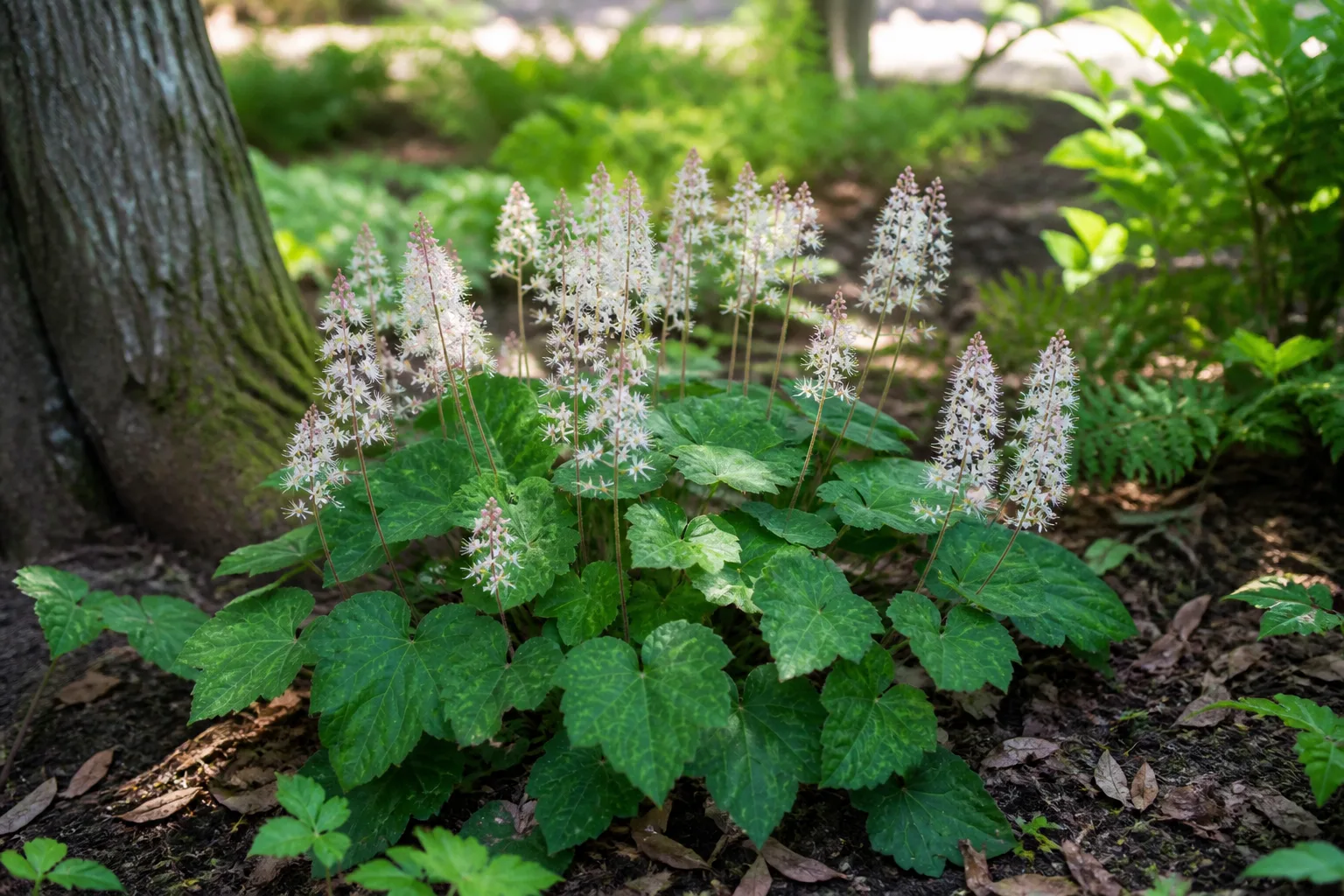
10. Foamflower (Tiarella cordifolia) is a native woodland choice for cool shade where the soil stays moist but drains well. Airy white-to-pink flower spikes rise above maple-like leaves in spring, and short runners gradually form a colony. The NC State Plant Toolbox notes that foamflower is not drought-tolerant; under a mature tree, supplemental watering during dry spells may be the difference between a settled planting and a thin one. Use it for a woodland edge, not a hot curb strip.
11. Allegheny pachysandra (Pachysandra procumbens) offers a native alternative to the more familiar Japanese pachysandra in parts of the southeastern United States. It grows in shade beneath trees, has mottled leaves and fragrant spring flower spikes, and is typically less aggressive than P. terminalis. The NC State profile describes a slow-to-moderate evergreen or semi-evergreen mat; choose it only within its regional range and give it a season to establish before expecting full coverage.
12. Barren strawberry (Waldsteinia fragarioides) has strawberry-like leaves but no edible strawberry fruit. Small yellow flowers brighten spring woodland edges, and its evergreen foliage makes it useful where you want a quieter cover after bloom. It is native to eastern Canada and the United States, but its growth is usually slower than the plants chosen for a fast fill. The NC State profile lists it for woodland settings and notes that it is endangered in parts of its range, so buy nursery-propagated stock and do not collect from the wild.
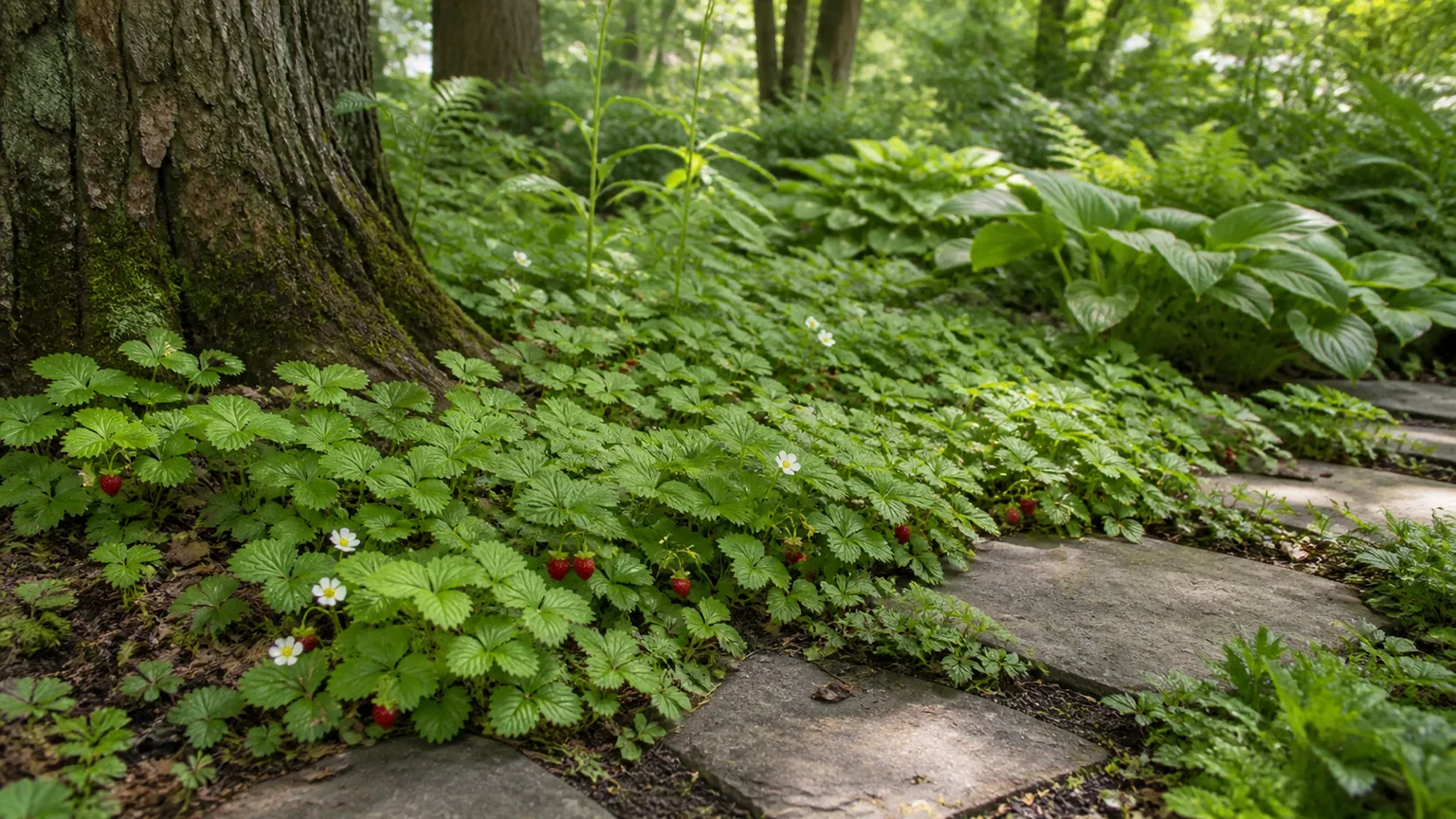
13. Wild strawberry (Fragaria virginiana) gives you white spring flowers, low foliage, and tiny edible berries on a runnering plant. It can cover sunny to partly shaded ground and tolerate a range of soils, but fruit production and density are best where it receives adequate light and moisture. NC State Extension describes its use for ground cover and slope erosion; expect runners to travel into neighboring beds and remove them where you want a crisp boundary. Eat fruit only from plants grown away from lawn chemicals and roadside contamination.
14. Sweet woodruff (Galium odoratum) is a fragrant, white-flowered ground cover for partial to full shade, particularly where soil is moist and rich. Its whorled leaves and spring flowers make an attractive woodland carpet, but its spreading rhizomes can outrun a small bed. The University of Wisconsin–Madison Extension says it can become aggressive in fertile, moist conditions and is considered invasive in Oregon. Keep it within a defined area and check local guidance before planting near woodland.
15. Common blue violet (Viola sororia) is a low native wildflower in eastern and central North America, with purple, blue, or white spring flowers. Violets tolerate shade, clay, and moisture better than many ornamental mats, which helps them fill a tough woodland edge. That same self-seeding habit can make them a lawn nuisance; plant them where you want a naturalized colony, not where you want a crisp monoculture. Penn State Extension’s native violet guide explains their early spring value to bees and their ability to spread into a dense patch.
16. Spotted deadnettle (Lamium maculatum) brightens a shaded bed with silver-marked leaves and pink, purple, or white flowers from spring into summer. It tolerates more shade than sun and makes a quick mat in evenly moist, well-drained soil. It can spread by stems that root where they touch the ground, so set it where edging or a path can contain it. NC State Extension warns that hot, humid summers may leave bare patches in mass plantings; it is not a reliable answer for every southern shade garden.
Foliage-first covers that still bloom
17. Hosta, especially fragrant Hosta plantaginea, makes a leafy ground-cover layer with fragrant white flowers in summer. Small and medium varieties work best for the ground-cover role; large cultivars become a focal mound rather than a carpet. Choose morning sun or dappled shade with moist, well-drained soil, and remember that deer and rabbits may browse the leaves. NC State Extension emphasizes that hostas are generally grown for foliage, so select one if leaf texture matters as much as bloom.
18. Big blue lilyturf (Liriope muscari) has evergreen, grass-like leaves and purple flower spikes in late summer or early fall. It is clump-forming and useful as a shady border or edging, not a flat floral carpet; use it when foliage and a late-season flower spike matter more than a spring blanket of color. NC State Extension says this clumping species is less aggressive than creeping lilyturf (L. spicata), which spreads by rhizomes. In the southeastern United States, compare local native sedges before planting nonnative lilyturf.
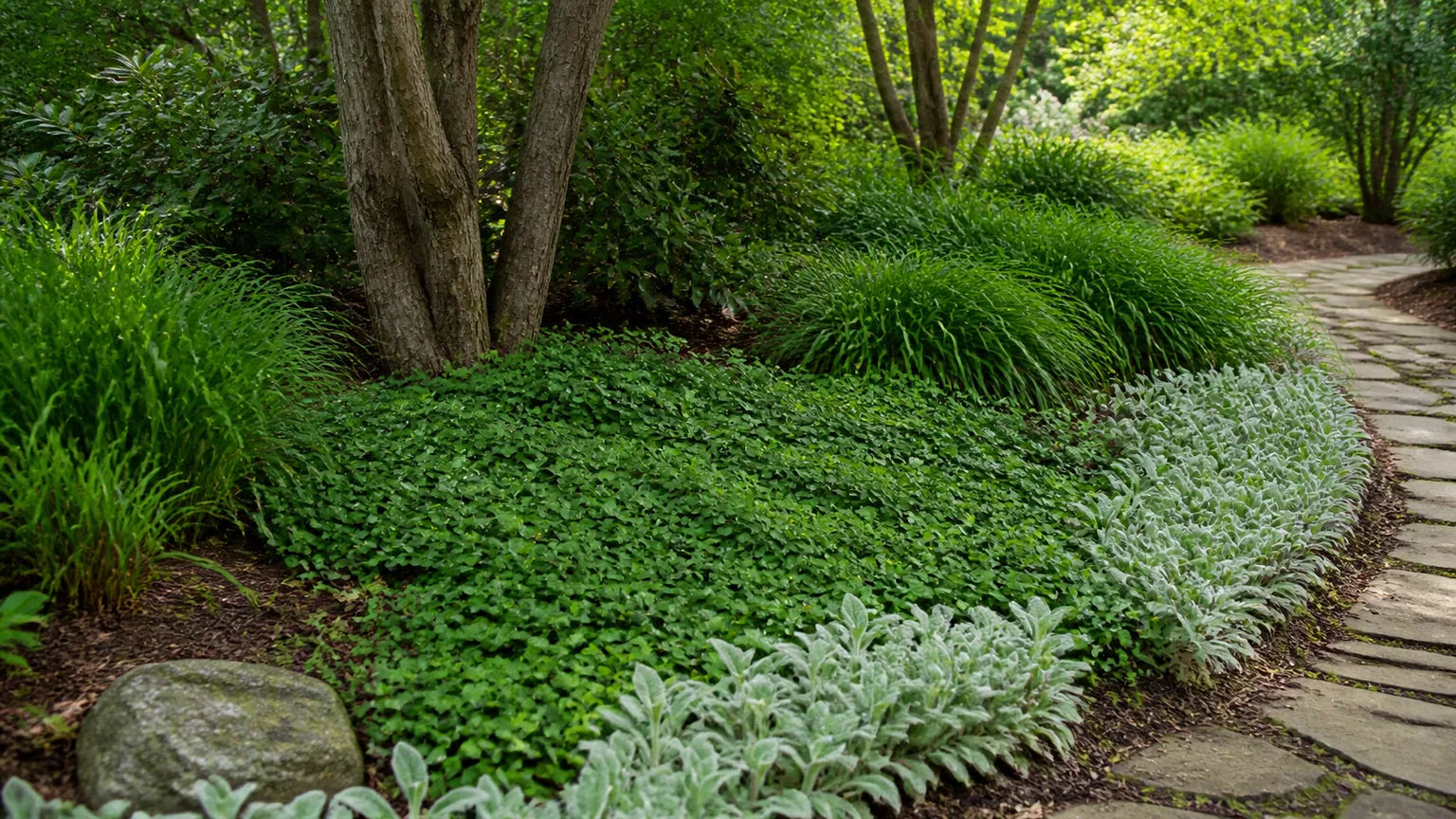
19. Lamb’s ear (Stachys byzantina) earns its place through soft silver foliage that stays decorative long after its early-summer flower spikes fade. It prefers sun and free-draining soil and is a strong edging plant for dry beds, but it is not a low floral carpet and may look untidy in humid, wet conditions. NC State Extension notes that overhead water can damage the foliage; keep water near the soil, divide crowded patches, and do not rely on it for a steep slope that needs deeper roots.
Give groundcover a fair start
Ground cover suppresses weeds by occupying space and shading the soil after it has knitted together. It does not kill established bindweed, quackgrass, or tree seedlings, and open soil between young plugs is an invitation to new weeds. Fine Gardening’s planting guide makes the practical point that spacing depends on growth habit, plant size, and how quickly you want coverage; closer spacing costs more, while wider spacing means more interim weeding.
Remove persistent weeds and set the spacing plan
Before planting, remove perennial weeds and their roots as thoroughly as you can. If you till a bed full of rhizomes or rooted runners, chopping them can create more pieces that regrow. On an existing slope, avoid exposing large amounts of bare soil at once; clear in manageable sections and use erosion-control fabric or temporary mulch where runoff would wash the soil away.
Lay out plugs in staggered rows rather than a rigid grid. Use the mature width on the plant label to estimate spacing, then shorten it if you can afford faster fill or widen it if the plant is a vigorous spreader. On a 2-foot-wide plant, spacing plants about 18 to 24 inches apart often closes sooner than spacing them 3 feet apart—but exact timing depends on cultivar, soil, and climate. Penn State Extension notes that spacing should account for habit, growth rate, and a plant’s tendency to spread or reseed.
Keep a few feet clear around shrubs and tree trunks. A groundcover mat should not bury bark, cover a shrub’s root flare, or smother small perennials you want to keep. If the bed contains several plant types, give each a defined drift and leave a path or mulch strip between strong spreaders so you can inspect and edit the edges.
Water through establishment, then manage edges
Even drought-tolerant groundcovers need regular water while roots are expanding. Water deeply enough to moisten the root zone, then check the soil before watering again; daily shallow sprinkles keep roots near the surface and can encourage disease. Spring or fall planting usually gives perennial plugs time to root before peak summer heat, a timing recommendation also made by Penn State Extension. If you plant in summer, start with smaller areas and have a dependable watering plan.
The first year is the weeding year. Pull seedlings while small, refresh a thin mulch layer in open gaps without burying crowns, and do not assume the plant’s mature width will arrive immediately. Established groundcovers can reduce weeding, retain soil moisture, and soften erosion, but results depend on density and slope; for a steep, actively eroding bank, deeper-rooted grasses, shrubs, or professional stabilization may be more appropriate than a shallow flowering mat.
Trim or lift spreaders at the edge before they cross a path or enter neighboring beds. Cut stolons and runners with a spade, then remove the rooted pieces rather than tossing them into moist soil where they can establish again. For rhizomatous plants, mow edging alone may not stop underground growth; use a physical barrier only if the species’ growth pattern makes it effective, and inspect the line each season.
Beautiful spreaders that can become problems
“Fast-growing” is not a universal benefit. A runner that quickly covers a gravel bank can also run through a perennial border, cross a property line, or move into woodland. A plant can also be invasive in one region and manageable in another; do not use a national hardiness zone or a nursery label as a substitute for a local invasive-plant list.
Fast coverage, native fit, and invasive risk are not the same
Common periwinkle (Vinca minor) and Japanese pachysandra (Pachysandra terminalis) are familiar evergreen shade covers, but both have escaped cultivation in parts of the eastern United States. The USDA Forest Service and University of Georgia invasive-species resource describes periwinkle spreading into forests and displacing native plants. Penn State’s native-replacement list suggests regional alternatives such as Allegheny pachysandra, foamflower, and native ferns. The exact replacement depends on where you garden.
Bugleweed (Ajuga reptans) and yellow archangel (Lamiastrum galeobdolon, also sold as Lamium galeobdolon) are other vigorous spreaders that may be difficult to keep inside a small planting. NC State Extension lists bugleweed as invasive in some parts of the country, while the University of Wisconsin–Madison Extension notes that yellow archangel is invasive in the Pacific Northwest and parts of the Mid-Atlantic. Sweet woodruff, mentioned above, is useful in some gardens but is invasive in Oregon and aggressive in fertile soil elsewhere. Search your state or county extension and invasive-plant authority for the exact botanical name before purchase, especially if the bed borders woods, wetlands, or a stream.
A native plant is not automatically the fastest or easiest choice, and a nonnative ornamental is not automatically invasive. Check local range and behavior, then decide whether you can maintain the edge. If you are unsure, use a small trial patch, keep a path between the planting and natural areas, and choose a slower-growing or clump-forming option.
Groundcover is not a high-traffic lawn
Most flowering groundcovers tolerate little or only occasional foot traffic. Creeping thyme can accept light stepping once established; that does not make it a play lawn or a route used several times a day. Moss phlox, foamflower, hosta, and lamb’s ear can flatten or break under repeated pressure, while compacted soil also becomes harder for new roots to penetrate.
If people need to cross the bed, add stepping stones before planting and keep a narrow path free of vegetation. If a slope or lawn replacement needs frequent use, choose a surface designed for traffic, or mix a tougher lawn alternative with planted islands. Treat groundcover as a living planting layer, not an instant carpet that eliminates care.
Conclusion
Choose a flowering ground cover by first matching the site, then deciding how much spread you can manage. For a sunny, dry slope, start with moss phlox, thyme, or ice plant; for woodland shade, compare woodland phlox, foamflower, Allegheny pachysandra, and violets; for foliage that still flowers, consider hosta or clumping lilyturf. Confirm local hardiness and invasive guidance, prepare the bed, water through the first season, and leave room to edit the edges. A plant that fits your yard will give you better cover and fewer surprises than the fastest grower on the shelf.



