Garden Lime: Uses, Types, and Safe Application
Garden lime can correct acidic soil, but the right product and rate depend on your test results. Learn when to use it, when to skip it, and how to apply it.
The Quick Answer: When Garden Lime Helps
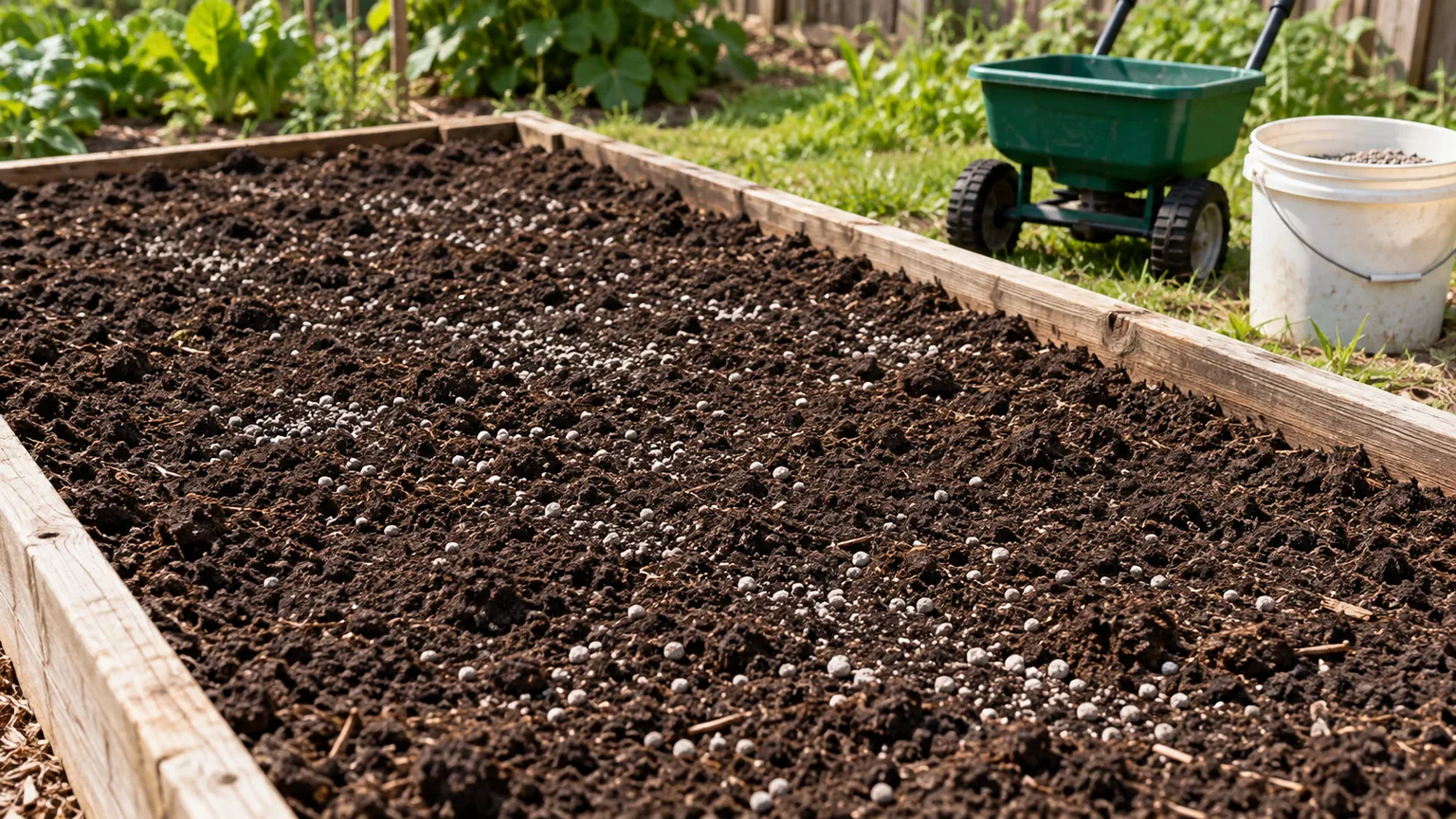
Garden lime is ground limestone used to raise soil pH when a soil test shows that the ground is too acidic for the plants you want to grow. It can also supply calcium, and dolomitic lime supplies magnesium, but lime is not an all-purpose fertilizer or a cure for every yellow leaf, weak lawn, or poor harvest.
The useful sequence is simple: test each distinct growing area, check the target pH for the plants there, follow the lab’s lime recommendation, then choose a product that matches it. If the test does not recommend lime, skip it. Adding a natural mineral without checking first can push soil too far toward alkaline conditions and make some nutrients harder for roots to access.
What Garden Lime Is Made Of
In garden and lawn products, “garden lime” usually means finely ground agricultural limestone, most often calcium carbonate. Limestone neutralizes soil acidity gradually; it does not work like a quick liquid treatment. North Carolina Cooperative Extension describes agricultural lime as ground limestone and identifies it as a pH-raising soil amendment, while University of Georgia Extension explains that a liming material’s chemistry, particle size, and moisture affect its neutralizing value and performance (North Carolina Cooperative Extension; University of Georgia Extension).
The name on the front of a bag is only the starting point. Read the ingredient statement and guaranteed analysis or liming-material label for the material type and its neutralizing value. Product names and label terms vary by state, so if the recommendation from your soil lab assumes standard agricultural limestone, ask the lab or local extension office how to adjust for a different product rather than guessing from the bag’s weight.
Calcitic and Dolomitic Lime Are Different Products
Calcitic limestone is primarily calcium carbonate and contributes calcium. Dolomitic limestone contains both calcium and magnesium carbonates, so it can address a magnesium need as well as raise pH. Neither type is automatically “better”; the useful choice depends on your soil test’s magnesium result and your plants’ needs. Penn State Extension notes that soil-test results can guide the choice between high-calcium and high-magnesium lime (Penn State Extension).
This distinction matters when a gardener sees “lime” recommended and assumes any bag will do. If magnesium is already adequate, adding more simply because dolomitic lime is widely available may be unnecessary. Conversely, if a test identifies a magnesium deficiency and recommends dolomitic material, a calcium-only product may not meet the same need. Use the soil report’s recommendation rather than selecting a product based on a “natural,” “premium,” or “complete” label claim.
Garden lime, hydrated lime, and quicklime are not interchangeable. Garden or agricultural lime is not the same material as hydrated lime (calcium hydroxide) or quicklime (calcium oxide). Colorado State University Extension lists these as chemically distinct materials with different calcium carbonate equivalencies; North Carolina Extension says hydrated and quick lime are not recommended for lawns and gardens (Colorado State University Extension; North Carolina Cooperative Extension). Do not substitute a masonry, construction, industrial, or unlabeled product for a bag marked for agricultural or garden use.
Other materials, including wood ash and some industrial by-products, can raise pH, but their strength and composition vary. University of Georgia Extension cautions that by-products may have lower neutralizing value or contain other elements that could harm plants; they should not be measured out as if they were ordinary garden lime. Unless a soil lab or qualified local adviser has recommended a known product and rate, stick with labeled agricultural limestone.
What Lime Changes in Soil
Soil pH affects how readily roots can take up nutrients. In strongly acidic soil, some nutrients can become less available while certain elements may become overly available; at high pH, nutrients such as iron can become less available. Penn State Extension explains that a deficiency can result from pH limiting access to a nutrient already present in the soil, and Colorado State Extension describes nutrient availability as changing across the pH scale (Penn State Extension; Colorado State University Extension).
Lime raises pH toward a less acidic range; it does not add a balanced supply of nitrogen, phosphorus, and potassium. Nor does it correct poor drainage, compacted soil, a disease problem, or a watering issue. If a plant is struggling, a soil test helps separate pH and fertility questions from other causes. A gardener who applies lime because a lawn has moss or a plant has yellow leaves may treat the wrong problem and create another one.
Lime also contributes calcium, and dolomitic lime contributes magnesium. That does not make it a reliable shortcut for blossom-end rot in tomatoes, weak growth, or any symptom assumed to be a calcium shortage. The plant’s access to calcium depends on several conditions, including root function and water movement. Only correct a soil pH or nutrient deficiency when the test supports that action; do not add lime to chase a symptom by itself.
Match Soil pH to the Plants You Grow
Many vegetables and ornamentals grow well in slightly acidic soil, but there is no single pH target for every landscape. North Carolina Cooperative Extension gives a general range of about 5.5 to 6.5 for many fruits, vegetables, and ornamentals in its region, while Penn State Extension describes 6.2 to 6.8 as suitable for many plants. Treat these as broad context, not as a universal prescription: the target on a regional soil report should reflect the crop or planting area you identify (North Carolina Cooperative Extension; Penn State Extension).
Some plants are adapted to more acidic ground. Blueberries, azaleas, and rhododendrons are common examples, and centipedegrass also prefers a lower pH than many turfgrasses. A shared bed with acid-loving shrubs should not be limed just because a neighboring vegetable plot needs it. Keep those areas separate when collecting samples and when applying amendments.
Regional soil conditions matter, too. Rainfall, parent material, soil texture, prior amendments, and fertilizer history can make one yard acidic and another nearby yard alkaline. North Carolina Extension notes that lime can help some local lawns and gardens while harming other nearby sites, especially where the soil already has a higher pH. A neighbor’s schedule or a general calendar is not evidence that your soil needs lime.
When Garden Lime Can Cause Problems
The most common failure is overliming: applying material without a test, repeating a dose before the first one has reacted, or treating a whole yard as if every bed had the same needs. Soil pH that rises too far can limit access to nutrients, including iron, and plants may develop interveinal yellowing or weak growth. That symptom is not proof that the soil is alkaline, however; use a soil test before treating it.
Avoid spreading lime around acid-loving plants unless a test and a plant-specific recommendation say otherwise. Raising the pH near blueberries, azaleas, rhododendrons, camellias, or other acid-preferring plants can undermine the conditions they need. If the goal is to grow a plant that does not suit your native soil, ask an extension office whether a separate bed or container is more practical than repeatedly trying to change the whole landscape.
Do not use garden lime as a weed killer, fertilizer replacement, or general deodorizer. Its reliable garden role is to change soil acidity when the test indicates that change is needed. A claim that lime “sweetens” soil is an old way of describing its pH effect, not a reason to broadcast it across a lawn or near pet areas. Use products only for the purpose and setting on their labels.
Start With a Soil Test, Not a Symptom
A laboratory soil test is the practical way to learn whether lime is needed and how much to apply. A quick meter or color-changing kit may provide a rough indication of pH, but it may not provide a lime recommendation that accounts for the soil’s ability to resist a pH change. A lab can assess the sample and, where available, provide a lime rate tied to a target pH and the test method it uses. Penn State Extension recommends testing before buying lime and fertilizer, and NC State Extension describes soil testing as the accurate way to determine a site’s need and rate (Penn State Extension; North Carolina Cooperative Extension).
Testing is especially useful before establishing a lawn, renovating a bed, planting a large shrub border, or correcting a persistent growth issue. It is also a way to avoid spending money on amendments your soil does not need. Penn State notes that testing every three to five years is usually sufficient for many garden situations, but the right interval depends on local guidance, intensive cropping, and whether you have recently amended the area (Penn State Extension).
Collect a Sample That Represents One Growing Area
Take separate samples from areas managed for different plants. A lawn, a vegetable garden, a perennial bed, and a blueberry row can have different pH targets and amendment histories, so combining them into one bag can blur the result. Also keep areas that have received different amounts of compost, fertilizer, ash, or lime separate.
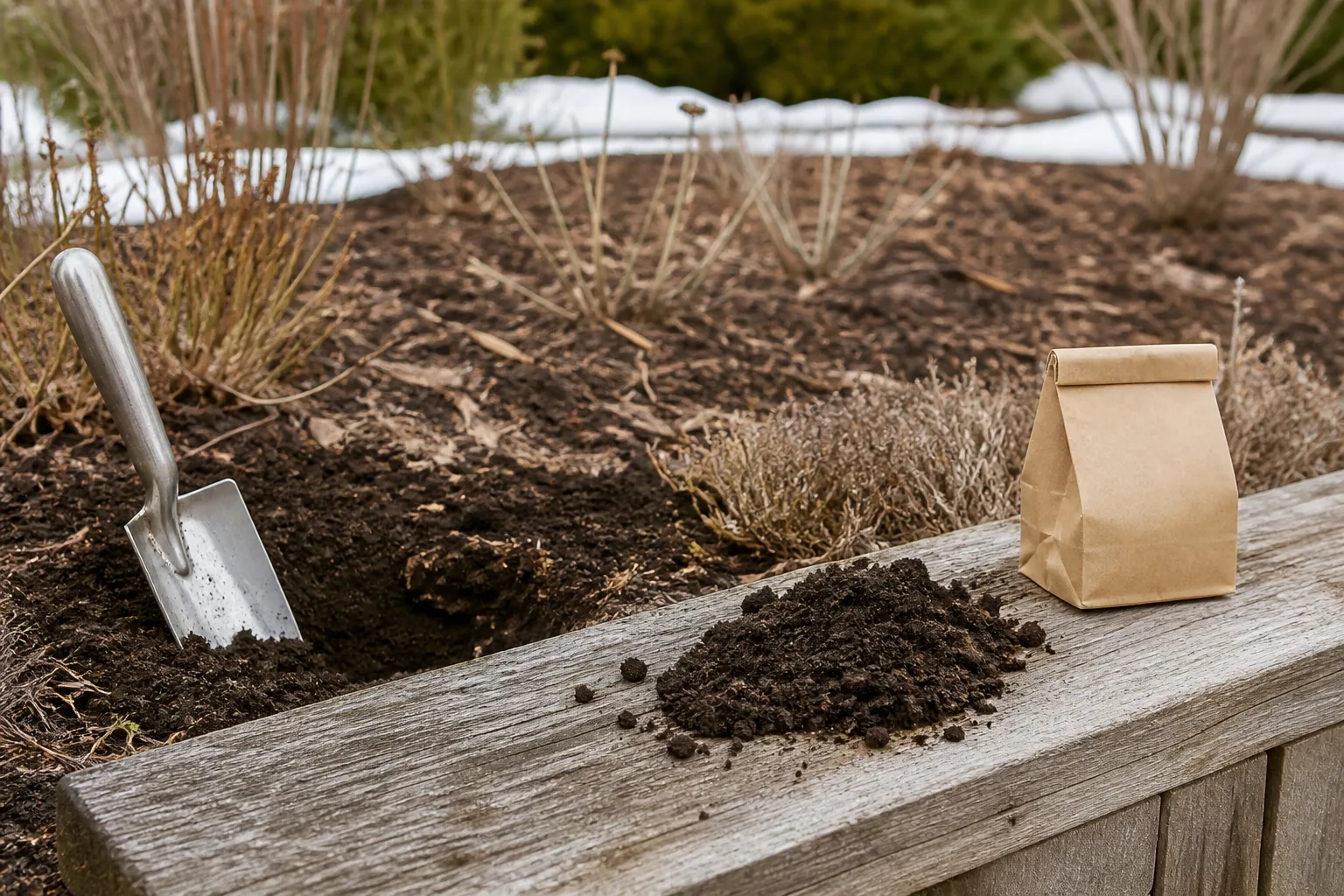
Follow the instructions from the lab that will analyze your sample. Most extension sampling directions ask you to collect multiple small cores from a consistent depth across one area, remove surface debris, mix the cores in a clean container, and submit the requested amount. North Carolina Extension’s local directions, for example, call for several random samples per area and a combined sample; depth and quantity instructions can differ among laboratories (North Carolina Cooperative Extension).
Avoid sampling directly from a compost pile, a fertilizer spill, a path edge, a soggy depression, or a single visibly unusual patch unless you are intentionally testing that spot separately. Do not use a rusty or dirty container that could contaminate the sample. Identify the intended crop or landscape use accurately on the submission form; a lab cannot tailor a recommendation to blueberries, turf, or vegetables if it does not know what is growing there.
Read the Lime Recommendation, Not Just the pH Number
The pH number tells you how acidic or alkaline the sample is; it does not, by itself, tell you the amount of limestone required to change the soil. Two soils with the same pH can need different rates because texture, organic matter, and cation-exchange capacity affect how strongly the soil resists a change. Colorado State Extension explains that laboratories use a buffer test and soil properties to determine the needed amount, which is why a generic online dose can be misleading (Colorado State University Extension).
Look for the report’s target pH, lime rate, units, and any assumptions about the liming material. A recommendation might be expressed per area and may assume a particular product or incorporation depth. If any part is unclear, contact the lab or county extension office and ask them to convert it for your bed size or product. Do not translate an agricultural field rate to a small garden by eye or assume all bags have identical neutralizing power.
Choose a Lime Product That Matches the Report
Start with the material type the lab recommends, then compare the label’s neutralizing value and particle-size information. Pure calcium carbonate is the reference point for neutralizing value; commercial agricultural lime can contain impurities, and its effectiveness depends partly on how much reactive material is present. UGA Extension describes chemical composition, fineness, and moisture as factors that affect the value and handling of liming material (University of Georgia Extension).
For a home garden, the safest shopping rule is to buy a clearly labeled agricultural or garden limestone from a known supplier and follow its directions alongside the soil report. When the test specifies magnesium, compare calcitic and dolomitic products. If the bag uses terms such as effective neutralizing value or calcium carbonate equivalent and the lab’s recommendation assumes a standard material, ask for a conversion instead of applying the same weight automatically.
Pelletized or Pulverized Lime: What Changes?
Pulverized lime is finely ground and can be dusty. Pelletized lime is generally fine limestone formed into larger granules to make it easier to spread through a rotary or broadcast spreader. Once the granules break apart, the underlying particle size and the product’s neutralizing value determine how it reacts; a pellet is not automatically stronger than a powder. Penn State Extension notes that the choice between pelletized and pulverized forms often depends on the spreader available, and that both can work when applied properly (Penn State Extension).
Choose a form you can distribute evenly without creating a cloud or piles. Fine material usually reacts more readily than coarse particles because more surface area is exposed, but that does not justify increasing the rate. If the product is too dusty for your setting, a pelletized formulation can make handling easier. The label, the lab recommendation, and the area to be treated matter more than whether the product looks like powder or pellets.
How Much Garden Lime Should You Apply?
Use the rate on the soil-test report, adjusted only as directed for the actual product and the area you plan to treat. There is no safe universal number of pounds per bed: the needed amount changes with initial pH, target pH, soil texture, organic matter, product quality, and sometimes the depth of incorporation. Colorado State Extension’s lime tables, for example, vary rates by texture and organic matter even when the goal is the same pH (Colorado State University Extension).
Measure the bed instead of estimating. For a rectangular area, multiply length by width; divide an irregular bed into rectangles or triangles and add the areas. Then scale the test recommendation to your measured area and its units. If a report recommends 40 pounds per 1,000 square feet and your bed is 250 square feet, the arithmetic gives 10 pounds for that bed, provided the recommendation is for the product and incorporation method you are using. That example shows how to scale a recommendation; it is not a general lime dose.
Do not apply a second round because the lawn still looks thin or the leaves are still yellow a few weeks later. Lime does not replace a nutrient test or diagnose a plant problem, and its reaction takes time. Applying extra before checking the soil again is one of the easiest ways to create an overly alkaline root zone.
When to Apply Garden Lime
The best time is the time that fits the lab recommendation, the planting calendar, soil moisture, and the product label. Applying before planting gives you a chance to incorporate the material into the intended root zone without disturbing established roots. Fall or early spring can be convenient in many climates, but there is no universal season that makes lime effective if the soil does not need it.
Avoid applying in strong wind, to dry dusty ground on a breezy day, or immediately before heavy rain that could move material off the target area. Moisture supports the gradual reaction, but there is no need to chase a storm. Grit describes applying lime before the first frost in fall as one practical schedule that may leave time before spring planting; use it as a possible window, not a rule that overrides a soil test or local conditions (Grit). If the garden is already planted, time any surface application for a calm day and take care not to coat foliage or pile material against stems.
How to Lime a New Garden Bed
For a new bed, first test the soil before adding compost, fertilizer, or lime so the lab can assess the actual site. Mark the boundary of the bed, remove surface debris, and use the recommendation for the plant group that will grow there. If the report says no lime is needed, spend your effort on drainage, organic matter, or another recommendation instead.
If lime is recommended, weigh or measure the amount for that bed and spread it as evenly as possible. For a small bed, divide the measured dose into two portions and broadcast one while walking in one direction, then the second across the bed at a right angle; this reduces streaks and heavy spots. Epic Gardening recommends this two-pass pattern as a way to distribute garden lime more evenly (Epic Gardening). For larger areas, use a spreader that is suitable for the product granule size and calibrate it over a known area with a measured quantity before treating the full bed.
Incorporate only as deeply as the soil report or local extension guidance recommends, and do it before planting when practical. Lime moves slowly through soil on its own, so mixing it through the intended soil layer can improve contact; an established planting cannot be tilled this way without damaging roots. Do not bury a concentrated pocket of lime in the planting hole or put it directly against a root ball. Apply the complete recommended amount to the soil volume the test was designed for.
How to Lime an Established Lawn or Landscape Bed
For established turf, use a soil-test recommendation that identifies the lawn as the crop and the existing soil depth. Broadcast the measured amount uniformly with a spreader suited to the material. Do not till lime into a lawn, and do not scatter extra product where the grass looks weak; the soil-test rate is the limit, not a starting point.
For planted landscape beds, a surface application may be the practical option when the test calls for lime and digging would damage roots. Pelletized material can be easier to place evenly around plants, but keep it off leaves and avoid piling it against stems or trunks. If the lab’s recommended rate assumes incorporation and you cannot incorporate without harming the planting, ask the lab how to adapt it before applying.
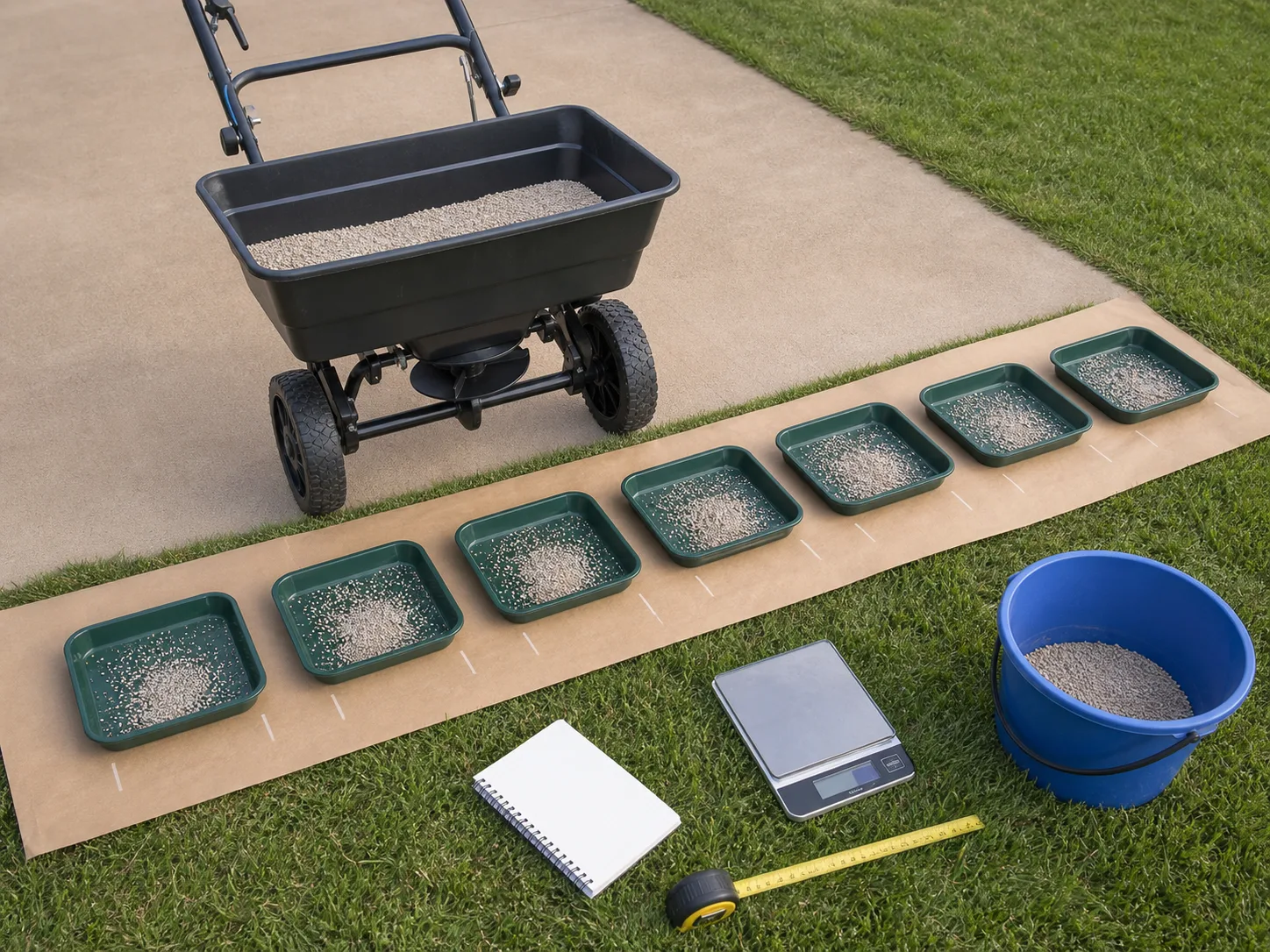
A spreader helps with even distribution, but it does not guarantee the correct dose. Measure the amount in the hopper, note the settings recommended by the manufacturer, and test the pattern over a small measured strip. Walk at a steady pace and avoid overlapping passes so one strip does not receive twice the intended amount.
Protect Nearby Plants and Handle Lime Carefully
Before spreading, identify nearby acid-loving plants and leave them outside the treatment area unless their own soil test calls for a pH change. A lawn may need lime while the adjacent blueberry bed does not. If two areas have different plants or test results, treat them separately and use a physical edge or clear boundary to avoid drift.
Read the entire product label before handling. Limestone dust can irritate eyes and airways, so wear gloves and eye protection, avoid breathing dust, and follow any label-specific protective equipment directions. Apply on a calm day, keep children and pets away while the product is being spread, and follow the label for when the area can be used again. Wash exposed skin and tools after use, and store the bag dry and closed so material does not spill or become difficult to spread.
Do not use quicklime or hydrated lime as a substitute for garden limestone. Their chemistry and causticity are different, and the extension guidance for garden use does not treat them as interchangeable. If a bag does not clearly identify an agricultural liming material, do not put it on a lawn, edible garden, or ornamental bed.
What to Expect After Applying Lime
Expect a gradual change, not an overnight green-up. Fine limestone can react more quickly than coarse material, and moisture and soil conditions affect the pace. NC State Extension notes that lime moves slowly through soil naturally; Georgia Extension explains that particle size affects how quickly it dissolves, with coarser particles taking much longer than fine material (North Carolina Cooperative Extension; University of Georgia Extension). A useful expectation is months rather than days, with the exact timing depending on the product and site.
Keep a record of the date, product, area, and amount applied. Follow the lab’s advice about when to test again, especially if the initial recommendation called for a large correction or staged application. Do not retest immediately and assume the final pH has already been reached; unreacted particles and uneven distribution can make an early sample unrepresentative.
If plants continue to show yellowing or poor growth after a reasonable interval, do not automatically add more lime. Check the pH and the rest of the soil report, then consider drainage, root damage, watering, pests, disease, and nutrient balance. High pH can itself cause iron-related chlorosis, so a symptom that persists after liming may be a reason to stop and retest, not to repeat the application.
Common Garden-Lime Mistakes to Avoid
The first mistake is treating a symptom as a soil diagnosis. Moss, weeds, yellow leaves, or a poor harvest can have several causes; none proves that the soil is acidic. A lab test is cheaper than correcting an assumed problem and then trying to reverse an avoidable pH shift.
The second mistake is copying a neighbor’s rate or using one pH target for the entire property. Soil types can change across a small yard, and blueberries, turf, vegetables, and ornamental shrubs may have different targets. Collect and interpret samples by management area, not by address.
The third mistake is confusing products or assuming one bag equals another. Calcitic and dolomitic lime contribute different minerals; hydrated and quicklime are not ordinary garden lime; and agricultural products differ in neutralizing value and fineness. Read the label and match the material to the soil report.
Finally, do not spread lime because a package calls it natural, because a calendar says “fall liming,” or because a previous application seemed harmless. The useful dose is the one backed by a current test, adjusted for your growing area and product. If the lab recommends no lime, the correct application rate is zero.
Conclusion
Garden lime is a tool for correcting acidic soil, not a routine treatment every landscape needs. A reliable soil test tells you whether the pH should change, which plants the recommendation applies to, and how much material to use. It also helps you avoid liming areas where the soil is already suitable or where acid-loving plants need lower pH.
Choose a labeled agricultural limestone that fits the report, distinguish calcitic from dolomitic material, measure the area, and apply the exact recommendation evenly. Give the amendment time to react, keep records, and retest before making another change. That cautious process is what makes garden lime useful: it solves a measured soil problem without creating a new one.



