Garden Tools: Types, Uses, and Buying Advice
Compare garden tools by task, fit, materials, and upkeep. Build a practical starter kit, choose pruners and digging tools, and keep them working longer.
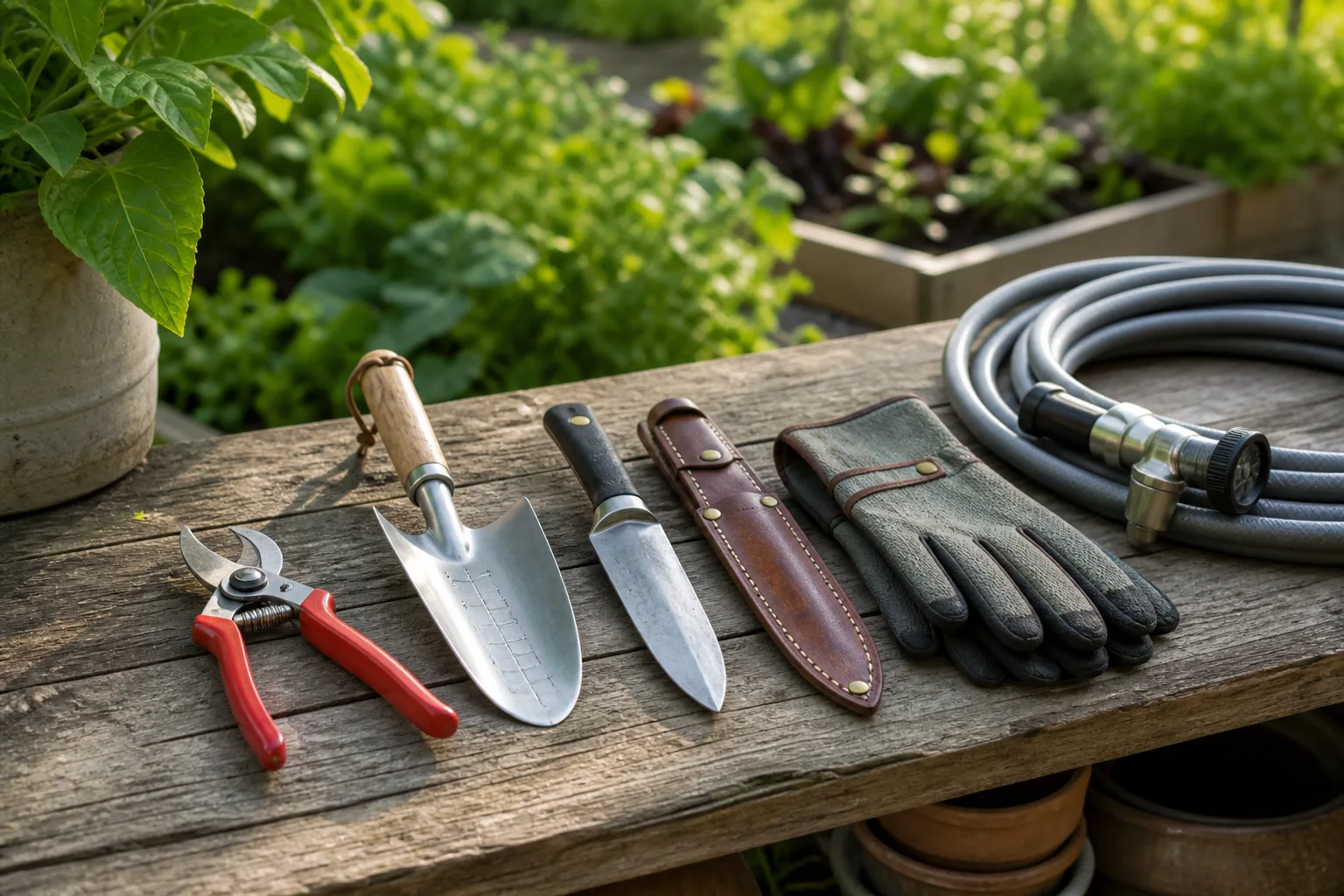
A useful garden kit is smaller than most store displays suggest. Start with the jobs you repeat, then choose tools that fit your soil, reach, grip, and storage space. A container gardener may need little more than a trowel, hand fork, pruners, and watering can; someone maintaining an in-ground bed may rely on a full-size spade, digging fork, hoe, and hose. The goal is not to own every tool. It is to make common work easier without forcing a tool to do a job it was not designed for.
Penn State Extension recommends judging tools by quality, material, weight, shaft length, handle shape, blade design, cost, and task. That framework is more useful than buying a large set based on how many pieces are in the box. This guide explains what each common garden tool does, what to check before buying, and how to keep your tools safe and serviceable.
Start with the jobs you actually do
Write down the gardening tasks you do in an ordinary month: planting seedlings, opening holes, loosening soil, pruning, watering, moving compost, or clearing leaves. Then note where the work happens. A narrow balcony bed favors compact hand tools; a long vegetable row makes a long-handled hoe more useful; a dry, compacted yard may call for a digging fork or sturdy spade rather than a thin hand trowel.
Frequency matters as much as the task. A tool used every week deserves a more careful fit and construction check than a bulb planter you will use twice a year. Also think about where it will live. A long shovel may be the right tool for a large bed but an awkward purchase if there is nowhere dry and secure to store it.
A small starter kit that covers repeat work
For containers or a small raised bed, start with gloves that fit, a hand trowel, a hand fork or cultivator, pruners if you grow woody plants, and a watering tool suited to the layout. Add a full-size shovel, rake, or hose only when the garden makes one genuinely useful. Buying these separately lets you choose the right handle and weight instead of accepting the weakest piece in a bundled set.
For an in-ground garden, a round-point shovel or spade and a digging fork cover deeper soil work; a hoe or hand weeder handles small weeds; bypass pruners take care of eligible stems. A sturdy rake and cart may be worthwhile in a larger yard, while a small patio may never need them. Fine Gardening and Savvy Gardening both emphasize tools that earn frequent use, including pruning tools and versatile hand tools, rather than a fixed universal kit.
Digging and planting tools
A trowel is for close, controlled work: planting small starts, filling pots, and digging modest holes in workable soil. A hand fork loosens mix and lifts small weeds without the broad cut of a trowel. For bulb planting, a dibber or bulb planter can save time when you plant many bulbs at a consistent depth, but it is unnecessary if you only plant a few and already own a trowel.
Long-handled tools transfer force differently. A spade has a relatively flat, straight-edged blade suited to slicing turf, shaping edges, dividing clumps, or turning soil. A round-point shovel has a more curved point that penetrates soil and moves it; it is a practical general digging tool when the job involves lifting or shifting soil. A garden fork has tines that open and loosen soil while passing around stones and roots more readily than a broad blade.
Spade, shovel, fork, and trowel are not interchangeable
Use a spade when you need a clean vertical cut or a defined edge. Choose a shovel for scooping and moving loose material or digging holes in ordinary soil. Use a fork when the ground is rooty, stony, or compacted enough that a blade binds, or when you want to loosen soil with less slicing. No tool makes wet, heavy soil easy: wait until it is workable if digging smears and compacts the soil around the blade.
The head-to-handle connection is a common failure point on digging tools. Look for a securely attached head, a shaft without cracks or splinters, and no loose movement when you apply moderate pressure. Step on the blade only if it has a safe, broad footrest and is designed for that kind of use. Do not use a shovel as a pry bar against rocks; leverage can bend the head or split the handle.
Cutting and pruning tools
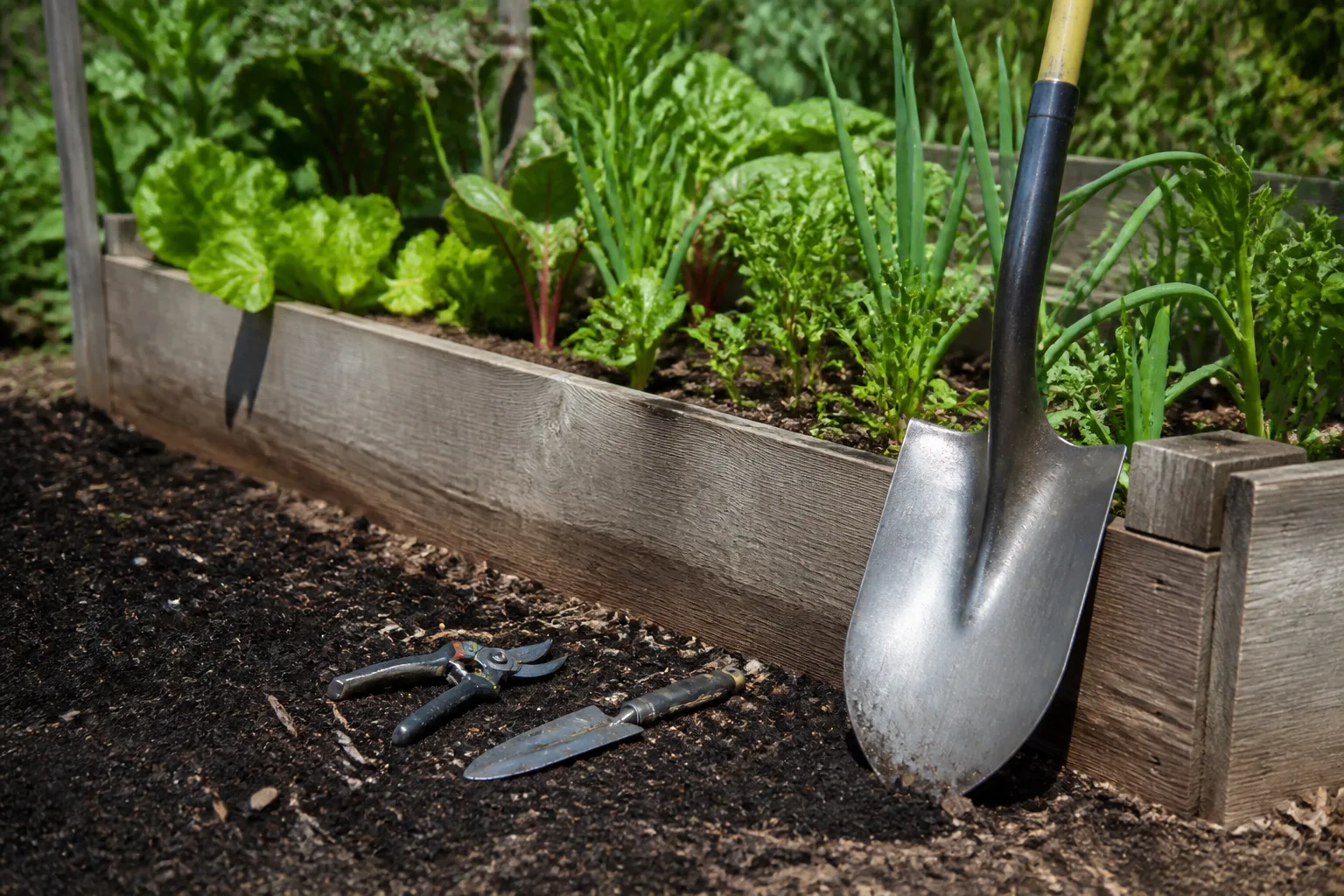
Hand pruners, also called secateurs or pruning shears, are for stems that fit fully between the blades and can be cut with a controlled squeeze. They are useful for deadheading, harvesting herbs, trimming small shoots, and removing appropriately sized branches. Check the manufacturer’s maximum cutting diameter, but treat that number as a limit for favorable wood and sharp blades, not a challenge. If a branch makes you twist, rock, or squeeze with both hands, switch to a tool made for thicker wood.
Bypass or anvil pruners?
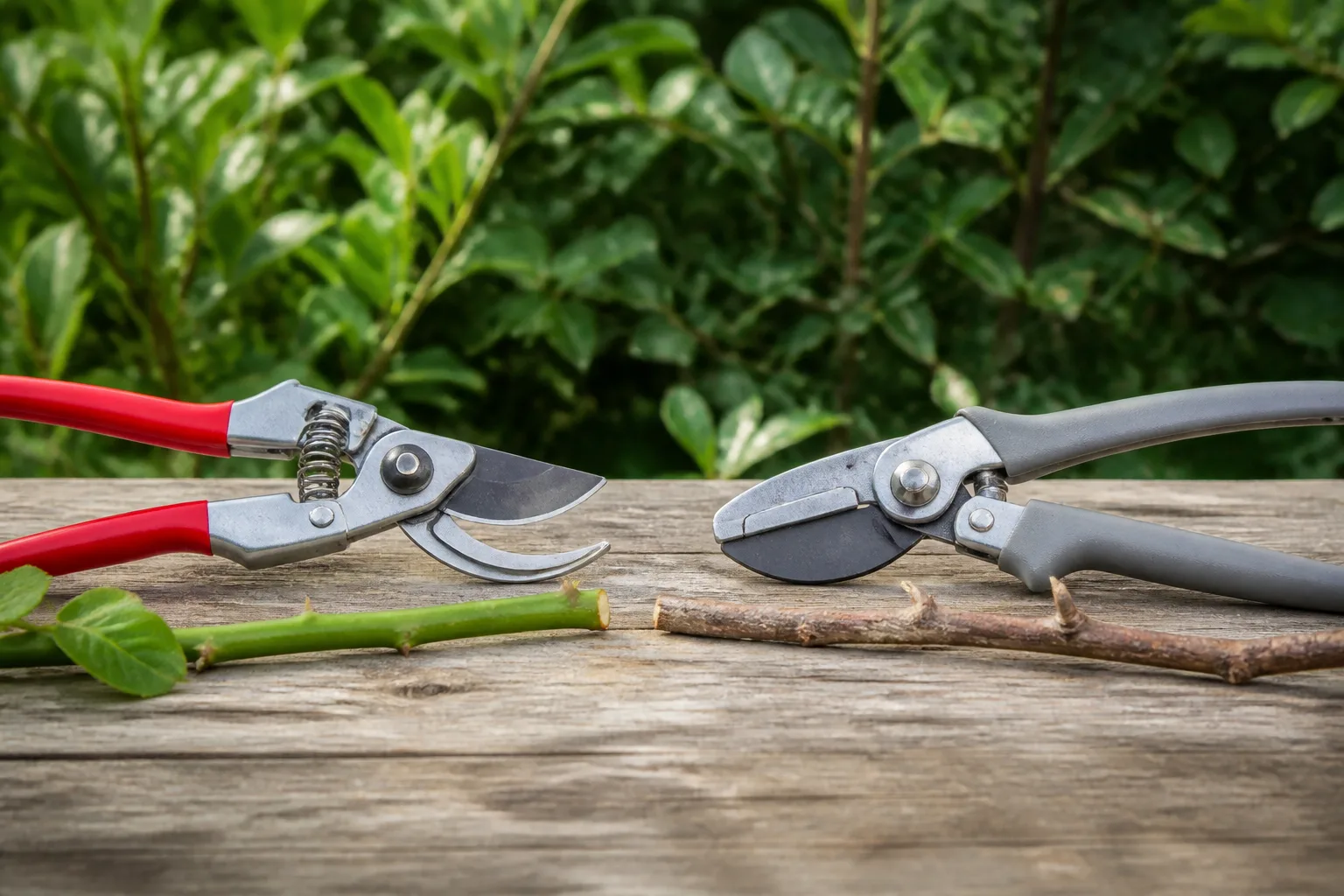
Bypass pruners have two blades that pass each other like scissors. They are usually the better choice for live green stems because a sharp, well-aligned cut is less likely to crush the tissue. Anvil pruners bring a blade down onto a flat surface; that action can be useful for dry deadwood but may bruise living stems. For a first pair used across ordinary pruning tasks, bypass is generally the more versatile style.
The pruner must also fit your hand. A tool that is too large can be hard to open fully; one that is too small may not give your fingers enough room around the handles. Check whether the lock is easy to reach without putting fingers near the cutting edge, whether the spring reopens smoothly, and whether replacement blades or springs are available if the model is designed to be serviced.
When to move up to loppers, saws, or shears
Loppers use longer handles to add leverage and reach for thicker branches. A pruning saw is a better option when a branch is too large for loppers or the cut binds. Hedge shears are made for shaping many small, similar stems across a hedge, not for making precise cuts on a few large branches. The right progression is to step up tool size as the wood gets thicker, rather than forcing a hand pruner beyond its capacity.
Use sharp tools with a stable stance and keep the cutting path away from your other hand and body. Do not cut overhead while standing on an unstable ladder or overreach to reach a branch. If work requires a chainsaw, tall ladder, or cutting near utility lines, stop and use a qualified professional. Powered pruners and hedge trimmers may help with repeated high-volume work, but their weight, guards, battery or cord needs, noise, and maintenance are part of the decision.
Weeding and soil-cultivation tools
A hand weeder or narrow hoe is useful for removing young weeds while their roots are small. A stirrup or scuffle hoe cuts just under the surface when pushed and pulled through loose soil, making it efficient between rows. A pointed hand hoe or cultivator is more practical where weeds are clustered among plants or the soil surface is crusted. Match tool width to the space: a broad head can cover a bed quickly but will be hard to maneuver close to seedlings.
A soil knife (often called a hori-hori) can combine digging, slicing, and light weeding in one hand tool. Savvy Gardening describes using one for bulbs, root-bound containers, and general garden tasks. That versatility is real, but a sharp blade is not the right choice for every gardener or job. Use its sheath, carry it securely, and keep it separate from casual hand tools; if you mainly weed seedlings in tight rows, a small forked weeder may give you more control.
For a large patch of perennial weeds, repeated surface hoeing may not remove deep roots. Identify the weed and choose a control method suited to its root system instead of buying a powered cultivator as a shortcut. Electric or gas cultivators can disturb soil quickly, but they may also chop roots into pieces, damage nearby plant roots, or be excessive for a small bed.
Watering tools that fit your layout
A watering can is simple and precise for pots, seedlings, and small beds near the house. A hose is more practical as the distance grows. A gentle rose or breaker on the nozzle reduces force for newly seeded areas, while a shutoff valve lets you pause without walking back to the faucet. A watering wand adds reach for deep containers and dense beds; it is less useful if it is too heavy when full of water or awkward to store.
Measure the route from the faucet to the farthest bed, including corners and obstacles, before choosing hose length. A very long hose can be heavy and difficult to coil; a short one that must be stretched tight can stress fittings and kink. Compare diameter, coupling quality, kink resistance, weight, and whether the hose needs to be drained and stored before freezing weather. If the hose routinely drags over sharp paving or is left under pressure, prioritize abrasion-resistant construction and accessible replacement fittings.
Lawn, leaf, and material-moving tools
A leaf rake gathers loose leaves without the aggressive action of a metal bow rake. A bow rake levels soil, spreads mulch, and breaks clods. Their heads are designed for different jobs, so buying one does not automatically replace the other. In a small ornamental bed, a hand rake may reach between plants with less risk of snapping stems than a full-size head.
A wheelbarrow or garden cart pays off when you regularly move compost, bags, prunings, pots, or tools across more than a short distance. Choose based on the route, not rated load alone: narrow gates, soft lawn, steps, and storage footprint determine whether a wheelbarrow or four-wheeled cart is easier to maneuver. For occasional light loads, a bucket or reusable tote may be enough. A mower, leaf blower, or powered trimmer should be matched to area size, noise tolerance, maintenance, and the task; avoid buying a machine simply because it bundles with a battery system you do not need.
Fit and ergonomics: the test most reviews miss
Weight printed on a package does not tell you whether a tool feels manageable after repeated use. Handle length, grip diameter, head balance, spring resistance, and the angle of your wrist all affect comfort. Penn State Extension notes that lighter tools can be easier to use for longer periods and that long shafts can add leverage on digging and weeding tools. But longer is not always better: a shaft that hits nearby walls or plants, or forces an awkward wrist angle, is the wrong fit for that space.
Check grip, balance, and reach before you buy
If possible, hold the tool in the position you will actually use it. For pruners, open and close them several times; your fingertips should not be crowded, and the lock should operate without awkward repositioning. For a shovel, put one hand at the end of the handle and one lower on the shaft, then mimic a lift without striking the floor. For a trowel, check that the grip does not dig into your palm when the blade is tilted.
Left- and right-handed gardeners should check whether the tool is symmetrical or made for a specific hand. If grip strength or wrist mobility is limited, look for lighter models, rotating handles, ratcheting mechanisms, or tools that reduce bending, but test the mechanism: a complicated latch or weak ratchet can add frustration. Take breaks and switch tasks when your grip becomes tired. A tool that feels acceptable for a few trial squeezes may still be unsuitable for long sessions, so buy from a seller with a clear return policy when you cannot test it in person.
Materials, construction, and repairability
Garden tool heads are commonly made from carbon steel, stainless steel, or other alloys. Carbon steel can be strong and easy to sharpen, but it needs to be dried and protected from rust. Stainless steel resists rust better, although its performance still depends on steel quality, thickness, heat treatment, and construction. A coating can slow corrosion but may wear at the edge or where soil abrades the surface.
Handle materials have trade-offs too. Wood can be comfortable and replaceable, but it may dry, split, swell, or loosen if stored wet. Fiberglass and other composites need less routine care but should be checked for cracks or splintering. Metal handles are sturdy in some designs but can be heavy or cold to grip. On a small tool, inspect how far the tang extends into the handle and whether the head is securely fastened; a polished blade does not compensate for a weak joint.
Check for replaceable blades, springs, bolts, handles, and standard fasteners before buying a frequently used tool. A repairable tool can stay in service after a blade dulls or a handle wears, while a sealed tool may be easier to use but impossible to fix. Penn State Extension advises weighing materials and maintenance alongside cost, and Fine Gardening underlines that even a well-made steel tool performs poorly when sap and rust accumulate.
How to read garden tool reviews
Look for a review that names the task, the conditions, and the length of use. A pruner review that only describes its grip after a few cuts does not tell you whether the blades stay aligned, the spring holds up, or the tool can be cleaned. A shovel review should identify the soil and load; a hose review should explain length, pressure, fittings, and how it behaves when dragged around corners.
Separate objective specifications from the reviewer’s preference. Cutting capacity, handle length, tool weight, material, warranty, replacement parts, and return window are checkable facts. Comfort, balance, and how a handle feels are subjective and may differ with hand size, strength, and technique. A claim such as “unbreakable” is not useful without knowing how the product was used and what the warranty excludes.
Compare several reviews for repeated failures: a loose head, a pruner that jams, a hose coupling that leaks, or a grip that becomes slick when wet. Be cautious with reviews that do not disclose affiliate relationships, combine unrelated items into a ranking without a clear method, or show only a product’s first impression. If a tool is sold in different sizes or left- and right-handed versions, confirm the exact variant being reviewed.
Clean tools after use and disinfect when needed
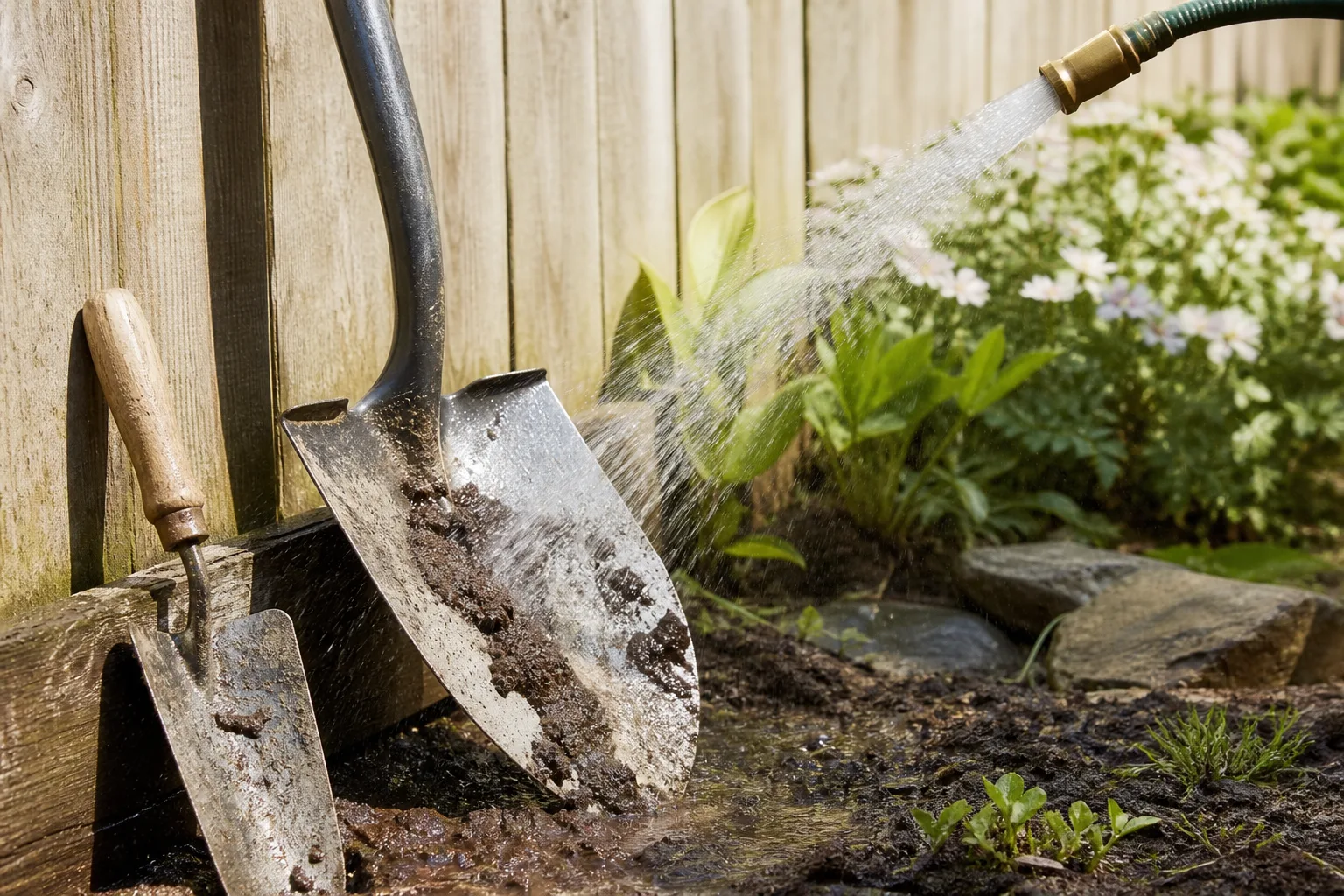
After digging, brush soil from the head and shaft before it dries. If mud remains, rinse the metal, then dry it rather than putting a wet tool away. For pruners and other cutting tools, remove sap and plant residue so the blades close fully. The Royal Horticultural Society recommends cleaning hand tools regularly, keeping them dry, and oiling pivots; its guidance also explains that tools contacting contaminated soil or diseased plant material should be cleaned and disinfected to reduce disease spread.
Disinfection is not necessary after every ordinary cut in a healthy garden, but it is sensible when moving from a plant with suspected disease to a healthy one, after handling contaminated soil, or when propagating material that must remain clean. First remove visible dirt and sap, because debris can interfere with contact. Then use a product labeled for the intended tool and follow its dilution and contact-time instructions; wipe and dry the tool afterward, and oil the pivot if appropriate. Do not mix cleaning products or assume that a quick wipe of a dirty blade is equivalent to proper disinfection.
For routine care, keep a stiff brush, cloth, and small bottle of suitable lubricant near the tool storage area. Clean pruning tools between visibly diseased plants rather than waiting until the end of the day. Clean spades at the site if you are trying to avoid carrying soil from one bed to another. These small habits take less time than removing dried dirt or trying to free a stuck pivot later.
Sharpen cutting and digging edges safely
A dull blade needs more force and can slip or crush plant tissue instead of cutting cleanly. Inspect the edge first: a dirty or sticky blade may seem blunt when it mainly needs cleaning. If a pruner is adjustable or disassembles, consult its manufacturer’s instructions before removing the pivot. Work on a stable surface, keep the cutting edge pointed away from your hands, and use eye protection when filing metal.
For a bypass pruner, sharpen the bevelled cutting blade while preserving its original angle; do not grind the flat face as if both sides were identical. Remove only a small amount of metal, then clear any burr and test the tool on an appropriate stem or paper away from your body. Oil the pivot after reassembly. The RHS recommends suitable files for hoes and spades and sharpening stones or diamond sharpeners for pruning tools, while warning that some damaged edges are better handled by a professional.
Do not sharpen a tool that is cracked, badly bent, loose at the joint, or beyond the manufacturer’s service guidance. A sharper damaged tool can be more dangerous without fixing the structural failure. For expensive saws, shears, or tools with a complex blade geometry, professional sharpening may preserve the edge better than an improvised file job.
Store tools so they stay usable
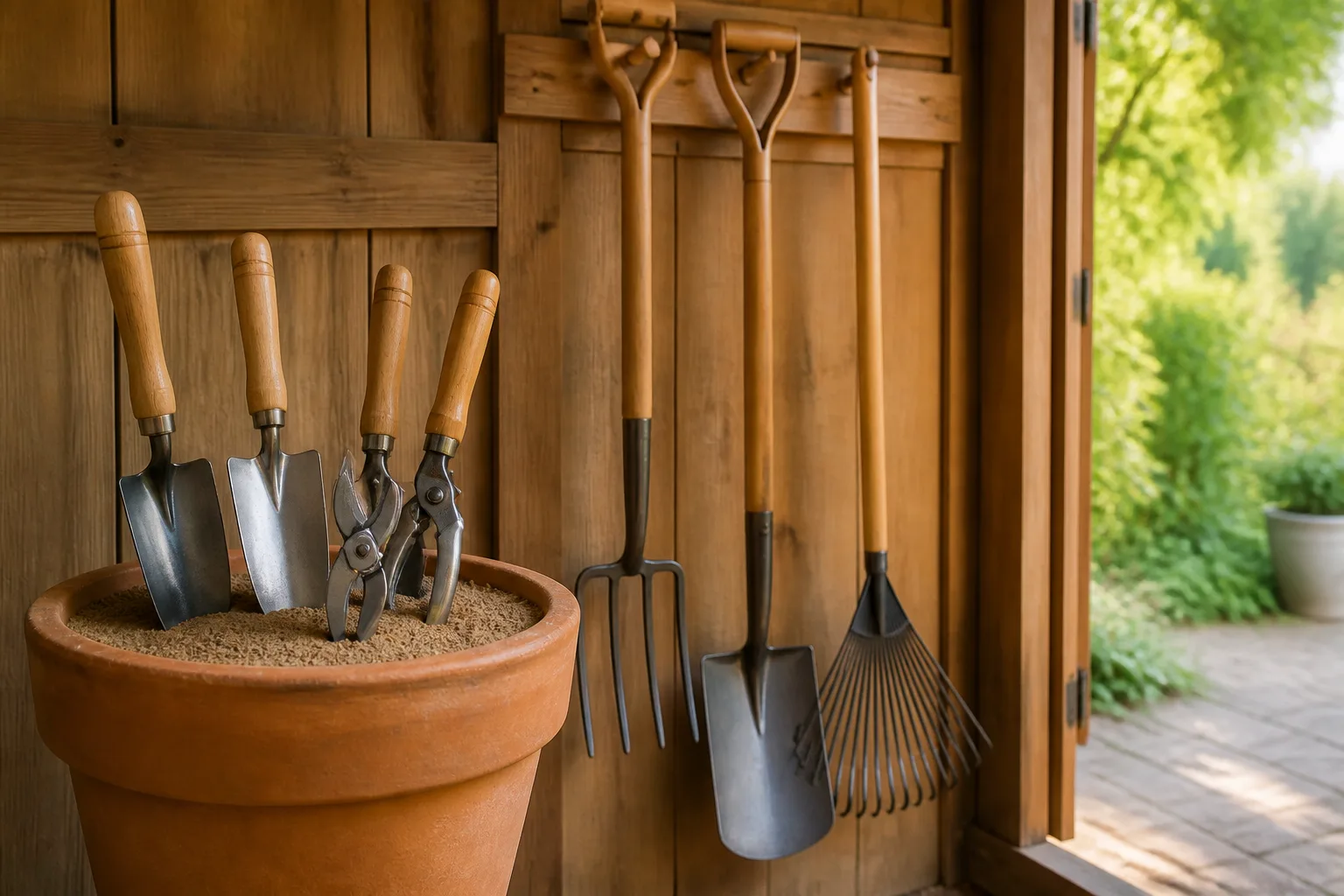
Brush, dry, and inspect tools before storing them. Hang long-handled tools where their heads cannot fall into a walkway, and keep pruner blades closed or sheathed. Store tools under cover in a dry place; avoid leaving metal heads in soil or a wet bucket. If a tool has a wooden handle, let it dry before storing it and check for cracks or looseness before the next use.
Before winter or a long break, clean and dry metal surfaces, add a thin protective film of appropriate oil where the manufacturer allows it, and oil moving joints. Do not coat handles with products that make them slippery. Keep sharp edges away from children and pets, and store powered equipment with its manual, charger, and safety guards together. A simple wall rack or tool caddy also makes missing or damaged tools easier to notice before you head outside.
Conclusion
Choose garden tools by the work they must do and the person who will hold them. A modest kit of well-fitting, maintained tools is more useful than a crowded shed of mismatched gadgets: start with repeat tasks, check construction and repairability, then add specialized or powered equipment only when it solves a recurring problem. Clean tools when the work is done, disinfect when disease transfer is a concern, sharpen edges before they force you to strain, and store everything dry and secure. These habits make your purchases safer and more dependable across many seasons.