Insect Identification and Control for Garden Plants
Identify garden allies and pests by appearance, life stage, and feeding signs, then choose targeted controls that limit damage and protect helpful insects.
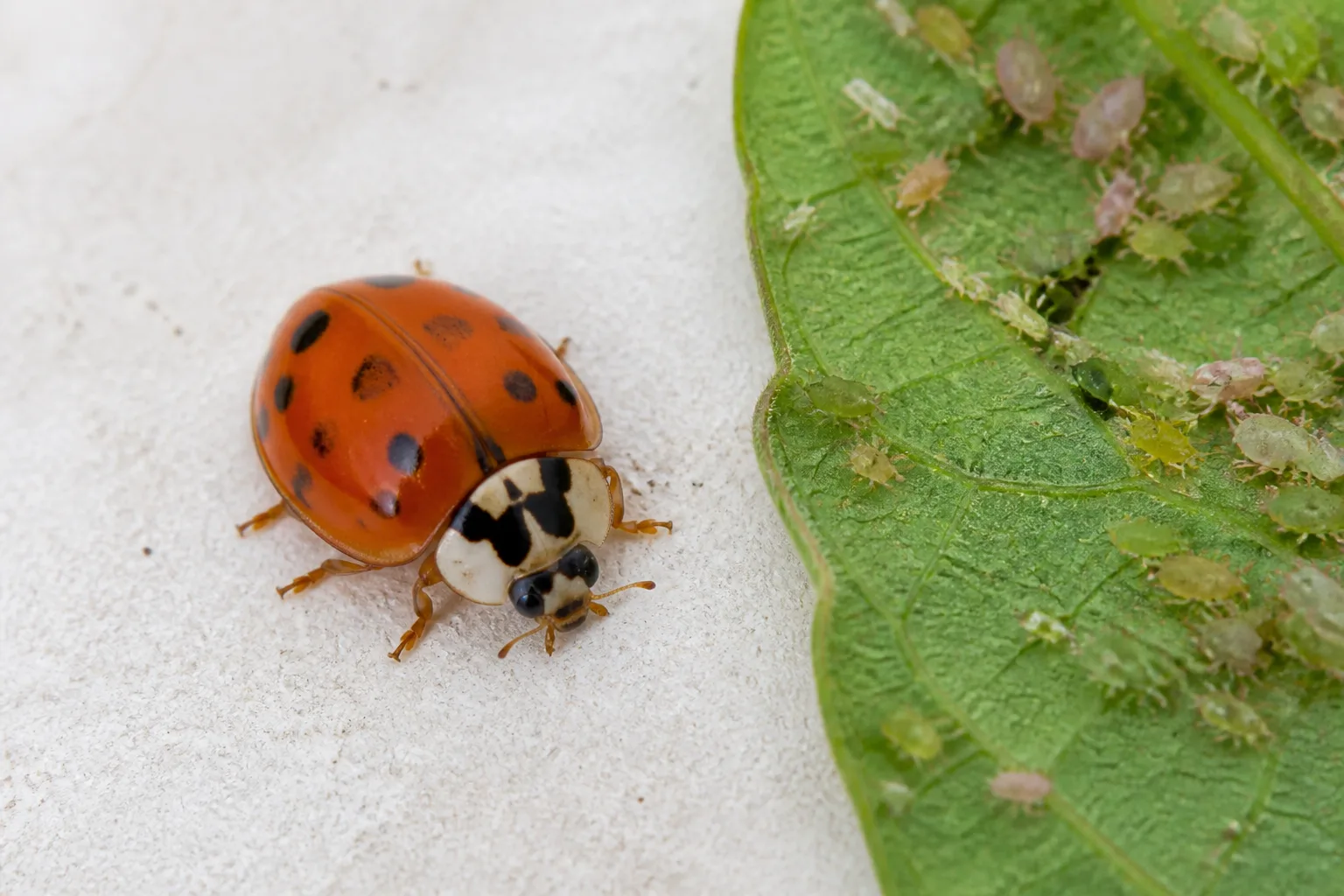
A bug on a leaf is not automatically a pest. It may be feeding on aphids, pollinating a flower, laying eggs, decomposing plant matter, or simply passing through. Before you spray or crush anything, look at the plant, the type of damage, and what the insect is doing. Those clues are usually more useful than color or a quick guess from one photograph.
This guide focuses on common garden allies and the pests gardeners most often need to manage. It also gives you a practical decision path: identify the likely role, check whether damage is spreading, use the least disruptive control that fits, and protect the insects doing useful work. If an insect is unfamiliar and the stakes are high, take a clear photo and ask a local extension service for identification; species and timing vary by region.
Start identification with the plant and the damage
Begin by recording four things: the plant species, where the insect is sitting, what it is doing, and what the plant looks like. Check both leaf surfaces, stems, buds, and the soil line. An insect on a flower may be collecting nectar; one tucked among aphids may be hunting; an insect on a chewed leaf may not be the one that made the hole. Look for fresh frass, sticky honeydew, stippling, webbing, eggs, shed skins, or a line between the insect and the injury.
Then check the life stage. Eggs, larvae, pupae, and adults can look unrelated, and some of the strongest aphid predators are larvae that people mistake for pests. A useful identification photo includes the whole insect, a close view of its body, the plant, and the damage. Add your location and the date. If there is no visible injury and the insect is not threatening people, pets, or a crop, watch for a few minutes before intervening. Behavior often resolves an uncertain identification better than a color pattern.
Beneficial insects and common pests at a glance
“Beneficial” describes a role, not a permanent label for every individual. Predators consume other arthropods; parasitoids develop in or on a host and eventually kill it; pollinators carry pollen while visiting flowers; decomposers help break down organic matter. Some animals that help the garden, including spiders and predatory mites, are not insects, but they belong in an insect-control guide because they affect the same food web.
| What you see | Likely role | What to check next |
|---|---|---|
| Round beetle or dark, spiny larva among aphids | Lady beetle predator | Look for aphids and eggs nearby; larvae do not resemble adults |
| Pale green, long-winged adult or narrow larva with jaws | Lacewing; larvae hunt small pests | Look for stalked eggs and prey on leaf undersides |
| Yellow-and-black insect hovering over flowers; legless larva on foliage | Hoverfly; adult visits flowers, larva may eat aphids | Count wings and look for aphids where the larva is feeding |
| Tiny fast bug among blossoms or in leaf crevices | Possibly minute pirate bug | Use a close photo; several small true bugs look alike |
| Ragged or skeletonized leaves, holes, stippling, or sticky leaves | Possible pest injury | Identify the host plant and inspect at dawn or dusk |
| Insect visiting flowers with no visible damage | Often a pollinator or nectar feeder | Observe rather than treating the flower visitor |
This is a starting point, not a complete field key. Extension guides such as Colorado State University Extension’s overview of beneficial insects and other arthropods and University of Minnesota Extension’s yard and garden insect guide show why host, behavior, and life cycle matter alongside appearance.
Lady beetles: useful adults, easy-to-miss larvae
Many lady beetles eat aphids, scale insects, mealybugs, or mites. Adults are usually round or oval and domed, but color and spot count vary widely. Their larvae are more easily overlooked: they have elongated, segmented bodies with dark coloring and orange or yellow markings, and they crawl on foliage while feeding. You may also find small clusters of yellow eggs on a leaf near a colony of prey.
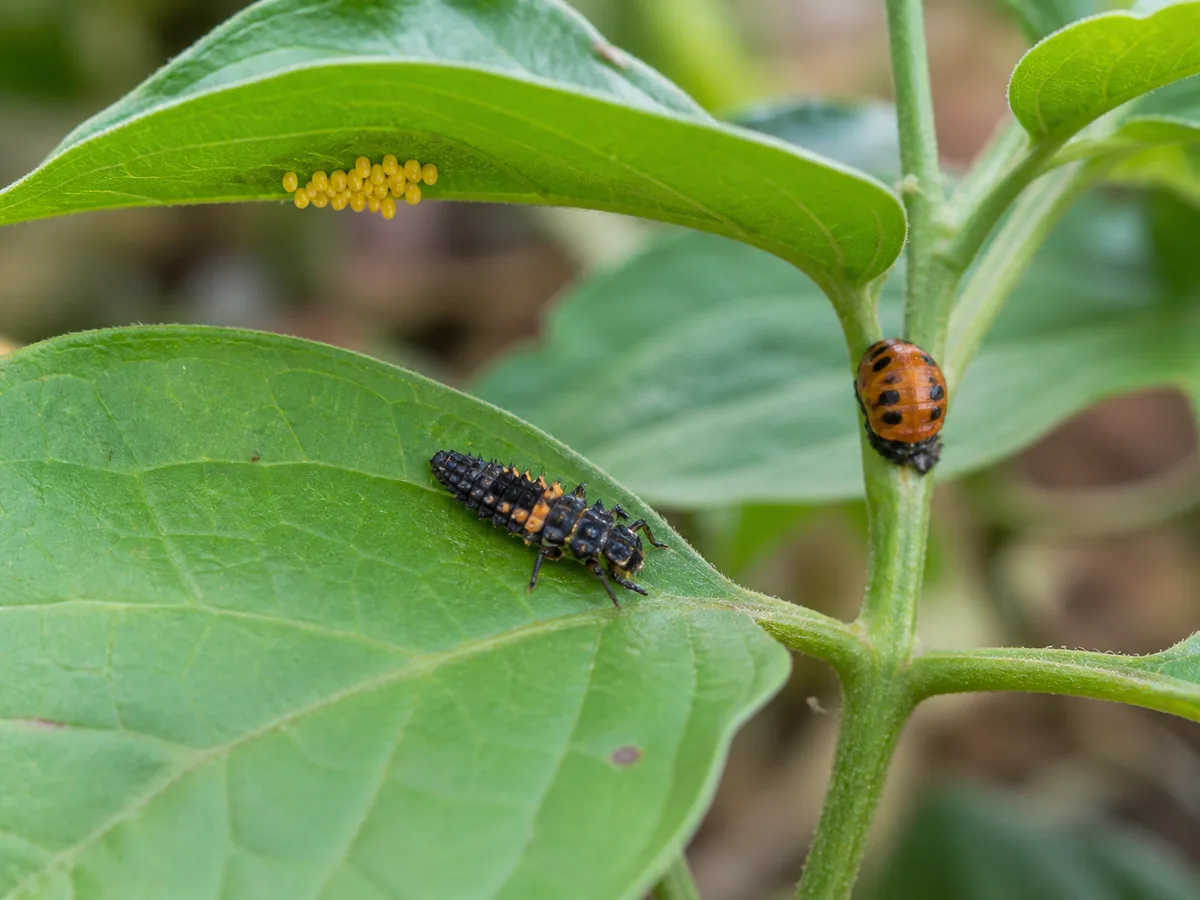
A photo of a bright red beetle is not enough to prove it is an ally. Mexican bean beetles, for example, feed on bean leaves; their larvae are yellow and spiny, and their damage is on the plant rather than an aphid colony. Lady beetles are diverse, so do not identify one by counting spots alone. Colorado State University Extension describes the contrasting larval forms and notes that both adult and larval stages of many species prey on soft-bodied insects; University of Arizona Cooperative Extension also identifies lady beetles among beneficial insects. If you find a predator among a small aphid population, monitor for a few days before removing it or spraying the plant.
Green lacewings and their predatory young
An adult green lacewing is pale green, delicate, and marked by clear, finely veined wings held rooflike over its body. Adults commonly feed on nectar, pollen, or other fluids. The young are the hunters: lacewing larvae have narrow, tapered bodies and prominent curved jaws that help them seize aphids, small caterpillars, and other soft-bodied prey. They may look like tiny alligators moving across a leaf.
Lacewing eggs are another clue. They sit at the end of hair-thin stalks, often on the underside of foliage. The stalks keep eggs separated from predators and each other. If you see the eggs, leave that patch undisturbed unless the plant is facing serious, increasing injury. Colorado State Extension reports that larvae emerge within several days to about a week and a half, depending on conditions; the visible eggs are therefore a sign to recheck the plant soon, not a reason to apply a broad treatment now.
Hoverflies: pollinating adults, aphid-eating larvae
Hoverflies, also called flower flies or syrphid flies, often imitate bees or yellowjackets with yellow-and-black markings. Their behavior and body shape help separate them: an adult can hover in place, dart, and land on flowers, and it has one pair of wings like other flies. A bee has two pairs of wings, though they may overlap visually, and a wasp tends to fly with a more direct, purposeful pattern. Do not grab an insect to test its identity.
The larva is a legless, tapered maggot that may be green, brown, or translucent. Some species crawl through aphid colonies and consume them. This life-stage switch is useful to remember: an adult sipping nectar is not the same thing as the larva hunting on a stem. A larva among aphids is a good reason to pause and watch. Colorado State University Extension notes that syrphid larvae can be especially helpful early in the season, when cooler weather may slow other predators. Avoid spraying flowering plants simply because a hoverfly is present.
Ground beetles, predatory bugs, and spiders
Ground beetles are often shiny, dark, and quick-moving. During the day many hide under leaf litter, boards, mulch, or stones; at night they hunt along the soil surface. Their prey can include insects and other small animals that spend time on the ground. Leaving a modest, undisturbed habitat edge can support them, but keep mulch away from stems that need to stay dry and do not create hiding places against a building foundation.
Several true bugs are predators. Minute pirate bugs, damsel bugs, assassin bugs, and ambush bugs use piercing mouthparts to feed on other insects or mites. Their small size and lookalikes make a photo useful; some plant-feeding true bugs can appear similar at a glance. Spiders are also predators, though they are not insects. Web-builders intercept flying prey, while wolf, crab, and jumping spiders hunt without a web. They may catch a pollinator as well as a pest, so think of them as part of a functioning food web rather than a perfect pest-control service.
Parasitic wasps and tachinid flies
Some garden allies are visible only through what they leave behind. Tiny parasitoid wasps lay eggs in or on specific hosts. Aphids that have been parasitized often become swollen, tan or brown “mummies,” sometimes with a neat exit hole. If you see round, papery aphid shells in a colony, predators or parasitoids may already be reducing it. Avoid scraping off every mummy if the infestation is otherwise stable.
Tachinid flies are bristly flies whose larvae develop in other insects. White eggs on a caterpillar or small cocoons attached to a hornworm can signal parasitoid activity. The host may still be alive when you first notice the evidence, so wait and reassess before removing it unless the crop is suffering substantial loss. Parasitoids are not identical to plant-feeding parasites: their host is another animal, not the garden plant. Their effects are often specific to host groups, which is why an unfamiliar egg cluster or cocoon should be identified before you treat the plant.
Bees, butterflies, moths, and other pollinators
Pollinators move pollen between flowers as they forage. Bees are important visitors, but flies, butterflies, moths, beetles, and some wasps also visit blooms. A pollinator on a flower is not evidence of a pest infestation. Watch whether it moves from flower to flower and whether the plant itself shows feeding injury. For most flower visitors, the useful response is to keep the bloom accessible and avoid insecticide exposure.
Some pollinators can leave minor, visible marks. Leafcutter bees cut neat semicircles from leaf edges to line their nests; they are collecting material rather than eating the whole leaf. If the plant remains vigorous, those clean cuts usually do not justify control. On the other hand, a bee or wasp nest in a high-traffic location raises a different safety question from an insect foraging in a flower bed. Keep distance, do not block an active entrance, and seek local identification before disturbing a nest.
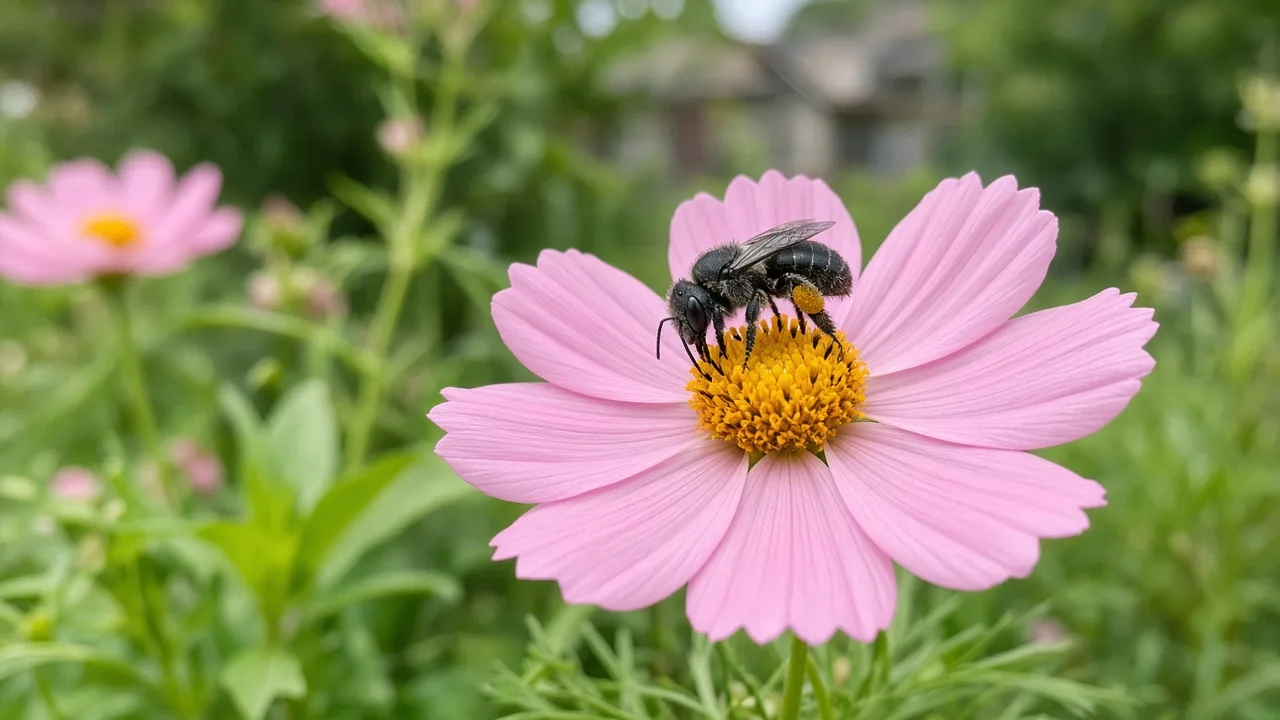
Pollinator roles and predator roles can overlap in complicated ways. Mantids and some other generalist predators may catch a pollinator as well as a pest. That does not make them “bad bugs,” but it does mean no single insect should be treated as a guaranteed, selective control agent. Gardening Know How’s overview of pollinator predators makes this ecological trade-off clear; prioritize habitat and targeted decisions over promises that one predator will eliminate every pest.
Decomposers and the less obvious garden crew
Not every useful animal directly protects a leaf. Many beetles, fly larvae, springtails, mites, and other small soil organisms feed on dead plant material, fungi, or other organic matter. Earthworms and woodlice are not insects, but they also participate in decomposition. They help fragment organic material so it can be processed by the soil community; they do not replace balanced watering, healthy soil structure, or composting.
Ants are a mixed case. Some move seeds or scavenge, while others protect aphids and scale insects to collect honeydew. If ants are traveling up a plant, check for aphids or scale rather than assuming the ants are chewing the plant. A small ant trail is not automatically a reason for pesticide. Address the plant-feeding insects only if they are causing meaningful damage, and avoid broad treatments that also kill predators visiting the same plant.
Identify likely pests by the damage they leave
Aphids cluster on new growth and leaf undersides; their feeding can curl tender leaves and leave sticky honeydew. Whiteflies flutter up when a plant is disturbed and gather underneath leaves. Thrips are slender and difficult to see; their rasping and scraping can leave silvery scars or black specks. Spider mites are arachnids, not insects, and may cause stippling, fine webbing, or bronzing during hot, dry conditions. These clues narrow the search, but none proves a species on its own.
Chewing pests leave a different pattern. Caterpillars may leave missing sections, ragged holes, frass, or skeletonized leaves; beetles may create small round holes or lace-like feeding, depending on the species. Mexican bean beetle injury is most relevant on beans, while flea beetles make many tiny “shot holes” on susceptible crops. Look under leaves and around the plant at dawn or dusk if the culprit hides during the day. A photograph of the insect plus the affected plant is much more diagnostic than damage alone.
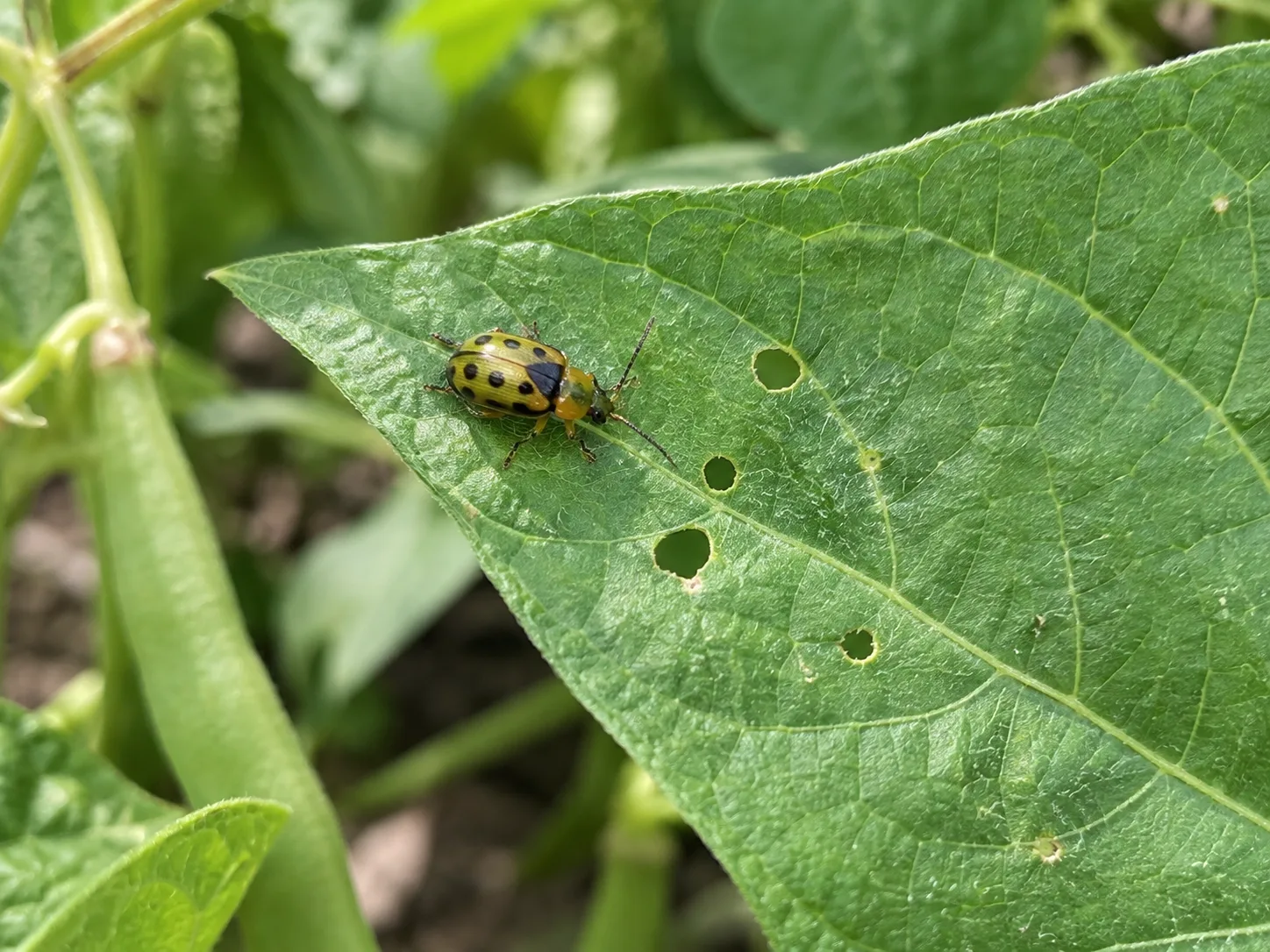
Before naming a pest, rule out non-insect causes. Wind, hail, sun scorch, nutrient stress, drought, overwatering, and disease can all mimic insect damage. If damage appears on many plants at once or follows a weather event, inspect the growing conditions as well as the foliage. Treatment aimed at an insect will not repair abiotic injury and can add stress without solving the problem.
Lookalikes that cause mistaken treatments
The most costly misidentifications often involve immature insects. A lady beetle larva is dark and spiny; a lacewing larva is slimmer and carries conspicuous jaws. Both can be found near aphids, but the shape of the head and how the insect moves provide clues. A row of tiny yellow eggs could belong to a predator, a pest, or another insect entirely; do not assume eggs are harmful until you know what they are.
A yellow-and-black hoverfly can resemble a stinging wasp, and a leafcutter bee’s leaf cuts can resemble chewing damage. An adult lacewing resting on a wall is not evidence that it is eating the house or plant. Even familiar groups include exceptions: not every lady beetle eats pests, and not every beetle on a crop is beneficial. When the match is uncertain, use a local extension office, state insect diagnostic service, or a reliable field guide. Include the state or region, plant, season, and a close photo with scale; the same common name can cover different species across the country.
Decide whether the damage needs control
A few aphids on a mature ornamental or a handful of leaf holes on vigorous plants may be tolerable. A spreading colony on new shoots, repeated feeding on seedlings, damage to the edible part of a crop, or injury to a plant that is already stressed deserves closer attention. The threshold depends on what you are growing and what you are trying to protect. A cosmetic mark on a shrub has a different cost from a pest destroying a newly planted vegetable row.
Check whether the damage is increasing and whether natural enemies are present. Take a quick count on the same representative leaves or plants, then repeat the check after a few days. If the pest population is flat or declining while predator larvae, parasitized aphids, or fresh growth appear, wait and monitor. If injury is spreading faster than the plant can replace tissue, intervene. There is no single insect count that works for every crop, region, plant stage, and gardener’s tolerance; avoid treating on sight alone.
Use an integrated, low-disruption response
Integrated pest management (IPM) starts with correct identification and monitoring, then combines prevention and targeted control. For a home garden, the practical sequence is: confirm the pest, judge the damage, correct conditions that favor it, use physical removal or exclusion where feasible, conserve natural enemies, and consider a pesticide only if the earlier steps do not protect the plant. The goal is acceptable plant health, not a garden with no insects.
Start with physical and cultural controls
For a small, localized colony, prune and discard the most infested tips, or dislodge aphids with a firm stream of water if the plant can tolerate it. Handpick confirmed pest beetles or caterpillars and drop them into soapy water away from the bed; wear gloves for unknown insects and never handle stinging species. For seedling crops, floating row covers can exclude some adult pests, but install them before the pest arrives and remove them when flowers need pollination or when heat could build up under the cover.
Correct the cause when it is cultural: remove badly infested crop residue at the end of the season, avoid excess nitrogen that produces unusually tender growth, and water consistently so drought-stressed plants are less vulnerable. Rotate susceptible vegetables and use physical barriers only where they fit the crop’s pollination needs. Do not apply homemade soap, oil, or detergent mixtures casually; concentration and plant sensitivity vary, and sprays can injure foliage or contact beneficial insects.
Give natural enemies time to work
When a pest is present with active predators, do not automatically remove every insect. Mark or photograph the affected plant, avoid spraying that patch, and check again in a few days. The delay is not always appropriate: protect young transplants, rapidly declining plants, or crops with serious food-quality damage. But when injury is minor and the pest is already being hunted, patience can prevent a second problem caused by killing the control agents.
Natural enemies work best when they can find both prey and adult food sources, and when the garden avoids repeated broad-spectrum treatments. They may not arrive in enough numbers to control every outbreak. Bought beneficial insects can also disperse, arrive at the wrong life stage, or lack suitable prey and habitat. Before purchasing them, identify the target pest and confirm that the species and release conditions are appropriate for your region; do not treat a release as a substitute for scouting.
If needed, narrow pesticide exposure
If a pesticide is justified, first confirm that the product is labeled for the plant, pest, and site. Follow the label exactly, including protective equipment, application rate, re-entry interval, and any restrictions on flowering plants or pollinator activity. A product described as natural or organic can still harm beneficial insects. Avoid treating open flowers or spraying when pollinators are foraging; drift can reach plants you did not intend to treat.
Choose the narrowest effective method and treat only the affected plant or area when the label permits. Recheck the pest and new growth before repeating an application. Do not mix products or increase a rate to “make it work.” Colorado State Extension advises checking for existing predators and parasites before insecticide use and choosing more selective options when treatment is necessary. If the pest remains unidentified or the product choice is unclear, pause and contact a local extension office rather than guessing.
Build habitat that supports beneficial insects
A useful insectary is not a single “magic” flower. Plant a mix that offers small, accessible blooms and nectar over a long season, with species suited to your climate and soil. Sweet alyssum, dill, cilantro allowed to flower, yarrow, fennel, and other small-flowered herbs or native plants can support different insects. Choose regionally appropriate, noninvasive plants; a list that works in a dry Southwest garden may fail in a cool, wet climate. Growing in the Garden’s guide to plants for beneficial insects and pollinators offers practical examples such as alyssum, dill, chamomile, and yarrow, while extension advice can help adapt choices locally.
Flowers are only one resource. Keep some undisturbed leaf litter or stems where safe, avoid clearing every patch of bare ground if native ground-nesting bees use it, and provide water in a shallow, stable dish with stones or textured edges so insects can land. Leave room for crop rotation and sanitation: supporting predators does not mean keeping diseased plants or heavily infested debris. A diverse garden can make it easier for natural enemies and pollinators to persist, but it does not guarantee that pests will stay below a damaging level.
A simple weekly insect-scouting routine
Once a week during active growth, walk the garden with a phone camera or notebook. Check a consistent handful of plants, including new growth and leaf undersides. Record the plant, date, likely insect, location on the plant, damage level, and whether you saw eggs, larvae, predators, or pollinator visits. Photograph the same leaf or section when possible. This simple baseline turns “there are bugs everywhere” into a trend you can evaluate.
If you see injury, revisit the plant after two or three days rather than spraying in a hurry. Ask: Is the damage spreading? Is the plant recovering? Are predators or parasitoid signs increasing? Does the insect match a known pest on this host? If you cannot answer those questions, get a local identification before using a control. For severe, persistent injury, contact your cooperative extension office or a qualified horticulture professional with the photos and notes; a regional answer is more reliable than a generic insect label.
Conclusion
The safest first step in garden insect control is accurate observation. Identify the plant, the feeding sign, the insect’s behavior, and its life stage; then decide whether the injury is serious enough to act on. Lady beetle larvae, lacewings, hoverflies, parasitoid wasps, bees, ground beetles, and spiders can all play useful roles, but a familiar color or common name is never a complete diagnosis.
When a pest is confirmed, start with monitoring, sanitation, barriers, or careful physical removal. Give natural enemies room to work when damage is limited, and use a labeled, targeted pesticide only when the plant’s risk justifies it. Insect control works best when it protects the garden’s helpful species along with the plant you are trying to save.



