How to Get Rid of Fire Ants: Bait, Treat, Prevent
Learn how to get rid of fire ants with a bait-first plan, targeted mound treatment, label-safe precautions, and a follow-up routine that limits reinvasion.
The most dependable way to get rid of fire ants is to treat the colony, not just the workers you can see. For most yards, that means using fresh fire-ant bait when ants are actively foraging, then treating only the mounds that still threaten people, pets, paths, or garden beds.
No home treatment makes a yard permanently fire-ant-proof. Colonies can move in from nearby property, arrive in soil or nursery stock, or rebuild after a partial treatment. The goal is practical control: reduce the current population, remove the immediate sting hazard, and keep checking before a few new mounds become a yard-wide problem.
Before you treat: make sure they are fire ants
Not every ant mound in a lawn is a fire-ant mound, and not every reddish ant is a red imported fire ant. Many native ants are harmless or even helpful predators of other lawn pests, so identification matters before you spread an insecticide over the whole yard.
If the ants are simply trailing to a sugary spill, nesting under a stone, or pushing up small craters beside paving, start with a closer look rather than assuming “fire ant.” A mound that puts people at risk, produces aggressive stinging ants, or appears in a vegetable bed deserves faster action than a quiet colony at the back of an unused border.
Signs that point to red imported fire ants
Red imported fire ant workers are usually reddish brown and vary in size, commonly from about one-eighth to one-quarter inch long. They can be confused with native fire ants and other reddish ants, so color alone is not a diagnosis; Oklahoma State University’s red imported fire ant profile describes the identification features and the need to distinguish them from similar species.
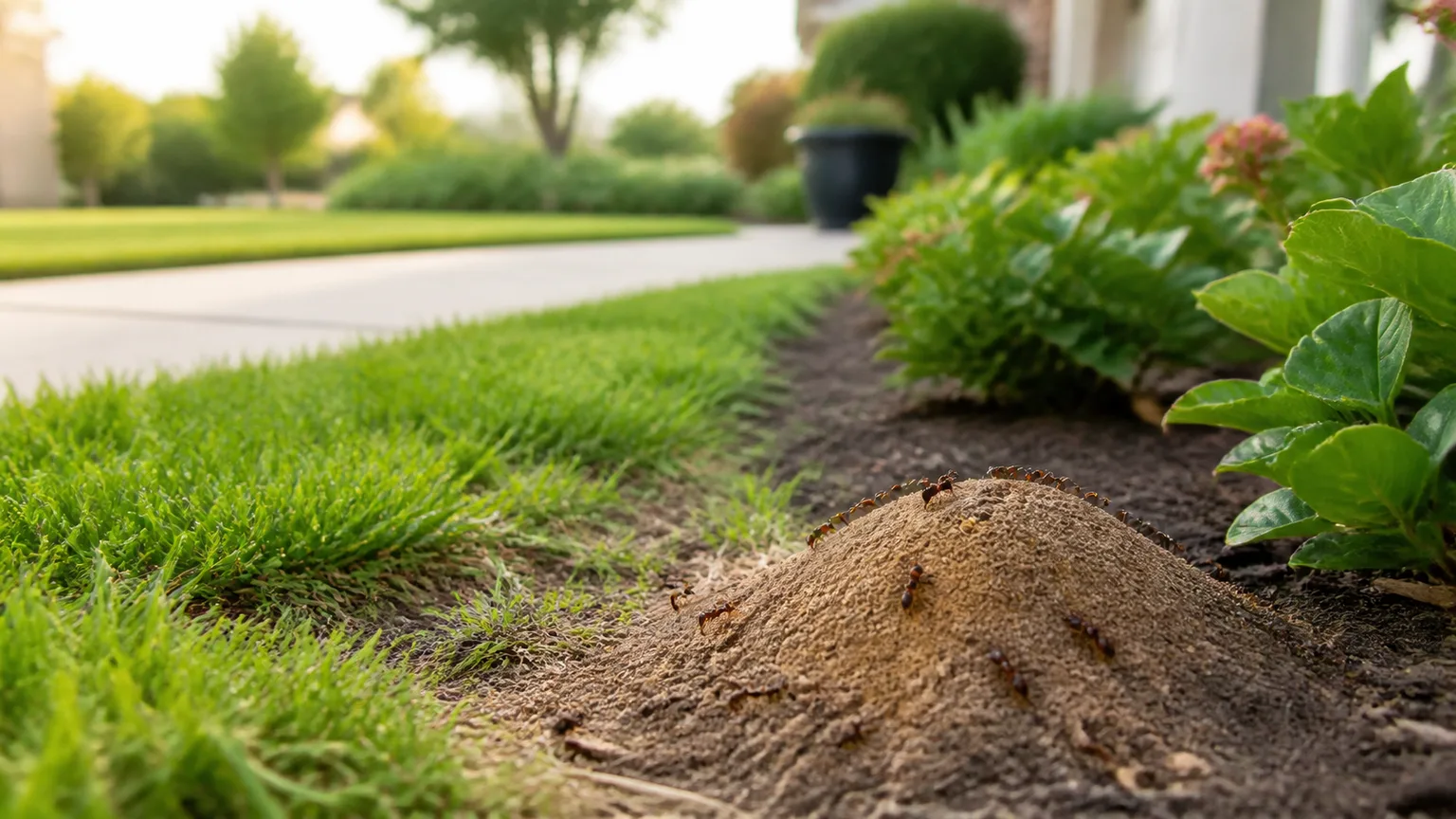
The mound is often the more useful field clue. A fire-ant mound can be a low, broad rise in sandy soil or a larger dome in heavier soil, may have grass growing through it, and often has no obvious opening in the center. Do not kick or rake it to check: workers can rush out quickly and sting repeatedly when the nest is disturbed.
If you cannot confidently identify the ants, photograph the workers and mound from a safe distance and send the images to your county extension office or a licensed pest professional. Identification is especially important before treating a flowering bed, a lawn shared with children, or an area near a pond where a broad application could affect non-target organisms.
Why killing the visible ants is not enough
The ants walking across the grass are mostly workers. Their job is to forage, feed the colony, care for brood, and protect the queen; killing a few on the surface does not reliably end the nest belowground. Fire-ant colonies also connect to foraging tunnels that may extend well beyond the visible mound, which is why a mound can seem empty while workers continue appearing at the edge of a patio.
That biology explains the difference between quick knockdown and lasting suppression. A contact spray, drench, or granule can reduce activity at one mound quickly, while a bait is carried by workers into the colony and shared with nestmates. N.C. Cooperative Extension describes drenches and granules as faster options and baits as the longer-lasting control method; its fire-ant treatment guidance is a useful model for matching the tool to the problem.
Think in two time frames. First, make a dangerous mound quiet if someone could step on it today. Second, reduce the wider population so new mounds do not keep replacing the one you treated.
Make the yard safer before you treat
Plan the treatment when you can keep people and animals away from the work area and follow the product label without improvising. Wear closed-toe shoes, long pants, and gloves; do not kneel on or handle an active mound, and keep children and pets indoors until the label’s re-entry directions are met.
Walk the property before opening a product. Mark mounds near play equipment, doorways, sidewalks, driveways, vegetable beds, compost, pet runs, and frequently mowed areas. This short survey prevents the common mistake of treating the easiest mound while missing the one most likely to cause a sting.
Also check whether the treatment is labeled for the exact site. A product approved for lawns may not be approved for vegetables, edible herbs, ponds, or grazing areas. N.C. Cooperative Extension notes that fewer fire-ant products are labeled for vegetable gardens than for lawns, so read the current label for the active ingredient, rate, application method, watering instructions, rain restrictions, harvest interval, and protection of people, pets, and wildlife before you apply anything.
The fastest reliable plan: bait plus mound treatment
For an established yard problem, the most useful sequence is:
- Confirm that the ants are actively foraging.
- Apply fresh fire-ant bait across the affected area or around individual mounds, following the label.
- Treat only high-priority mounds that need faster relief, using a product and method labeled for that site.
- Recheck the yard weekly and follow the product’s retreatment interval rather than adding more product the next day.
The order matters. If you drench every mound first, you may kill workers that would have carried bait into their colony. If you spread bait when ants are not foraging, the granules can sit untouched, spoil, wash away, or be eaten by non-target animals.

Test whether the ants are actively foraging
Place a small pinch of the intended bait near—not on—the edge of a mound or along a visible trail. Watch from a distance for up to an hour. If workers quickly pick up the bait and carry it away, conditions are suitable for that application; if they ignore it, wait for a cooler foraging period and test again rather than scattering a full application that may go unused.
This simple test comes from practical fire-ant guidance published by Gardening Know How. Use it as a behavior check, not as permission to taste, touch, or mix the product. Keep the sample inaccessible to children, pets, poultry, and wildlife, and discard unused bait according to its label.
Apply bait in cool, dry conditions
Fire ants often forage more actively during the cooler parts of the day. In summer, N.C. Cooperative Extension recommends applying bait in the morning after dew has dried when rain or irrigation is not expected for at least 24 hours; the label for your product takes priority if it gives a different window.
Use fresh bait. Fire-ant baits often rely on an edible carrier, and old or heat-damaged bait may be less attractive to workers. Spread it evenly at the labeled rate with a calibrated hand spreader or shaker—never estimate by handfuls—and avoid applying before rain, irrigation, mowing, or any activity that will move the granules away from the target area.
Do not pile bait on top of a mound unless the label explicitly directs that method. For a single-mound application, the usual goal is an even ring around the mound with as little disturbance as possible. Broadcasting is different: it treats the wider foraging area so workers from colonies you cannot see can encounter the bait.
Treat individual mounds only when you need quick relief
A mound-specific drench, granular treatment, or contact product makes sense when one colony is beside a doorway, play area, pet bowl, garden path, or other place where waiting several weeks is not reasonable. Choose a product labeled for the site and apply exactly as directed; some granules require watering in, while a liquid drench requires a measured volume and careful coverage.
Treating the mound does not replace baiting the yard. Drenches can leave ants in deeper galleries, and surviving colonies can produce a new mound nearby. Use the spot treatment to reduce immediate risk, then keep the bait-and-monitoring part of the plan in place.
When broadcast baiting makes sense
Broadcast baiting is the better fit when you see numerous mounds, workers across several parts of the yard, or colonies that are too dispersed to treat one by one. N.C. Cooperative Extension gives more than five visible mounds per quarter acre—or more than 20 per acre—as a practical point at which broadcasting becomes more efficient than spot treatment, but the product label and local extension guidance should determine the final plan.
Treat the entire relevant lawn or outdoor area, not a narrow circle around the two mounds you noticed first. Fire-ant workers can forage away from the mound, and a colony can be hidden under turf, mulch, a landscape edge, or a potted plant. Keep granules off water, food surfaces, and places where children or pets can reach them unless the label specifically allows that use.
Broadcast bait is slower than a surface knockdown, but it gives workers a chance to transport the active ingredient through the colony. Some products begin reducing activity within a few weeks; products that include an insect growth regulator can take longer to show their full population effect. A quiet lawn the next morning is not proof that the colony is gone, and visible ants after a few days are not proof that a correctly applied bait failed.
What contact drenches and granules can—and cannot—do
Contact treatments are valuable tools, especially for a mound that threatens a high-traffic area. They can reduce exposed workers quickly, but they generally act where the product reaches; they should not be described as a guaranteed way to eliminate every queen, chamber, or connected foraging tunnel.
Liquid drenches are poured over or around the mound so the solution penetrates the nest. Granules may be sprinkled on a mound, around it, or broadcast across the lawn, and some must be activated with water. The only safe rate is the one on the current label; do not increase the concentration because a mound looks large, and do not mix a drench with a bait unless both labels allow the combination.
If you repeatedly treat the same mound and it returns, stop escalating the dose. Recheck the species, application timing, weather, and site label, then consider a bait-first program or professional assessment. N.C. Cooperative Extension notes that drenches often give a quick reduction while new mounds can appear again within days, which is exactly why follow-up is part of the treatment rather than an optional extra.
Diatomaceous earth and other “natural” remedies: use them carefully
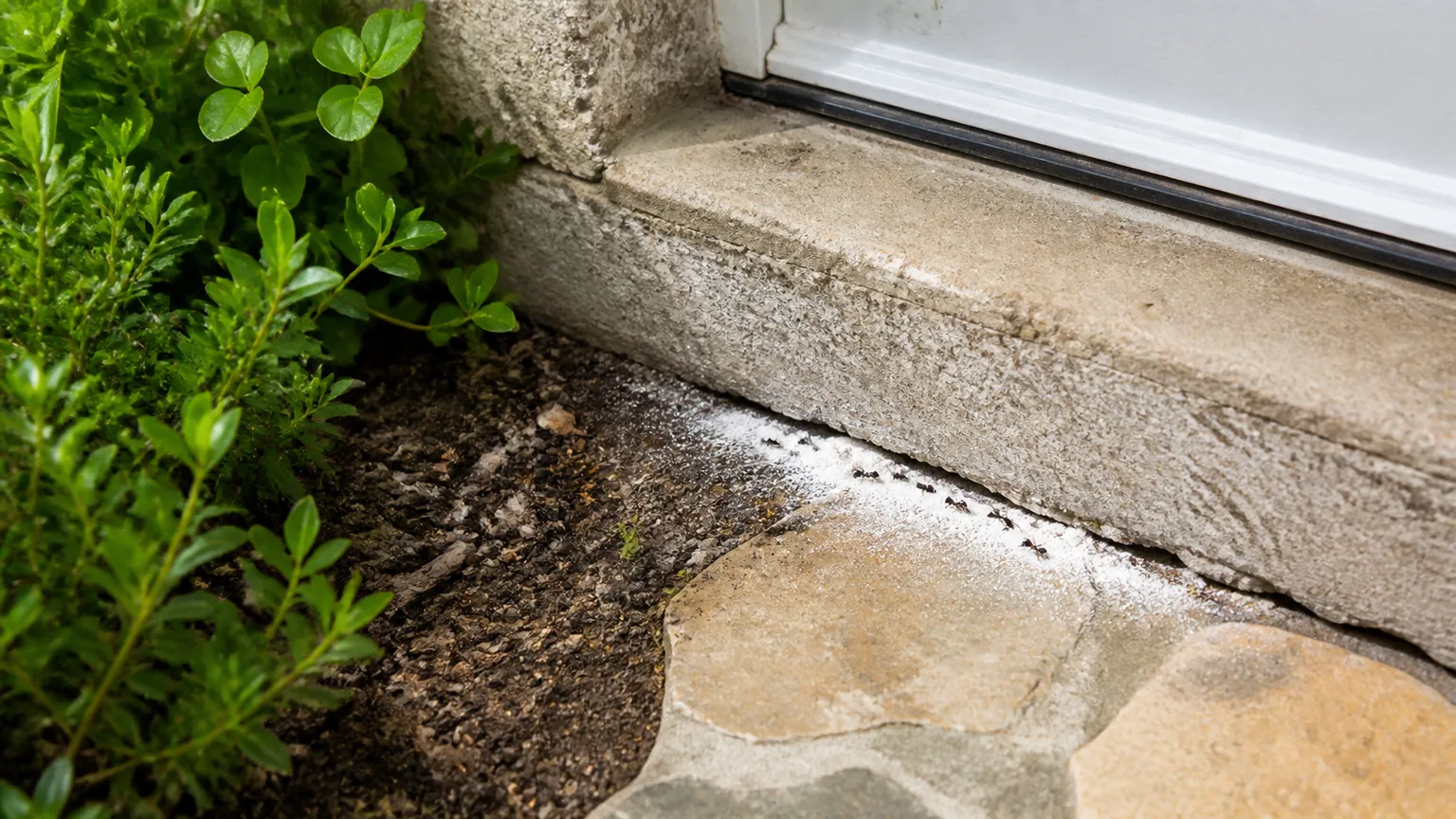
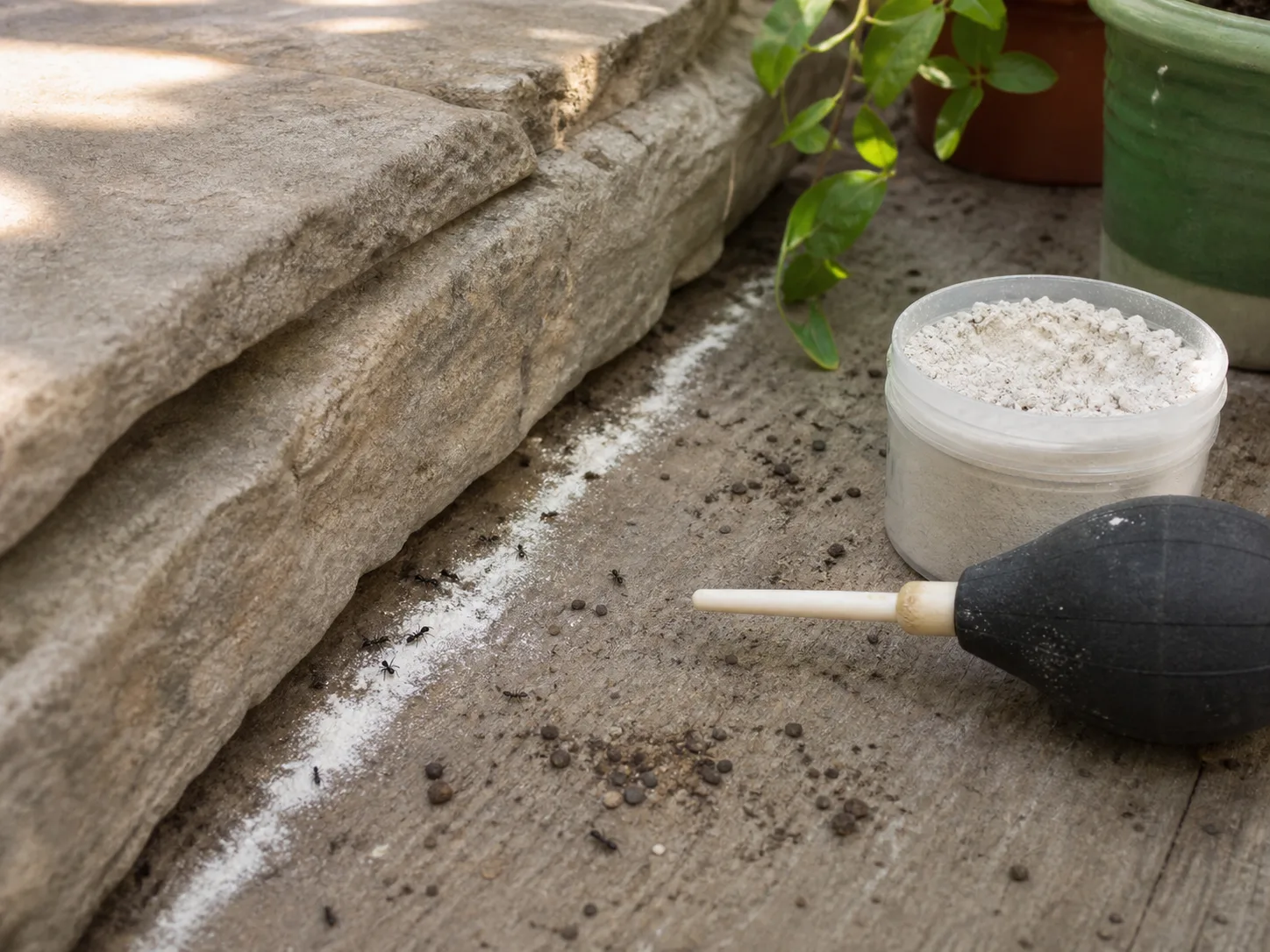
Diatomaceous earth can kill insects that contact a dry deposit because its particles damage the insect’s protective outer layer and contribute to drying. It is not a queen-targeting bait, it loses usefulness when wet, and a visible white line does not prove that a deep fire-ant colony has been eliminated.
If you use a diatomaceous-earth product, choose one labeled for the intended outdoor pest use, avoid breathing the dust, keep it away from eyes, and apply a thin, targeted amount rather than coating an entire garden. Dust can affect beneficial insects as well as pests, and wind can move it into places where children, pets, or pollinators contact it. A label-safe bait program is usually the more useful foundation for a true fire-ant infestation.
Skip gasoline, bleach, ammonia, and similar caustic or flammable “home remedies.” They can contaminate soil and water, injure plants, and create a hazard without reliably reaching the queen. Boiling water can kill an individual mound roughly 60 percent of the time according to Oklahoma State University and Gardening Know How, but it can also cause severe burns, kill nearby plants, and leave a surviving colony to rebuild; it is not a good routine treatment for a lawn or planted bed.
Mint, lavender, rosemary, cinnamon, citrus oils, and other strongly scented materials may change ant activity briefly around a small area, but they are not a reliable replacement for colony treatment. Plant them because they suit your garden, not because they promise to repel an invasive fire-ant population.
Protect vegetable gardens, pets, children, and pollinators
A lawn and an edible garden are not interchangeable pesticide sites. Before treating a vegetable bed, verify that the product is labeled for that crop and site, follow any pre-harvest interval, keep granules out of harvested produce, and use the least disruptive method that addresses the actual risk. If no suitable label exists, ask your county extension office or a licensed professional for a site-specific option.
For pets and children, remove food bowls, toys, and bedding from the area, prevent access during application, and follow the label’s re-entry and watering directions. Never place loose bait where a pet can eat it directly, and do not assume that “natural,” “organic,” or plant-derived means harmless. If someone is stung and develops trouble breathing, facial or throat swelling, dizziness, chest symptoms, or widespread hives, seek emergency medical care; Oklahoma State University notes that some people are hypersensitive to fire-ant venom.
Pollinators and other beneficial insects are another reason to avoid blanket spraying. Apply only where the label permits, avoid flowering plants when the product warns against contact with bees, and do not use a broad treatment to solve a single low-risk mound. A targeted ring, bait station, or professional application can be safer than covering the entire garden edge.
Keep fire ants from returning
Prevention here means lowering reinvasion and catching new colonies early, not creating an invisible barrier that no ant can cross. Walk the yard after heavy rain, irrigation changes, soil work, and hot weather; new mounds are easier to address when they are small and not yet connected to a larger network of colonies.

Keep the lawn and bed edges maintained enough that you can see the soil. Mow and irrigate according to the needs of your turf, repair thin or bare areas, trim vegetation that blocks inspection, and remove unused boards, dense debris, or loose materials that give ants undisturbed nesting spots. These steps improve visibility and reduce favorable disturbed pockets, but they do not replace bait where fire ants are already active.
Inspect new plants, compost, mulch, and sod
Fire ants can move with nursery stock, sod, soil, and soil-moving equipment. Inspect the outside of new pots, the root-ball surface, pallet gaps, and the ground where a delivery sat before placing plants in the yard. If workers are active in the pot or around the shipment, isolate it and ask the seller or extension office how to handle it instead of planting first and spreading the colony through the garden.
Compost, mulch piles, landscape timbers, and stored bags of soil can also hide ants when they sit undisturbed. Turn or inspect materials carefully with gloves and closed shoes, and do not carry a mound into a new bed on a shovel, wheelbarrow, pot, or clump of sod. Clean tools after moving soil from a suspect area.
Repair thin or disturbed lawn areas
Fire ants favor open, sunny areas, and thin turf creates more exposed soil for mound building. Reseed or repair bare patches when conditions suit your grass, correct compaction or irrigation problems that keep the lawn sparse, and avoid leaving fresh piles of soil or mulch scattered across the property.
Healthy turf is not a guarantee against fire ants, especially in warm climates, but it makes new mounds easier to spot and reduces the number of unobserved nesting pockets. Prevention works best when paired with a regular walk-through rather than treated as a one-time landscaping project.
When to call a professional
Bring in a licensed pest professional when mounds cover a large area, keep reappearing after a correctly applied bait program, sit under a structure or electrical equipment, or threaten someone with a history of severe sting reactions. Professional help is also sensible when you cannot identify the ants, cannot keep people and pets out of the treatment zone, or need a product for a vegetable garden, pond edge, pasture, or other restricted site.
Ask what the treatment is intended to accomplish: immediate mound knockdown, property-wide suppression, or both. A good plan should identify the pest, explain the active ingredient and label site, describe weather and re-entry precautions, and include a follow-up visit or monitoring schedule rather than promising a permanently ant-free yard.
What not to do
Several tempting shortcuts make fire-ant control less effective or less safe:
- Do not disturb a mound with your foot, shovel, mower, or rake to see how active it is. Observe foraging from the edge instead.
- Do not blanket-spray the yard for one mound. It can harm beneficial insects and increases exposure without solving the colony problem.
- Do not use gasoline, bleach, ammonia, or boiling water as a routine strategy. The first three can contaminate or injure; the last can burn people and plants.
- Do not apply bait on wet grass or before rain unless the label specifically permits it. Wet or old bait is less likely to be collected.
- Do not reapply because you still see ants tomorrow. Read the label’s retreatment interval and allow time for workers to carry bait into the colony.
- Do not assume a scented plant or household powder will repel an established colony. Treat those ideas as limited experiments, not a fire-ant management program.
How to monitor results and decide whether to retreat
Take a quick baseline before treatment: count visible mounds in a few marked zones, photograph the most important ones, and note which are near doors, paths, children’s play areas, pets, or edible plants. After baiting, inspect the same zones weekly. You are looking for fewer active mounds, less foraging, and no new high-risk colonies—not necessarily an empty yard the next morning.
Follow the label for retreatment timing and the extension guidance for your region. If the bait is untouched, weather washed it away, or ants are active at a different time of day, correct the application conditions before increasing the amount. If activity declines and then returns across the whole property, a seasonal broadcast program may be more appropriate than repeated spot drenching.
Use the pattern of failure to choose the next step. One mound returning beside a path suggests a missed colony or a need for a label-directed spot treatment; many new mounds suggest reinvasion or a population-wide problem; ants that are not fire ants suggest the need to stop treating and identify them. Keep the product container or a photo of the label so a professional or extension agent can review exactly what was used.
Conclusion
To get rid of fire ants, start with identification and safety, then use a bait-first plan that gives workers a chance to carry treatment into the colony. Add a targeted mound treatment only where you need faster relief, and follow the label for the site, weather, rate, watering, re-entry, and retreatment interval.
The last step is the one that keeps the problem manageable: inspect the yard regularly, check incoming plants and soil, protect high-traffic areas, and respond to new mounds early. Fire ants can return, but a measured cycle of bait, targeted control, and monitoring is safer and more durable than chasing surface workers with stronger and stronger sprays.



