How to Get Rid of Odorous House Ants: A Home Plan
Learn how to get rid of odorous house ants with colony-reaching bait, smart trail cleanup, moisture control, and steps that prevent new indoor trails.
Quick answer: a colony-focused plan
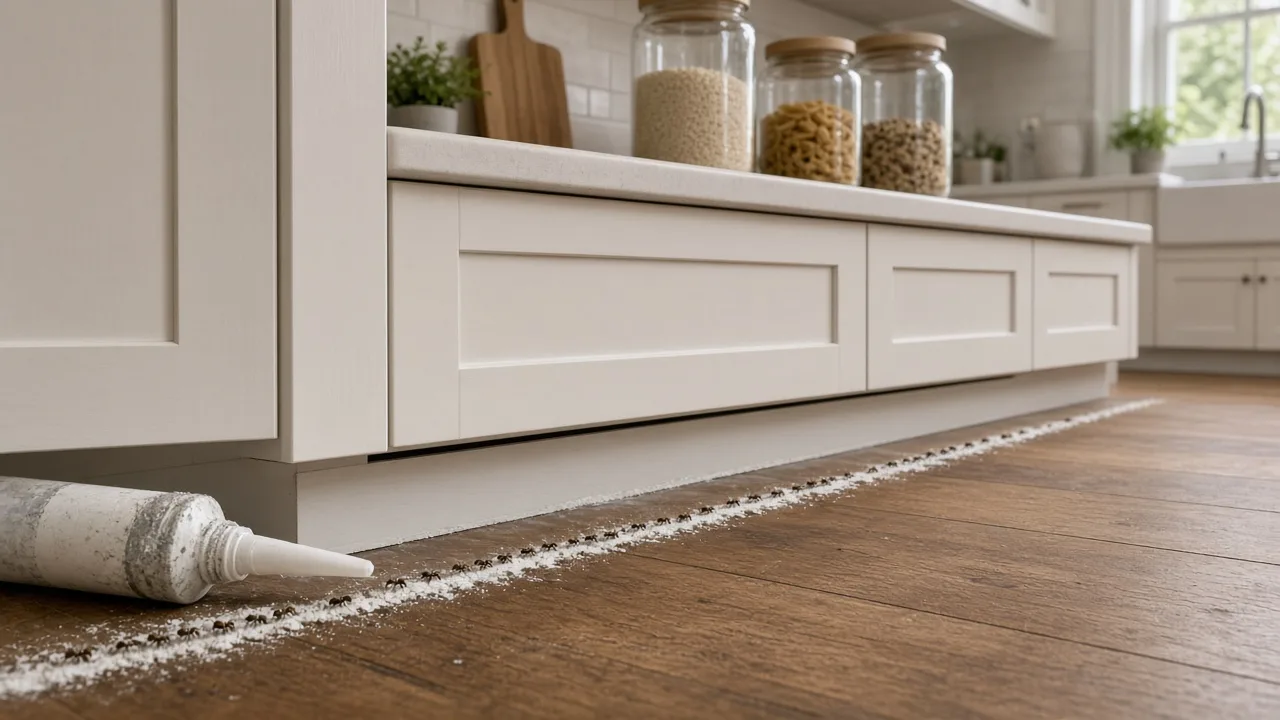
To get rid of odorous house ants, identify their route, remove competing food and water, and place a labeled ant bait beside an active trail where children and pets cannot reach it. Let workers carry the bait back before you wash the trail or seal the entry; spraying or disturbing the colony can leave the queen and nestmates untouched.
Start with the ants you can see, but do not make the visible line the whole target. These ants can nest in several connected locations, including outdoor mulch or sheltered spaces indoors, so a single spray or treated nest may not resolve the source. A better plan is to observe, bait, monitor, then close the access points and conditions that keep the route useful.
On the first day, spend a few minutes tracing the line before disturbing it, clear exposed food and standing water, and place bait beside the route if you can do so safely. Keep a quick note of where ants enter and whether they are feeding; that simple record helps you tell normal bait recruitment from a trail that has shifted to a new room.
Confirm the ants before choosing a treatment
“Sugar ant” is a loose everyday label, not a reliable identification. Several small ants forage for sweet foods, yet the right treatment can differ by species; check the trail, body, and behavior before buying a product or applying a pesticide.
What odorous house ants look and smell like
Odorous house ants are typically dark brown to black and roughly one-eighth inch long. Their most familiar clue is the odor released when one is crushed, often compared with rotten coconut or blue cheese. Their waist has one flattened node that can be hard to see without magnification, so size and color alone are not enough to confirm them. The University of Wisconsin–Madison Extension species guide describes these traits and their common nesting and feeding habits.
You do not need to crush an ant to identify it. If an ant has already been crushed, the smell can help; otherwise, take a sharp close-up photo beside a ruler or coin and note where the trail runs. If the insects sting, bite repeatedly, are much larger than tiny kitchen ants, or appear with sawdust-like debris near wood, pause and get an identification rather than assuming they are odorous house ants.
Winged ants may appear during a reproductive flight in late spring or early summer, but a few wings near a window do not tell you whether the nest is in the house. If many winged insects emerge from a wall, ceiling, or window frame, save a sample and request identification before applying a general ant spray; termite swarmers need a different response.
When the clue points to another ant
Ants that appear in a kitchen can include pavement, pharaoh, carpenter, or other species. A carpenter ant is larger and may excavate damp or decaying wood for nesting; the presence of ants alone does not prove wood damage, but recurring large ants, frass, or softened wood deserves an inspection. Flying insects indoors also need a closer look because ant and termite swarmers can be mistaken for one another.
If identification is uncertain, avoid a repellent spray or a whole-home treatment as a test. Save a specimen in a sealed container or take clear photos from above and the side, then ask a local university Extension office or pest professional. The National Pesticide Information Center recommends identifying the ant before selecting a control approach because species differ in food, nesting, and behavior.
Map the trail to its food, water, and entry point
Watch the ants for a few minutes before cleaning their route. A steady line often reveals a hidden gap at a window, door frame, plumbing penetration, or foundation edge; the destination may be a spill, pet dish, pantry item, damp cabinet, or an inaccessible nest.
Look at the places where the trail slows or disappears. Under sinks, behind a refrigerator, inside a pantry, along baseboards, and around pipes are useful inspection points. Outdoors, check beneath stones, loose bark, boards, dense mulch, and objects resting near the foundation. Odorous house ants favor moist, sheltered sites and can forage between connected nests, according to Wisconsin Extension.
Follow the trail in both directions, but do not dismantle a cabinet or pull up trim just to chase it. Mark the last visible point with a small piece of removable tape or take a phone photo, then look nearby for a crack, pipe opening, or moisture source. A trail that vanishes behind a fixed appliance is still useful evidence: bait placed along its accessible portion can reach workers without forcing you to open the structure.
Read what the trail tells you
If the ants travel in and out through one crack and head for food, you may be seeing outdoor foragers rather than an indoor colony. If they emerge from a wall void, cabinet seam, or plumbing opening, the nest may be inside or close to the structure. A burst of activity after rain or a sudden weather change can mean conditions outside have shifted; it does not identify the exact nest location by itself.
Notice what the ants are carrying or visiting. Sugary spills and fruit are obvious draws, but pet food, grease, crumbs, and water around a leak can keep a route active. If they repeatedly visit a houseplant, inspect leaves and stems for aphids, scales, mealybugs, or whiteflies; the honeydew those insects leave behind can attract ants even when the ants are not feeding on the plant. Gardening Know How’s houseplant guidance explains this distinction.
Use bait to reach the colony, not just visible workers
Bait works differently from a contact spray. Workers find the food-like material and carry it back to feed other ants; the active ingredient must act slowly enough for that transfer to happen. A bait placed correctly can reach nestmates you cannot see, while killing only the workers on the counter leaves the colony largely intact.
Choose bait by what workers will carry
Odorous house ants commonly respond to sweet, sugar-based baits, so a labeled liquid or gel bait designed for indoor ant control is a sensible first choice. If workers ignore it, do not assume they are “immune” or pour on more product. The bait may be old or dry, positioned away from the trail, blocked by another food source, or simply the wrong formulation for the ants’ current preference.
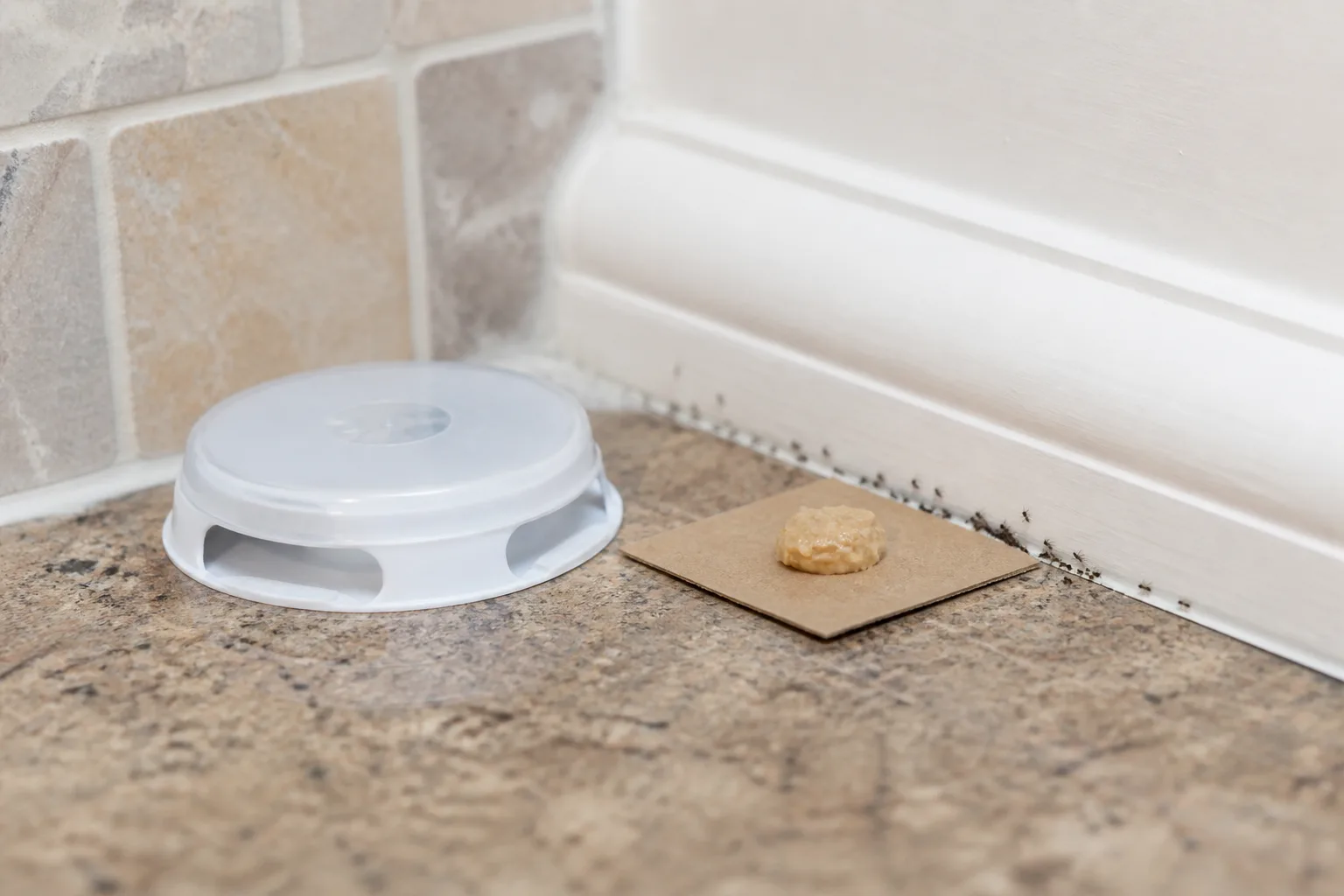
Use a product whose label allows the location and method you plan to use. Do not make a homemade borax mixture or transfer pesticide into a food container when a labeled bait station is available; a labeled product provides directions for placement and use, and a sealed station can reduce accidental contact. For product-specific safety, follow the package exactly and keep bait away from children, pets, and food-contact surfaces.
The word “bait” describes the food-and-active-ingredient combination, not a single recipe. A liquid station, enclosed solid station, or gel may all be appropriate when the label covers the setting, but do not assume a product intended for lawns or exterior cracks is safe for a kitchen counter. If you have a toddler, a curious pet, or food-preparation surfaces close to the trail, choose a placement that is physically inaccessible or ask a professional to recommend a safer setup.
Place bait on the active route and protect it
Set a small number of bait stations or label-directed gel placements beside a trail where ants are already walking. A bait that is tucked behind an appliance but disconnected from the route may go undiscovered; one placed in the middle of a counter can create an avoidable exposure risk. Choose a protected spot that workers can reach but a child or pet cannot.
Do not spray the trail, wipe it with a strong cleaner, or lay down repellent powder immediately around the bait. Those steps can deter ants from reaching it. If the trail runs through a food-preparation area, remove exposed food and clean the food itself first, then place bait nearby on a separate, safe route that ants can still follow.
Monitor without sabotaging the bait
Check the bait according to its label and observe whether ants are feeding. A temporary increase in visible ants can mean workers have recruited nestmates to collect food; it is not, by itself, proof that the bait failed. Leave an accepted bait in place, replace it when it is empty, dried out, or no longer attractive, and keep other food sources tightly covered.
If the bait is untouched, first move it a short distance to an active path and remove competing crumbs or sweet residue. If that still fails, try a different labeled formulation rather than adding spray. General UC IPM ant guidance notes that fewer ants may take about 5 to 10 days to become noticeable, but that is a broad expectation, not a deadline for every odorous-ant colony. Large or connected colonies may take longer, and the product label remains the rule for use.
Use the pattern you observe to decide what to change:
| What you see | What it may mean | Next move |
|---|---|---|
| Workers feed steadily | The bait is accepted | Leave it accessible to workers and refresh it as directed. |
| No ants visit | The station is off-route, stale, or competing food is easier | Move it beside a live trail and remove other food residue. |
| Activity rises briefly | More workers may be recruited to the food | Keep the route undisturbed and monitor rather than spraying. |
| Ants avoid the area after treatment | A repellent or cleaner may have interrupted the path | Stop applying repellents there and place fresh bait on an untreated active route. |
Clean trails and remove attractants in the right order
Cleaning helps, but timing matters. Before bait is accepted, leave enough of the active route for foragers to find the station; remove competing food, not the only path to the bait. Once ant activity falls and the bait is no longer being visited, wipe washable surfaces with soapy water or an ordinary household cleaner to remove food residue and scent trails.
Clean sticky drink spills promptly, rinse containers before putting them in recycling, and store sugar, syrup, honey, pet food, and ripe fruit in sealed containers. Wash trash and recycling bins when residue builds up, and remove food waste regularly. These simple steps matter because ants can continue using a route even after the original spill is gone if crumbs, grease, or a leaky pipe still reward them.
Do not use vinegar as a substitute for colony control. A scent or cleaner may temporarily disrupt a trail on a surface, but it cannot carry bait to a nest or correct a damp nesting site. On stone or other sensitive finishes, use a cleaner appropriate for the material rather than experimenting with acidic solutions.
Why sprays and home remedies rarely solve the colony
A spray can kill ants that it directly reaches, which may feel effective for a moment, but it does not necessarily reach queens or workers inside a wall, under a slab, or outdoors. Odorous house ants can have multiple queens and interconnected nests, and a disturbed colony may relocate or bud into new nesting sites. A repellent product can also scatter the visible trail or stop workers from accepting a nearby bait.
Use a spray only when its label calls for that exact use and you are not trying to maintain bait feeding along the same route. Do not spray into wall voids, under cabinets, or around children’s toys based on guesswork. The University of Wisconsin Extension specifically warns against insecticide sprays near odorous-ant bait because they can reduce bait effectiveness; UC IPM also notes that indoor sprays generally do not prevent more ants from entering.
Dish soap, vinegar, essential oils, cinnamon, and coffee grounds are often suggested as quick fixes. A damp cloth or soapy water can remove visible ants and their trail from a surface, but that is sanitation, not proof that a colony has been eliminated. Repellent odors may send ants to another route, and essential oils or concentrated mixtures can create exposure or surface-damage concerns. Use them only if a product label supports the intended use; do not depend on them to destroy a nest.
Find indoor nests and correct the moisture problem
Odorous house ants may nest in wall voids, attics, insulation, damp wood, or near plumbing and vents. You can look for entry gaps, leaks, wet cabinet bottoms, condensation, and wood softened by moisture, but opening a wall or injecting pesticide without knowing the nest can spread the problem or expose people to unnecessary chemicals.
These ants may share an area through interconnected nests rather than one neat mound that can be treated once. Wisconsin Extension notes that they can relocate when nests are disturbed, so a sudden shift in the trail after a spray or renovation does not necessarily mean the colony has vanished. Keep monitoring the route and avoid sealing a wall void or plugging an opening while workers still need to reach an accepted bait station.
Fix a dripping faucet or pipe and dry the area, but do not seal the ants’ only active opening while bait is still being carried through it. If they disappear into a wall, continue baiting on the route they use and monitor the entrance. If they keep emerging from several locations, appear in multiple rooms, or return after baiting, a professional can map the route and determine whether the colony is inside the structure or connected to an outdoor nest.
Prevent new trails after activity stops
Keep food, water, and shelter from lining up into an easy route. Store pantry staples in closed containers, wipe grease and sugary residue from counters, empty pet bowls when they are not being used, and keep trash can rims and recycling bins clean. Fix leaks, unclog gutters, and remove moisture-damaged wood rather than relying on a pesticide barrier to compensate for a wet or sheltered nesting area.
If a potted plant is involved, check the potting soil and inspect foliage for honeydew-producing insects instead of spraying the plant and the ant trail together. Ants around a plant may be foragers taking honeydew from aphids or scales; treating the actual food source may reduce the traffic without harming the plant.
Seal entry points after baiting
Once bait activity has dwindled, clean the route and close gaps around pipes, window frames, door thresholds, siding, and foundation openings with an appropriate sealant. Follow the trail outdoors before sealing if possible, so you do not mistake an unused crack for the access point. Caulk can block a route, but sealing every visible gap without fixing food, water, or the colony may simply send ants to another opening.
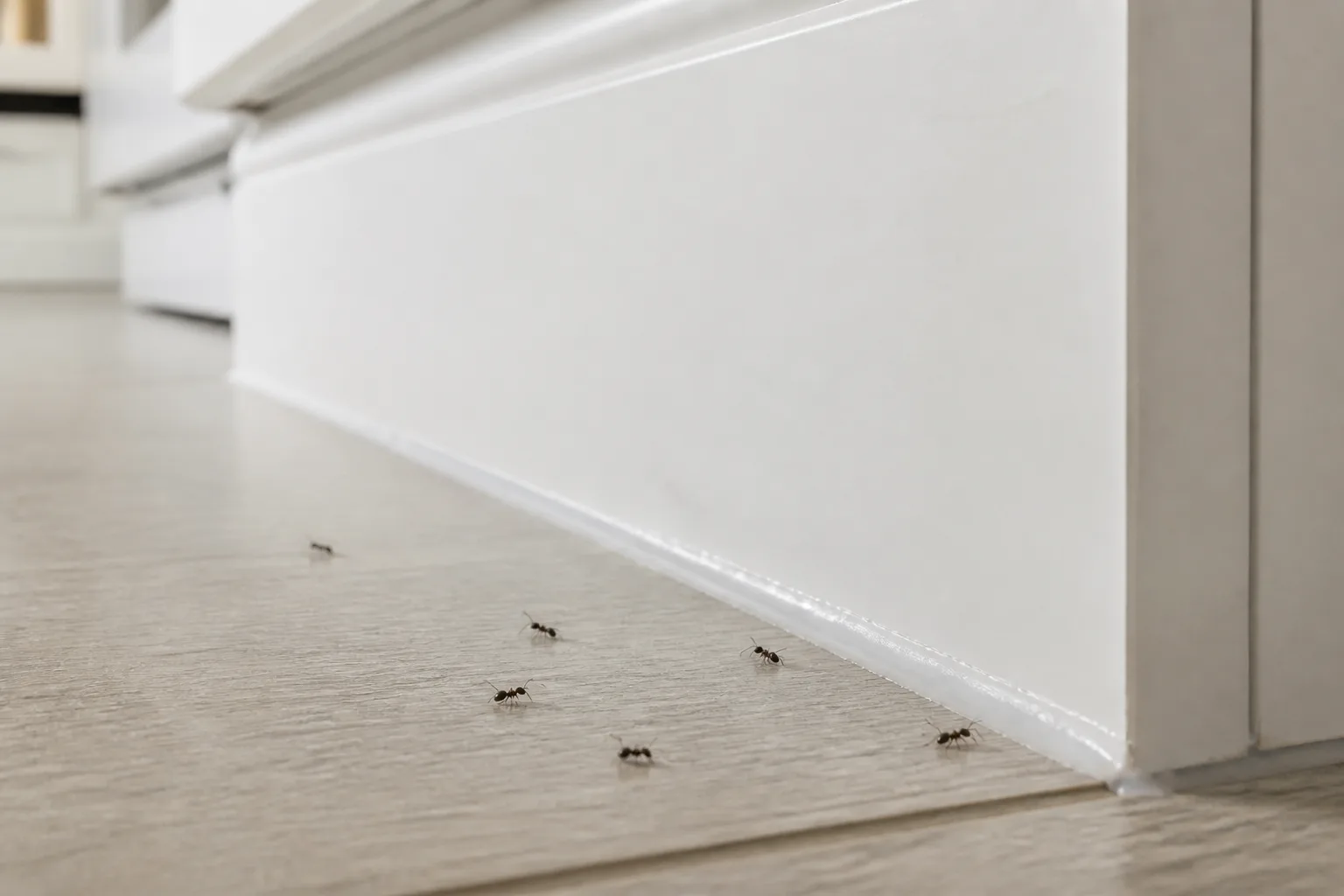
Check the repair after rain and during the next period when ants are active. If the same trail returns, note whether it uses a new gap or whether ants are emerging from inside the wall. That distinction tells you whether to improve exclusion or call for help locating an indoor nest.
Reduce outdoor bridges without treating the whole yard
Trim branches and dense vegetation that touch siding, remove loose boards and stones stored against the house, and keep dense mulch from piling directly against the foundation. These changes reduce sheltered routes and nesting places near the building, but you do not need to poison every ant nest in the yard.
Outdoor ants are part of garden food webs, and broad elimination is neither practical nor necessary when the problem is a line entering the kitchen. UC IPM advises focusing on exclusion and food or water sources rather than trying to eradicate outdoor ants; the Royal Horticultural Society likewise recommends tolerating garden ants unless a nest is causing a specific problem. A Homes & Gardens interview with gardening experts makes the same useful distinction between limiting ants in a particular area and eliminating them from the whole yard.
Know when to call a pest professional
Bring in a licensed pest-management professional when ants continue to forage despite fresh, correctly placed bait; when several rooms or wall voids are involved; when a nest is inaccessible; or when you cannot confidently identify the species. If the infestation is in an apartment or shared building, coordinate with the property manager because the route or nest may cross walls and common areas.
Ask the professional to identify the ant, explain whether the nest appears indoors or outdoors, and describe how bait or any spot treatment will be kept away from people, pets, food, and non-target wildlife. A focused treatment plan should include monitoring and entry-point repair, not just a promise to spray the perimeter on a recurring schedule. Follow all label and re-entry directions for any pesticide used; the National Pesticide Information Center’s ant guidance recommends reading and following the product label.
Before treatment, ask what will be applied, where it will go, what must be moved or covered, and when people and pets can return to the area. Ask how success will be measured and what to do if ants reappear at a different opening. Clear answers should connect the treatment to the species and route you observed, not rely on a generic guarantee.
Conclusion
The reliable way to get rid of odorous house ants is to stop treating the visible workers as the whole problem. Confirm the species, follow the route, remove competing food and water, and let a labeled bait reach the colony before cleaning the trail and sealing the entry.
Give the bait time, keep it inaccessible to children and pets, and do not spray over an active bait route. If ants persist, shift to identification and nest-location help rather than escalating to stronger or broader treatments; that is usually the point where a professional can make the next step more precise.