How to Deadhead Peonies: Timing and Cut Points
Deadhead peonies after flowers fade but before seed pods mature. Get the exact cut point, fall cleanup timing, and fixes for buds that never open.
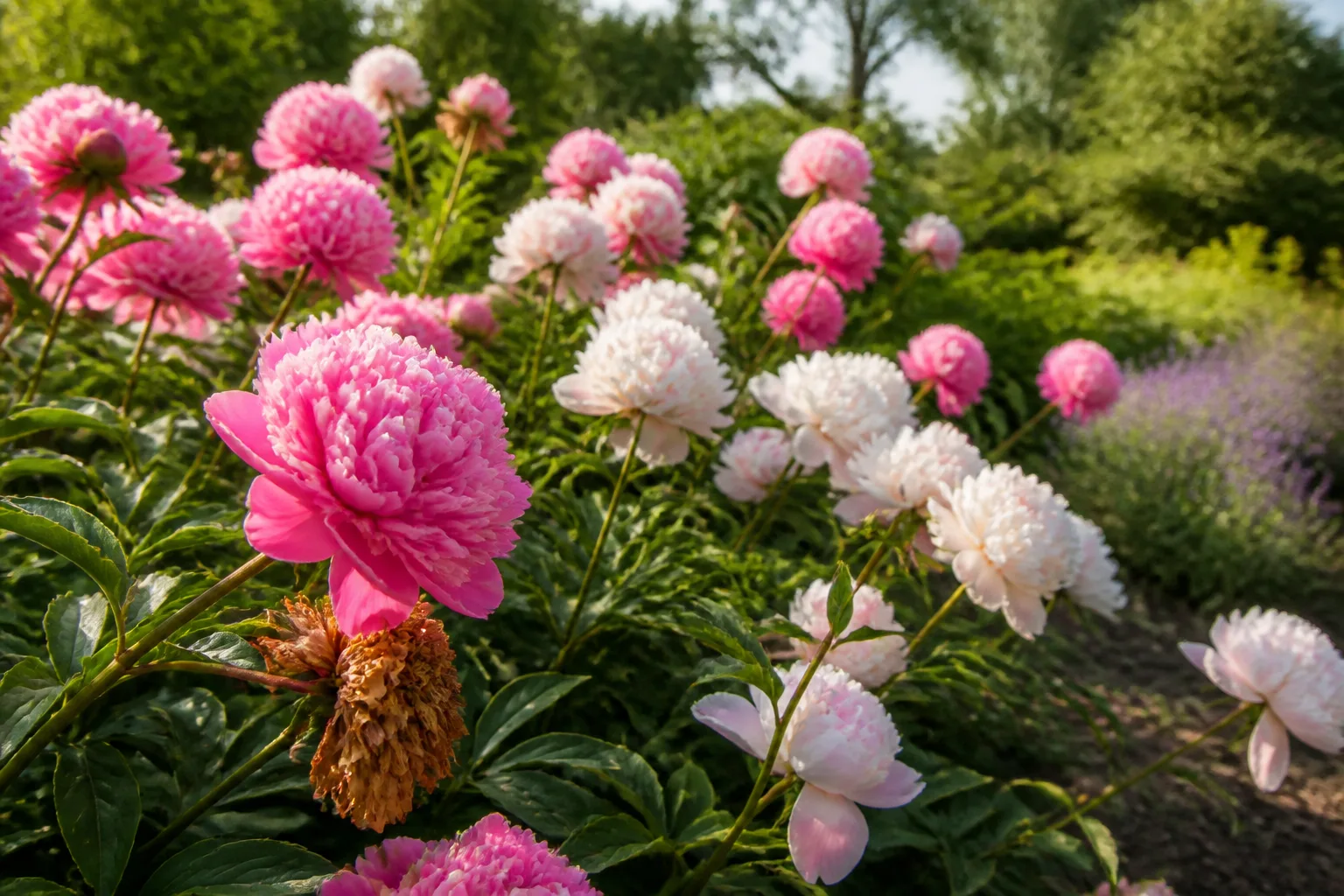
Deadhead peonies when the flowers have faded, the petals are wilting or falling, and the plant has not yet invested heavily in mature seed pods. Cut off the spent flower stem while keeping every healthy leaf you can. Then leave the leafy plant alone until its foliage naturally yellows or is killed by frost.
That two-part rule is the heart of peony care after flowering: remove the old flower, not the plant’s solar panels. Deadheading makes the clump look better and limits seed production, but it does not make an ordinary garden peony bloom again a few weeks later. The leaves still need to work through summer so the plant can replenish its crown and roots for the next growing season.
The quick answer: remove flowers, preserve foliage
Find each flower that has finished blooming, follow its stem downward through the leaves, and make a clean cut at the first healthy leaf cluster or where the flower stem joins the leafy plant. Do not shear the entire top of the peony after bloom, and do not remove healthy leaves just because the flowers are gone.
This is a small job, but the distinction matters. A peony’s flowers are temporary; its foliage is the tissue that captures light and supports the next cycle of dormant growth buds. Ohio State University Extension recommends going down into the plant below the top layer of foliage when removing dead blooms, which prevents a row of conspicuous bare stems from sticking above the clump. (Ohio State University Extension)
If you want to save seed, leave one or two healthy flowers to develop pods and remove the rest. If you are growing a named hybrid for the same flower next year, division is the predictable propagation method; seedlings can vary from the parent and may take years to flower.
Identify your peony before you cut
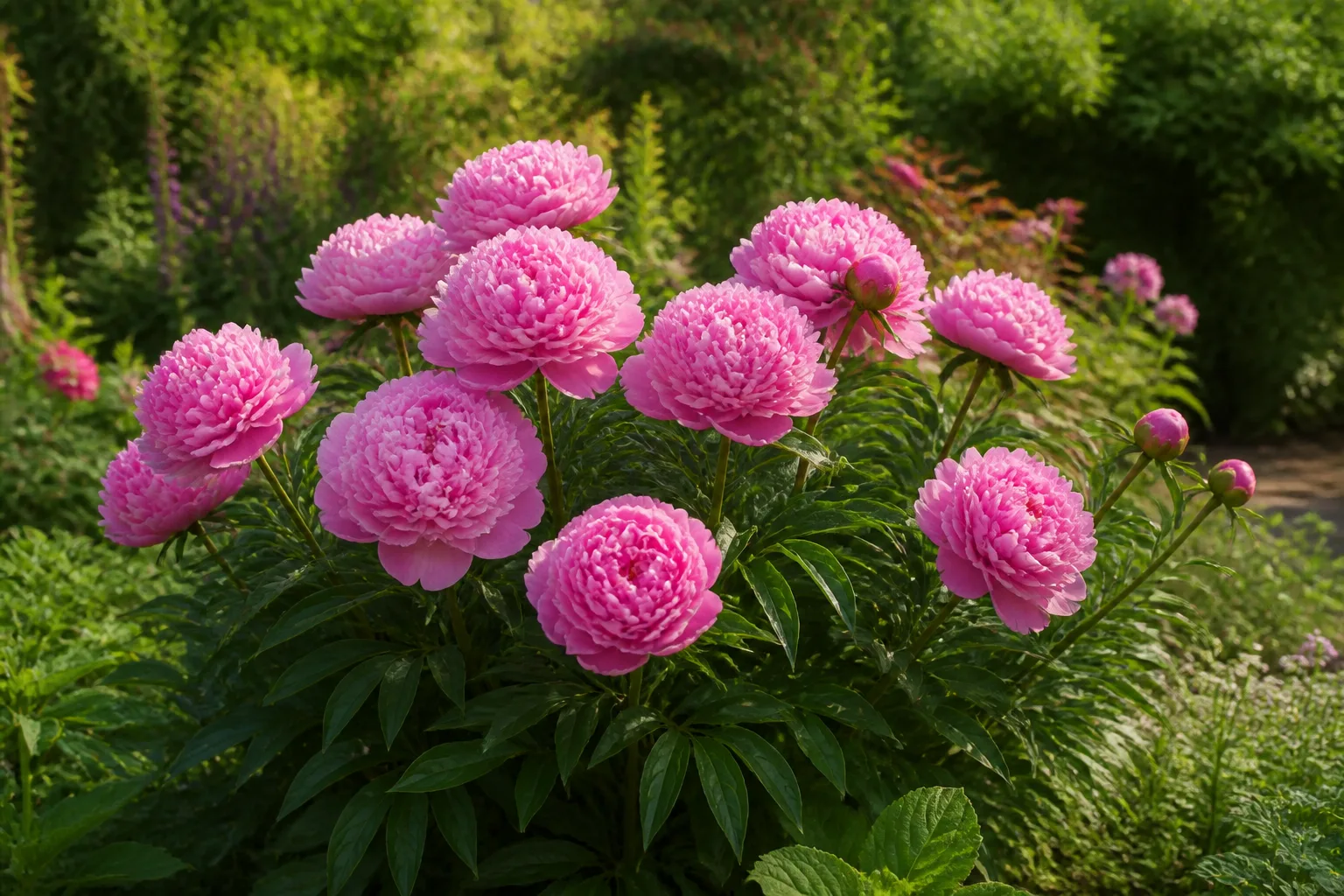
Most plants sold as garden peonies fall into three practical groups: herbaceous peonies, Itoh or intersectional peonies, and tree peonies. The flower-deadheading decision is similar for all three, but the fall cleanup is not. Misidentifying a tree peony is how gardeners end up cutting living woody stems that should remain in place.
Herbaceous, Itoh, and tree peonies have different fall boundaries
Herbaceous peonies produce soft stems and leafy growth from the crown each spring, then die back to the ground in autumn. Once the foliage has completely died back, you can cut the stems close to soil level and remove the debris. The Royal Horticultural Society recommends cutting herbaceous peony foliage at ground level in autumn to reduce the risk of infection from peony wilt. (Royal Horticultural Society)
Itoh peonies are hybrids with a woody lower framework and herbaceous upper growth. Deadhead the flowers as you would on a garden peony, but wait until autumn for the leafy stems to die back; then remove the soft growth while leaving the woody base intact. A few short woody stems are not a sign that you cut incorrectly.
Tree peonies are woody shrubs. Remove faded flowers and any genuinely dead or damaged wood, but do not cut the whole plant to the ground in fall. Tree peonies often need only light, selective pruning, so identify the woody structure before reaching for shears. Savvy Gardening’s type-by-type pruning guidance also separates tree peonies from herbaceous and Itoh peonies for this reason. (Savvy Gardening)
When to deadhead peonies
The best time is after a flower has finished its display but before its seed pod has fully matured. In many gardens that window falls in late spring or early summer, but bloom timing varies with climate, cultivar, weather, and whether the plant is herbaceous, Itoh, or tree type.
Use the flower’s condition, not a calendar date
Start with the bloom itself. A flower is ready when most petals are wilted, brown, rain-beaten, or already on the ground. If the flower still has fresh petals and pollinators are using it, leave it for now unless disease or storm damage makes removal the better choice.
You do not need to deadhead every flower in one dramatic pass. Walk the clump every few days during the bloom-to-fade transition and remove the flowers that have crossed the line. This staggered approach is especially useful when early, midseason, and late cultivars open at different times.
Watch the center of a fading flower for a swelling green seed pod. A pod is a cue to act, not a disaster. Gardening Know How notes that even gardeners who miss the ideal window can remove seed pods later in the season; the main cost of waiting is that the plant has had more time to put resources into seed formation. (Gardening Know How)
The tools and the exact cut point
For a small clump, clean bypass pruners or sharp garden scissors are enough. Choose a tool that makes a crisp cut without crushing the stem. Wipe dirt and plant residue from the blades before you begin, and disinfect them between plants if you are moving from a sick-looking peony to a healthy one.
The cut point is more important than the angle. Trace the spent stem downward until it meets a healthy leaf cluster or disappears into the leafy crown, then cut just above that growth. On a stem with a visible healthy leaf pair, leave the leaves in place; on a stem that rises from deeper inside the plant, reach below the outer layer of foliage so the cut stem is hidden without cutting the foliage around it.
Avoid three unhelpful cuts:
- Do not cut the entire leafy top flat after blooming.
- Do not leave a long, bare stalk above the foliage simply because it is easier to reach.
- Do not slice through a nearby leaf, remaining bud, or the crown at soil level while trying to remove one flower.
Penn State Extension describes deadheading as the removal of spent flower heads and lists appearance, plant health, repeat bloom in some perennials, and seed prevention among the reasons gardeners use it. Peonies are a useful exception to the “repeat bloom” expectation: removing the flower helps tidy and may reduce seed production, but it does not turn a once-a-season peony into a rebloomer. (Penn State Extension)
Five steps for clean, low-stress deadheading
Deadheading is easiest when you treat it as an inspection task rather than a haircut. The goal is to remove only tissue that has finished its job and to notice problems—brown buds, leaf spots, broken stems, or a crowded center—while you are already inside the plant.
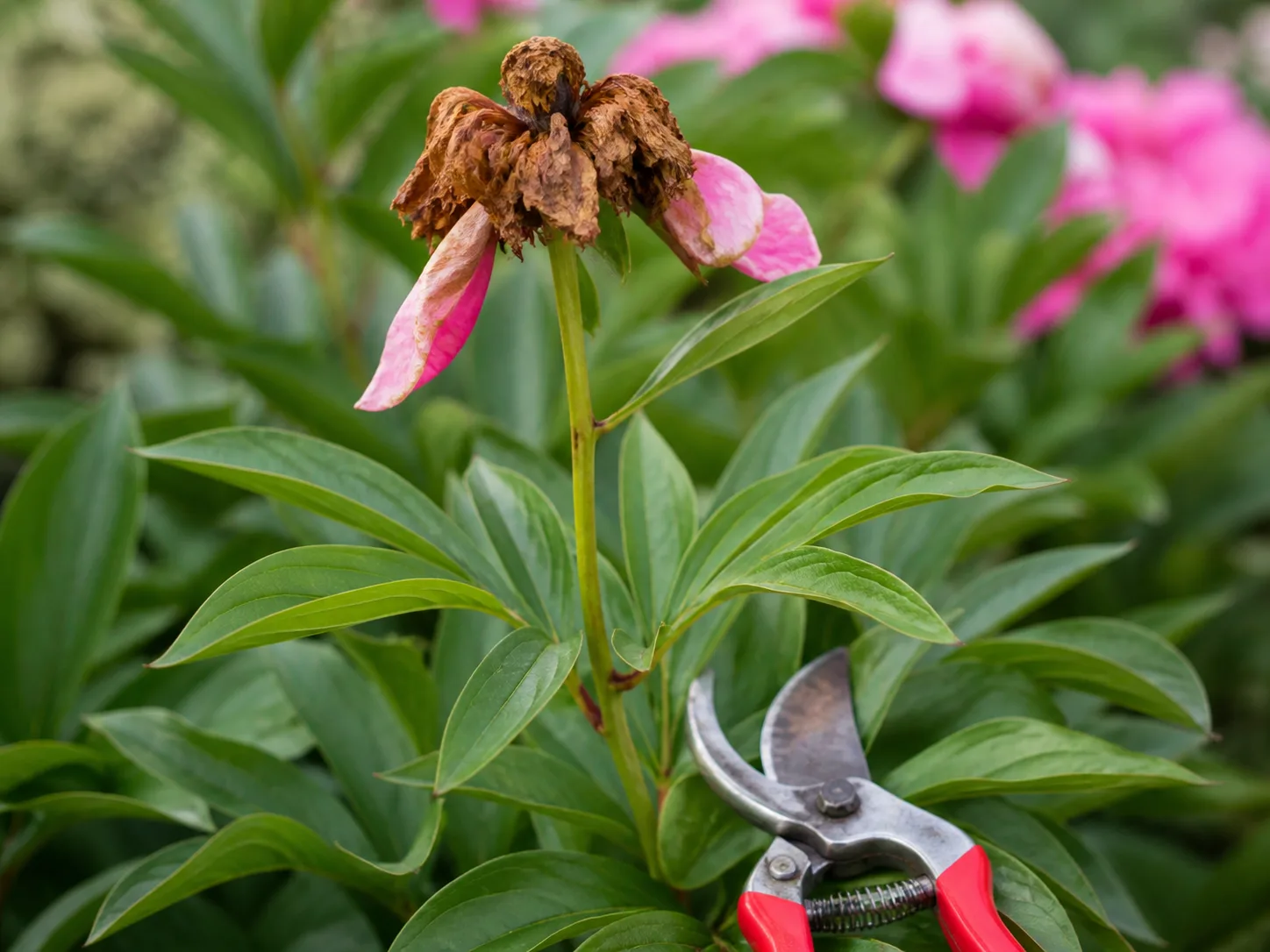
1. Sanitize and inspect your pruners
Use sharp, clean bypass pruners or shears. Open and close the tool once before cutting so you know the blades meet cleanly; a dull blade can bend a soft stem and leave a ragged wound. If the plant has visible mold, dark lesions, or collapsing stems, clean the blades again before moving to another peony.
2. Trace the spent stem into the foliage
Hold or visually follow the flower stem from the faded head down to its nearest healthy leaf cluster. Look for a living bud before you cut. A small green bud tucked near a spent flower is not a deadhead, and removing the stem above it may remove the next flower in a staggered sequence.
The lowest practical cut is usually best for appearance, but “low” does not mean “at ground level.” On herbaceous peonies, the foliage below the flower is valuable. Reach into the clump and remove the individual flower stem below the top layer of leaves rather than stripping the whole branch of leaves.
3. Make a clean cut without stripping leaves
Cut just above the healthy leaf cluster or at the stem’s natural junction with the foliage. Use one confident squeeze instead of sawing back and forth. If the stem is visibly diseased, cut back to healthy tissue and keep the suspect material out of the compost.
Do not worry about making an ornamental 45-degree cut on every peony stem. A clean, small cut that does not damage a leaf or remaining bud is the useful target. The plant will hide the stub as the surrounding foliage fills out.
4. Remove debris and check the next stem
Pick up fallen petals and detached flower heads from the center of the plant, especially after wet weather. A mass of damp, decaying petals can sit against leaves and make an already crowded peony harder to inspect. Ohio State Extension emphasizes sanitation, full sun, and good air circulation because peonies can develop powdery mildew and leaf spots. (Ohio State University Extension)
Repeat the inspection one stem at a time. Healthy, dry flower debris can go into a well-managed compost pile, but material from a plant with obvious disease is safer in municipal yard waste or the trash according to local rules. Do not spread suspect leaves or stems around the garden as mulch.
5. Stop when only healthy foliage remains
When the spent flowers are gone, put the pruners down. There is no benefit to continuing into a summer haircut just because the plant looks untidy from a distance. A peony that has finished flowering should spend the rest of the growing season as a leafy plant, not as a bare crown.
What to leave on a peony after flowering
Leave healthy green leaves and stems in place through summer. They are still photosynthesizing, and cutting them away early can reduce the plant’s ability to build reserves for next year’s flower buds. Savvy Gardening specifically advises leaving herbaceous peony foliage standing until fall, even when individual leaves begin to look less attractive. (Savvy Gardening)
There are two important exceptions. Remove foliage that is clearly diseased and spreading, rather than allowing it to remain pressed against healthy leaves. Also remove broken or fully collapsed stems when leaving them would trap wet debris or create a safety problem. In both cases, be selective: cutting one diseased stem is different from removing every green leaf on the plant.
Do not fertilize aggressively to compensate for early pruning. If your soil test or local growing recommendations call for feeding, follow a modest, appropriate schedule and keep fertilizer away from the crown. Good light, adequate moisture during drought, and open air around the plant usually matter more than extra fertilizer for a peony that is otherwise established.

Deadheading versus fall cleanup
These are two different jobs that happen months apart:
| Job | What you remove | When | What stays |
|---|---|---|---|
| Deadheading | Faded flower heads and their individual stems | As flowers fade in late spring or early summer | Healthy leaves and the rest of the clump |
| Fall cleanup | Dead herbaceous stems and foliage | After foliage dies back or frost finishes it | The crown, dormant buds, and any woody tree-peony framework |
The summer pause between those jobs is intentional. Let the leaves turn yellow and shut down naturally unless disease requires earlier, selective removal. The RHS growing guide identifies autumn as the time to cut back dead stems on herbaceous and intersectional peonies, while its quick facts also emphasize full sun, space, and the need not to plant peonies too deeply. (Royal Horticultural Society)
When fall cleanup arrives, cut dead herbaceous stems close to the soil surface without gouging the crown. Gather the leaves and stems rather than tucking them under a mulch layer. This is particularly important if the plant had peony wilt, leaf spot, or other disease symptoms; sanitation cannot cure a problem already present, but it can reduce the amount of infected debris left for the next season.
If buds never opened or seed pods already formed
An unopened peony bud is not automatically a pruning problem. If a bud is still firm and green, leave it alone. If it is brown, collapsed, mushy, or clearly dead, remove it with its short stem using the same clean-cut approach as a spent flower.
Several brown unopened buds after a wet, cold spring can reflect weather damage or botrytis rather than a lack of deadheading. Repeated failure to open can also point to shade, drought during bud development, poor air movement, disease, or a plant set too deeply. Start by looking at the pattern: one damaged bud after a storm is different from every bud on a shaded, crowded plant collapsing at once.
If seed pods have begun to swell, you have not missed your only chance. Remove the pod and its stem if you do not want seed, or leave a pod if you are intentionally experimenting with peony seedlings. Gardening Know How notes that established plants are not ruined when flowers remain until frost, but earlier removal avoids spending more energy on seed production. (Gardening Know How)
Do not expect seed-grown plants to reproduce a named hybrid exactly. Peonies are often hybrids, and seedlings can differ in flower color, form, and performance. Seed is a long-term breeding project; division is the better choice when your goal is to make a new plant that matches the parent.
Will peonies rebloom after deadheading?
Usually, no. Herbaceous garden peonies generally have one main flowering period each year, so deadheading removes the finished display but does not trigger a second flush of flowers in the same season. Itoh peonies may have a longer or more staggered display because of their genetics and branching, but deadheading still does not create unlimited new buds.
This is one reason to judge deadheading by the right benefits. You are improving the plant’s appearance, removing tissue that is no longer useful, limiting unwanted seed formation, and making it easier to inspect the foliage. The next year’s bloom depends on a wider set of conditions: the cultivar’s maturity, adequate light, healthy foliage, correct planting depth, sufficient moisture during growth, and a winter period appropriate for the plant.
If a nursery tag or social-media tip promises that deadheading will make a peony rebloom immediately, treat that as a mismatch with peony biology rather than a reason to cut harder. A clean flower-removal routine is worthwhile; aggressive pruning is not a substitute for the conditions that create next season’s buds.
Why a peony may still fail to flower next year
Deadheading protects the post-bloom routine, but it cannot correct every reason for poor flowering. If a plant produces leaves but few flowers, diagnose the growing conditions before pruning more.
Check light, planting depth, water, and disease
Light: Peonies perform best in full sun. A plant that gets morning light but is shaded by a fence, tree, or new building for much of the day may grow green foliage without setting a satisfying number of flowers. The fix is a site change or a careful plan for nearby competition, not extra deadheading.
Planting depth: Deeply planted peony crowns are a classic cause of weak flowering. The RHS recommends covering the bright red growth buds with no more than about 2.5 cm (1 inch) of soil; moving or replanting a peony can cost a season or two while it reestablishes. Do not dig up an established clump in summer just to chase an uncertain diagnosis—plan a fall correction if depth is clearly the issue. (Royal Horticultural Society)
Water: Established peonies are relatively drought tolerant, but prolonged spring dryness can interfere with bud development. New plants and recently moved divisions need more consistent moisture while they establish, especially in sandy soil or hot weather. Water the root zone deeply when needed, then let excess drain; constantly wet soil creates a different set of problems.
Disease and airflow: Peony wilt can collapse leaves, stems, and buds; powdery mildew and leaf spots can make the foliage look poor even when the plant survives. Give the clump room, avoid routinely wetting the foliage late in the day, remove diseased debris, and do not compost visibly infected material unless your local composting system reaches conditions appropriate for it. If symptoms are severe or recur, take a clear sample or photograph to a local extension service or qualified horticulturist rather than guessing at a treatment.
Plant age and cultivar: A newly planted division may need more than one season to flower reliably, and some cultivars simply bloom earlier or later than others. A peony that is healthy, well lit, and slowly getting larger is not necessarily failing because it has not reached its mature display yet.
Conclusion
Deadhead peonies as each flower fades: follow the spent stem into the foliage and cut it at the nearest healthy leaf cluster, while leaving the plant’s green leaves intact. That keeps the bed neat and reduces unnecessary seed formation without sacrificing the photosynthetic work that supports next year’s growth.
After deadheading, switch from pruning mode to observation mode. Keep healthy foliage through summer, remove diseased debris selectively, cut herbaceous stems to the ground only after fall dieback, and leave tree-peony wood in place. If flowers still disappoint next year, check sun, planting depth, spring moisture, air circulation, disease, and plant maturity before blaming the deadheading cut.