Parlor Palm Care: Light, Water, and Growing Tips
Grow a healthy Chamaedorea elegans indoors. Use this parlor palm care guide to choose light, water by soil moisture, prevent root rot, and fix browning.
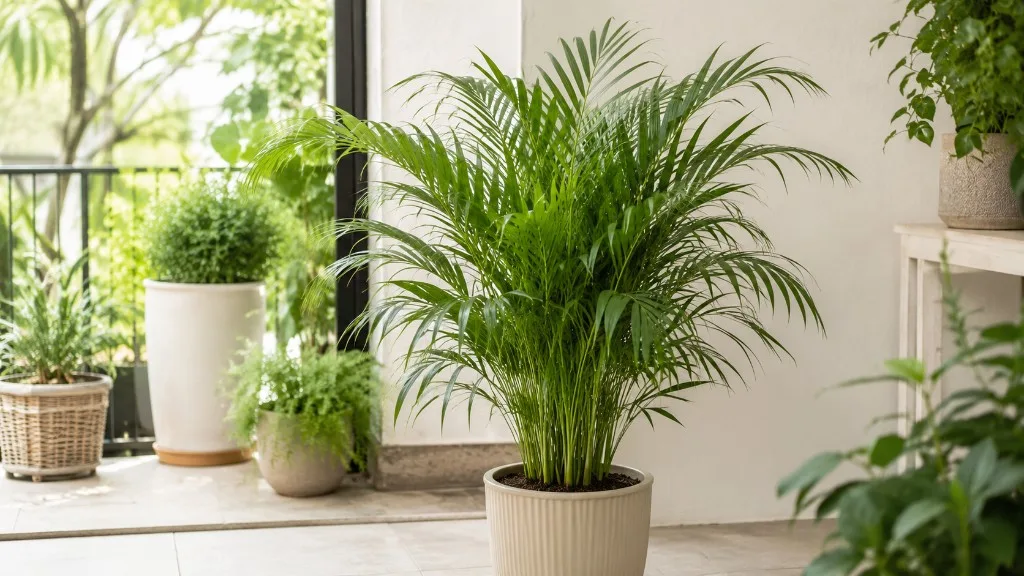
The parlor palm, Chamaedorea elegans, is an understory palm from southern Mexico and Guatemala. Its narrow, arching leaflets evolved for the broken light beneath taller rainforest trees, which explains the combination that makes it such a useful houseplant: it tolerates dim rooms, yet looks fuller and grows better when it receives bright, filtered light. The Royal Horticultural Society describes it as compact, long-lived, and easy to grow, while the Missouri Botanical Garden lists indoor plants at roughly 2 to 6 feet tall depending on age and conditions.
The most reliable parlor palm care routine is not complicated. Give it steady indirect light, water when the upper layer of mix has dried rather than on a fixed weekday, use a draining pot, and keep fertilizer modest. Most failures come from treating “tropical” as a command to keep the soil wet, or treating “low light” as permission to put the plant in a dark corner where the mix never dries and new growth weakens.
What parlor palm is and why it works indoors
Parlor palm is also sold as Neanthe bella palm or parlour palm. In nature it grows under a canopy, protected from harsh midday sun, wind, and rapid temperature swings. Indoors, it is usually sold as several slender seedlings planted together so the pot looks full; that is a nursery-created clump, not a single trunk that naturally branches into a dense shrub. NC State Extension notes that some stems in these clumps can eventually be outcompeted and die, so losing one older stem does not always mean the entire plant is failing.
This is a slow-growing palm, not a plant to buy for instant height or weekly new fronds. A healthy plant may spend a long time maintaining its existing canopy before producing a new leaf, especially after a move, repot, winter slowdown, or pest attack. The reward is longevity and tolerance: when the roots are sound and the light is usable, a parlor palm can occupy a home or office for years without constant pruning.
It is also a sensible choice for homes with cats and dogs. The ASPCA lists Chamaedorea as non-toxic to cats and dogs. That does not make any plant a good food or eliminate the possibility of stomach upset from chewing, so keep fronds out of reach of pets that repeatedly graze on houseplants.
Quick care at a glance
| Care factor | Practical target | What to watch for |
|---|---|---|
| Light | Bright, indirect or filtered light; light shade is acceptable | Bleaching or scorch in direct sun; weak, pale growth in deep shade |
| Water | Water when the surface and upper layer feel dry, then drain fully | Constantly wet mix, yellowing, and soft roots indicate too much water |
| Soil | Airy, fast-draining houseplant mix with slightly acidic to neutral reaction | Compacted or sponge-like mix stays wet and starves roots of air |
| Temperature | Normal indoor warmth; protect from cold drafts and frost | Blackening or sudden browning after a cold exposure |
| Humidity | Average household humidity is usually adequate; moderate humidity helps | Crispy tips plus dry air, heater airflow, or spider-mite stippling |
| Feeding | Weak balanced fertilizer during active growth only | Brown tips, crusty mix, or sudden decline after heavy feeding |
| Repotting | Only when roots fill the pot or the mix has broken down | Oversized pots dry slowly and increase root-rot risk |
The table is a starting point, not a substitute for observing the plant. A palm in a small terracotta pot beside a bright window will dry much faster than the same palm in a large plastic cachepot several feet from a window. Adjust the interval, not the basic rules.
Light: bright filtered is the sweet spot
Place a parlor palm near a north- or east-facing window, or a few feet back from a brighter exposure behind a sheer curtain. Filtered daylight should make the fronds clearly visible and cast a soft shadow, but the leaves should not sit in a hot shaft of direct afternoon sun. Missouri Botanical Garden recommends bright filtered light and shade while warning against direct sun; that is a better description than simply calling the plant “low light.”
Low-light tolerance means the palm can survive and hold foliage under less intense light than many tropical houseplants. It does not mean it can grow well in a windowless room. In very dim conditions, water use falls, growth slows, and the same watering schedule that worked in summer can leave the root ball wet for too long. If the plant is far from a window, a full-spectrum grow light on a timer can provide useful supplemental light without moving it into direct sun.
Match the plant’s response to the location
Read the newest growth and the pattern of damage rather than reacting to one old leaflet. Long gaps between leaflets, a leaning crown, pale green new growth, or a plant that stays wet for many days point toward insufficient usable light. Tan, crisp patches on the window-facing side point more strongly toward sun scorch or heat. Move gradually: shift the pot closer to the window over a week or two so foliage can acclimate, particularly after a dim nursery or a winter indoors.
Turn the pot a quarter turn every week or two if one side is stretching toward the window. Do not rotate a stressed plant as a substitute for better light, and do not prune healthy fronds just because the silhouette is uneven. New leaves are produced from the crown; cutting the growing point can permanently stop that stem.
Water: let the surface dry, then soak thoroughly
Parlor palms prefer a moist root zone with air spaces, not a permanently saturated one. Check the mix with a finger or a wooden skewer below the surface; if the top layer is dry but the center of the pot is still cool and damp, wait. If the upper inch or two has dried and the pot feels noticeably lighter, water slowly across the entire surface until a little drains from the bottom.
The key is the combination of timing and volume. Small sips wet only the top and encourage uneven roots, while repeated full waterings into a pot with no drainage can create a stagnant lower layer. After watering, empty the saucer or outer cachepot so the pot is not standing in runoff. In winter, check more often but water less frequently because lower light and cooler rooms slow evaporation.
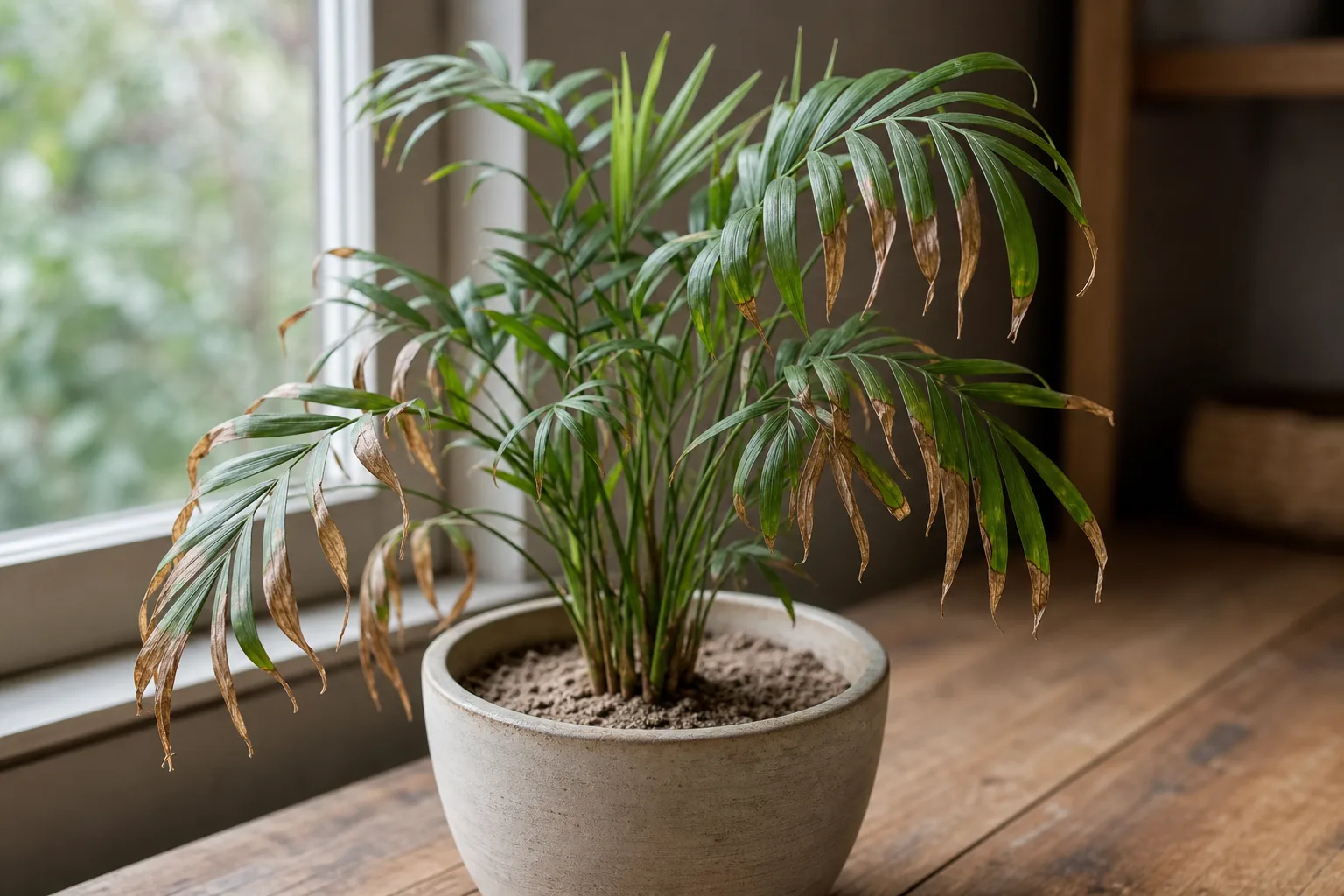
A safe watering routine
- Check moisture below the surface at several points, especially near the pot edge and between stems.
- Water at room temperature until the whole root ball is wet and a small amount exits the drainage holes.
- Let the pot drain for several minutes, then empty the saucer.
- Recheck in a few days if the plant is newly moved, recently repotted, or showing symptoms; do not immediately water again because a leaf drooped.
Water quality can matter when browning persists despite a sensible routine. The RHS advises using room-temperature rainwater where possible and avoiding regular hard tap water, which can contribute to alkaline conditions and leaf browning. You do not need to buy bottled water automatically: if your tap water is soft and the palm is thriving, changing it may accomplish nothing. Consider filtered or collected rainwater when the tips repeatedly brown, the potting mix develops a pale crust, or local water is notably hard.
Soil and pot: drainage matters more than a brand
Use a fresh, airy houseplant mix that holds some moisture but collapses slowly. A peat-free blend of coir or fine bark with a modest amount of perlite, pumice, or another coarse aeration ingredient works well; a commercial palm or indoor-plant mix is fine if it drains freely. A slightly acidic to neutral mix suits the plant. RHS guidance uses a light, fast-draining acidic compost, while NC State Extension calls for a humus-rich houseplant or container mix. The useful common ground is structure: roots need moisture and oxygen together.
Choose a pot with an actual drainage hole and only a little more room than the current root ball. Decorative cachepots are safe when the palm remains in a draining nursery pot inside them; they are risky when used as sealed planters. Do not add a layer of gravel at the bottom to “create drainage.” It raises the perched wet zone instead of replacing a properly draining mix. If water runs straight through a severely dried-out root ball, soak the pot once in a basin until the mix rehydrates, then let it drain; do not respond by keeping the pot submerged.
Temperature and humidity: steady beats tropical extremes
Normal indoor temperatures around 65–80°F (18–27°C) suit active growth. Keep the palm away from heating vents, air-conditioner blasts, frequently opened exterior doors, and cold glass during winter. The RHS gives a broad tolerance of 50–80°F, but tolerance is not the same as a growth target: a brief cool spell is different from a pot sitting in a cold draft every night.
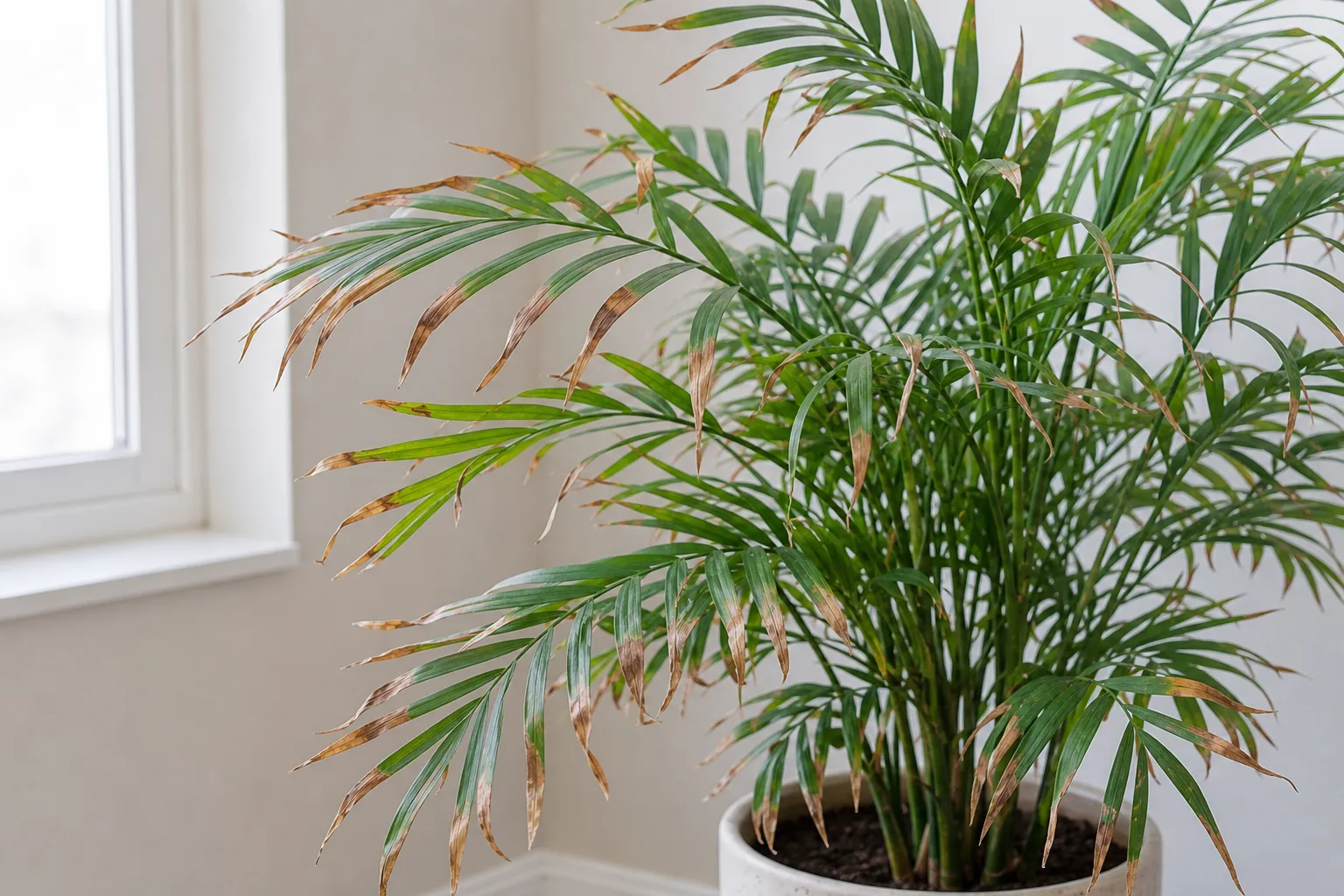
Average household humidity is usually enough, especially when the plant is not pressed against a heater. A hygrometer is more useful than guessing from a calendar. If the air is very dry and the palm has crisp margins, group plants, move the palm away from forced-air flow, or use a room humidifier. A pebble tray can add a small local effect only when the pot sits above the water on stones; it cannot turn a dry room into a rainforest, and the pot should never sit in standing water.
Misting may temporarily wet the leaf surface, but it does not provide stable humidity. It can be useful as part of occasional cleaning, yet repeated misting should not replace better placement, airflow, or a humidifier. Keep foliage from staying wet overnight, especially in a cool room, because prolonged leaf wetness can favor spotting.
Feeding: small doses while it is growing
Parlor palms are light feeders. During spring and summer, use a balanced liquid houseplant fertilizer diluted according to the label—often at half strength for a cautious routine—about monthly if the plant is actively producing growth. Missouri Botanical Garden recommends monthly feeding during the growing season and reducing both water and fertilizer in winter. A palm that is barely growing in a very dim room does not need the same feeding as a brightly placed palm.
Never fertilize bone-dry soil or a plant in obvious root distress. Water first if the mix is dry, then feed at a later watering. Pause after repotting until the plant has settled, and stop if brown tips, a crusty surface, or a sudden decline follows feeding. Gardening Know How connects brown tips with overfeeding and salt or fluoride stress; flushing a draining pot with plain water can help remove soluble buildup, but a severely damaged or compacted mix is better replaced.
Repotting: wait for a reason
Repot a parlor palm when roots circle densely and the plant dries unusually fast, roots emerge from the drainage holes, the mix has become compacted or sponge-like, or the container is unstable. Do not repot on a two-year alarm if the roots are healthy and the mix still drains. Slow-growing palms often stay in the same container for several years. RHS recommends moving up only a couple of centimeters, while Gardening Know How recommends a container just one or two inches larger than the root system.
The biggest repotting mistake is jumping from a snug pot to a much larger one. Extra mix holds extra water around a small root ball, so the plant may look surrounded by fresh soil while the roots lose oxygen. If the palm is top-heavy, increase stability with a heavier outer cachepot or a modestly wider pot, but keep the root volume change conservative.
Low-stress repotting sequence
- Repot in spring or early summer when the plant can recover in warm, usable light.
- Prepare a clean draining pot and fresh mix before disturbing the plant.
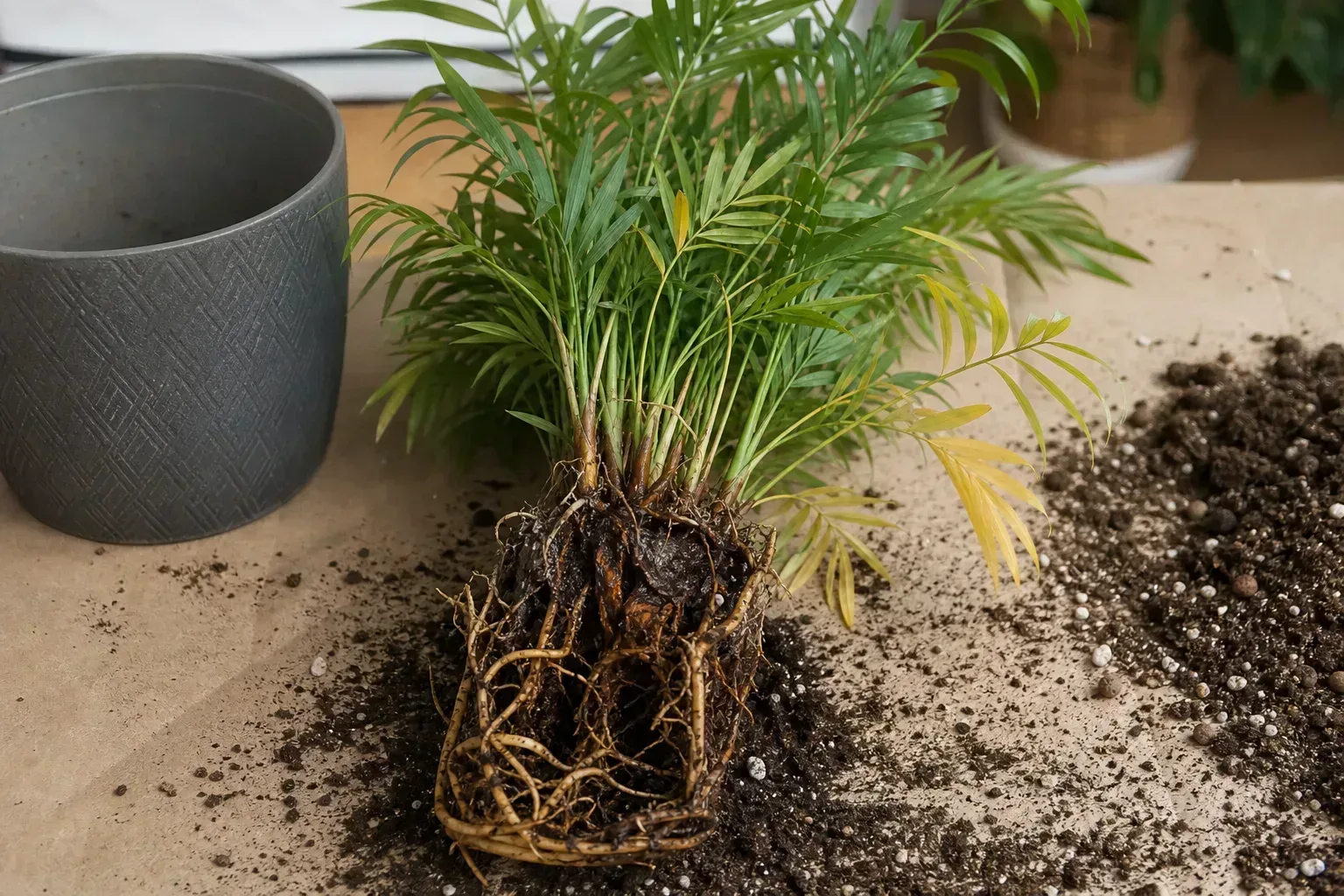
- Slide out the root ball and inspect it. Healthy roots are generally firm; dark, mushy, sour-smelling sections need attention.
- Loosen only the outermost circling roots and remove clearly dead material with clean scissors. Avoid tearing apart every stem in a nursery clump.
- Set the palm at the same depth, fill around it without packing the mix into a hard mass, and water until it drains.
- Let it recover in bright indirect light, then resume light feeding only after new growth or clear stability returns.
Pruning and grooming
Parlor palms grow from a terminal crown, so cutting the top of a stem will not make it branch. Remove a fully brown or dead frond at its base with clean scissors, taking care not to injure nearby stems. If only the tips are brown, trimming the brown tissue along the leaflet’s natural shape improves appearance but does not reverse the original stress.
Wipe dust from the fronds occasionally with a damp, soft cloth. This makes inspection easier and keeps the leaf surface from being coated in residue, but it is not a cure for poor light or dry roots. While cleaning, inspect the undersides of leaflets and the narrow stem joints for webbing, cottony deposits, or fixed brown bumps.
Propagation: division or seed?
You cannot make a new parlor palm from a leaf or ordinary stem cutting. Commercial growers usually start plants from seed, and seed work is slow because the palm is dioecious: male and female flowers occur on separate plants. A female plant needs compatible pollen before it can produce viable fruit and seed. For most home growers, buying a healthy young palm is easier and more predictable than waiting for seed.
Division is possible when a mature clump naturally separates into sections with stems and a useful amount of root. RHS describes gently pulling a healthy clump apart so each division retains roots. The trade-off is stress: every division has less foliage and root mass than the original, and some older fronds may yellow afterward. Divide only a vigorous plant in active growth, water it a day beforehand, keep each section in a snug pot, and give the divisions warm indirect light while they re-establish.
Troubleshooting parlor palm problems
Symptoms overlap, so diagnose in an order that prevents making the problem worse: check light and drafts, check soil moisture below the surface, inspect roots only when wetness or decline justifies it, then inspect for pests. Do not move a struggling palm into direct sun, fertilize a yellow plant automatically, or water repeatedly because one frond drooped.
Brown tips or brown leaflets
Brown tips are a pattern, not a diagnosis. Crispy tips on otherwise green fronds are consistent with dry air, a missed watering, hard-water or soluble-salt buildup, or a recent fertilizer mistake. If the brown areas are bleached and papery on the window-facing side, suspect direct sun or heat. If browning follows a cold night, draft damage may be involved. The RHS lists overwatering, underwatering, hard water, and direct sunlight among the possible causes, which is why changing only humidity may fail.
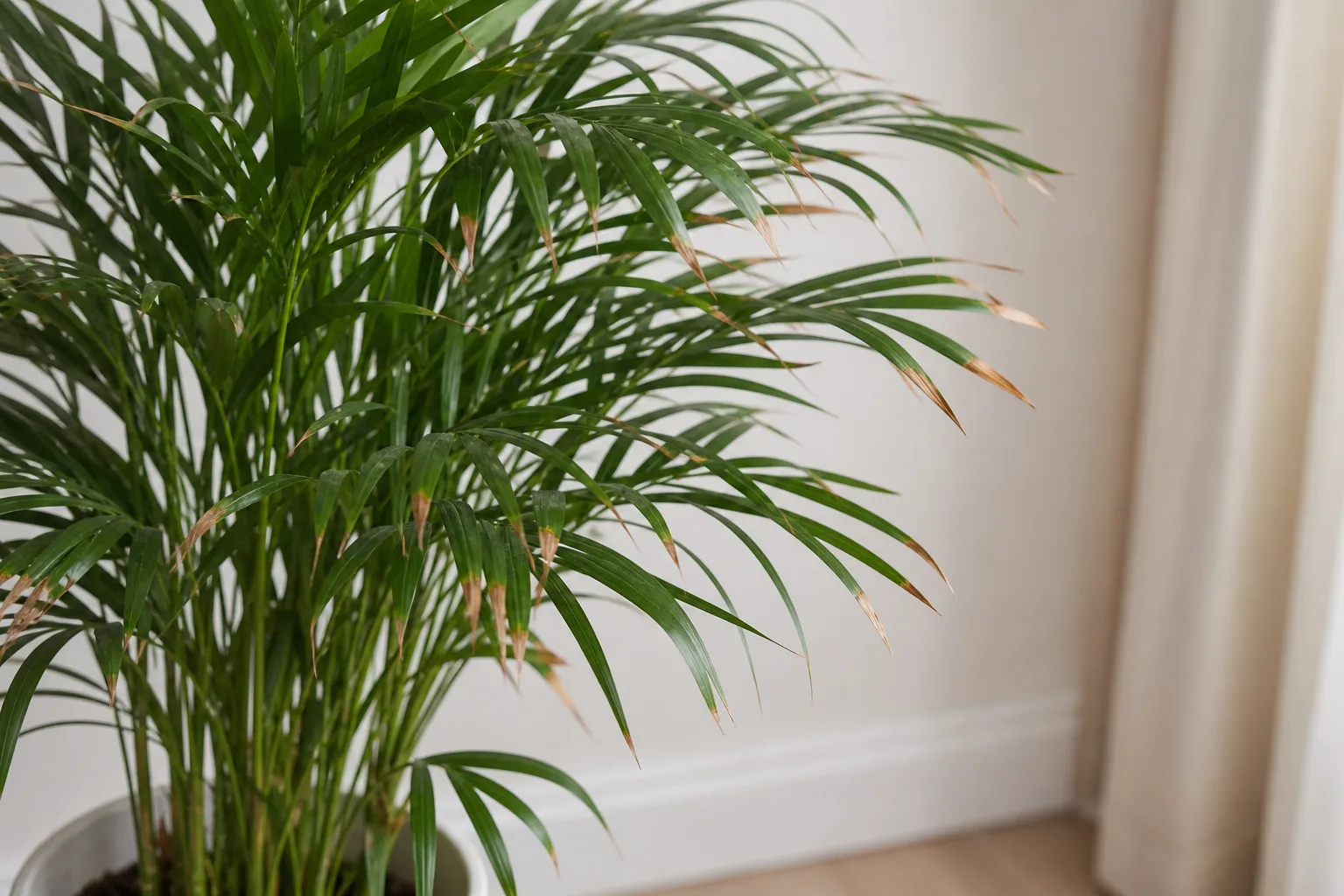
Start with the mix. If it is dry well below the surface, water thoroughly and reset the checking routine; if it is wet for many days, improve drainage and delay the next watering. Then inspect light and airflow. Trim only the dead tissue after the cause is corrected—brown tissue will not turn green again, but new leaves can emerge cleanly.
Yellow leaves, drooping, and weak growth
One old lower frond yellowing slowly can be normal aging, especially in a multi-stem clump. Several leaves yellowing together, a soft base, or a pot that stays wet points toward root stress from overwatering, compact mix, poor drainage, or a pot that is too large. Yellow leaves with dry, loose mix and drooping are more compatible with underwatering, though a root-damaged plant can also droop while its soil is wet because damaged roots cannot move water.
If growth is pale, stretched, and slow while the plant remains wet, improve usable light before adding fertilizer. If the leaves are pale but the soil, light, and roots are sound, a weak feed during active growth may help. NC State Extension emphasizes that the palm tolerates low light but still benefits from bright indirect light and should dry slightly between waterings.
Root rot, pests, and leaf spots
Root rot is most likely when the mix is persistently saturated and the roots are dark, soft, or foul-smelling. Unpot only when those signs, repeated wilting in wet soil, or a failing base justify inspection. Cut away rotten roots with clean scissors, move the palm into fresh draining mix and a clean, appropriately sized pot, and do not put the rescued plant immediately back on the old watering schedule. If most roots and the crown are mushy, recovery may not be possible.
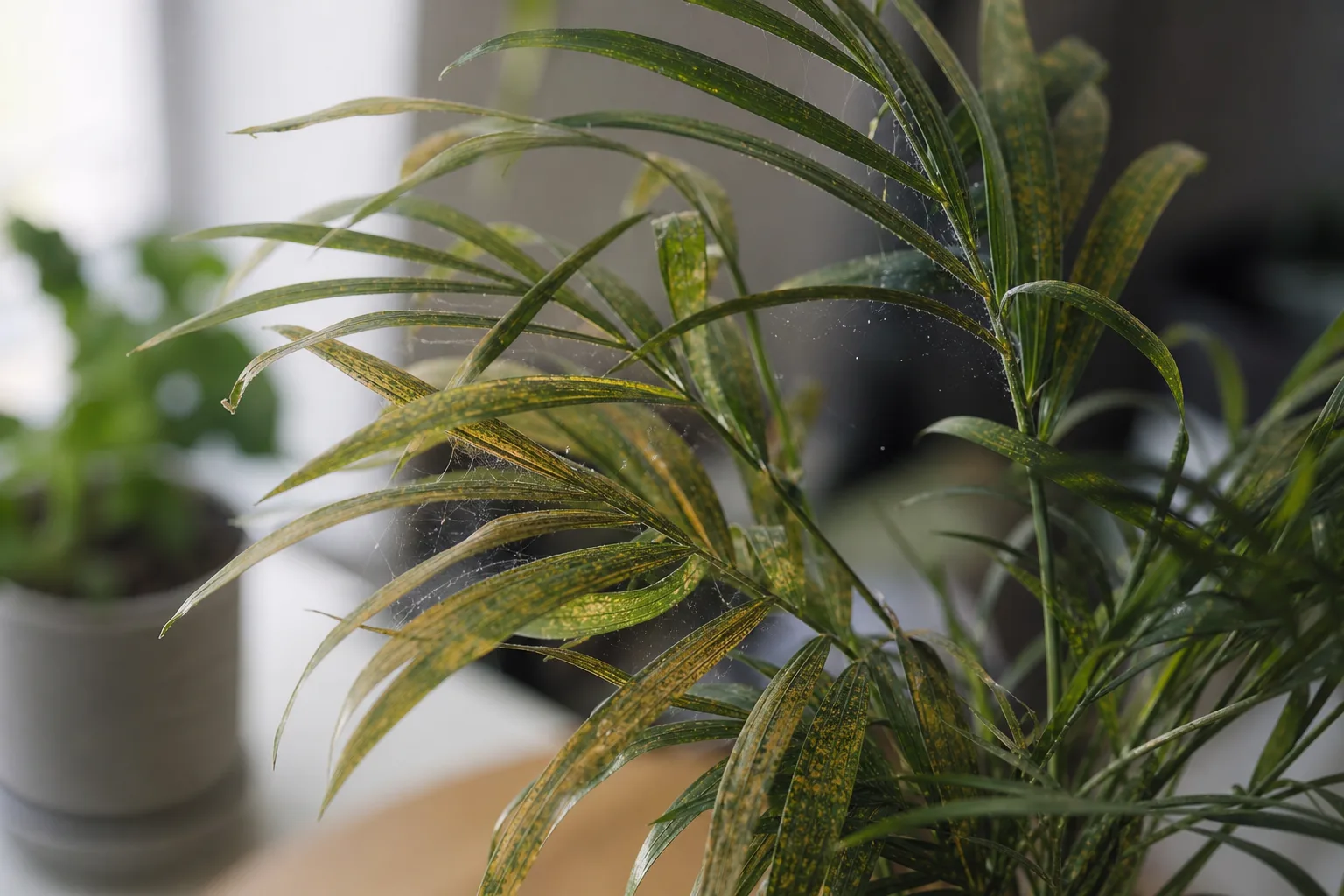
Spider mites favor hot, dry conditions and may cause fine stippling or webbing. Mealybugs look like white cottony clusters in joints; scale appears as fixed bumps on stems or leaf undersides. Isolate the palm, wash accessible pests from the foliage, and repeat a properly labeled insecticidal-soap or horticultural-oil treatment as directed. Test any product on a small area first, keep sprays off hot sun, and never improvise stronger concentrations. Gardening Know How’s parlor palm pest guidance also recommends checking leaf undersides and isolating new plants before grouping them.
Small brown or black spots can follow wet foliage, poor airflow, or a disease issue rather than simple dry air. Remove badly affected leaves, keep water off the foliage, improve spacing and ventilation, and avoid propagating from a visibly diseased clump. If spotting spreads quickly, the stem blackens, or the crown collapses, discard the plant rather than exposing a collection to an uncertain infection.
Outdoor summering and warm-climate care
Parlor palm can grow outdoors year-round only in warm, frost-free climates, commonly USDA Zones 10–12. Even there, choose filtered shade and well-drained soil protected from strong wind; the plant is adapted to forest shade, not an exposed, sun-baked patio. Missouri Botanical Garden gives the same warm-zone, moist-but-well-drained, shaded preference.
For a seasonal move, acclimate over one to two weeks. Start in deep shade, then move toward the brighter outdoor position as the foliage adjusts. Outdoor rain and predators may reduce some pests, but wind, intense sun, and a pot that dries rapidly can create new stress. Bring the palm indoors before cold nights in cooler regions, inspect every frond and stem for hitchhiking insects, and quarantine it from other plants for a couple of weeks.
Conclusion
Good parlor palm care is mostly about moderation and observation. Give Chamaedorea elegans bright filtered light instead of direct sun or a dark corner, keep the root ball lightly moist but never waterlogged, use a draining pot and airy mix, and feed only while the plant is actively growing. Stable indoor warmth, occasional grooming, and sensible pest inspections will do more than a complicated schedule.
When the tips brown or the fronds yellow, start with evidence: feel the soil, look at the light, check drafts and water quality, and inspect roots or pests only when the pattern supports it. Correct the cause, leave damaged tissue in place until the plant stabilizes, and remember that a slow-growing palm may need weeks or months to show recovery. That patience is part of the plant’s character—and one reason a healthy parlor palm can remain a graceful indoor companion for a very long time.