How Far Apart to Plant Hydrangeas: The Easy Rule
Learn how far apart to plant hydrangeas by mature width, variety, and hedge style, plus spacing from walls, paths, trees, and companion plants.
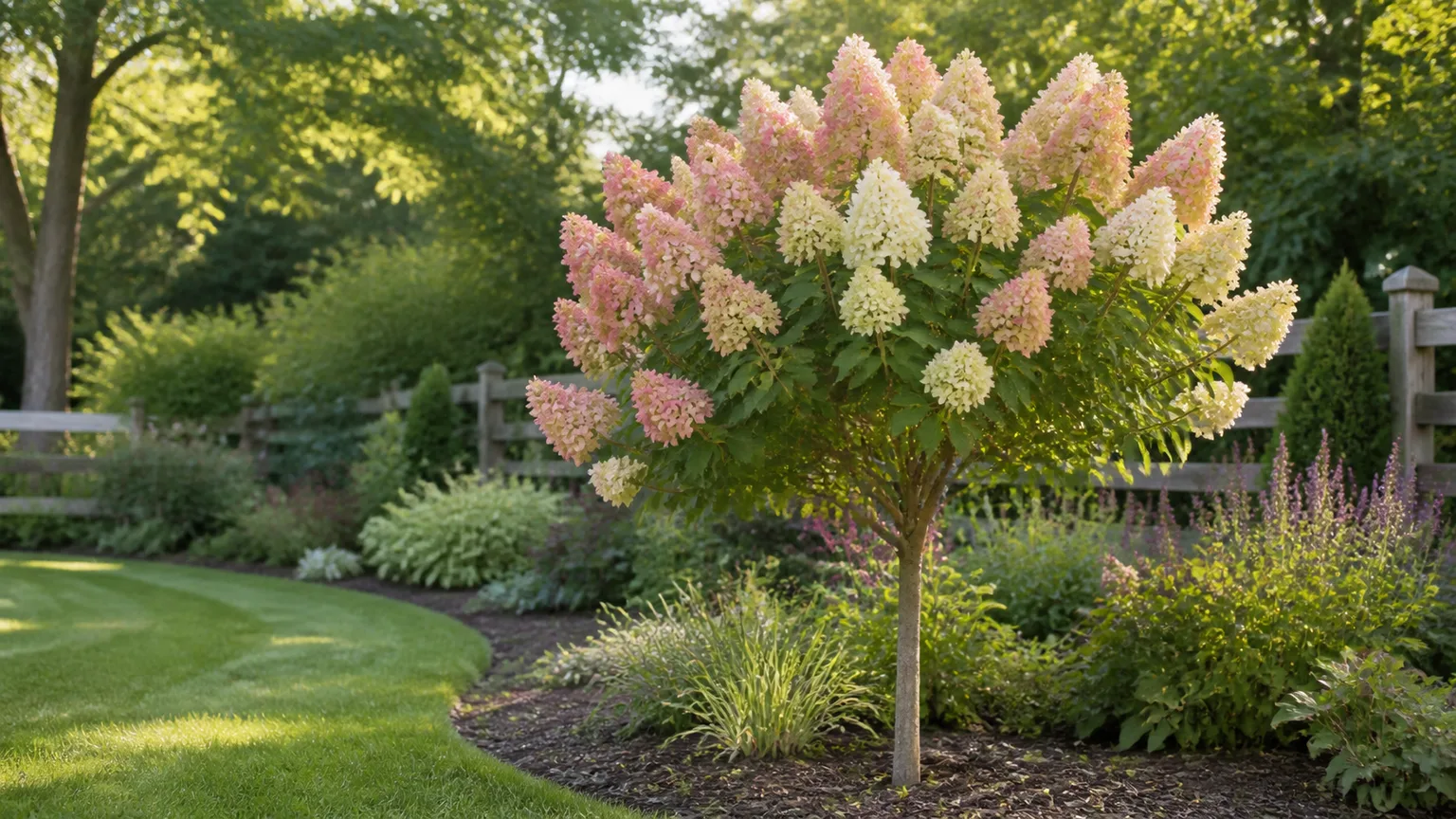
If you need one starting number, use the hydrangea’s mature width plus about 1 foot, measured from the center of one plant to the center of the next. A variety that matures at 5 feet wide therefore starts at about 6 feet center to center for a specimen planting.
That rule is a planning baseline, not a universal command. A compact mountain hydrangea can sit much closer than a full-size ‘Limelight’, and a flowering hedge can be tighter than a row of specimen shrubs. The plant label’s mature width, your desired look, and the way air moves through your garden should decide the final measurement.
Spacing is easiest to fix on paper. Once a hydrangea has filled a bed, moving it means lifting a large rootball, and pruning it hard every year just to keep it off a path usually sacrifices the natural form you planted it to enjoy.
The short answer: start with mature width, not the nursery pot
Measure the width the shrub is expected to reach in its permanent location, then add a small buffer. Do not measure the one- or three-gallon pot sitting at the nursery; that is the plant’s temporary shipping size, not the footprint it will occupy after several seasons.
For most free-standing shrubs, this quick calculation works:
Center-to-center spacing = mature plant width + 1 foot of breathing room
If the label says 4 feet wide, mark the next hydrangea about 5 feet away. If it says 8 feet wide, mark the next center about 9 feet away. The extra foot creates roughly 6 inches of open space between the mature canopies when both shrubs are the same width. In a humid garden or a bed with limited breeze, add more rather than less.
Think of this as a minimum comfortable layout for a specimen, not a prediction that every plant will stop at the number on the tag. Hydrangea size is affected by cultivar, climate, pruning, soil, irrigation, and whether the plant is grown as a shrub or trained into a tree form. A label that says “4 to 6 feet wide” deserves a layout based on the upper end when the bed is permanent or hard to access. The cost of waiting for a gap to fill is usually lower than the cost of relocating a mature shrub.
If you are planting a mixed row, calculate each plant separately. Do not average a 3-foot hydrangea and an 8-foot hydrangea and give both the same 6-foot spacing. Mark the smaller plant from its own center, then measure the larger plant from its own center. That simple step prevents the vigorous shrub from swallowing the compact one and keeps the row’s widest canopy from becoming the hidden constraint.
The RHS hydrangea growing guide gives a broad 3- to 8-foot spacing range for shrubby hydrangeas and specifically says to check the label for eventual size. That range is useful as a reality check, but the mature-width formula is safer for a named cultivar because hydrangeas sold under the same broad type can have very different dimensions.
Identify the hydrangea type before you measure
“Hydrangea” describes a genus, not one uniform shrub. The NC State Extension hydrangea profile lists bigleaf, smooth, panicle, oakleaf, mountain, and climbing forms, with differences in habit, light tolerance, mature size, and pruning. Identification does not need to be perfect before you begin, but you do need the cultivar’s expected width.
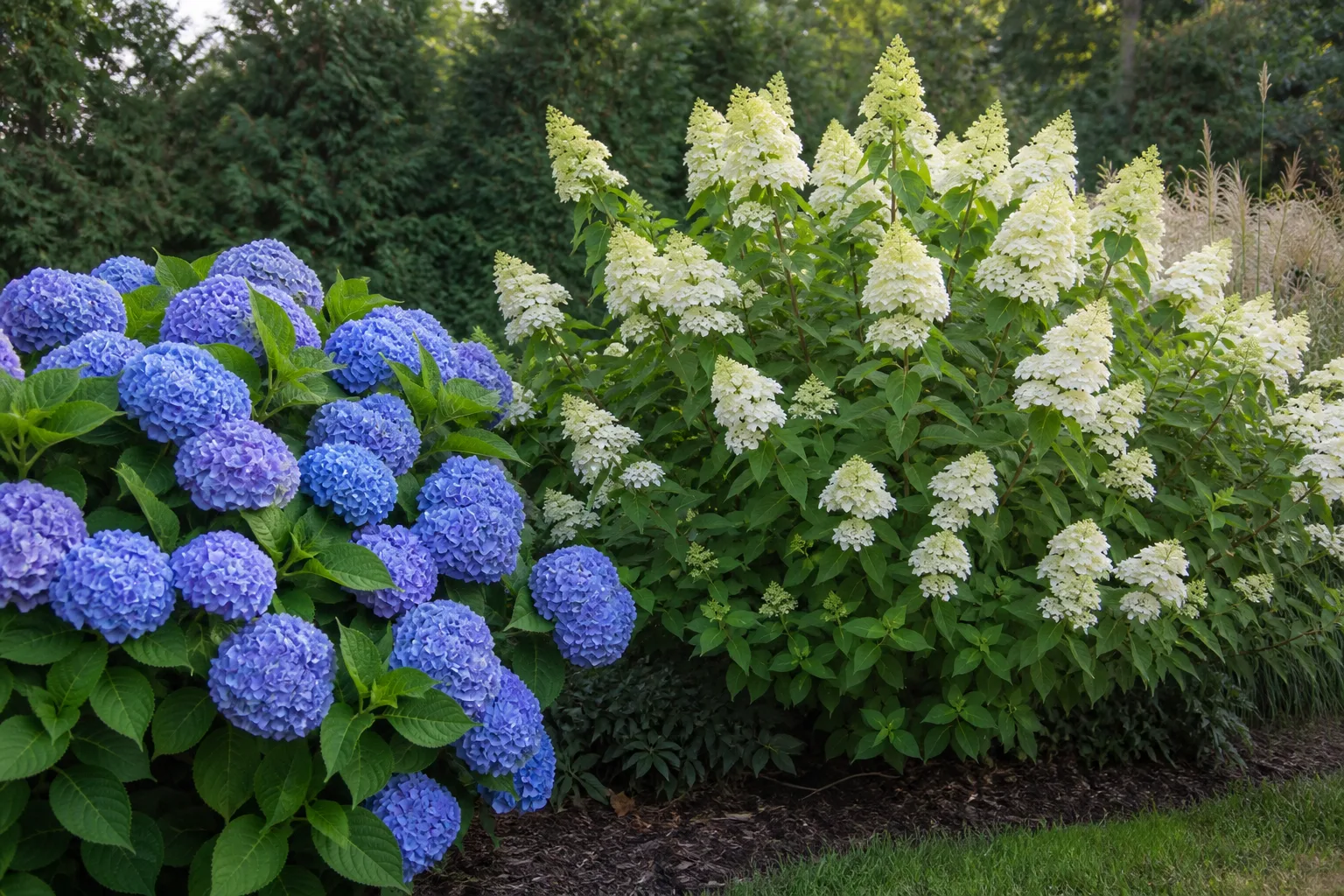
Compact bigleaf, mountain, and smooth cultivars
Bigleaf hydrangeas, including mopheads and lacecaps, are often rounded shrubs, but their mature widths range from compact patio-sized cultivars to broad landscape plants. Mountain hydrangeas can be similarly compact. Smooth hydrangeas include small selections as well as vigorous ‘Annabelle’-type plants that need a much wider footprint.
For these groups, the label is more useful than the common name. A compact cultivar listed at 2 feet wide may work at roughly 3 feet center to center as a specimen, while a 5-foot-wide selection may need 6 feet. If you are planting a low hedge, you can reduce that distance enough for the mature branches to meet, but keep enough separation for leaves to dry after rain.
Large panicle and oakleaf cultivars
Panicle hydrangeas are the common source of spacing mistakes because some are compact shrubs while others become large, upright plants or tree forms. A ‘Limelight’ that matures around 6 to 8 feet wide does not belong on the same 3-foot grid as a tiny mountain hydrangea. Oakleaf hydrangeas also vary widely and may be as important for their broad leaves and fall color as for their flowers.
Allow the full width before you decide that a bed is too empty. The NC Cooperative Extension hydrangea overview notes that hydrangeas can grow from about 4 to 12 feet depending on variety and describes some panicle hydrangeas as much larger. Those figures are reminders to inspect the exact cultivar, not promises that every plant will reach the maximum.
Climbing hydrangeas are a different spacing problem
Climbing hydrangea is not a shrub that you simply repeat along a border. It needs a wall, tree, fence, or other support, and its mature height and spread are measured vertically as well as outward. Give it room to climb and to reach the support without wrapping around windows, gutters, utility lines, or delicate trees.
For a climber, prioritize the distance from the support and the available vertical surface. Use the plant’s mature spread to keep it away from neighboring shrubs, but do not apply a shrub-hedge spacing chart to a vine. The NC State plant profile identifies climbing hydrangea among the group and notes that climbing forms can grow much taller than ordinary garden shrubs.
Use a simple spacing formula that works in most beds
Start with the mature width on the label. Add a foot for a free-standing specimen, or use the label’s hedge recommendation if the goal is a continuous row. Then draw the layout using the center points of the plants, not the edges of the nursery containers.
This matters because “3 feet apart” can mean different things in casual conversation. Garden spacing is normally center to center. If two shrubs are each 4 feet wide and their centers are 5 feet apart, the mature branches are expected to come within about 1 foot of each other. If you measure 5 feet between the outer edges of two small pots instead, the shrubs may end up far closer than you intended.
Measure center to center, then check the edge gap
Use a tape measure and two temporary stakes. Mark the first plant’s center, measure the calculated distance, and place the second stake at that point. Stand back and look at the line from several angles before digging; a mathematically perfect row can look awkward if the bed curves or the plants sit at different elevations.
Now check the space between the mature canopies and between each hydrangea and its neighbors. If the bed is shaded, humid, or difficult to access, the extra air gap is valuable. If your climate is dry and the plants are small, you may choose a slightly tighter arrangement, but do not assume pruning will permanently correct an undersized planting plan.
Decide whether you want a specimen, hedge, or mass planting
The same cultivar can need different spacing depending on the visual job. Decide what “finished” means before you set the stakes: individual rounded shrubs with visible gaps, a soft hedge that eventually touches, or a layered mass planting with companion plants filling the early years.
Specimen shrubs need breathing room
For a specimen, use mature width plus a buffer. This lets the shrub show its outline, improves access for watering and pruning, and reduces the amount of foliage trapped against its neighbors. Odd-numbered groups can still look full without turning into one congested wall; stagger the centers instead of squeezing every plant into a straight line.
A specimen also needs room on the outside. A 6-foot-wide hydrangea placed 2 feet from a path will eventually lean into the walkway even if it has perfect spacing from the next shrub. Treat paths, doors, air-conditioning units, and windows as real boundaries when you plan the mature footprint.
Hedges can close sooner, but not at the cost of airflow
For a hedge, the goal is for the branches to meet after establishment. A loose hedge is usually planted close to the mature width, while a denser hedge uses a smaller center-to-center distance. The trade-off is time versus airflow: tighter plants fill sooner but compete more intensely for water and can stay damp longer after rain.
There is no prize for closing the hedge in its first summer. Hydrangeas often look undersized when newly installed because the root system is still settling, but a patient layout gives each shrub a chance to build a strong framework. A hedge that takes an extra season to meet can still be healthier and easier to renovate than one planted so tightly that its inner stems become a dark, wet tangle.
Use the label’s hedge spacing first. As examples, Savvy Gardening’s hydrangea spacing guide gives about 3 to 4 feet for an ‘Endless Summer’ hedge and about 4 to 5 feet for a ‘Limelight’ hedge, while Epic Gardening’s cultivar guide places ‘Limelight’ specimens about 8 feet apart. Those are cultivar examples, not a license to plant every hydrangea at one of those distances.
In a wet climate, choose a slightly looser hedge or leave openings where prevailing breezes can pass through. If the hedge borders a lawn or path, a little more room also makes mowing, mulching, and inspecting the lower stems much easier.
Hydrangea spacing chart for common cultivar examples
The chart below is a planning shortcut for named examples. Confirm the current nursery label before buying; selections are updated, sold under different trade names, and grown to different sizes in different climates. “Specimen” means center to center with room for the plant to show its form. “Hedge” means a closer row intended to knit together over time.
| Hydrangea example | Approximate mature width | Specimen spacing | Hedge spacing |
|---|---|---|---|
| ‘Tiny Tuff Stuff’ mountain hydrangea | About 2 feet | About 3 feet | About 18 inches to 2 feet |
| ‘Pee Wee’ oakleaf hydrangea | About 3 feet | About 4 feet | Check label; usually tighter than specimen spacing |
| ‘Nikko Blue’ bigleaf hydrangea | About 4 to 6 feet | About 6 feet | About 4 feet |
| ‘Annabelle’ smooth hydrangea | About 4 to 6 feet | About 6 feet | About 3 to 4 feet |
| ‘Limelight’ panicle hydrangea | About 6 to 8 feet | About 8 feet | About 4 to 5 feet |
These figures synthesize the cultivar examples in Epic Gardening and Savvy Gardening. The most important column is still the mature-width line on your plant’s tag. If the label says your selection will be wider than the example above, increase the spacing.
Choose the site before you set the tape
Spacing cannot rescue a hydrangea planted in the wrong light or in soil that swings from flooded to bone-dry. Before measuring, observe the bed through a summer day, find where water naturally collects, and notice whether the area gets an afternoon blast of heat from pavement or a south-facing wall.
Light and moisture matter as much as distance
The RHS recommends light shade and moist soil that drains well, while noting that hydrangeas tolerate sunnier positions when the soil does not dry out. NC State Extension similarly describes morning sun and afternoon shade as a reliable setting and cautions against hot, dry locations.
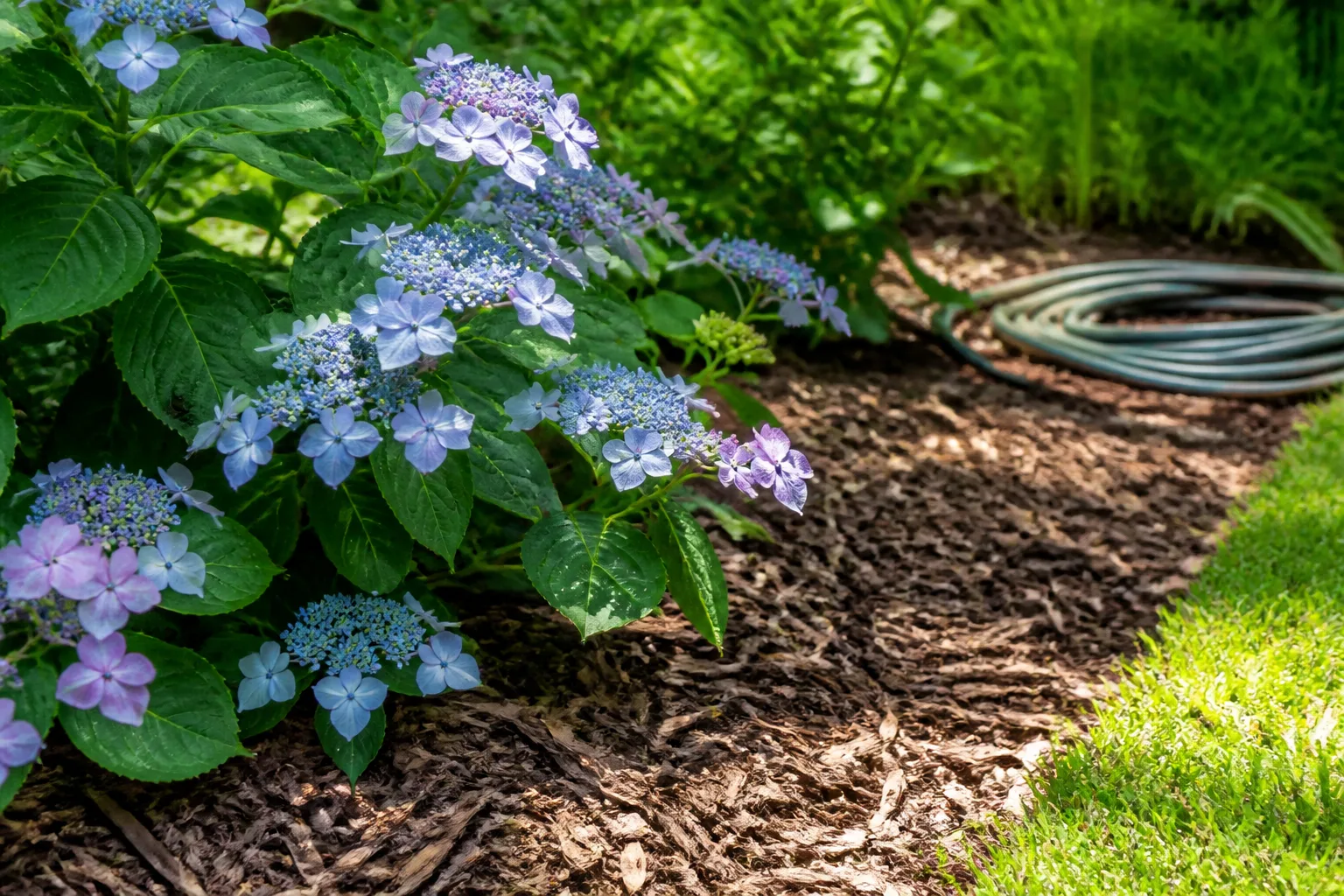
That does not mean every hydrangea wants deep shade. Panicle types generally tolerate more sun than many bigleaf types, but a sunny site also increases the water demand of every plant in a row. If your only available spot is bright and dry, choose a more sun-tolerant cultivar, improve the soil’s organic matter, install a way to water deeply, and give the shrubs extra room rather than planting a tight hedge.
Mulch helps hold moisture, but it does not make poor drainage disappear. Keep mulch off the stems and leave a visible ring around each crown. In a crowded row, that open ring is one of the few places you can check soil moisture and spot stem damage before a problem spreads.
Leave room for buildings, paths, trees, and thirsty neighbors
For a wall or house, convert the center-to-center rule into an edge measurement: place the hydrangea’s center at least half its mature width plus about 1 foot from the wall. A 6-foot-wide shrub therefore starts about 4 feet from the wall. Add more space if you need to paint, clean windows, inspect siding, or keep branches away from gutters.
For a path, add the clearance you want to the same calculation. If a shrub is 6 feet wide and you want 2 feet of walking space outside its mature canopy, place its center roughly 5 feet from the path edge. This is a practical layout rule, not a universal building code, so adjust for the plant’s habit and the access the site requires.
Trees create a second problem: their roots and canopy can compete for water and light. A hydrangea under a mature tree may need more irrigation and may flower less if the canopy is too dense. Avoid placing a thirsty hydrangea directly in the tree’s most crowded root zone unless you are prepared to manage the moisture and light carefully.
Planting day: mark the centers and protect the root zone
Set all of the stakes before digging. Check the sightline from the house, the spacing along the bed, and the distance from the nearest path or structure. It is much easier to move a stake 6 inches than to move a planted shrub.
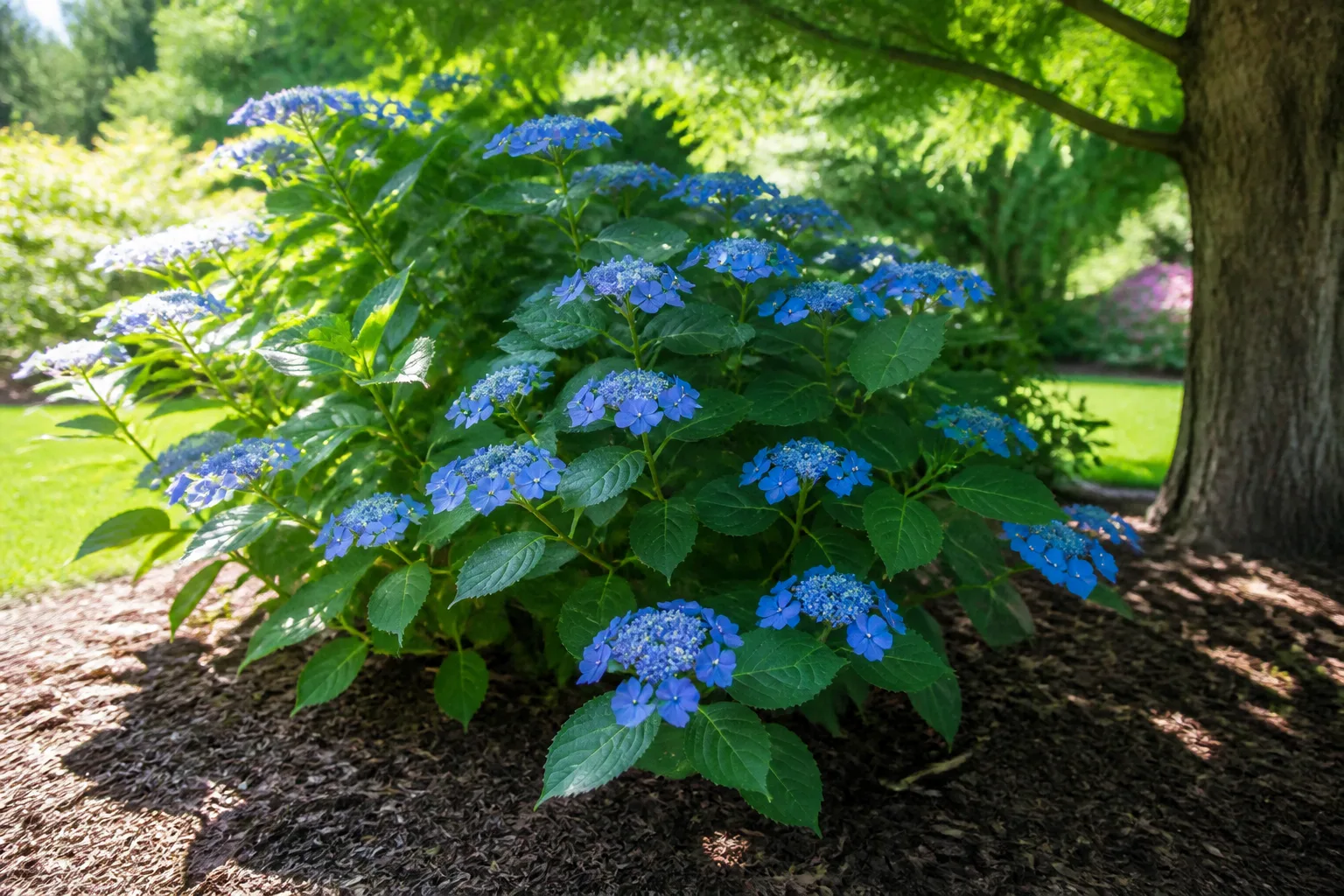
On planting day, water each hydrangea while it is still in its container. The RHS planting instructions call for a hole as deep as the rootball and about three times as wide, with the top of the potting mix level with the surrounding soil. Keep that depth consistent; a wide hole does not compensate for a rootball planted too deeply.
Backfill with the soil you removed, breaking up hard clods and incorporating organic matter only when the site needs improvement. Firm the soil, water slowly, and add an organic mulch layer while leaving roughly 4 to 6 inches clear around the base. The newly planted gap may look excessive, but the shrub needs those open inches while its roots establish.
During the first growing season, water based on soil moisture and weather rather than a rigid calendar. Newly planted shrubs can wilt even when the surrounding lawn looks fine. Water at the base, check below the mulch with your finger, and keep the root zone evenly moist without leaving it waterlogged.
Add companion plants without crowding the hydrangeas
Hostas, ferns, heuchera, and astilbe can work well around hydrangeas because many tolerate the same bright shade or filtered light and look good beside large leaves and flower clusters. Their value is mostly shared site preference and contrast, not a special biological partnership that makes hydrangeas bloom.
Use companions to fill the foreground or the spaces between the hydrangea centers, not to jam plants into the shrub’s crown. Place low-growing plants near the edge of the hydrangea’s eventual canopy, keep a clear mulch ring around the stems, and leave enough room to walk in for watering or pruning. If a companion is tall or spreads aggressively, treat it like another shrub and include its mature width in the layout.
A practical sequence is to plant the hydrangeas first, mulch, and wait a season before filling every open pocket. That pause reveals how much shade the mature foliage creates and whether the bed stays damp. You can then add ferns or hostas where the light is filtered, heuchera where the foliage contrast is most useful, and astilbe where there is enough moisture for its flower plumes without turning the bed into a solid root mat.
What to do when hydrangeas are already too close
First decide whether the problem is genuinely poor spacing or simply young plants that have not filled out. If the foliage is still separate, the shrubs are flowering well, and you can water and inspect them easily, leave them alone and reassess after a full growing season.
If the plants are pressing into each other, staying wet after rain, or blocking a path, rank the options from least disruptive to most permanent:
- Remove competing weeds and tall companions from the shared root zone.
- Redirect irrigation to the soil rather than spraying the foliage.
- Thin only the stems that rub or block access, using the pruning timing for that hydrangea type.
- Move one shrub during a mild, dormant or shoulder-season window if it is young enough to lift with a manageable rootball.
- Remove or relocate a plant when the bed cannot support the mature widths.
Do not solve a spacing error by shearing every hydrangea into a small ball. Bigleaf and mountain hydrangeas can lose future flowers if pruned at the wrong time, and repeated hard cuts often create a cycle of weak, crowded regrowth. If the label’s mature size clearly exceeds the bed, relocation or replacement with a compact cultivar is kinder to the plant and usually easier for you.
Conclusion: give the mature shrub room to become itself
The best answer to “how far apart should I plant hydrangeas?” begins with the mature-width line on the label. Use mature width plus about 1 foot for specimen shrubs, tighten the distance only when you are intentionally making a hedge, and widen it for humid sites, large cultivars, structures, paths, or difficult access.
The result should look slightly sparse on planting day. That is not wasted space; it is the room hydrangeas need for healthy roots, drier foliage, easier watering, and a natural shape that does not require constant rescue pruning.