Heart-Leaf Philodendron Care & Growing Guide
Learn Philodendron hederaceum care with a reliable light and watering rhythm, airy soil, safe placement, propagation steps, and fixes for yellow leaves.
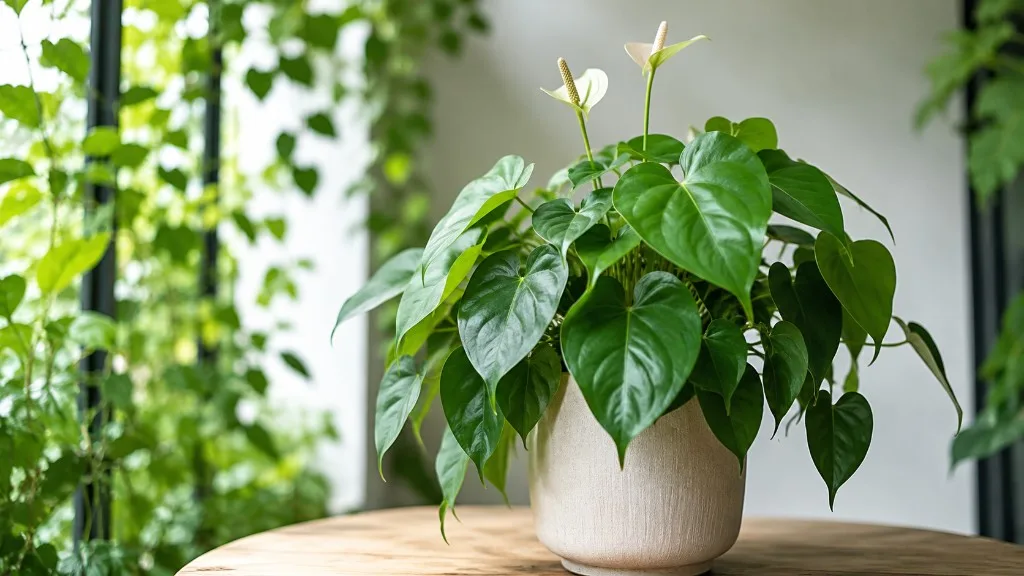
Heart-leaf philodendron (Philodendron hederaceum) is forgiving because it can tolerate a wider range of indoor conditions than many tropical houseplants. It is not careless-proof, though: a dark corner plus wet soil is a slow route to thin growth and root loss, while intense sun and irregular watering can leave the leaves scorched or crisp.
The most reliable routine is simple. Give it bright, indirect light; use an airy potting mix in a container with a drainage hole; water when the mix has partly dried; and let the stems trail or climb according to the space you have. This guide explains how to make those decisions, how to propagate a healthy vine, and how to read yellow, brown, or sparse growth before the problem spreads.
Heart-Leaf Philodendron Care at a Glance
| Care factor | Practical target | What tells you to adjust |
|---|---|---|
| Light | Bright, filtered or indirect light | Long gaps between leaves mean more light is needed; bleached patches mean less direct sun |
| Water | Soak thoroughly after the upper part of the mix dries | Wet mix plus yellow leaves points to slow drainage; limp leaves with a light, dry pot point to thirst |
| Soil | Airy, moisture-retentive, and fast-draining | A sour smell or mix that stays wet for many days is a root warning |
| Temperature | Typical warm indoor conditions; avoid cold drafts | Growth slows sharply near cold glass or below about 50°F (10°C) |
| Humidity | Average household humidity is acceptable; moderate humidity is better | Crispy margins, especially near a heater or vent, mean the environment is too dry or erratic |
| Feeding | Diluted houseplant fertilizer during active growth | Brown tips and a crust on the mix can mean fertilizer or mineral buildup |
| Shape | Trail from a shelf or hanging basket, or climb a support | Bare lower vines need more light, pruning, or several cuttings planted back into the pot |
| Safety | Keep away from pets and children who may chew it | The sap and foliage contain insoluble calcium oxalates |
These targets reflect the plant’s biology rather than a universal weekly schedule. UF/IFAS describes heart-leaf philodendron as an easy vining houseplant that prefers diffuse light, tolerates ordinary household air, and should be watered when the top inch of soil is dry; NC State Extension also notes that it tolerates low light but grows as a trailing or climbing vine in moist, well-drained soil. (UF/IFAS Gardening Solutions) (NC State Extension Plant Toolbox)
Identify the Plant Before You Change Its Care
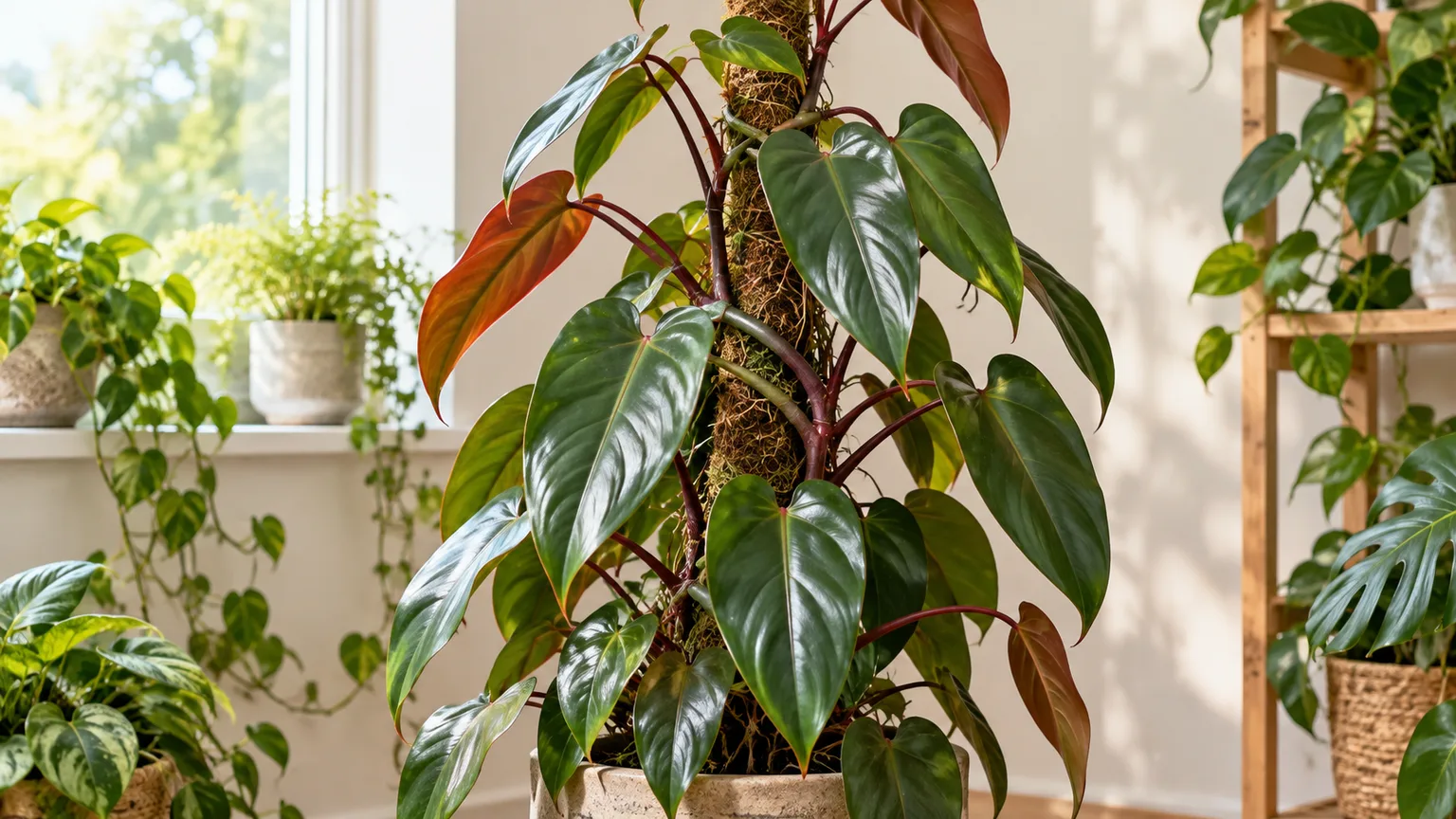
The common name covers a recognizable group of vining philodendrons, but labels can be inconsistent. The species is a tropical evergreen aroid with glossy, heart-shaped leaves and thin stems that can cascade from a pot or cling to a support. NC State Extension lists Philodendron hederaceum as a low-maintenance vine that can reach roughly 13 feet in climbing growth, although an indoor plant usually stays much smaller unless you give it a tall support and enough light.
The plant changes character when it climbs. A trailing indoor vine commonly has small leaves and long, flexible stems; when the stems attach to a support, new growth can become larger and more vigorous. That difference is not a sign that the plant has changed species—it is a response to its growth habit and the support available.
Heartleaf Philodendron vs. Pothos
Heartleaf philodendron and golden pothos are often sold side by side because both have trailing stems and heart-shaped leaves. Pothos leaves are usually thicker and waxier, while heartleaf philodendron leaves tend to have a more pronounced inward notch at the base and a softer, less rigid feel. Their petioles and new growth also differ, but a plant tag or nursery photo is not always enough for a quick identification.
The distinction matters most when you are buying a cultivar or troubleshooting a plant with unusual markings. Solid green P. hederaceum is the baseline form; ‘Brasil,’ ‘Lemon Lime,’ ‘Cream Splash,’ and similar selections need enough indirect light to hold their variegation, but harsh sun can damage any of them. When in doubt, photograph the leaves and growth habit, then compare the whole plant rather than relying on one leaf.
Light for Healthy, Compact Growth
Place heart-leaf philodendron in bright, indirect light where a hand shadow is soft rather than sharply defined. An east-facing window, a bright room a short distance from a south or west window, or a filtered spot beneath a skylight usually works well. Direct summer sun through glass can bleach or scorch the leaves, especially after the plant has been kept in a dim shop.
Low light is a survival advantage, not the recipe for a full, fast-growing plant. In a darker room, the vine may remain alive but produce smaller leaves, longer spaces between nodes, and fewer new leaves. If the plant is healthy but sparse, move it closer to a bright window in small steps over a week or add a grow light rather than increasing fertilizer.
Use the leaves and internodes as your light meter. Pale, dry patches on the window-facing side mean the plant is receiving too much direct light; evenly green leaves with stretched stems mean it needs brighter indirect light; and a healthy color with slow growth may simply reflect the cooler, darker season. Rotate the pot a quarter turn every week or two so one side does not monopolize the window.
Soil, Pot, and Drainage
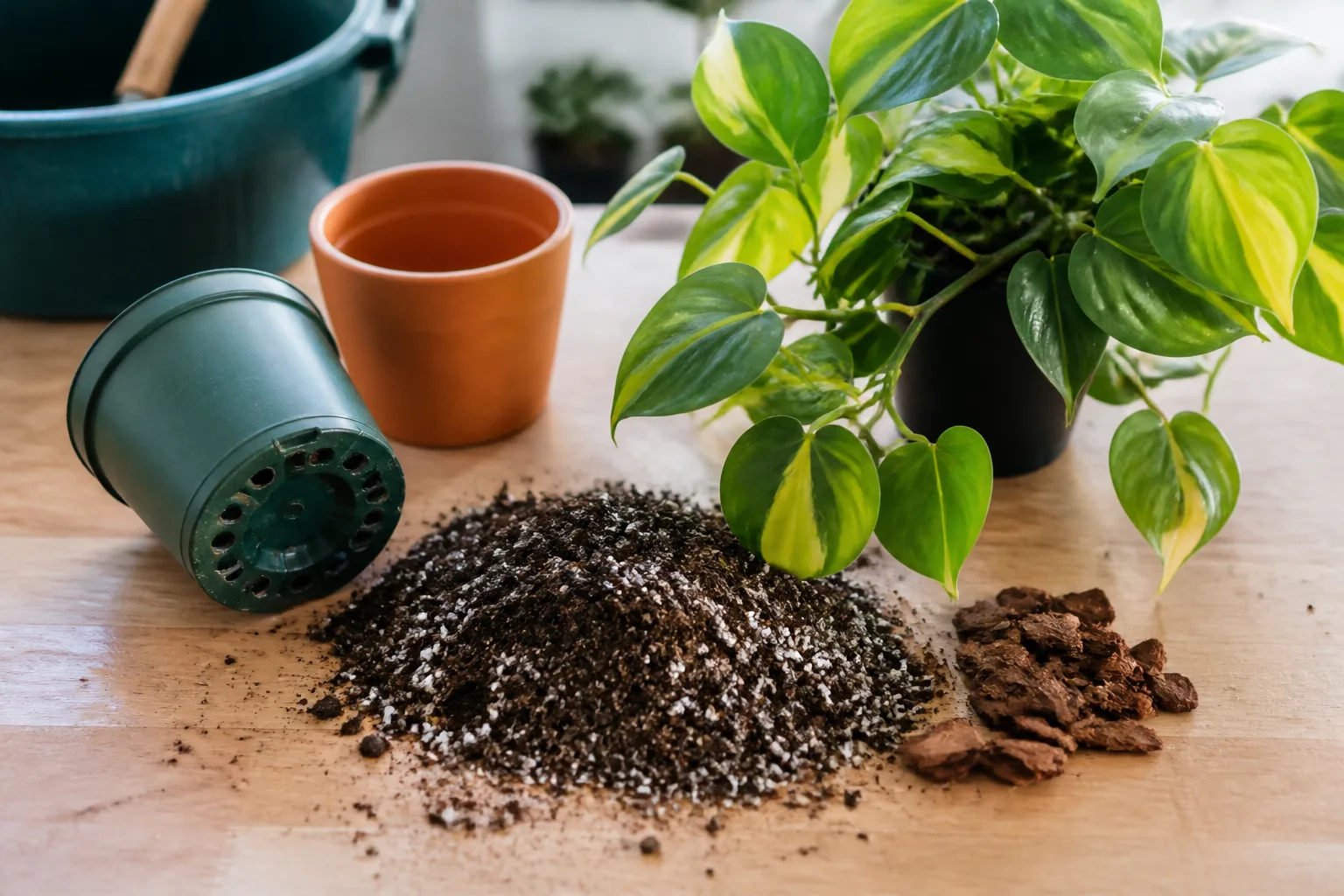
The best heart-leaf philodendron soil is not a specific brand or pH number. It is a mix that holds enough moisture for the roots to use while leaving air-filled spaces after watering. A standard indoor potting mix amended with perlite and a modest amount of fine orchid bark is a useful starting point; the exact ratio should be adjusted to your room, pot material, and watering habits.
If your home is cool or the plant sits in lower light, use more drainage material and water less often. If your home is warm, bright, and dry, retain a little more moisture—but never compensate for a pot without drainage by adding rocks at the bottom. A drainage hole is the escape route; a decorative cachepot can hide it, but it cannot replace it.
Choose a pot only one size larger when the roots have filled the current container. An oversized pot creates a large wet zone that the vine cannot use quickly, increasing the chance of root rot. Plastic retains moisture longer and is useful for a hanging plant; terracotta dries faster and can be helpful for a grower who tends to overwater, but it may require more frequent checks.
Watering Without Root Rot
Water by the condition of the mix, not by the calendar. Push a finger into the upper inch or two, lift the pot to feel its weight, and look at the drainage rate. When the top portion has dried but the root zone is not bone-dry, water slowly across the surface until a little drains from the bottom; then empty the saucer or cachepot.
The plant prefers a repeatable wet-to-partly-dry cycle. Do not add a small splash every day, because that keeps the surface and upper roots wet while the middle of the pot may remain stagnant. On the other hand, waiting until every leaf is limp and the mix has pulled away from the pot can damage fine roots and leave the vine unable to recover evenly.
Light, temperature, pot size, and soil texture decide how quickly the pot dries. A plant in bright light may need checking twice a week in summer, while the same plant in a cool, dim room may go much longer between waterings. In winter, slow down when growth and evaporation slow; never keep the old summer interval simply because the calendar says it is watering day.
If the leaves droop, test the soil before you water. A dry, light pot with flexible leaves calls for a thorough soak and a closer schedule; a heavy, wet pot with drooping leaves points to root stress, not a shortage of water. That one check prevents the most common rescue mistake: adding water to roots that are already oxygen-starved.
Water Quality and Brown Tips
Brown tips do not automatically mean low humidity. They can also follow drought, fertilizer salts, hard-water minerals, a cold draft, or root damage. If the potting mix is appropriately moist but new leaf tips keep browning, flush the mix with clean water until it drains freely, then allow the pot to drain completely before returning it to its saucer.
Use filtered or rainwater if your tap water leaves a heavy white crust or the plant repeatedly develops tip burn despite steady moisture. Change one variable at a time and judge the next leaves, not the damaged old tissue: a brown tip will not turn green again, but new growth can show whether the adjustment worked.
Temperature and Humidity
Heart-leaf philodendron is comfortable in the range found in most lived-in rooms, but it dislikes abrupt extremes. Keep it away from cold drafts, exterior doors, radiators, and HVAC vents that repeatedly swing the leaves from hot to cold or dry to damp. UF/IFAS warns that temperatures below about 50°F are too cold for this plant; bring an outdoor specimen inside before nights approach that threshold.
Average household humidity is usually survivable, and the plant does not need a foggy bathroom to stay alive. Moderate humidity improves leaf quality and reduces the stress of dry winter air, but a humidifier is useful only if it raises the humidity around the whole plant grouping. Misting may wet leaves briefly, yet it does not reliably change the room’s relative humidity and can leave foliage wet where airflow is poor.
If you use a pebble tray, keep the pot above the water line on the stones. The tray is a small local humidity aid, not a substitute for drainage, and the pot should never sit in standing water. A hygrometer near the leaves is more useful than guessing from the calendar or assuming that a bathroom is automatically humid enough.
Fertilizer Through the Seasons
Feed a growing plant with a balanced liquid houseplant fertilizer diluted according to the label, or weaker if the plant is in fresh, pre-fertilized mix. UF/IFAS suggests feeding every three to four months; that conservative rhythm is a good baseline for a green heart-leaf philodendron in ordinary indoor light. Brighter, actively growing plants can use food more often, while a dim, cool, newly repotted, or stressed plant should receive less.
Never fertilize a dry root ball or a plant that is actively collapsing. Water first, correct the environment, and wait for new growth before feeding. A crust on the soil, crispy margins, or sudden brown tips after fertilizing means the salt load may be too high; flush the mix thoroughly and pause feeding until the plant resumes growth.
Variegated cultivars may grow more slowly because less of each leaf contains chlorophyll. More fertilizer will not create missing green tissue and may burn the roots. Give variegated forms steady indirect light and patience, then prune stems that repeatedly produce weak, mostly green or mostly white growth if maintaining the cultivar’s balance matters to you.
Pruning, Trailing, and Climbing Support
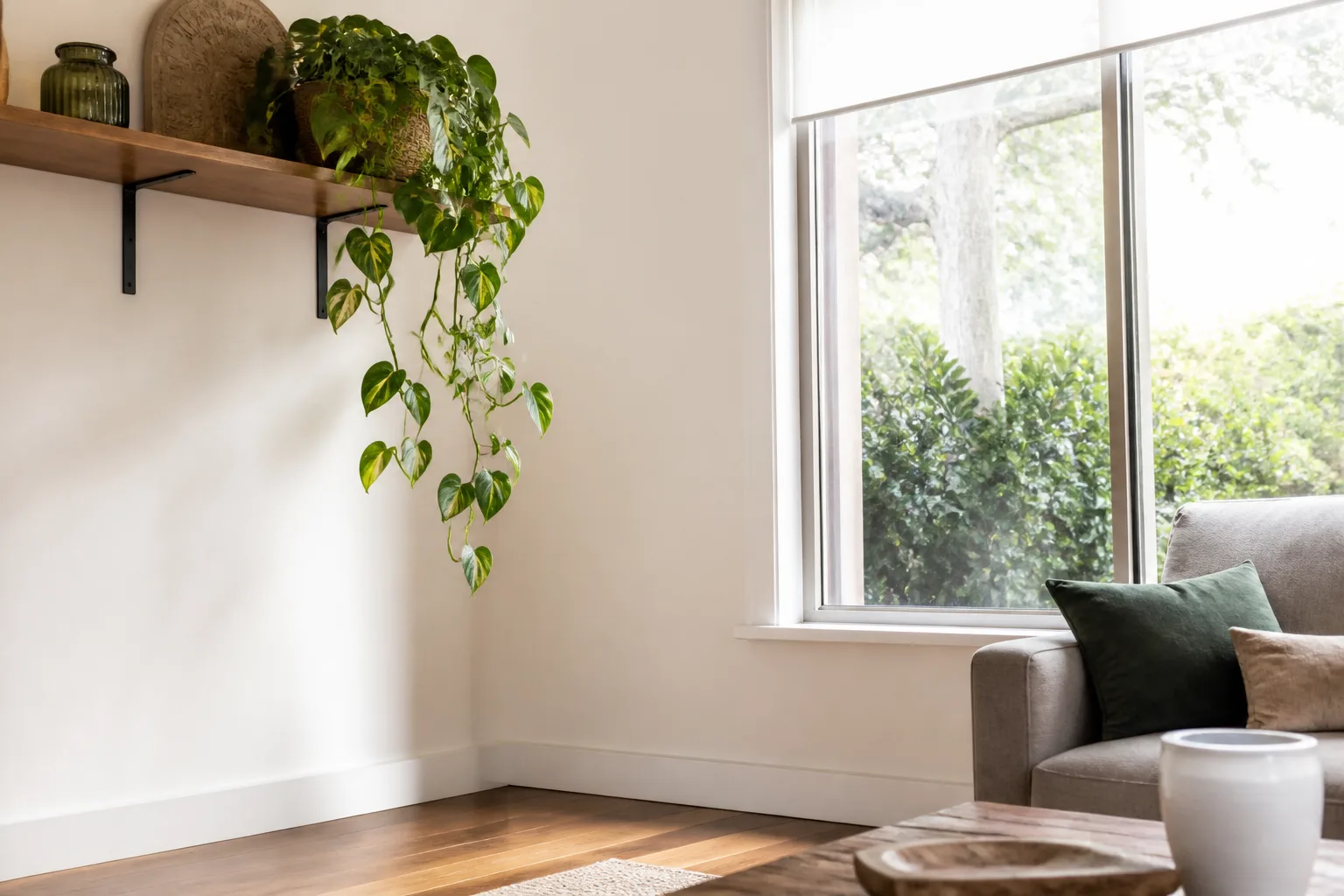
Let the plant trail if you want a relaxed cascade from a high shelf or hanging basket. Train it to climb if you want larger leaves, a more vertical silhouette, or a vine that occupies wall space; a trellis, coir pole, or textured support gives the stem somewhere to attach. BBC Gardeners’ World describes heartleaf types as suitable for both hanging and climbing, which is why the plant works in more layouts than its small nursery pot suggests. (BBC Gardeners’ World)
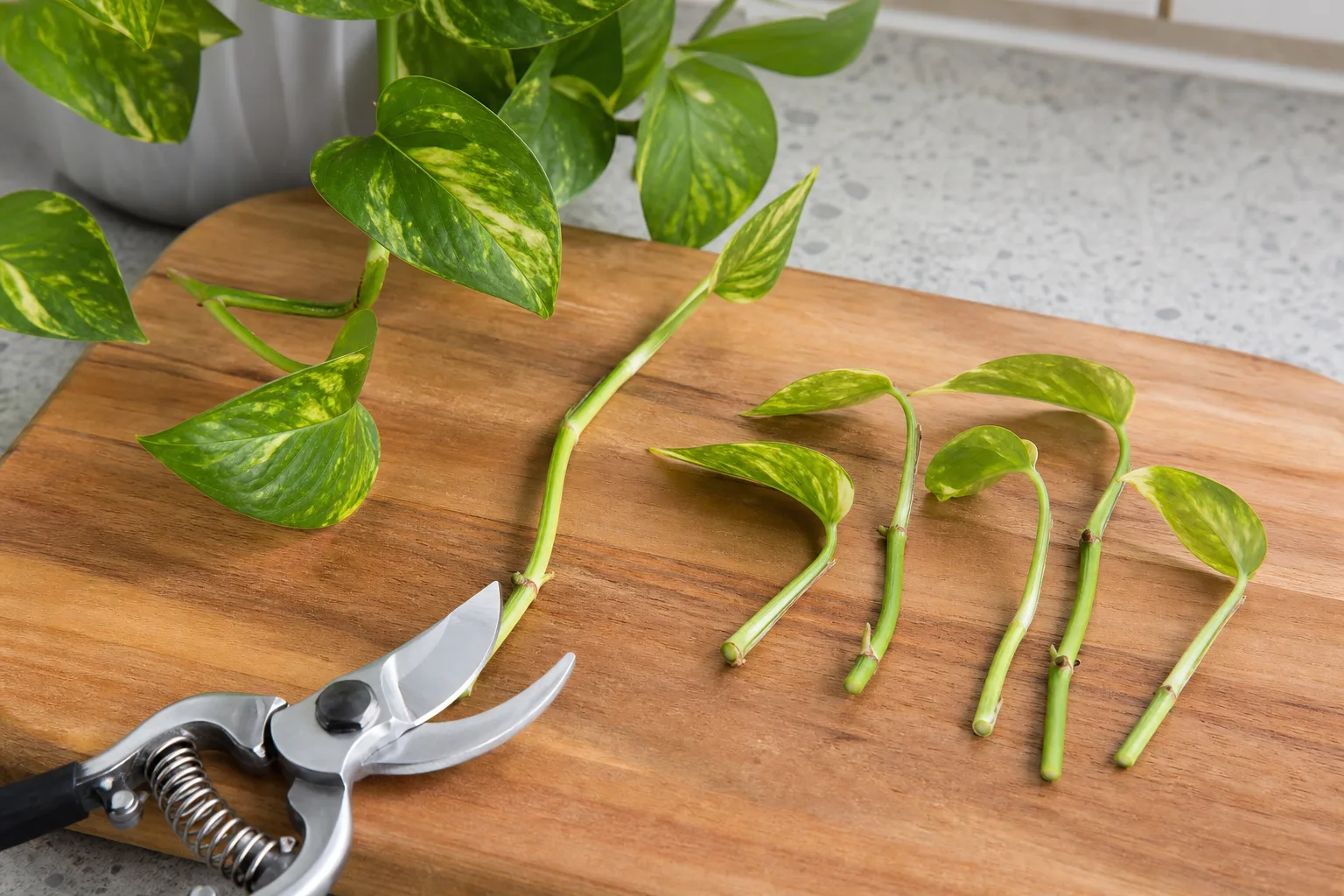
Prune just above a node with clean scissors when a stem has outgrown its space, lost leaves near the base, or needs to branch. The node is the point from which new growth can emerge; cutting the bare end without leaving useful nodes gives you a cutting but does little to make the parent pot bushier.
For a fuller container, take several healthy cuttings and root them, then plant the rooted pieces back into the same pot. Keep the cuttings from the same plant together so their roots establish under the same light and watering routine. Remove yellow or fully dead leaves, but do not strip a plant of every aging leaf while it is trying to recover from root or temperature stress.
Propagation by Stem Cuttings
Stem cuttings are the practical way to make more heart-leaf philodendrons. Take a healthy piece of vine during active growth with at least one visible node; a cutting with two or more nodes gives you more flexibility because one node can root while another supports a leaf.
- Sterilize scissors and cut just below a node.
- Remove the lowest leaf so the node will not be buried or submerged.
- Place the node in clean water, or set it against moist, airy propagation mix.
- Keep the cutting warm and in bright indirect light; refresh water regularly if using a jar.
- Pot it when roots are several centimeters long or when a soil cutting resists a gentle tug and begins new growth.
Do not bury a long section of leafless stem in wet soil. Excess stem under the mix can rot before it roots. Keep newly potted cuttings slightly more evenly moist than an established plant, but still give excess water a way out of the container.
Water Propagation vs. Soil Propagation
Water propagation makes the node and new roots easy to see, which is useful for a first attempt. Its roots are formed in a low-resistance environment, so the cutting may pause after potting while it grows roots suited to soil. Soil propagation avoids that transition but requires more careful moisture control because a buried node can rot out of sight.
Choose water if you want a visible progress check or are working with a short cutting. Choose soil if you can keep the mix lightly moist, the pot small, and the humidity steady. In both methods, the node—not the leaf alone—is the part that can produce roots; a leaf without a node is unlikely to become a new vine.
Repotting Without Root Stress
Repot when roots circle the container, water runs straight through because the mix has collapsed, the plant dries far too quickly, or the stem base is unstable. A healthy plant does not need a larger pot simply because a calendar says two years have passed. BBC Gardeners’ World recommends moving philodendrons to the next pot size and checking the root ball for brown, soft roots during repotting. (BBC Gardeners’ World)
Water the plant the day before if the mix is dry, then slide it out and inspect the roots. Healthy roots are usually firm and pale; rotten roots are brown, soft, hollow, or easy to pull apart. Trim only damaged tissue with clean scissors, remove the surrounding collapsed mix, and repot at the same depth in fresh, airy mix.
After repotting, water thoroughly once and let the pot drain. Return the plant to the same type of indirect light, protect it from drafts, and hold fertilizer until it is actively growing again. Repotting is a chance to fix soil and root problems, not a reason to make several other major changes at the same time.
Pests, Leaf Spots, and Root Problems
NC State Extension lists aphids, spider mites, mealybugs, and scale among the pests to monitor, with leaf spots and root rot possible in stressed or overly wet plants. Inspect new plants before placing them beside a collection, and check leaf undersides, nodes, and the pot rim every week or two. (NC State Extension Plant Toolbox)
For a small pest outbreak, isolate the plant, rinse foliage with a gentle stream of water, and wipe visible insects away. Insecticidal soap or horticultural oil can help when the product is labeled for the plant and pest; coverage matters, repeat applications are often needed, and leaf sensitivity should be tested on a small area first. Do not mix household cleaners, vinegar, or essential oils into a homemade spray and assume the result is safe for foliage or pets.
Fungus gnats usually signal a mix that stays wet too long. Let the upper mix dry farther between waterings, improve light and airflow, and repot if the medium has become compacted. A wobbling plant, sour-smelling mix, or widespread yellowing deserves a root inspection rather than another pest spray, because damaged roots cannot take up water normally.
Heart-leaf philodendron is toxic if chewed. ASPCA identifies Philodendron hederaceum as toxic to dogs, cats, and horses because of insoluble calcium oxalates; possible signs include oral pain and swelling, drooling, vomiting, and difficulty swallowing. Keep it out of reach, wear gloves if the sap irritates your skin, and contact a veterinarian or the ASPCA Poison Control line promptly if a pet has eaten part of the plant. (ASPCA Poison Control)
Troubleshooting Yellow, Brown, and Sparse Growth
Start by identifying where the symptom appears and whether the pot is dry or wet. One old lower leaf turning yellow can be normal aging; several leaves yellowing at once is a pattern that calls for a root, light, or pest check.
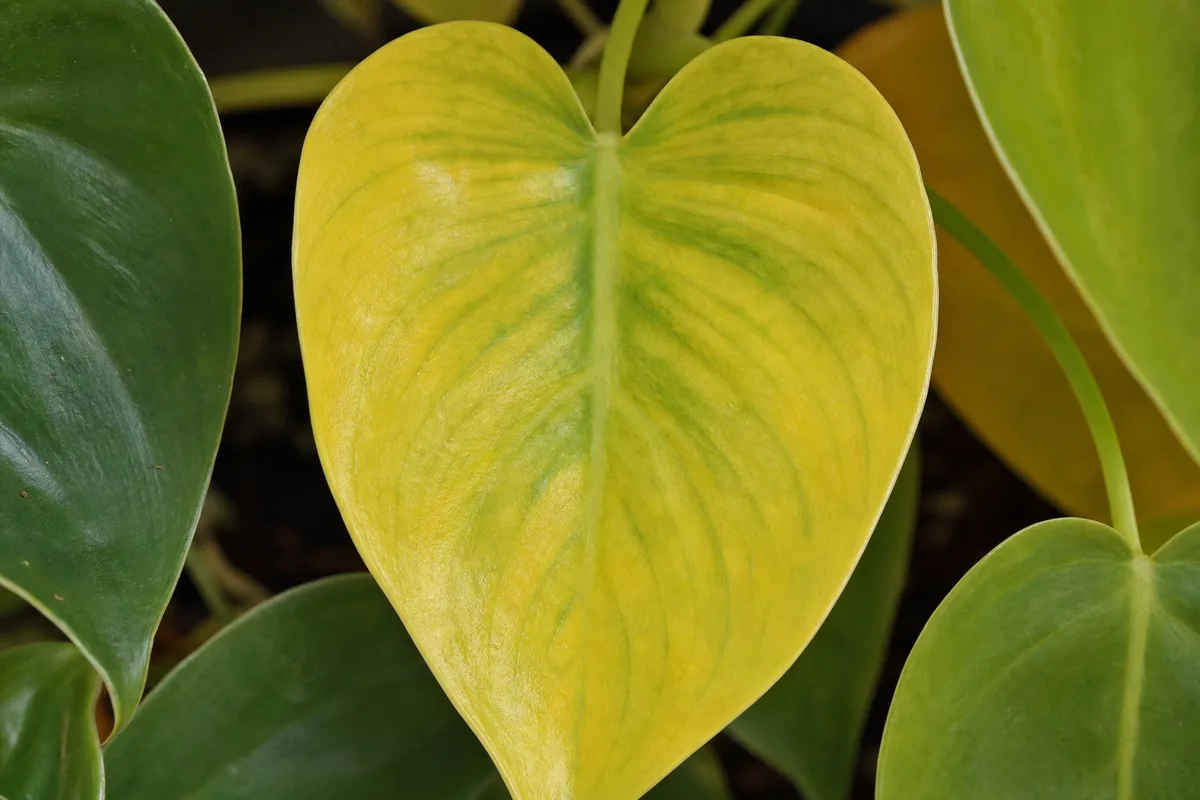
Yellow leaves: If the pot stays wet and yellowing begins low on the plant, suspect overwatering, compacted mix, low light, or root rot. If the mix is very dry and the plant is limp, underwatering is more likely. Pale, bleached patches on the window-facing side point to direct sun; stippling or fine webbing points to mites.
Brown tips and edges: Check drought first, then dry air, drafts, fertilizer salts, and water quality. If only the newest tips are affected after feeding, flush the mix and pause fertilizer; if brown edges appear beside a heater while the soil swings from bone-dry to soaked, stabilize both moisture and the plant’s location.
Long stems with few leaves: Increase indirect light before reaching for fertilizer. If the plant is healthy but the lower vine is bare, prune back to useful nodes and root the cuttings in the same container. A climbing support can also change the size and spacing of new leaves, but it cannot compensate for darkness.
Drooping in wet soil: Do not water again. Check for root rot, a blocked drainage hole, a cachepot holding runoff, or a sudden temperature change. Remove soft roots and replace collapsed mix only when inspection confirms damage; otherwise allow the plant to dry to the appropriate point and improve airflow.
Brown spots: Keep leaves dry when the room is cool and airless, improve spacing, and remove heavily damaged tissue with clean scissors. If spots spread quickly or appear on many plants, isolate the affected plant and seek local extension help for diagnosis rather than treating every spot as a fungal disease.
Outdoor Growing and Overwintering
In warm, frost-free climates, heart-leaf philodendron can grow outdoors in bright shade or filtered light and may be used as a groundcover or trained up a support. UF/IFAS places outdoor suitability around USDA hardiness zones 10B through 11, while NC State lists the plant as a tropical vine with a much wider native range than most temperate gardens can provide. (UF/IFAS Gardening Solutions)
Outdoor light is stronger than it looks, so acclimate a plant gradually and protect it from direct afternoon sun. Use a container if the climate is marginal or the plant could escape into a natural area; check local guidance before planting a vigorous tropical vine outdoors. Bring container plants inside before cold nights, inspect for insects, and reduce watering only after the plant is in a warmer, lower-light indoor location.
Conclusion
Good heart-leaf philodendron care comes down to matching water to light and drainage. Give Philodendron hederaceum bright indirect light, an airy mix, a pot with a drainage hole, and a partly dry interval between thorough waterings; then adjust humidity, fertilizer, pruning, and support to the room rather than forcing a rigid schedule.
When the plant struggles, test the soil before watering and inspect the roots before repotting. When it grows long, decide whether you want a cascade or a climb, then prune above nodes and use the cuttings to build a fuller pot. Keep the vine away from pets that chew, make changes one at a time, and judge success by the next healthy leaves rather than trying to erase damage that has already happened.