How Often Should You Prune Shrubs? A Simple Guide
Find the right shrub pruning schedule for flowering shrubs, hedges, evergreens, and overgrown plants—and avoid the cuts that remove next year’s buds.
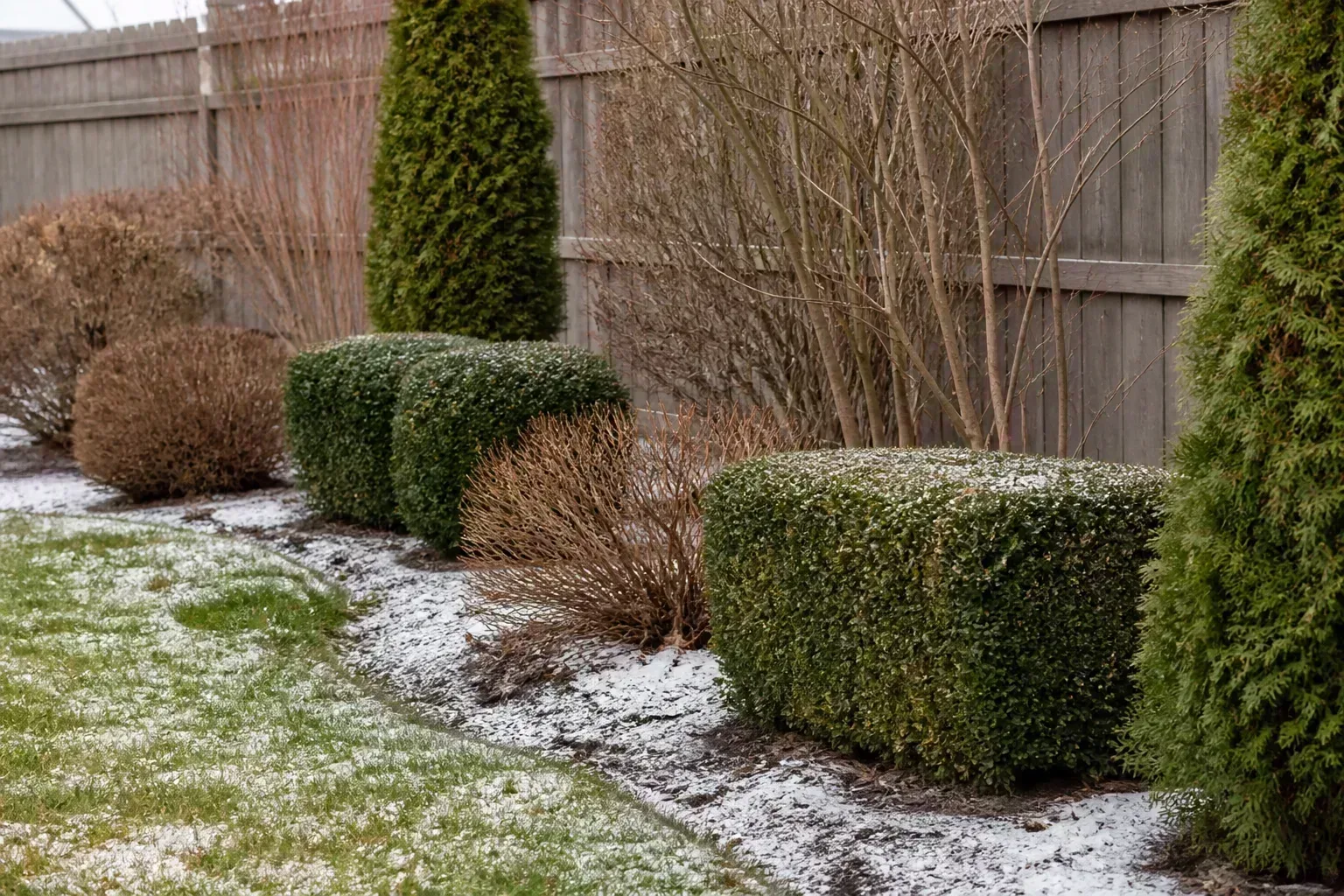
Most established shrubs do not need to be cut on a rigid monthly schedule. A better rule is to inspect them at least once a year, remove damage whenever it appears, and do larger structural pruning only when the shrub’s flowering cycle, growth habit, or condition calls for it.
That usually means one purposeful pruning session each year for a fast-growing flowering shrub, a lighter session every two or three years for a naturally well-shaped shrub, or several small trims during the growing season for a formal hedge. The calendar matters, but the shrub matters more: a lilac, boxwood, panicle hydrangea, and rhododendron may all live in the same yard and need completely different treatment.
The short answer: most shrubs need a yearly inspection, not a yearly buzz cut
For most landscape shrubs, plan to inspect the plant once in late winter or early spring and again after its main flowering period. Those checks do not always lead to a major cut. They simply give you two good opportunities to spot dead wood, winter injury, crossing branches, suckers, disease symptoms, and growth that has begun to block paths or windows.
Routine pruning falls into a few different jobs. Removing a dead branch is an as-needed health cut. Deadheading spent flowers is a light maintenance task. Reducing a hedge to hold a formal outline may happen several times in a season. Renovating a neglected shrub is a structural project that may be spread across three years. Calling all of these “pruning once a year” hides the decision you actually need to make.
Penn State Extension describes pruning as a way to maintain health, appearance, and size, but it also cautions that controlling size is not the main reason to prune. A plant that is permanently too large for its location is a plant-selection problem; repeated hard cuts can keep it stressed without ever making the site a good fit. (Penn State Extension’s guide to pruning flowering shrubs explains why natural form and selective cuts usually outperform constant shearing.)
Identify the shrub before you choose a pruning schedule
The most useful question is not “Is it spring yet?” It is “Where is this shrub making the buds that will open next?” If flowers form on branches produced last year, pruning before bloom can remove the display. If flowers form on the current season’s growth, late-winter pruning usually gives the plant time to produce strong flowering shoots.
When the plant is unfamiliar, find its botanical name on the nursery tag, landscape plan, or a reliable plant record before cutting. Common names overlap, and hydrangeas are a good warning: different species and cultivars can have opposite pruning needs even when they look similar in a garden center.
Old-wood bloomers need pruning after flowering
Old wood means growth made during the previous season. Many early-flowering shrubs set their next flower buds on that older framework, so their main pruning window is immediately after the current flowers fade. That timing gives the plant the longest possible stretch of summer to grow replacement shoots and form the next season’s buds.
Typical old-wood or spring-flowering examples include forsythia, lilac, weigela, mock orange, flowering quince, azalea, rhododendron, some viburnums, and traditional bigleaf hydrangeas. You can still remove a clearly dead, broken, or hazardous branch at another time, but save the broad shaping session for after flowering if preserving blooms matters.
The practical test is simple: if you see a shrub covered in spring flowers, do not assume the leafless weeks before spring are automatically the best time to reshape it. That is exactly when its flower buds can be easiest to remove by mistake. The Royal Horticultural Society recommends pruning early-flowering deciduous shrubs after flowering and removing some ageing stems back to the base rather than flattening the whole plant. (RHS guidance on early-flowering shrubs groups the work by growth habit and explains the difference.)
New-wood bloomers are usually pruned in late winter or early spring
New wood is the current season’s growth. Shrubs that flower in summer or fall often form buds on shoots they produce after the winter dormant period, which is why they can usually be pruned in late winter or very early spring before new leaves expand.
Common examples include butterfly bush, smooth hydrangea, panicle hydrangea, summer-blooming spirea, summersweet, buttonbush, chaste tree, and Rose of Sharon. A hard cut can be appropriate for some of these plants, but “new wood” does not mean every cultivar should be cut to the same height. Use the species or cultivar’s mature size and growth habit as the next check.
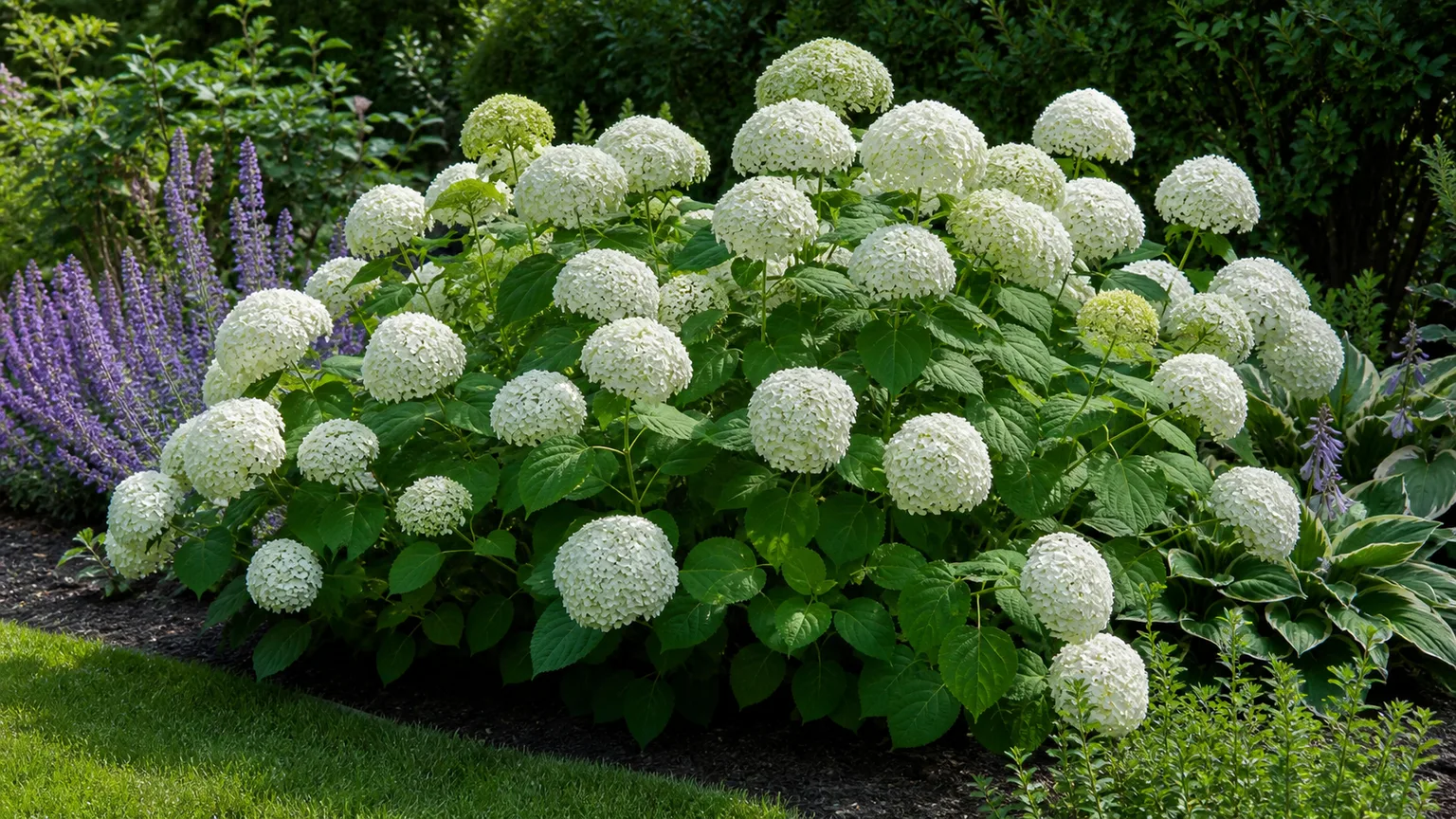
Hydrangeas deserve extra caution. Smooth hydrangea, such as Hydrangea arborescens, and panicle hydrangea, H. paniculata, flower on new wood and are generally pruned before spring growth begins. Oakleaf hydrangea and many bigleaf hydrangeas flower mainly on old wood and should be treated more lightly, usually after flowering. Some newer cultivars blur the categories, so identify the plant instead of relying on the word “hydrangea.” Penn State’s regional guidance gives the same warning: the species and cultivar determine whether a late-winter cut protects or removes the coming flower display. (Penn State Master Gardeners’ hydrangea and shrub timing notes are a useful reference.)
Evergreens, formal hedges, and new plantings follow different rules
Established evergreen shrubs often need little pruning beyond removing winter damage, correcting a stray branch, or maintaining a specific shape. Many respond best to light pruning in mid- to late spring, after the first flush of growth, although the correct window still depends on species. Spring-flowering evergreens such as azaleas and rhododendrons belong with the after-flowering group, not in a generic “trim all evergreens in spring” bucket.
Formal hedges are the main exception to the idea that shrubs need only occasional pruning. A fast-growing privet, boxwood, or similar hedge may need light shaping more than once during the growing season. Trim only enough to hold the outline, keep the base slightly wider than the top so light reaches lower growth, and periodically make selective cuts into the interior rather than clipping only the surface forever.
Newly planted shrubs usually need time to establish roots before they receive a major size-reduction cut. Remove broken or diseased growth, correct an obviously misplaced branch, and make light formative cuts when necessary. Do not turn a recently planted shrub into a project simply because it looks uneven; water and root establishment come first. The goal in its first season is a strong framework, not an instant finished shape.
Choose frequency by the job you need pruning to do
A useful pruning schedule begins with the result you want. If the job is plant health, remove dead, diseased, broken, or rubbing wood whenever you can do so safely. If the job is flower production, prune according to old-wood or new-wood timing. If the job is formal shape, plan for light repeat trimming. If the job is size reduction, step back and ask whether the shrub is planted in the wrong place.
Naturally shaped shrubs often need a substantial session only every two or three years, followed by small corrections. A mature lilac may need the oldest canes removed after flowering, but it does not need its entire outline clipped every month. A slow-growing evergreen can be damaged by trying to force it into a smaller silhouette repeatedly. A hedge, by contrast, is maintained for an artificial shape and may need two to four light trims depending on its species, climate, and desired finish.
The best frequency is the least frequent schedule that keeps the plant healthy, safe, and within its intended space. If you find yourself removing large portions every few months, stop treating that as normal maintenance. Check the mature size, available light, soil moisture, and nearby structures; repeated pruning may be compensating for a poor match between plant and site.
How much should you remove at one time?
The one-third rule is a useful default: in one major session, avoid removing more than about one-third of the shrub’s healthy growth or height. It is not a substitute for plant-specific guidance, and it does not mean you must cut exactly one-third. It means that a smaller cut is usually safer when you are uncertain.
Use the one-third rule as a safe default
Start by removing dead, diseased, broken, or dangerous wood. Those cuts are a health priority and should not be counted the same way as optional reshaping, although a severely damaged or diseased plant may need a different management plan. After the cleanup, look at what remains before deciding whether more reduction is actually needed.
For an established shrub that has simply become a little too wide, take out a few of the oldest stems at their origin and shorten only the longest branches that are clearly outside the desired outline. Several large, well-placed cuts are usually better than dozens of little snips across the outer surface. If the plant looks worse after the first pass, more cutting will not automatically improve it.
There are exceptions. Some vigorous, multi-stemmed shrubs, including certain forsythias and red-twig dogwoods, can tolerate hard rejuvenation when they are healthy and correctly identified. Slow-growing shrubs, many conifers, magnolias, and shrubs that do not reliably produce new shoots from old wood require more caution. Treat the one-third rule as a guardrail, not permission to take one-third every year without a reason.
Choose renewal or rejuvenation for an overgrown shrub
Renewal pruning is the gradual option. Over two or three seasons, remove roughly 15 to 25 percent of the oldest or tallest stems at ground level each year, leaving younger, well-placed stems to flower and carry leaves. This preserves more of the plant’s appearance while steadily replacing unproductive wood. It is the better choice for an older shrub that is stressed, slow-growing, or still capable of looking acceptable while it recovers.
Rejuvenation pruning is the fast option. For a healthy, multi-caned shrub known to respond well, all stems may be cut back close to the ground in late winter or early spring. The immediate trade-off is visual: you may lose a season of flowers and have a low, bare-looking plant while new shoots rebuild the framework. Do not use this treatment on a shrub merely because it is untidy, and do not assume every woody plant can regenerate from old wood.
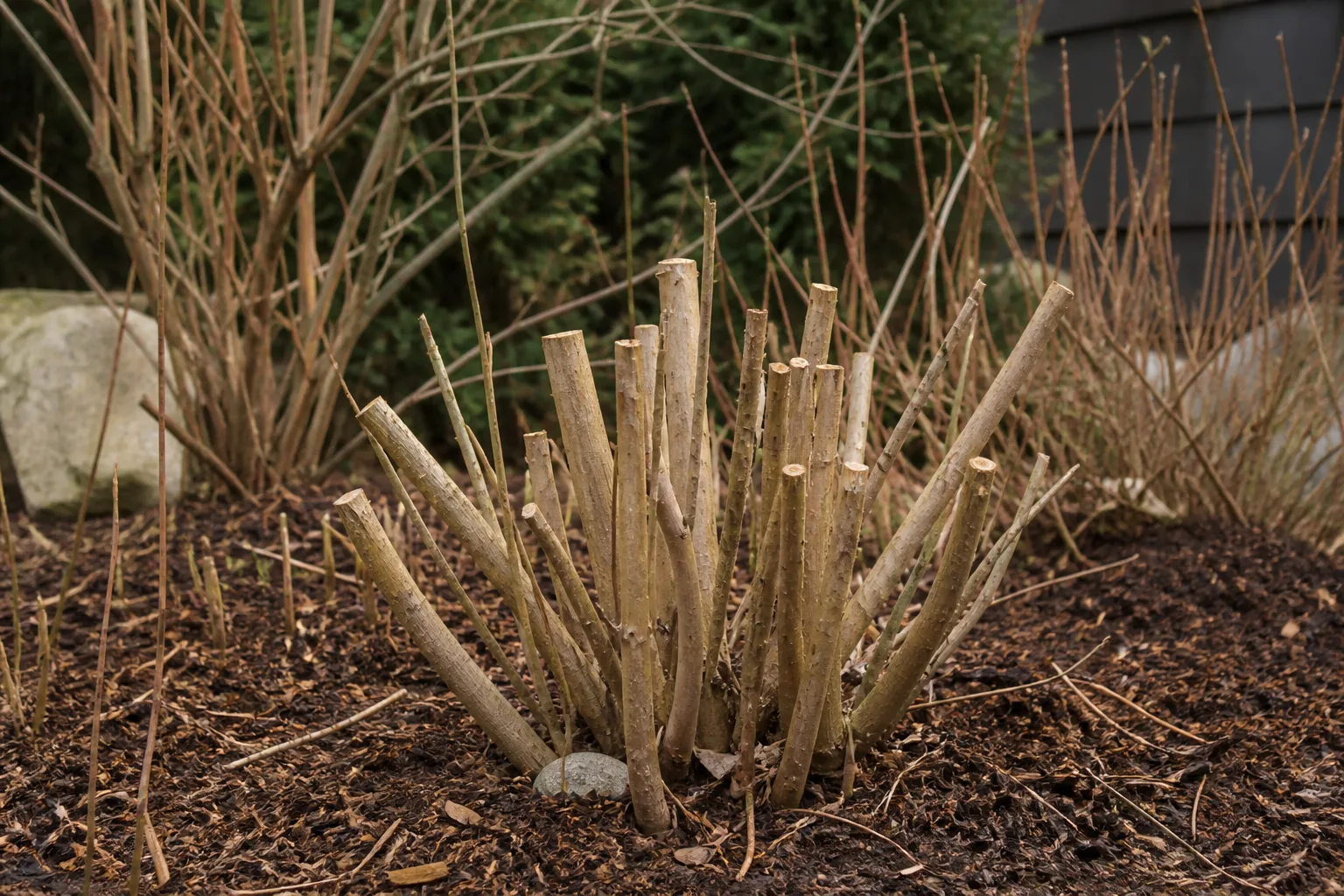
Penn State Extension describes renewal and complete rejuvenation as separate methods, and Utah State University Extension warns against giving shrubs a “buzz cut” simply to make them look tidy. Its renewal approach focuses on removing about 20 to 25 percent of older branches from the base while leaving enough leaf-producing wood to sustain the plant. (Utah State University Extension’s spring pruning pointers explain why gradual renewal is often a better size-control strategy.)
How to prune shrubs step by step
Once you have identified the shrub and selected the right season, the actual process is straightforward. Work from the plant’s interior outward, and pause often; the most common pruning mistake is making the next cut before seeing what the last few cuts accomplished.
Inspect the plant and decide what “better” means
Walk around the shrub before picking up a tool. Look for its strongest stems, the direction of its natural growth, the places where branches collide, and the parts that are blocking a walkway, window, light, or neighboring plant. Decide whether you are cleaning, flowering, thinning, reducing, or renovating; one session can include more than one purpose, but one purpose should lead.
Check the bark and twigs for dead sections, cracks, cankers, unusual swellings, insect activity, and storm damage. A dead branch is often dry and brittle, but do not scratch living bark repeatedly just to test every twig. If the plant has widespread dieback, a root problem, or a disease you cannot identify, pruning alone is unlikely to solve it.
Remove dead, diseased, damaged, and rubbing wood first
Make the first cuts at the point where the problem branch begins, or back to a healthy lateral branch. Do not leave a long stub, and do not cut flush into the trunk or main stem. When removing a larger branch, preserve the branch collar, the slightly swollen area where the branch joins its parent; it helps the plant compartmentalize the wound.
Cut out branches that rub together or grow directly through the center of the shrub. Rubbing removes bark and creates repeated injury in wind. Crossing stems also make the interior crowded, so removing one of the pair can improve airflow and reduce the chance that dense, damp foliage stays wet after rain.
If you find diseased wood, work from healthy plants toward affected plants when possible, disinfect the blade between shrubs, and keep suspect debris out of home compost. The precise disease response depends on the pathogen, but spreading contaminated sap or debris is an avoidable mistake.
Thin crowded stems, then shape with selective cuts
Thinning cuts remove a branch back to its origin or to a strong lateral branch. They open the center, preserve the shrub’s natural outline, and encourage light to reach interior growth. Use them for old, crowded, weak, or poorly placed stems.
Heading cuts shorten a branch back to a bud or side shoot. Make the cut just above a healthy bud that points in the direction you want new growth to travel, usually outward rather than into the center. A heading cut can be useful for a young branch or a hedge, but repeatedly heading every branch at the same height creates a dense outer shell and leaves the interior shaded.
Remove suckers that rise from the base and water sprouts that shoot vertically from older branches when they do not belong to the shrub’s natural form. Then step back. A good shrub should look deliberately lighter and more open, not carved into a perfect ball unless it is a formal hedge designed for that treatment.
Finish with aftercare and a pause before making more cuts
Gather and dispose of diseased material, water the shrub if the soil is dry, and restore a thin layer of mulch without piling it against the stems. Do not respond to a fresh cut by automatically applying fertilizer; the plant needs time to rebalance roots and shoots, and a healthy soil and watering routine are more important than a quick feed.
Watch the plant through the next flush of growth. If it responds with many weak vertical shoots, the previous cuts may have been too heavy or too concentrated at the ends of branches. Thin the excess later when the plant’s timing allows, rather than repeating the same heading cuts that created the problem.
Tools, cut placement, and sanitation that protect the shrub
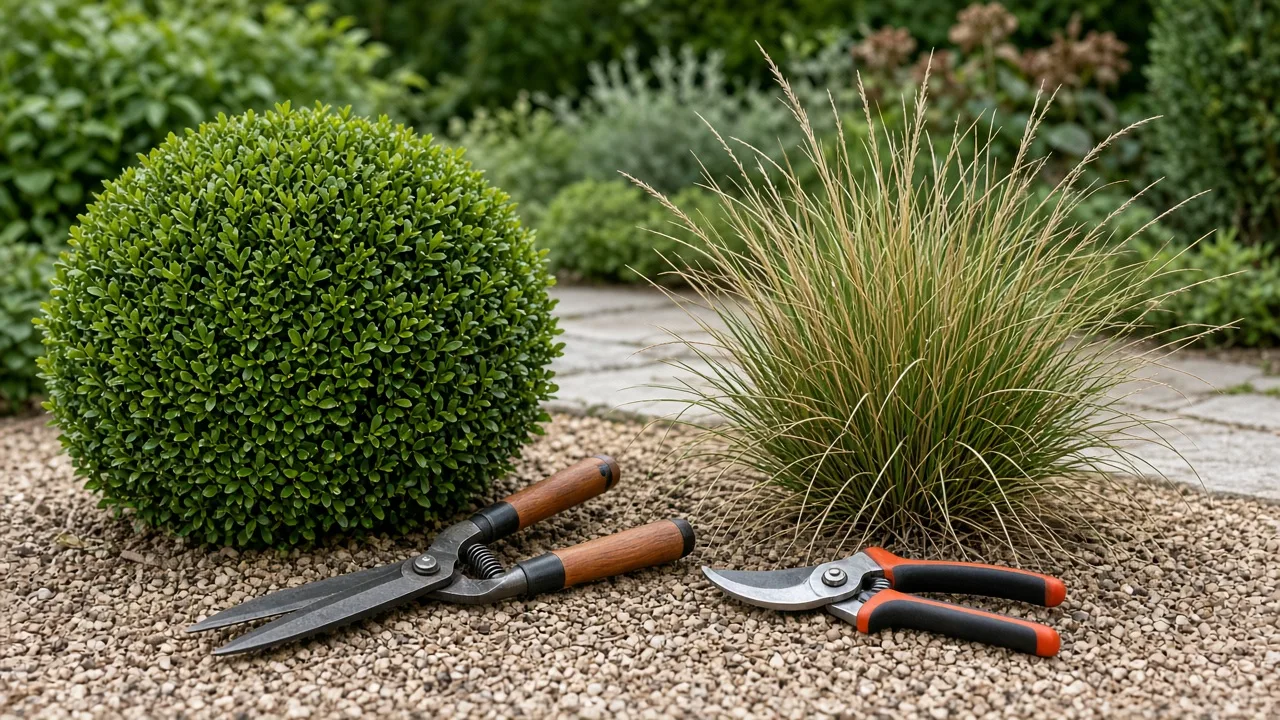
For most shrubs, keep three tools available: bypass hand pruners for small live stems, loppers for thicker branches that fit the tool’s capacity, and a pruning saw for large limbs. Hedge shears belong mainly to formal hedges; they are a poor substitute for selective pruning on a flowering shrub because they cut through many buds and branches without regard to structure.
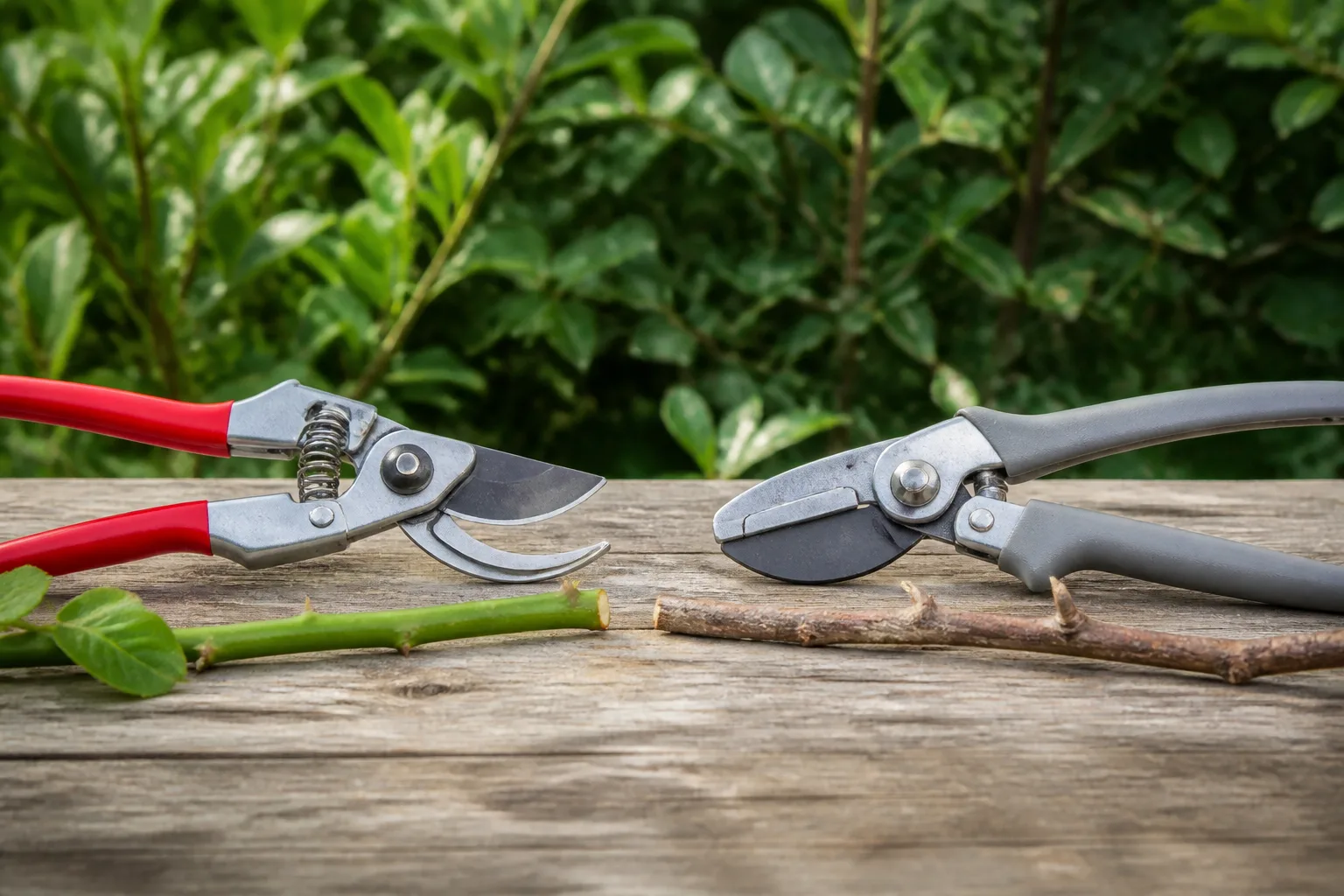
Choose a tool that closes cleanly without forcing it. A dull or undersized blade crushes tissue and leaves a ragged wound. A bypass pruner makes a scissor-like cut and is generally the better choice for live wood; anvil-style tools are more useful for dead wood or material that will not be preserved.
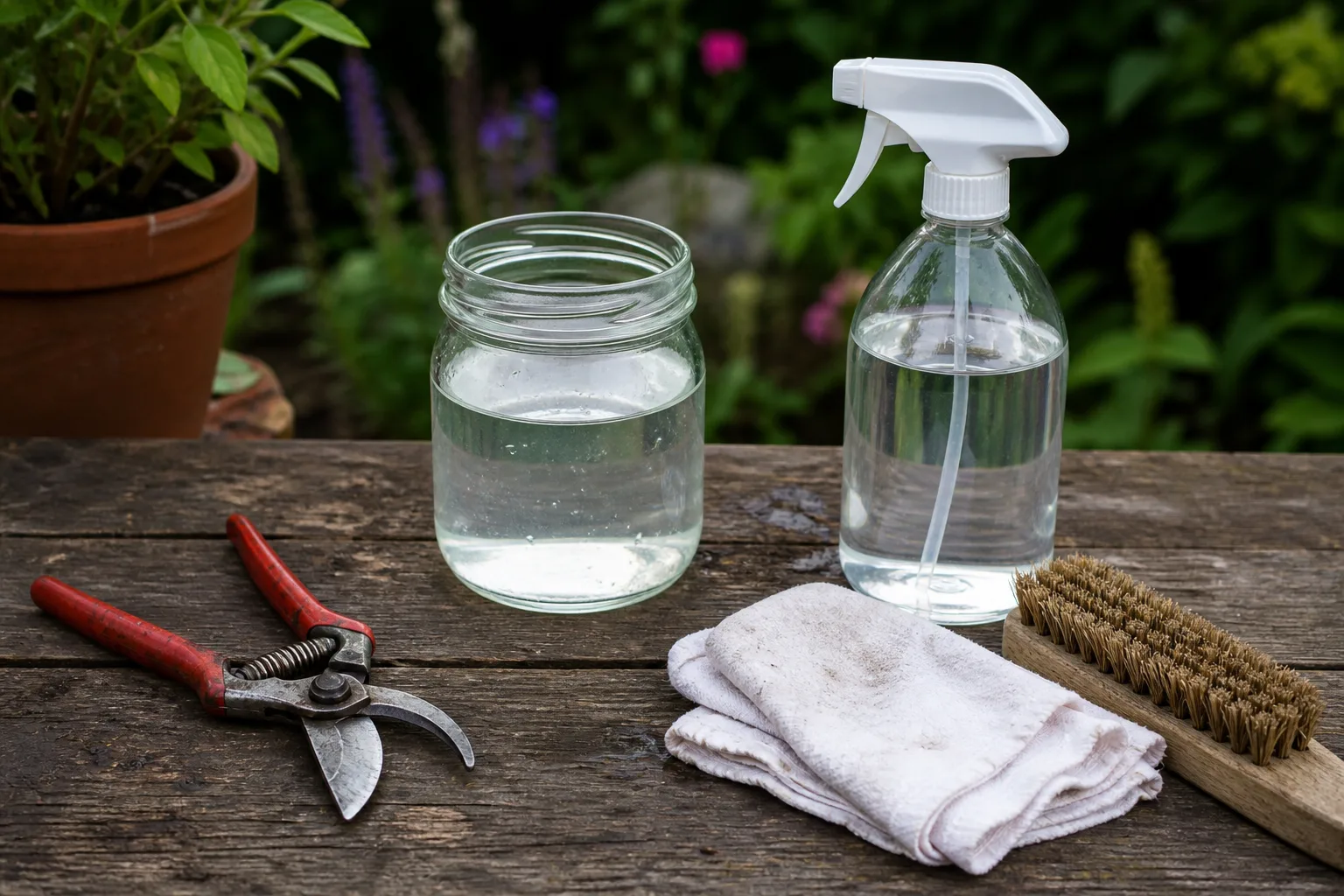
Keep blades clean and sanitize them between plants, especially when one shrub has visible disease symptoms. Penn State Extension lists 70 percent alcohol, a 10 percent bleach solution, and hydrogen peroxide as options for hand-tool sanitation; bleach can corrode metal, so rinse and dry the tool afterward. (Penn State’s pruning guidance gives the sanitation details.)
Make a clean cut close to the branch collar or just above a healthy bud, without damaging the bud or leaving a long stub. A modest angle can help water shed from a bud, but cut quality and placement matter more than chasing a perfect number of degrees. Never use a chainsaw from a ladder or attempt a large overhead limb near utility lines; those jobs need an arborist.
Seasonal exceptions, newly planted shrubs, and weather
Avoid major pruning during extreme heat, severe cold, drought stress, or a stretch of wet weather when wounds will stay slow to dry. Late-fall pruning is especially risky for many flowering shrubs: old-wood plants may already have set next year’s buds, and a flush of tender new growth can be vulnerable before winter. There are exceptions for specific hedges and plants, but a late-season “tidy-up” is not a safe universal habit.
Newly planted shrubs should be allowed to establish unless they arrive broken, diseased, or badly unbalanced. Light formative pruning can correct a crossing branch or preserve a clear framework, but a major reduction immediately after planting asks a plant with a reduced root system to rebuild too much top growth at once.
Weather also changes the best day within the right season. Wait until the worst hard freezes have passed for late-winter cuts, avoid pruning a heat-stressed plant in hot sun, and do not prune wet foliage when you can safely wait for a dry period. Before significant hedge work, look through the plant for active bird nests and follow local wildlife protections; an attractive hedge is not an emergency.
Common pruning mistakes that reduce flowers or weaken growth
The most damaging mistake is treating every shrub as a hedge. Shearing a naturally shaped flowering shrub may make its outer surface look neat for a few weeks, but it can remove flower buds, shade the interior, encourage weak shoots, and lock the plant into a cycle of frequent surface trimming. Use hedge shears only when the plant and the design call for a formal hedge.
Another mistake is pruning by month without checking the flower cycle. A March cut can be perfect for a panicle hydrangea and the wrong choice for a lilac. If you cannot identify the shrub, remove only clear hazards and dead wood, then identify it before doing the structural work.
Avoid making every cut at the same height, cutting past the branch collar, leaving stubs, or cutting so close to a bud that it is damaged. Do not remove a large percentage of healthy growth just because the shrub looks uneven in winter. Shape is easier to improve gradually than to rebuild after a severe mistake.
Finally, do not confuse a lack of flowers with a need for more pruning. Too much shade, drought, overfertilization, winter injury, immature age, or a cultivar that is not suited to the site can all reduce flowering. More cuts may remove the very wood the shrub needs to bloom.
When pruning is not the real solution
Pruning can correct a branch, open a crowded center, and renew a suitable shrub. It cannot permanently make a sun-loving plant thrive in deep shade, turn a mature eight-foot shrub into a two-foot plant without repeated stress, or cure a root disease by itself.
If a shrub repeatedly outgrows its space, blocks a structure, or declines despite appropriate water and light, compare its mature size with the site. Moving a young plant or replacing a badly mismatched one is often kinder than cutting it back hard every season. Likewise, a large, unstable shrub near a house, a tree with heavy limbs, or any branch near power lines is a safety job for a qualified professional.
For an old shrub that still has healthy roots and flexible young stems, gradual renewal is usually the safest first experiment. For a healthy, multi-stemmed species known to tolerate hard renovation, rejuvenation may be reasonable in the right season. If the plant is slow-growing, evergreen, grafted, diseased, or unidentified, keep the cuts conservative until you have species-specific guidance.
Conclusion: prune to improve the shrub, not to keep it busy
Most shrubs need an annual inspection, not an annual haircut. Remove damage when necessary, prune spring bloomers after they flower, prune many summer bloomers before spring growth begins, maintain formal hedges with light repeat trims, and leave naturally attractive shrubs alone between purposeful sessions.
When a plant is overgrown, start with the one-third rule and decide whether gradual renewal can solve the problem. Use rejuvenation only for a healthy shrub that is known to respond to it, and make every cut for a reason: better health, better structure, safer clearance, or more reliable flowering. The right pruning frequency is the one that respects the shrub’s growth cycle while keeping the plant suited to the place where it grows.