How to Grow and Care for Rattlesnake Plant (Goeppertia insignis)
Learn how to care for rattlesnake plant (Goeppertia insignis): light, water quality, humidity, fertilizer, pests, and propagation, with ASPCA pet-safety and fluoride tip-burn guidance.
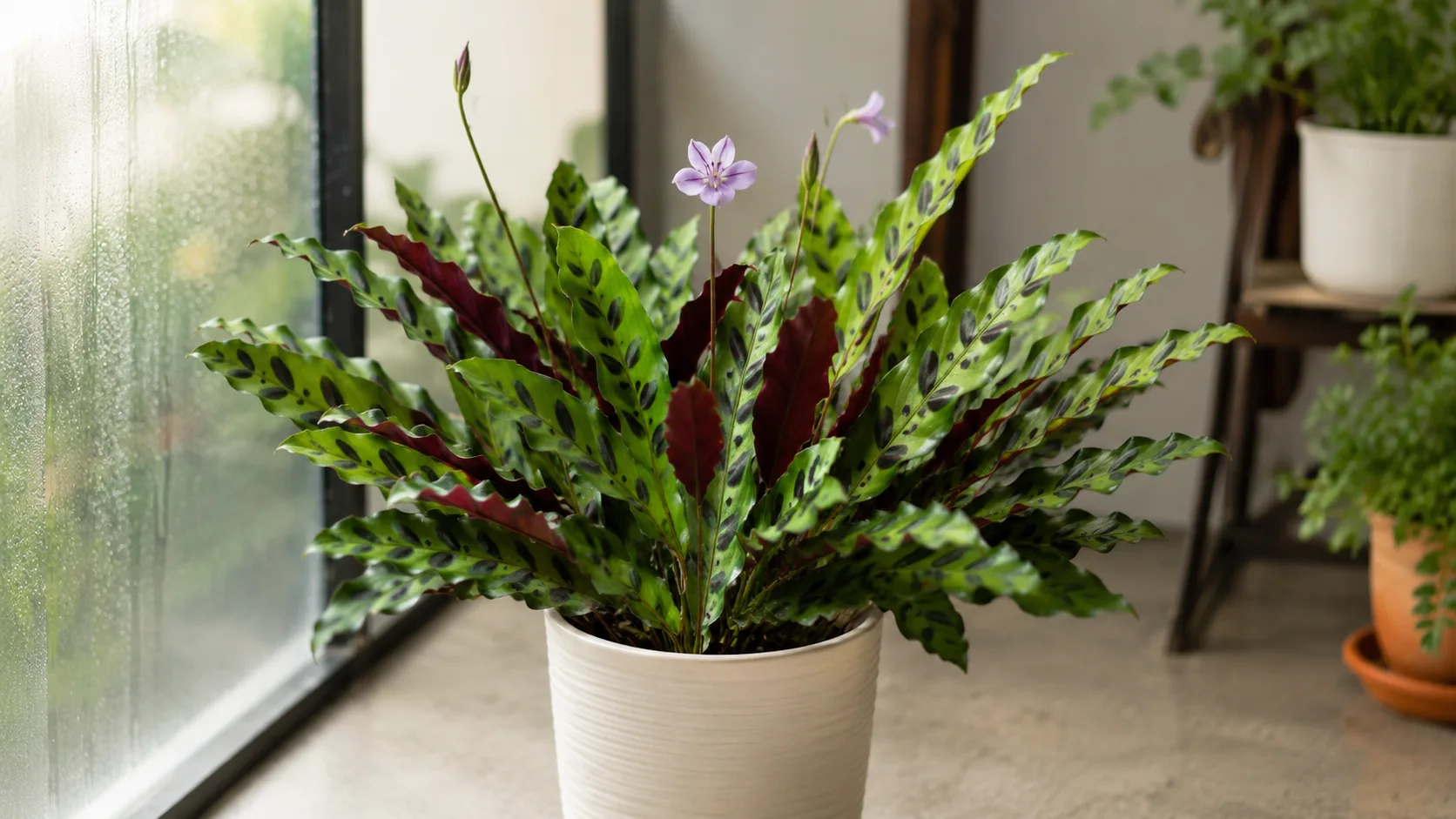
Rattlesnake plant (Goeppertia insignis) looks like it belongs in a design magazine—long wavy blades marked with dark green ovals on bright green, with a flash of purple-maroon when a leaf flips. That polish hides a Brazilian rainforest understory plant that punishes guesswork on light, water chemistry, and humidity. Treat it like a sun-loving succulent and the pattern fades, edges crisp, and growth stalls. Match forest-floor conditions—soft light, evenly moist roots, warm stable air, and water low in salts—and a Calathea Rattlesnake becomes one of the more manageable members of a genus famous for drama.
This guide covers the full indoor care loop: placement, soil, watering rhythm, humidity that survives winter heat, fertilizer timing, division propagation, pet safety, pests, and a troubleshooting path for the leaf symptoms that send most owners searching again. For factor-by-factor schedules, the Calathea Rattlesnake hub splits light, watering, soil, fertilizer, repotting, propagation, and problem pages when one variable—not the whole plant—needs attention.
Rattlesnake Plant Quick Reference
Use this table before you change anything. If something looks wrong, match the symptom to the troubleshooting section instead of adding water by reflex.
| Factor | Indoor target | First warning sign |
|---|---|---|
| Light | Bright to medium indirect | Faded pattern or bleached patches |
| Water | Moist mix; top inch dry before refill | Yellow lower leaves = too wet; tight curl = too dry |
| Water quality | Filtered, RO, or rainwater preferred | Brown tips despite good humidity |
| Soil | Peaty, well-draining, high organic matter | Sour smell, gnats = staying too wet |
| Humidity | 60%+ ideal; 50% minimum if other factors right | Crispy leaf margins in heated rooms |
| Temperature | 65–75°F (18–24°C) | Drafts and AC blasts cause sudden curl |
| Fertilizer | Half-strength monthly spring–summer | Salt crust on soil surface |
| Pets | Non-toxic to cats and dogs | ASPCA lists Calathea insignis |
| Size | 9–20 in. tall × 9–18 in. wide | NC State Extension typical container size |
| Outdoors | USDA 11a–12b only | Houseplant everywhere else |
What Rattlesnake Plant Actually Is
Rattlesnake plant is a clumping, rhizomatous evergreen perennial grown almost exclusively for foliage. The accepted botanical name is Goeppertia insignis, though nursery tags still print Calathea lancifolia or Calathea insignis—all refer to the same species per NC State Extension. It belongs to Marantaceae, the prayer-plant family, alongside Maranta, Ctenanthe, and other Goeppertia species.
Native to humid forests in southeastern Brazil, G. insignis grows on the rainforest floor in dappled shade. Leaves are lance-shaped with undulate margins, medium to light green above with alternating dark green blotches, and purple-maroon undersides—NC State describes blades up to 18 inches long on short erect stems. Flowers are yellow to gold, borne on small spikes in late spring to early summer when grown outdoors; indoor plants rarely bloom, which is fine because the foliage is the show.
Mature indoor specimens typically reach 9 to 20 inches tall and 9 to 18 inches wide with moderate growth when light, moisture, and humidity align. Growth slows or stops when any pillar drifts out of range—usually before the plant outright dies, which gives you time to correct course if you read the newest leaves honestly.
Goeppertia vs Calathea Names on Nursery Tags
Taxonomists moved many former Calathea species into Goeppertia based on molecular evidence. Care did not change—if a label says Calathea or Goeppertia, light, water, and humidity needs stay the same. What matters is matching tolerances, not winning a Latin argument at the garden center.
Do not confuse rattlesnake plant with snake plant (Dracaena trifasciata), a completely different, drought-tolerant species that wants the opposite care. Rattlesnake calathea is also not the same as true prayer plant (Maranta leuconeura), though both fold leaves at night—more on that below. For broader genus context, see the Calathea care guide and prayer plant growing guide.
Light Requirements for Sharp Leaf Pattern
Rattlesnake plant needs bright to medium indirect light—enough intensity to keep the snake-skin markings crisp, never so much that leaves bleach or scorch. NC State classifies its outdoor tolerance as deep shade to partial shade (roughly two to six hours of gentle direct sun at most). Indoors, that translates to an east-facing window, a bright spot back from a south- or west-facing window behind a sheer curtain, or a well-lit north exposure close to the glass.
Direct sun—especially hot afternoon rays through closed glass—fades the pattern, scorches tissue, and triggers tight daytime curling. Too little light produces stretched petioles, smaller pale new leaves, and washed-out blotches even when the plant otherwise looks alive. A dim plant also dries more slowly, which raises overwatering risk if you keep the same summer watering cadence through a dark winter.
The practical test is always new growth from the center. A well-placed rattlesnake pushes firm, correctly patterned leaves. Old damage will not heal, but the youngest leaf tells you whether the current spot works.
Best Windows and When to Add a Grow Light
An east window is often the sweet spot: gentle morning sun, bright ambient light the rest of the day. West and south windows work when the pot sits several feet back or behind diffusion—never in unfiltered afternoon sun. North windows can work if the plant is close enough to receive real daylight, not just room brightness.
Interior rooms, north apartments in winter, and office cubes may need a full-spectrum grow light on a 10–12 hour timer, positioned 12–18 inches above the canopy. When you move a plant, acclimate gradually over one to two weeks; a shaded rattlesnake jumped straight to a bright sill will burn even though it “wanted more light.”
For placement specifics and seasonal shifts, the Calathea Rattlesnake light guide walks through window-by-window decisions, and the grow lights complete guide covers fixture selection.
Soil and Pot Setup That Stays Moist but Aerated
Rattlesnake roots want consistently moist soil that still drains and aerates—the same contradiction rainforest litter solves with organic matter above and air below. NC State notes preference for high organic matter, good drainage, and moist soil texture with acidic to neutral pH.
A reliable indoor mix is two parts peat or coco coir to one part perlite, or a quality aroid/potting blend amended with 20–30% perlite. Avoid straight garden soil in containers—it compacts and suffocates fine roots. The pot must have a drainage hole; cachepots are fine only if you empty runoff within thirty minutes.
Repot every two to three years in spring when roots circle the pot or water runs straight through dry mix. Choose a container only one size up—an oversized pot stays wet too long and invites rot. Deep dives on mix tweaks and repot timing live in the soil and repotting pages.
Watering Rhythm, Drainage, and Water Quality
Watering separates thriving rattlesnakes from chronically stressed ones. The plant wants evenly moist root-zone soil, not alternating flood and drought, and not a permanently soggy pot. Most growers water when the top inch of mix feels dry—often every five to seven days in warm bright months and every seven to ten days in cool winter when growth slows.
That interval is a starting point, not a calendar command. Pot size, soil, light, and room temperature all change dry speed. Check the pot every time with a finger, skewer, or weight before you pour, and follow the how to water indoor plants the right way fundamentals if you are still calibrating.
When you water, soak thoroughly with room-temperature water until a little drains from the bottom, wait ten to fifteen minutes, then empty the saucer so roots are not standing in runoff. Shallow daily sips wet the surface while the center stays dry—or worse, keep a wet zone that never aerates.
Water quality matters as much as timing. Municipal tap water carries chlorine, fluoride, and dissolved minerals that accumulate at leaf margins and cause brown crispy tips even when humidity looks acceptable. The Pacific Northwest Pest Management Handbooks explain the mechanism: fluoride is an accumulative poison in foliage that moves in the transpiration stream and concentrates in leaf margins, producing marginal and tip necrosis; municipal water is often fluoridated at about 1 ppm, enough to injure sensitive plants over time 2. Filtered water, reverse-osmosis water, or rainwater are the best choices. If you must use tap, let it sit overnight to off-gas some chlorine (not fluoride), and flush the pot occasionally by running plain water through until it drains freely. High calcium (dolomite) in the medium can also tie up fluoride 2.
Signs of overwatering include yellowing lower leaves, soft stems at the soil line, fungus gnats, and a sour smell from the mix. Signs of underwatering include limp or tightly curled leaves, dry compacted mix, and a pot that feels dramatically light. One dry episode usually recovers with a full soak; repeated drought damages fine roots.
Summer vs Winter Dry-Down Rules
In spring and summer, active growth pulls water faster—check twice a week in bright warm rooms. In fall and winter, shorter days and cooler rooms slow both photosynthesis and evaporation; let the top inch dry a bit deeper before watering again. Never keep summer frequency on autopilot through January unless the pot is genuinely light.
If you moved the plant closer to a heating vent for winter, dry-down accelerates at the surface while the core stays wet—lift the pot and assess weight, do not trust the top alone. The Calathea Rattlesnake watering guide expands seasonal rhythms and recovery after drought stress. For self-watering experiments, the diy self-watering system guide covers what actually works.
Humidity and Temperature in Real Homes
Humidity is the second pillar after water quality. Brazilian understory air often exceeds 80% relative humidity; central heating can drop indoor air to 30% or lower in winter, pulling moisture from thin leaf edges faster than roots replace it. Aim for 60% or higher around the plant; 50% can work if light, watering, and water quality are already dialed in.
Keep daytime temperatures roughly 65–75°F (18–24°C) and avoid sudden swings. Do not park the pot beside AC vents, radiators, or frequently opened doors—dry blasts and cold drafts cause immediate leaf curl that owners misread as underwatering.
Pebble Trays, Humidifiers, and Why Mist Is a Backup
Rank humidity fixes by reliability:
- Humidifier near the plant (best for winter rooms)
- Grouping tropicals on one tray or shelf to share transpiration
- Pebble tray—wide saucer, stones, water below stone tops, pot sitting on pebbles above the waterline
- Bathroom placement if bright enough
- Misting—temporary surface wetting only; Gardening Know How notes mist can help briefly, but it does not replace ambient humidity and wet foliage overnight can invite fungal spots and pests
Skip commercial leaf shine entirely—it clogs stomata and browns edges. Wipe dust with a damp cloth instead.
If margins stay crisp despite a pebble tray, the gap is usually room-scale dryness—upgrade to a humidifier before misting harder. More on low humidity symptoms and brown-tip causes on the dedicated problem pages.
Fertilizing Without Burning Sensitive Roots
Rattlesnake plant is a moderate feeder during active growth, not a hungry tropical that wants full-strength weekly doses. Feed monthly in spring and summer with a balanced liquid fertilizer diluted to half label strength, applied only to already-moist soil so salts do not concentrate on dry roots.
Skip or reduce feeding in fall and winter when growth slows. Pale new leaves in bright humid conditions may need nutrition; yellow lower leaves in wet soil usually mean overwatering, not hunger—fix moisture before adding fertilizer.
Salt buildup shows as white crust on the soil surface and worsening tip burn. Flush the pot with plain water between feedings if you fertilize regularly. Details on products and timing: fertilizer guide.
Pruning and the Night Leaf-Folding Habit
Nyctinasty is the night movement you will notice—leaves lie more horizontal by day and rise or fold at night in response to light cycles, the same prayer-plant family trait. It is normal behavior, not a distress signal, as long as leaves reopen by morning.
If the plant stops folding, check for insufficient light, temperatures below about 60°F, drafts, or severe underwatering before assuming decline. Pruning needs are minimal: remove dead or fully brown leaves at the base with clean scissors. Never tug partially green tissue—cut only what is truly lost.
Propagating Rattlesnake Plant by Division
Seeds are impractical; division at repotting is the reliable method. The best window is early to mid-spring when active growth resumes.
- Water the day before so roots are hydrated and soil holds together.
- Slide the root ball out gently—tilt the pot, squeeze plastic sides, never yank leaves.
- Brush away loose soil and locate natural splits in the rhizome with multiple stems each.
- Separate by hand or with a sterile knife—each division needs roots plus at least one growth point.
- Pot divisions in the same mix as the parent, at the same depth, in pots with drainage.
- Water thoroughly, drain, and keep humidity high (bag loosely or humidifier) for two to three weeks.
- Resume normal care when new growth appears.
Do not propagate by leaf cuttings—they root for some plants, not rhizomatous Goeppertia. Step-by-step photos and timing: propagation guide.
Pet Safety: ASPCA Non-Toxic Status
Pet owners can relax on toxicity. The ASPCA lists Prayer Plant (scientific name Calathea insignis, an older synonym for Goeppertia insignis) as non-toxic to dogs, cats, and horses. Chewing foliage may still cause mild stomach upset, so keep plants out of reach if your pet is a nibbler—but you do not need to treat rattlesnake calathea as a toxic emergency unlike snake plant (Dracaena trifasciata). This is a YMYL claim and the ASPCA is the authoritative source; do not rely on affiliate blogs for pet safety.
Common Pests and Early Treatment
Thick foliage attracts spider mites, mealybugs, and aphids, especially when air is dry or soil stays too wet on the surface. Inspect leaf undersides weekly—webbing and stippling mean mites; cottony clusters mean mealybugs.
Treat early with insecticidal soap or neem oil per label directions, covering undersides, repeating at seven to ten day intervals. A gentle soapy cloth wipe works for small mealybug patches. Spider mites explode in dry rooms—fix humidity and watering alongside spray or they return.
See spider mites on Calathea Rattlesnake and related pest pages for species-specific recovery.
Troubleshooting Fading, Yellow, and Brown Leaves
Work symptoms in order—water status, then light, then humidity/water quality—before repotting or fertilizing.
Pattern fading or dull green spots: Usually too much direct sun (bleaching) or too little light (loss of contrast). Adjust placement and read the next leaf.
Yellow lower leaves with wet soil: Overwatering or poor drainage. Let the mix dry one full dry-down cycle, confirm the drainage hole is open, and reduce frequency. Persistent yellow in wet soil may be early root rot—inspect roots if smell is sour.
Limp stems and droop in cold wet mix: Overwatering combined with temperature drop—move to stable warmth, cut back water, ensure drainage.
Brown leaf edges and tips: Low humidity, tap-water minerals, or leaf shine residue. Raise humidity with a humidifier, switch water source, flush salts, and wipe leaves without products. Dedicated help: brown tips. Gardener’s Path notes brown, crispy edges on prayer plants are most often tied to water quality and humidity, not age—so fix inputs rather than trimming forever 5.
Tight curling during the day: Underwatering, low humidity, or hot direct sun—check soil moisture first, then placement.
Related Guides and Topic Pages
For single-variable fixes, the Calathea Rattlesnake hub links every care and problem page. Stronger sibling reads: Calathea care guide, prayer plant growing guide, how to water indoor plants the right way, and grow lights complete guide.
Growing Rattlesnake Plant Outdoors
In USDA zones 11a–12b, G. insignis can grow outdoors in dappled shade with consistently moist, organic-rich soil—think Florida, Hawaii, and coastal Southern California microclimates, not temperate summer patios.
Everywhere else, grow it as a houseplant or move a potted specimen outdoors only when nights stay above about 60°F, then bring it in before cool nights return. Outdoor transition requires shade acclimation; an indoor plant placed in direct patio sun will burn within hours.
Conclusion
Rattlesnake plant rewards growers who treat it like a humid forest-floor species, not a forgiving foliage filler. Give it bright indirect light, filtered water on a check-the-pot schedule, 60%+ humidity from a humidifier or pebble tray, and half-strength fertilizer in the growing season—and the wavy marked leaves stay vivid with purple-backed drama.
When something slips, read new growth first, fix water before fertilizer, and raise humidity before misting harder. Division in spring is the path to a second plant without gambling on cuttings. For deeper single-topic help, the Calathea Rattlesnake plant hub links every care and problem page so you do not have to search again for the basics.