How to Grow and Care for Hens and Chicks (House Leek)
Hardy hens-and-chicks succulents need sharp drainage and full sun—not weekly watering. Learn planting, offsets, bloom cycles, and fixes for mushy rosettes.
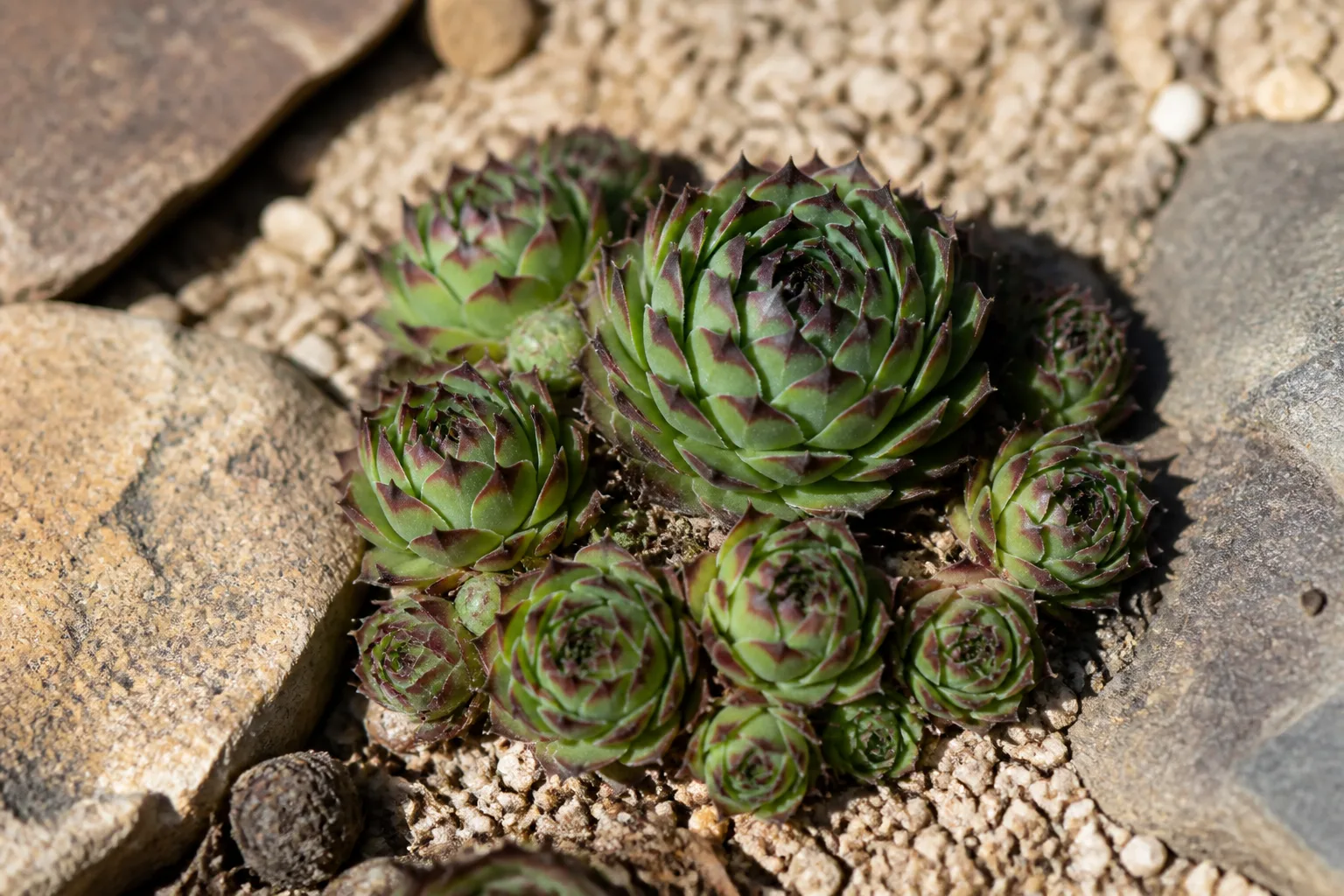
Hens and chicks (Sempervivum tectorum and related Sempervivum species) are cold-hardy rosette succulents that multiply into spreading mats of geometric foliage. Gardeners love them for rock walls, gravel pockets, and shallow containers where tougher perennials fail—but the same traits that make them nearly indestructible outdoors (tight leaves, drought storage, winter dormancy) turn against you when soil stays wet or a pot sits in dim indoor light. This guide covers identification, light and soil rules, a watering decision framework, propagation, the monocarpic bloom cycle, and fixes for the problems that actually kill colonies.
What Hens and Chicks Actually Are
Sempervivum belongs to the stonecrop family (Crassulaceae), the same broad group as sedums and echeverias. The Latin name sempervivum means “always alive,” referring to how offsets keep the colony going even after an individual rosette flowers and dies. The species epithet tectorum means “of roofs”—a nod to the old European practice of planting house leeks on slate and stone shingles.
NC State Extension describes S. tectorum as native to the mountains of southern Europe, cultivated across Europe for its fleshy rosettes. Plants form evergreen mats rarely taller than six inches, spreading outward by stolons that bear small daughter rosettes. Flowers appear in summer on thick stalks rising from the center of a mature rosette; after bloom, that central hen dies, but surrounding chicks continue the patch for years.
Hen, Chick, and Colony Anatomy
Each hen is the main rosette—the mother plant that produces offsets. Chicks (also called pups or offsets) emerge on short horizontal stems called stolons, root when they touch soil, and eventually become independent hens themselves. A healthy outdoor colony can spread two to three feet across over several seasons without any help from you.
Rosettes are typically two to four inches tall and four to six inches wide at maturity, though cultivars vary. Leaves are thick, pointed, and often tipped with red or purple when sun-stressed. The colony looks best when crowns sit slightly above surrounding soil so water does not pool in the leaf axils—a detail rock-garden guides emphasize because crown rot is the number-one killer.
Sempervivum vs Look-Alike Succulents
Big-box stores often label both Sempervivum and Echeveria as “hens and chicks.” They are not interchangeable. Sempervivum leaves usually have fine serrated teeth along the margins and tolerate frost; Echeveria leaves are smooth-edged and will not survive hard freezes outdoors. If your rosette sailed through a snowy winter in zone 5, it is almost certainly sempervivum. If it melted after the first hard frost, you bought a tender echeveria mislabeled as hardy.
Jovibarba (rolling hen-and-chicks) is a close cousin that produces offsets on thread-like stolons that roll away from the parent—worth knowing if your chicks appear on long dangling stems rather than tight clusters. For offset propagation methods shared across succulent types, see the succulent propagation guide.
Quick Care Summary at a Glance
| Factor | Outdoor (ground) | Container / indoor |
|---|---|---|
| Light | Full sun (6+ hours); afternoon shade in desert heat | Brightest window available; rotate weekly |
| Soil | Sandy or gravelly; sharp drainage | Cactus/succulent mix + extra grit |
| Water | Deep soak when soil is dry 2 in. down; rarely in winter | Same rule—never on a calendar schedule |
| Hardiness | USDA zones 3–8 reliably | Bring pots in below zone 5 or if soil will freeze solid |
| Feed | Optional light spring feed | Half-strength once in spring, or skip |
| Propagation | Detach rooted chicks anytime spring–fall | Same; easiest method by far |
The through-line: dry crowns, bright light, gritty soil. Break any one of those three and mushy rosettes follow.
Light Requirements for Outdoor and Indoor Plants
Outdoors, hens and chicks want full sun—at least six hours of direct light daily—for the tightest rosettes and strongest red-purple leaf tips. Missouri Botanical Garden notes they tolerate some light shade but perform best in full sun with dry to medium moisture and excellent drainage. In cool northern climates, all-day sun is ideal.
Plants grown in too much shade stretch upward, open their rosettes, and lose the vivid marginal coloring that makes cultivars worth collecting. If your colony looks pale and loose, move it to a sunnier face of the rock garden or trim overhanging branches before assuming the plant needs fertilizer.
When to Provide Afternoon Shade
Heat changes the rule. NC State Extension warns that sempervivums are less heat-tolerant than many succulents, especially in zones 8 and above where summer nights stay warm. In hot-summer regions (Southwest deserts, lower South), give afternoon shade or plant on an east-facing slope so rosettes avoid scorching midday rays. Scorched leaves show brown, crispy patches on the sun-facing side—move the pot or add a light shade cloth rather than increasing water.
Indoors, treat hens and chicks as a short-term accent, not a permanent houseplant. They need a south- or west-facing window with direct sun for several hours. Without it, rosettes etiolate within weeks. For year-round indoor succulent culture, tender species in the indoor succulent care guide are usually a better fit; keep sempervivum outside when possible.
Soil, Drainage, and the Right Planting Mix
Sempervivums evolved in rocky alpine crevices with almost no organic matter. They need fast-draining, gritty soil and will rot in heavy clay or waterlogged low spots. NC State Extension recommends average, dry to medium, well-drained soils in full sun, with sand or gravel amendments where drainage is poor.
For in-ground planting, loosen the pocket and mix in coarse grit, perlite, or pea gravel until water drains within minutes. In containers, use a commercial cactus/succulent mix blended 50/50 with perlite or pumice. Avoid regular potting soil alone—it holds too much moisture around fleshy roots.
Plant slightly high: set the crown a quarter-inch above the soil line and top-dress with gravel so splash rain does not sit in the rosette center. This single habit prevents more rot than any fungicide. Neutral pH is fine; these plants are not acid-lovers.
Watering Without Rotting the Crown
Hens and chicks are drought-tolerant perennials, not desert cacti that want months of absolute dryness—but they still die faster from too much water than too little. The correct rule is simple: water only when the soil is dry two inches down. Poke your finger or a dry chopstick into the mix; if it comes out clean and dusty, soak deeply. If it clings or feels cool, wait.
Newly planted offsets need more frequent checks for the first four to six weeks while roots establish. After that, established outdoor colonies in temperate climates may need no supplemental water except during extreme summer drought. Potted plants dry faster and may need a deep soak every two to three weeks in summer—far less in winter dormancy.
Always water the soil surface, not the rosette cup. Evening overhead sprinkling is how crown rot starts. Morning deep watering at soil level lets excess moisture evaporate before night cooling. In winter, stop watering outdoor plants unless you are in a warm zone with active growth; dormant rosettes sitting in wet cold soil dissolve from the center out.
Wrinkled, slightly soft leaves signal underwatering—rare outdoors but common in overheated indoor windows. Mushy, translucent lower leaves mean overwatering; salvage unrotted chicks immediately and improve drainage before replanting.
Temperature, Hardiness, and Overwintering
Sempervivums are among the few succulents that laugh at frost. Colonies survive snow and temperatures well below zero when soil drains freely. Missouri Botanical Garden lists USDA zones 3–8 for S. tectorum—a more realistic range than the zone 11 figures sometimes printed on generic succulent tags.
They prefer average summer temperatures roughly between 65 and 75°F and go semi-dormant when cold or heat extremes slow growth. Winter wet is the enemy, not winter cold. Clean leaf litter away from crowns so rain does not trap moisture against tight leaves. In rainy winter climates, a gravel mulch or slight slope keeps colonies drier than flat lawn-grade planting.
Potted Plants in Cold-Winter Regions
Containers freeze faster than ground soil. In zones 3–5, move pots to a cold bright porch, unheated garage window, or sheltered south wall before the soil freezes solid. You do not need a heated room—sempervivum wants cool winter rest, not tropical warmth. Keep the soil barely moist at most; a frozen-soggy pot is fatal.
If pots must stay outdoors, cluster them against the house foundation, elevate on pot feet, and cover only during ice storms—not all winter, which traps condensation. For broader winter-container strategy, the guide on bringing potted plants indoors for winter covers the dry-succulent split decision.
Fertilizer and When to Skip It
These plants thrive in lean soil and do not need heavy feeding. A light application of low-nitrogen cactus fertilizer in early spring—diluted to half strength—is plenty for ground plantings. Over-fertilizing pushes soft, watery growth that rots easily and can even trigger premature flowering followed by hen death.
Skip fertilizer entirely on new transplants for the first season and on any plant recovering from rot. If your colony spreads vigorously with good color on gritty soil alone, do not fix what is not broken.
Best Cultivars and Species to Try
While S. tectorum is the classic house leek, nurseries stock dozens of species and hybrids. Leaf color shifts with season and sun—part of the fun.
| Cultivar / type | Foliage notes | Best use |
|---|---|---|
| ’Bernstein’ | Copper-gold rosettes | Sunny troughs, contrast with blue sedums |
| ’Big Blue’ | Bluish-green, large rosettes | Rock-garden focal mats |
| ’Black’ | Green with purple-black tips | Containers, wall caps |
| ’Terracotta Baby’ | Orange-red tones | Stepping-stone gaps |
| ’Claudia’ | Bright red, large rosettes | Mixed succulent bowls (outdoor) |
| ‘Morgenrote’ | Plum-red with green edges | Vertical crevice planting |
| S. arachnoideum | Cobweb hairs on leaf tips | Collector troughs, alpine displays |
| S. heuffelii | Tight balls; offsets split the rosette | Unique texture in rock gardens |
Pair sempervivum with creeping sedums and thyme in a rock garden planting plan for a layered mat that covers stone without one species overpowering the rest.
Propagating Hens and Chicks From Offsets
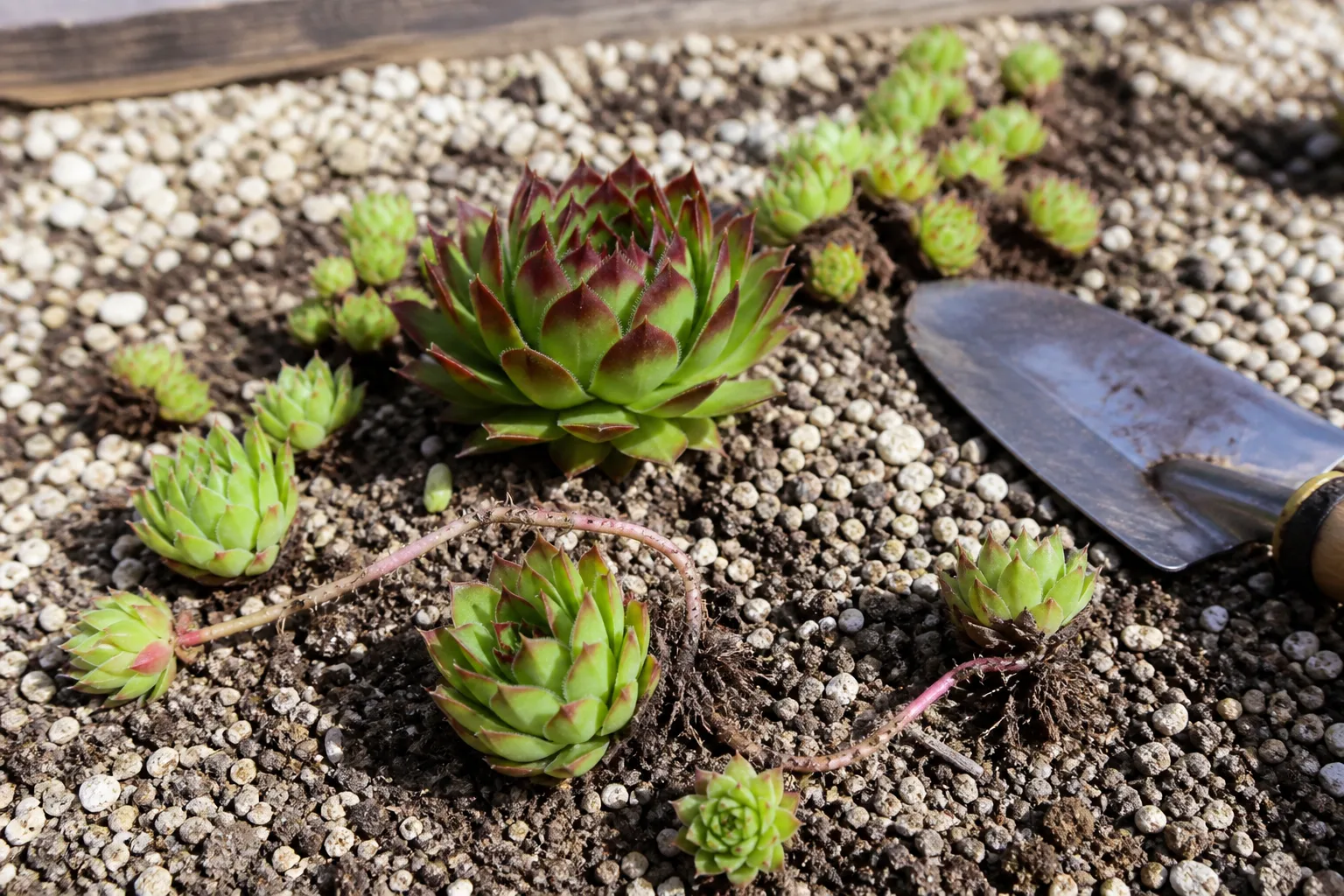
Vegetative propagation is easier and faster than seed and produces identical clones of the parent cultivar. Mature chicks often root while still attached; you can simply redirect a stolon into a gravel pocket and anchor it with a small stone.
To divide actively:
- Lift the chick with a thin trowel or fork, keeping as many roots as possible. Detach from the stolon where it meets the daughter rosette.
- Plant in gritty mix in a shallow hole just deep enough to spread roots. Set the crown at or slightly above grade.
- Wait three to seven days, then give one deep soak. Let soil dry completely before the next watering.
Spring and early fall are ideal timing; summer divisions work if you shade them for a week. Offsets without roots can still succeed—set them on dry mix, mist lightly every few days until roots form, then treat as established plants. This is the same offset logic described for aloes and haworthias in the propagation guide, but sempervivum chicks root with almost embarrassing ease outdoors.
Growing From Seed (When It Is Worth the Wait)
Seed propagation is a hobby project, not the practical way to fill a rock garden. Hybrids do not come true from seed—you may get surprise colors. Still, if a hen flowers and you want to experiment:
Collect dried seed from spent flower heads in late summer. Surface-sow on moist cactus mix, press lightly, and keep bright at room temperature. Germination often appears within two to three weeks. Grow seedlings in bright light with careful dry-down cycles; they are tiny and rot easily if overwatered.
For landscape coverage, buy named cultivars or divide offsets instead. Seeds make sense for breeding curiosity, not instant ground cover.
Container and Rock-Garden Placement

Sempervivums excel in shallow containers—bulb pans, hypertufa troughs, strawberry jars, and wide clay bowls with drainage holes. Clay wicks moisture and helps prevent the chronic overwatering that kills indoor succulents. A six-inch-deep pot is plenty; excess soil volume stays wet too long.
In rock gardens, plant in raised pockets on the sunniest face of the structure. Tuck rosettes into horizontal cracks in dry stone walls, between flagstones, or on roofline ledges where historical house-leek tradition started. Avoid depression bottoms where water collects after every rain.
Mixed succulent bowls work outdoors in summer; bring them to bright frost-free shelter before hard freeze if the bowl includes any tender companions. Let sempervivum dominate the planting when winter hardiness matters.
What Happens When a Hen Flowers
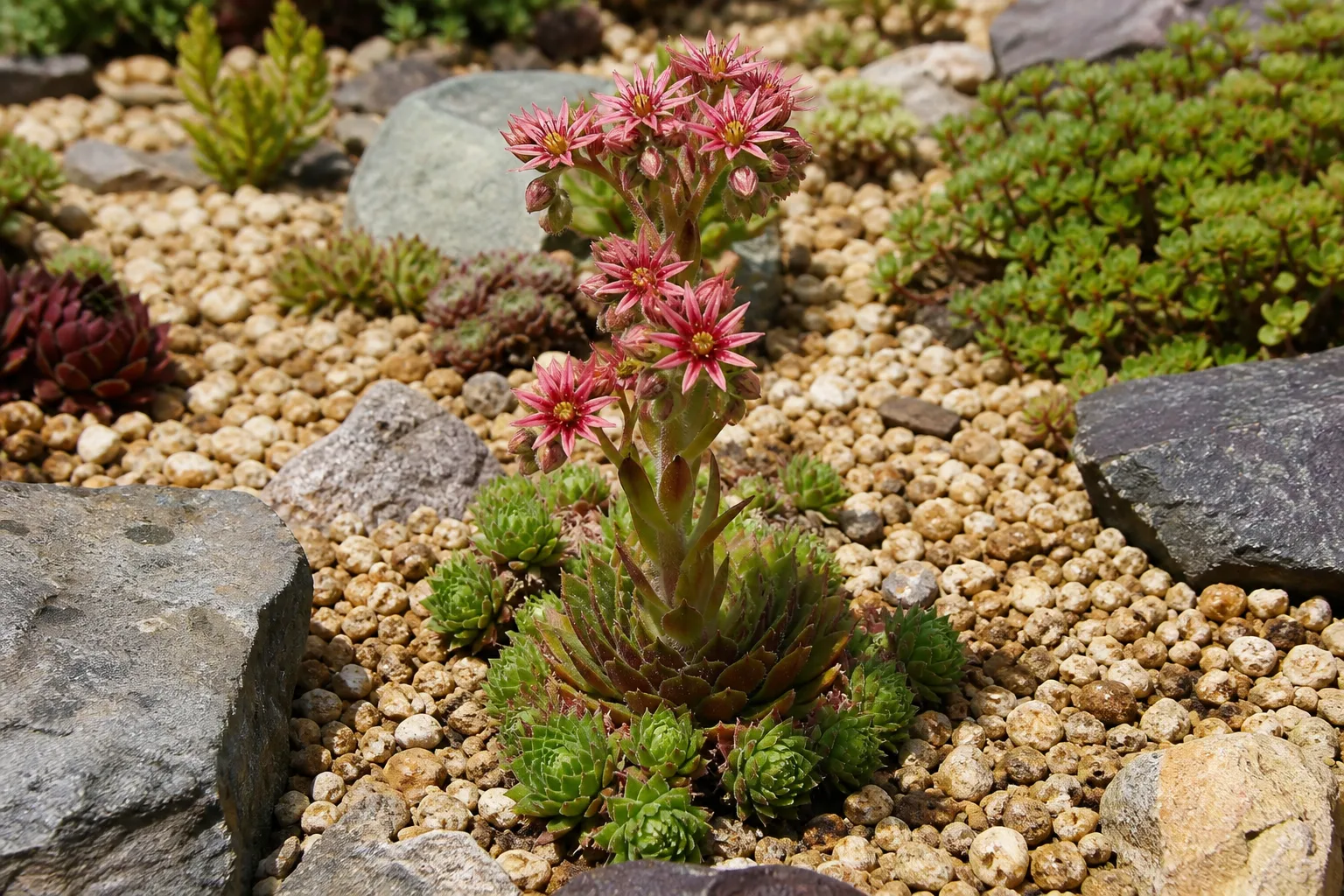
Flowering is monocarpic: the rosette that blooms will die after setting seed. Do not panic—this is normal biology, not necessarily a care failure. A thick stalk rises from the rosette center in summer, topped with star-shaped pink, red, or yellow flowers on a cyme. The display lasts several weeks.
After bloom, the hen browns and shrivels. You can snip the spent stalk at the base once flowers fade, taking care not to damage nearby chicks. Leave the collapsed hen in place to compost into the colony, or remove it to tidy the mat. Surrounding offsets fill the gap within a season.
Stress can trigger early flowering—overcrowding, overwatering, or extreme root constriction. A hen blooming in its second year in a cramped pot may signal unhappy roots rather than old age. Repot chicks into grittier, roomier conditions if you see a death bloom on a young plant.
Removing the emerging stalk does not stop monocarpic death once the hormone shift begins; appreciate the flowers or collect seed, then plan on chick expansion.
Common Problems and Quick Fixes
Healthy sempervivums are nearly pest-free outdoors. Most issues trace to moisture, shade, or misidentification of a tender succulent sold as hardy.
Mushy Rosettes and Crown Rot
Soft, translucent leaves starting at the center mean crown or root rot from wet soil. Act fast: lift the colony, cut away rotted tissue with a clean knife, and salvage firm chicks. Discard the mushy hen. Replant in fresh gritty mix on a slope or in a raised pocket. If rot repeats in the same spot, the site drains poorly—move the colony rather than replanting in place.
Indoor Pest Issues
Mealybugs and aphids appear on overwatered indoor plants or greenhouse stock. Dab insects with a cotton swab dipped in rubbing alcohol, or spray insecticidal soap on a mild day outdoors. Fix the underlying culture—more light, less water, better airflow—so pests do not return.
Fungal leaf spots show as brown lesions after wet leaves; remove affected rosettes and improve drainage. Sempervivums are not pet-toxic emergencies at low severity per NC State’s poison profile, but keep any treated plants away from pets until sprays dry.
Conclusion
Hens and chicks reward gardeners who respect their alpine roots: bright light, gritty soil, and disciplined dry-down watering. Plant crowns high, propagate chicks freely, and expect an occasional hen to flower and fade—a colony renews itself for decades through offsets, not through any single rosette living forever. Outdoors in zones 3–8, they are among the lowest-input groundcovers you can grow; indoors, they are a sunny-season accent at best. Nail drainage, and you will spend more time deciding which cultivar color to add next than troubleshooting mushy leaves.