How to Get Geese Off Your Lawn: 6 Humane Fixes
Keep geese away from your yard by removing food cues, changing shoreline habitat, rotating deterrents, and handling nests legally and safely.
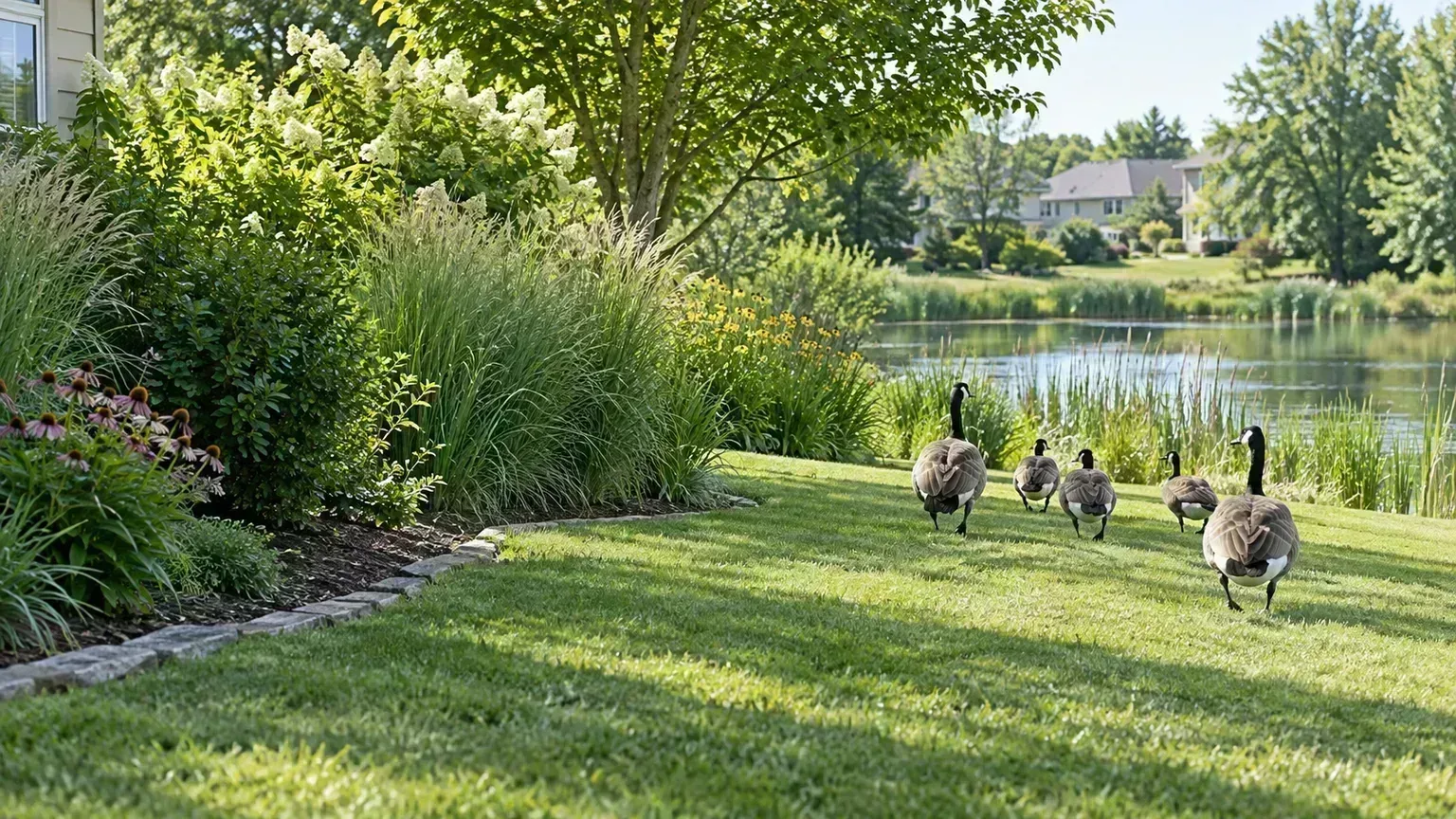
If geese are grazing across your lawn, the fix is rarely one magic gadget. They usually have several reasons to stay: short, nutritious grass, a clear view of approaching predators, easy access to water, and no physical reason to leave. Remove the welcome mat first, then add a barrier or rotating deterrent where the flock is still getting through.
The most reliable homeowner plan is to stop feeding, clean up spilled seed and pet food, make the pond edge or lawn less open, and block the route to water with a low, visible barrier. Motion devices and repellents can help during the transition, but they work best as layers rather than permanent solutions. Canada geese are protected wildlife in the United States, and local rules elsewhere can also restrict harassment, nest removal, or egg treatment, so humane control starts with prevention.
Start with why geese chose your yard
Look at the property from a goose’s point of view. A wide, closely mowed lawn beside a pond, fountain, pool, or drainage swale is an easy feeding and resting site. Short turf exposes fresh shoots and makes it easier for a flock to see danger; open water offers an escape route. Food dropped below bird feeders, unsecured trash, compost, poultry feed, and pet bowls can turn an occasional landing into a routine.
Geese also remember useful places. A pair that successfully nested or raised goslings on a property may return to the same general area, while a flock can learn that a quiet yard is safer than a busy park. That is why a scarecrow that worked for two days may stop working later: the birds have learned that the object never changes and poses no consequence.
When a pair becomes a nesting problem
Frequent visits by a pair, a flattened patch of grass near a pond, repeated trips to one corner, or a goose that stands between you and a particular spot can signal nesting behavior rather than casual grazing. Once eggs or goslings are present, the adults may defend the nest and the surrounding route more aggressively. Give the family space and switch from hands-on DIY work to observation and local wildlife guidance.
The distinction matters because habitat changes that are sensible before nesting can be unsafe during nesting. Do not walk toward a nest to move it, pick up eggs, chase adults with a pet, or try to force a family across a road or through a gate. The Michigan Department of Natural Resources advises keeping a safe distance around nests, controlling pets, and using licensed wildlife professionals for injured birds or permitted goose-management work.
The fastest humane plan: remove the welcome mat first
Start with the changes that make the whole yard less rewarding. They are less dramatic than a flashing light, but they address the reasons geese return and keep working after the flock has learned to ignore a novelty.
Stop feeding and clean up food cues
Never deliberately feed geese. Bread is not a healthy food for them, and feeding can concentrate birds, increase aggression, and leave more droppings. The Fairfax County Wildlife program also warns that supplemental feeding can make geese dependent on people and increase the spread of wildlife-transmitted disease concerns. Its management guidance is written for a county program, but the same principle applies to a backyard.
Inspect the whole feeding chain rather than only the lawn. Move songbird feeders away from the goose landing zone, use a catch tray, sweep up spilled seed, secure trash, and bring in pet food before dusk. If you keep poultry, protect feed and clean spilled grain. Do not remove every bird-friendly feature automatically; first remove the food that is reaching the turf or pond edge.
Keep short, lush lawn out of the shoreline zone
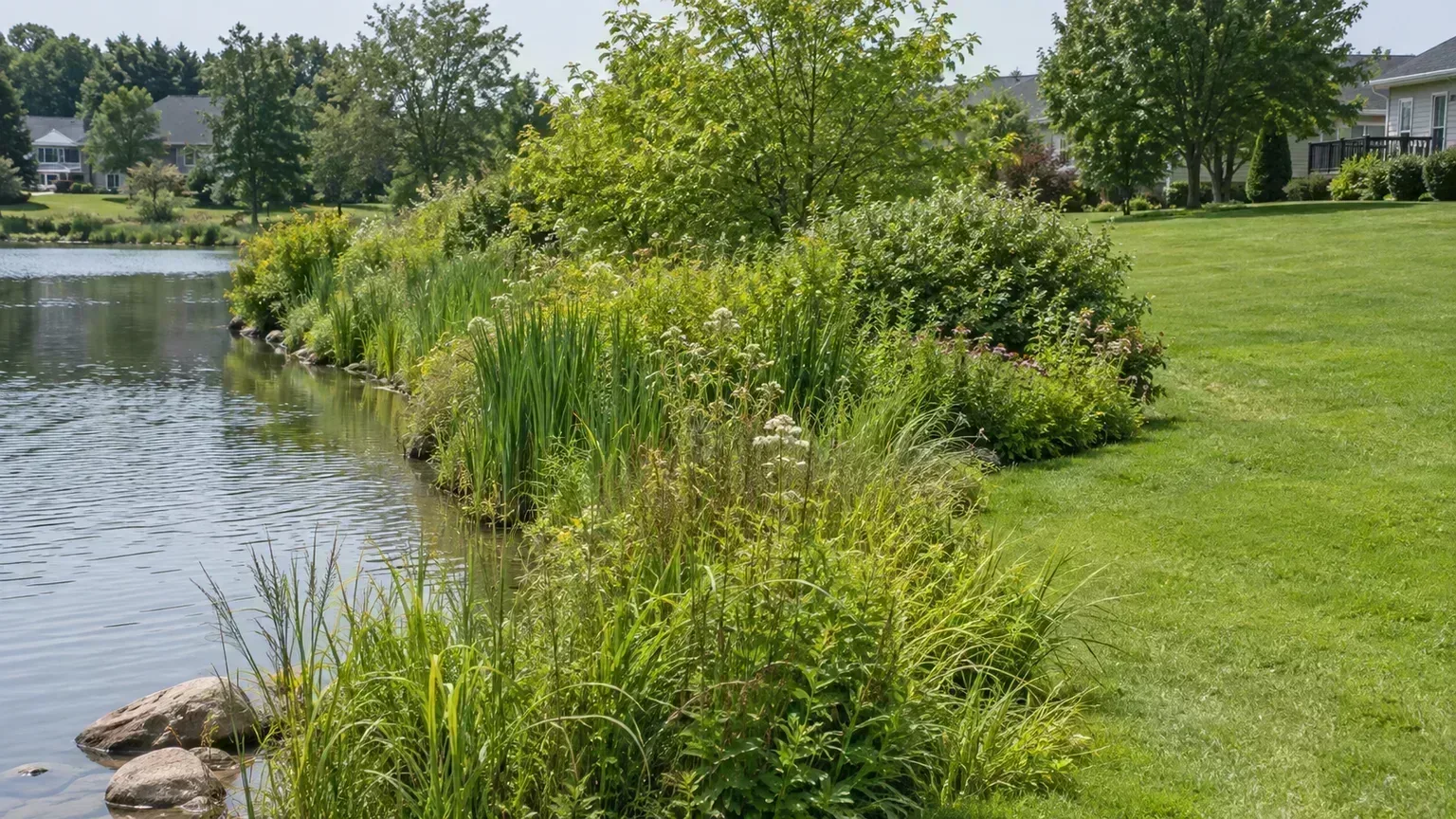
If water is the anchor, change the strip between water and mowed turf. A dense, taller band of native grasses, sedges, shrubs, or flowering perennials interrupts the clear walking route and removes the wide-open sightline geese prefer. The Michigan DNR recommends minimizing mowed lawn within roughly 10 to 30 feet of water and, where practical, allowing a tall, dense vegetation buffer or planting several rows of native shrubs.
That does not mean letting every part of a usable yard become shoulder-high. Keep the play area, path, and sitting space maintained, then concentrate the taller planting where geese approach, rest, or enter the water. Check HOA rules, sightline requirements, and local drainage before changing a shoreline. A planted buffer that blocks a neighbor’s view or traps stormwater in the wrong place creates a different problem.
Six humane tricks that work best in combination
Choose two or three tactics that address different parts of the goose’s routine. For example, food control removes the reward, a planted edge removes the easy route, and a rotating motion device makes the remaining landing zone unpredictable. Use the smallest combination that changes behavior, and reassess after several days instead of adding every gadget at once.
1. Break up open sightlines with planting
Geese favor open ground because it lets them scan for predators while they graze. Shrubs, tall ornamental grasses, sedges, and uneven planting masses make the lawn feel less like a safe runway. You do not need a solid hedge across the entire property; target the broadest approach from the pond or the corner where the flock lands.
Use plants suited to your climate, soil, and water conditions, and keep the planting dense enough to interrupt movement. Along a pond, a 10- to 30-foot buffer is a useful planning scale, but the right width depends on the site and the agency or watershed rules that apply. Where a full planting bed is impractical, a shorter layered border plus a temporary fence can still break the route.
Planting is a long-term fix, not an instant hazing method. Newly planted shrubs can be trampled, and some ornamental grasses flatten in snow or heavy rain. Protect young plants while they establish, and do not choose toxic or invasive plants simply because a list claims geese dislike them. The goal is physical and visual structure, not a fragrance miracle.
2. Block access with low fencing or string lines
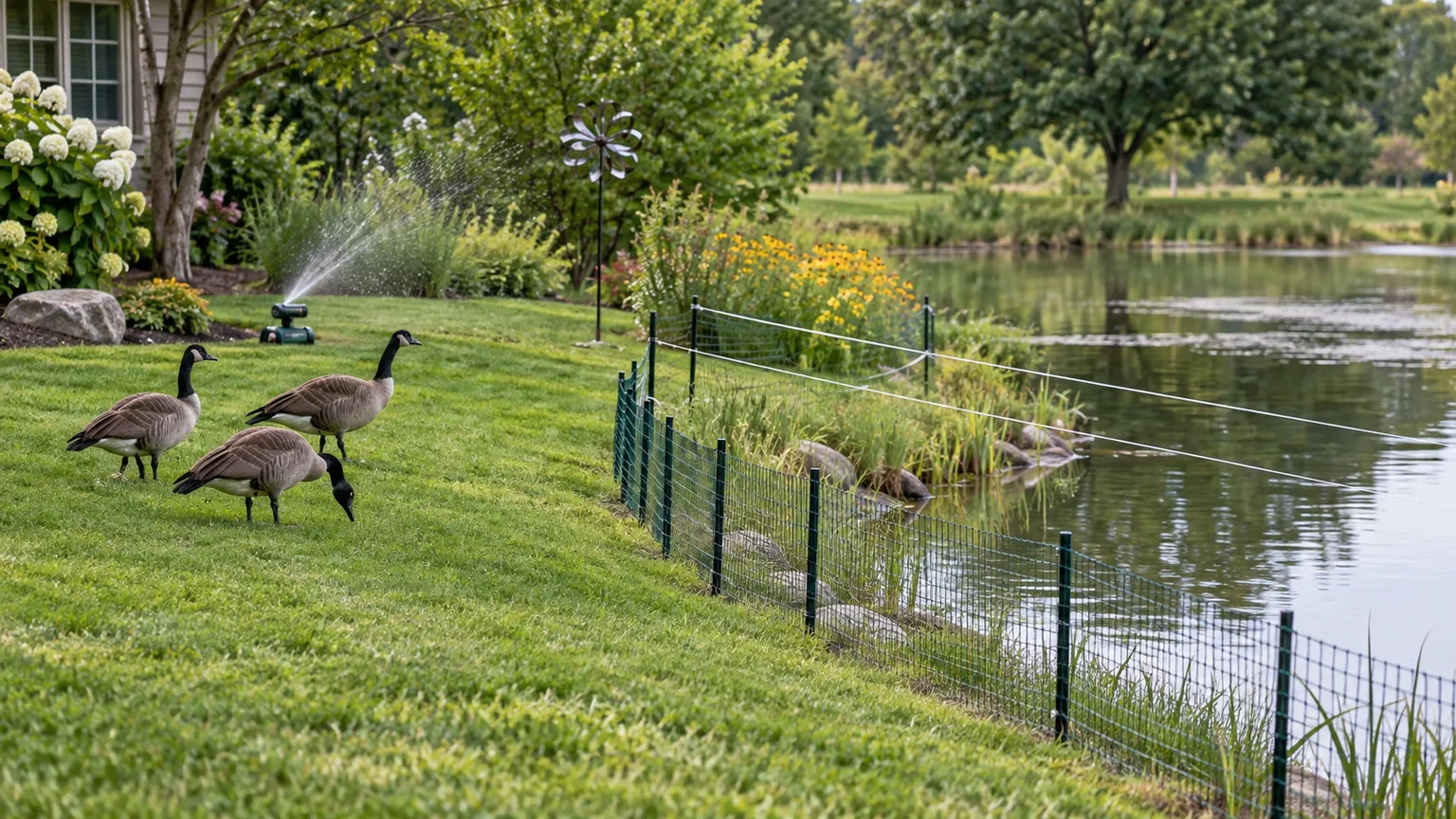
A low mesh fence works because it changes where a goose can walk, not because it frightens the bird. Place it along the water’s edge, around a small pond, or across the narrow access point where the lawn meets the shoreline. Keep the material visible and tensioned, close gaps at ground level, and inspect it after storms so it does not sag into a snare.
Overhead string lines can discourage geese from landing or settling along a shoreline when they are installed carefully. Use a pattern that is visible to birds and people, anchor it securely, and avoid improvised wire that could entangle wildlife or become a hazard to children, pets, mowers, or boats. The Michigan DNR lists fencing, overhead string lines, and vegetative barriers among non-lethal ways to limit access to preferred areas.
The best barrier is often a route change rather than a fortress. Leave a clear, safe way for people to reach the pond, and do not fence a goose family into a confined corner. If the flock is already nesting, stop moving barriers around the nest and call the local wildlife agency for direction.
3. Rotate visual and motion deterrents
Wind spinners, reflective material, moving flags, predator-shaped decoys, and motion-activated lights or sprinklers can make an open lawn less comfortable for a while. The important word is rotate. Move a decoy every few days, vary where motion begins, and remove a device that has become background scenery. The Pond Guy’s practical guidance also notes that birds learn a fixed decoy, which is why one unmoved object rarely changes a well-established pattern. See its Canada goose deterrent advice.
Motion-activated sprinklers are a reasonable experiment for a small landing zone, but do not assume geese hate water. They already use water, and some birds may simply walk around the spray or become accustomed to it. Water use, winterization, neighbors, and runoff also matter. A motion sprinkler should support a barrier or habitat change, not replace one.
Reflective tape and sound devices have similar limits. They may be useful during a short transition, but wind, weather, and habituation reduce their effect. Point lights away from roads, windows, and neighboring properties, and never use a laser around water, vehicles, aircraft, or reflective surfaces. The goal is to make the site inconvenient and uncertain, not to injure, blind, or panic the birds.
4. Change the water’s edge
If your property has a pond or fountain, manage the landing and exit points rather than trying to make the entire water feature hostile. Dense edge planting, a shallow physical barrier, and fewer open ramps from turf into water can reduce use while preserving the pond for fish, amphibians, or other wildlife. A fountain or rippled surface may make a small ornamental pond less attractive for loafing, but it will not solve a wide-open lawn beside a natural lake.
Pools need a different response. Keep covers secure, remove floating objects that could look like resting platforms, and use a code-compliant barrier around the pool. Do not add oils, detergents, or unapproved chemicals to water to deter birds. They can harm aquatic life, pets, and the water system while leaving the lawn attractant untouched.
For a drainage swale or shared pond, check with the municipality, HOA, or watershed manager before altering the edge. A homeowner can plant and fence within their property, but cannot assume they can block a shared access route, fill wetland habitat, or redirect runoff.
5. Use a dog only as a controlled professional tool
A pet dog is not a goose-management system. Letting a dog chase geese can end with a bitten dog, an injured bird, a road crossing, or an adult goose defending a nest. It can also count as unlawful harassment under some state wildlife laws. Keep your dog leashed or behind a secure fence when geese are present, especially in spring and around goslings.
Professional goose-control contractors may use trained herding dogs under the required permits and conditions. That work is different from releasing a family pet: the handler reads the birds, protects escape routes, avoids nests and hazards, and stops before the flock is cornered. The Michigan DNR specifically directs landowners toward licensed contractors for trained-dog deterrence and warns against allowing pets to chase wildlife.
6. Use a labeled goose repellent only as a short-term layer
Some chemical repellents are formulated to make turf less appealing to geese for a limited period. If you consider one, choose a product whose current label specifically includes the intended bird, site, and application, and follow the label for rates, re-entry, rain, pets, waterways, and edible plants. “Natural,” “non-toxic,” or “safe” on a sales page is not a substitute for reading the product label or checking local requirements.
Expect a temporary assist, not a permanent boundary. The Michigan DNR says chemical repellents may help temporarily deter geese from feeding on lawn grass, while also listing food removal, reduced mowing, shoreline limits, fencing, and vegetation as the stronger habitat-level measures. Do not spray a nest, gosling, pond, or bird directly, and do not mix household cleaners, essential oils, hot pepper, or other homemade substances on turf or water.
Match the fix to the pattern you see
You can save time and money by identifying the main behavior before you buy anything. A grazing flock needs a less rewarding lawn and a blocked route; a nesting pair needs distance and wildlife guidance; a droppings problem needs access control plus cleanup.
Geese are grazing on lawn
Start the same day: stop feeding, remove spilled seed and pet food, secure trash, and identify the direction of travel between water and turf. If the birds are using a broad shoreline, mark the strip for a taller planting buffer or temporary low fence. Add one rotating visual or motion device while the longer-term change is being installed.
If the lawn has no nearby water, look for a hidden attractant such as a drainage ditch, retention basin, irrigated sports field, food waste, or a neighbor who feeds wildlife. A motion sprinkler may interrupt the visit, but it cannot compensate for a large, quiet, well-fed lawn. After a week, keep what changes the route and retire what the birds ignore.
Geese are nesting or defending goslings
Do not approach the nest to inspect it more closely, move it, cover it, or oil the eggs. Canada geese are protected under the Migratory Bird Treaty Act, and the U.S. Fish and Wildlife Service explains the federal protection framework in its Migratory Bird Treaty Act guidance. State, provincial, and local rules can add requirements; the fact that a nest is on private property does not automatically make it yours to remove.
Keep children and pets away, give the adults a broad escape route, and use a different path if possible. If the nest is beside a door, driveway, play area, or workplace, contact the relevant wildlife agency or a permitted wildlife professional before taking action. Some jurisdictions allow trained personnel to addle eggs under a permit, but that is not a backyard shortcut: timing, authorization, and technique are regulated.
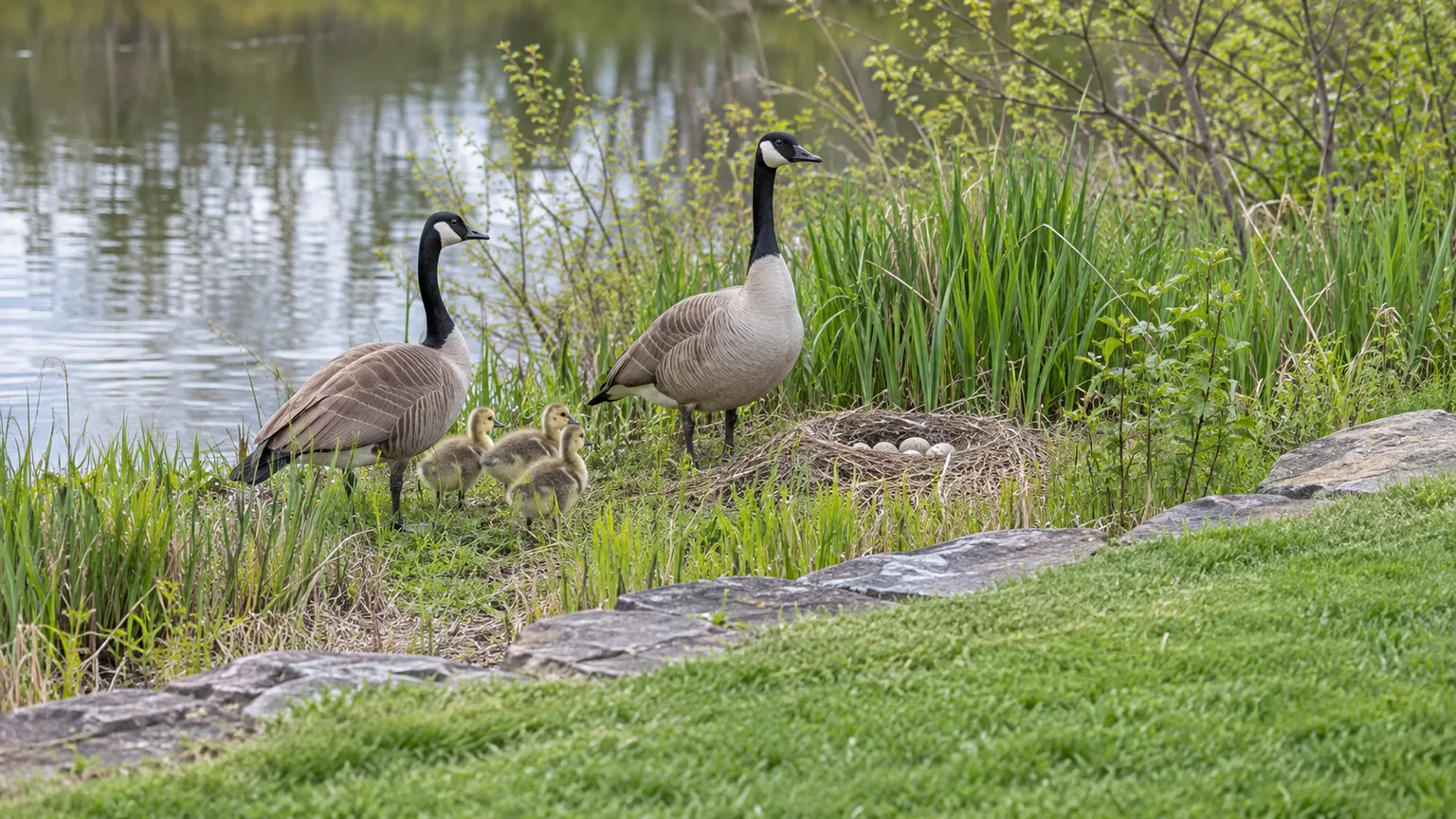
If an adult is standing tall, hissing, or spreading its wings, back away without cornering it. Keep a solid object such as a fence, vehicle, or building between you and the bird when possible, and do not wave your arms, throw objects, or send a dog after it. Report an injured goose or an apparently orphaned gosling to a licensed wildlife rehabilitator rather than trying to capture or raise it yourself.
Droppings are the main problem
If geese are passing through but not nesting, access control is usually more useful than repeated cleaning. Place the barrier at the entry route, remove food cues, and protect the areas people use most: steps, play lawns, patios, and paths. A small flock can leave enough waste to make a yard feel unusable even before it causes visible turf damage.
Treat accumulated droppings as contaminated animal waste rather than garden fertilizer. The Fairfax County program flags potential disease-transmission concerns and notes that droppings can be tracked indoors. Keep children and pets out of the area during cleanup, use gloves, avoid dry sweeping that creates dust, and wash hands and tools afterward. If waste is extensive, repeatedly contaminates a play area, or comes from a large flock, use a wildlife or environmental cleanup service and follow local disposal rules.
What not to do
Do not poison, shoot, trap, relocate, or physically handle geese on your own. Do not destroy a nest or treat eggs because a social-media post says it is allowed, and do not assume a permit from one jurisdiction applies in another. The Fairfax County guidance describes egg addling as a permitted management tool, while the U.S. Fish and Wildlife Service sets the federal migratory-bird framework; together they show why local authorization matters.
Avoid fishing line, barbed wire, electric fencing, glue, adhesive bird gels, loose netting, or any barrier that can entangle a bird. Avoid household repellents, mothballs, bleach, ammonia, gasoline, and essential-oil mixtures around lawns, ponds, pets, and edible gardens. These methods can injure wildlife, contaminate water, harm beneficial animals, or expose people and pets without addressing the reason geese chose the site.
Be skeptical of permanent claims for fake predators, ultrasonic devices, wind chimes, and a single application of repellent. Practical residential guidance from Hawkeye also notes that geese adapt to fixed visual and noise devices and that habitat changes matter more than a lone store-bought deterrent. Read its residential goose-control overview as a useful reminder that repeat problems often need a combination of access control and habitat work, not more noise.
Clean goose droppings without spreading the mess
Wait until the birds have left and keep the cleanup zone clear. Put on disposable gloves and, if dry material is likely to become airborne, use a well-fitting mask; lightly dampen the area before collecting rather than dry sweeping. On turf, lift or rake the waste into a bag, remove obvious residue, and rinse hard surfaces toward an appropriate drain only if local rules allow it—never into a pond, stream, storm drain, or vegetable bed.
Wash reusable tools with soap and water, remove gloves carefully, and wash hands. Keep contaminated shoes and clothing away from indoor living areas. For a large shoreline, public path, kennel, or heavily used play space, ask the local health or environmental authority about disposal and disinfection rather than improvising a strong chemical treatment.
Cleaning is the final step, not the strategy. If droppings return to the same strip, watch where the flock lands and walks, then move the food control, vegetation buffer, or barrier to that route. The Pond Guy notes that goose waste can add nutrients to pond water and contribute to water-quality problems, so controlling access protects both the lawn and the feature beside it.
Conclusion
To get geese off a lawn humanely, work from the reason they stay: remove food cues, reduce the appeal of short open turf, and interrupt the route between water and grass. Add a low fence or carefully installed string lines where birds still enter, then use a rotating sprinkler, spinner, or decoy only as a temporary layer. A labeled repellent can support that transition, but it should never be the whole plan.
If you see a nest, eggs, goslings, or defensive adults, stop DIY hazing and give the family space. Keep pets controlled, clean droppings with basic protective measures, and call the appropriate wildlife agency or permitted professional for regulated work. The combination of prevention, habitat change, and patience is what makes the yard less attractive without turning a nuisance into an injury or legal problem.



