How to Get Rid of Moths With Vinegar
Get rid of moths with vinegar safely: identify the moth, clean the breeding site, treat compatible surfaces, freeze vulnerable items, and monitor traps.
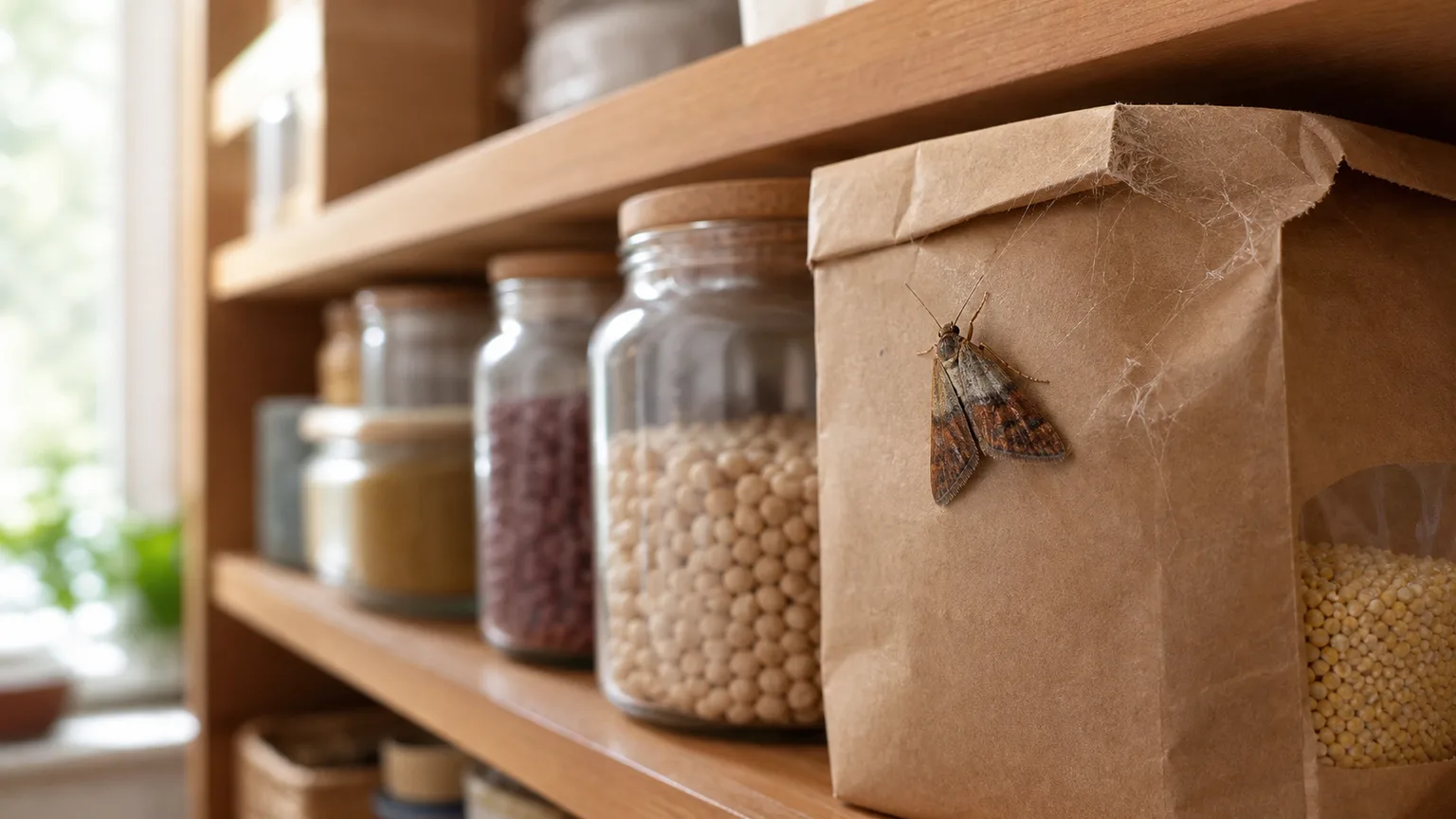
Vinegar can be useful in a moth cleanup, but it is not a moth-killing shortcut. A careful treatment uses white distilled vinegar to clean compatible, empty surfaces after the food or textile source has been removed. The part that actually ends an infestation is source removal: discard or isolate infested food, clean hidden crumbs and cocoons, treat susceptible clothing, and monitor long enough to catch the next adults.
That distinction matters because the moth you see is often not the stage doing the damage. In pantry infestations, the larvae chew and web stored food. In clothing infestations, larvae feed on keratin-rich fibers such as wool, fur, silk, and feathers. Texas A&M AgriLife Extension describes Indian meal moth development as highly variable—about 27 to 305 days from egg to adult—so one spray and one quiet week do not prove the problem is over.Texas A&M AgriLife Extension
Use the plan below as a vinegar-assisted cleanup, not as a promise of instant eradication. It is deliberately conservative around food, pets, children, natural stone, wood finishes, and delicate clothing.
The one-sentence answer
To get rid of moths with vinegar, first identify whether the activity is coming from stored food or textiles, remove the infested source, vacuum cracks and wandering larvae, wash empty hard surfaces with soap and water, then use a diluted white-vinegar wipe or spray only on a material you have confirmed is compatible. Freeze, wash, dry-clean, or discard infested items as appropriate, and leave a species-specific trap in place to monitor the cleanup.
Vinegar is best thought of as a residue and odor cleanup step. It can help lift food traces and make a freshly cleaned shelf or cabinet less attractive than one coated with flour dust, but there is not good evidence that a household vinegar spray reliably kills every egg, larva, or pupa hidden in a pantry or closet. The National Pesticide Information Center’s pantry-moth guidance instead puts identification, removal, vacuuming, washing, freezing, sealed storage, and monitoring at the center of control.National Pesticide Information Center
Identify the moth before mixing anything
Moths that look similar can require completely different cleanups. Start with the room, the damage, and the larval food source rather than trying to identify a tiny adult from memory. The comparison below is a practical first sort; if the clues conflict, collect a specimen in a small sealed container or ask a local extension office for identification.
| Clue | Pantry or food moth | Clothes moth |
|---|---|---|
| Where to search first | Flour, cereal, grains, nuts, dried fruit, spices, birdseed, or dry pet food | Dark closets, rugs, drawers, woolens, fur, feathers, and stored blankets |
| Adult appearance | Indian meal moths often have two-toned gray and coppery-brown wings | Webbing clothes moths are small and straw-colored; adults are weak fliers |
| Larval sign | Silken threads, clumped food, droppings, cast skins, or larvae crawling away to pupate | Holes, grazing, webbing, cases, and larvae in or near natural fibers |
| First priority | Seal and discard or isolate food; clean the pantry | Isolate and treat textiles; vacuum the closet and nearby carpet |
Plantura’s identification guide emphasizes the same useful dividing line: food moth larvae develop in stored food, while clothes moth larvae feed on keratin fibers. Adult clothes moths do not chew clothing; larvae do.Plantura’s moth identification guide
Pantry moth clues
Pantry moths are often discovered when a small moth flies out of a cabinet, but the cabinet is only the meeting point. Inspect every dry product in and around that area, including unopened-looking cardboard boxes, paper bags, packets of flour, cereal, rice, pasta, baking ingredients, nuts, dried fruit, chocolate, spices, tea, birdseed, and dry pet food. NPIC notes that pantry-moth larvae can chew through thin cardboard and plastic bags, which is why an apparently intact package cannot be cleared by looking only at its outside.National Pesticide Information Center
Look for silk threads that bridge grains, powder that has clumped into a webby mass, small caterpillars, or a dusty cocoon tucked under a shelf edge. A larva may leave the food and crawl up a wall or into a ceiling corner before pupating, so finding one away from the pantry does not mean the bedroom is the source. Trace the problem back to food before spraying rooms at random.
Clothes moth clues
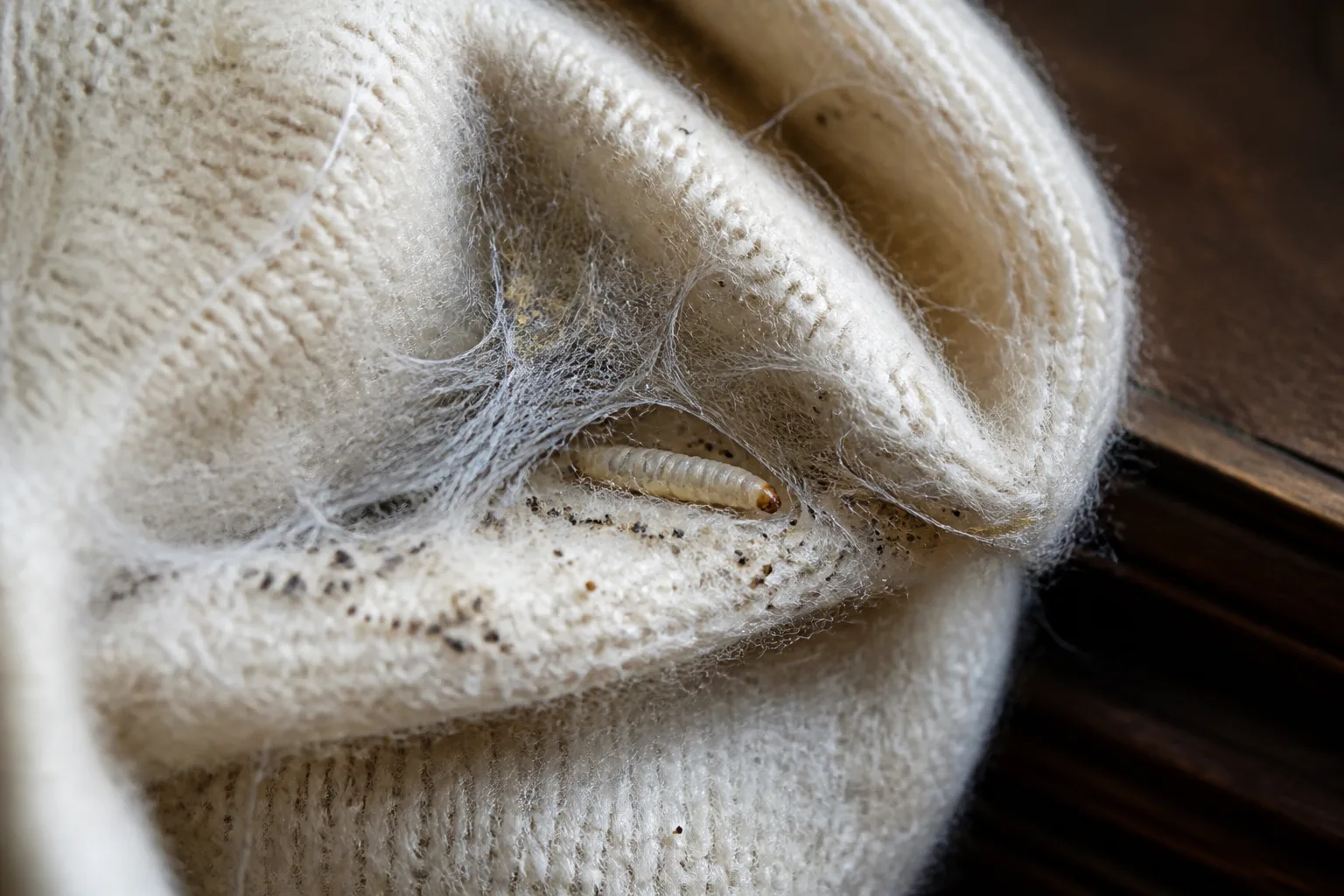
Clothes moths prefer dark, quiet, undisturbed spaces. Look at the underside of rugs, the back of a closet, garment seams, folded blankets, wool hats, upholstered furniture, and pet bedding. Small irregular holes or thin patches in wool and other animal fibers are more informative than the presence of one flying moth. Webbing or a small portable case strengthens the diagnosis, but carpet beetle larvae can cause similar damage, so do not treat every hole as a moth infestation.
Do not spray vinegar directly on wool, silk, leather, fur, or an heirloom textile just because it smells musty. Vinegar can alter dyes, finishes, and fibers, and it will not reach larvae deep in a folded garment. Bag the item instead and choose a label-safe laundering, dry-cleaning, freezing, or disposal route.
What vinegar can and cannot do
Vinegar’s useful job is cleaning. Diluted white vinegar can help remove light mineral residue or lingering odor from a compatible, nonporous surface after crumbs, webbing, eggs, and cocoons have been physically removed. It may also make it easier to see whether a shelf is truly clean. That is a housekeeping benefit, not proof that the spray has sterilized a breeding site.
Vinegar cannot reliably do the following:
- Reach every egg hidden under a jar rim, shelf liner, cabinet joint, carpet edge, or garment fold.
- Kill larvae protected inside food packaging or deep in a textile.
- Remove an infestation while the moths still have accessible food.
- Replace freezing or laundering for salvageable items.
- Substitute for a registered pesticide label when a professional treatment is warranted.
The distinction is supported by the practical advice in an Ask Extension response: a directly sprayed oil-based product would not eliminate hidden eggs, so a surface spray alone should not be expected to control a whole clothes-moth infestation.Ask Extension clothes-moth response Vinegar is an even better reason to keep expectations modest because its household role is primarily cleaning, not residual insect control.
Gather the safe materials
Set up the cleanup before opening a suspect package or shaking out a garment. You will need a trash bag that can be sealed, a flashlight, a vacuum with a crevice attachment, paper towels or washable cloths, dish soap, clean water, a labeled spray bottle, and airtight containers or lidded totes. Add disposable gloves if you dislike handling contaminated food or webbing.
For the vinegar step, use plain white distilled vinegar and water. Do not add essential oils, salt, baking soda, or pesticide concentrate to improvise a stronger formula. Baking soda neutralizes much of vinegar’s acidity and creates foaming; it does not turn the mixture into a proven larvicide. Essential oils can irritate skin, airways, pets, and sensitive surfaces, and adding them makes it harder to know what caused a reaction or finish damage.
Keep a second bucket or cloth for soap-and-water cleaning. Food-storage areas need physical removal of spilled material, not a strong scent. Keep food, dishes, utensils, and pet bowls out of the work zone until the surfaces are dry and residue-free.
Make the right vinegar solution
For a small batch on compatible sealed hard surfaces, mix one part white distilled vinegar with one part water in a clean, labeled spray bottle. Make only what you will use that day. A diluted solution is easier on many finishes than straight vinegar, but “safer” is not the same as universally safe.
Do not heat the vinegar. Warmth is not needed to make the cleaner reach a crack, and heated acid creates unnecessary fumes, spill burns, and eye irritation. Do not mix vinegar with bleach, ammonia, hydrogen peroxide, drain cleaner, or another household cleaner. Mixing products can release irritating or dangerous gases or create an unpredictable chemical reaction.

Patch-test an inconspicuous spot first. Avoid unsealed wood, marble, limestone, travertine, cement-based stone, waxed finishes, delicate paint, natural rubber, and anything whose care instructions say to avoid acids. For a food-contact surface, wash with warm water and dish soap first, rinse with clean water, and let it dry. Only use the vinegar mixture afterward if the manufacturer’s care instructions permit it; never spray a food item, open package, cutting board, dish, or utensil and then assume it is ready for food.
Clean the pantry or closet first
Vinegar works best after the breeding material is gone. NPIC recommends removing infested food, vacuuming pantry corners, washing surfaces with warm water and soap, freezing potentially affected food, and using traps to monitor.National Pesticide Information Center The same logic applies to a closet: treat the fibers and clean the places where lint, hair, and dust accumulate before you worry about fragrance.
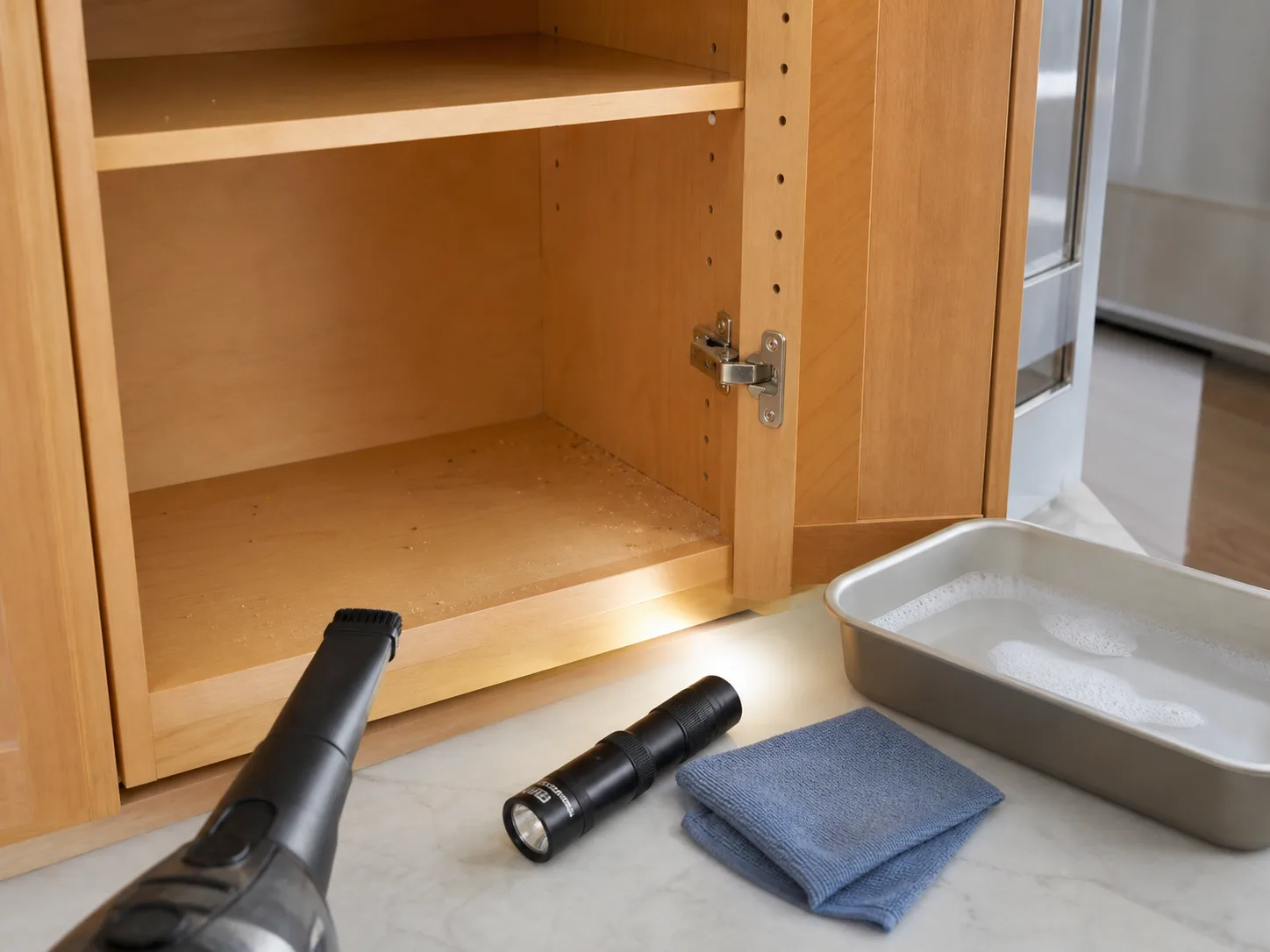
The kitchen sequence
- Clear the entire cabinet group. Do not clean only the shelf where you saw the adult. Put products on a table or counter where you can inspect them one by one.
- Seal the suspect package before carrying it through the home. Put infested food in a bag, close it, and move it to an outdoor trash can. Do not leave it in an open kitchen bin.
- Inspect the quiet items. Check corners and seams of bags, the inside of boxes, jar lids, shelf-paper edges, and nearby birdseed or pet-food containers. When in doubt, isolate the product in a lidded tote rather than returning it to the pantry.
- Vacuum dry debris first. Use the crevice tool along shelf pins, joints, corners, cabinet hinges, the underside of shelves, and wall-to-cabinet gaps. Empty the canister or remove the bag outdoors so surviving larvae do not crawl back into the kitchen.
- Wash with warm soapy water. Wipe shelves, walls, jar exteriors, and the underside of cabinet parts. A soft brush or cotton swab can dislodge residue from grooves and screw holes. Let everything dry fully.
- Use vinegar only as a compatible-surface finish. Mist the cloth rather than flooding the cabinet, wipe the empty surface, and allow it to dry completely before restocking.
- Restock into clean, hard-sided containers. Glass or thick plastic containers with tight lids are safer than thin bags or folded cardboard. Label the date so older food is used first.
The vinegar step cannot rescue infested food. If the food contains webbing, larvae, a cocoon, or unexplained clumping, discard it. Do not taste-test a questionable ingredient to decide whether it is safe.
The closet sequence
Move clothing in sealed bags or lidded bins, not loose armfuls. Separate clean-looking wool, cashmere, silk, fur, feathers, and blends from cotton or synthetic items. Inspect cuffs, collars, seams, hems, pockets, blanket folds, and the floor under hanging clothes. Vacuum the closet floor, baseboards, shelf joints, carpet edge, and the space under the lowest garment.
Treat each natural-fiber item according to its label. Hot washing may be appropriate for a washable item that permits it; dry cleaning is usually the conservative choice for tailored or delicate garments; freezing can treat some dry items when they are sealed correctly and the fabric or manufacturer permits it. Vinegar is not a substitute for any of these methods, and a vinegar mist can leave a damp textile that takes longer to dry and may develop a new odor.
For compatible painted or sealed hard surfaces, put the diluted vinegar on a cloth and wipe lightly after vacuuming. Do not soak closet wood, spray into electrical fixtures, or use vinegar to treat carpet padding. A professional can advise on wall voids, extensive carpeting, or a recurring infestation in an apartment building.
Apply vinegar to the right surfaces
Use a small amount and keep the target narrow. A good application is a wipe of an empty, sealed pantry shelf, cabinet side, or painted baseboard that has already been vacuumed and washed. A bad application is a cloud of spray over food, clothing, carpet, unfinished wood, or the entire room.
Spray the cloth, not the crack, when you are working near hinges, drawer runners, outlets, or a porous finish. Wipe until the surface is lightly damp, then ventilate and let it dry. If the surface becomes tacky, cloudy, discolored, or strongly scented, stop and rinse or follow the surface-care instructions rather than applying another coat.
The goal is a clean, dry, inspectable surface. Do not leave a wet pantry closed around food or a damp closet closed around wool. Moisture can damage materials and creates a separate storage problem. Vinegar should never be the reason you skip the final dry-down.
Use heat, cold, and containment for infested items
Life-stage control is what makes the cleanup hold. For food, NPIC says potentially affected items may be placed in a freezer for a week to kill eggs or larvae.National Pesticide Information Center Seal the package or transfer it to a freezer-safe bag first, because freezing the product does not help if larvae can escape during handling. Allow a frozen package to warm while still sealed so condensation does not wet the food.
For clothing, follow the garment label and choose dry cleaning, approved washing, or freezing. A sealed bag prevents any surviving insect from spreading during transport and keeps condensation off a cold textile while it returns to room temperature. Freezing is not a universal permission slip: a home freezer may fluctuate, bulky items may not freeze through quickly, and fragile fabrics, leather trim, adhesives, or electronics can be damaged. Ask the cleaner or manufacturer when the item is valuable.
Containment is also useful when you cannot decide whether a product is safe to keep. Store questionable dry goods in a labeled lidded tote away from the pantry while you monitor them. Do not mix suspect and cleared items in one container. For a severe or persistent clothes-moth problem, a professional textile or pest specialist can help select a treatment that reaches the relevant life stage without damaging the garment.
Add traps as monitors, not magic erasers
Species-specific pheromone traps are useful because they tell you whether adult males are still active and which room deserves another inspection. They do not catch hidden eggs and larvae, and they do not prove that every female or immature stage is gone. Plantura describes pantry and clothes-moth traps as detection and monitoring tools rather than a complete elimination method.Plantura’s moth identification guide
Use a pantry-moth trap near the affected food-storage area, following the product’s placement and replacement instructions. Do not put a clothes-moth trap in the pantry or interpret a pantry-moth trap’s silence as proof that a closet is clear. Traps are best used after cleanup, when a new catch points you back toward a missed source.
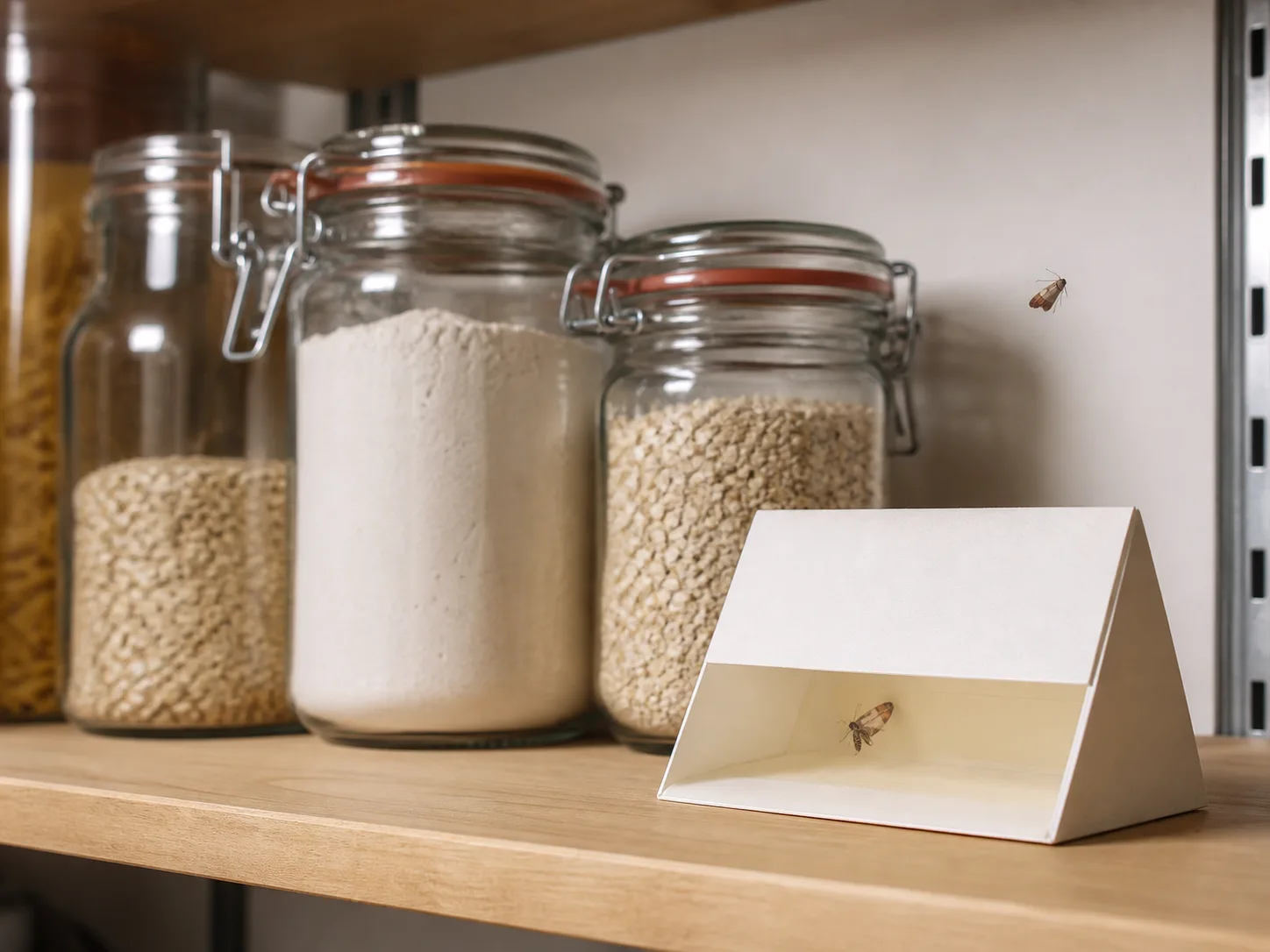
Record the date you placed the trap and the number of moths caught each time you inspect it. A declining count over several checks is more useful than one empty trap. If the count rises, revisit unopened-looking packages, pet food, birdseed, shelf joints, ceiling corners, rugs, and stored textiles.
What to do if moths keep appearing
Seeing a few adults after the first cleanup is not automatically a failure. Pupae that were already hidden may emerge later, and larvae can travel away from their food before making a cocoon. Give the home a planned recheck rather than spraying more often.
Start with the room where the trap catches moths, then inspect the closest connected storage. In a kitchen, check every dry product and the cabinet above, below, and beside the original shelf. In a closet, inspect rugs, hampers, coats, blankets, upholstered furniture, and pet bedding. Look for the source, not just the moth on the wall.
Repeat vacuuming whenever you find new webbing, crumbs, cast skins, cocoons, or larvae. Keep dry food in sealed containers while you monitor. Keep treated clothing isolated until it has passed through its selected kill or cleaning method. If the trap count is not trending down after several thorough cycles, stop treating with vinegar and seek a pest professional or extension identification service.
Mistakes that make the problem worse
Spraying instead of removing the source. A fragrant shelf still contains a breeding food if the webbed flour or pet food remains. Remove the source before any wipe-down.
Spraying food or packaging. Vinegar is not a food-preservation treatment. Discard contaminated food and keep sprays off food, dishes, utensils, and pet bowls.
Heating vinegar. Heat adds fumes and burn risk without turning a household cleaner into a reliable moth treatment.
Mixing vinegar with other cleaners. Especially never combine it with bleach or ammonia. Use one product at a time and rinse where the surface-care instructions require it.
Adding baking soda or essential oils because stronger sounds better. These additions do not solve hidden eggs, can create residue, and may irritate people or animals or damage surfaces.
Using mothballs in an open closet or pantry. NPIC warns that mothball vapors can pose risks when used improperly and should not be used around food or food-preparation areas.National Pesticide Information Center
Returning items too soon. A clean shelf cannot compensate for untreated wool or an unopened bag of birdseed that was sitting beside the original source. Restock gradually after items have been inspected or treated.
Ignoring the vacuum. Eggs, larvae, and spilled food left in a crevice can restart the problem. Empty the vacuum outdoors and clean a removable canister before bringing it back inside.
When to skip DIY and call a professional
Call for help when the infestation is widespread, keeps returning after careful source removal, reaches wall voids or extensive carpet, affects valuable textiles, or appears in a shared building where another unit may be the source. Also ask for help when you cannot distinguish moths from carpet beetles or another stored-product pest.
If you use a pesticide, choose only a product labeled for the exact site and pest, follow the label, keep people and pets away as directed, and never spray food or food-contact surfaces. NPIC recommends reading the label before buying and using pesticide information resources when a product is being considered.National Pesticide Information Center A professional can select a treatment and explain re-entry, ventilation, and cleanup requirements; vinegar should not be used to avoid that conversation.
Conclusion
The professional way to use vinegar against moths is to give it a limited, useful job: clean an empty, compatible hard surface after you have removed the food or textile source. Do not rely on it to kill hidden eggs, larvae, or pupae. Identify the moth, discard or isolate infested material, vacuum the cracks where larvae hide, wash with soap and water, use a diluted vinegar wipe only where the surface allows it, treat salvageable items with the right heat or cold method, and monitor with the correct trap.
That sequence may take more than one pass because moths develop in stages and can pupate away from the original food. If the trap count keeps rising or the source cannot be found, escalate rather than applying more spray. A clean, dry, sealed home is the lasting solution; vinegar is only one small tool in that plan.



