How to Get Rid of Spiders on Your Porch
Learn how to get rid of spiders on your porch by removing webs safely, reducing insects, changing outdoor lighting, and sealing entry points.

If spiders keep appearing on your porch, the porch is probably paying them in food and shelter. Outdoor lights can concentrate moths, flies, and other flying insects; rooflines, railings, planters, and quiet corners then give spiders solid places to hunt, hide, and anchor webs.
That is why killing one spider rarely changes the pattern. The durable fix is to remove the webs you do not want, reduce the insects that make the porch profitable, and close the gaps that let spiders move from the porch into the house. Most porch spiders are nuisance wildlife rather than a sign of danger, but suspected black widows or brown recluses deserve distance and professional identification.
The quick answer: break the food-and-shelter loop
Start at dusk by turning off decorative porch lights, then remove accessible webs and egg sacs with a long-handled soft brush or vacuum attachment. The next day, inspect the light fixture, the underside of the eave, the door threshold, screen edges, planters, and nearby trash or recycling for the insects and hiding places that keep restarting the cycle.
Over the next week, use the five fixes below in this order: clean the web network, make lighting less attractive to flying insects, remove food and moisture sources, seal access points, and reduce sheltered clutter. This sequence follows the logic of integrated pest management (IPM)—inspect, identify, change conditions, use the least-risk effective control, and check whether the change worked—rather than spraying every visible spider.
The Centers for Disease Control and Prevention’s IPM guidance makes an important point that applies well to porches: pest management is a system of prevention, reduction, and follow-up, and eliminating access to food, water, or shelter is often more durable than relying on a pesticide alone.
| What you notice | Likely reason | First correction |
|---|---|---|
| Webs are concentrated around a lamp | Flying insects gather in the light | Shorten light runtime and use a warm, shielded bulb if appropriate |
| Webs return in the same corners | The location offers a stable anchor and shelter | Remove webs on a schedule and clear nearby clutter |
| Spiders appear after rain or around planters | Moisture supports insect activity and hiding places | Correct drainage and remove damp debris |
| Spiders show up at the door or indoors | A gap, screen tear, or door sweep is allowing access | Repair screens and weatherstrip the opening |
| Activity is widespread or includes egg sacs indoors | The porch may be one part of a larger pest problem | Document the locations and ask a licensed professional to inspect |
Why a porch is such a good spider habitat
A porch is not automatically “dirty” because it has spiders. It is a transitional space: partly sheltered from rain, exposed to insects from the yard, and often lit at the exact time nocturnal prey are moving. Understanding that combination helps you fix the reason for the activity instead of chasing individual spiders.
Porch lights can concentrate flying insects
Many moths, flies, beetles, and other insects gather around artificial light after dark. A spider does not need to be attracted to the bulb itself to benefit; it only needs the light to make prey predictable. A web beside a lamp is effectively a fishing net beside a busy dock.
If webs are thickest near a lantern, motion light, string lights, or bright window, look at the insects before you look for a stronger spider spray. A warm, lower-intensity bulb may reduce insect activity compared with a bright cool-white light, but the result depends on the fixture, bulb, surrounding vegetation, and local insect population. The simplest test is to switch off decorative lighting for a week or put it on a timer and compare the number of new webs.
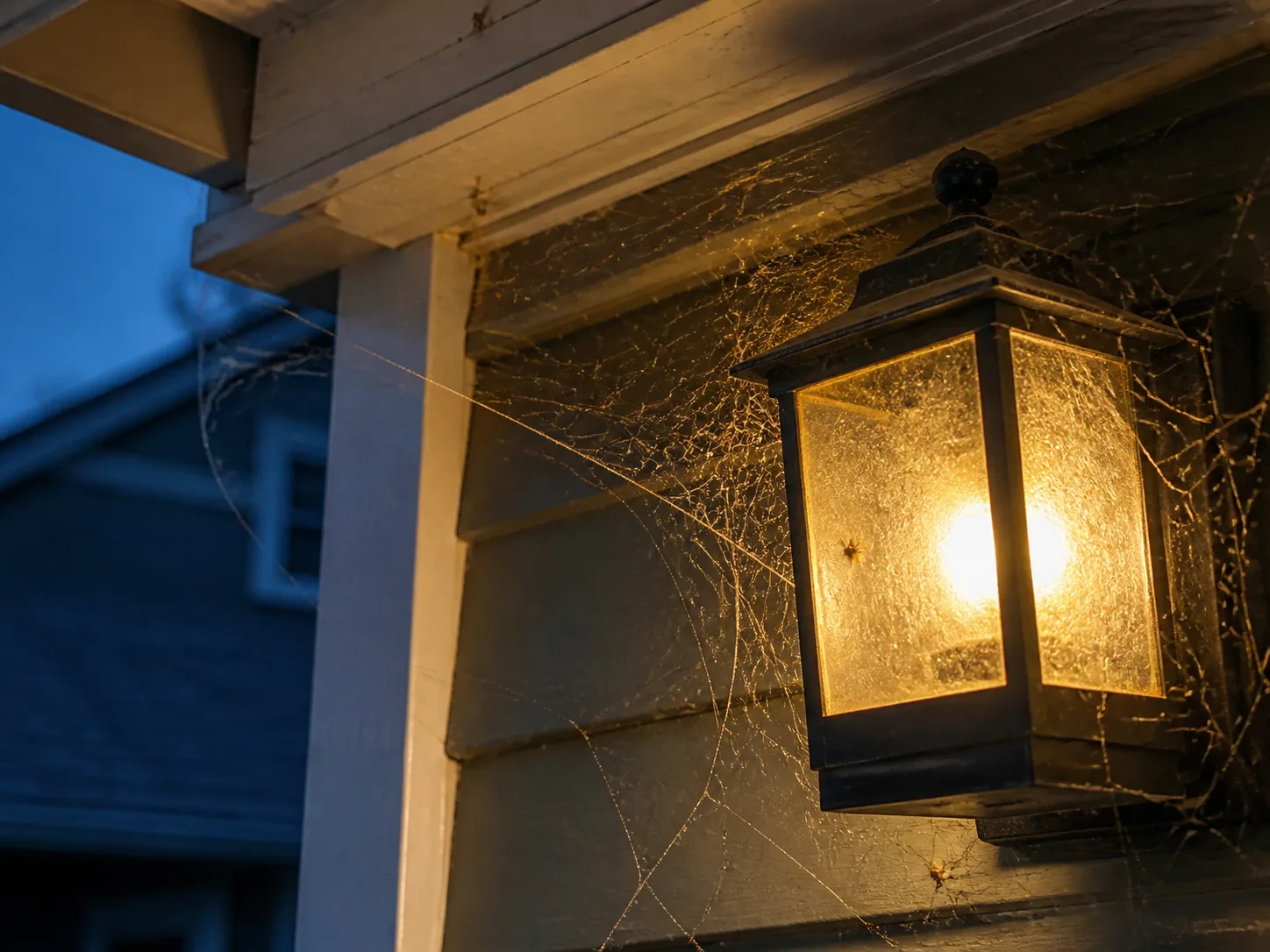
Lighting is not the only variable. A lamp mounted beside a wall or under a deep eave can create a protected web anchor, while a light shining through a torn screen can draw insects directly toward the doorway. Move the fixture only if it is safe and practical; shortening the hours it runs is usually the first, easiest experiment.
Eaves, corners, and clutter provide shelter
Spiders prefer places where a web or retreat is less likely to be destroyed by rain, wind, or foot traffic. The undersides of porch ceilings, the back of railings, gaps behind planters, the space beneath furniture, and corners where siding meets trim can all work. A screened porch can be especially attractive because it blocks some weather while still allowing insects to enter through a damaged mesh or door gap.
Clutter does not create spiders out of nowhere, but it creates more protected surfaces and makes inspection harder. Stacked pots, cardboard, seldom-used furniture, leaf piles, firewood, and dense vines close to the wall can hide spiders and the insects they hunt. The CDC’s outdoor-worker guidance specifically recommends reducing debris and inspecting undisturbed materials because sheltered piles are the kind of place where people are more likely to surprise a spider.
Weather and seasonal activity change the pattern
Warm nights can increase insect movement and make porch webs seem to appear overnight. After rain, damp debris and lush vegetation can support more small insects, while a cool or windy change can push spiders toward protected edges. In late summer and fall, you may also notice more large webs because mature orb-weaving spiders are easier to see and their webs catch dew.
That seasonal rhythm does not mean every sudden increase is an infestation. Country Living’s overview of common house and garden spiders notes that many spiders remain unnoticed for much of the year and become more visible as conditions change. Treat timing as a clue: if activity rises only during a short weather window, maintenance and lighting changes may be enough; if it continues across rooms and seasons, inspect the structure and nearby insect sources more thoroughly.
Before you remove anything, check safety and location
Do not reach barehanded into a dark corner, lift a planter against your body, or climb a shaky chair to clear a web. Most spiders avoid people, but the risk comes from surprise contact, and a fall from a porch step or ladder is more likely than a serious spider bite.
A low-contact cleanup setup
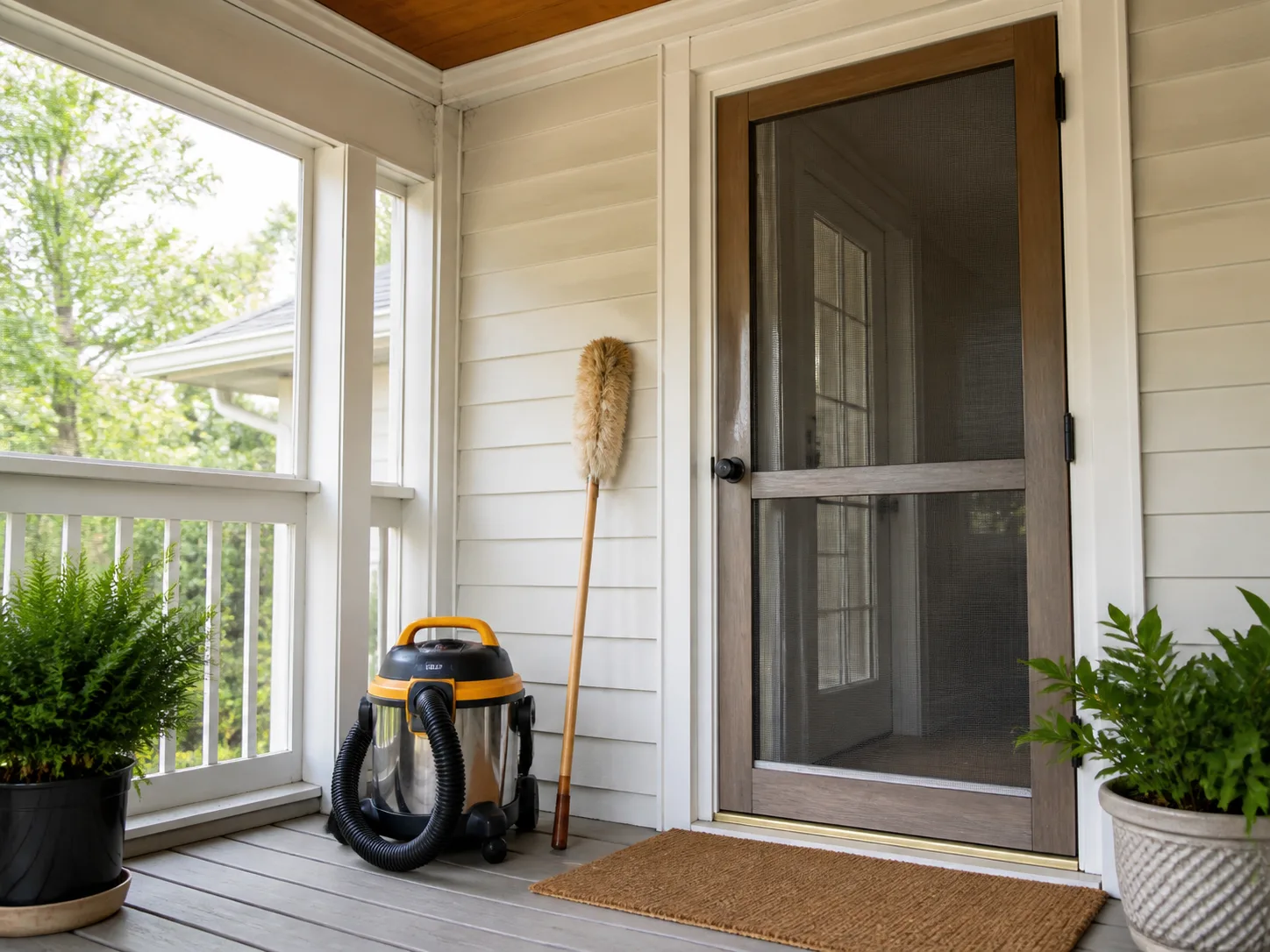
Gather a long-handled soft duster or web brush, a vacuum with a wand or extension, a flashlight, gloves, closed-toe shoes, and a sealable bag or container. Work in daylight when possible, keep children and pets away from the area, and switch off the porch light before cleaning the fixture or anything near wiring.
For a live spider you want to relocate, place a clear cup or container over it, slide stiff paper or thin cardboard underneath, and carry it to a sheltered spot away from the doorway. Do not attempt that method if the spider is in an awkward high corner, behind stored materials, or difficult to identify; a professional can remove it without asking you to get close.
If you vacuum webs, egg sacs, or spiders, use the extension rather than your hands, then empty a bagless canister outdoors into a sealed trash bag or close and discard the vacuum bag. The aim is to remove the web network and eggs as well as the visible adult. Do not dismantle a screen, light, or electrical fixture just to reach one web.
When identification matters
Color alone is not a reliable identification method. Spiders vary by age, sex, region, lighting, and posture, and many harmless species are mistaken for medically important ones. A blurry phone photo can be useful to a local extension office or licensed pest professional, but do not handle a spider to get a better picture.
The Oregon Department of Agriculture’s spider guidance is a useful reminder that local species lists differ and that bites are uncommon. If you are in an area where black widows or brown recluses occur and you see a spider in a protected, undisturbed spot, keep your distance and arrange identification rather than trying to relocate it yourself.
If someone is bitten, wash the area with soap and water, apply a cool cloth, and seek medical advice for severe or worsening symptoms. The CDC advises not trying to remove venom; urgent symptoms such as trouble breathing, spreading pain, severe muscle cramps, or significant swelling call for immediate medical attention.
Five fixes that reduce porch spiders
These fixes work together, but you do not have to make your porch sterile. The practical goal is a clean, usable entrance with fewer webs and fewer surprise encounters—not the removal of every harmless spider from the yard.
1. Remove webs and egg sacs on a schedule
Use a soft brush or vacuum wand to clear webs from the ceiling, wall corners, light housing, railings, furniture, and the area behind planters. Move slowly from the outside edge of the web toward its anchor so you do not fling debris across the porch. Inspect the same spots for pale silk sacs tucked into corners or behind objects; removing only the adult leaves the next generation in place.
Do not assume one aggressive cleaning will solve the problem. A porch that still has a bright light, abundant insects, and protected corners can be rebuilt quickly. Clean the highest-traffic areas once a week during peak activity, then stretch the interval when the number of new webs drops. If a corner produces a fresh web every day for several days, record what is nearby—light, plant, drain, trash can, or screen gap—because that pattern tells you what to fix next.
Avoid smashing spiders against painted siding or porch furniture. It creates a stain, may spread young spiders if an egg-carrying species is involved, and does nothing to remove the conditions that brought them there. A brush, vacuum, or cup-and-paper method is cleaner and gives you more control.
2. Change how and when porch lights run
Turn off decorative lights when no one is using the porch. For a necessary entry light, try a motion sensor or a timer that limits the hours it runs. Shielded fixtures that direct light downward can reduce the bright vertical surface that insects circle, although the fixture must still meet local safety and electrical requirements.
If you replace a bulb, compare a warm-colored bulb with the cool-white bulb you were using rather than assuming the label “bug light” guarantees a result. Keep the bulb and fixture free of dead insects, and do not spray oils or household cleaners into a powered light. A light change is successful only if it reduces new insect activity and new webs; the spider count may lag by several days while existing adults move on or die naturally.
Do not move the light toward the door simply to make the wall brighter. That can shift insects and webs closer to the threshold. If possible, place needed illumination where it helps people see the steps and lock without washing the entire porch wall in light.
3. Reduce the insects and moisture that feed the problem
Look at the web’s catch. Moths and small flies point you toward lighting and vegetation; mosquitoes point you toward standing water; ants or beetles may point you toward plant debris, food waste, or a nearby landscape issue. You do not need to eliminate every insect, but you can remove the concentrated sources right beside the entrance.
Keep trash and recycling containers closed and rinsed, remove fallen fruit and damp leaf piles, clean clogged gutters and downspouts, and correct puddles near the steps. Trim vegetation that touches the porch wall or blocks airflow, but do not strip the entire garden. Fine Gardening’s discussion of spiders in the garden makes the ecological trade-off clear: many spiders are valuable predators of insects, so reducing pesticide use in the garden can preserve useful control away from the doorway.
Use a targeted approach. If the only strong insect source is a bright lamp, change the lamp; if it is a leaking gutter, fix the water; if a flowering vine is swarming with pollinators, leave it in place and adjust the porch boundary rather than spraying it. A porch can be less attractive without turning the surrounding garden into a dead zone.
4. Close the gaps that turn a porch into a doorway
On an open porch, you can reduce access to the house even if you cannot block spiders from the entire outdoor structure. Check the bottom of the exterior door, the corners of the frame, the meeting points of screen panels, the edge of a pet door, and gaps around utility lines. Repair torn mesh, replace worn weatherstripping, and install a properly sized door sweep if daylight is visible under the door.
Use exterior-rated caulk only where the joint is appropriate for caulking and the surface is clean and dry. Do not seal a required drainage opening, weep hole, vent, or moving joint. For a screened porch, the smallest opening at a corner can matter more than a large hole in the middle because spiders can follow the frame and remain near the protected edge.
After repairs, turn off the inside lights at night and stand outside for a moment. If you can see a bright line around the door or screen, insects can often find the same route. This simple nighttime check does not identify every gap, but it gives you a practical priority list without dismantling the porch.
5. Make the porch less useful as a hiding place
Remove unused cardboard, stacked pots, stored fabric, leaf debris, and furniture that is pushed tight against the wall. Raise planters enough to inspect underneath them, keep firewood away from the doorway, and leave a small service gap around the porch edge so you can sweep and see what is happening.
Clean the underside of furniture and the back of railings, not just the walking surface. A spotless floor does not help much if the web anchor is on the ceiling or behind the chair. At the same time, keep reasonable garden habitat farther from the entrance: a shrub border or mulch bed can support beneficial predators without giving them a quiet, undisturbed retreat beside the door.
Do not use constant movement as a “repellent.” People walking through a web zone may disrupt webs temporarily, but the durable change comes from removing stable anchors, food concentration, and access to the house. Make the porch easy to inspect and easy to clean instead.
What not to rely on first
Peppermint oil, vinegar, citrus peels, cinnamon, garlic, and similar home remedies are popular because they smell strong to people. Their performance is inconsistent, the effect is usually temporary, and some mixtures can stain paint, damage finishes, irritate skin, harm plants, or be unsafe around pets. I would not make an essential-oil spray the first-line fix for a porch that has not been inspected.
The same caution applies to broad “natural” or commercial sprays. Natural does not mean harmless, and a contact spray kills only what it reaches; it does not remove egg sacs, repair a screen, or lower the insect population. If you use a pesticide, choose a product labeled for the exact outdoor site and pest, follow the label’s dilution and re-entry directions, keep children and pets away as instructed, and never spray light fixtures, food-contact surfaces, or flowering plants unless the label specifically permits it.
Do not use mothballs outdoors as a spider repellent. They are pesticides intended for labeled uses, not open-air porch treatments, and placing them where people, pets, or wildlife can contact them creates an exposure problem. A product that promises a spider-free perimeter is also a reason to read the label more carefully, not a reason to apply more often.
Finally, do not seal every crack with expanding foam or caulk before you understand what it does. Blocking drainage or ventilation can create moisture damage that is more expensive than a few webs. IPM works because each intervention is tied to an observed condition and checked afterward.
When to call a pest professional
Call a licensed pest professional when spiders are spreading into several rooms, egg sacs are appearing repeatedly indoors, you find activity in wall voids or inaccessible structural spaces, or cleaning and exclusion have not changed the pattern after a reasonable trial. Ask for an inspection and identification before agreeing to routine perimeter spraying, and ask what nonchemical steps will be included.
Professional help is also sensible when the porch is high, the webs are above a stairwell, the infestation is in a rental or shared building, or fear makes safe cleanup unrealistic. A good technician should be able to explain the likely prey source, access points, treatment target, and follow-up plan rather than simply promising that all spiders will disappear.
Take photos of web locations, note whether they appear only at night, and list recent changes such as new lighting, irrigation, landscaping, or construction. That record can save time and helps distinguish a short seasonal surge from a building or insect problem.
Do not handle a spider for a technician or save it in an unventilated container unless they specifically instruct you. A location, a safe photo, and a description of the web type are usually more useful than risking a bite.
A 10-minute weekly porch routine
Once the initial cleanup is done, prevention can be simple. Pick a daylight time when the porch is dry and work through the same short route every week during the months when webs are forming fastest:
- Look first. Scan the light, eaves, corners, door frame, screen edges, planters, and furniture before disturbing anything.
- Remove webs and sacs. Use the soft brush or vacuum wand from the ground; do not climb onto furniture.
- Check the food source. Note moths at the light, flies near trash, mosquitoes near water, or beetles in nearby vegetation.
- Reset the boundary. Sweep debris, move clutter away from the wall, and keep vegetation from touching screens and trim.
- Test access. Close the door, inspect the sweep and screens, and mark any visible gap for repair.
- Review the trend. If new webs are fewer, keep the routine. If they are unchanged, change one variable—usually lighting or insect source—before adding a spray.
The routine is deliberately small because consistency beats an occasional dramatic cleanup. During a heavy seasonal flush, check twice a week; during quiet months, a monthly inspection may be enough. The correct interval is the one that keeps webs from becoming established without turning porch care into a daily battle.
Conclusion
Spiders keep appearing on a porch because the porch often offers a profitable combination: insects to eat, protected surfaces for webs, and gaps that connect outdoor shelter to the house. The most effective response is to break that loop in order—remove webs and egg sacs, shorten unnecessary lighting, reduce concentrated insects and moisture, repair screens and door gaps, and clear sheltered clutter.
That plan lets you keep useful spiders in the wider garden while making the entrance clean and comfortable. If activity moves indoors, includes repeated egg sacs, or involves a spider you cannot safely identify, stop handling it and bring in a licensed professional.



