How to Remove a Wasp Nest Safely
Identify paper wasp, yellowjacket, and hornet nests, then follow a safer removal plan for exposed, underground, or hidden nests.
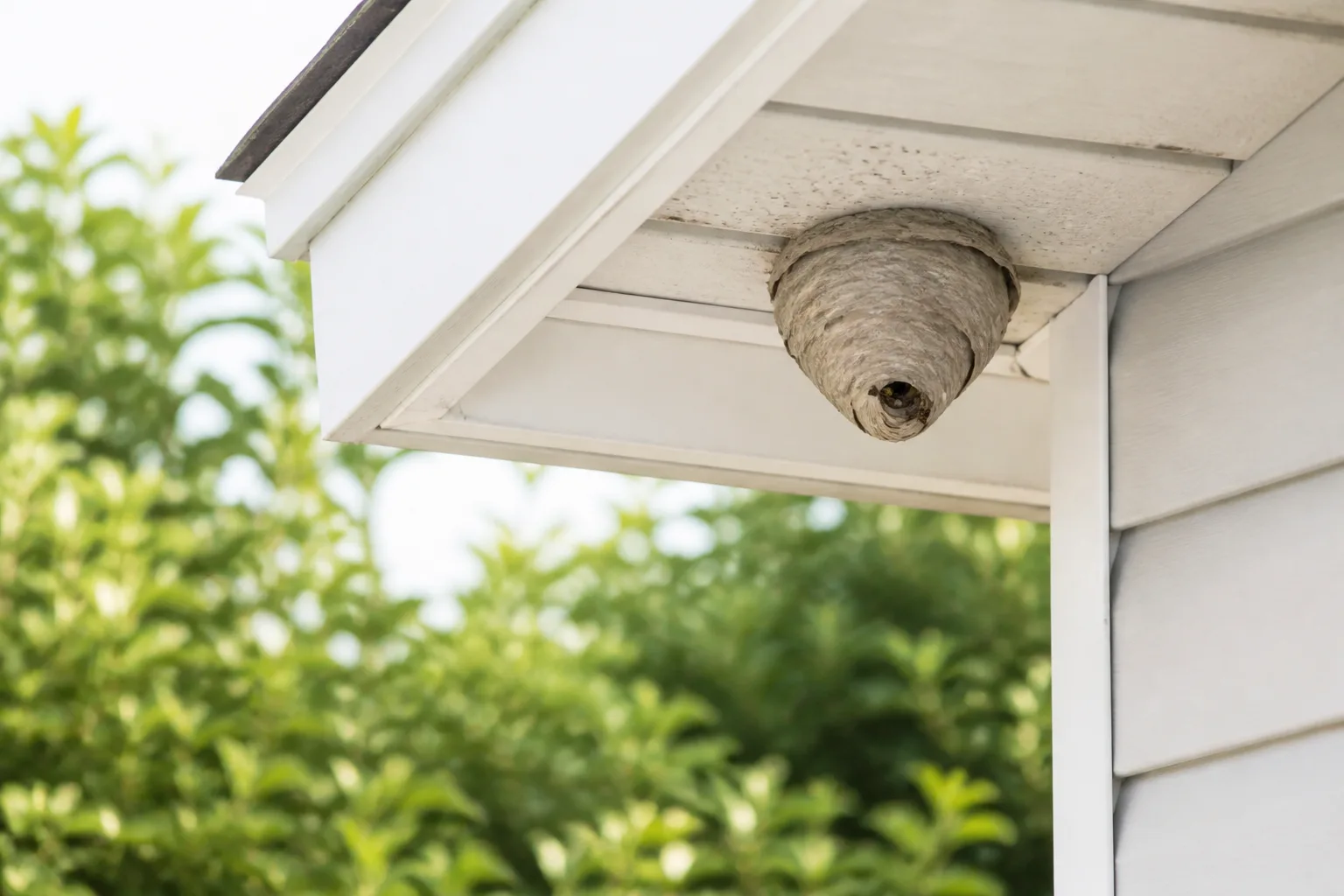
The safest way to remove a wasp nest is to identify the insect and its nest location first, then match the response to the risk. A small, exposed paper-wasp nest under an eave is a different job from a yellowjacket colony in the ground, a basketball-sized aerial nest, or wasps entering from a wall void.
Do not start by spraying, knocking, flooding, or plugging the entrance. Watch the nest from a distance, keep people and pets away, and decide whether the colony can be left alone, requires a professional, or is a genuinely small and accessible DIY job. That pause is the step most likely to prevent a sting.
Decide whether the nest needs removing
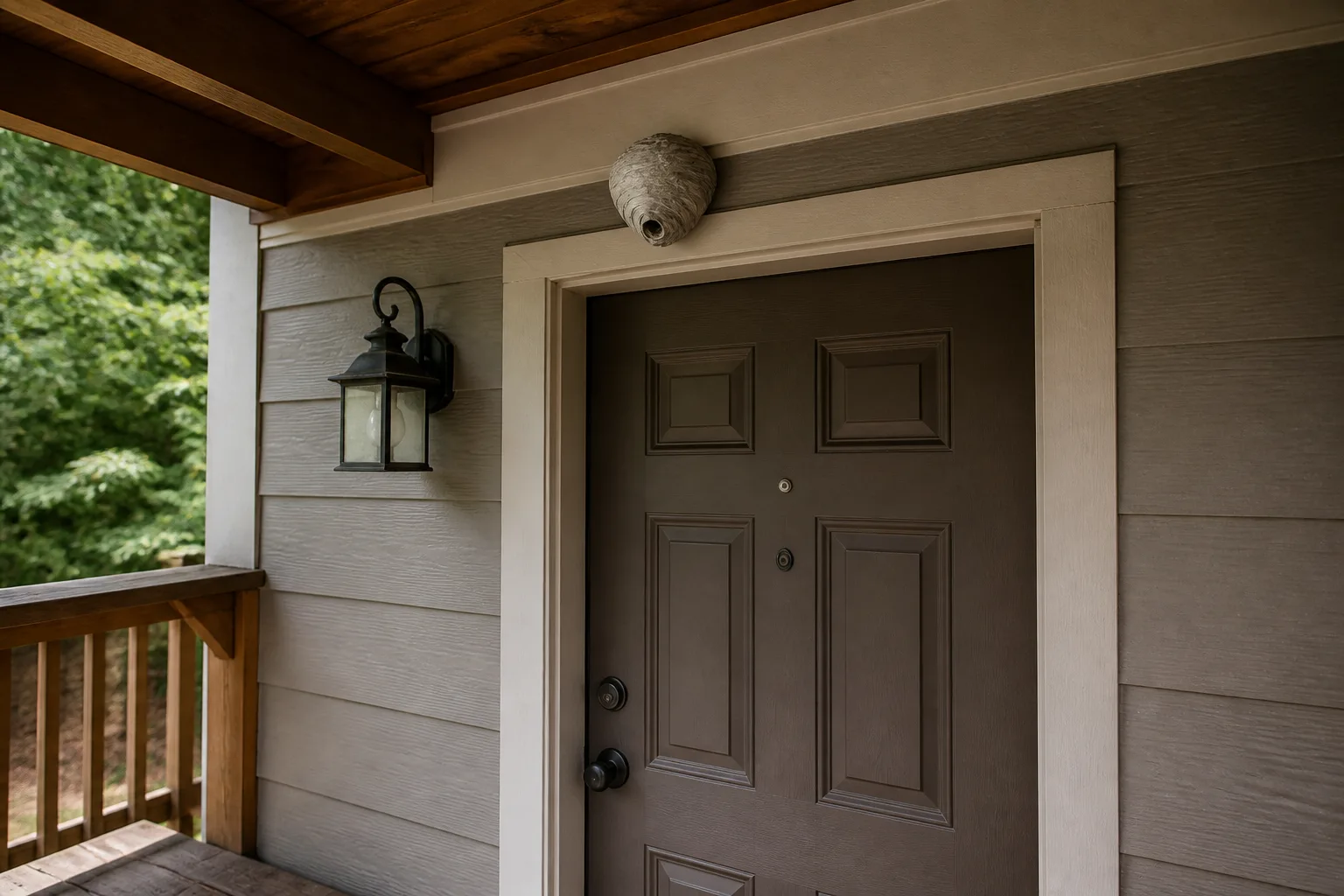
Wasps are not automatically a problem just because they are in the garden. Many species pollinate flowers, hunt caterpillars and aphids, or clean up other insects. A nest at the far end of a property may be providing useful pest control with little contact, while the same nest beside a door, play area, outdoor dining space, or frequently used path creates a predictable sting hazard.
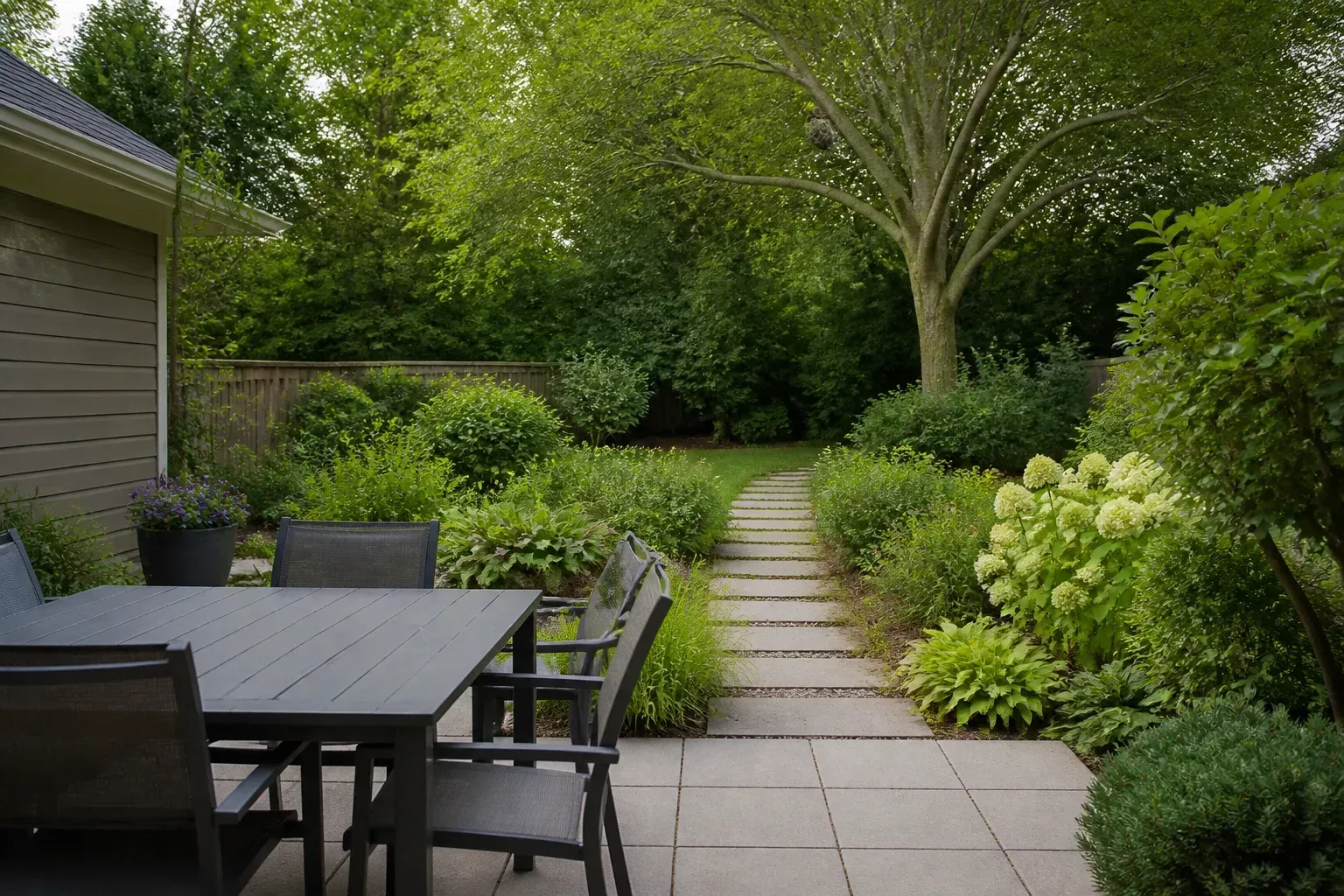
Start with three questions: Where is the nest? How much traffic passes beside it? How quickly must that area be used? A quiet nest high in a tree may be tolerable. A nest under the only porch light or inside a shed that children enter is not. Penn State Extension recommends weighing the nest’s size and location against the risk and benefits of leaving the colony in place rather than treating every nest as an emergency (Penn State Extension’s stinging-insect management guide).
Timing matters, too. Social wasp colonies usually begin with a queen in spring, grow through summer, and decline when the season ends; fertilized queens overwinter to start new colonies. A nest found late in the season may be approaching its natural decline, but “wait for winter” is only sensible when you can keep everyone safely away. A nest beside a doorway, in a classroom garden, or near a path used every day may need professional treatment sooner.
Identify the insect and nest first
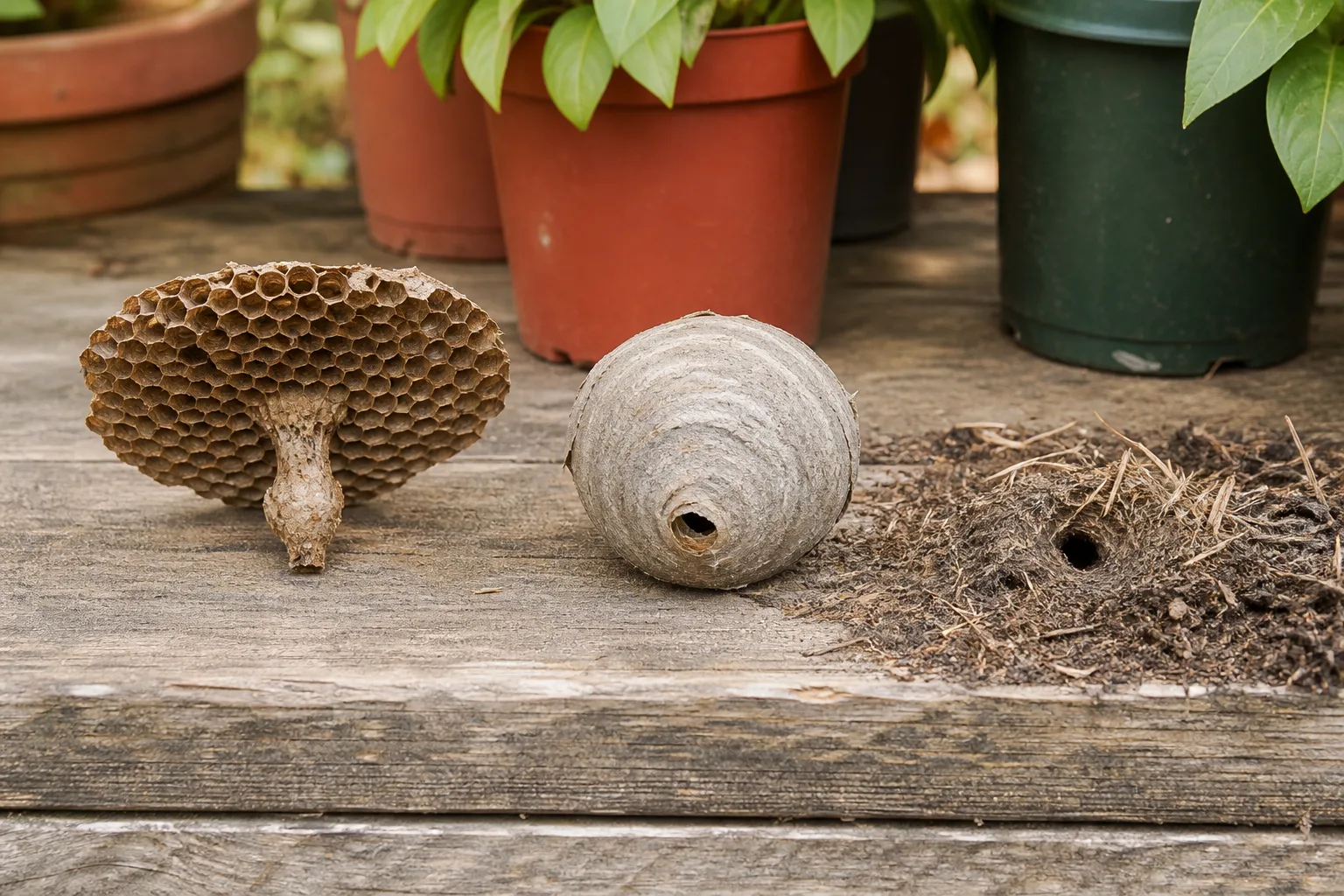
A photograph taken from a safe distance can help, but do not stand under a nest to get a better one. Look at the nest shape, the insects’ body shape and color, the entrance pattern, and whether workers disappear into the ground, a hole, or a paper envelope. Identification does not need to be perfect for a professional to help, but it does need to be good enough to avoid spraying a bee colony or approaching a defensive yellowjacket nest as if it were a harmless mud tube.
Paper wasp: open comb under cover
Paper wasps build a small, papery comb with the cells exposed. It often looks like an upside-down umbrella or a single open-faced fan under an eave, porch ceiling, deck rail, shed roof, or protected branch. The adults are relatively slender, often brown or reddish with yellow markings, and their long legs may hang below them in flight.
An open comb does not mean the nest is harmless. Paper wasps defend the nest when it is disturbed, and a colony can become harder to approach as it grows. It does mean the structure is visibly exposed, which is one of the factors that may make a small nest manageable for an experienced adult on the ground after a careful risk check.
Yellowjacket or bald-faced hornet: defensive social colony
Yellowjackets are usually shiny and compact, with yellow-and-black markings and little visible hair. Depending on the species, they nest in old rodent burrows, landscape holes, wall voids, attics, sheds, or other cavities. The entrance may be nothing more than a small hole with steady traffic, so a “tiny nest” at the surface can conceal a much larger colony.
Bald-faced hornets are a type of aerial yellowjacket, despite the common name. Their nests are enclosed in a gray, layered paper envelope and often hang from a tree, shrub, eave, or structure. The insects have black bodies with pale markings on the face, and the colony can defend the envelope aggressively. Utah State University Extension describes yellowjackets as social, seasonal, and capable of nesting in burrows, holes, and structural voids; it also specifically warns against plugging nest entrances (Utah State University Extension’s western yellowjacket profile).
Bee or solitary wasp: do not spray by mistake
Honey bees and bumblebees are generally hairier and rounder than wasps. Bumblebees may nest in abandoned rodent burrows, under sheds, in long grass, or in other cavities. Honey bees can occupy wall spaces, chimneys, attics, and tree cavities, where the colony and stored honey create a different removal and repair problem.
Solitary wasps and mud daubers are another common source of mistaken identity. Mud tubes or small individual cells made from mud do not indicate the large, cooperative colony that makes a social-wasp nest dangerous. Solitary wasps rarely defend a nest as a group, but that does not make every insect around a hole safe to handle. If the insect looks fuzzy, the nest is made of mud, or the identification is uncertain, leave it alone and ask a local extension service or pest professional for identification.
The University of Minnesota Extension explains why wasps deserve a measured response: many species prey on garden pests and contribute to pollination, while the social species become defensive near their nest (University of Minnesota Extension’s wasp overview). That balance is useful in practice: remove a dangerous colony when the site demands it, but do not treat every flower visitor or solitary nest as a target.
Mark the nest’s risk level
Use the following quick screen before you choose a method:
| Situation | Safer decision |
|---|---|
| Known sting allergy, previous anaphylaxis, or no one on site can respond to an emergency | Do not attempt DIY removal; use a professional and follow your medical plan. |
| Nest is in a wall, attic, roof, crawlspace, chimney, utility area, or inside a building | Call a professional; treatment and physical removal may require access and repairs. |
| Nest requires a ladder, roof access, climbing, or reaching over your head | Call a professional; height and stings create two hazards at once. |
| Large enclosed nest, steady heavy traffic, or aggressive insects | Call a professional and keep the area closed. |
| Small, exposed, clearly identified paper-wasp comb reachable from the ground | A careful DIY assessment may be reasonable for a healthy, prepared adult. |
| Nest is distant and the area can be cordoned off until cold weather | Leaving it alone may be the lowest-risk and most wildlife-friendly option. |
This is a decision guide, not a guarantee that any nest is safe. Protective clothing reduces exposed skin but is not sting-proof, and no home treatment removes the possibility of an agitated colony flying toward you. If the insects begin circling, hit your face, or leave the nest in numbers, stop and retreat without swatting.
Choose the removal route
There are three legitimate routes: tolerate and isolate, use a professional, or handle a small exposed nest with a label-directed treatment. The right choice depends more on access, species, and consequences than on whether a product or homemade recipe is available.
When to call a professional
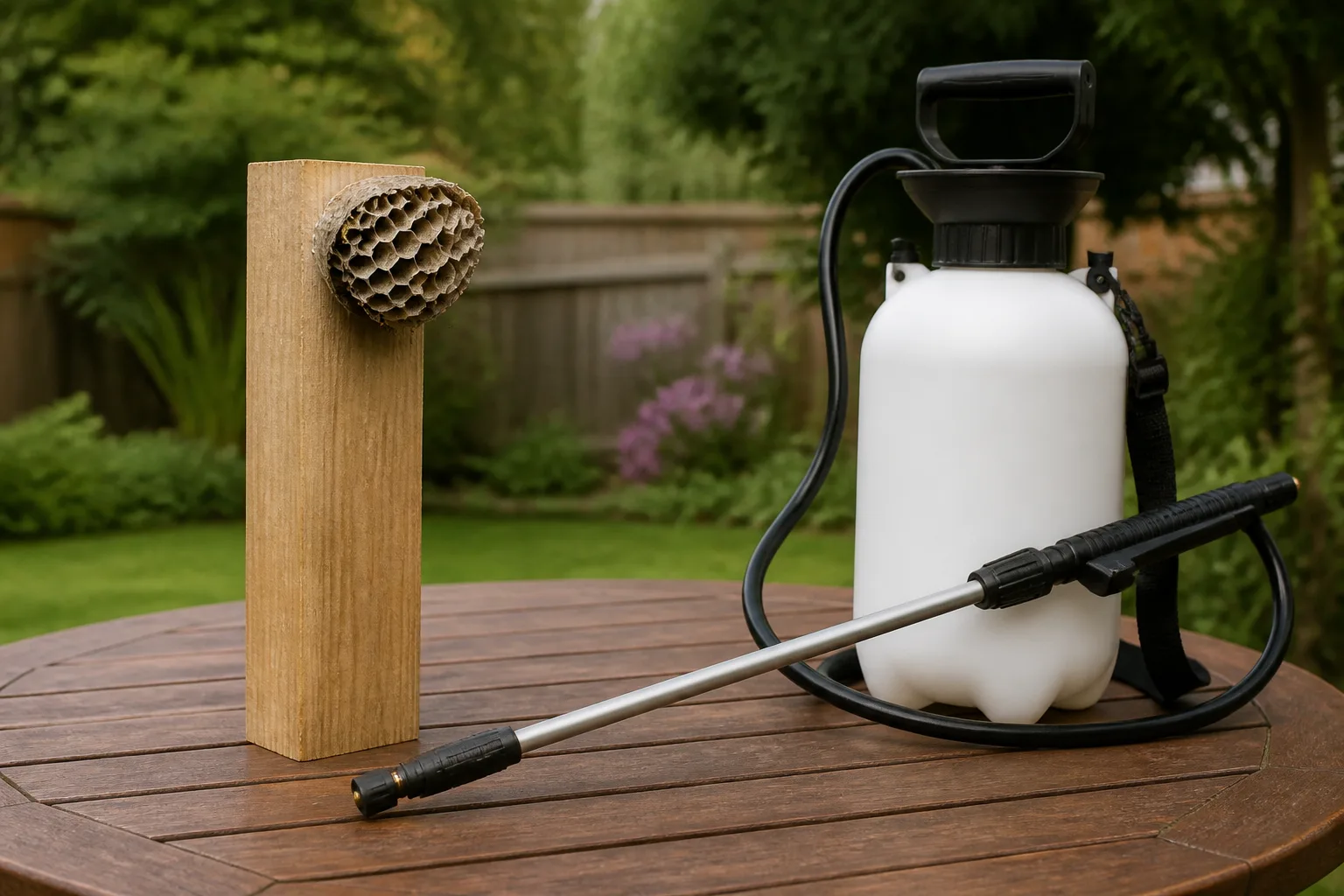
Call a licensed pest professional when the nest is underground, hidden, large, enclosed, high, attached to a building, or close to a place people cannot avoid. Also call when you cannot identify the insect, when the nest has already reacted defensively, or when anyone nearby is highly allergic to stings. If the nest is in a wall or roof, ask whether the service includes locating the colony, treating it without driving insects indoors, removing the remains, and repairing the entry point.
Professionals bring equipment, insurance, and experience with the nest types most likely to cause multiple stings. Ask what product class will be used, where it will be applied, how long people and pets must stay away, and whether the treatment will affect flowering plants, edible crops, ponds, or other beneficial insects. A lower-cost service that leaves a colony or contaminated nest material behind may not be the better value.
When a small exposed nest may be a DIY job
DIY removal is limited to a small, exposed, clearly identified nest that can be reached from the ground without a ladder, preferably early in the colony cycle. You should have a clear retreat path, no children or pets outdoors, no one with a sting allergy participating, and protective clothing that covers the body without trapping loose fabric against the skin.
Do not turn a small nest into a DIY job simply because it is on your property. A small gray envelope can be an early aerial yellowjacket nest; a small entrance hole can lead to an underground colony; and a nest beside a light fixture can bring disturbed wasps toward your face. If any part of the assessment feels uncertain, the professional route is the correct one.
Plan a low-risk treatment window
Observe the nest during daylight from roughly 10 to 15 feet away, staying out of the main flight path. Identify where workers leave and return, where you will stand, and where you will retreat. Do not stand directly below the nest, block the entrance, or place a bright light behind your own head.
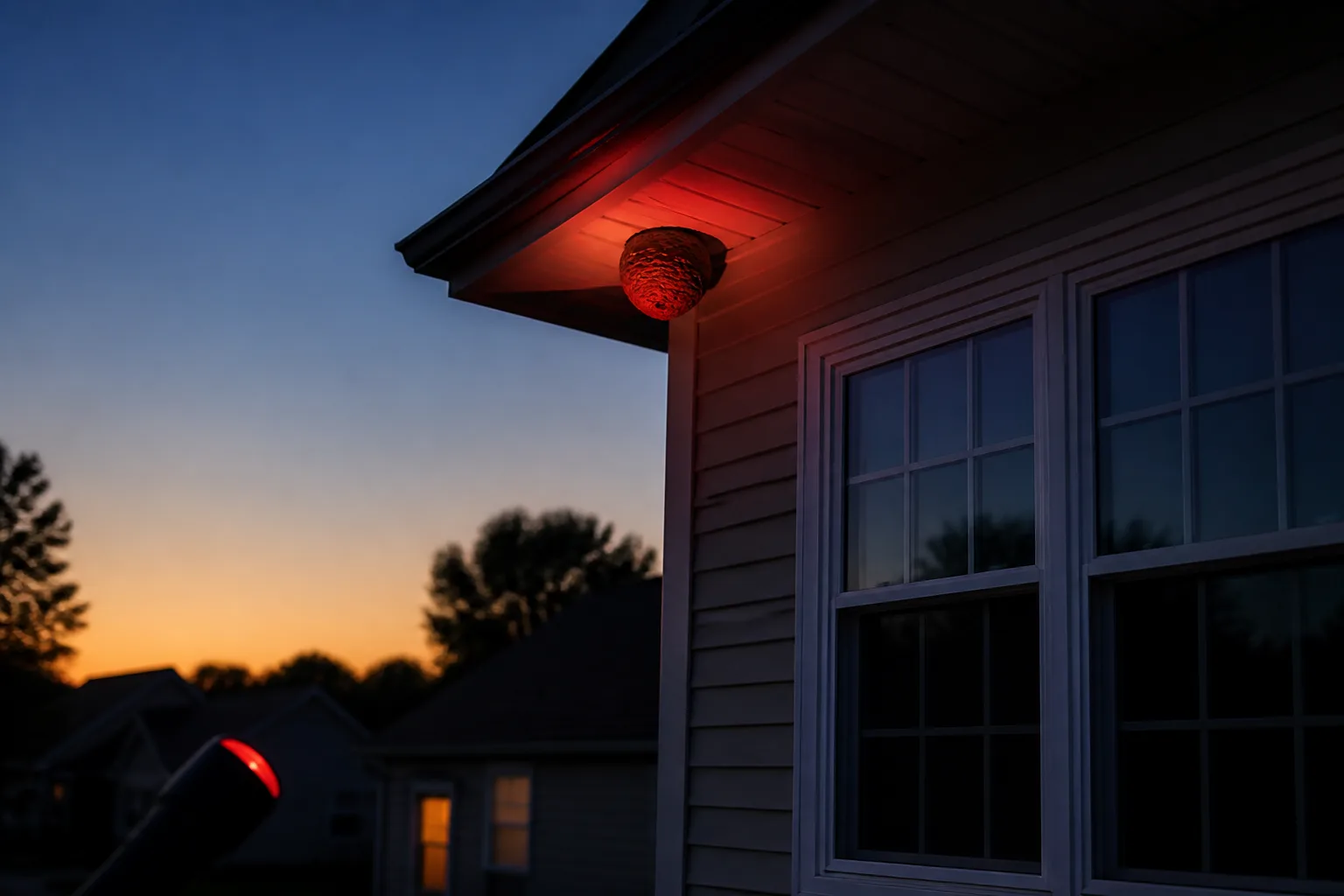
Plan the work for nighttime, when social wasps are less active and less able to see. Choose a calm period with no rain or strong wind if a label-directed spray is being considered. Keep windows and doors closed, turn off nearby outdoor lights, bring pets inside, and make sure another adult knows where you are. The person not doing the work should stay indoors rather than watch from the yard.
Penn State’s entomology guidance recommends planning in daylight and treating at night, while keeping the normal flight path and the treatment light away from your body. It also suggests a red light or red filter because many stinging insects have difficulty seeing red; the light still needs to illuminate your work without drawing flying insects toward you (Penn State’s guidance on timing and protective behavior).
Have an escape route that does not pass a fence, wall, pool, or locked gate. If wasps emerge, walk calmly and quickly away from the nest; do not wave your arms or swat. If you are stung, leave the treatment area first, wash the sting site, and do not return to finish the job.
Gather protective gear and tools
For any DIY attempt, wear thick, loose-fitting layers that cover the arms and legs, long socks with pant cuffs secured outside or inside as appropriate, closed shoes, gloves, and eye protection. A properly fitted veil or face protection is preferable to relying on sunglasses or a hood. Avoid perfume, bright floral prints, and loose openings where an insect could enter.
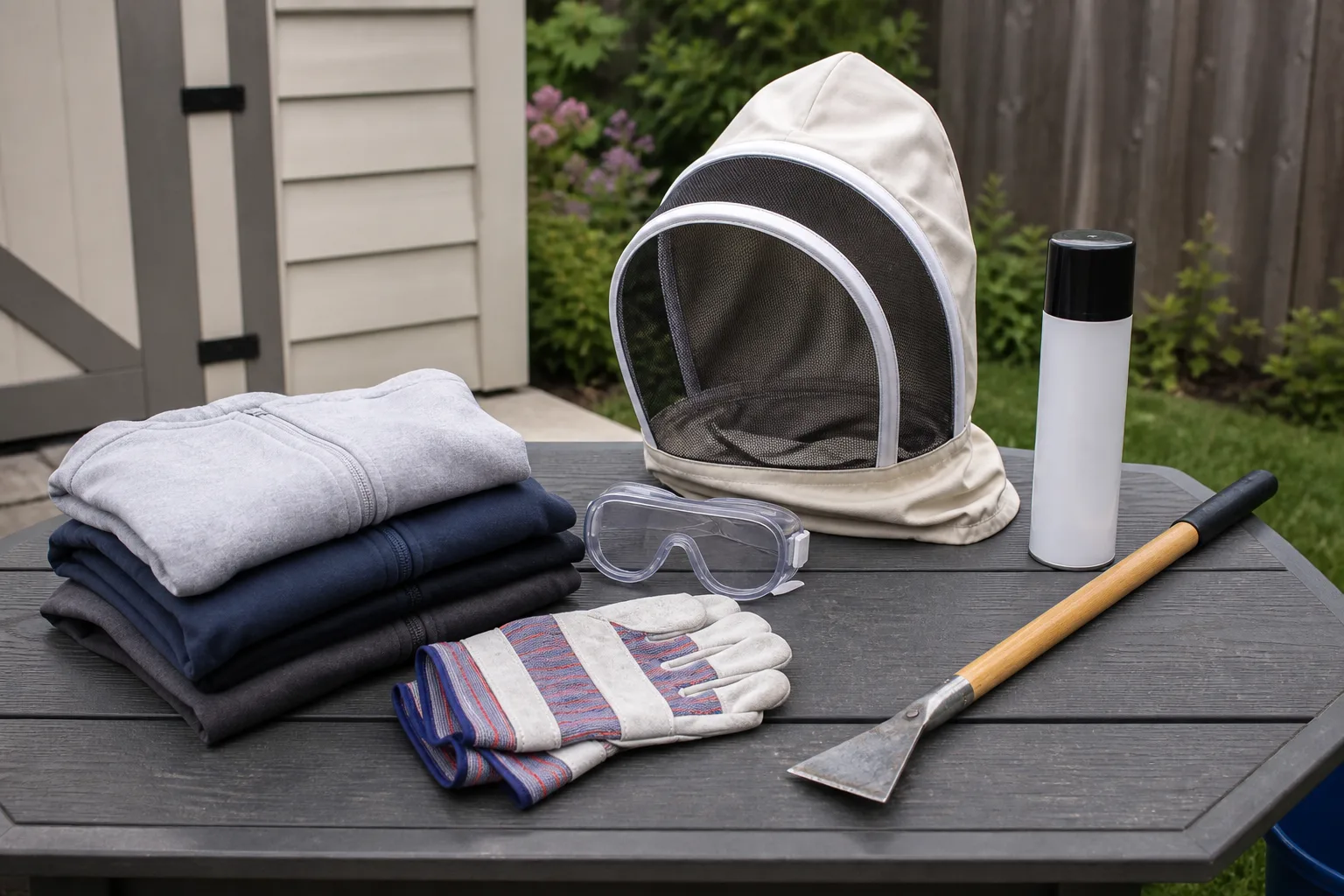
Use a long-handled scraper, broom, or similar tool only if the nest can be reached without climbing or leaning into it. Have a heavy bag or lidded container ready for the inactive nest, soap and water for cleaning a sting, and a phone within reach but not in your hand during the treatment. Do not improvise a torch, gasoline, kerosene, fire, or a sealed container that could burst.
If you use an insecticide, select a product whose current label lists the insect and the application site, and follow the label for protective equipment, spray distance, weather, application amount, and re-entry. Never combine products or add dish soap, essential oil, vinegar, boiling water, or another household ingredient to a pesticide. The label is the legal and safety instruction for that product, not a suggestion to make stronger.
Remove a small exposed nest
This method is only for the small, exposed, ground-accessible nest described above. Penn State Extension’s practical sequence is to treat a small exposed nest at night with a ready-to-use product labeled for wasps, then knock down and destroy the nest after the insecticide has dried. The exact product and wait time vary, so the label controls; do not copy a time interval from another can (Penn State’s small-exposed-nest guidance).
- Set the perimeter. Bring everyone indoors, close nearby doors and windows, keep the route clear, and position yourself away from the nest’s flight line.
- Dress and check the route. Secure cuffs, put on face and eye protection, and make sure you can leave without stepping backward or passing through vegetation where insects may hide.
- Apply only as the label directs. For an exposed nest, hold the container at the label’s stated distance and target the nest and entrance without standing underneath it. Do not spray flowers, open water, food surfaces, or people’s belongings unless the product label explicitly permits that site.
- Retreat and wait. Leave the area immediately after treatment and observe from indoors or from a safe distance. Do not approach because the nest looks wet, quiet, or partly detached.
- Confirm before removal. At the label’s specified re-entry time, check from a distance for returning or emerging workers. If activity continues, stop and call a professional rather than adding repeated applications at close range.
- Remove the dry, inactive structure. Only when the nest is confirmed inactive and the product is dry, use a long-handled tool to knock it into a bag or container. Seal it, dispose of it according to the product label and local waste rules, and wash the tool and gloves as directed.
Do not stomp a fallen nest with your boot or pick it up to check whether it is dead. A nest can contain pupae that emerge later, and a few surviving workers can defend it. Keeping your hands and face away is safer than trying to make removal feel instant.
Treat an underground nest
Treat an underground nest as a yellowjacket problem until an expert says otherwise. The entrance may be a small hole in lawn, mulch, a bank, a bed, or beside a foundation, but the colony is below ground and can contain many workers. Mowing, edging, digging, pouring liquid into the opening, or placing a rock over it can trigger a defensive response.
Do not flood an underground nest with boiling water, vinegar, or a soap mixture. These liquids may fail to reach the colony, can injure nearby plants and soil organisms, and force you to stand close to an entrance where defenders may emerge. A soap solution may affect an individual insect it directly wets; that is not the same as safely eliminating an established underground colony.
Utah State University Extension lists label-directed insecticidal dust applied at night and professional management among options for western yellowjackets, while warning that even vacuum approaches can be dangerous if done incorrectly (Utah State’s yellowjacket IPM recommendations). For a homeowner, the practical boundary is simple: if you are not trained and equipped to treat the entrance from a safe position with a product labeled for that use, outsource the job.
After treatment, keep people and pets away until the label allows re-entry and activity has stopped. Do not seal or dig up the entrance while wasps are still active. If the nest is beside a play area, path, septic cover, irrigation box, or foundation, tell the professional exactly what surrounds it so the treatment can be planned around those hazards.
Handle nests in walls, roofs, and voids
Wasps entering a building require more than killing the insects visible at a window. The nest may be inside a wall, attic, soffit, chimney, crawlspace, or roof cavity, and a second entrance may lead directly into the living space. Spraying the outside hole and immediately sealing it can trap or redirect surviving wasps into the house.
Keep people out of the room or area where insects are appearing, close interior doors, and call a professional. Do not cut into drywall, remove soffit panels, drill into a wall, or inject a household chemical into a cavity. Water-based foams and liquid products can damage wood, insulation, wiring, or drywall; even a dry dust can leave a contaminated nest and dead insects behind.
When you schedule service, ask how the technician will locate the nest and protect indoor air, food-preparation surfaces, pets, and ventilation systems. Once the colony is inactive, physical removal of the nest and dead insects may matter because remains can attract scavengers, create odor or staining, or expose a gap in insulation. Repair and seal the entry only after the colony is dealt with and the structure is ready for repair.
Honey bees in a cavity should not be treated as an ordinary wasp job. A beekeeper or bee-removal specialist may need to remove comb and honey as well as the living colony; leaving those materials inside a wall can lead to moisture damage and odor. If you see fuzzy bees rather than wasps, pause and request an identification before any pesticide is used.
What not to do
Several popular shortcuts create more risk than control:
- Do not plug a nest entrance while it is active. Yellowjackets may find another exit, including into a room or under a roofline.
- Do not use fire, gasoline, kerosene, or a homemade flame treatment. Fire can spread through dry vegetation or structures, and fuel adds toxic exposure and property risk.
- Do not climb a ladder with a spray can. A fall and a sting can happen together, and a nest under a soffit is often harder to retreat from than it appears.
- Do not rely on vinegar, peppermint oil, boiling water, or dish soap as a colony treatment. Direct-contact effects and repellency anecdotes do not establish that a method will reach the queen, larvae, or workers in a protected nest.
- Do not treat a trap as a nest solution. A bait trap may reduce some foraging workers, but it will not reliably eliminate a colony in a wall or underground.
- Do not spray flowering plants to repel wasps. Wasps and other pollinators visit flowers for food, and a broad spray can harm non-target insects.
- Do not hang a paper-bag decoy and assume the site is protected. Territorial behavior is not a dependable barrier; Penn State Extension notes that there is no clear evidence that decoy nests prevent paper wasps or yellowjackets from nesting nearby (Penn State’s decoy-nest discussion).
Confirm the colony is inactive and remove remains
The job is not finished when visible wasps stop flying. Check from a distance at the time the product label allows, then again later in daylight. Look for workers entering or leaving, insects emerging from comb, or traffic returning to a removed attachment point. If you see any activity, keep the area closed and call a professional; do not lean in for a closer look.
For an exposed nest that is confirmed inactive, wait for the product to dry and use a long-handled tool to detach it without touching the paper or comb. Bag the material, follow the label for disposal, and wash exposed clothing and equipment according to the label. Do not compost a pesticide-treated nest or place it beside a vegetable bed unless the product instructions and local rules specifically allow that disposal route.
If someone is stung, move away from the nest before giving first aid. Wash the area with soap and water and use a cold compress for local discomfort. Seek emergency help for trouble breathing or swallowing, swelling of the lips, tongue, face, or throat, widespread hives, dizziness, or a rapidly worsening reaction. Multiple stings can be especially serious for children, older adults, and people with heart or breathing problems; the University of Illinois’ bee-and-wasp safety guidance recommends prompt medical attention when illness follows multiple stings (University of Illinois bee-and-wasp safety guidance).
Reduce wasp pressure afterward
Prevention is mostly about removing food and shelter where people gather, not eliminating every wasp from the landscape. Keep outdoor bins tightly closed and clean, wipe up sugary drinks and meat juices, pick up fallen fruit, cover pet food, and rinse sticky residue from picnic tables. In late summer and fall, yellowjackets often shift from feeding nest larvae to scavenging sweet drinks, ripe fruit, meat, and trash, which explains why a yard can suddenly feel busier even when the nest has not moved.
Gardening Know How recommends starting porch and patio prevention in spring, when queens are choosing protected sites, and combines sanitation with checking eaves, sheds, and hidden corners (Gardening Know How’s spring wasp-proofing advice). Do a visual inspection from the ground in early spring, but never poke into a suspected nest or lift cushions, tarps, stacked boards, or garden furniture with bare hands.
Keep a buffer between heavily flowering plants and the exact places where people sit or walk, but do not remove a healthy pollinator garden simply because wasps visit it. Prune vegetation that blocks visibility around paths, repair dripping hose fittings, cover food at outdoor meals, and keep water sources from pooling beside doors. These changes reduce encounters without asking the garden to be insect-free.
The most useful prevention step is early observation. BBC Gardeners’ World Magazine notes that social wasp colonies are annual and that workers become more noticeable in late summer as their food sources and colony duties change; it also recommends considering whether a late-season nest can be tolerated for a short remaining period (BBC Gardeners’ World’s wasp guide). Savvy Gardening likewise points out that paper-wasp colonies are abandoned at the end of the season and suggests cordoning off a nest when it can be safely avoided (Savvy Gardening’s paper-wasp overview). Use those observations as timing context, not as permission to ignore a nest that people cannot avoid.
Conclusion
To remove a wasp nest safely, first identify the insect and determine whether the nest is exposed, underground, or hidden in a structure. Leave a distant nest alone when you can isolate it; call a professional for allergies, ladders, large or defensive colonies, underground entrances, and wall or roof voids. Only consider DIY treatment for a small, clearly identified nest that is exposed and reachable from the ground.
If you proceed, work at night, cover your skin and eyes, keep an escape route open, use only a product labeled for the insect and site, and wait for the label’s re-entry instructions before confirming inactivity and removing the remains. Skip fire, plugged entrances, boiling water, vinegar, essential-oil recipes, and casual soap sprays: they can fail to reach a colony while putting you close to the insects. Then close food and waste sources, inspect likely nesting sites early next season, and preserve the wasps that can safely do their work away from people.