How to Plant and Grow Yellow Flag Iris
Learn how to grow yellow flag iris, check local invasive rules, plant it in wet soil, limit seeds and rhizomes, and choose safer pond-edge alternatives.
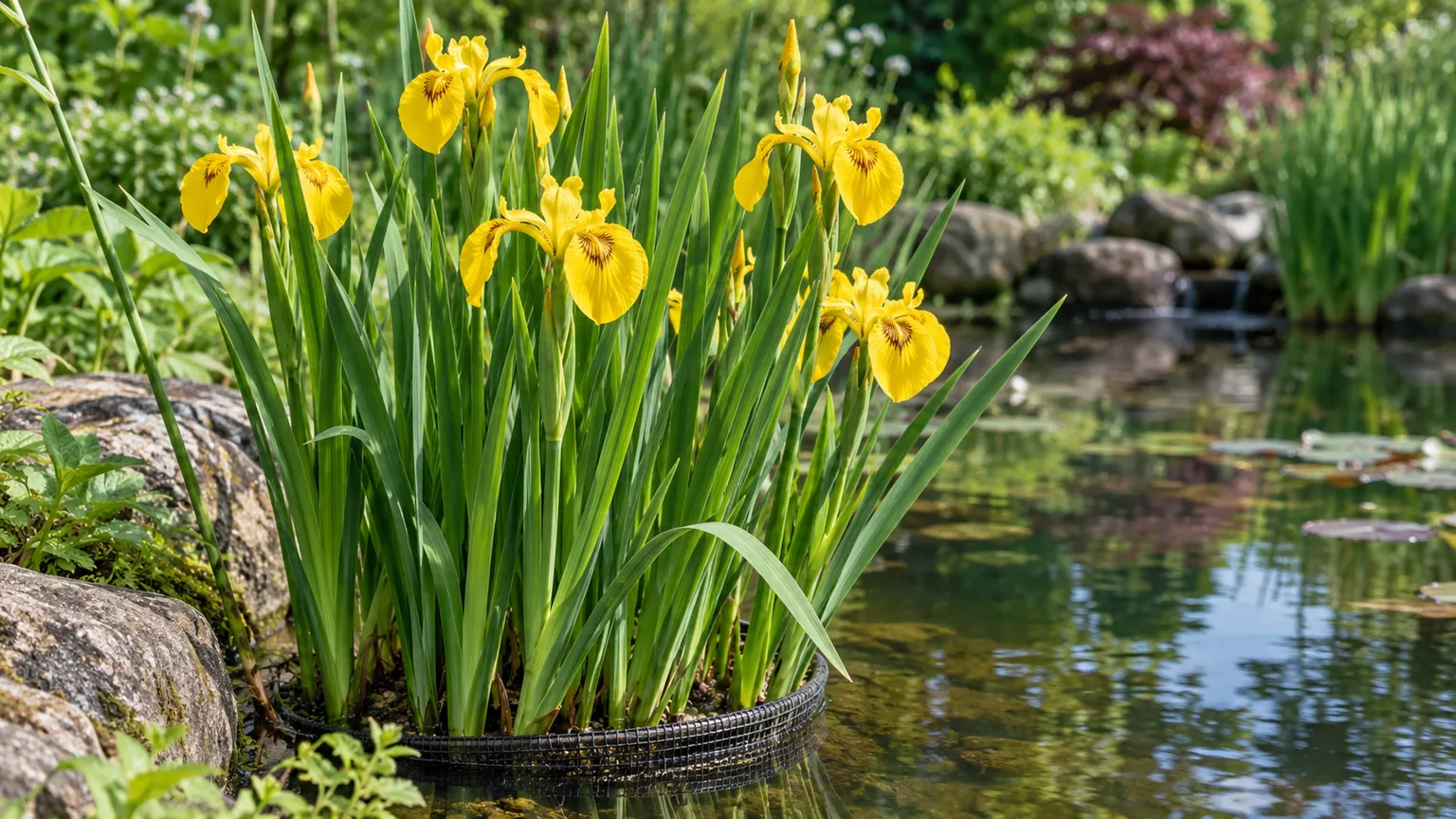
Yellow flag iris (Iris pseudacorus) is a bold, yellow-flowering perennial for wet ground and shallow pond margins. It is also a vigorous plant that can escape gardens: it spreads underground through thick rhizomes and produces buoyant seeds that water can carry to new shorelines. Before you buy or divide one, check the current rules where you live and the path water takes from your site. In many North American regions, a locally native wetland plant is the safer choice.
If local guidance permits cultivation, the basic recipe is simple: give it sun to partial sun, consistently moist soil or shallow water, and room for a substantial clump. The more important job is containment. Plant it only in a site you can monitor, cut off seed capsules before they mature, and use a removable aquatic basket where appropriate. A basket slows rhizome spread; it cannot stop seeds from leaving on water.
Before You Buy, Check Local Status and Water Risk
“Invasive” describes ecological behavior, while a “regulated” or “prohibited” designation has a specific legal meaning that depends on your jurisdiction. Yellow flag iris is native to parts of Europe, North Africa, and western Asia, and has naturalized widely in North America. Extension and government sources identify it as invasive or regulated in multiple places, but the rules are not uniform: Minnesota, for example, classifies it as a regulated invasive plant, while Oregon includes it on its state noxious-weed list. Those labels do not mean the same thing as a universal ban. Check the current state or provincial invasive-plant list, county weed board, and water-management authority before buying, selling, transporting, planting, or propagating it. NC State Extension and the Minnesota Department of Natural Resources document local status and identification; the Oregon Department of Agriculture lists its noxious-weed designation.
Treat any site connected to a stream, lake, ditch, floodplain, stormwater channel, or wetland as a high escape risk. High water can move floating seed capsules and pieces of rhizome beyond a property line. In Minnesota, yellow iris may not be introduced into a free-living state, and the state advises against using it on public-water shorelines; in Oregon, its noxious-weed status and applicable quarantine rules should be checked before handling it. If a local agency advises against planting it, follow that advice even if a nursery sells it elsewhere.
A genuinely isolated, lined ornamental pond is lower risk than a natural shoreline, but “contained” still takes work. Flooding, drainage outlets, wildlife movement, discarded plant material, and overlooked seed pods can all defeat the idea that a backyard planting is sealed off. If you cannot inspect it regularly or manage all plant waste responsibly, choose a native marginal species instead.
Identify Yellow Flag Iris Reliably
The botanical name Iris pseudacorus is the clearest way to confirm what a label means by yellow flag, yellow flag iris, yellow water iris, or water flag. Mature plants generally make upright clumps of flat, sword-shaped leaves from a basal fan. Leaves can reach roughly 2 to 3 feet long, and a strong central rib can be noticeable. The plant commonly grows along wet shorelines, in shallow water, ditches, and saturated garden soil.
Flowers provide the most useful field clue. Each flower has three large, drooping outer sepals, often marked with brownish or purple veins, and three smaller upright petals; several yellow flowers may share a stalk. After flowering, the plant forms long, three-sided capsules filled with flattened seeds. When capsules mature, they can open and release seeds that float away, so flowering is also the time to plan seed control. Oregon State University Extension’s identification guide includes the flower, capsule, and rhizome clues.
Separate It From Blue Flag and Garden Irises
Blue flag irises (Iris versicolor and related native species) can look similar when they are not flowering, especially along northern shorelines. Blue flag has purple or blue flowers, while yellow flag has yellow blooms with marked drooping sepals; the Minnesota DNR cautions that the two can be difficult to distinguish from foliage alone. A yellow-flowered bearded iris in a dry garden bed may be a cultivated garden iris rather than a wetland yellow flag; bearded irises have a fuzzy “beard” on the falls and generally prefer well-drained ground. Do not remove an uncertain iris from a natural area based only on leaf shape—photograph it, note the habitat, and ask a local extension or weed-identification service to confirm it. Minnesota DNR’s look-alike notes help separate northern blue flag from yellow iris.
Yellow Flag Iris at a Glance
| Trait | Typical yellow flag iris |
|---|---|
| Botanical name | Iris pseudacorus |
| Type | Rhizomatous, herbaceous perennial; semi-aquatic |
| Native range | Europe, North Africa, and western Asia |
| Mature size | Commonly about 2–4 ft. tall; clumps can spread wider over time |
| Flowers | Yellow, often with brownish or purplish markings on drooping sepals |
| Bloom | Late spring into summer; timing varies by climate |
| Site | Full sun to partial sun; consistently moist soil or shallow water |
| Spread | Underground rhizomes and seed carried by water |
| Main caution | Invasive or regulated in some regions; toxic if eaten |
The plant is not a delicate pond accent that stays where its first crown is planted. It can form a broad, dense colony, and the size of a clump depends on time, water, and conditions. Plan for future removal or division before you place it, not after it has filled a pond margin.
Treat yellow flag iris as an ornamental plant, not an edible one. NC State Extension describes poisonous characteristics, and the ASPCA lists irises as toxic to dogs, cats, and horses, with the highest concentration in the rhizomes. Wear gloves when lifting or dividing it, wash after handling, and keep pets and livestock away from dug-up plants and clippings; if an animal eats any part, contact a veterinarian or animal poison-control service.
Choose a Site That Can Contain Its Spread
Yellow flag iris likes a sunny, wet location, but a pond is not essential. It can also grow in persistently moist soil, such as a bog garden or a damp border. A site that dries completely for long periods can reduce vigor and flowering, while the wettest locations support the strongest growth—exactly where a plant that escapes could have the most impact. The Royal Horticultural Society’s wet-soil iris guide describes pond edges and bog gardens as suitable settings and notes that I. pseudacorus is very vigorous.
Before planting, trace overflow and drainage. A shallow basin that drains into a natural waterbody, a low spot that floods in spring, or a pond with an overflow pipe is not meaningfully isolated. Even a raised bog bed can release plant fragments if its runoff reaches a ditch. If the site is connected to natural water or you cannot prevent seed and rhizome movement, skip yellow flag iris and select a native plant suited to the same depth and sun exposure.
Give an allowed planting enough room for mature leaves, access for deadheading, and a path to lift the basket or clump. Avoid planting in a narrow pond corner where every new rhizome will be difficult to reach. The best containment plan is one you can carry out without stepping into deep water, damaging a liner, or disturbing wildlife habitat.
Plant Yellow Flag Iris Only Where It Is Suitable and Legal
Buy a correctly labeled plant only after checking local restrictions. Do not collect plants from the wild, accept an unidentified division from a neighbor, or pass rhizomes to another gardener without confirming the species and local rules. Iris rhizomes can hide in a small clump and are easy to transport accidentally with soil.
Plant when the soil is workable and the plant is not under heat or drought stress. In mild climates that may include early spring or fall; in colder locations, spring gives a new planting more time to establish before winter. Local extension advice should override a generic calendar. Keep the rhizome roots damp during planting, and set it into a basket or moist ground so the crown is near the soil or water surface rather than buried deeply.
Planting at a Pond Edge
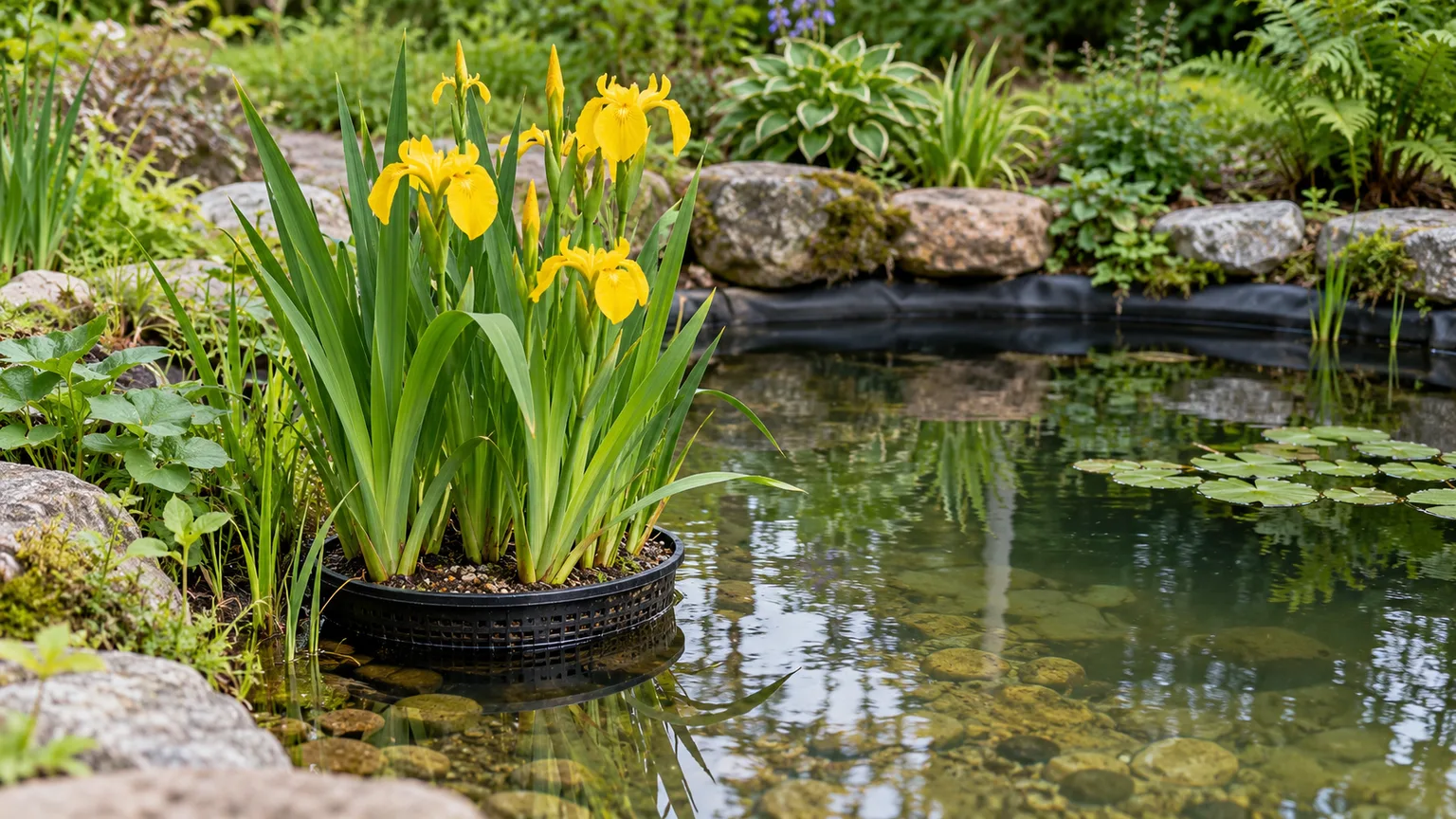
Use a sturdy, wide aquatic basket with drainage openings and aquatic soil, not ordinary garden soil that can cloud the pond. A practical Gardening Know How guide to water irises also recommends a wide container for types that spread aggressively, because a liftable basket makes inspection and control more practical. Set the rhizome horizontally with roots directed down and the growing crown at or just above the basket’s surface. Lower the basket so it sits in shallow water at the pond margin; published recommendations differ on exact depth, and local water conditions matter. Starting with the crown near the waterline is a cautious approach, then you can adjust the basket after observing growth.
Keep the basket accessible enough to lift for inspection, pruning, and division. A pond basket limits where rhizomes can travel, but rhizomes can grow through drainage openings or over the rim, and the basket does nothing to contain seeds. Do not place the container where floodwater can carry the seed pods away, and do not plant this species in public or natural waters unless local authorities explicitly allow it.
Planting in a Bog Bed
Choose a bed that stays moist through the growing season but drains enough to avoid becoming an uncontrolled runoff channel. Dig a hole wider than the root mass, spread the roots, and cover them with soil while keeping the crown at the same depth it was growing in the nursery pot. Water thoroughly to settle the soil, then keep the root zone evenly moist while the plant establishes.
A bog bed is easier to inspect than a submerged pond margin, but it does not stop lateral rhizomes by itself. If cultivation is permitted and the site is appropriate, place the plant in a large buried container or create a maintainable edge that lets you see and cut back rhizomes. Never assume a root barrier provides safe containment if the bed can flood or if mature capsules can reach moving water.
Light, Soil, Water, and Fertilizer
Light: Full sun usually produces the strongest flowering, but yellow flag iris tolerates partial sun. In a hot, dry climate, afternoon shade may reduce stress, though soil should remain consistently moist. Dense shade is more likely to produce leaves than a satisfying bloom display.
Soil: Moist loam or clay is suitable; a rich, wet pond margin supports more vigorous growth than ordinary garden soil. It can tolerate a range of soil conditions, so there is rarely a reason to amend pH or add specialty products. If soil drains quickly, choose a naturally wetter location rather than trying to keep a thirsty planting alive with constant irrigation.
Water: Keep newly planted roots from drying out. Established plants tolerate saturated soil and shallow water, but do not bury a new crown deep below the surface simply because the plant is called aquatic. Water depth and growth vary by site; baskets make it easier to raise a plant that is struggling in deep water.
Fertilizer: In an ordinary garden bed, compost worked into poor soil before planting is generally enough. Avoid routine fertilizer in a pond unless an aquatic-plant professional or local extension adviser recommends it for that specific system. Excess nutrients can feed algae and complicate water quality, while a vigorous iris rarely needs help making more leaves.
Seasonal Maintenance That Prevents Seed Spread
In spring, inspect the entire clump and its edge for seedlings or rhizomes beyond the basket. Remove unwanted seedlings while small, before they establish a new crown. Check that the crown has not sunk under sediment and that pond overflow still directs water where you expect.
During bloom, keep an eye on flowers and remove the stalks as soon as they fade if you do not want seed. Cut the stem down to the foliage with clean pruners and collect every piece. Deadheading prevents seed production; it does not slow underground rhizomes, so it is only one part of a containment plan.
In summer, lift or divide an overcrowded basket only if regulations allow cultivation and you can capture every rhizome fragment. Keep removed pieces out of the pond and away from drains. In fall, remove dying leaves if they would accumulate in the water or hide seed capsules, but do not cut healthy foliage early just to force a tidy look. The leaves continue to support the rhizome as the plant finishes its season.
Keep Seeds and Rhizomes From Escaping
Yellow flag iris has two separate spread routes, and each needs a different response. The thick rhizome mat expands the original clump and can regenerate from pieces left behind. Seed pods add a longer-distance route: they contain many flat seeds, and water can carry them to a new shoreline. Oregon State University Extension describes floating seed capsules and rapid rhizome spread; the U.S. Fish and Wildlife Service risk assessment also documents water dispersal and vegetative regeneration.
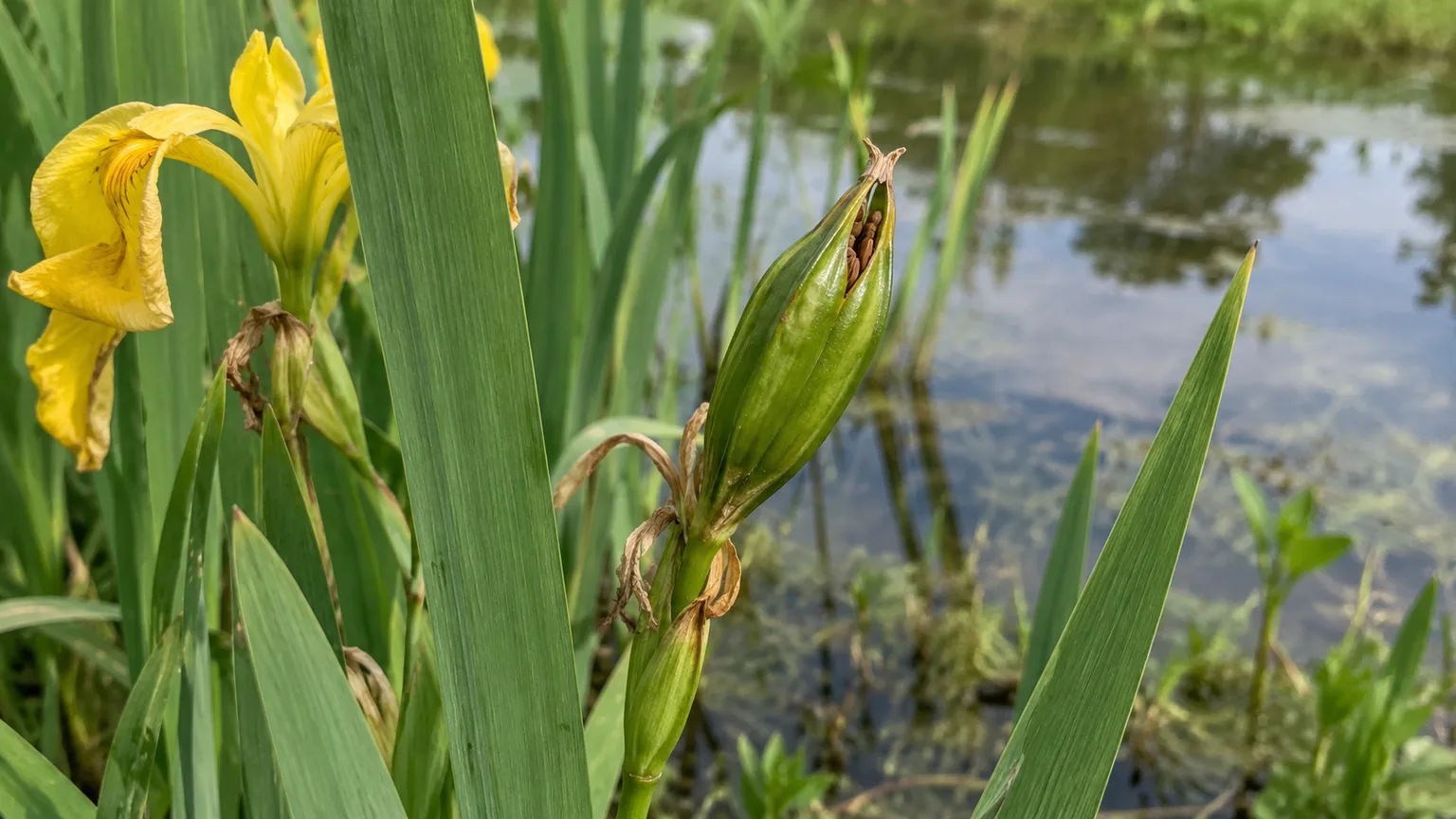
A practical monitoring routine is to inspect after flowering, after major rain or flooding, and at least once more before winter. Cut capsules before they brown and split; if any are already mature, bag them carefully rather than carrying them open across the garden. Look for new fans beyond the original planting and remove them with the full rhizome when the ground is soft enough to work.
Do not toss live rhizomes, seed capsules, or damp leaves into a stream, roadside ditch, open compost pile, or community green-waste bin unless the facility explicitly accepts invasive aquatic plants. Bag and dispose of material according to your local weed authority or waste provider. Clean soil and rhizome fragments from tools, boots, and basket surfaces before moving to another pond or wetland site.
Divide or Propagate Only When Local Rules Allow
Division is the quickest way to create more plants, which is also why it is the wrong choice in a place where yellow flag iris is prohibited or discouraged. Never divide a restricted plant for friends or move a clump to a creek, drainage pond, or public shoreline. If you are uncertain whether the plant is permitted, do not propagate it until the local weed board or extension service confirms what is allowed.
Where cultivation is allowed, divide a crowded clump after flowering or during a locally recommended mild-weather window. Lift the basket or clump carefully, rinse or shake away enough soil to see the rhizomes, and separate only healthy sections with attached roots and a growing fan. Replant the divisions immediately at the same depth and keep them moist while they establish. Collect every small fragment from the work area and dispose of it as directed; a scrap left in wet soil can restart a plant.
Growing from seed is not a good home-garden propagation method for this species. It creates many seedlings, makes containment harder, and may create legal or ecological problems. If your purpose is simply to add yellow flowers to a wet bed, select a locally appropriate native species rather than raising yellow flag iris from seed.
Grow Yellow Flag Iris in a Container
A large aquatic basket or rigid pot can make maintenance more manageable in a private ornamental pond, especially because you can lift it to divide or remove the plant. Use a wide, stable container with drainage openings and aquatic planting medium, then place it at the shallow margin where the plant receives ample light. Inspect the sides and bottom regularly for rhizomes that have escaped through openings or grown over the rim.
Container culture is not ecological containment on its own. Seeds still escape from flower stalks, and a connected pond can transport them farther than you can see. A floating basket is especially vulnerable to shifting, overflow, or storm movement. If your pond connects to public water or the species is not allowed locally, do not rely on a pot to make planting acceptable; choose another plant.
Troubleshoot Weak Growth, Yellow Leaves, or Poor Flowering
Yellow flag iris is tough, so a problem usually points to one of four things: the plant is too dry, it is shaded, the crown has been buried or crowded, or the plant is entering seasonal dieback. Check the water and soil first, then examine the whole clump before adding fertilizer or moving it. A few older leaves turning yellow at the end of the season are different from widespread yellowing during active growth.
Read the Whole Plant Before Changing Care
If leaves are pale and growth is weak during warm weather, feel the soil several inches below the surface. Dry soil suggests the plant needs more consistent moisture; saturated soil is normal for this iris, so do not respond by letting the roots dry. If a basket smells foul, lift it when safe and inspect the crown and accumulated plant debris; if leaves are yellow mostly on the shaded side and the plant produces few blooms, more sun may help—but do not move it closer to natural water just to gain light.
If the plant grows many leaves but few flowers, consider crowding, deep shade, or overfeeding. Lift and divide only where allowed, and do not use high-nitrogen fertilizer as a quick fix. A large, old clump may need to be thinned, but where spread risk is high the better solution may be complete removal and replacement with native plants.
Brown leaf tips can follow drought, winter damage, or physical injury, and are not by themselves proof of a pest. Inspect the leaves for feeding holes or larvae before using any treatment. Remove only dead or badly damaged tissue with clean tools, and avoid applying pesticide or herbicide to a pond without a site-specific, label-compliant recommendation.
Remove Established Yellow Flag Iris Safely
For a small clump in a garden bed that is not connected to a natural waterbody, carefully digging out the entire rhizome system may work. Wear gloves, use a digging fork to loosen soil around the plant, and lift from below rather than chopping through the rhizomes. Remove all visible fragments, screen the loosened soil, and revisit the site as new shoots appear; repeat visits are often needed because a missed piece can regrow.
On a pond edge, stream, wetland, or large established stand, pause before pulling or cutting. Digging can break and move rhizomes, muddy the water, damage a pond liner, or disturb habitat. Contact the local extension service, aquatic invasive-species program, county weed board, or land manager for a site-specific plan. Large pond treatments and aquatic herbicides can affect water quality, non-target plants, and fish; treatment choices, permissions, and water-use restrictions are local and label-specific. Texas A&M AgriLife notes that physical control is difficult and that decomposition of treated vegetation can deplete oxygen in ponds, so broad or chemical control is not a casual DIY project. Its yellow-flag control guide recommends expert help when needed and emphasizes following product labels.
Bag plant material and follow local disposal instructions. Do not move a loaded shovel, muddy boot, or unsealed bag from an infested shoreline to another waterbody. After removal, monitor the site for several growing seasons and revegetate disturbed soil promptly with native plants suited to the water depth and light. Bare wet soil is an open landing place for floating seeds.
Choose Native Alternatives for Wet Sites
There is no single replacement that fits every region, water depth, and light level. Start with your state or provincial native-plant list, then match the plant to the site—submerged margin, wet mud, seasonal flood, or moist soil away from standing water. Good local candidates may include a native blue flag iris, marsh marigold, pickerelweed, blue vervain, native sweetflag, swamp milkweed, or turtlehead. These examples are not universal substitutes; several have limited natural ranges, so confirm that a species is native to your area before buying it. The Ontario Invasive Plant Council’s best-management guide lists regional alternatives including Iris versicolor, Caltha palustris, and Pontederia cordata.
For a similar iris form in many northern and eastern U.S. wetland gardens, locally native blue flag iris is a reasonable starting point, but its exact range and water needs still matter. Pickerelweed brings upright leaves and blue-purple flowers to shallow water; marsh marigold offers yellow spring flowers in wet soil; native sedges and rushes provide structure where a flowering iris would be too large. Choose plants from a reputable native-plant nursery, avoid wild collection, and ask for the botanical name so a substitute does not introduce a different invasive species.
Conclusion
Yellow flag iris is easy to grow in sun and consistently wet ground, but its ease of cultivation is also the reason to make a local-status and escape-risk check before planting. If your jurisdiction permits it and your site is truly manageable, use an accessible pond basket or bog bed, remove seed capsules before they mature, inspect for rhizomes, and dispose of every fragment responsibly.
If local rules prohibit it, a pond connects to natural water, or you cannot maintain containment, do not plant it. Choose a locally native wetland iris or another native marginal plant instead. If a clump is already spreading, ask the local extension or weed-control office how to remove it without moving fragments into the next waterbody.



