How to Hang Plants From the Ceiling Without Drilling
Learn how to hang plants from the ceiling without drilling. Compare tension rods, clamps, and magnets, then choose a support for the wet pot and safer watering.
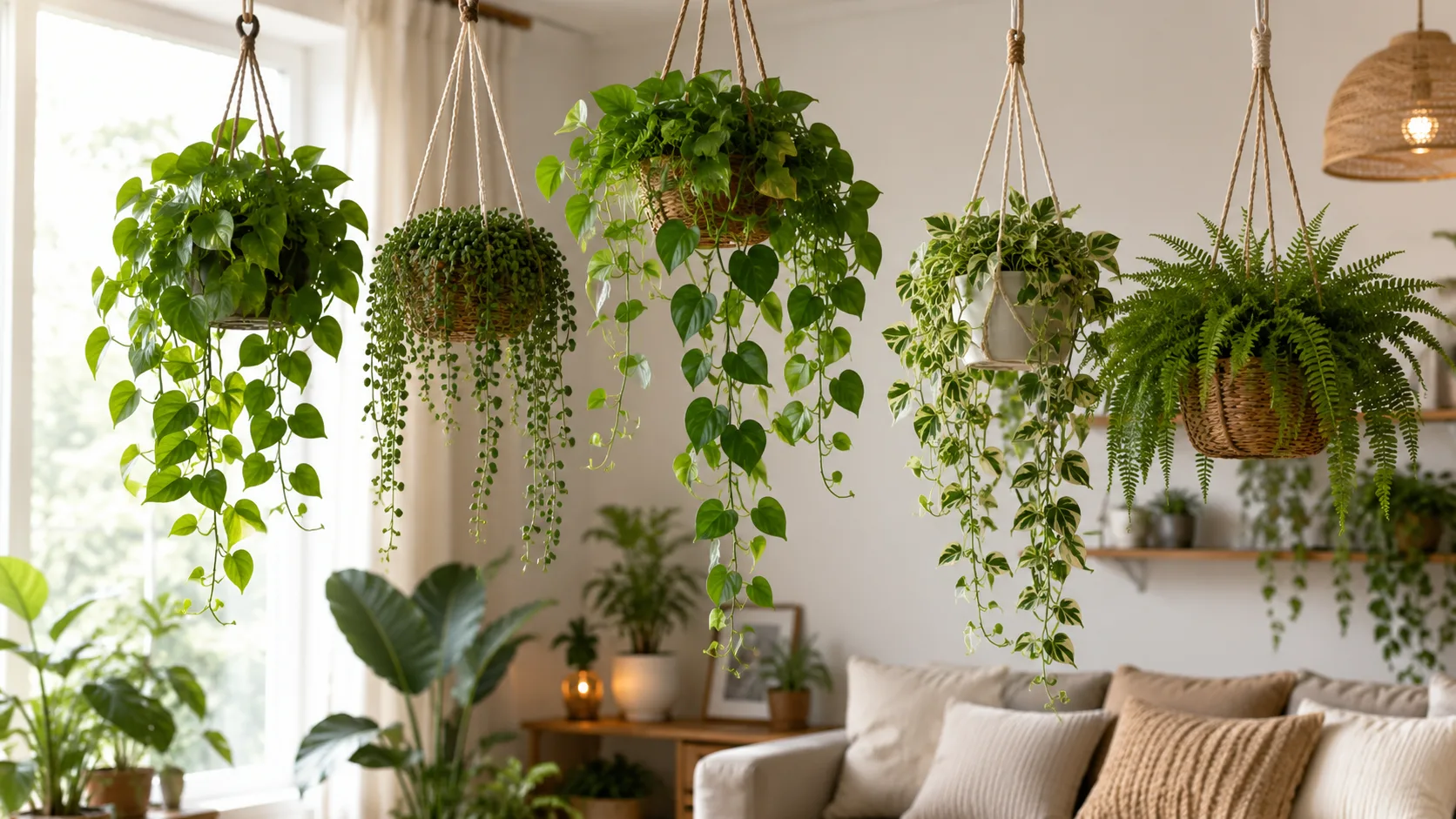
You can get the look of a ceiling-hung plant without drilling, but the safest solution depends on what the plant can actually attach to. A tension rod between two solid walls, a floor-to-ceiling plant pole, or a clamp on an exposed beam can work in the right room; an adhesive hook stuck to painted drywall usually is not a dependable support for a wet, living planter.
Start with the plant’s full weight and the exact surface, not the hook’s biggest advertised number. If you cannot verify that the support is designed for the load and the way you plan to use it, move the plant to a freestanding stand or stable shelf. A small change in height is worth avoiding a pot falling onto a person, pet, floor, or piece of furniture.
Start With Safety, Weight, and Light
“No holes” does not mean “no support needed.” A pot hanging overhead is a suspended load, and every part between the plant and the building—the hanger, hook, bar, clamp, magnetic base, and contact surface—must remain secure. The weakest part determines what the setup can carry; a strong hanger cannot rescue a weak ceiling finish or a slipping rod.
Decide first whether the plant truly needs to hang from the ceiling. If your goal is simply to raise vines above a desk or free up floor space, a tall plant stand, bookcase, or existing shelf may solve the problem with less risk. A hanging display makes sense when there is a compatible support and you can still reach the plant for watering, pruning, and pest checks.
Weigh the Complete Setup After Watering
Weigh the whole assembly at floor level: plant, pot, soil, decorative cover, hanger, chains, hooks, and any saucer or reservoir. Water the plant as you normally would, let it drain, then weigh it again; the heavier reading is the useful one for choosing a support. That reading accounts for the moisture a dry-pot estimate misses.
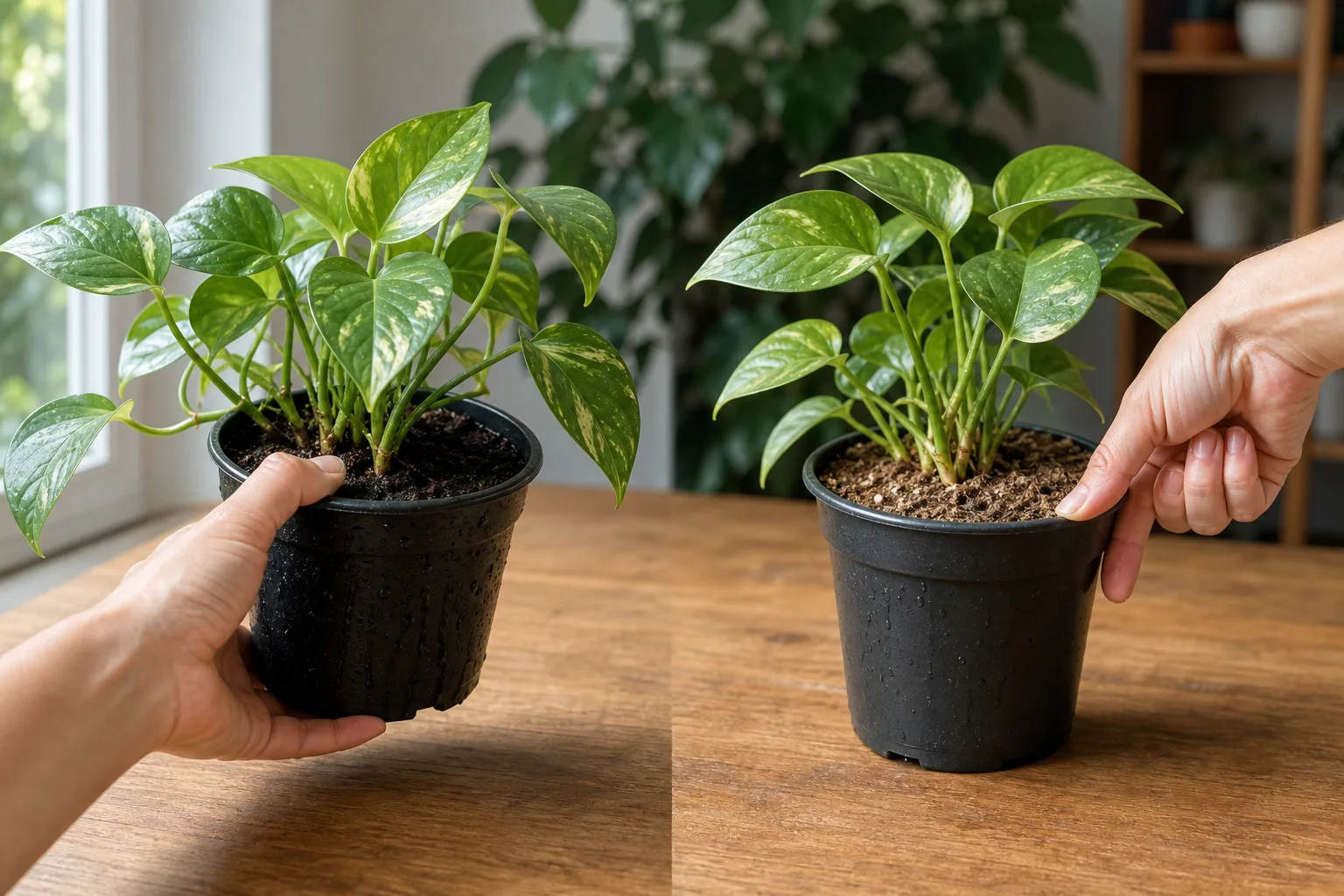
Do not use the plant’s nursery tag, the empty pot’s weight, or a dry potting mix as your load estimate. Clay and ceramic containers add more weight than a small plastic nursery pot, and wet growing medium adds more again. Allow for future growth, too: a trailing plant can gain foliage, and its stems may make the planter easier to bump or pull.
The RHS guide to hanging baskets notes that some compost choices add weight and that hanging baskets need regular moisture checks. That guidance is written for garden baskets, but the weight lesson applies indoors as well: count the contents and retained water, not just the container.
Choose a Place Where a Fall Will Not Injure Anyone
Keep a suspended planter out of the drop zone above beds, chairs, sofas, cribs, desks, pet resting spots, and fragile objects. Avoid walkways and door swings, where a person can catch a trailing vine or knock the pot while moving through the room. If the only available spot is directly above someone or a valuable item, choose a stand instead.
Do not use a light fixture, ceiling fan, smoke or carbon-monoxide alarm, sprinkler head, vent, camera, curtain track, or electrical box as a plant support. These objects are not plant hangers, and blocking or loading safety equipment can create a separate hazard. Keep the plant clear of doors, window operation, blinds, and fan blades, and check that dripping water cannot reach electrical equipment.
A location must also suit the plant. A high spot may be warmer or drier than a lower shelf, and it may receive less useful light if the leaves sit far from the window. Keep plants away from heating and air-conditioning vents; the Missouri Botanical Garden’s indoor-watering guidance explains that room temperature, light, humidity, and nearby vents affect how quickly indoor plants use water.
Which No-Drill Method Actually Works?
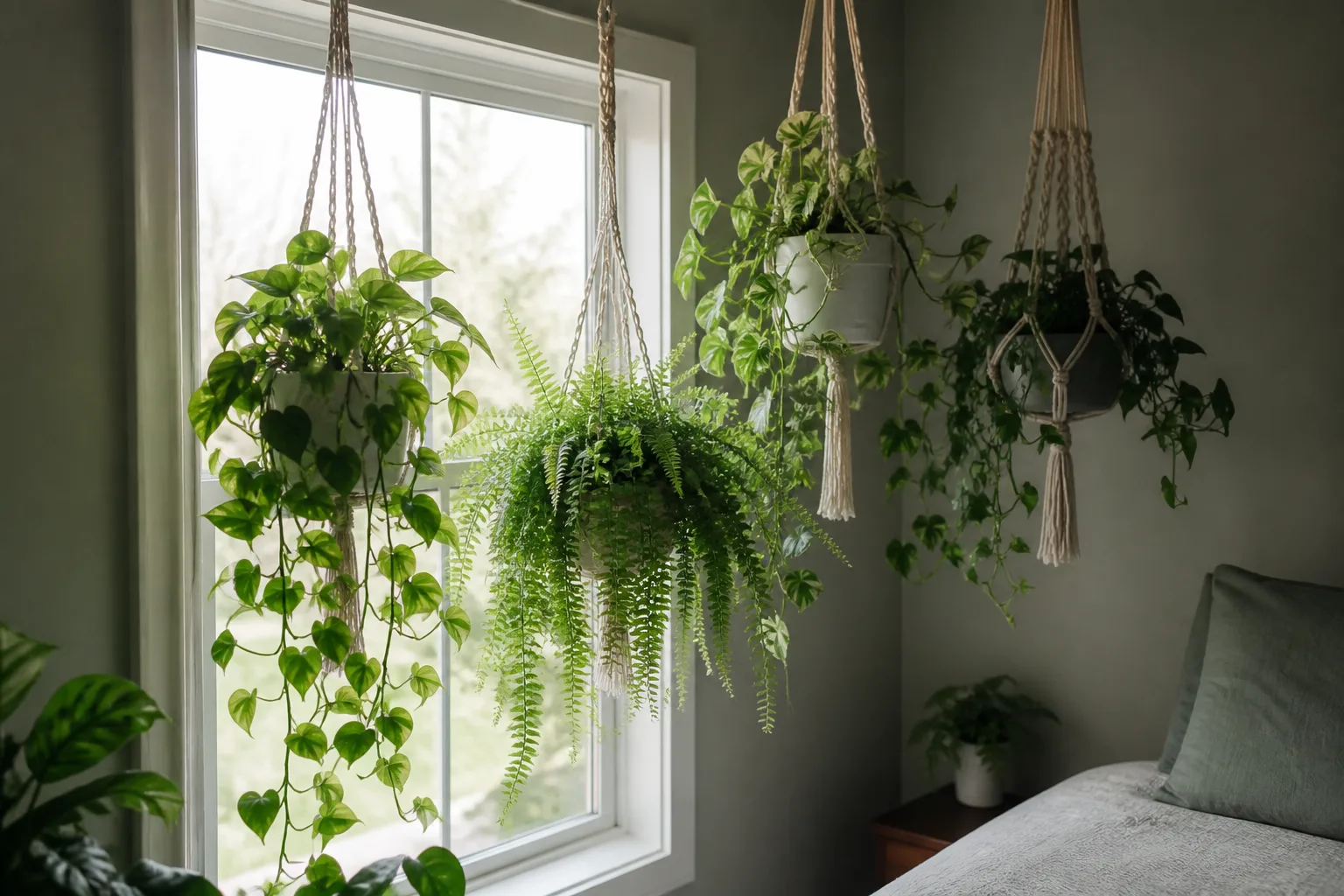
There is no universal ceiling hook that safely holds every plant without screws. These options work only when the room, surface, and total load match the hardware instructions; if none fits, use furniture or a floor-standing support.
Tension Rods Work Best Across a Short, Supported Span
A tension rod turns a narrow opening into a plant bar. It can span an alcove, a doorway, or the space between two close walls, so the plant hangs from the rod rather than from the ceiling itself. This is most practical for a light pot and a short span; the longer a rod extends, the more important its product-specific load rating and installation become.
Choose a rod that locks securely and is rated for the full extension you need. Install it exactly as directed, with its ends bearing on sound, parallel surfaces—not loose wallpaper, crumbling plaster, slick trim, or a weak edge. Do not assume that a shower rod’s curtain rating also applies to a concentrated plant load hanging from its center. Keep heavier pots near the supported ends only if the manufacturer allows that placement, and do not overload the bar with several planters.
A tension rod can still mark paint or shift if the surfaces are fragile, the rod is overextended, or someone bumps it. If the ends begin to creep, the bar bows noticeably, or the wall surface compresses, take the plant down and stop using the setup. A rod that is easy to nudge out of place is not suitable for an overhead planter.
A Floor-to-Ceiling Plant Pole Avoids Ceiling Hardware
A compression pole stands between the floor and ceiling and offers clips or hooks along its length. It avoids drilling and can be useful in a corner where a freestanding stand would take up more floor space. Unlike a wall-to-wall rod, it does not depend on two side walls, but it does press against both the floor and ceiling.
Use a pole made for plant display or another product whose instructions explicitly allow the planned load and surfaces. A pole that is too loose can tip; one tightened against a fragile ceiling, suspended ceiling tile, or decorative molding can leave marks or cause damage. Keep the plant close to the pole rather than far out on a swinging arm, because a side load can twist the assembly. Check the pole periodically for loosening, especially after moving or watering the plant.
Clamp Only to a Solid Exposed Beam or Sturdy Shelf
A padded clamp can hold a light planter from an exposed beam or a sturdy shelf edge when there is no need to penetrate the structure. The clamping point must be a solid, stable member that can take the pressure without splitting, bending, or crushing. Use pads designed for the clamp or a non-slip protective layer that does not compromise the grip, and tighten it only as instructed.
Do not clamp to drywall, a thin ceiling tile, a hollow trim board, a pipe, or a narrow ledge that can flex. A clamp can also leave an indentation, scratch a finish, or slide off a rounded surface. Keep its handle and screw clear of walkways, and position the pot so it cannot swing into glass or a person. If the beam or shelf is not clearly sturdy, treat it as unsuitable.
Magnetic Hooks Need Verified Ferrous Steel
A magnetic hook works only when the magnet contacts a suitable ferrous steel surface directly. Many ceilings are drywall, wood, plaster, concrete, or aluminum, none of which gives a magnet a reliable attachment. A hidden screw head is not a substitute for an exposed steel support: the magnet may grab the tiny head while the screw itself remains anchored only in the ceiling finish.
Before choosing a magnetic hanger, identify what the metal part is and what it is attached to. Use a magnetic hook only on an exposed steel beam or bracket when its maker’s instructions specify a load for that exact contact and orientation. Do not rely on a generic magnet-strength number; pull-off strength can differ greatly from the load the hook safely carries when mounted overhead.
Treat Adhesive and Suction Hooks as Low-Load Options
Adhesive hooks usually depend on a clean, smooth surface and a particular direction of pull. Many are designed for vertical walls, where gravity pulls down the wall, rather than ceilings, where the adhesive is peeled away from the surface. Paint, texture, dust, humidity, heat, and the weight of damp soil can all undermine a bond. For a potted plant overhead, skip a hook unless the manufacturer explicitly approves ceiling use and gives a limit for that orientation and surface.
Suction cups need a smooth, nonporous surface such as suitable glass or tile, plus a seal that stays intact. Dust, condensation, surface texture, temperature changes, and a small leak can weaken that seal without warning. Do not use a suction cup over a bed, seat, or electronics; in most homes it is better for a tiny lightweight accent on a vertical pane than for a real planter overhead.
If a product’s instructions do not clearly cover ceiling mounting, the actual surface, and the expected load, do not improvise. Adhesive and suction hardware are poor places to test how close you can get to the stated maximum. Use a support with a verifiable load path or keep the plant on a shelf.
Match the Method to the Room, Not the Product Label
Choose by answering three questions: what supports the hanger, how heavy is the full watered planter, and what happens if it falls? A small alcove with sound side walls may suit a tension rod; an exposed structural beam may accept a padded clamp; a confirmed steel beam may suit a magnet whose overhead rating is known. Smooth glass alone does not make suction cups a good choice for a heavy plant.
| Room or support | More sensible option | Main condition to verify |
|---|---|---|
| Narrow opening between sound walls | Tension rod | Rated for the span and a suspended load; ends cannot creep |
| Corner with a suitable floor and ceiling | Plant tension pole | Product allows both surfaces and the total load |
| Exposed solid beam or shelf | Padded clamp | Member is stable, thick enough, and not easy to crush or split |
| Exposed structural steel | Magnetic hanger | Actual overhead rating on that steel surface is known |
| Painted, textured, or fragile ceiling | Freestanding stand or shelf | Avoid adhesives or pressure that can pull paint or damage finish |
| No reliable surface or rating | Floor-standing plant display | Stable base and easy access for care |
Use the manufacturer’s stated working limit for the exact hardware configuration, and stay comfortably below it. A rating for a static vertical wall hook, short rod span, or magnet on a thick steel plate does not automatically transfer to a ceiling, a longer span, or a planter that swings. If the instructions are missing or unclear, that uncertainty is a reason to choose another method, not a reason to estimate a safe number yourself.
Install and Check the Hanger Before Raising the Plant
Set up at floor level first. Read the product’s instructions, measure the span or pole height, and inspect the bearing surfaces for loose paint, cracks, dust, moisture, or soft trim. Clean only as the instructions permit; solvents and abrasive cleaning can damage a finish or interfere with adhesive grip.
Use a hanger that keeps the pot level and prevents the container from slipping through its supports. Confirm that the chain, cord, hook, or basket has no fraying, bent links, loose knots, or cracked plastic. If you use a decorative macramé hanger, check every supporting loop and knot, not just the ring at the top.
Do not balance a potted plant on the narrow hook of a tension rod or clamp if a small sideways movement could unseat it. A closed hanging ring or basket that cannot slide off is preferable. Keep the plant near the support’s centerline; a long offset arm can create leverage that the product’s load rating does not cover.
Use a Short, Controlled Commissioning Check
Follow any installation and test procedure supplied with the hardware. After fitting it, check that the rod, pole, clamp, or hook stays in position under a gentle hand check made from outside the drop zone. Do not stand underneath, pull hard, hang your body weight on the support, or add improvised weights to “prove” it; a one-time test cannot establish a safe working capacity or reveal how a bond will age.
Raise the actual plant only when it is within the rating and can be placed without climbing over furniture. Keep people and pets clear while you position it, then check again for slipping, visible deflection, and a secure pot connection. Recheck after the first watering, after moving the plant, and whenever you notice a change in the wall, ceiling, rod, or hanger.
Reduce Weight Without Compromising Plant Health
A lighter setup gives you more options. Use a small plastic nursery pot with drainage rather than a large ceramic cachepot, and place it inside a light decorative sleeve only if the sleeve cannot slide off. Do not fill the hanger with stones, gravel, or a heavy self-watering reservoir unless the support is rated for the added load. A big saucer or deep outer pot can store water and raise the weight just when the planter is most vulnerable.
Choose a manageable plant and a container proportionate to its roots. Trailing pothos, heartleaf philodendron, hoya, or an air plant can make an attractive display, but none is automatically safe simply because it trails or has a reputation for being easy. The Savvy Gardening guide to hanging succulents describes several trailing species with different light and watering preferences; let the plant’s needs guide placement rather than buying one only to reduce watering.
The weight-reduction rule has a limit: do not make a plant lighter by leaving it dry, cutting away healthy roots, or using a pot too small for its root system. If a plant’s normal watered weight is too much for the support, use a smaller specimen, a lighter pot, or a different display. The Gardening Know How guide to indoor hanging baskets also warns that damp mix and heavier pots can make indoor hanging plants substantial loads.
Make Watering and Maintenance Easy to Reach
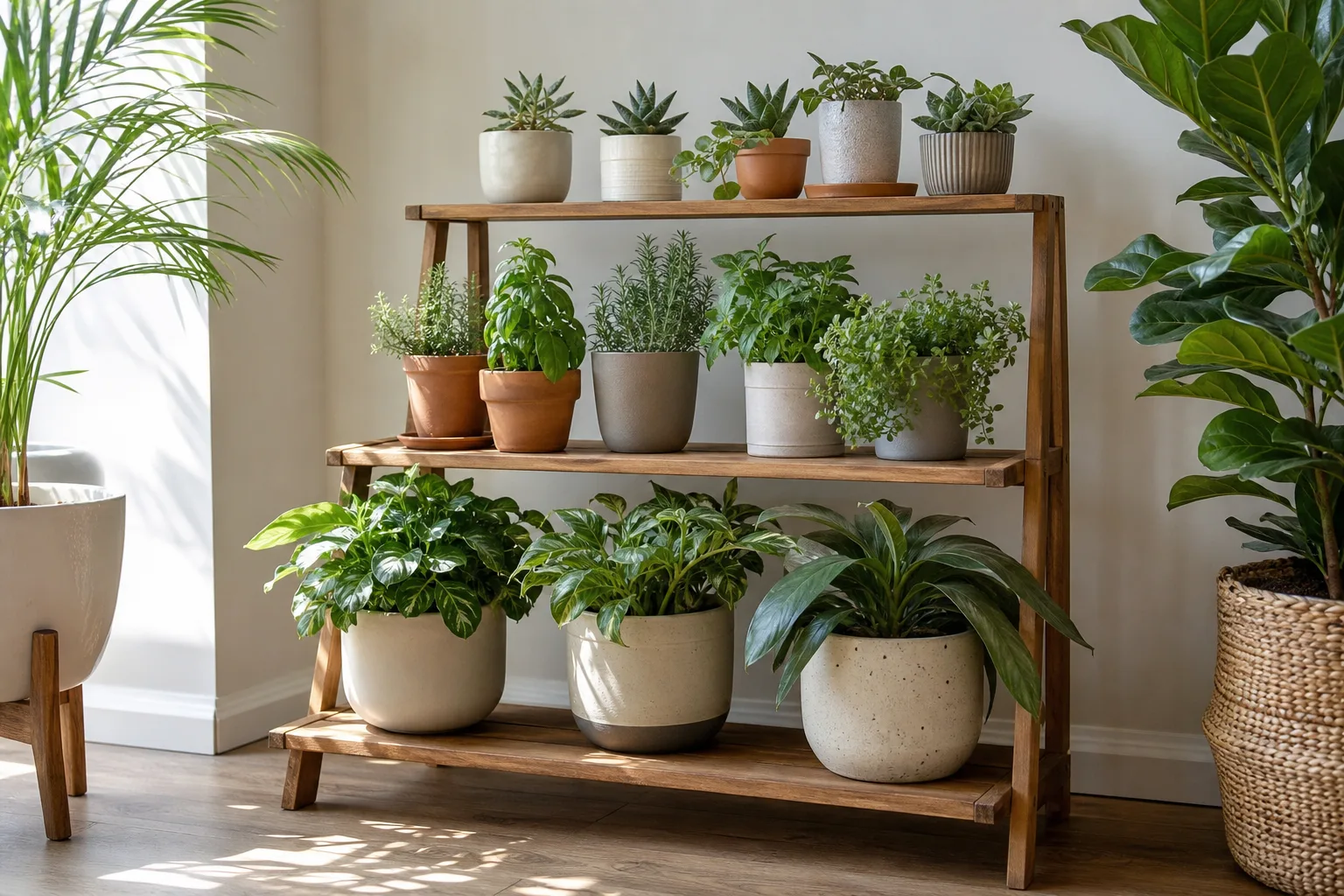
A plant that is difficult to water will eventually be watered carelessly. Before hanging it, make sure you can lower the pot or reach it with a stable step stool without stretching sideways. If you have to lean over a stairwell or climb onto a chair, use a stand or a lower shelf instead.
For a plant that can be removed safely, lift the nursery pot out of its hanger or cachepot, water it at a sink, and let it drain fully before returning it. That protects wood, carpet, electronics, and the hardware from runoff while giving the roots a proper drink. Keep drainage holes open; a closed decorative pot can trap excess water, and the Missouri Botanical Garden advises emptying a saucer after the pot drains rather than letting roots sit in runoff.
If the planter must stay in place, use a watering method that does not make you reach over your face or pour blindly into the pot. A narrow-spout can can help you aim, but take care not to saturate the hanger or floor. Put a removable drip tray or catch pot under the nursery pot only if it will not slide and you have included its retained water in the load; empty it after watering.
Water by the plant’s needs and the potting mix, not by a fixed weekly schedule. The RHS hanging-basket advice recommends regular checks because exposed baskets can dry quickly, while the Missouri Botanical Garden’s guide explains that indoor watering varies with the plant, light, and room conditions. A hanging location may change those conditions, so check the soil at the plant rather than assuming it needs more water because it is high up.
Give the Plant the Light and Air the Species Needs
Light at ceiling height can be very different from light on the windowsill. Check the plant where its leaves will sit, and move it if new growth stretches, loses color, or scorches; a trailing stem reaching the room does not mean the crown gets enough light. If the spot is dim, choose a plant suited to that light level or use a grow light positioned safely away from water.
Avoid air-conditioning or heating vents and places where hot air pools near the ceiling. The Missouri Botanical Garden notes that temperature, humidity, and air movement affect watering needs, while indoor hanging-basket guidance from Gardening Know How also cautions that elevated spots can dry out faster. Rotate the planter if the plant grows toward the window, and inspect both sides of the foliage during routine watering so pests do not go unnoticed.
Fix Slipping, Sagging, and Paint Damage Early
A support that moves is telling you to take the plant down, not to tighten it harder or add a second adhesive strip. If a tension rod shifts, unload it and inspect its extension, lock, and wall contact. If a pole leans, remove the plant and check the floor and ceiling contact before attempting to reset it. If a clamp marks or compresses the beam, stop and use a protective pad or another support.
If an adhesive edge lifts or a suction cup releases, lower the plant immediately and do not reattach the same failed piece for another overhead attempt. Replace worn cords, bent hooks, cracked baskets, and loose knots before rehanging. A new hook cannot correct a weak surface; move the plant to a stand, a stable shelf, or another support with a verified rating.
Water damage is another warning sign. Drips on the ceiling, paint bubbling near a tension pole, damp wood under a hanger, or water reaching electrical equipment means the location or watering method needs to change. Take the plant down, dry the area, and resolve the source before putting it back.
Conclusion
The safest way to hang plants from the ceiling without drilling is to use a support that is designed for the actual room and the planter’s full watered weight. A tension rod, floor-to-ceiling pole, padded clamp, or magnetic hook can be useful only when its surface and load rating match the installation; adhesive and suction hooks are rarely a sensible choice for a heavy pot overhead.
Measure the complete setup, choose a location with a clear fall zone and suitable light, and make watering easy before you hang anything. If you cannot verify the support or safely reach the plant, a plant stand or shelf is the right no-hole solution.