7 Ways to Keep Bees Away From a Hummingbird Feeder
Bees on your hummingbird feeder? Use seven humane fixes, from bee guards and shade to clean nectar and native flowers, plus a reset plan for swarms.
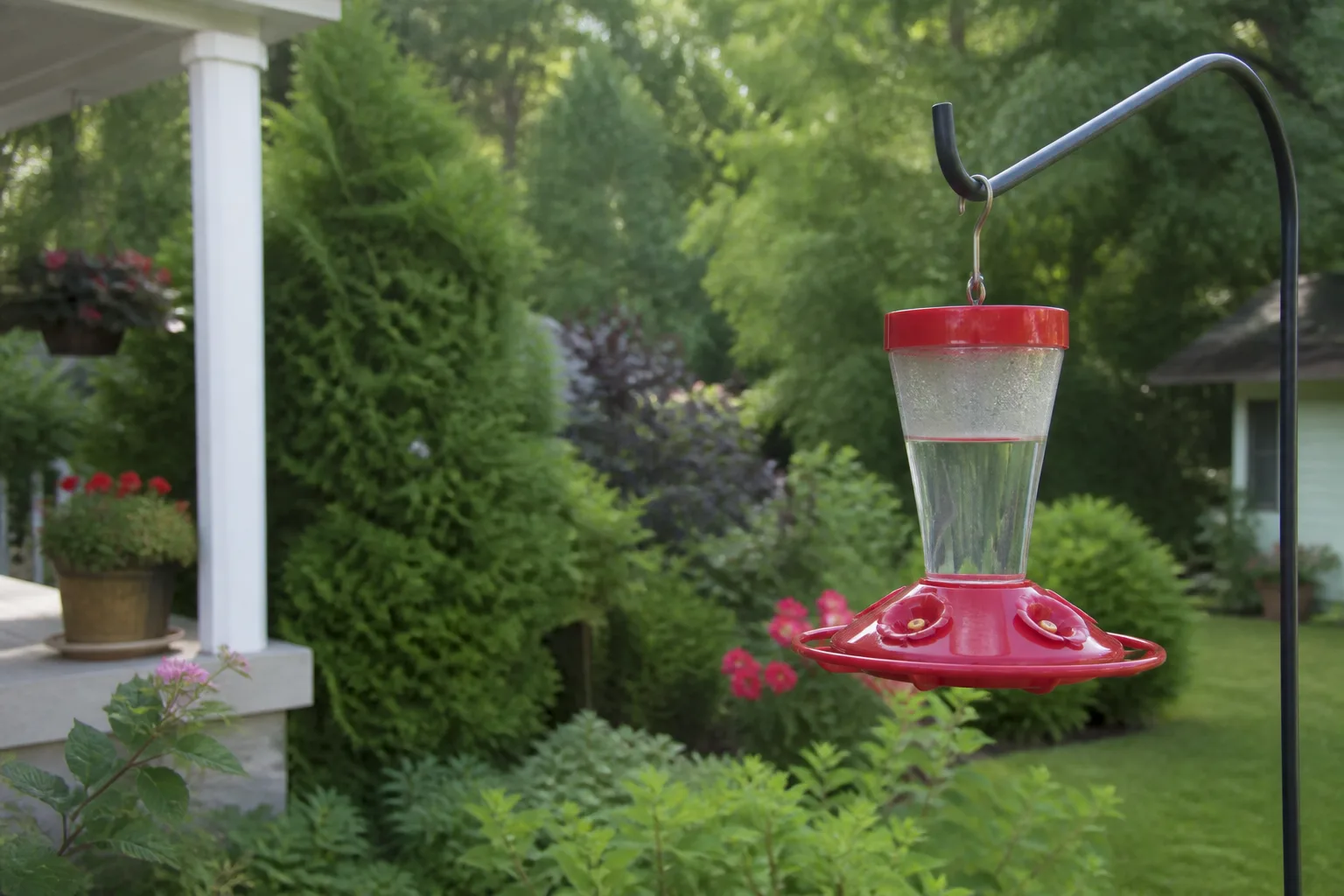
To keep bees away from a hummingbird feeder, make the nectar harder to reach and harder to find—not more toxic. The most reliable combination is a saucer-style feeder with compatible bee guards, no leaks or sticky residue, a shaded open location, and small batches of fresh nectar. If the feeder is already covered in insects, take it down, clean it, and give the foragers time to move on before you hang it again.
A few bees visiting a feeder is normal. Bees and hummingbirds both need sugar for energy, so a clean feeder full of sugar water is an easy nectar source, especially when flowering plants are between flushes. The problem is a takeover: insects crowd the ports, drain the reservoir, or make hummingbirds avoid the station entirely.
The goal is not to eliminate pollinators from your yard. It is to separate the feeding jobs. Give hummingbirds a clean, mechanically selective feeder and give bees safe natural forage elsewhere. No household scent, spray, or feeder design can promise that a bee will never investigate, but the seven steps below can greatly reduce the pressure without exposing birds or insects to pesticides.
What to Do First When Bees Swarm a Feeder
If dozens of bees are covering the feeder, do not stand there swatting at them or spray the feeder while it hangs. Bring people and pets away from the area, wait for the busiest activity to settle, and remove the feeder carefully if you can do so without disturbing an aggressive insect. Put it indoors or in a closed utility area, then empty and wash it.
For a moderate problem, a 24- to 48-hour pause can break the visual and scent trail to the feeder. If bees return in force after a clean restart, use a more serious reset—several days or even a week—while you change the feeder design and location. Hummingbird nectar is a supplement, not the only food in a well-planted yard, so a short pause is preferable to leaving spoiled nectar or a hostile feeding station outside.
Identify the Visitors Before You Choose a Fix
Honeybees are usually brown or golden and somewhat fuzzy; bumblebees are larger and conspicuously hairy; carpenter bees are large, often with a shiny dark abdomen, and commonly forage alone. Their presence is annoying at a feeder, but they are not the same management problem as a nest of defensive wasps.
Wasps and yellowjackets have a smoother, narrower-waisted appearance and often show stronger yellow-and-black markings. They can become defensive around food or a nearby nest. Ants usually arrive in a trail and crawl over the hanger or feeder rather than hover around the ports. This distinction matters: bee guards address access for bees and wasps, while an ant moat addresses a climbing route.
If you see repeated stinging insects flying to a hole in a wall, roofline, tree cavity, or underground opening, treat that as a nest question, not a feeder question. Do not probe or spray a nest to protect a bird feeder. Remove the feeder, keep clear, and contact a local extension service or licensed pest professional if the nest is near a doorway, play area, or regular seating area.
Why Bees Find Sugar Water So Quickly
From a bee’s point of view, a hummingbird feeder is an unusually concentrated artificial flower. The water contains sugar that mimics nectar, the reservoir may be exposed through large ports, and a drip leaves a strong sweet scent on the outside. The University of Georgia Cooperative Extension explains that bees are drawn to the sugar water because it resembles the nectar they seek, particularly when natural nectar sources are scarce.
Once a honeybee finds a dependable food source, more foragers may arrive. That is why a feeder can look fine one morning and become a buzzing mass by afternoon. You are not dealing with a bee that has formed a permanent attachment to your plastic feeder; you are dealing with a profitable food location that is being rediscovered and reinforced.
Color and placement add more signals. Yellow parts can resemble flower centers and stand out to bees, while a feeder in hot, full sun warms the nectar and increases the need for frequent replacement. A feeder beside a dense flowering patch also puts two nectar sources in the same short flight zone. These cues do not guarantee an insect invasion, but removing several of them at once makes the station less rewarding.
The 7 Safest Ways to Keep Bees Away
Use the list as a sequence, not a menu of fragrances. Start with physical access and contamination, then adjust location and habitat. If one change reduces the insects but does not solve the problem, keep that improvement and add the next one rather than undoing the whole setup.
1. Switch to a Saucer-Style Feeder
The most useful feeder change is usually a saucer-style design. It holds nectar in a shallow dish below the feeding ports, so the liquid is not immediately at the surface. A hummingbird can extend its long tongue down to the nectar, while many bees cannot reach it without crawling into the opening.
When comparing feeders, look for a clear reservoir or dish that lets you see the fill level, ports that do not drip when the feeder swings, a stable perch, and parts you can take apart with a brush. A bottle-style feeder is not automatically unsafe, but gravity-fed designs often keep nectar close to the ports, which makes access easier for insects.
Some practical feeder guides suggest keeping the nectar surface roughly half an inch below the port openings and choosing small ports, but treat those measurements as design targets rather than a universal guarantee. Feeder shapes vary, and a hummingbird still needs comfortable access. Watch the birds after changing models; if they repeatedly probe without drinking, choose a different compatible design.
The trade-off is capacity and cleaning. Saucer feeders can be easier to inspect but may hold less nectar, so you may refill more often. That is useful if it prevents a large volume from sitting outdoors for days, but only if the feeder is genuinely easy for you to clean.
2. Add Bee Guards to Every Port
Bee guards are small barriers, cages, or mesh-like port covers that reduce the opening and increase the distance between the insect and the nectar. They are designed around the hummingbird’s long bill and tongue, so a hummingbird can reach through while a bee has a much harder time.
Choose guards made for your feeder model rather than assuming every replacement part will fit. A loose guard can leak, block a bird’s bill, or create a narrow crevice that traps old sugar. After installation, fill with a small amount of nectar and watch from a distance: the birds should approach, feed normally, and leave without repeatedly bumping the guard.
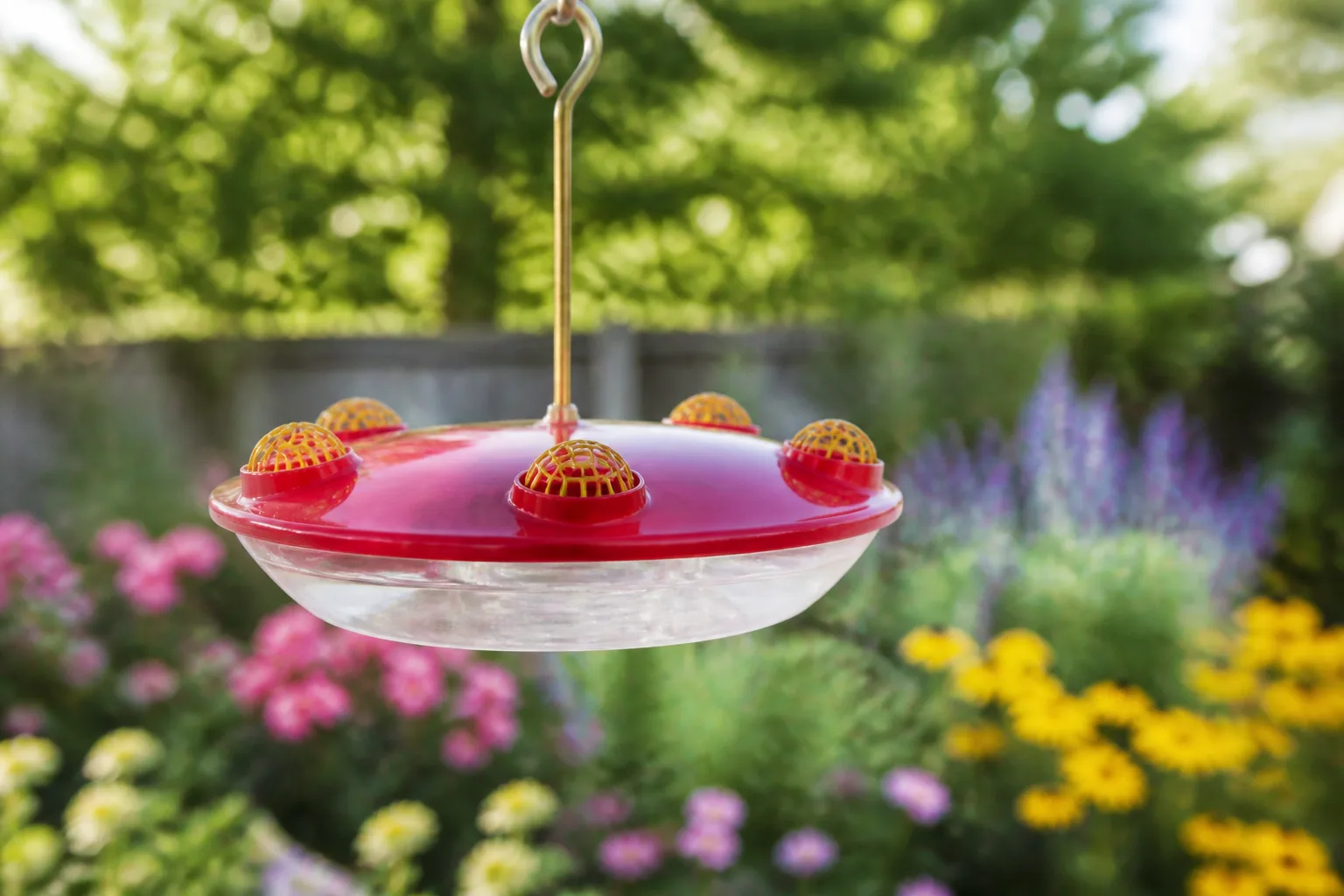
Guards are a mechanical barrier, not a cleaning substitute. Audubon specifically cautions that blocking the drinking hole will not solve an insect problem if the feeder is coated with sugar water. Wash the guards along with the rest of the feeder, and replace any that crack or no longer seat tightly.
3. Remove Yellow Accents, but Never Add Red Dye
If your feeder has removable yellow flowers, port covers, or decorative panels, replace them with red or clear parts when the manufacturer offers them. Bees use color along with odor to locate food, and Empress of Dirt notes that yellow, orange, blue, green, and violet can be more conspicuous to bees than red. This is a supporting change, not a standalone repellent.
Do not try to compensate by coloring the nectar red. The red belongs on the feeder, not in the food. The National Wildlife Federation advises against red-dyed nectar, and the International Hummingbird Society likewise recommends clear nectar made from white sugar and water.
Color can also be overemphasized. A bright red feeder covered in drips will still attract insects, while a less colorful feeder that is clean, recessed, and shaded may perform better. Treat color as the last part of a design check after access and leaks are fixed.
4. Stop Leaks and Clean Away Every Sticky Trace
A tiny leak can defeat every bee guard. Check the feeder after hanging it and again after wind, rain, or an accidental bump. Look for a cracked reservoir, a loose base, a missing gasket, a tilted dish, or nectar wicking through a port. Tighten or replace the damaged part; wiping the outside helps today, but it does not fix the source.
Clean the feeder every time you refill it rather than topping off old nectar. Take it apart, scrub the reservoir, base, perches, ports, and guards with hot water and a dedicated brush, then rinse thoroughly and let the parts drain before refilling. A weak vinegar cleaning solution may be used for some feeders, but it must be rinsed away completely; never leave a sour-smelling residue in the nectar or on the drinking surfaces.
NWF’s hummingbird feeder guidance recommends cleaning every one to three days depending on weather, with more frequent attention in hot conditions. Audubon also recommends wiping spills, checking that parts are tightened, and changing the nectar more often in warm weather.
If you see black mold, cloudiness, bubbles, or a fermented smell, discard the nectar immediately and deep-clean the feeder. Do not try to rescue it by adding fresh syrup. Spoiled food is a bird-health problem first and a bee problem second.
5. Move the Feeder Into Shade and Open Air
Move the feeder to a spot with afternoon shade, protection from strong wind, and enough open space for a hummingbird to hover. Shade reduces heat on the nectar and may make the station less attractive to sun-foraging insects. It also slows spoilage, although it does not remove the need for frequent cleaning.
Keep the feeder visible to birds and to you, but do not tuck it into dense shrubs where a cat can hide or where leaves brush the ports. The National Wildlife Federation recommends nearby shelter with open flight space, while the International Hummingbird Society advises shade and a position that is not too close to a nest.
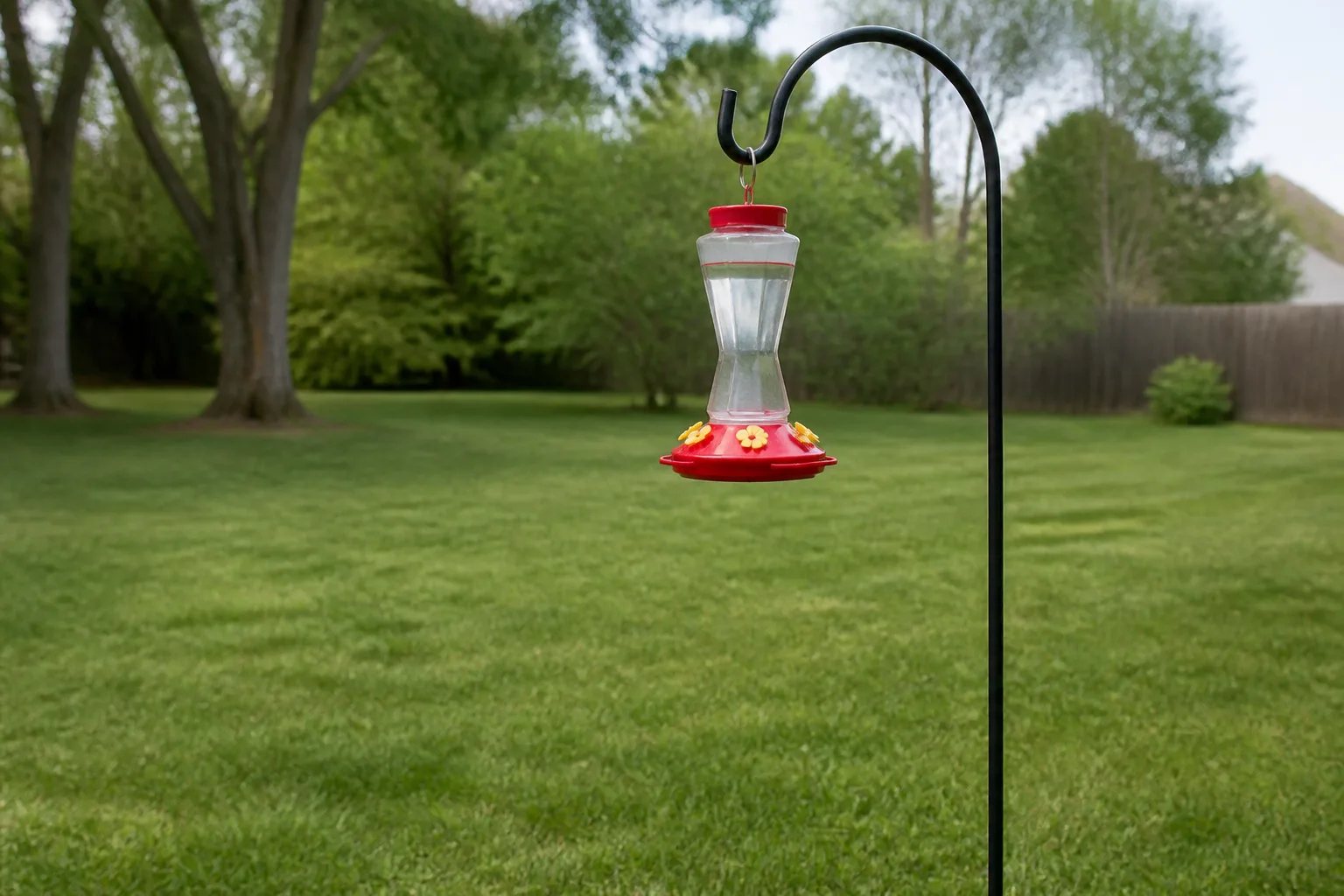
If the feeder hangs directly beside a mass of blooming plants, move it several feet away so the artificial nectar is not placed in the busiest bee traffic. Do not move it so far that you create a long exposed flight path for the birds or make it impossible to monitor. A quiet porch edge, shaded arbor, or open branch near—but not inside—a planting bed is often a workable compromise.
If bees follow the first move, relocate once more after cleaning rather than shifting the feeder every few hours. Hummingbirds search visually and usually find a familiar feeder again; the important goal is to break the insects’ profitable route and remove the original scent trail.
6. Use Less Nectar and Pause the Feeder When Needed
Choose a feeder size that hummingbirds can empty in about two to three days in mild weather, and fill only what they are likely to use. NWF recommends matching feeder size to consumption so nectar does not sit long enough for mold and bacteria to grow. In a heat wave, that same amount may need to be replaced daily.
Do not deliberately make the nectar unusually weak to repel bees. The standard hummingbird recipe is the safer baseline, and changing the concentration can create a food that is less appropriate for the birds without reliably stopping insects. Reduce the quantity you offer, not the quality of the food.
When bees cover the ports, take the feeder down for 24 to 48 hours, then clean and relaunch it with the design and location changes above. If the insects return immediately, extend the pause for several days. A short interruption is especially sensible in late summer, when bees may be using the feeder because other nectar is temporarily scarce.
Multiple feeders can help distribute territorial hummingbirds, but they can also create several insect targets. Add a second feeder only after the first one is clean, well-designed, and easy to maintain. Space it away from the original rather than hanging two reservoirs side by side.
7. Grow a Natural Nectar Buffer for Pollinators
The long-term answer is not a “bee-repellent” plant. It is a healthier yard with enough natural forage that bees are not forced to treat your hummingbird feeder as the easiest nectar source available. The University of Georgia Cooperative Extension recommends bee-friendly flowers such as mountain mint, butterfly weed, and bee balm; those plants give pollinators a legitimate food source away from the feeder.
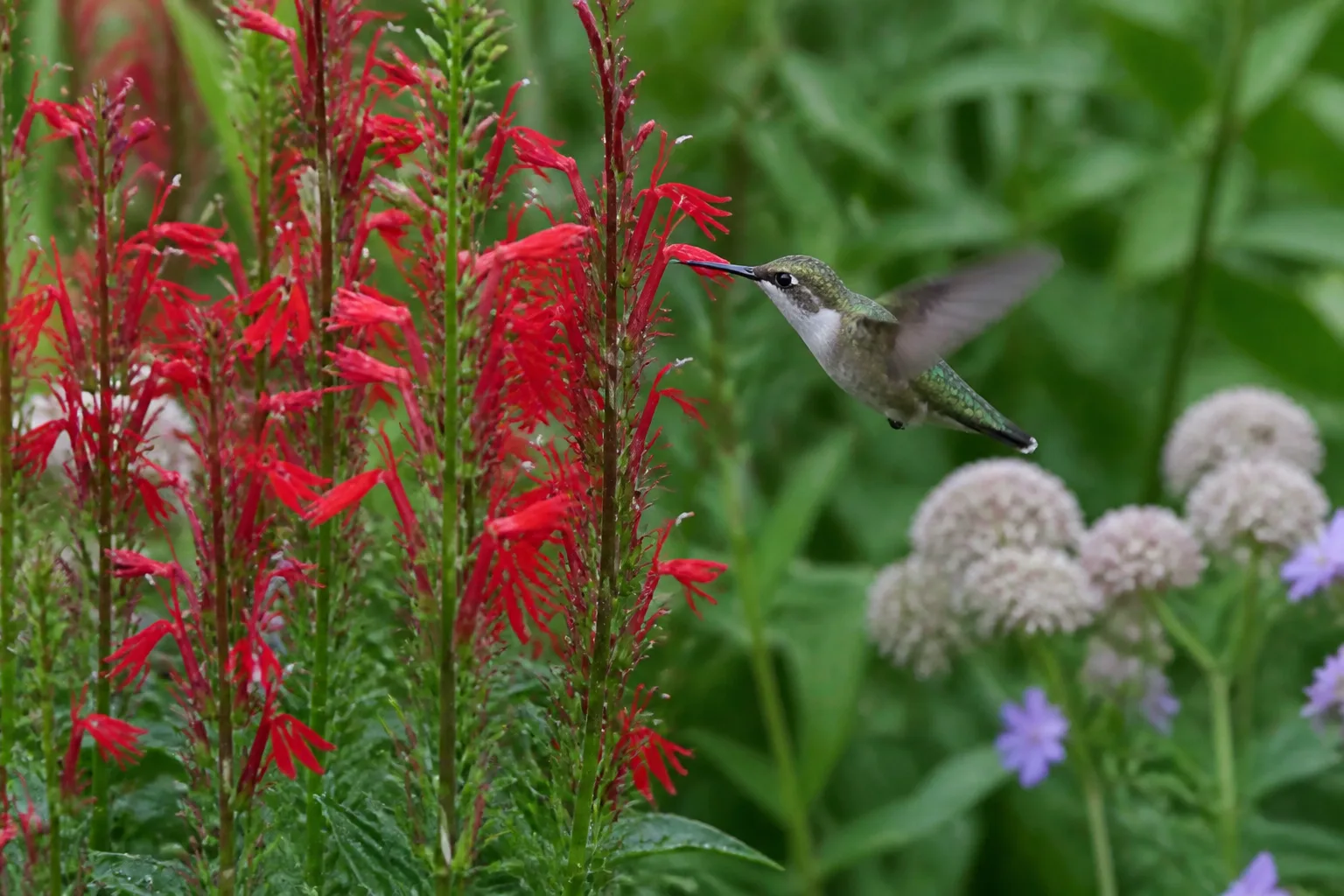
Place the bee-friendly planting away from the feeder rather than directly under it. Consider a sunny border, side-yard bed, or far end of the patio where bees can forage without covering the hummingbird ports. The exact distance depends on your yard, but separation matters more than a magic number: you want two recognizable food zones instead of one crowded station.
For hummingbirds, choose regionally appropriate nectar plants with a sequence of bloom times. Cardinal flower, native salvias, coral honeysuckle, trumpet-shaped flowers, and zinnias can all be useful depending on climate and species. Savvy Gardening recommends native plants and a bloom season that stretches from spring through fall, while also noting that hummingbirds take small insects for protein. Avoid treating the flowers with broad-spectrum insecticides; the insects are part of the habitat you are trying to build.
Natural flowers will not guarantee a bee-free feeder. Bees may still investigate a bright, sugary reservoir, and some flowers—especially bee balm, lavender, and many composite blooms—are attractive to both groups. The benefit is resilience: hummingbirds gain natural nectar and insect prey, bees gain forage, and the feeder no longer has to carry the entire food supply.
Use the Fixes in the Right Order
The order matters because each change removes a different reason for bees to return. A scent-heavy leak cannot be solved by shade alone, and a large exposed port cannot be solved by moving the same feeder to the other side of the yard. Reset the source, then remove the access and visibility cues.
The First 24 Hours
Start by removing the feeder if it is visibly swarmed. Empty the nectar, take the feeder apart, wash every part, rinse it, and set it aside to dry. Inspect the base and seals for cracks, then decide whether the feeder can accept compatible bee guards or whether a saucer-style replacement makes more sense.
While the feeder is down, clean any sticky drops from the hanger, hook, porch rail, or nearby leaves. Move the hanging point to afternoon shade with an open flight path, away from the busiest flowering bed. If you have no way to check the feeder at least every day or two during hot weather, use a smaller feeder or leave it down until you can maintain it properly.
Do not fill a bowl of sugar water nearby just to lure the bees away unless you are prepared to manage another food source with the same care. An open dish can attract more insects, spill, ferment, or drown small pollinators. Natural flowering plants are a safer long-term buffer than an unattended syrup station.
The Restart Test
Relaunch with a small amount of fresh, room-temperature nectar. Watch for normal hummingbird feeding and count the insects rather than reacting to the first bee you see. One or two visitors do not mean the reset failed; the useful question is whether bees are blocking ports, draining the feeder, or keeping hummingbirds away.
If the feeder stays usable for a day or two, keep the setup and slowly adjust the fill volume to match consumption. If a swarm reforms, take it down again and change another variable—usually the feeder design or distance from the flowering bed. Repeated returns despite clean nectar, guards, shade, and relocation are a signal to pause the feeder longer and rely on habitat until the local nectar shortage passes.
Keep Hummingbird Nectar Safe While You Reduce Bees
Trying to make nectar unattractive to bees should never make it questionable for hummingbirds. Use the established recipe, make only what you can store or use promptly, and treat cloudy or moldy syrup as waste—not as something to dilute or filter.
The Four-to-One Recipe and the Right Fill Level
Mix one part plain white granulated sugar with four parts water. For a small batch, that is one-quarter cup of sugar in one cup of water; for a larger batch, use one cup of sugar in four cups of water. Warm the water enough to dissolve the sugar, let the mixture cool to room temperature, and then fill a clean feeder.
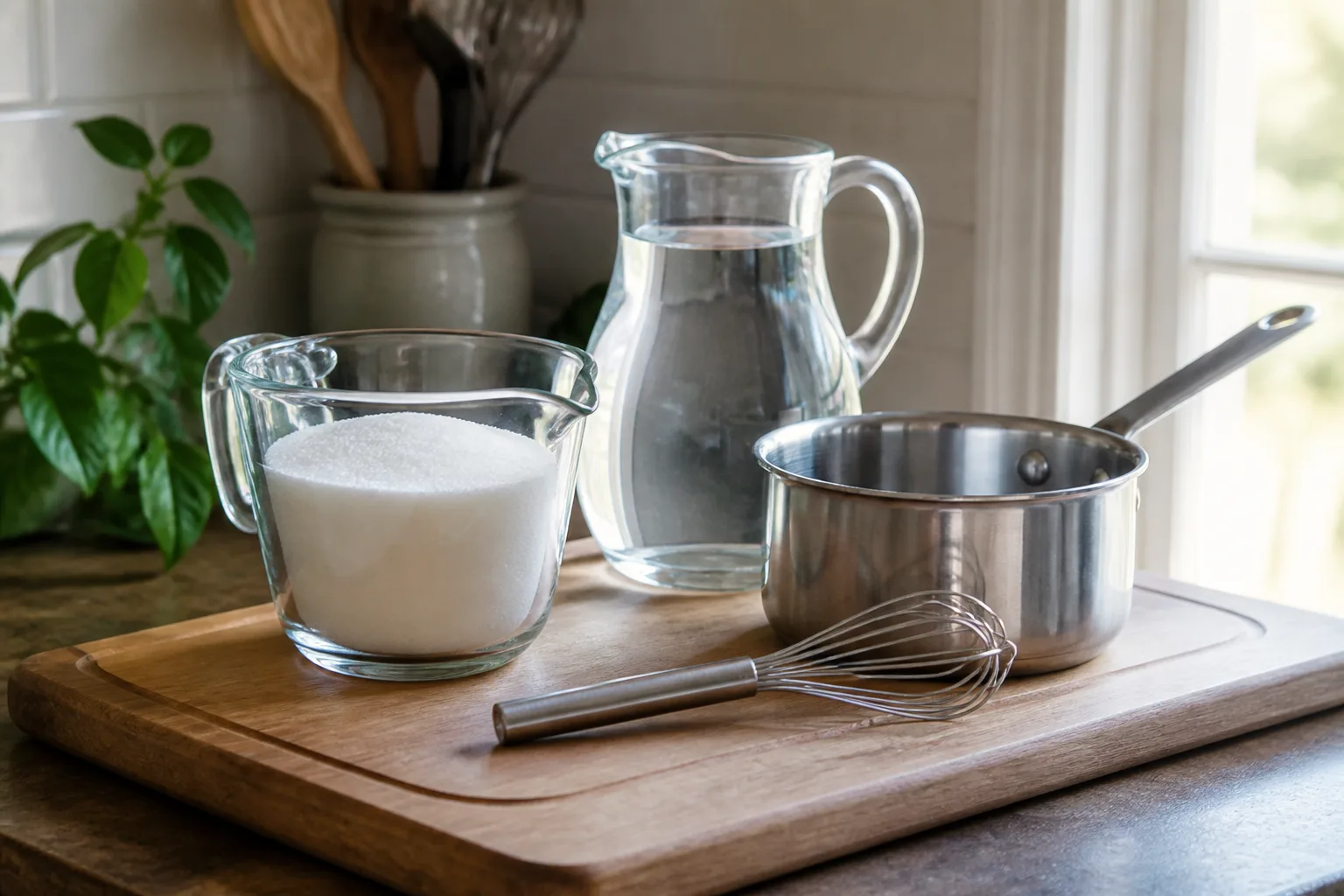
The International Hummingbird Society and NWF both use the four-to-one ratio as the standard baseline. Do not add red food coloring, honey, molasses, brown sugar, artificial sweeteners, spices, or essential oils. Red feeder parts attract attention without putting dye in the drink.
Fill only enough for the birds’ normal use over the next day or two, then adjust from observation. If nectar remains after two or three days, reduce the next batch. If the feeder empties before the next check, increase the amount slightly or add a second, well-spaced feeder only if you can maintain both.
A Weather-Based Cleaning and Refill Schedule
Use temperature and inspection—not a rigid calendar—as your trigger. A practical routine is:
- Hot weather: inspect daily and expect to change nectar every day or every other day, especially when the feeder receives heat or direct sun.
- Mild weather: change nectar about every two to three days, always cleaning the feeder between refills.
- Any weather: discard nectar immediately if it turns cloudy, smells fermented, develops mold, or has debris in it.
- After a leak or storm: wipe the outside, check the seals and fill level, and clean before the next use.
The Tennessee Wildlife Federation advises starting with a smaller amount and replacing nectar every one to two days, with daily changes in hot weather. Follow your feeder manufacturer’s cleaning directions if they are stricter, and keep a spare feeder so you can swap in a dry, clean one instead of rushing a refill.
Never top off old nectar with new syrup. That carries the oldest residue forward and makes it harder to notice spoilage. Clean the ports and guards as carefully as the reservoir because the outside film is exactly what attracts bees after the liquid inside is no longer easy for them to reach.
What Not to Put Around a Hummingbird Feeder
Skip insecticides, herbicides, aerosol sprays, petroleum jelly, cooking oil, sticky traps, essential oils, menthol rubs, cayenne, and mystery “natural” repellents. A substance that discourages a bee may coat a hummingbird’s bill or feathers, contaminate nectar, harm beneficial insects, or expose other wildlife that visits the feeder. Audubon recommends an insecticide-free yard because pesticides can injure birds, bees, and other animals.
Vinegar belongs only in a controlled cleaning routine when the feeder material and instructions allow it, followed by a thorough rinse. Do not spray vinegar, mint water, citrus oil, or any other scent around a hanging feeder and assume the birds will be unaffected. Never put herbs, spices, oils, or vinegar into the nectar itself.
Also avoid sealing the feeder in an inaccessible cage or wrapping the ports with improvised mesh. A barrier that prevents a bee but also catches a hummingbird’s bill, blocks a bird from feeding, or creates a damp crevice is not a safe solution. Use a purpose-built guard, keep the ports open enough for the birds, and observe the first few visits after every hardware change.
Conclusion
The safest way to keep bees away from a hummingbird feeder is to make the feeder a clean, difficult target while making the rest of the yard a better place to forage. Start with a short pause if the ports are swarmed, then wash and repair the feeder, switch to a recessed saucer design or add compatible bee guards, remove yellow accents, move the station into shade and open air, and offer only the amount of fresh nectar the birds will use.
Plant a separated, pesticide-free nectar garden for pollinators instead of trying to drive them out with oils or sprays. If bees still return after a clean restart, accept that the local food shortage may be stronger than any small adjustment and leave the feeder down for longer. A hummingbird feeder is a supplement; clean habitat, natural flowers, and safe maintenance are the part that supports wildlife for the long term.



