5 Ways to Keep Crows Away From Bird Feeders
Crows crowding out songbirds? Use this humane plan to remove food cues, choose a crow-resistant feeder, control spills, and reset the routine.
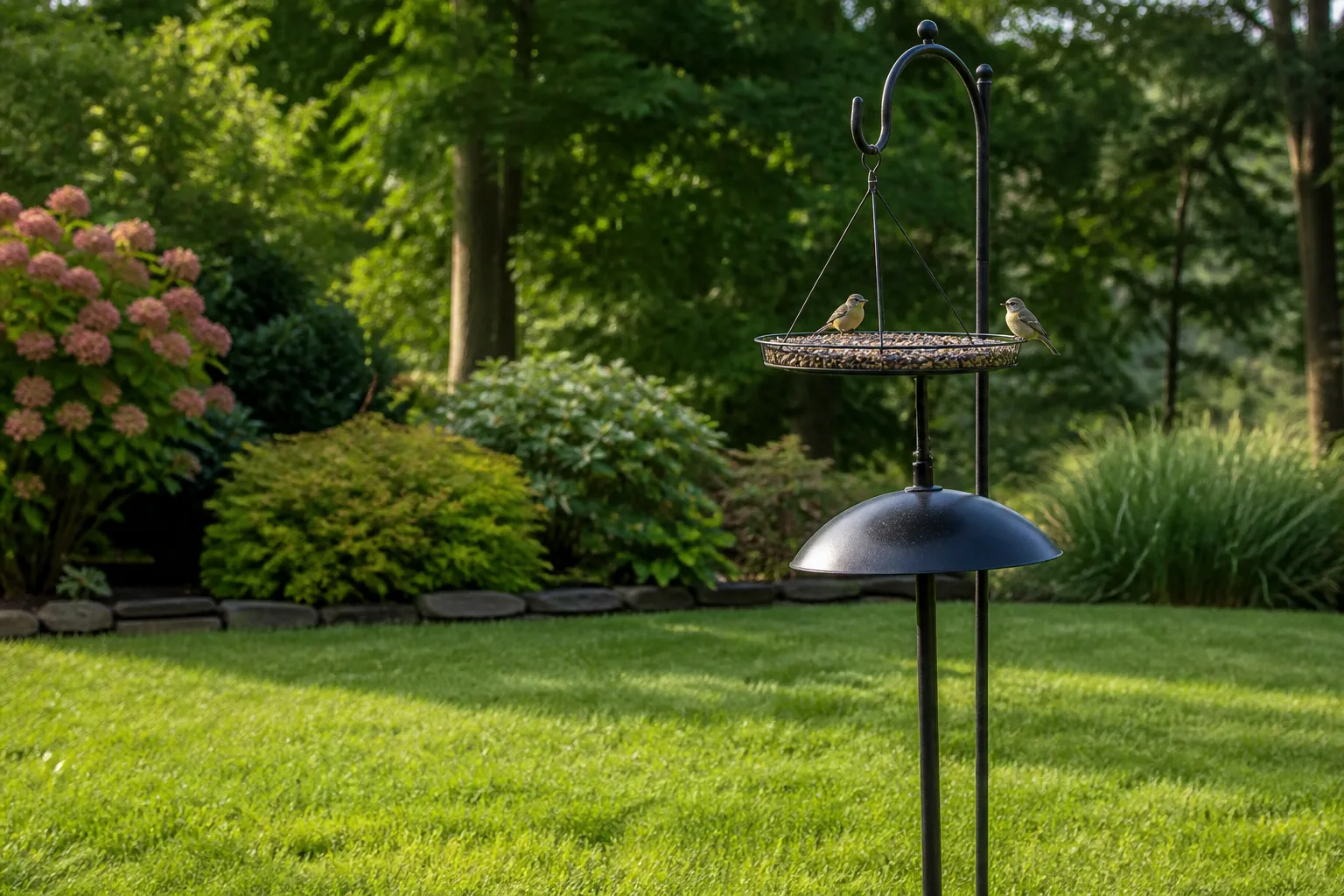
The most reliable way to keep crows away from bird feeders is to remove the easy food reward, then make the feeder physically difficult for a large bird to use. Start by cleaning up spilled seed and securing other food sources, switch to a caged or weight-sensitive feeder if needed, move the feeder away from convenient launch points, and use motion or reflective deterrents only as backup.
You may not be able to make a yard with a nearby crow family completely crow-free. You can, however, stop your feeder from functioning as an open buffet while preserving access for finches, chickadees, cardinals, and other smaller visitors. The key is to change the setup in an order that lets you see which fix is doing the work.
Why crows show up at bird feeders
An American crow is not visiting because it has a special attachment to your feeder. It is responding to an easy, predictable food source in a landscape it already knows how to use. The Cornell Lab of Ornithology’s American Crow guide describes crows as omnivores and ground foragers that eat seeds, fruit, insects, garbage, compost, carrion, and food left for pets.
That broad diet explains why a feeder problem often continues after the feeder is changed. A crow may be eating the seed below the feeder, raiding an open compost bin, checking a tipped trash can, or taking pet kibble from a porch. If those rewards remain, the bird has little reason to care that the tube feeder itself is now harder to reach.
What crows find attractive
Crows favor food they can see, reach, and carry away without much effort. Platform feeders, broad trays, cracked corn, peanuts, suet, sunflower seed, and mixed seed scattered on the ground all create opportunities for a large, confident bird. A low feeder beside a roof, fence, branch, deck railing, or retaining wall is also easier to approach than a feeder suspended in open space.
Their social behavior can amplify a small mistake. One crow finds the feeder, feeds or caches food, and other crows learn that the location is worth checking. A few scattered kernels may therefore become a daily route, especially when natural food is less available. Penn State Extension notes that birds use feeders as a supplement to natural food and that feeder use changes with habitat and weather, so the pressure in your yard will not be identical in every season.
What success should look like
Success is not necessarily zero crows anywhere in the yard. A more useful goal is no direct access to the feeder, very little food on the ground, and enough open feeding space for smaller birds to use the station without being repeatedly displaced.
Watch for evidence instead of relying on a single quiet morning. Record which birds use the feeder, whether crows land on it or only forage below, how much seed remains on the ground after a day, and whether the crows appear at the same time each day. That simple observation tells you whether you need a barrier, a cleanup routine, or a wider yard reset.
1. Remove every easy food cue first
Before buying a crow-proof feeder, empty and clean the area beneath the existing one. Sweep seed from paving, rake it out of mulch, check under shrubs, and empty any catch tray before it spills over. Look several feet around the feeder because birds kick and sort seed farther than the spot directly below a port.
For a week, offer only the amount that smaller birds reliably finish during the day. A full hopper is convenient for you, but it also leaves a large, visible reward if a crow finds a way in or if the feeder leaks. Smaller fills make the station less profitable and reduce the time that wet seed can sit and spoil.
Then inspect the rest of the property. Lock trash-can lids, keep compost covered, bring in pet food, secure chicken feed, and pick up fallen fruit. The Cornell Lab specifically lists compost, garbage, and pet food as crow attractants, making these fixes relevant even when the feeder itself is well designed.
This step is also a diagnostic. If the crows stop visiting after the ground is clean, a new feeder may be unnecessary. If they continue to patrol the station but cannot find food, you have confirmed that the birds are attached to the location or routine and can move on to access control.
2. Choose a feeder and seed mix strategically
Large birds are easiest to exclude at the feeder opening, not after they have already landed on a broad platform. A narrow-port tube feeder with short perches is more selective than an open table, while a feeder enclosed in a wire cage can leave openings sized for smaller birds. A suet cage can do the same job for clinging birds, although it will not automatically prevent a crow from eating pieces that fall below.
Do not treat any seed as a guaranteed crow repellent. Crows are opportunistic and may eat many kinds of seed, and the Penn State Extension guidance on attracting birds to a feeder emphasizes matching food and feeder type to the birds you want while discarding moldy or insect-damaged seed. Use seed choice to reduce waste and target smaller birds, not as a magic odor barrier.
Nyjer in a finch tube is a reasonable trial when goldfinches, siskins, or other small finches are your priority. Safflower is also worth testing if it suits the birds you want, but the response is local and inconsistent; crows may still eat it, especially if it is presented on a tray or spilled on the ground. Sunflower hearts are attractive to many songbirds but can create a high-value spill, so pair them with a feeder that limits tossing and a catch tray that is cleaned often.
The best mix is the one your target birds finish with minimal sorting. Cheap mixes packed with filler can leave unwanted seed on the ground, while an oversized hopper can keep food available long after your smaller birds have moved on. Change one variable at a time for several days so you can tell whether the improvement came from the seed, the feeder, or the cleanup.
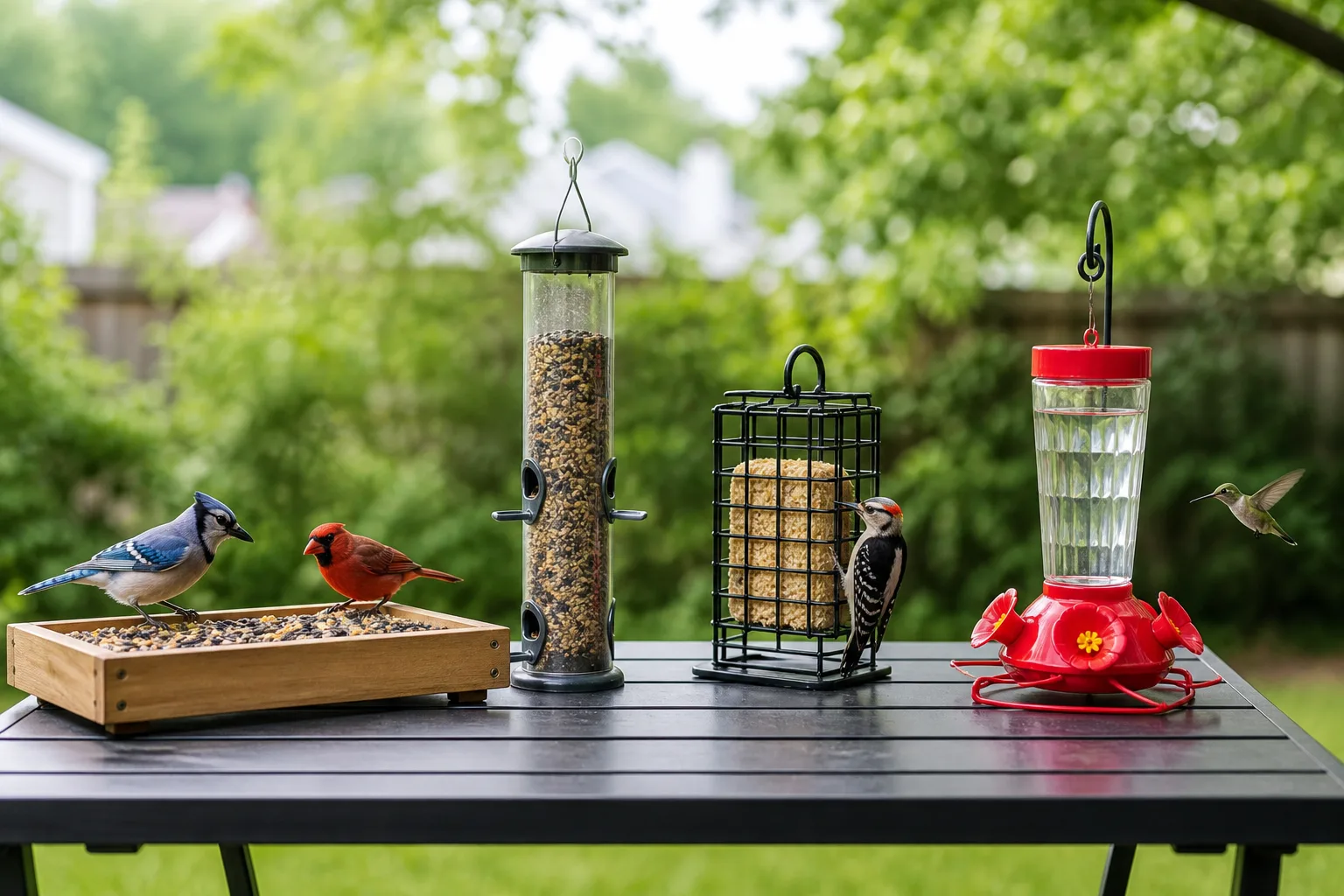
Cage versus weight-sensitive feeders
A caged feeder surrounds the food ports with a wire mesh or metal guard. Smaller birds pass through the openings, while crows and other large birds cannot fit their bodies or bills far enough inside. Check the actual spacing and construction: an oversized cage may admit jays, grackles, or other birds you were hoping to exclude, and flimsy wire can bend after repeated use.
A weight-sensitive feeder closes its ports when a heavy bird lands on the perch. It can be useful when the problem includes squirrels or larger birds, but it must be adjusted and mounted correctly. A crow that can reach the seed from the roof, hopper lid, or a broad feeding ring may bypass the perch mechanism entirely.
Avoid modifying a feeder with sharp wire, sticky substances, grease, or loose netting. Any barrier has to exclude the large bird without entangling feet, wings, or bills. Choose a model you can take apart for washing, because a complicated feeder that never gets cleaned creates a different problem.
3. Move the feeder with flight paths in mind
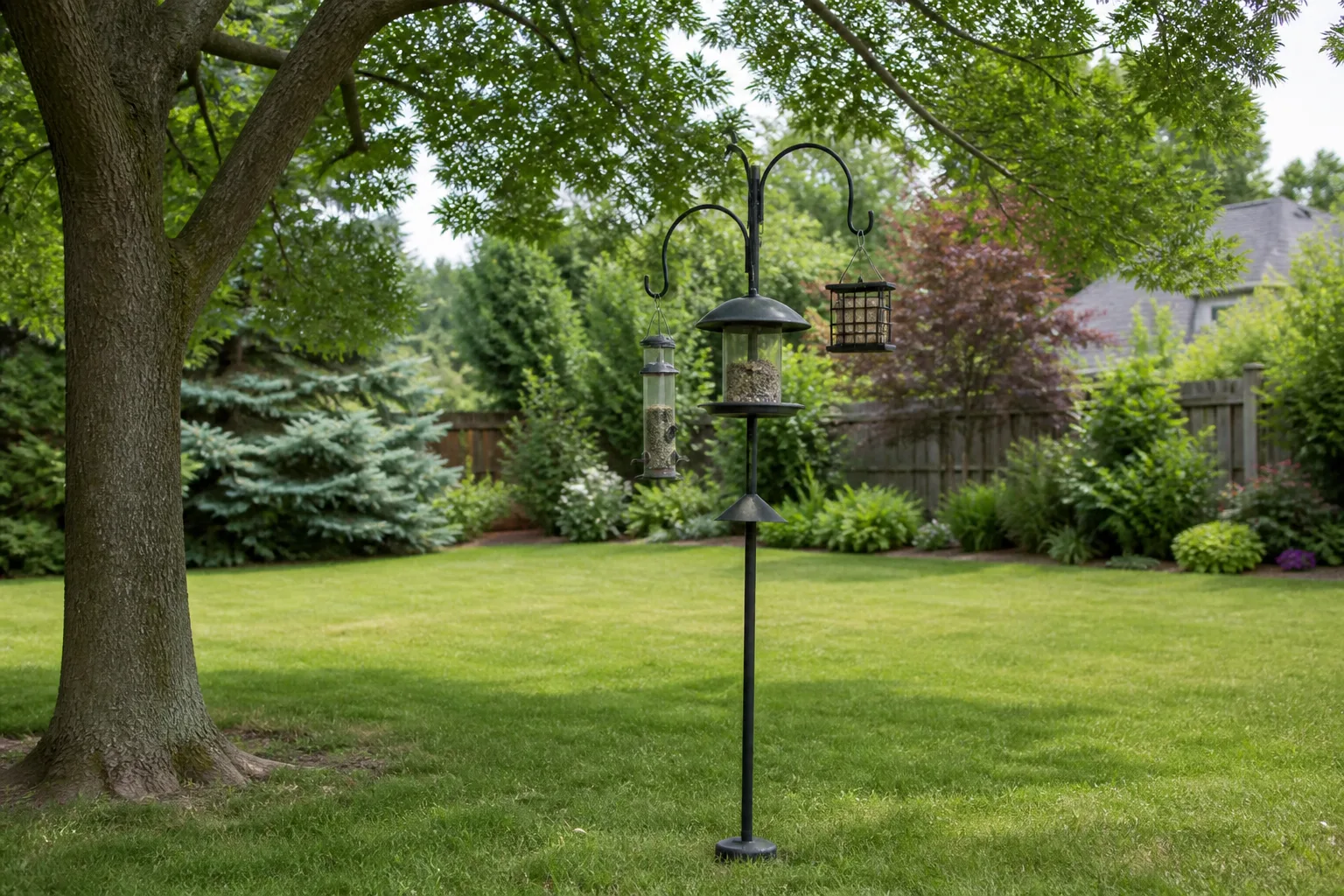
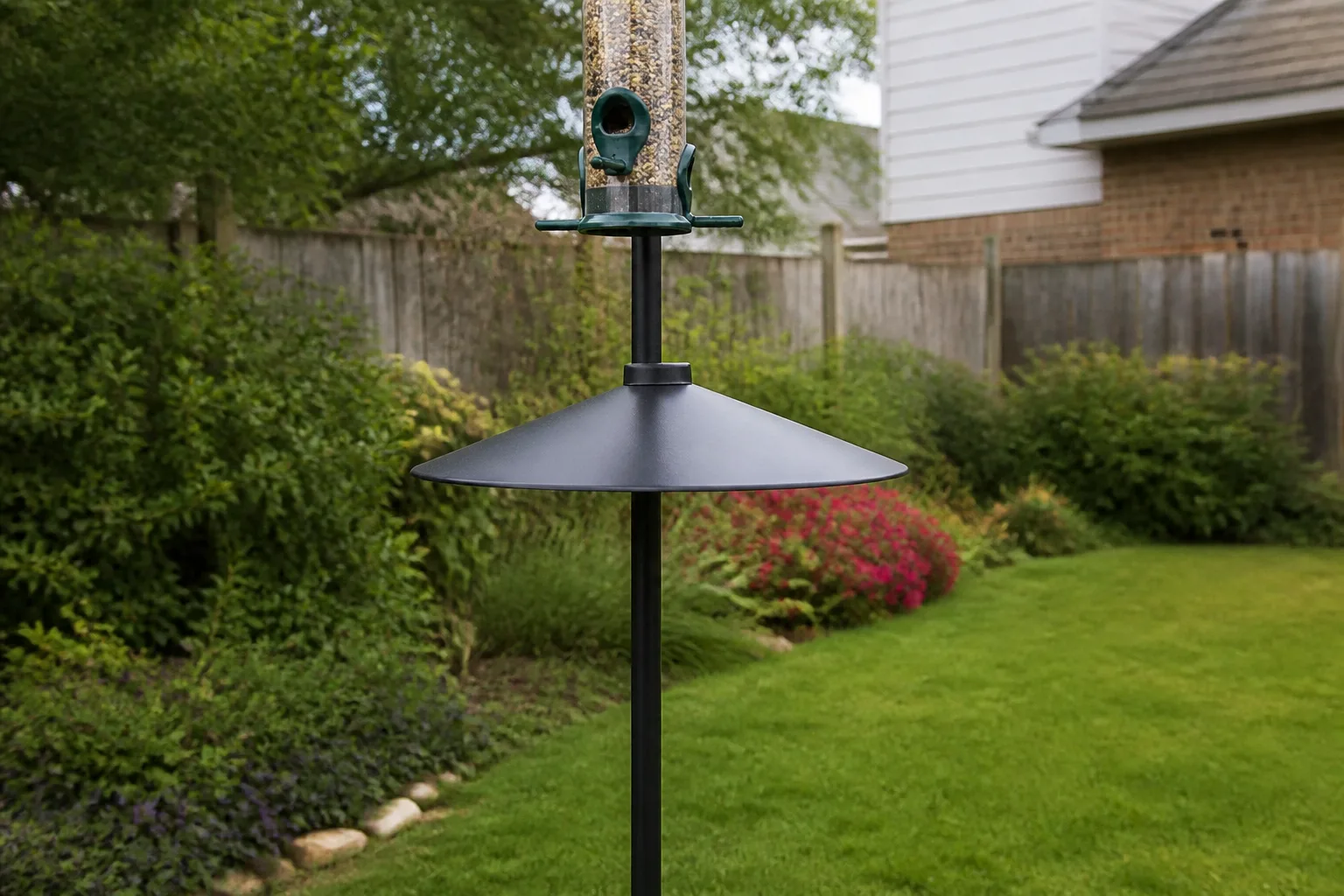
Placement determines whether a crow has to work for the food. Move the feeder into a genuinely open area, not merely a few inches from its old position. Keep it away from roofs, fences, pergolas, decks, thick horizontal branches, woodpiles, and walls that let a crow approach, perch, or launch directly toward the feeding ports.
The best location still gives smaller birds a nearby escape route. They need shrubs or trees close enough to provide cover, but a feeder buried in dense branches can create an ambush point for cats and a convenient network of perches for larger birds. The BHG guidance on common feeder mistakes recommends placing feeders near, rather than completely surrounded by, protective cover.
Balance clearance with protective cover
Think in three dimensions. From the ground, a crow should not be able to walk up to the feeder and reach it; from above, it should not be able to land on a branch and hop across; and from the side, it should not have a short glide from a roof or fence. The exact distance depends on the height of the feeder and the structures in your yard, so inspect the route rather than trusting a single number.
If you move a feeder into the middle of a lawn, add cover at a safe distance instead of placing it directly inside a shrub. Keep the station visible enough that you can monitor crows, cats, and spilled seed. Also account for wind: a swinging feeder can drift toward a branch or wall even when the static installation looked well separated.
Multiple feeders can help smaller birds spread out, but adding more stations can also multiply the food reward and cleanup area. If you use more than one, separate the food types and observe whether the new layout reduces crowding or simply creates several crow checkpoints.
4. Control feeding time, amount, and waste
Feeding on a schedule can reduce the hours in which a crow can profit from the station. It is not a guarantee because crows may be active at dawn, midday, or dusk depending on the local flock, weather, and nearby food. Watch your yard for two or three days, then offer a small amount shortly before the smaller birds usually arrive and remove leftovers before the crow activity peaks.
This routine works best when paired with portion control. Fill only what your target birds can consume in a day, and pause refilling if the feeder is still full. A feeder that sits empty for a short period is less damaging than a feeder that constantly broadcasts food to every opportunist in the neighborhood.
Make the ground part of the schedule. Sweep or rake beneath the feeder after the main feeding period, and clear damp clumps after rain. If a catch tray is useful for reducing waste, empty it frequently rather than allowing it to become a second platform feeder. The BBC Gardeners’ World Magazine feeder guide highlights the value of easy-clean designs and notes that flat surfaces can collect contaminated food.
If you cannot keep the area clean, take the feeder down temporarily. That is not a failure; it is a reset that removes the reward while you correct the setup. You can restart with a smaller fill and a better location once the ground is clear.
5. Add visual or motion deterrents carefully
Reflective tape, pinwheels, or a small moving object may make a new feeder feel unfamiliar, but visual deterrents lose value once crows learn that nothing follows the flash. Use them as a temporary layer while you change the food and access conditions, and move them occasionally so the stimulus does not become part of the background.
The popular idea that shiny objects reliably repel crows is not a strong enough basis for a whole control plan. Young crows may investigate objects, and adult crows may ignore them; your result will depend on the individual birds and what else the yard offers. Never hang anything that can shed strips, form loops, or entangle a bird.
Motion-activated sprinklers can be more useful when a crow approaches along a known route. Aim one at the approach path rather than directly at the feeder, and test the spray so it does not soak electrical connections, freeze on a walkway, or startle people and pets. A sprinkler is a behavior interruption, not a permanent barrier, and a determined flock may simply approach from another direction.
Avoid distress-call recordings, fake dead birds, aggressive chasing, and throwing objects. Crows are intelligent, social animals, and a threat that causes alarm can create noise, defensive behavior, or conflict with neighbors. Humane control should make the food reward disappear, not turn the yard into a repeated confrontation.
Should you create a separate crow feeding station?
A separate crow station sounds logical: put peanuts or other crow-preferred food in an open area far from the songbird feeder, then hope the crows stay there. It can work for a person who deliberately wants to observe crows and has enough space to manage two feeding zones, but it does not remove the flock from the property.
The Cornell Lab’s crow profile identifies peanuts in an open place as a strong crow attractant. That makes a diversion station a real food source, not a repellent. It may draw more crows, increase caching, attract mammals, or place crows closer to a garden, chicken run, or neighbor’s yard.
When diversion helps and when it backfires
Consider diversion only when you have intentionally decided that feeding crows is compatible with your space, local expectations, and cleanup capacity. Put the station well away from the small-bird feeder, keep it visible and easy to clean, and never assume that providing more food will make crows ignore the original source.
Skip the strategy when you are trying to reduce total wildlife visits, already have a large flock, live close to neighbors, or cannot manage spilled food. For most songbird gardeners, a barrier and a clean feeding area are simpler and more predictable than adding a second buffet.
The seven-day reset plan
Use this sequence when the crows keep returning and you need a controlled test:
- Day 1: Remove the reward. Take down the feeder, sweep the feeding zone, secure trash and compost, and remove pet food or fallen fruit.
- Day 2: Inspect the access map. From the ground, identify branches, roofs, fences, railings, walls, and slopes that connect a large bird to the feeder.
- Day 3: Choose one equipment change. Install a properly sized cage or weight-sensitive feeder, or switch from an open platform to a smaller-port design.
- Day 4: Rehang with clearance. Put the feeder in open space with nearby protective cover, then check that wind cannot swing it toward a launch point.
- Day 5: Refill sparingly. Offer only enough fresh seed for one day and remove any food that remains after the smaller birds finish.
- Day 6: Add one temporary deterrent. Test reflective movement or a motion sprinkler on the approach path, but do not add several devices at once.
- Day 7: Review the evidence. Compare crow landings, ground spill, target-bird visits, and feeder cleanliness with your notes from before the reset.
If crows still land directly on the feeder, the access barrier is the weak point. If they remain on the ground, the problem is probably spill or another food source. If smaller birds vanish too, the station may be too exposed, too close to a predator route, too noisy, or using a food they do not prefer.
Keep the feeding station safe for all birds
Crow control should not turn the feeder into a disease or predator hotspot. Wash feeders on a routine suited to the weather and feeder style, remove damp or moldy seed, and allow every part to dry before refilling. BHG’s bird-feeder guidance recommends thorough cleaning at least every two weeks and more often during wet conditions, while noting that open platform feeders may need weekly cleaning because damp food supports bacteria and fungi.
The Penn State Extension feeder guide also warns against feeding seed that has become moldy or insect-damaged. Do not pour suspect seed onto the ground as a disposal method; seal it for the trash or compost it only if your local compost system can handle it safely and the seed will not be spread back into a feeding area.
Place the feeder where you can see it, but do not create a cat ambush. Keep outdoor cats indoors, trim or manage cover that lets a cat hide immediately beneath the feeder, and avoid pesticide use around a station where birds forage. Native shrubs and seed-bearing plants can give birds food and shelter without requiring you to keep a large quantity of seed available every day; Penn State’s guide to inviting birds into a garden describes that broader habitat approach.
What not to use around a bird feeder
Do not coat seed with hot pepper, oil, grease, soap, chemicals, or an untested homemade mixture. Birds and mammals may contact the substance directly, residues can transfer to feathers or feet, and a treatment that is safe in one situation may be unsafe for pets, plants, or people in another. A substance added to food is especially hard to control because you cannot know which species will consume it.
Do not use glue traps, snares, fishing line, sharp wire, poison, or projectiles. These methods can injure non-target wildlife and create a hazard for pets and children. They also treat the bird as the problem when the real cause is usually a concentrated, accessible food source.
Be skeptical of fake owls, rubber snakes, upside-down crow decoys, and permanent scarecrows. A stationary prop may work briefly in a new location, but habituation is common and a decoy can make your feeder look strange without changing access. If you try one, use it only as a short-lived experiment while you make a structural or cleanup fix.
Troubleshoot when crows still win
If a crow still reaches the feeder
Look for a bypass rather than buying a stronger repellent. Is the bird feeding from a broad tray, clinging to the cage, knocking seed from the roof, or reaching through a gap that is too wide? Is the feeder hanging beside a branch or roof edge? Replace or adjust the single weak point, then observe for several days before adding another change.
If the crow is not reaching the food but is bullying smaller birds from a nearby perch, move that perch or reposition the feeder. Do not force the feeder into dense cover just to hide it; a safer solution is an open feeding zone with nearby retreat cover. A large flock or a permanent roost may limit how much separation is possible, in which case reducing the feeder’s food reward may be the most realistic goal.
If smaller birds stop visiting
Check the placement before assuming the crow-proof design failed. A cage with openings that are too small, an exposed feeder with no retreat cover, a new shiny device, or a motion sprinkler can discourage the birds you wanted to keep. Compare visits at the old and new location if you can, and change one feature at a time.
Also check the seed. Birds use feeders as a supplement, so visits naturally rise and fall with weather and wild food availability. If seed is fresh, the feeder is clean, and the location is safe, a short lull does not automatically mean the setup is wrong.
If the yard remains crowded, messy, or unsafe despite these changes, leave the feeder down for a longer period. A bird-friendly garden does not require a feeder, and native plants, clean water changed regularly, and natural shelter can support birds without concentrating them at one food point.
Conclusion
The best way to keep crows away from bird feeders is to make the station less rewarding and less accessible, in that order. Clean the ground and secure other food sources, then use a caged or weight-sensitive feeder, thoughtful placement, modest fills, and a short feeding window. Add motion or reflective devices only when the basic setup is already doing most of the work.
Keep the goal practical: smaller birds can feed safely, crows are not injured, and the yard does not become a permanent food hotspot. If the flock still dominates after a careful reset, taking down the feeder and shifting toward habitat-based bird gardening is a responsible solution, not giving up.