How to Keep Mulch From Washing Away on a Slope
Learn how to keep mulch from washing away with slope-ready materials, careful depth, erosion blankets, and runoff fixes that protect your soil and plants.

Mulch that disappears after rain usually points to one of two problems: the material is too loose for the slope, or water is moving through the bed too quickly. Sometimes both are true. Replace the mulch only after you know whether water is spreading gently across the surface or arriving in a concentrated stream from a roof, path, driveway, or higher part of the yard.
The dependable fix is a sequence, not a thicker layer. Find the water source, slow or safely manage the flow, use a fibrous mulch that can knit together, protect bare soil while plants establish, and then let roots provide the durable hold. Mulch reduces raindrop impact and can limit erosion, but it is not a retaining wall and cannot stop a channel of fast runoff by itself.
First identify what is moving
Look at the bed after rain before you rake it smooth. If the mulch has shifted but the soil surface underneath is still level and covered, the issue may be material choice, slope, wind, or a modest runoff pulse. If you see exposed roots, a thin layer of sediment at the bottom, muddy water, small channels, or a newly cut groove, soil is moving too; adding mulch without addressing water flow will only hide the warning for a short time.
Notice where the displaced mulch ends up. A fan-shaped pile at the foot of the bed often points to broad runoff down a grade, while a narrow trail that begins under a downspout, at a path edge, or below a low point suggests water is being concentrated. Also check whether the mulch is floating: light bark can bob and travel in a puddled bed even when the grade is mild.
Read the runoff before changing the mulch
Observe the next ordinary rain from a safe place, or use a hose at low flow if the ground is not already saturated. Trace water from the highest point that drains toward the bed, not just the patch where mulch collected. Roofs, paved paths, compacted soil, sprinkler runoff, and a neighboring grade can all feed a planting bed more water than it can absorb.
Do not test a slope during a severe storm or walk on muddy, unstable ground. A short video from an upper window can show whether water spreads, converges, ponds, or exits the property without putting you on the bank.
Thin sheet flow
Sheet flow is water moving as a shallow, broad layer rather than in a defined channel. It can push loose bark, especially on a long or steep face, but it may be manageable with a rougher, more interlocking mulch, healthy groundcover, and small breaks in the slope’s uninterrupted run. If the soil stays intact and there is no repeated gully, start with these surface-level changes before building anything.
The slope still matters. Iowa State Extension describes gentle grades as having fewer special planting demands and notes that steeper grades are harder to access, more likely to shed water before it soaks in, and more prone to erosion when roots are absent. The same guidance recommends planting along contour and staggering plants so rows do not become channels. (Iowa State University Extension and Outreach)
Concentrated flow and repeat gullies
A groove that deepens after each storm is not a mulch problem alone. Water has found a path and is carrying soil with it, so the priority is to reduce the amount or speed of water reaching that point and protect the exposed ground. Look uphill for a downspout outlet, a compacted track, a roof valley discharge, a paved surface, or a swale that now empties into the bed.
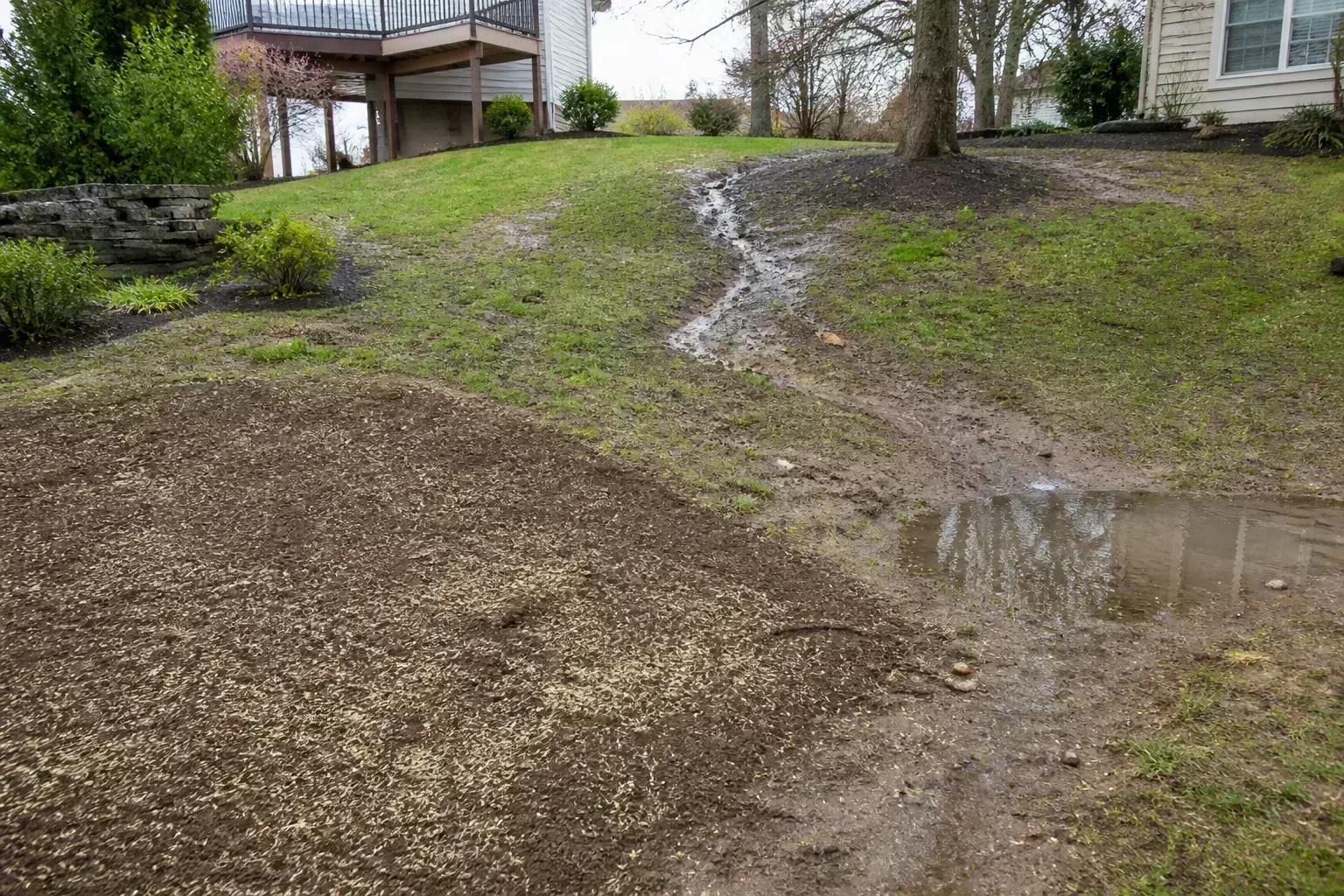
Do not fill a gully with loose mulch and assume it is fixed. The next flow can wash out both the material and more soil, while an improvised ditch may collect water and send it toward a foundation, sidewalk, neighbor, septic field, or public drain. For persistent channelized flow, use local stormwater guidance or a drainage professional to choose an outlet and stabilizing treatment.
Match the fix to the cause
Use the lightest intervention that addresses the actual source. For simple surface movement, change the mulch texture, correct thin or bare patches, and cover exposed soil. For flow coming from above, reduce or redirect that inflow only toward a safe, approved area; for a steep unstable bank or repeated soil loss, a mat, plants, terracing, engineered drainage, or a combination may be needed.
The order matters. Do not spend money on a tackifier, stone border, or extra mulch until you know what it is expected to do. A product that holds mulch in place during a light shower may fail during roof runoff, and a barrier that catches mulch can become a dam that holds water against a structure.
Choose a mulch that grips the slope
For a planted slope with low to moderate, diffuse runoff, choose a material with fibers or irregular pieces that settle into one another. Iowa State Extension notes that shredded bark, leaf mold, and grass clippings are less likely to wash downhill than bark chips or river rock. UF/IFAS Extension similarly describes shredded mulch as useful for erosion control on slopes, while cut chips are looser and may not pack together as tightly; Fine Gardening likewise emphasizes matching mulch to the plants and the job rather than expecting one material to suit every bed. (Iowa State University Extension and Outreach; UF/IFAS Extension Polk County)
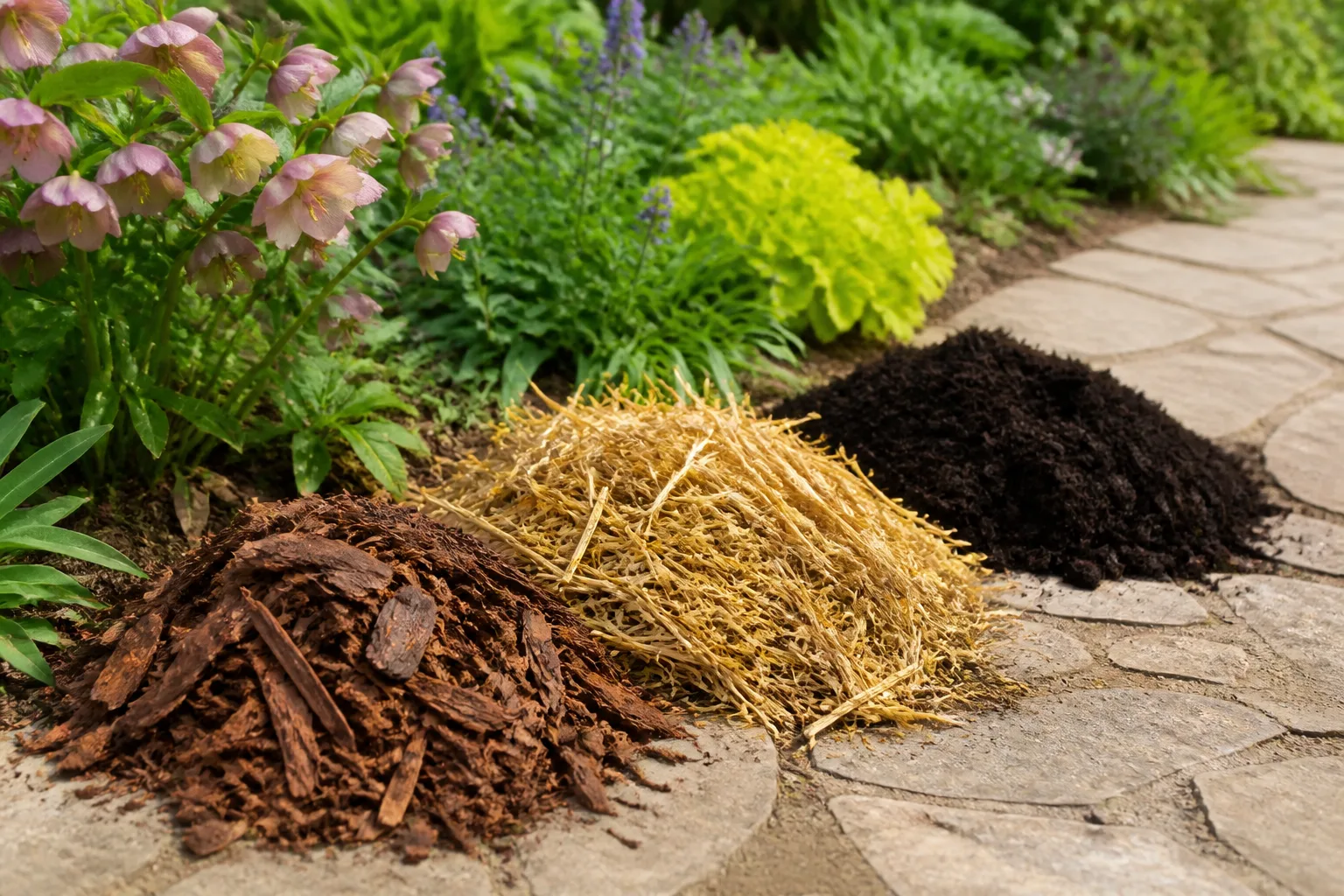
Shredded bark, leaf mold, and pine straw
Shredded bark often knits into a mat once it settles, so it can work better than large bark nuggets on a sloped bed. Leaf mold and chopped leaves are light and improve the soil as they break down, but whole leaves can blow or mat; shred them and use a thin, even layer. Pine straw can interlock and is easy to tuck around established plants, but it is not appropriate for every climate, plant palette, or fire-prone site, so check local fire-wise guidance before using it near structures.
Coarse wood chips can be useful around shrubs and perennials, especially when they include different particle sizes and rest directly on soil. Their bulk can make them harder to move, and very fresh woody material may tie up nitrogen where it is mixed into soil; keep chips as a surface layer. Grass clippings are best applied in thin, dry layers because thick wet clippings mat, heat, smell, and shed water instead of forming a stable blanket.
No material is guaranteed to stay put in every storm. A product that behaves well on a short garden bank with occasional showers may move in a low rain garden, a steep cut slope, or a bed receiving roof runoff.
Why bark nuggets and gravel still move
Large bark nuggets seem heavy in a bag, but individual pieces can float when water pools and roll downhill on a smooth grade. Rounded gravel can travel with fast water too, and loose stone does not improve soil structure; in a hot sunny bed, rock can also heat the root zone. Stone may be appropriate at a deliberately designed, high-energy inlet or outlet, but that is different from spreading river rock over a planted slope and expecting it to stop erosion.
Landscape fabric under organic mulch is not a reliable anchor. Mulch placed over fabric is less connected to the soil, so it can be more vulnerable to blowing or washing away; weeds also establish in the organic debris that accumulates above the fabric. Iowa State Extension recommends avoiding sheet material beneath organic mulches when soil contact and long-term soil improvement matter. (Iowa State University Extension and Outreach)
Rebuild the bed without overloading it
Once the rain has passed and the soil is workable, remove only the material that is blocking a drain or piled against plants. Rake displaced mulch back uphill only if it is clean and has not mixed with sediment, road grit, or contaminants. If topsoil has been exposed, restore the surface gently with compatible soil or compost rather than deep digging that loosens the slope further.
Preserve existing roots and plant cover wherever possible. On a slope, a patch of established grass or groundcover may be doing more to hold soil than a newly installed layer of mulch; cutting everything back to bare dirt increases the vulnerable area. Iowa State recommends leaving killed turf and its roots in place when converting a hillside, then planting through it, because those roots continue to hold soil while new plants establish. (Iowa State University Extension and Outreach)
Remove old landscape fabric only when you can do so without tearing up roots or destabilizing the bed. If it is embedded, cut it into manageable sections and work gradually rather than pulling a large sheet out of a steep, wet bank. Where the current layer has become a thick, decomposing mat, loosen or thin it before adding new mulch so water can reach the soil and the finished layer does not bury crowns.
Apply an effective layer without piling it on
Spread a consistent, settled layer rather than creating a thick mound to add weight. For many landscape beds, about 2 to 3 inches of fibrous mulch is a reasonable starting point, but the best depth depends on the mulch texture, soil, plants, climate, and drainage. Iowa State Extension gives a general working range of 2 to 4 inches, with finer materials toward the lower end; Caltrans uses 2 to 3 inches in its erosion-control practice for slopes 2:1 and flatter, a useful reminder that added depth is not a universal substitute for slope stabilization. (Iowa State University Extension and Outreach; Caltrans Erosion Control Toolbox)
Keep mulch clear of trunks, crowns, and plant stems, and do not bury low-growing foliage or seedling bases. On a slope, gravity naturally makes the lower edge thicker, so rake material into a nearly even layer instead of building a heavy lip at the bottom. A deep blanket can keep water from reaching roots, hold excess moisture near crowns, or hide a gully that still needs a drainage fix.
Do not work compost, fresh chips, or bark into the soil just to make it “stick.” Incorporating bulky woody material into the root zone can disrupt planting and temporarily affect nitrogen availability, while turning the slope can expose more soil to runoff. Place organic mulch on the surface and let soil organisms incorporate it gradually.
Reduce water arriving from above
If water enters the bed at the top, correct that source before stabilizing the lower area. Check gutters for overflow, downspouts for a loose elbow, roof valleys for a concentrated discharge, and paths or paving for a low edge that channels water onto the slope. Move a downspout outlet only if the new discharge point can safely handle the flow and does not send water toward a building or neighboring property.
Sometimes the first fix is maintenance rather than construction: clear a clogged gutter, reconnect a downspout, repair a leaking hose, or redirect a sprinkler head away from the bed. If a broad paved area drains toward the slope, a small landscape adjustment may not be enough; a properly sized rain garden, swale, infiltration area, or drain needs suitable soils, setbacks, and an overflow path. The U.S. EPA’s landscaping guidance recommends deep-rooted regional groundcovers and shrubs for slope stabilization, while Massachusetts homeowner stormwater guidance emphasizes dissipating concentrated flow rather than allowing it to scour exposed ground.
Secure bare soil while plants establish
When the soil is exposed or seed is at risk of washing downhill, a biodegradable erosion-control blanket can hold the surface while vegetation takes root. Jute, coir, or a straw-fiber blanket can be pegged firmly against the grade, with seed or small plants installed according to the manufacturer’s directions; a loose gap underneath lets water run under the mat and can lift it. Choose a product rated for the slope and intended use, and check whether its netting is biodegradable or could persist after the fiber decays.
Blankets are temporary protection, not a permanent drainage plan. They are most useful while plants establish, on slopes where loose mulch slides, or where seed needs surface contact; they will not stop a strong pipe discharge or stabilize a failing bank. The RHS describes pegged coconut matting as temporary soil protection that can be planted through, while Oregon State Extension guidance describes combining mats or wattles with vegetation on more demanding slopes. (Royal Horticultural Society; Oregon State University Extension, Ask Extension)
For a very small patch, biodegradable netting can be overkill. A few strategically placed plants, a thin layer of shredded mulch, and small stones around individual root balls may be enough if the slope has only mild sheet flow and no sign of soil loss.
Use plant roots as the long-term anchor
Mulch is a bridge until the bed is covered by plants. Choose groundcovers, low shrubs, sedges, or ornamental grasses that suit local light, soil, moisture, winter temperatures, and rainfall; a fast-growing plant that dislikes your climate can create more work than it saves. Native or well-adapted plants often need less supplemental water and fertilizer once established, but even drought-tolerant plants may need reliable watering during their first season or two.
Use a mix of growth forms rather than one shallow mat everywhere. Fibrous grasses and sedges cover soil, spreading groundcovers fill gaps, and small shrubs add deeper roots and structure; stagger them across the slope rather than planting straight rows that guide water downhill. Keep mature size and spreading behavior in mind so a low-maintenance planting does not become invasive or crowd paths and neighboring beds.

Iowa State Extension notes that layered plantings and varied root systems can help reduce surface erosion, while the EPA advises selecting regionally appropriate native plants for local climate and soil conditions. That is a long-term strategy, not an immediate repair: keep temporary mulch or matting in place until plants provide consistent cover, and water according to establishment needs rather than assuming the slope is self-sufficient from day one. (Iowa State University Extension and Outreach; U.S. EPA)
Make edging and terraces work with the slope
Edging can catch mulch at a lawn boundary, but it cannot absorb runoff. A low, porous edge that allows water to pass is safer than a solid lip that holds water against paving, a foundation, or the next bed; leave deliberate openings where drainage must continue. If the problem is a narrow gap where mulch spills over a walkway, a modest border may be all you need, but if water piles behind that border, the design has turned into an unplanned dam.
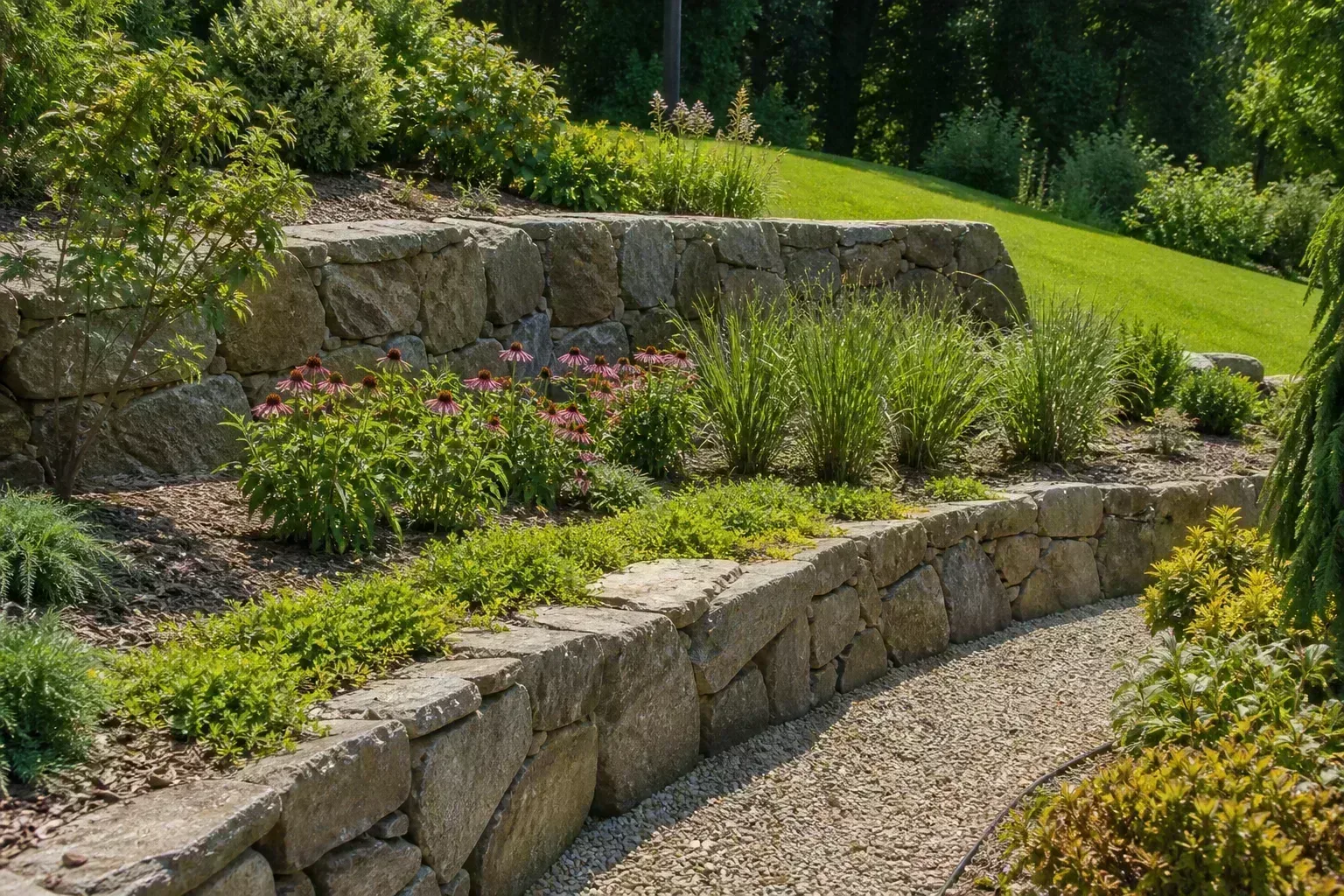
Terraces, boulders, timber, or stone steps can shorten a long slope and create planting shelves, but structural work changes how water and soil move. Retaining walls need suitable foundations, drainage behind the wall, and sometimes permits; do not treat stacked landscape blocks as a DIY fix for a tall or loaded bank. Iowa State Extension describes terraces as a way to slow runoff and create planting zones, while emphasizing plants and soil cover as part of broader hillside management. (Iowa State University Extension and Outreach)
Avoid digging an arbitrary trench across the top or bottom of a slope. A trench can concentrate water, undermine roots, or route runoff to a neighbor if it is not graded to a stable outlet. Use a designed swale or channel only when it is sized for the flow, protected against scour, and allowed by local rules.
Treat downspouts and wet areas as drainage projects
A rain garden or vegetated swale can help manage runoff, but only when the site is suitable and the overflow has a safe route. Soil that drains slowly, a high water table, contaminated ground, nearby wells or septic systems, a steep grade, and proximity to a foundation can change what is safe to build. A mulch bed that stays underwater may need water-tolerant plants, an approved overflow, or a more stable surface material rather than repeat applications of bark.
In an area that regularly floods or receives fast flow, organic mulch can float and leave soil bare. The Missouri Botanical Garden’s rainscaping guidance warns that loose organic mulch is a poor choice in steep, high-volume, high-velocity rain-garden and bioswale areas; denser vegetation or an engineered mineral surface may be appropriate in the flow path, while surrounding planting beds can still use organic mulch. (Missouri Botanical Garden Rainscaping Guide)
Do not move a downspout discharge to a neighbor’s yard, block an existing drainage path, or send sediment into a storm drain. Penn State Extension’s stormwater-neighbor guidance advises homeowners not to direct runoff onto a neighboring property or block water from leaving it; check municipal stormwater rules before changing grades, installing a drain, or altering an outlet. (Penn State Extension)
Follow local rules before major grading
Minor surface mulching is different from regrading land, building a retaining wall, changing a drainage easement, or discharging water to a public system. Before digging, check local requirements for stormwater connections, grading, erosion control, wetland buffers, tree protection, and property-line drainage. In the United States, contact the relevant utility-locate service before excavation; where a local agency has specific rainwater or downspout rules, its instructions take precedence over generic online advice.
Keep the natural path of water in mind as you plan. A solution should make the flow slower or more stable without creating a new problem at the foundation, sidewalk, property line, septic system, or waterway. If you do not know where an outlet can safely go, pause and ask the municipal stormwater office, conservation district, Extension service, or a qualified drainage professional before digging.
Repair washout and inspect after storms
Wait until water has drained and soil is firm enough to work without smearing or compacting it. Remove mulch that has crossed into pavement or a drain, replace lost soil only where the surface has actually eroded, and refill with a light, even layer of appropriate mulch. If washout repeats from the same point, mark that area and fix the cause instead of refreshing it after every storm.
After the next few rains, check four things: whether the top of the bed is still receiving concentrated water, whether the mulch layer is thinning unevenly, whether soil or sediment is moving, and whether the outlet is clear. Rake mulch that has formed ridges back across the bed; do not scrape away leaves or healthy groundcover that are protecting the soil. Replenish only what has decomposed or truly left the site, and keep the final depth within the range appropriate for the plants and material.
Make a simple maintenance note after unusually heavy rain. If the bed performs well during several ordinary storms but fails only when a gutter overflows or water backs up, the response should target that event; if each moderate rain expands a gully, escalate the slope or drainage design before erosion deepens.
Know when the problem needs a professional
Call a qualified landscape drainage or slope professional when water cuts a deepening channel, a large area of soil is moving, an uphill discharge cannot be safely redirected, or a wall is leaning, cracking, bulging, or holding wet soil. Also seek site-specific advice if the slope is very steep, supports a driveway or structure, sits near a foundation or property line, or remains saturated long after surrounding ground dries.
One Oregon State Extension response uses rough site-specific screening guidance: mulch and vegetation may suffice below a 30 percent grade; a 30 to 50 percent grade may need a combination of mats or wattles and plants; above 50 percent, structural measures may be needed. Those are not universal design standards or a guarantee of slope stability; soil type, slope length, water volume, and signs of ground movement matter, and the same Extension response recommends professional assessment when those forces are present. (Oregon State University Extension, Ask Extension)
An experienced professional should explain where water enters and exits, what will prevent erosion during construction, and how the finished system handles overflow. Ask whether a permit, engineer, utility locate, or local stormwater review is required, and avoid anyone who promises that extra mulch alone will permanently stabilize an active slope.
Conclusion
To keep mulch from washing away, first identify whether you are dealing with loose material, a gentle sheet of runoff, or a concentrated stream that is carrying soil. Choose an interlocking mulch for mild slopes, spread a measured layer without burying plants, and use a biodegradable blanket or temporary cover when bare soil needs help while roots establish.
If a downspout, paved surface, or repeat gully is feeding the problem, make a safe runoff plan before rebuilding the bed. Mulch can protect soil and conserve moisture, but lasting stability comes from matching the material and drainage to the site and letting suitable plants cover the ground over time.



