How to Keep Peonies From Falling Over in Spring
Learn how to keep peonies from falling over with the right cage, stake, tie, timing, and site fixes for heavy blooms and spring rain.
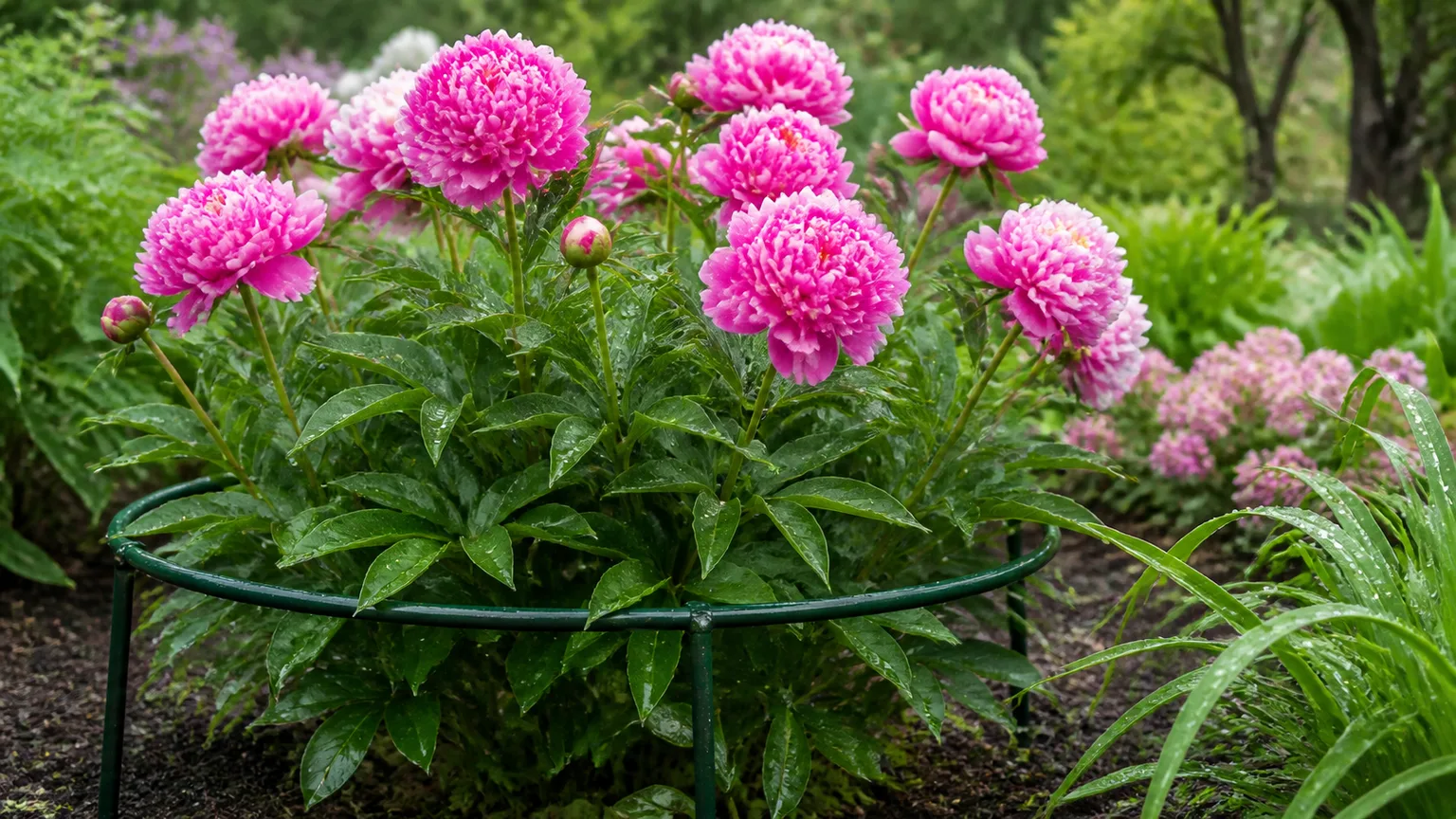
If your peonies fall over every spring, start with support—not a shovel. A grow-through cage or peony ring installed while shoots are still short prevents the whole clump from splaying, while a bamboo stake and soft tie can rescue one wayward flower stem after buds appear.
The right fix depends on the failure pattern. Heavy double blooms that collapse after rain need a structure around the clump; one bent stem needs a single stake; a sprawling row needs perimeter stakes or horizontal netting. Light, planting depth, drainage, and fertilizer affect stem strength, but they rarely eliminate the need to support a top-heavy cultivar.
The fastest fix depends on when your peony flops
If the shoots are still only a few inches tall, place a cage or grow-through support over the plant now. The stems will grow through the grid, hiding much of the structure by bloom time. The Royal Horticultural Society recommends inserting perennial supports in early spring, before growth becomes difficult to work around, and Penn State Extension notes that supports should be inconspicuous but strong enough for the mature plant (RHS staking guidance; Penn State Extension).
If the plant is already in bud or flower, do not force a full cage over a dense canopy. Use individual stakes for the stems that need help, or assemble a loose perimeter corral outside the crown. This late-season approach takes longer to hide, but it reduces the chance of snapping shoots or knocking off buds while you work.
If rain has already pushed the flowers to the ground, first check whether the stems are bent or broken. A bent stem can sometimes be lifted gently into a support; a split or sharply creased stem is a cut-flower candidate, not a stem to straighten by force.
Why peonies fall over in the first place
Peony flopping is usually a load-and-leverage problem, not proof that the plant is unhealthy. A tall stem carries a large flower at its tip, and the farther that flower extends from the crown, the more force it places on the lower stem. Double and semi-double flowers are especially vulnerable because their many petals hold rain.
The support question is therefore not “How do I make every stem rigid?” It is “How do I keep the flower heads from pulling the stems outside the plant’s base?” A good cage spreads the load across the clump, while a good tie gives a single stem a little help without pinching it.
Heavy blooms and rain multiply the load
A dry peony flower may stand upright until a spring storm turns its petals into a wet, top-heavy mass. Longfield Gardens describes this as a common weakness of many double and semi-double herbaceous peonies and recommends low-tech structures that hold flowers above the soil (Longfield Gardens’ peony support guide).
Wind adds a different force. It rocks the crown, rubs stems against supports, and can push an entire clump over if the stakes are shallow or the support is too small. A sheltered bed helps, but even a protected plant can need a cage when its flowers are large enough to act like sails after they open.
Low light, rich soil, and exposure weaken stems
Peonies grown in insufficient light may stretch toward the brightest side of the bed instead of building a compact, balanced clump. Penn State Extension lists less-than-optimal light, high wind, heavy rain, and top-heavy flowers among the conditions that increase the need for support. If a plant leans toward one direction before the buds open, the site is part of the diagnosis, not just the symptom.
Too much fertility can also push soft, lush growth. The RHS warns that nutrient-rich soil or overfeeding can make perennials more prone to collapse, while its peony growing guide recommends fertile soil without waterlogging and says peonies benefit from staking because their flower heads are large (RHS guide to staking perennials; RHS herbaceous peony growing guide).
Match the support to the failure pattern
Use the smallest support that solves the actual problem. A full cage around a single rogue stem is unnecessary and can make a small plant look crowded; one short stake in a mature clump is unlikely to stop every flower from dropping after a storm.
| What you see | Best first support | Why it fits | Main limitation |
|---|---|---|---|
| Most of the clump is leaning or splaying | Grow-through cage or grid ring | Distributes weight and lets stems grow through | Must be installed early or fitted in sections |
| One or two flowers are leaning | Individual stake with a soft tie | Targets the load without disturbing the whole plant | More visible and needs checking as the stem grows |
| Several stems are falling outward | Four to six perimeter stakes with two or three twine loops | Inexpensive and adjustable for large clumps | Less discreet than a purpose-built cage |
| A row of plants needs one continuous structure | Horizontal netting over perimeter stakes | Supports multiple plants at a consistent height | Requires early setup and tight, well-anchored netting |
Whole clump leaning: use a cage or grow-through ring
A peony cage is the most forgiving choice for a bushy clump with many heavy flowers. Its grid or rings catch stems at several points, keeping the flowers separated and making the mature plant look fuller rather than tying every stem into one bundle. Longfield Gardens notes that cages are designed to go over the plant in early spring, before the plant has leafed out, and that they can remain in place if they do not interfere with seasonal growth.
A ring without a grid is quicker to add around a partly leafed plant and can be a good compromise for an established clump. Choose a support tall enough that flower stems do not bend sharply over its top edge; Longfield Gardens recommends rings at least 24 inches tall because a low ring can become a new break point when rain-soaked flowers lean against it.
One or two stems leaning: stake them individually
Individual staking makes sense when most of the plant is standing and only a few flowers are too heavy. Insert a sturdy bamboo, wood, or metal stake beside the stem, close enough to offer support but not so close that you drive it through the crown. Penn State Extension recommends placing the stake near the stem while avoiding root damage, then using a loose figure-eight tie so the living stem does not rub directly against the stake.
This is also the best late-season option because you can place the stake beside a visible stem instead of trying to thread a cage through a full canopy. The trade-off is appearance: a few stakes may show, and you will need to inspect them as the stem lengthens and the flower opens.
Several stems sprawling: corral the perimeter or net a row
For a large clump that is too mature for a cage, push four to six strong stakes around the plant’s outer perimeter, not through the crown. Connect them with soft twine at two heights, leaving enough room for foliage and stems to move. Longfield Gardens recommends adding two or three loops at different levels for larger plants; the lower loop catches outward growth while the higher loop supports the flowers.
For multiple peonies planted in a row, horizontal netting can be more efficient than separate cages. Longfield Gardens recommends setting strong stakes around the row before plants reach about 12 inches tall, suspending the netting roughly 18 to 20 inches above the soil, and keeping it taut so stems grow up through the openings. This works best in a production-style or long border planting where a visible grid matters less than even support across several plants.
When to install support without damaging growth
The ideal window is early spring, when peony shoots have emerged but the plant has not filled out. A support installed while growth is small becomes part of the plant’s framework; a support forced over a fully leafed clump can bend shoots, break buds, and disturb the crown. The RHS specifically advises early insertion because later staking becomes difficult as growth advances.
For a new plant, do not wait to see whether its first bloom flops. A young peony may have fewer stems, but its flower-to-stem ratio can still be awkward, and establishing support early is easier than repairing a bent plant. If you are unsure, place a low grow-through ring with room for the clump to widen rather than wrapping the young plant tightly.
Supports are not a one-time installation. Check them after a week of rapid growth, after strong wind, and when buds begin to swell. Loosen ties, raise a tier of twine, or reinforce an anchor before the stems are pressed hard against the structure.
How to fit a peony cage early in spring
Choose a cage or grid ring that matches the plant’s mature width, not just the current shoot spread. The legs need to reach firm soil outside the crown, and the upper grid should sit low enough to catch stems before they lean but high enough that new shoots can emerge freely.
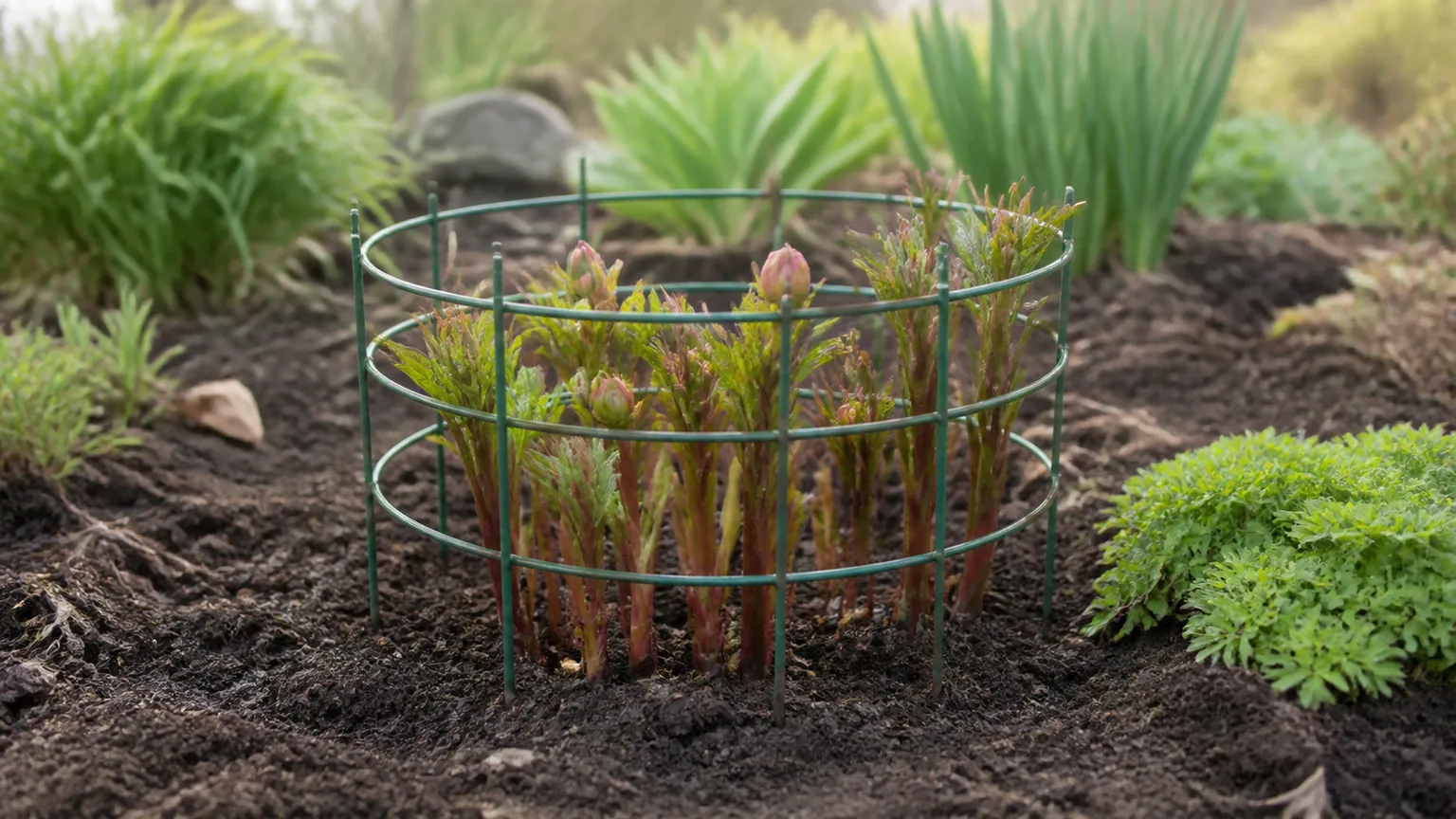
A grow-through cage is easiest to hide when it is installed before the peony fills out.
Set the support over the plant while the shoots are small, then press each leg into the soil with steady downward pressure. Do not rock a leg back and forth through the crown, and do not use the support as a lever against a thick root. If the soil is hard, water the bed first and place the leg in open soil at the perimeter.
As the stems grow, guide them through the grid rather than pulling them sideways. The goal is a loose, distributed framework: foliage should not be trapped, flowers should have room to open, and the plant should still move slightly in wind. The RHS advises against rigidly tying plants and emphasizes that supports need to be securely anchored for tall plants and large clumps.
How to stake a blooming stem safely
Use a stake that reaches the ground deeply enough to hold its position but stays shorter than the mature plant’s visible height. Penn State Extension advises choosing stakes about 4 to 8 inches shorter than the mature plant while driving them 8 to 10 inches into the ground, a useful way to keep the support discreet and stable.
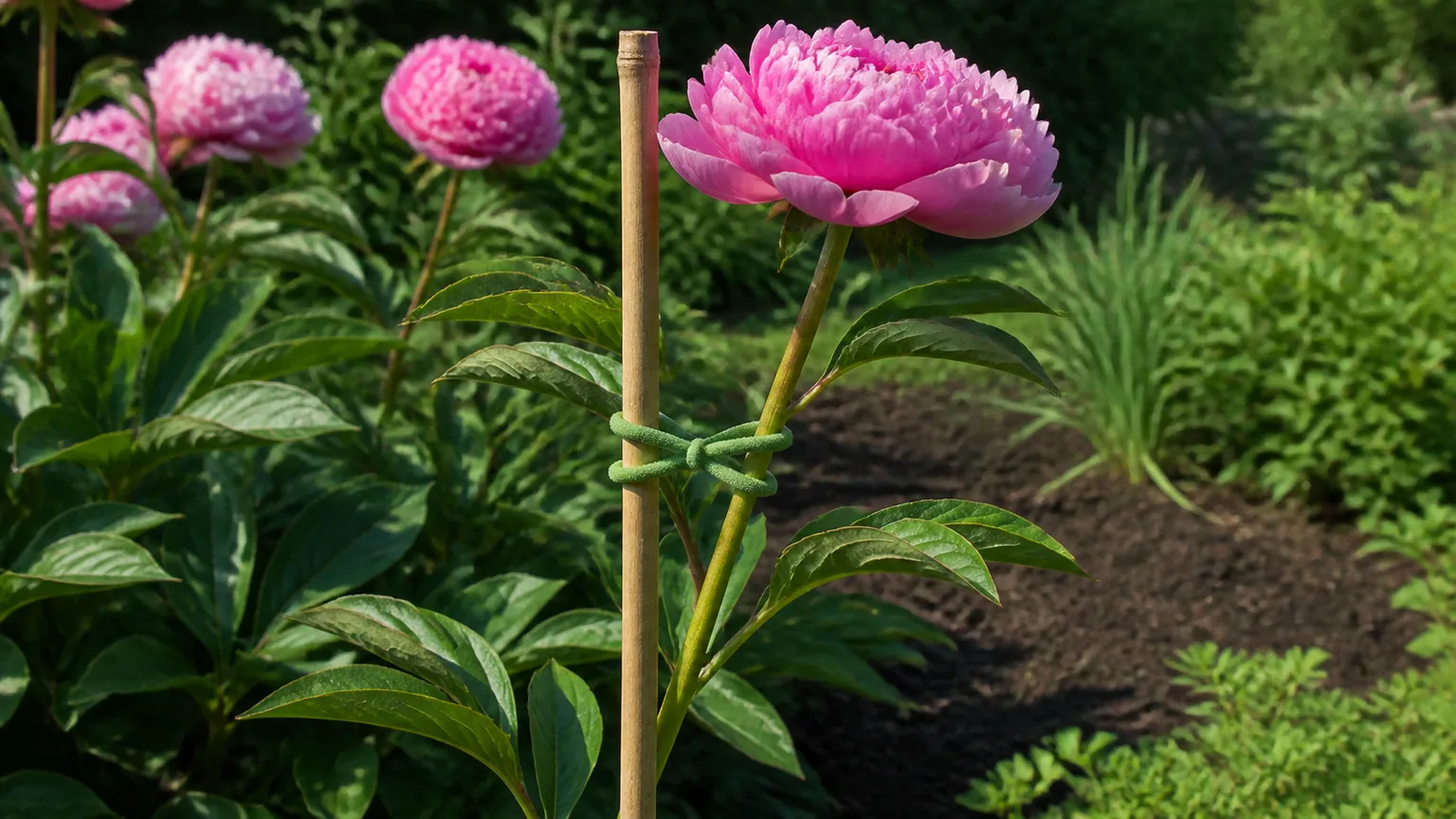
A soft, loose tie supports one heavy bloom without cinching the stem against the stake.
Place the stake beside the stem, then tie the stake first and the stem second so the tie forms a loose figure-eight. Leave a small gap where the stem crosses the tie; the stem should not be pressed flat against the stake. For a tall flower, use one tie lower on the stem and another closer to the bloom, as described by gardening experts in Ideal Home’s comparison of individual peony stakes and cages (Ideal Home).
Use soft twine, a flexible plant tie, or a strip of fabric rather than bare wire or a thin plastic loop. Check the tie every few days during peak growth and after rain. If you can slide a finger between tie and stem, that is a quick check; if the tie has cut into the bark-like surface or the stem is rubbing, retie it immediately.
What to do after rain or wind knocks blooms down
Do not start by pulling every flower upright. First walk around the plant and sort the stems into three groups: upright, bent but intact, and split or broken. Leave upright stems alone, gently lift bent stems into an existing cage or add a nearby stake, and cut broken stems cleanly for the vase.
If the flowers are soaked, let excess water drain naturally rather than shaking the plant hard. A light, careful movement can release droplets, but rough handling can snap a stem that is already carrying more weight than it can manage. After the storm, check whether the support itself has tilted; a cage leaning with the plant is not providing useful support.
Remove fallen petals and flowers from soil if they are decaying against foliage, but do not strip healthy peony leaves just because the flowers are finished. The leaves continue to power the plant after bloom. Cleanly remove diseased or badly damaged tissue, and keep the foliage open enough for air to move through the clump.
Build stronger plants for next spring
Support structures are the direct fix; site correction is the long-term fix. Give herbaceous peonies full sun or a bright position suited to your climate, keep them away from constant wind tunnels, and leave enough room for the clump to develop without being crowded by shrubs or aggressive groundcovers. The RHS recommends about 1 meter, or 3¼ feet, of space between peonies depending on mature spread, and says the soil should be fertile but not waterlogged.
Check planting depth before you blame the cultivar. Peony eyes should sit shallowly beneath the soil surface; the RHS specifies no more than about 2.5 centimeters, or 1 inch, of soil over the buds. Deep planting is more strongly associated with poor flowering than with a simple support failure, but a poorly placed plant may also lean toward light and be difficult to support evenly.
Feed conservatively. A peony that receives repeated high-nitrogen fertilizer can make a lot of foliage and soft growth without gaining a proportional increase in stem strength. A soil test is more useful than guessing; if the bed is already fertile, compost or a light, balanced feeding at the appropriate seasonal window is less likely to create an oversized, floppy canopy than repeated nitrogen applications.
Variety choice matters too. Some double-flowered herbaceous peonies are simply more likely to need support because the flowers are large and densely petaled. Intersectional peonies often have sturdier stems, but they can still need support in wet or windy weather; tree peonies have woody stems and a different growth habit, so do not use a tree-peony care rule as a substitute for the needs of an herbaceous clump.
When moving a peony is worth the risk
Move a peony only when the site problem is persistent and significant: deep shade, repeated wind exposure, poor drainage, severe crowding, or a location where the plant cannot be supported without damaging nearby growth. Do not transplant a healthy, well-placed peony simply because one wet week flattened its flowers. A cage may solve that problem with far less disruption.
If relocation is justified, plan it for fall after the foliage dies back, not during spring bloom. The RHS recommends fall planting for bare-root divisions and says established peonies can be lifted and divided in late autumn when flowering declines. A moved peony may take a year or two to return to reliable flowering, so correct the site first and accept the delayed payoff.
When replanting, preserve as much of the root system as practical, keep the eyes shallow, and do not bury the crown under a thick mulch layer. Water the new planting through its first dry season, but avoid turning a poorly drained site into a permanent wet pocket. Support the new clump early in its first spring, even if it is still small.
Common support mistakes that make flopping worse
The most common error is waiting until the flowers are fully open to install a cage. Late cages can damage buds and foliage, and the plant may already have developed a bend that support cannot reverse. Use a ring or cage early, or switch to individual stakes once the plant is too full to fit safely.
Other failures are mechanical rather than botanical:
- Tying too tightly: a fixed loop can pinch a growing stem and create a weak point. Use a loose figure-eight and inspect it often.
- Staking through the crown: perimeter placement is safer than driving several stakes into the root zone.
- Using flimsy or shallow supports: a support that moves in wet soil will not hold a mature clump through wind.
- Making one rigid bundle: peony stems need distributed support, not a tight collar that traps foliage and concentrates pressure.
- Ignoring the support after installation: growth can outgrow a cage, ties can tighten, and stakes can loosen after rain.
- Cutting all foliage after bloom: deadheading flowers is separate from removing healthy leaves; the plant needs its foliage to replenish roots.
- Overfertilizing to grow “stronger” stems: lush, soft growth can make the leverage problem worse.
If a support keeps failing, enlarge the structure or change the support type before adding more ties. Four well-anchored stakes around a large clump are usually more useful than one taller stake in its center.
Conclusion: support early, then let the foliage work
The most reliable way to keep peonies from falling over is to install a grow-through cage or grid ring in early spring, before the stems and buds fill the plant. Use an individual stake for an isolated leaning flower, a four-to-six-stake corral for a large late-season clump, and horizontal netting when several peonies grow in a row.
After rain, save bent stems gently and cut broken ones cleanly. For next year, improve light, spacing, drainage, planting depth, and feeding—but accept that some spectacular double peonies will always need a little support. The aim is not to make a peony rigid; it is to give heavy flowers a discreet framework that keeps the plant healthy, visible, and out of the mud.