How to Keep Raccoons Out of Bird Feeders: 4 Ways
Learn how to keep raccoons out of bird feeders with a better baffle, safer placement, less spilled seed, and a night-time reset plan.
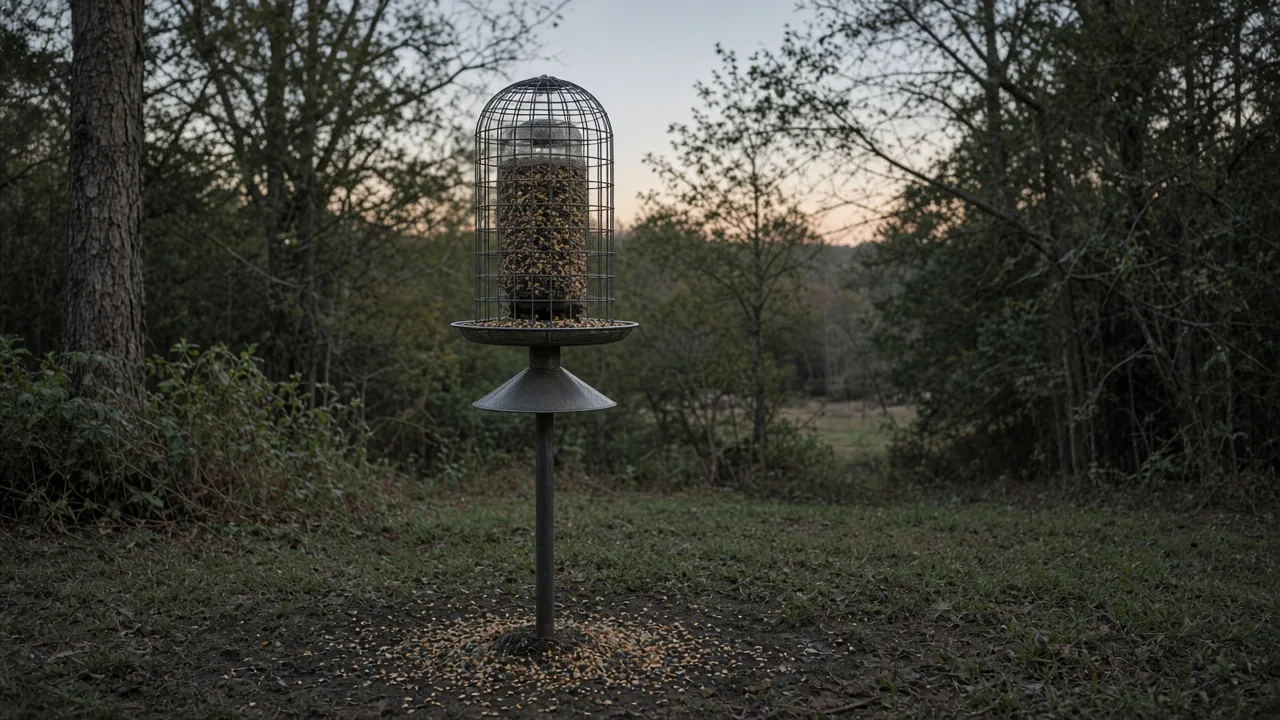
The most reliable way to keep raccoons out of bird feeders is to remove the easy food reward, block the climbing route, and eliminate any branch, fence, deck, or roofline that lets them bypass the pole. Start with the setup you already have: a wide raccoon-sized baffle, a stable pole, less spilled seed, and a routine that removes exposed food before the animals become regulars.
Raccoons are not simply oversized squirrels. They are strong climbers with dexterous front paws, an excellent sense of smell, and the ability to learn which backyard routines pay off. Virginia Cooperative Extension’s raccoon guidance describes them as adaptable omnivores that exploit readily available food and can learn new sources from other raccoons. That is why a single shiny object or a small cone labeled “squirrel-proof” often disappoints: the animal is solving a route-and-reward problem, not reacting to a permanent scare.
Start with this 10-minute diagnosis
Before buying another feeder accessory, look at the yard at dawn. Raccoons are mostly active at night, so the evidence is often easier to read after they leave than while you are watching from a window. Note whether the feeder itself is disturbed, whether the tray is empty, and whether there is a broad patch of seed on the ground.
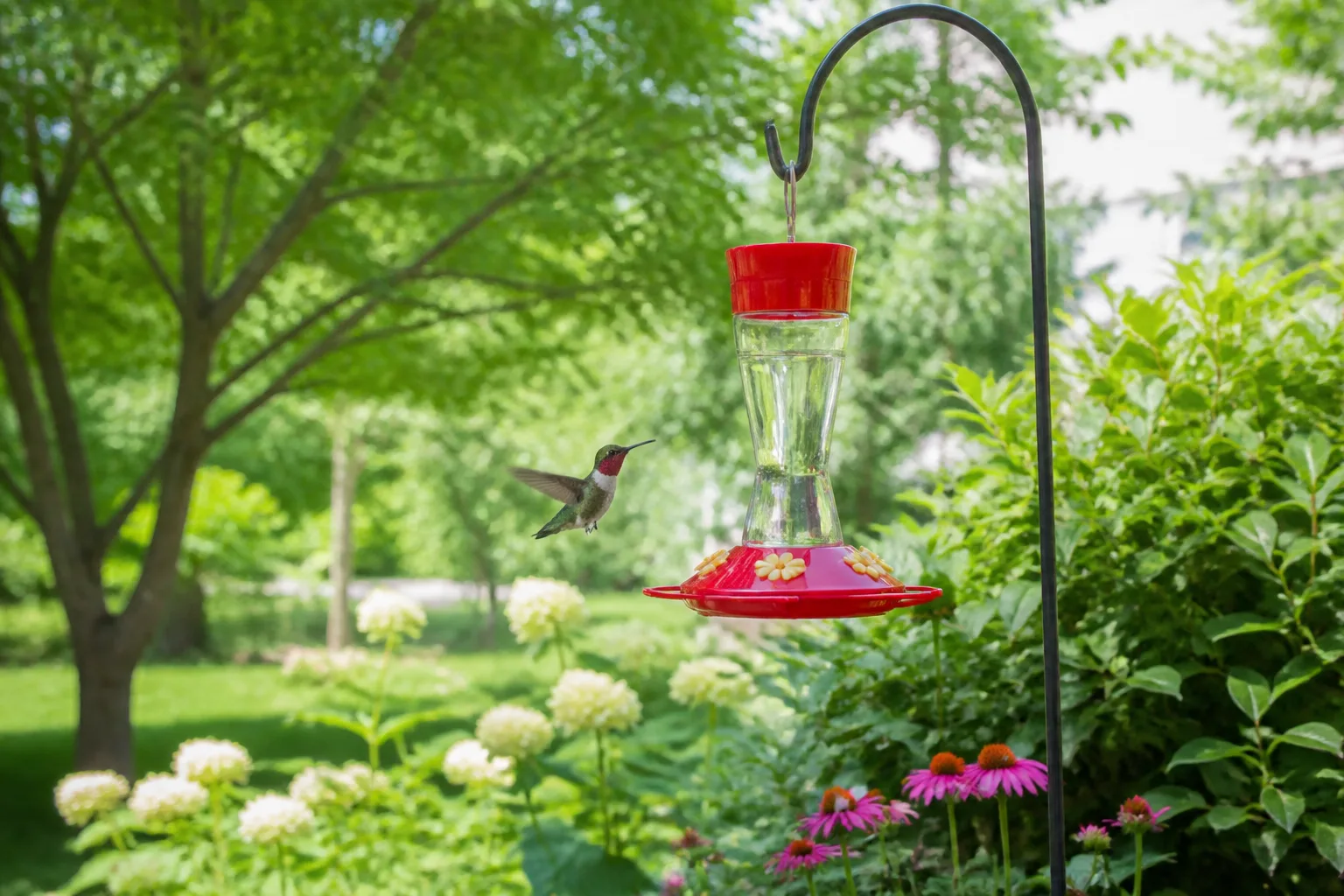
The distinction matters. If the feeder is untouched but the ground is scraped clean, cleanup and portion control may solve the problem. If the pole has muddy paw marks or the feeder is bent, you need to block a physical route. If both are true, do both in sequence: remove the ground-level reward first, then make the hardware harder to reach.
Confirm the visitor before changing the feeder
Long, finger-like tracks in mud, an overturned tray, scattered hulls, and night-time rustling are useful clues, but do not assume every visitor is a raccoon. Squirrels are active by day and may chew feeder parts; deer leave larger hoof prints; rats often follow the seed patch rather than climbing the feeder. A small motion camera pointed at the pole for two or three nights can answer the question without you approaching a wild animal.
You can also inspect the feeder for the kind of damage. Raccoons may pull at lids, bend light hooks, or leave smudges around a tray because they can grasp and manipulate objects. Their activity can overlap with opossums, skunks, or even a loose pet, so a photograph or video is more useful than a guess when the fix may involve a barrier or a wildlife professional.
Do not confront a raccoon at the feeder, corner it, or try to hand-feed it. A wild animal that is sick, injured, unusually aggressive, disoriented, or active in full daylight deserves distance and a call to your local wildlife agency or a licensed wildlife-control operator.
Find every food and water reward
Walk a circle around the feeding station and list everything a raccoon could eat or drink. That includes seed on the soil, a full catch tray, suet, fruit in a nearby tree, outdoor pet food, an open compost bin, fallen fruit, and a birdbath that stays full overnight. Better Homes & Gardens notes that raccoons tend to linger around homes when they find a reliable food source, and a bird feeder can become only one part of a much larger buffet.
You do not need to make the entire yard sterile or remove every native plant. The goal is to stop your feeder from being the easiest predictable meal. Rake or sweep the ground, empty the tray, bring in pet bowls, close trash and compost lids, and remove dropped fruit. Once the site is clean, you can tell whether a hardware change is working because new tracks will no longer be mixed with old food disappearing from the same spot.
1. Use a raccoon-resistant feeder and oversized baffle
A feeder is “raccoon-resistant” only in relation to the route the animal is using. Weight-activated perches can close under a heavy visitor, and metal-capped tube feeders or caged designs are harder to pry apart than delicate plastic or open trays. Those features reduce direct access, but they do not stop a raccoon from climbing a pole, reaching a catch tray, or eating the spill underneath.
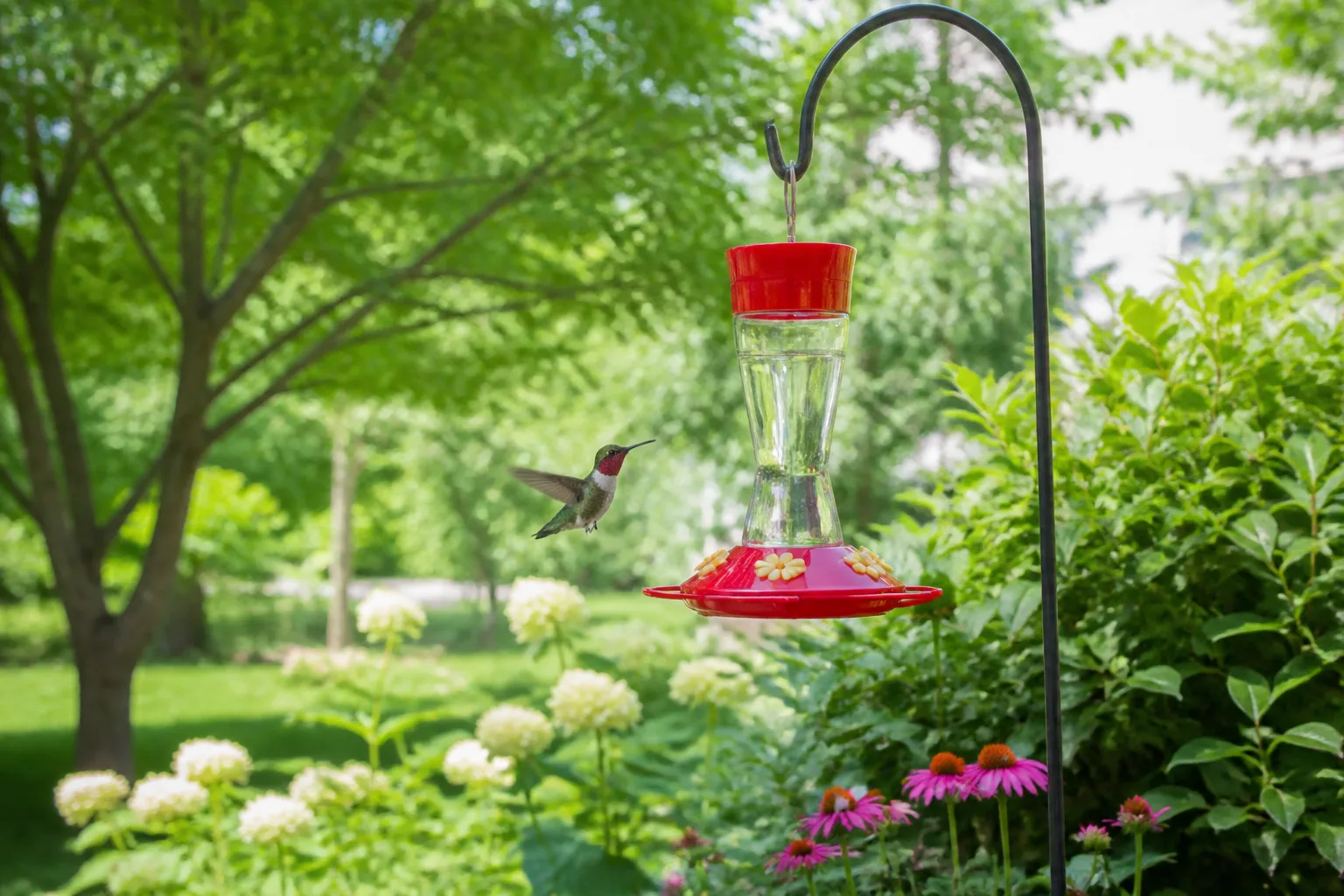
For a pole-mounted station, pair the feeder with a large, smooth baffle designed for raccoons, not just the small cone commonly sold for squirrels. Birds & Blooms’ practical raccoon guidance recommends a much larger barrier, including smooth sheet metal around the lower pole and a wide baffle above it. Think of the baffle as a slippery break in the route, not as decoration under the feeder.
What feeder features matter
Choose a feeder that can be taken apart and thoroughly washed. A tight-fitting metal lid, a sturdy hanging point, and a tray that drains rather than holding rainwater are more useful than a complicated mechanism you cannot clean. If your birds use a tube feeder, short perches can favor smaller birds, but do not assume the port design alone excludes a raccoon; the animal may be targeting the seed at the base or the spill below.
Weight-activated feeders are most helpful when the animal must sit on the perch to reach the food. They are less useful when the feeder has a broad platform, when a raccoon can reach through a gap from above, or when the animal can simply knock the feeder down. Test the lid, spring, and perch with the feeder empty, then inspect them after the first few nights. A “wildlife-proof” label is not a substitute for checking the actual installation.
Avoid putting sticky substances, grease, or oils on poles, perches, or feeder openings. They can foul feathers, contaminate the feeding area, and create problems for birds or other wildlife. If the design is so fragile that it needs a coating to discourage a climber, replace the vulnerable part or change the route instead.
How to install a baffle that reaches the ground route
Start with a pole driven firmly enough that a raccoon cannot rock it toward the feeder. The lower barrier should interrupt the climb before the animal reaches the feeder’s height. Birds & Blooms gives a useful starting concept: a smooth sheet-metal sleeve extending up to about four feet from the ground, combined with a broad baffle. Exact dimensions depend on your pole, soil, and baffle design, so use the manufacturer’s fit instructions and make sure the barrier cannot slide down.
Keep the baffle centered, smooth, and free of nearby objects. A pole that touches a fence, shrub, trellis, firewood stack, or low branch is no longer a single route. A raccoon may use that object to step above the barrier or swing around it. Check the setup after wind and heavy rain, because a tilted pole or sagging hook can turn a good design into an easy ladder.
Do not confuse “larger” with “sharper.” The goal is a smooth, stable surface that prevents climbing without exposed edges that can cut an animal, a child, or you. If a baffle is damaged, loose, or too close to the ground for mowing and maintenance, repair it before refilling the feeder.
2. Move the feeder out of the raccoon’s launch zone
Height works only when it is paired with open space. A feeder can be high above the lawn yet reachable from a tree branch, fence top, deck railing, shed roof, retaining wall, or sloped bank. Raccoons are skilled climbers, and the easiest route is often the one you did not notice from directly beneath the feeder.
Use height and distance together
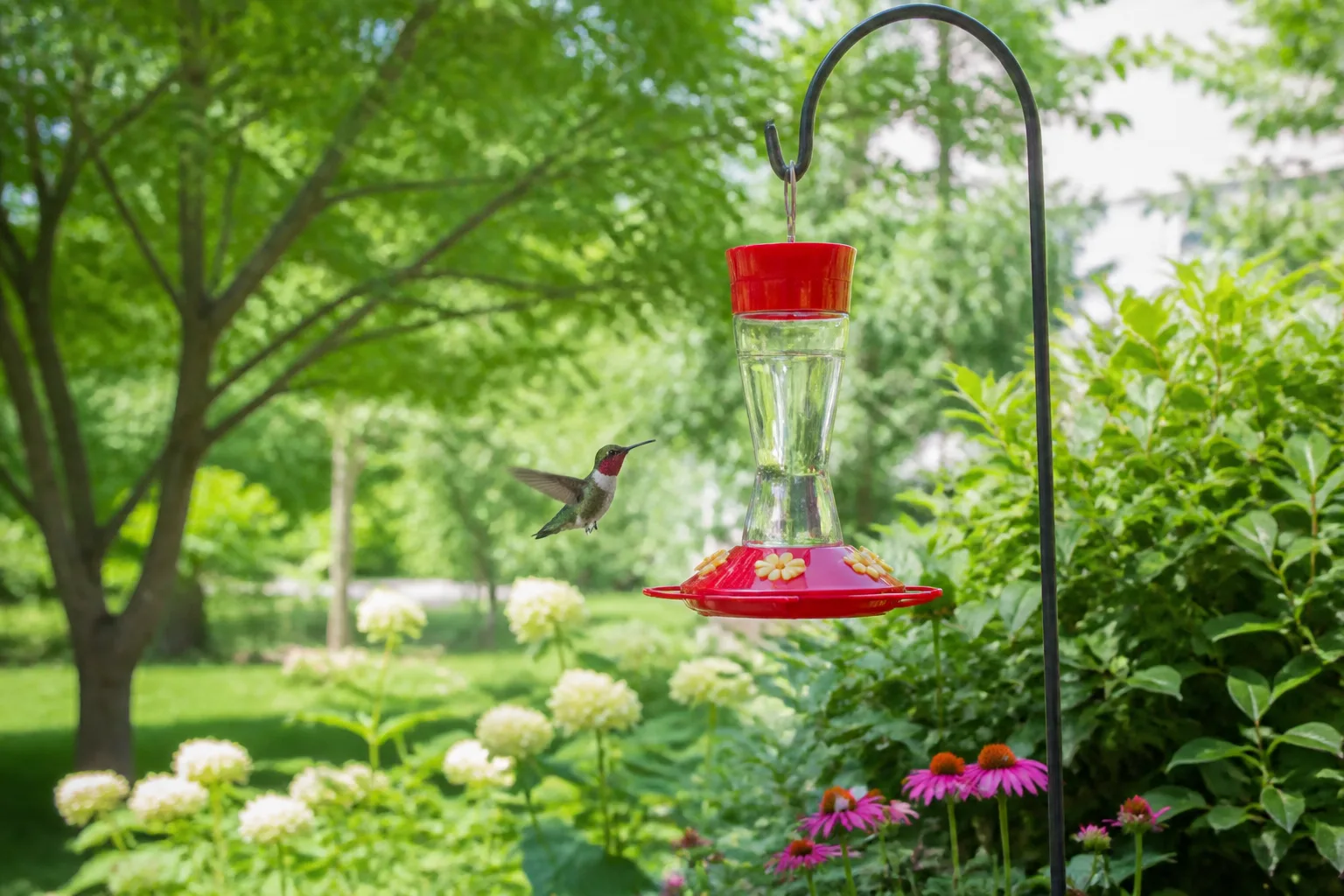
Mount the feeder at least about five feet above the ground as a practical starting point, then inspect the site from several angles. Better Homes & Gardens recommends mounting feeders at least five feet high and adding a raccoon baffle, but height alone is not a guarantee. A raccoon can stand on a slope or raised border, and a low structure may give it the missing reach.
For jump access, keep the feeder and pole roughly 10 feet from branches, fences, roofs, and other launch points whenever your yard allows. Cornell Lab of Ornithology’s feeder-placement guidance uses about 10 feet from natural cover as a compromise: close enough for birds to retreat, but not so close that branches become a launch pad for climbing animals. Measure from the nearest usable branch or edge, not from the trunk.
The best spot is usually an open section of lawn or patio where you can see the pole, sweep below it, and notice new tracks. Do not place it beside a deck simply because the hook is convenient. If you hang a feeder from a tree, assume a raccoon can eventually reach it unless the branch and suspension system create a genuinely separate, well-protected route.
Balance raccoon exclusion with bird safety
A completely exposed feeder may be harder for a raccoon to ambush, but birds still need nearby shelter from weather and predators. Cornell’s placement guidance recommends natural cover while warning that branches too close to the feeder can become launch points for squirrels and other animals. Aim for a compromise: cover nearby, with the feeder’s immediate approach zone open.
Window safety adds another constraint. Cornell recommends placing feeders closer than three feet to a picture window when that is the chosen location, because a bird taking off has less momentum before a possible collision. If the feeder must be farther away, use window-collision markers or another bird-safe treatment. Do not move a feeder into an unsafe location just to gain a few feet from a raccoon’s route.
Check accessibility for your own routine too. You should be able to lower the feeder without standing under a shifting branch, refill it without spilling seed across a deck, and remove the catch tray for cleaning. A setup that is technically high but awkward to service usually becomes neglected, and neglected food and droppings create a new wildlife and bird-health problem.
3. Stop the seed spill that keeps raccoons returning
Raccoons do not need to reach the feeder if the ground beneath it offers a meal. Birds knock seed from ports, discard hulls, and sort through mixes; wind and rain spread the leftovers beyond the pole. A raccoon that finds a dependable patch of food may keep checking the location even after the feeder itself becomes difficult to climb.
Tune the feeding routine
Fill feeders with a smaller amount more often rather than keeping them packed for days. Start with enough for a day or two of normal bird use, then adjust based on what remains. This limits waste, reduces damp seed, and makes it easier to take the feeder down in the evening. Overfilling also adds weight to the feeder and catch tray, which can stress hooks and poles.
Pay attention to what birds reject. Cheap mixed seed can contain ingredients that your local birds toss aside, leaving a broad patch of unwanted food. Try a single seed that the birds actually eat, or use separate feeders for different species. The right mix varies by region, but the test is simple: compare how much goes into birds versus how much reaches the ground.
A catch tray can help, but it is not a license to leave a permanent bowl of seed below the feeder. Choose a tray that is wide enough to intercept the main spill, has drainage, and can be emptied easily. Check it at least daily during wet weather and whenever the feeder is busy. If the tray fills with hulls, droppings, or rainwater, it becomes a dirty secondary feeder rather than a control measure.
If your goal is to support ground-feeding birds, make that a deliberate, measured choice. Scatter a small amount only when you can remove leftovers, or use a temporary feeding area away from the pole. A constant ground buffet undermines every baffle and height adjustment you make above it.
Clean the feeder and ground safely
Cornell Lab recommends cleaning seed feeders about every two weeks, with more frequent cleaning during heavy use, wet weather, or a local disease concern. Project FeederWatch gives a similar weekly-to-biweekly range and emphasizes cleaning the ground as well as the feeder. For a raccoon problem, daily removal of spilled seed is the practical minimum until visits stop; the full feeder still needs routine washing.
Take the feeder apart, discard old food, scrub away debris, and wash the pieces with warm water and dish soap. Rinse thoroughly and let everything dry completely before refilling. Project FeederWatch advises avoiding feeders that cannot be thoroughly washed, including some wooden designs. If you use a dishwasher, confirm that the feeder is dishwasher-safe before placing it inside.
Disinfection is an extra step when a feeder has heavy contamination or sick birds have been seen. Cornell and Project FeederWatch describe a dilute bleach solution of one part bleach to nine parts water after cleaning, followed by a thorough rinse and complete drying; follow the current source guidance and the feeder manufacturer’s material instructions. Never combine bleach with other cleaners, and do not return damp parts to service.
Wear gloves when handling dirty feeder parts. If the ground contains a large amount of dry droppings or dusty debris, Project FeederWatch recommends gloves and a mask while raking or sweeping, followed by careful handwashing. Do not dry-sweep a heavily soiled patch toward a child’s play area or a pet’s bowl. Removing the food reward should improve the raccoon problem without creating a sanitation problem for your household.
4. Remove the feeder before dark, then add a motion deterrent
Raccoons are primarily nocturnal, so the simplest way to prevent a night raid is to remove exposed feeders before dusk and bring them back after daylight. This is especially effective for hanging feeders, suet cages, and lightweight feeders that can be stored in a secure place. Birds generally do most of their feeder visits during daylight, so the schedule targets the raccoon’s active window without permanently removing the food source.
Nightly removal is not mandatory for every well-designed pole station, but it is a valuable reset when raccoons have already learned the location. Birds & Blooms recommends taking detachable feeders down before dark, and Better Homes & Gardens includes putting bird feeders away at night among the steps that remove food resources. Try it for one to two weeks while you correct placement and cleanup; if the animals stop checking the site, you can decide whether the improved hardware is sufficient for a less hands-on routine.
When a light or sprinkler helps
Use a motion-activated sprinkler or light to protect the approach route, not as a substitute for a baffle. Watch where the raccoon enters the yard and aim the device across that path. A sprinkler can deliver a harmless surprise, but it needs a working water supply and may freeze, trigger on pets or people, or soak the feeder and seed. Keep spray away from electrical connections, walkways, windows, and areas where children play.
A motion light can help you see what is happening and may make an exposed approach less appealing for a while. It is less useful when pointed at the feeder as the only intervention. Virginia Cooperative Extension explains that frightening devices work best when the stimulus is unpredictable and that raccoons can become habituated when a light, sound, or visual threat has no consequence.
Do not place loud devices beside a bedroom, a neighbor’s property, or a nesting area simply to protect a small seed supply. A brief, targeted cue is more considerate and easier to evaluate than a device that runs all night. If the light or sprinkler changes the animal’s route but not its interest in the food, remove the food reward and strengthen the physical exclusion.
Rotate the cue before habituation
If you use a motion deterrent, move it after several nights, vary the coverage, and turn it off once the access problem is fixed. A raccoon that walks into the same beam or sprinkler zone repeatedly may learn the edge of the detection area. The animal may also approach from the opposite side, especially if the original route has been made uncomfortable but the seed is still available.
Think of fright devices as a short bridge while the permanent work happens. Pair one with a clean ground, a feeder removed at night, and a baffle that blocks the pole. If you keep adding devices without removing the reward, you can end up startling birds, pets, and people while the raccoon simply waits for a quiet moment.
What not to use around a bird feeder
Skip homemade chemical experiments, sticky coatings, mothballs, ammonia-soaked rags, and anything that can be ingested by birds or transferred to their feathers. Odor and taste repellents may have a place in a labeled wildlife-management plan, but Virginia Cooperative Extension says chemical repellents have low success when used alone. “Natural” does not automatically mean bird-safe, pet-safe, child-safe, or harmless to soil and water.
Do not coat birdseed with a homemade cayenne or essential-oil mixture. Even when a mammal reacts differently from a bird, loose powder can become airborne and irritate eyes and airways during mixing or cleanup. If you consider a commercial repellent, read the entire label, confirm that the target and application site match, and keep treated material away from feeder ports, birdbaths, and surfaces birds touch unless the label explicitly allows it.
Avoid traps as a first response to a feeder raid. A trap can catch a pet, skunk, opossum, or other non-target animal, and a captured raccoon can bite or scratch. Laws governing trapping, transport, release, and euthanasia vary by location; a solution that is allowed in one county may be prohibited in another. Physical exclusion and food management are safer starting points for a feeder problem.
When to stop DIY and call wildlife professionals
Call for professional help if the raccoon is living in an attic, chimney, crawl space, shed, or other structure; if there are signs of young; if it is injured or unusually aggressive; or if you have had direct contact. Virginia Cooperative Extension warns that spring and early summer encounters may involve a mother with dependent kits and that poorly planned eviction can separate the family or leave young behind. Do not seal an opening until you are confident every animal is out.
If a raccoon has only visited the feeder, you usually do not need to remove it. Remove the food reward, improve the station, and allow the animal to move through. If it continues returning despite a clean site and blocked access, contact your local wildlife agency for legal, humane options rather than improvising relocation or poison. Never use toxic bait around a feeder where birds, pets, and other wildlife can reach it.
Keep your distance from any raccoon that is staggering, circling, unusually tame, snarling without retreat, or active in a way that seems abnormal. Do not try to photograph it up close. If you are bitten or scratched, or saliva contacts an open wound or mucous membrane, wash the area and contact a medical professional and local health authorities promptly for guidance.
A seven-day reset plan
When several fixes are needed, change the station in a controlled order so you know which improvement mattered. This plan works for a pole feeder or a detachable hanging feeder:
- Day 1: remove the reward. Empty and clean the feeder, sweep or rake spilled seed, bring in pet food, secure trash and compost, and empty water sources that raccoons are using overnight.
- Day 2: inspect the route. Walk the approach from the animal’s point of view. Mark branches, fences, decks, rooflines, walls, stumps, and slopes within reach of the feeder or pole.
- Day 3: rebuild the hardware. Stabilize the pole, fit a broad smooth baffle, and keep the lower route clear. Replace a feeder that is cracked, impossible to wash, or easy to knock down.
- Day 4: reset portions. Refill with a smaller amount of seed. Add a draining catch tray, and note how much birds actually eat instead of how much the feeder can hold.
- Day 5: add timing. Bring detachable feeders in before dark. Store them in a sealed, clean container that does not become another accessible food source.
- Day 6: use a targeted cue if needed. Place a motion sprinkler or light across the approach route, then watch for a route change. Keep it away from windows, pets, walkways, and sleeping areas.
- Day 7: read the evidence. Look for fresh tracks, new spill, disturbed hardware, and the direction of approach. If the ground stays clean and the pole is undisturbed, keep the routine. If the raccoon is bypassing the baffle, move the station or ask a wildlife professional to assess the site.
This sequence also tells you when to stop feeding temporarily. If you cannot keep the feeder clean, the ground is repeatedly contaminated, or raccoons are creating a safety conflict, take the feeder down for a short period and support birds with native plants and natural shelter instead. Project FeederWatch notes that bird feeding is supplementary and that bird-friendly gardening can provide food, shade, and habitat without concentrating birds and spilled seed in one small spot.
Conclusion
The strongest raccoon solution is a layered setup: a sturdy feeder that is hard to pry open, a broad smooth baffle on a stable pole, open space between the station and launch points, and a clean ground beneath it. Add smaller portions, nightly removal, or a targeted motion device when a raccoon has already learned the routine, and treat repellents as temporary at best.
Start with the evidence you can change today: remove spilled seed, identify the access route, and inspect the station from the raccoon’s point of view. If the conflict involves a den, young, an injured or abnormal animal, direct contact, or local trapping rules, hand the problem to the appropriate wildlife professionals rather than escalating the hardware yourself.



