How to Keep Roses Alive Longer in a Vase
Learn how to keep roses alive with a clean vase, fresh stem cuts, correctly mixed flower food, a cool display spot, and a simple refresh routine.
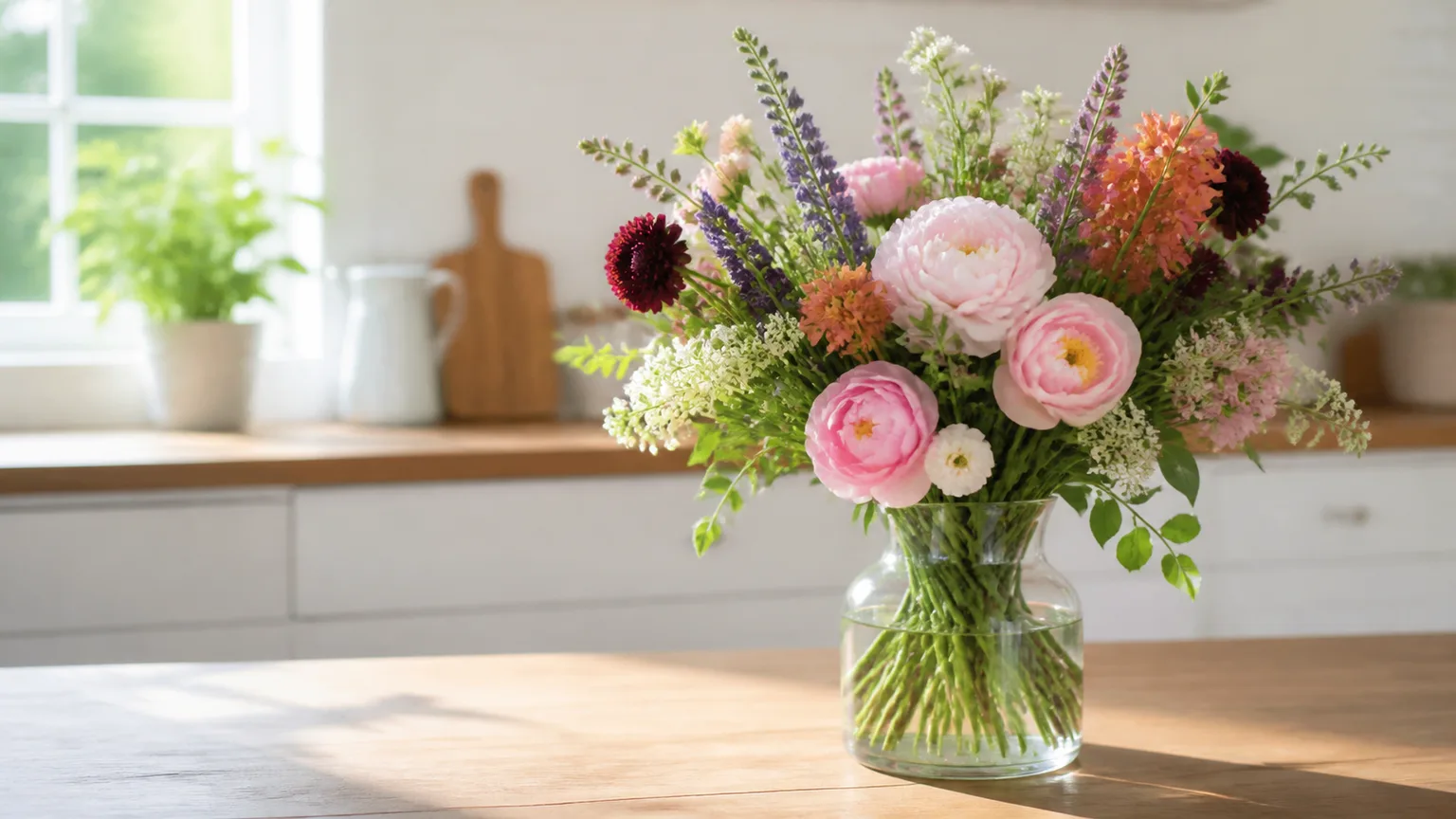
A rose bouquet starts losing water as soon as it is cut. Your job is not to make the flower immortal; it is to keep its stem able to drink, limit the conditions that speed moisture loss, and avoid adding problems to the vase. The quickest payoff comes from getting the flowers into a clean vessel with freshly cut stems and correctly mixed flower food, then keeping that water clean.
That sequence matters more than a dramatic trick. A study of cut roses published in Frontiers in Plant Science found that commercial preservative solutions helped maintain vase life compared with tap water under the study’s specific conditions, while the Royal Horticultural Society’s home guidance emphasizes clean equipment, stem conditioning, and regular water changes. Neither source can promise how long a particular bouquet will last: cultivar, harvest maturity, time in transit, room temperature, and the flowers’ starting condition all matter.
Choose roses that can still hydrate
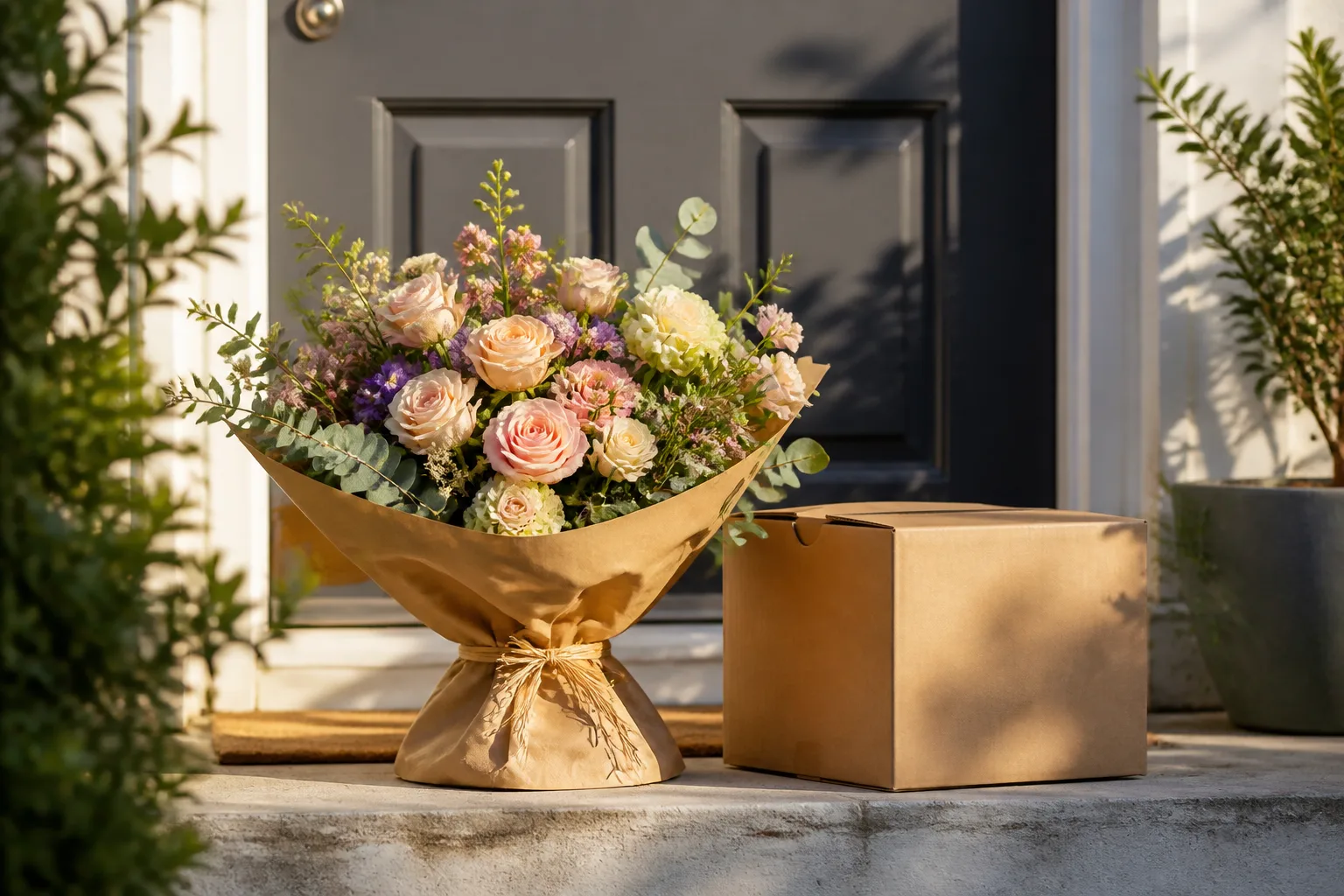
If you are choosing roses at a shop or accepting a delivery, look past the most open bloom. A rose that has already opened fully may give you an immediate, dramatic display, but it has also used more of its vase life than a sound bud that is beginning to show color. For a bouquet you want to enjoy for several days, choose firm stems and foliage, heads that feel supported rather than limp, and petals without widespread bruising or wet, translucent patches.
A few imperfect outer petals are not an automatic reason to reject a rose. Florists call these protective outer petals guard petals; they can look darker or rougher because they shielded the inner petals during development and handling. A loose petal or dry edge at the outside is different from a soft, brown center or a head that is already bent at the neck.
Read the flower, not only the color
Different roses open differently. A many-petaled garden rose may look ruffled and fully open sooner than a tighter, high-centered rose, so the number of visible petals alone does not tell you that it is old. Judge the stem and the whole bloom together: a fresh flower should hold its head, and its petals should feel reasonably resilient rather than papery, slimy, or bruised.
Leave guard petals in place while the bouquet is hydrating. If their edges are badly damaged and you want a cleaner display, remove only the outermost tired petals by gripping each near its base and easing it away; pulling several layers can make the bloom look unnaturally open and removes the protection around the inner petals. If the flower looks depleted beneath those outer petals, removing them will improve appearance only briefly.
Check how the blooms sit in the bundle as well. Rose heads should not be crushed against one another inside tight packaging, and a bent or pinched stem can interrupt water uptake before you arrange anything. If a delivery has been in transit, treat it as dehydrated even if the paper wrap and flower heads still look attractive.
Give garden-cut roses a different start
A rose you cut yourself should not sit on a bench while you choose a vase. The RHS cut-flower conditioning guidance recommends cutting flowers when stems are hydrated, placing cut stems into water as soon as possible, and avoiding the hottest part of the day; it also cautions that roses cut as tight buds may not develop fully. For a garden bouquet, take roses in the morning or after the day’s heat has eased, when the flower is showing color and beginning to loosen rather than still being a hard, closed bud.
Bring a clean bucket of water to the garden, use sharp bypass pruners, and put each stem into the bucket immediately. Then move the roses to a cool, shaded place while you prepare the final vase. If the rose is growing outdoors, wear gloves and avoid scraping the stem while handling it; the thorns are not the main vase-water problem, but punctures and torn bark can damage the stem.
The RHS suggests conditioning woody stems such as roses with a clean cut and a short vertical split at the base. That extra split is optional for a home bouquet rather than a guarantee of longer life, so do not hammer the stems or crush them to force water in; the RHS notes that hammering can encourage bacterial infection. If you are unsure, a sharp, clean recut followed by prompt hydration is the simpler and lower-risk start.
Prepare the bouquet in the first 20 minutes
Unwrap the roses carefully and decide how they will fit the vase before you cut them down. Remove sleeves and ties that press on the blooms, but keep the heads supported as you handle the stems. If the flowers arrived dry, get them into water first and adjust the arrangement after they have had time to drink; trying to make a perfect design before rehydration wastes the minutes when water matters most.
Pick a vase that can hold the stems without squeezing them together. A narrow-necked vessel can support a smaller, shorter arrangement, while a wider opening gives long stems room to spread; in either case, the water line needs to reach the freshly cut stem ends. A vase that is tall enough for the stems but too narrow for the heads can press petals against one another and leave the arrangement looking cramped.
Use a clean vase and clean tools
Wash the vase with dish detergent and warm water, including the inside rim and base where residue can cling. Rinse away all soap, then use a clean bottle brush if the opening is narrow; an old vase ring or cloudy film is a sign to scrub, not a harmless decoration. Both Better Homes & Gardens and the RHS emphasize starting with a clean vase, and the RHS recommends washing a dirty vessel thoroughly with detergent and a bottle brush.
Use clean, sharp floral shears, bypass pruners, or a knife designed for flowers. A dull blade can crush the stem end, while a dirty tool can transfer residue to a fresh cut. Wipe the blades before you start and again if you cut diseased or dirty garden material; there is no reason to use a household cleaner on the flower stems themselves.
Recut stems and remove submerged leaves
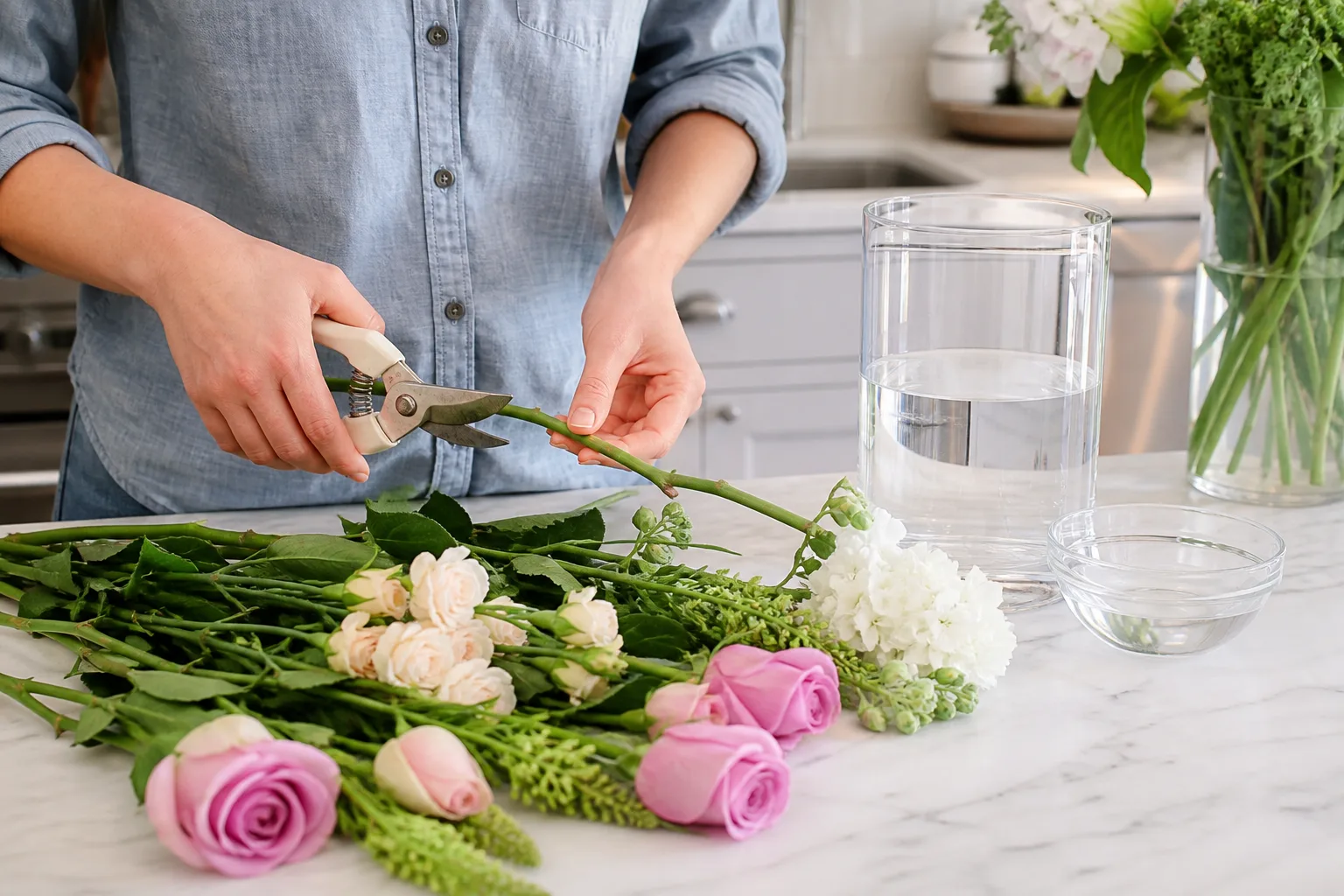
Trim each stem to the height the vase needs, making a smooth angled cut with sharp blades. The angle is useful because it avoids a flat end sealing flush against the bottom of a narrow vase, but a perfect 45-degree angle is less important than a clean cut and enough water around the stem. The RHS advises recutting with a sharp knife or secateurs and avoiding jagged edges that can decay.
Remove leaves that would sit below the water line, and keep the remaining foliage dry. Leaves left underwater break down and create debris in the solution, which makes the vase harder to keep clean; stripping every leaf above the line is unnecessary and can leave stems bare. Better Homes & Gardens and the RHS both recommend removing foliage below the water, while the RHS also advises keeping the vase and solution clean.
After trimming, place roses into the prepared water right away rather than leaving the ends exposed while you finish the table. You may see advice to cut stems underwater to prevent air from entering; for an ordinary home bouquet, the practical basics are a fresh, sharp cut and immediate hydration. If a rose arrives wilted, do not repeatedly shave the stem every few minutes; give it a stable, clean setup and reassess after it has had time to take up water.
Use water and flower food as designed
Fill the vase with fresh, clean water at roughly room temperature, then dissolve the flower-food packet before adding the stems. Room-temperature water is a sensible household default: it is easy to prepare and avoids extremes, while exact water temperature is not a substitute for cleanliness or the right preservative dose. Both Better Homes & Gardens and Southern Living recommend room-temperature or lukewarm water; the RHS focuses on clean water and commercial flower food rather than prescribing a precise temperature.
Measure the packet instead of guessing
Use the amount of flower food specified for the volume of water you are mixing. A packet is formulated for a defined amount of water; stretching one packet across a large vase makes a weaker solution, while adding extra powder to a small vase can make the solution too concentrated. If a packet is missing, buy a cut-flower preservative and follow that label instead of trying to recreate its chemistry from memory.
Commercial flower food typically combines ingredients with different jobs: a carbohydrate source supports the flower, an acidifier helps manage solution pH, and an antimicrobial ingredient helps control microorganisms, as Better Homes & Gardens explains. This is why sugar alone is not equivalent to flower food. A controlled study of one cut rose cultivar compared tap water with several commercial preservatives and found longer vase life for some preservative treatments; it also tested graphene oxide, a research treatment that is not a household recommendation. The results support using a purpose-made solution correctly, but they do not mean every brand or bouquet will gain the same number of days.
Mix the solution in the vase or a clean measuring vessel before placing the flowers in it so the powder dissolves evenly. Do not add a fresh full packet each time you top up a partly full vase unless the packet says to use that dose for the added water. When you replace the entire solution, mix a fresh batch at the package ratio.
Skip untested kitchen fixes
Aspirin, pennies, vodka, soda, sugar, vinegar, and household bleach are common suggestions, but a kitchen ingredient is not automatically a balanced flower preservative. A useful solution needs the right combination and amount for the stems; changing the pH, adding sugar without microbial control, or guessing at bleach concentration can leave you with murky water or damage the flowers. Better Homes & Gardens notes that familiar remedies such as aspirin, vodka, and coins have little evidence for a meaningful improvement over proper flower food and clean water.
If you have no packet, clean water and a clean vase are a safer temporary choice than combining several pantry ingredients. You can obtain a commercial preservative later, or change the water and recut the stems as needed. Do not mix household bleach with other cleaners or acids; a home-made flower-water recipe is not worth creating a chemical exposure risk.
The same caution applies to adding ice or hot water as a shortcut. The aim is a stable, moderate environment, not a temperature shock; use the water temperature recommended by your flower-food instructions if they specify one. The RHS does describe specialized hot-water conditioning for some soft-stemmed flowers, but that is not a reason to pour boiling water into a rose vase or improvise a treatment for a bouquet.
Choose a location that slows water loss
Place the vase in a cool part of the room with bright ambient light if you want to enjoy the flowers, but keep the blooms out of strong direct sun. Sun through glass, a fireplace, a radiator, a heating vent, or a sunny kitchen counter can warm the heads and increase water loss. A room that feels pleasant to people can still be a poor floral display if it puts the vase beside a heat source.
Avoid direct airflow too. An air-conditioning or heating vent can dehydrate petals and create a rapid temperature swing, and a drafty window can be colder than the rest of the room. The practical test is where the bouquet stays coolest without sitting in direct sun, touching a window, or being blasted by moving air; BHG and Southern Living give similar advice about avoiding direct light and temperature extremes.
Manage light, heat, drafts, and fruit
Keep the vase away from ripening fruit, especially a fruit bowl that includes apples or bananas. Ripening produce releases ethylene, a plant hormone involved in aging; flowers can be sensitive to it, and the RHS advises keeping cut flowers away from ripe fruit. Move the bouquet a few feet away rather than trying to ventilate a kitchen that is already warm.
Remove flowers that are collapsing or shedding heavily if they are crowding the rest of the arrangement. A single aging rose does not automatically doom the whole bouquet, but old petals and foliage that fall into the water add debris. Check neighboring heads at the same time, because the first drooping stem may signal low water or heat affecting the entire vase.
A cool room is a better daily strategy than repeatedly moving the bouquet between hot and cold places. If you want the roses on a dining table during an event, display them there while people are present and move them afterward to a cooler location away from fruit and vents. That gives you the arrangement where you want it without leaving it under a lamp or in sun all day.
Decide when a refrigerator can help
A cool, dark overnight location can slow flower aging, but a household refrigerator is not automatically a floral cooler. It may contain ripening fruit, run very cold, have strong dry airflow, or be crowded enough to bruise flower heads. If you can give the vase a stable, cool room away from fruit, that is usually simpler.
If you do use the refrigerator, keep roses away from produce and the freezer compartment, and check that the flowers will not be crushed by shelves or food. Better Homes & Gardens suggests refrigerating cut roses overnight only when the temperature stays above freezing; use that as a caution, not a promise that every home fridge improves vase life. Skip refrigeration if you cannot control the temperature or separate the flowers from fruit.
Maintain the vase without overhandling roses
Roses do not need a complicated hourly routine. Check the water level each day, remove any leaves or petals that have fallen into it, and keep the flower heads from leaning against a hot window or heating source. A large bouquet in a warm room may drink more quickly than a few stems in a cool bedroom, so the water line is more useful than a fixed calendar alone.
Top up today; refresh on a schedule
If the stems are still submerged and the solution looks clean, add water to restore the level. If the vase water is cloudy, slimy, or smells sour, do a full change now rather than topping it up; empty the vase, wash away the film, rinse it, and mix a fresh solution. The RHS recommends checking and topping up the water every couple of days, and changing the water and recutting stems every two to four days; a practical home baseline is to refresh every two to three days, sooner when the water turns cloudy.
When changing the solution, lift the roses gently and recut a small amount from each stem with clean, sharp blades. You do not need to remove several inches each time; preserving length gives you more options for styling later. Then put them straight into fresh, correctly measured solution and wipe water from the outside of the vase so you can see the new water line.
This is a good moment to remove petals or foliage that have dropped into the water and inspect the stems. A darkened or slimy cut end calls for a little more stem removal until the cross-section looks fresh, but do not keep trimming a healthy rose out of anxiety. If the stem is too short after several refreshes, arrange it in a smaller vase rather than forcing it into the original one.
Troubleshoot drooping heads and tired petals
A drooping rose is a symptom, not a diagnosis. The cause may be an empty vase, a blocked or damaged stem, heat exposure, or a flower that has simply reached the end of its display life. Start with reversible causes in order: confirm water reaches every stem, look for submerged foliage and debris, move the vase away from heat or direct sun, and check whether the affected stem is bent, crushed, or slimy near the base.
| What you see | Likely explanation | First useful action |
|---|---|---|
| Several heads droop at once | Water level fell, solution is dirty, or the bouquet was exposed to heat | Refill or replace the solution, clean the vase if cloudy, and move the bouquet to a cooler spot |
| One head bends while others look fine | That stem may be damaged, blocked, or older than the rest | Remove it, recut below the damaged section, and hydrate it separately |
| Outer petals have dry or browned edges | Transit bruising, normal guard-petal wear, or dry air | Remove only the visibly damaged outer petals and reduce heat or drafts |
| Inner petals are soft, wet, or browning | The bloom may be aging or damaged beyond a simple water fix | Remove the bloom if it no longer looks presentable; do not soak the entire flower |
| Vase water is cloudy or smells off | Debris or microbial growth has accumulated | Empty and wash the vase, remove submerged foliage, and make fresh solution |
Separate recoverable wilt from spent blooms
If one rose is only slightly limp and its stem is still firm, isolate it from the arrangement, recut the bottom of the stem, and place it in a clean, narrow vessel with fresh solution so it can stand upright. Keep it in a cool spot and give it a few hours before deciding whether it has recovered. A firm head that rises again may return to the bouquet; a neck that remains sharply bent or a stem that is soft and discolored probably will not.
Do not dunk an entire rose head in a sink or bathtub as a first step. Wet petals can bruise, and soaking cannot reverse tissue aging or repair a broken stem; if you try to rehydrate a drooping bloom, keep the stem end in clean water and support the head rather than rubbing or squeezing the petals. The RHS recommends recutting and conditioning for drooping roses, but rescue is not guaranteed.
Guard petals with rough edges can be removed if they are the only flaw and the inner bloom is sound. If the inner petals are turning translucent, brown, or mushy, or the rose has started shedding heavily, accept that it is spent and remove it from the display. A fresh stem cut cannot make an old bloom young again, and learning when to stop is part of keeping the rest of the arrangement attractive.
If every rose wilts soon after arranging, think about what happened before it reached your home. The bouquet may have spent too long without water or in heat, or it may have been harvested too tight to open well. Refresh the water and recut once; if multiple stems do not respond, contact the florist or seller promptly with a photo and the delivery time instead of cycling through unverified remedies.
Style roses so they stay upright and open
Let the vase support the stems rather than forcing the blooms into a pose. Trim long stems in stages, placing the bouquet into the vase as you go, so the heads sit above the rim without collapsing outward. A narrow vase can gather a small number of stems into a tidy cluster; a wider vase suits a fuller group but may need enough stems or a simple grid of floral tape across the opening to prevent them from splaying.
Arrange the tallest stems first, then add shorter roses to fill gaps and turn a few heads slightly outward. Keep enough space for air around the flower heads, and avoid letting petals press against a sunny pane or a warm lamp. If the bouquet contains garden roses with many petals, handle them at the stem rather than gripping the bloom, which can bruise the outer layers.
It is tempting to reflex a rose by bending its petals back for a wide, theatrical opening. That changes the bloom’s shape but also stresses petals and can make a rose look worn sooner; reserve it for a short event display rather than a bouquet you want to preserve. For a longer-lasting arrangement, let healthy roses open on their own and remove only the outer guard petals that are visibly damaged.
Conclusion
The best way to keep roses alive longer is a short, repeatable routine: start with sound flowers, use a clean vase and sharp tools, recut the stems, keep leaves above the water, and mix commercial flower food at the label rate. Put the arrangement somewhere cool and away from direct sun, heat, drafts, and ripening fruit, then top up daily and replace cloudy solution every two to three days.
When a head droops, check the water and the stem before trying a rescue. A slightly thirsty rose may recover after a clean recut and fresh solution; a damaged or spent bloom may not. Protecting the healthy stems and accepting the limits of each flower will keep the bouquet looking its best for as long as its starting condition allows.



