12 Ways to Keep Squirrels Out of Bird Feeders
Keep squirrels out of bird feeders with 12 humane fixes, including the 8–10-foot placement rule, weight-activated feeders, safflower seed, and what to avoid.
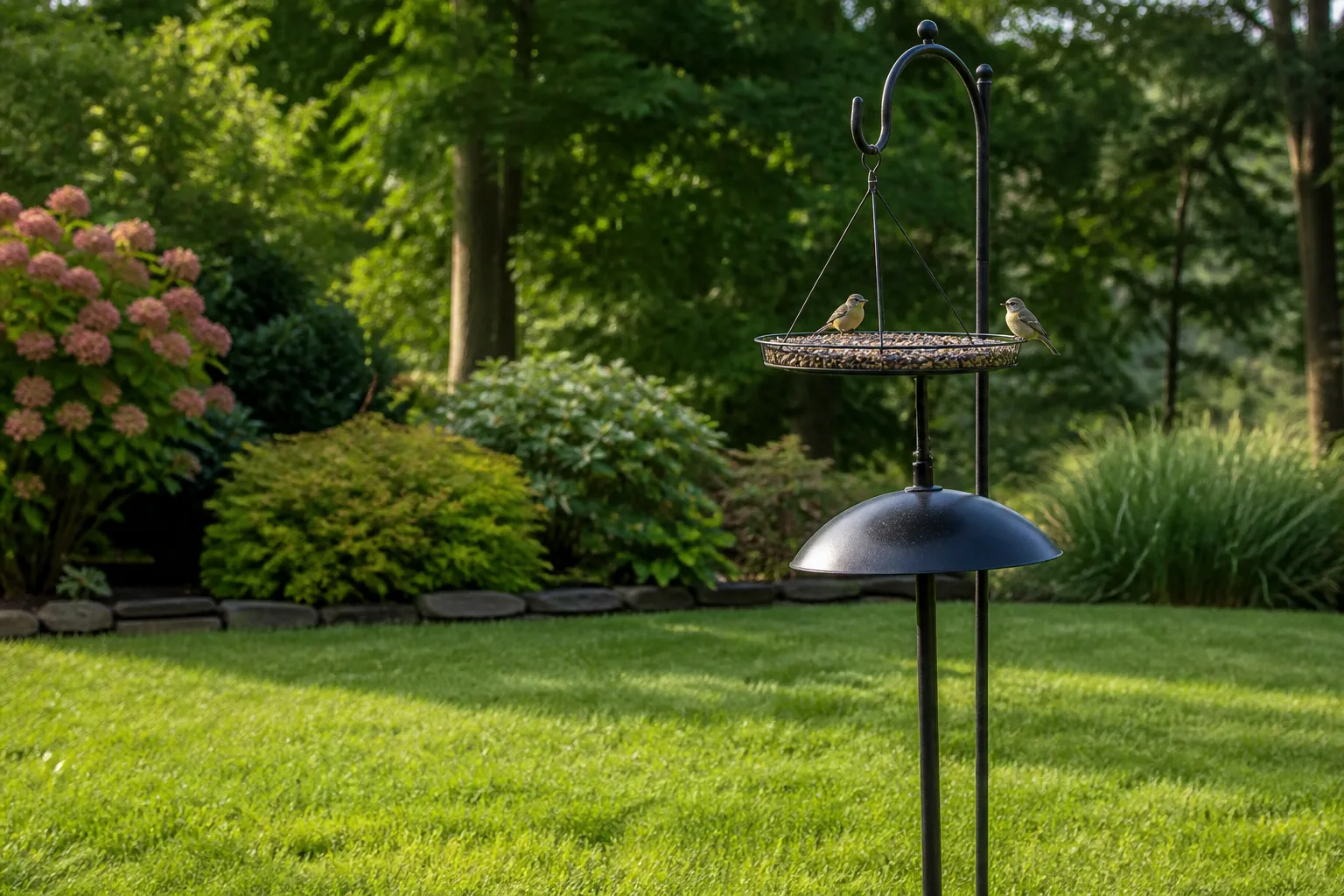
The reliable way to keep squirrels out of a bird feeder is to block their route to the food. A baffle, a feeder placed beyond jumping range, and a design that closes or cages the ports will outperform cinnamon sprays, soap, or a pole smeared with grease.
No feeder is permanently squirrel-proof in every yard. “For good” means the squirrels stop getting a reward often enough to keep checking the same setup. Start with the physical barrier, then tune the seed and cleanup routine around it. Project FeederWatch calls baffles one of the best ways to protect seed, while Cornell’s bird-feeding guidance warns that squirrels can still leap from nearby structures and defeat a good device when the placement is wrong. (Project FeederWatch; Cornell Lab of Ornithology)
Before you start: fix the access route, not the squirrel
Watch the feeder for five minutes before buying anything. Is the squirrel climbing the support pole, dropping from a branch, walking along a clothesline, launching from a fence, or pulling the feeder close from a deck? The answer determines the fix. A pole baffle cannot stop a squirrel that simply jumps from the roof, and a weight-activated feeder cannot help if the animal can reach the ports from a nearby trunk.
Use this order: remove the easiest access route, install a physical barrier, make the food less attractive or less wasteful, and then clean up the reward on the ground. This sequence also protects birds better than scattering a collection of strong-smelling products around the feeding station.
1. Put the feeder on a pole with a real squirrel baffle
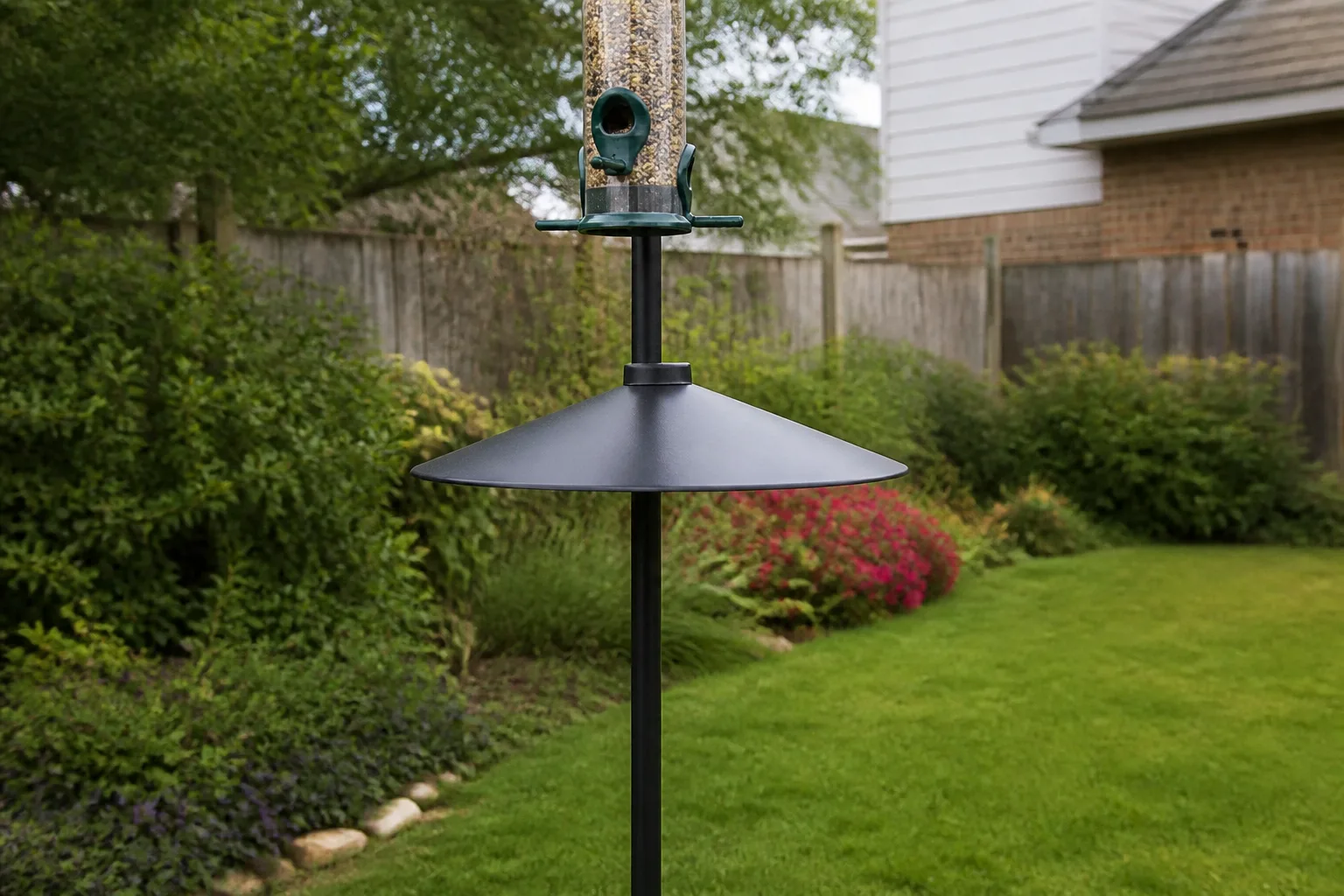
For a yard with enough open space, a smooth pole topped with a feeder and fitted with a broad, wobbling or cone-shaped baffle is the best first setup. The baffle creates a gap squirrels cannot grip or climb around. Place it below the feeder on a pole-mounted station; use a hanging baffle above a feeder that is suspended from a branch or line.
The distinction matters. A dome perched on top of a pole may look like a barrier but leave the climbing route open. A baffle that is too narrow can become a shelf, and a rigid homemade piece with rough edges may give claws something to hold. Smooth metal or sturdy plastic with enough overhang is the goal. University of Nebraska–Lincoln Extension recommends a smooth baffle roughly 14–18 inches wide and at least four feet above the ground for a pole-mounted feeder. (University of Nebraska–Lincoln Extension)
2. Create an 8–10-foot no-jump zone
Measure from the feeder—not just from the base of the pole—to the nearest tree trunk, fence, roof edge, deck railing, shrub, or overhead branch. An 8–10-foot gap is a practical starting range; Cornell Lab guidance uses at least 10 feet from jumping-off points, and Project FeederWatch gives the same warning for squirrels jumping from trees or buildings. (Cornell Lab of Ornithology; Project FeederWatch)
Do not assume a tall pole solves a short horizontal gap. Squirrels are better jumpers than climbers in this particular contest, so a feeder six feet high beside a fence can be easier to raid than a lower feeder in the middle of an open lawn. Move the pole, prune a single launch branch, or change from a tree-hung feeder to an open pole station.
There is one important bird-safety trade-off: a feeder should not be placed far from the house simply to satisfy a squirrel rule if that creates a window-collision hazard. If you are feeding near glass, follow bird-collision guidance for your region; a feeder very close to a window—within about three feet—is often safer for collision prevention than one placed at an intermediate distance. The best location solves both problems instead of blindly following one measurement.
3. Set the baffle at the right height and width
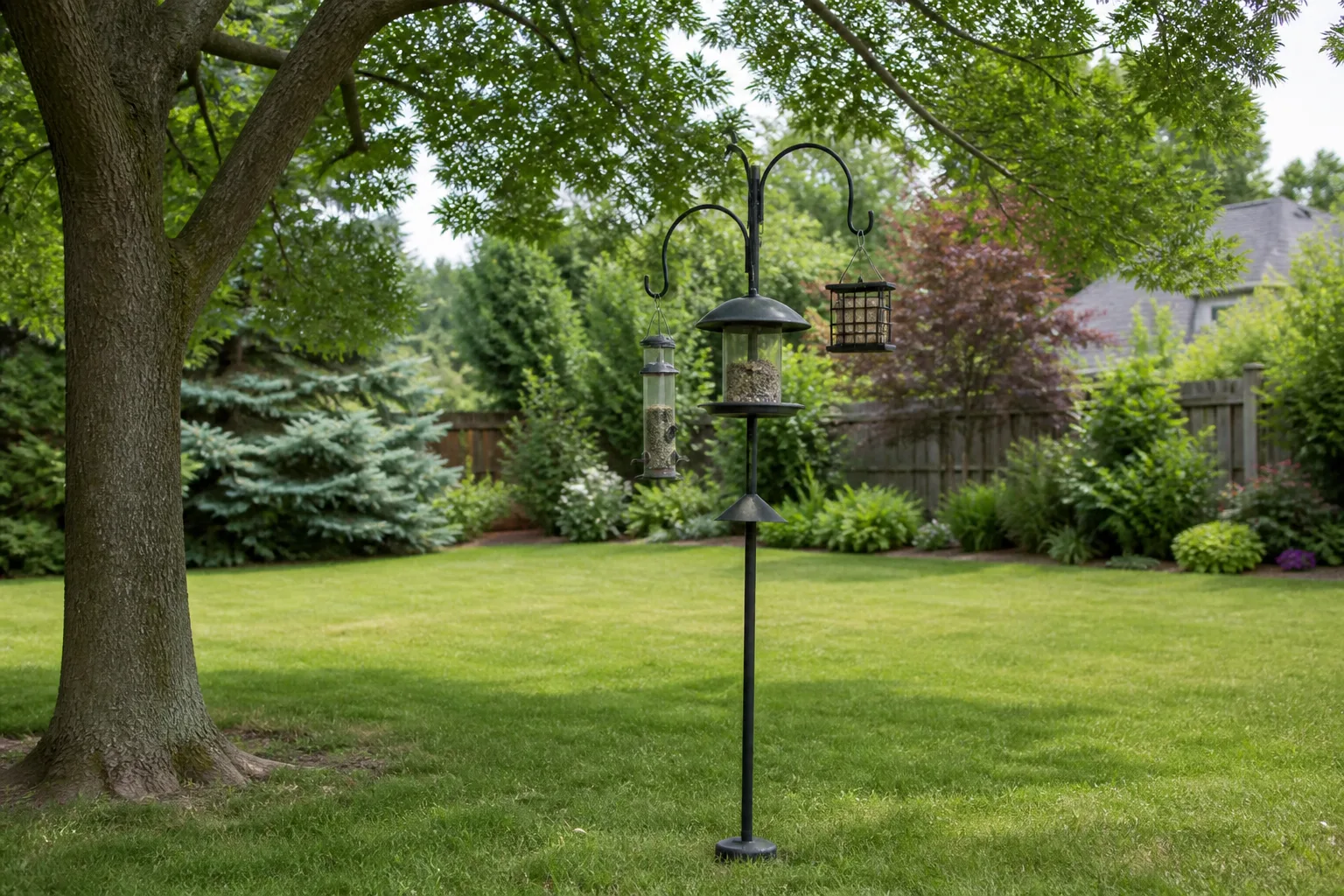
A baffle fails when it is installed at the wrong point on the pole. For a pole-mounted feeder, begin with the barrier about four to five feet above the ground, then check that the feeder itself is not close enough to the baffle for a squirrel to bridge the gap. The baffle should be high enough that the squirrel cannot jump onto it from the ground, but not so high that the animal can climb above it and reach the feeder.
For a hanging feeder, the barrier belongs above the feeder and needs to tilt or swing when a squirrel lands on it. Project FeederWatch and Cornell both point to an overhead baffle at least 18 inches in diameter as a useful starting point. A squirrel that can jump from a branch onto the top of the feeder may never encounter a pole-mounted baffle below it, so match the barrier to the direction of attack. (Project FeederWatch; Cornell Lab of Ornithology)
After installation, look at the setup from a squirrel’s perspective. Can it jump from the ground to the barrier? Can it leap from a branch to the feeder? Can it reach around the baffle from a wall or railing? Fix those three failure points before deciding that baffles do not work.
4. Switch to a weight-activated feeder
Weight-activated feeders use a spring-loaded or counterweighted shroud that closes the seed ports when a heavy animal lands on the perch. Smaller songbirds can still feed, while a squirrel’s weight pulls the cover into place. This is the strongest hardware option when your yard does not have enough room for a ten-foot clearance.
Treat the weight setting as a compromise, not a magic number. A feeder adjusted to exclude squirrels may also exclude larger birds such as cardinals or jays. Some squirrels can also pull a hanging feeder toward a trunk or perch from which they can reach the ports without fully triggering the mechanism. Hang it farther from any solid structure than the squirrel can stretch, and test the closure after every adjustment.
Choose a model that comes apart for cleaning and has a clear, inspectable mechanism. A complicated feeder that traps wet seed or cannot be washed is a poor trade for a little extra squirrel resistance. Project FeederWatch recommends choosing feeders that can be taken apart and cleaned regularly, not just devices that claim to be squirrel-proof. (Project FeederWatch)
5. Use a caged feeder when small birds are the priority
A cage around a tube feeder creates a physical opening that smaller birds can pass through while blocking squirrels and many larger birds. It is especially useful when your goal is to support chickadees, finches, titmice, and similar small visitors rather than every bird in the neighborhood.
The trade-off is predictable: the same mesh that excludes squirrels can exclude cardinals, jays, doves, and other larger birds. Check the mesh size against the birds you actually want to see, and make sure the cage is strong enough that a squirrel cannot bend it or reach through to the ports. Cornell’s feeder guidance describes caged feeders as a practical option, while also noting that spring-loaded feeders can be adjusted to exclude larger birds. (Cornell Lab of Ornithology)
Use a cage as a targeted solution, not as a reason to hang the feeder beside a tree. If a squirrel can jump onto the cage, it may still knock seed out or chew the feeder even when it cannot reach the ports.
6. Hang the feeder from a line with spinning tubing
If a pole is not possible, suspend the feeder from a strong horizontal line and thread several short sections of smooth plastic tubing over the line. The tubing should spin when a squirrel tries to walk across it, interrupting the animal’s grip before it reaches the feeder. Project FeederWatch and Cornell both describe this rotating-tube approach as a way to protect a feeder hung from a wire. (Project FeederWatch; Cornell Lab of Ornithology)
Keep the line taut, use weather-resistant hardware, and inspect the tubing for cracks or sharp edges. A line that sags close to a branch defeats the point, and a feeder hanging too close to a trunk can still be reached from the side. The method is best for a truly open span—not a feeder hung from the first convenient branch.
7. Test safflower or nyjer seed
Changing seed will not block a determined squirrel, but it can reduce repeat visits when hardware is limited. Squirrels often show less interest in safflower and nyjer than in sunflower-heavy mixes. Many finches use nyjer, while safflower can suit birds such as cardinals and chickadees depending on your region and the visitors already using your yard. University of Nebraska–Lincoln Extension notes that squirrels tend to leave nyjer and safflower alone, and Audubon describes safflower as a useful fallback for small spaces where a full baffle setup is difficult. (University of Nebraska–Lincoln Extension; Audubon)
Make the switch gradually if birds are used to a different mix. Fill the feeder with a small amount, observe which birds take it, and avoid buying a large bag until you know the seed is accepted. Safflower is a deterrent by preference, not a lock; hungry squirrels may eventually eat it, especially if there is no easier food nearby.
8. Cut down on seed waste with a better mix and feeder
Spilled seed is an invitation on the ground, even when the feeder itself is difficult to reach. Birds often sort through bargain mixes and flick unwanted fillers out of the ports. A smaller, species-appropriate mix, hulled sunflower hearts, or a nyjer feeder can reduce the debris that accumulates under the station. University of Nebraska–Lincoln Extension specifically warns that rejected fillers can lead to scattered food, while Project FeederWatch recommends avoiding ground feeding when it creates unwanted visitors. (University of Nebraska–Lincoln Extension; Project FeederWatch)
Match the feeder to the seed. A tiny-port finch feeder wastes less nyjer than a broad platform, while a tube feeder with a tray can help catch larger seeds but may also attract larger birds and collect droppings. Start with the smallest amount birds finish in a day or two, then increase only if the feeder is consistently empty for the right reason—not because squirrels are dumping it.
9. Use a catch tray only if you can keep it clean
A catch tray can reduce the visible mess beneath a feeder, but it is not automatically a squirrel deterrent. A large open tray gives squirrels a lower, easier feeding platform and can collect wet seed and droppings. Use one only when it is easy to remove, empty, and wash, and keep it sized to catch modest spill rather than become a second feeder.
If the tray is constantly full, solve the cause instead: reduce the amount of seed, use a less wasteful blend, adjust the ports, or change the feeder. Project FeederWatch cautions that debris and droppings can harbor pathogens and says feeding areas should be raked or swept regularly. (Project FeederWatch)
10. Rake spills and rotate the feeding spot
Sweep or rake beneath the feeder before the squirrels start treating that patch of ground as a reliable restaurant. Remove wet, moldy, or spoiled seed rather than burying it in mulch. Ground cleanup will not stop a squirrel that is already inside the feeder, but it removes the reward that keeps the animal patrolling the area between hardware attempts.
Rotate the feeder a short distance when the ground becomes heavily soiled, provided the new location still meets the no-jump clearance and bird-safety requirements. Project FeederWatch recommends moving feeders periodically to limit waste buildup, and it also notes that scattered bird food can attract rodents. Wear gloves, wash your hands afterward, and use extra care when sweeping a heavily contaminated area. (Project FeederWatch)
11. Offer squirrels a separate station only as a trade-off
A separate squirrel feeder stocked with a small amount of peanuts or dried corn can redirect some animals, particularly when you enjoy having wildlife in the yard and want to reduce competition at a premium bird feeder. Put it well away from the bird feeder and do not place it beside a deck, door, vegetable garden, or other area where you do not want squirrels to spend time.
This is not an exclusion method and it can backfire. You may attract more squirrels, raccoons, deer, or rodents, and a well-fed squirrel may still investigate the bird feeder out of habit. Penn State Extension and Cornell’s feeder guidance both present alternative feeding as an option rather than a guarantee. Use it only if you accept the extra wildlife and can keep the station clean. (Penn State Extension; Cornell Lab of Ornithology)
If the goal is to support birds rather than to watch a particular feeder, a native-plant garden can be a better long-term alternative. Native shrubs, seed-bearing plants, and insect-friendly habitat provide food and cover without concentrating a pile of seed in one exposed spot.
12. Choose a feeder with metal-reinforced ports
Some squirrels stop trying to climb when they cannot get to the seed, but others switch to chewing. Plastic ports and thin hopper edges can be enlarged, cracked, or pulled apart. If you have already seen chew marks, choose a feeder with metal-reinforced ports, a durable metal cage, or a body made from a material that resists gnawing.
This upgrade works best alongside a baffle or a weight-activated closure. A strong feeder can survive a visit, but it does not prevent the visit, the mess, or the stress it causes feeder birds. Cornell recommends durable or metal-reinforced designs when squirrels are damaging feeders, especially after ordinary plastic models have failed. (Cornell Lab of Ornithology)
What not to use on or around a bird feeder
Do not coat the pole with Vaseline, grease, oil, petroleum jelly, or other sticky products. They can mat fur and feathers, strip away insulation, and interfere with a bird’s ability to fly and maintain its plumage. Cornell Lab and University of Nebraska–Lincoln Extension both warn against greasing feeder poles; the extension guide also notes that grease becomes tacky and may eventually make climbing easier. (Cornell Lab of Ornithology; University of Nebraska–Lincoln Extension)
Be cautious with cayenne, chili, or capsaicin-coated seed. Some commercial products are designed for this purpose, but Project FeederWatch says it discourages adding untested products to bird food, and recent Audubon reporting describes mixed squirrel results: hungry squirrels may return to even very spicy seed, while excessive spice may discourage birds. A clean, uncoated seed switch is easier to control and easier to stop. (Project FeederWatch; Audubon)
Skip cinnamon sprays, peppermint, hanging soap, predator urine, coffee grounds, slinkies, and other scent or novelty tricks as a primary solution. Their performance is inconsistent, rain can erase a scent, and anything that drips or scatters near the food creates an unnecessary contamination question. Extension guidance is much clearer about barriers and feeder placement than about household scent recipes. If a method does not remove the squirrel’s access route, treat it as an experiment at best—not the foundation of a bird-feeding setup.
Never use poison, glue traps, or a product that can entangle wildlife. If squirrels are causing a broader property problem or you live in an area with bears, stop feeding temporarily and follow local wildlife guidance. Cornell Lab advises against feeding in areas and seasons where bears are active because food-conditioned bears create a risk for people and for the animals themselves. (Cornell Lab of Ornithology)
Choose the right combination for your yard
The best setup depends on the access route you observed, not on the number of gadgets you can attach. Use this quick decision guide:
| Your setup | Start here | Add if squirrels still get in |
|---|---|---|
| Open lawn with room to move the feeder | Smooth pole, broad baffle, 8–10 feet from launch points | Weight-activated or metal-reinforced feeder |
| Feeder beside a deck, fence, or wall | Weight-activated feeder or caged feeder | Move it farther out; reduce spills and use less attractive seed |
| Feeder hung from a branch | Overhead tilting baffle and a genuine gap from the trunk | Replace the branch route with a pole or open wire span |
| Horizontal wire between posts | Spinning plastic tubing on the line | Add a baffle above the feeder and inspect for side-launch points |
| Small balcony or window feeder | Caged or weight-activated feeder; safflower or nyjer trial | Feed smaller amounts and clean more often |
| Squirrels chewing through plastic | Metal-reinforced ports or durable cage | Pair with a baffle; pause feeding to reset the routine |
If the feeder has been raided for weeks, take it down while you change the layout. Clean the feeder, discard wet seed, rake the ground, and reinstall it only after the barrier and clearance are ready. That short reset prevents the squirrel from being rewarded while you are still adjusting the hardware.
Keep the feeder clean even after the squirrels disappear. Project FeederWatch recommends cleaning seed and suet feeders about every week or two, more often in wet weather or heavy use, and allowing all parts to dry before refilling. If you see sick birds, follow local wildlife-health guidance and consider removing the affected feeder temporarily while you clean the feeder and the ground beneath it. (Project FeederWatch)
Conclusion: make the feeder boring to squirrels
Start with the physical facts: squirrels climb, jump, walk lines, and chew. A broad baffle on a properly placed pole, a weight-activated or caged feeder when space is tight, and a deliberate seed-and-cleanup routine address those behaviors directly. Safflower, nyjer, a lower-waste mix, and a separate squirrel station can fine-tune the result, but they are supporting moves.
The safest “repellent” is a feeder that offers no easy reward and no hazardous coating. Measure the gaps, watch how the squirrel approaches, fix the access route, and give the birds a clean, stable place to feed.