Banana Water for Plants: What the Science Actually Says
Banana peels contain nutrients, but does soaking them make useful fertilizer? Learn what extension experts say and what works better for plants.
Banana water is one of those garden ideas that feels intuitively right. Bananas contain potassium, plants need potassium, and soaking banana peels in water seems as though it should transfer that nutrient into a free homemade fertilizer. Social posts and videos often take the next step and promise stronger roots, more flowers, better tomatoes, or healthier houseplants.
The problem is not that a banana peel contains nothing useful. It is that a jar of soaked peels is not a standardized fertilizer with a known nutrient analysis, and there is little research showing that the homemade liquid improves plant growth. University extension responses that have addressed the practice generally recommend composting the peels or fertilizing according to actual plant and soil needs instead.
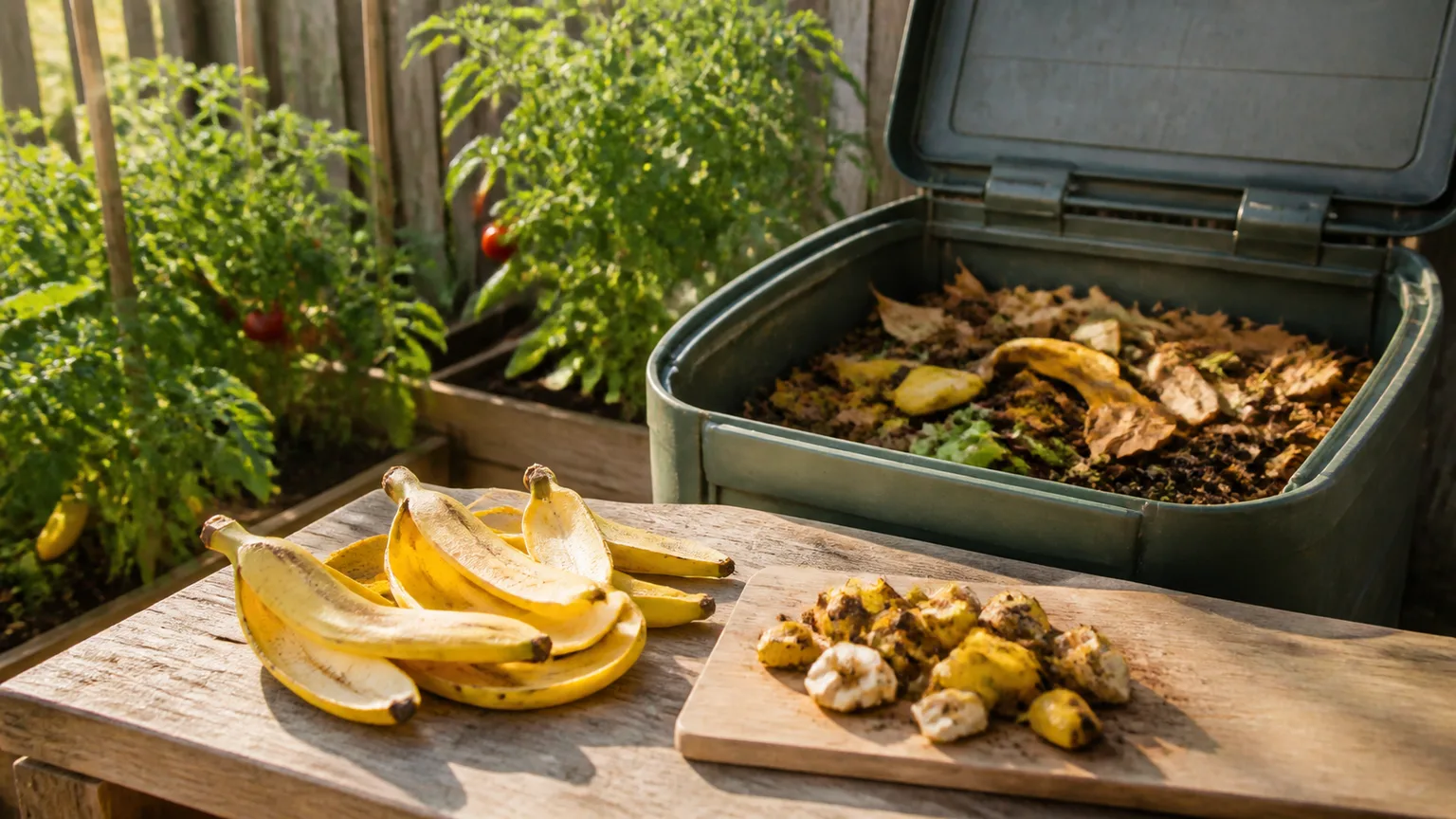
Composting the whole peel is more predictable than applying an unmeasured soak.
That distinction matters. “Some nutrients may enter the water” and “this is an effective fertilizer” are not the same claim. If your goal is healthier plants rather than simply reusing kitchen scraps, predictability matters.
What People Mean by Banana Water
The usual recipe is simple: place one or more banana peels in a jar or bucket, cover them with water, let the mixture sit for anywhere from a day to several days, strain it, and pour the liquid around plants. Some versions ferment the peels for longer, blend them, boil them, dry and powder them, or dilute the liquid before use.
Those variations are part of the problem when people discuss “banana water” as though it were one consistent product. A single peel in two liters of cold water for 24 hours is chemically different from five chopped peels fermented for a week in a warm kitchen. Neither has a fertilizer label telling you how much nitrogen, phosphorus, potassium, soluble salt, sugar, or other material is present.
Gardeners also use the term “banana peel tea,” but this is not tea in a horticultural testing sense and should not be confused with a professionally managed compost extract. It is simply water that has been in contact with fresh or decomposing banana peel.
If you enjoy experimenting, that can still be interesting. Just separate the experiment from the evidence: you are making a variable kitchen-waste infusion, not a measured potassium fertilizer.
The Short Answer: It Is Not a Reliable Fertilizer
The most defensible conclusion is that banana-peel water is not a reliable substitute for balanced fertilizer or soil-based nutrient management. In a 2024 response, University of Maryland Extension said it was not aware of research supporting the idea that soaking banana peels produces fertilizer-strength water. The response notes that food scraps contain nutrients but that the amount released from the soak is unlikely to provide sufficient fertilization.
An Ohio State University Extension response on banana peel tea similarly described the homemade brew as difficult to evaluate because there is no definitive chemical analysis for a typical recipe. That is the central issue: without a known concentration and a demonstrated response in plants, you cannot dose it in the way you can a labeled fertilizer.
This does not prove that absolutely no potassium, phosphorus, or other soluble material ever enters the water. Organic material changes as it sits, and some compounds can leach. But “not zero” is a very low bar. Plants need nutrients in appropriate amounts and proportions, and the gardener needs to know whether an application is correcting a real deficiency.
For most plants, you will get a more predictable result by using compost to recycle the peel and choosing fertilizer based on the crop, container mix, or soil test rather than on a social-media recipe.
Banana Peels Contain Nutrients, but That Is Not the Same as Plant-Available Fertilizer
A banana fruit and its peel contain mineral elements, including potassium. That fact is often used as the entire argument for banana water. But plant nutrition is not determined simply by asking whether a source material contains an element; it depends on how much of that element becomes available in the root zone, in what chemical form, over what time, and whether the plant actually needs more of it.
Think about a compost pile. Banana peels decompose alongside leaves, stems, coffee grounds, and other organic material. Microorganisms break down those materials, nutrients cycle through the composting process, and the finished product contributes organic matter and a range of nutrients to soil. That is a very different process from briefly soaking a fresh peel in water and discarding the solid material that still contains much of its original matter.
The same logic applies to other kitchen-scrap remedies. Eggshells contain calcium, coffee grounds contain nitrogen, and wood ash can contain potassium, but none of those facts tells you that a homemade handful or soak is automatically the right treatment for a particular plant. Nutrient source, release rate, concentration, pH, salts, and existing soil fertility all matter.
A plant that already has sufficient potassium will not become “extra healthy” simply because more potassium is nearby. Excess or imbalance can also interfere with other nutrient relationships. Fertilization should solve a need, not merely introduce an ingredient with a good reputation.
Why the Nutrient Dose Is Unknown
Commercial fertilizers list nutrient percentages because dose matters. If a product says it contains specified percentages of nitrogen, phosphate, and potash, you can calculate how much nutrient you are applying and follow a tested rate for the plant. Banana water has no equivalent analysis.
Peel size varies by banana cultivar and ripeness. Recipes vary in peel-to-water ratio, chopping, temperature, soaking time, oxygen exposure, and dilution. Water chemistry varies too. Once microbes begin decomposing the peel, the mixture changes again.
That makes claims such as “one cup per plant” scientifically weak unless the solution has actually been analyzed. One person’s cup could contain far less or far more soluble material than another person’s. Even if both plants survive, survival does not tell you whether the treatment was useful.
Unknown concentration is especially relevant in containers. Houseplant pots hold a small root-zone volume, so repeated additions of any dissolved material can accumulate differently than in a large garden bed exposed to rain and broad soil buffering. Using a known, diluted fertilizer at the labeled rate is easier to control.
If you see a recipe that gives very precise banana-water dosing without measuring what is in the liquid, treat that precision with skepticism. A precise-looking number is not the same as a measured nutrient recommendation.
Potassium Alone Does Not Make a Complete Fertilizer
Potassium is essential for plants. It participates in water regulation, enzyme activation, stomatal function, and many physiological processes. But plants also require nitrogen, phosphorus, calcium, magnesium, sulfur, and micronutrients, with needs that vary by species, growth stage, and growing medium.
A fertilizer strategy focused entirely on potassium can miss the actual limiting factor. A pale nitrogen-deficient plant will not necessarily green up because you applied a potassium-rich material. A plant in waterlogged soil may show nutrient-stress symptoms even when the soil contains adequate nutrients because damaged roots cannot function normally.
Container plants are a good example. Many commercial potting mixes contain little long-term fertility after their starter charge is used, so a complete fertilizer supplies several essential nutrients in known proportions. Banana water cannot be assumed to do the same job.
In garden soil, the existing nutrient reserve can be substantial. If your soil already tests high in potassium, adding more is unnecessary. University of Maryland Extension specifically recommends soil testing rather than assuming banana-water potassium is needed.
The practical rule is simple: fertilize for the plant’s need, not for the nutrient contained in your kitchen scrap.
Does Banana Water Help Houseplants?
There is no strong evidence that houseplants need or specifically benefit from banana water. Indoor plants are often grown in small containers with controlled drainage, making them a poor place for decomposing kitchen-waste liquids whose composition is unknown.
A soak that has sat for several days can become cloudy, smell fermented, or contain suspended organic material. Ohio Extension’s banana-peel-tea response raised concern about sugars and carbohydrates in homemade mixtures and the possibility of encouraging fungus gnats and other nuisance organisms in indoor pots. Even if the liquid does not immediately injure the plant, creating a moist, food-rich surface layer is not a useful trade.
Houseplant problems also have many non-fertilizer causes. Yellow leaves can result from overwatering, underwatering, root damage, low light, cold drafts, natural leaf aging, pests, or inappropriate pH. Adding banana water before diagnosing the cause can distract from the actual fix.
If an actively growing houseplant needs feeding, use a complete houseplant fertilizer at the label rate, often beginning with a conservative dilution if the plant is sensitive. Flush the pot periodically with plain water when appropriate for the species and mix, and do not fertilize a severely stressed plant merely because its leaves look poor.
Compost kitchen scraps elsewhere rather than turning the pot into a mini composting system. That keeps decomposition where it is easier to manage.
Does Banana Water Help Tomatoes, Roses, or Flowering Plants?
Tomatoes, roses, peppers, and flowering plants are frequently named in banana-water claims because potassium is associated with many aspects of plant growth and reproduction. The leap from “these crops need potassium” to “banana-peel water improves flowering or fruiting” still requires evidence and a known nutrient dose.
A tomato planted in potassium-sufficient soil does not need an extra homemade potassium treatment just because it begins flowering. If fruiting is poor, heat, cold, pollination, nitrogen imbalance, disease, water stress, light, or cultivar performance may be responsible. Pouring on an unmeasured liquid can leave the real problem untouched.
Roses likewise need appropriate fertility, but they do not have a unique biological requirement for banana water. A soil or container-fertilization program designed for roses is more predictable than alternating kitchen remedies based on whichever nutrient a scrap is rumored to contain.
Flower production is an outcome of the whole plant system. Adequate light, healthy roots, proper water, suitable temperature, pruning or deadheading where appropriate, and balanced nutrition matter together. No single kitchen ingredient replaces those fundamentals.
If you garden in soil and suspect a potassium deficiency, confirm it with a soil test or local extension guidance. If you grow in containers, use a fertilizer whose analysis matches the crop rather than trying to estimate nutrients from peel count.
Can Banana Water Make Plants More Drought-Tolerant?
Potassium is involved in plant water relations, which can make “banana water for drought resistance” sound plausible. But a true physiological role for potassium does not prove that an unknown amount from soaked banana peels will correct water stress.
University of Maryland Extension directly addressed this claim in its 2024 banana-peel-water response and stated that banana-water potassium would not make plants more drought-tolerant. During hot, dry weather, the practical priority is appropriate, deep watering and water-conserving garden practices.
For outdoor beds, improve drought resilience with species selection, adequate root-zone watering, mulch where suitable, healthy soil structure, and irrigation timing. For containers, use an appropriately sized pot, a suitable potting mix, and consistent watering; small pots can dry dramatically faster than garden soil.
If a soil test identifies a genuine potassium deficiency, correct it with a measured recommendation. Do not use a drought-stressed plant as a test site for an unstandardized fertilizer brew.
What Can Go Wrong With Homemade Banana Water
The most common downside is not dramatic toxicity. It is mess, odor, pests, and false confidence. A fermenting jar can smell unpleasant, and organic residues applied repeatedly to indoor soil can create food for fungus gnats, molds, and other decomposers.
Cloudiness or a surface film does not mean the mixture has become more nutritious in a controlled way. It means biological activity is occurring. Without controlled aeration, temperature, sanitation, and analysis, the microbial community is unknown and changes from batch to batch.
There is also an opportunity cost. If a plant has chlorosis caused by root rot, iron unavailability, or insufficient nitrogen, spending weeks testing banana water delays diagnosis. Garden advice should make problems easier to solve, not add another uncontrolled variable.
Outdoors, small quantities are less likely to cause obvious trouble because soil volumes are larger and decomposition is already occurring. Even there, a kitchen soak is not automatically harmless in every context. Avoid pouring fermenting organic liquids into ponds, waterways, seedling trays, sterile propagation media, or any site where sanitation matters.
And do not make the remedy more concentrated on the theory that “more nutrients” must be better. Without an analysis, concentrating the liquid increases uncertainty rather than improving the recommendation.
Is Banana Water the Same as Compost Tea?
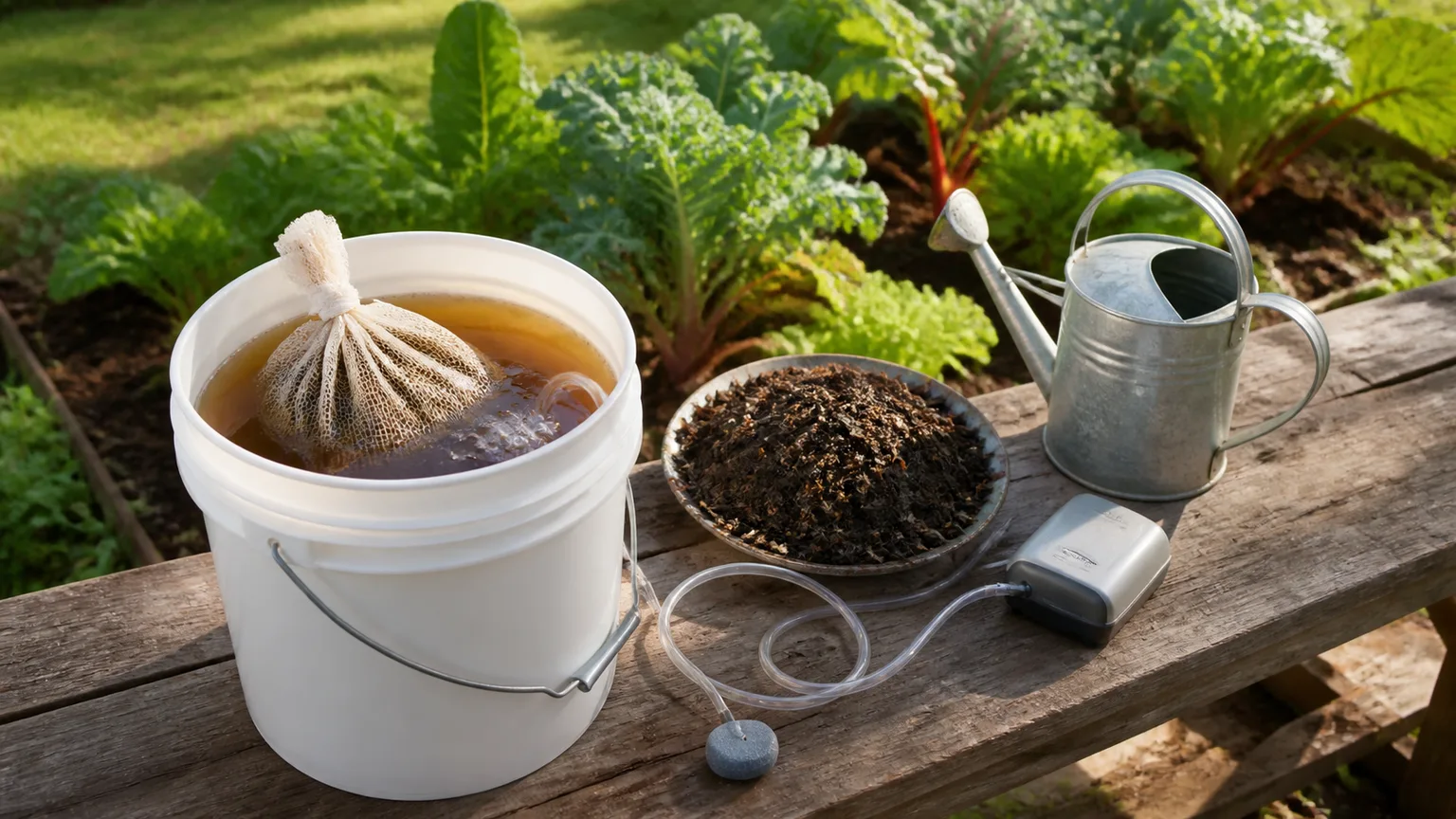
Finished compost is a stabilized amendment; a short peel soak is not the same product.
No. The terms are sometimes blurred online, but banana water is usually a soak of fresh banana peels. Compost tea, in its various forms, starts with finished compost and may involve specific extraction or aeration procedures. Even compost tea has context-dependent evidence and safety considerations; it is not a synonym for any brownish organic liquid made in a jar.
Finished compost itself is much easier to recommend. Proper composting transforms mixed organic residues into a stabilized amendment that contributes organic matter and recycles nutrients. The process uses the whole peel rather than discarding most of the solid material after a short soak.
For vegetable gardens, use mature compost according to sound horticultural practices rather than applying immature kitchen waste directly around roots. For houseplants, compost content should be appropriate to the potting mix and species; dumping unfinished scraps into pots invites decomposition problems.
Calling banana water “compost tea” can make the method sound more established than it is. Use accurate names so the expected benefits remain realistic.
Better Ways to Use Banana Peels
If you already compost, the simplest answer is to put banana peels in the compost system. Chop them if you want them to break down faster, mix them with carbon-rich material, maintain suitable moisture and aeration, and let the composting process do the work.
A municipal food-scrap program is another good option where home composting is impractical. The peel still becomes part of a managed organics stream without fermenting on a kitchen counter or accumulating in houseplant soil.
Worm composting can accept banana peels too, provided the bin is managed correctly and the amount does not overwhelm the worms or create wet, acidic, pest-prone conditions. Add scraps in moderation and balance them with bedding.
In a garden, some extension sources discuss burying food scraps in suitable empty soil areas, but composting first is more predictable and avoids attracting animals or creating temporary pockets of decomposition beside active roots. Follow local pest and food-waste guidance, especially where rodents or wildlife are common.
The goal is to recycle the whole material through a process designed for decomposition. That captures more value than chasing a small, unknown fraction of soluble nutrients in soak water.
How to Fertilize Plants More Predictably
Start with the plant and growing system. A leafy houseplant in potting mix, a tomato in a raised bed, a rose in mineral soil, and an orchid in bark do not share one universal feeding recipe. Use a fertilizer labeled for the crop or growing situation and apply it at an evidence-based rate.
For containers, complete fertilizers are useful because repeated watering can leach nutrients and many soilless mixes have limited reserves. Follow the label, reduce or pause feeding when growth slows, and avoid combining multiple fertilizers simply because each one has a different marketing promise.
For garden beds, organic matter management and soil testing can guide decisions. Compost improves soil properties and contributes nutrients gradually, while a soil test can show whether phosphorus or potassium is already high enough that more is unnecessary.
When using any fertilizer, more is not better. Excess soluble salts can injure roots, stimulate weak growth, contaminate runoff, or create nutrient imbalances. Measured products are valuable not because “chemical” is inherently better than “natural,” but because you know the analysis and can dose them deliberately.
If you prefer organic fertilizers, choose a labeled product with a guaranteed analysis and follow the application rate. Predictability and responsible nutrient use are compatible with organic gardening.
When a Soil Test Is Worth It
A soil test is especially useful before repeatedly adding phosphorus or potassium to an outdoor garden. Those nutrients can already be adequate or high, and visual symptoms alone do not reliably tell you the soil concentration.
Use a reputable local laboratory or extension-recommended service and sample according to instructions. The report can provide pH and nutrient information, and many services include fertilizer recommendations for the crop or garden type you specify.
Testing is less straightforward for a small houseplant pot because commercial potting mixes and liquid-feeding schedules behave differently from field soil. In that setting, use a sensible complete fertilizer, good watering practice, and periodic repotting rather than trying to correct a presumed potassium deficiency with kitchen scraps.
If a garden plant shows a persistent unexplained symptom despite suitable soil fertility, look beyond nutrients. Root disease, compaction, drainage, herbicide injury, insects, and environmental stress can mimic deficiency symptoms.
The value of testing is that it reduces guessing. Banana water does the opposite: it adds a nutrient source whose concentration you do not know to a root zone whose nutrient status you may not know either.
If You Still Want to Experiment With Banana Water
A low-stakes experiment can be educational as long as you do not confuse it with a proven treatment. Use healthy, inexpensive outdoor plants rather than a prized houseplant or food crop with a diagnosed problem. Keep the recipe mild, do not ferment it for long periods, and stop if it becomes foul-smelling or visibly slimy.
Most importantly, include a control. Use two similar plants in similar conditions, give both the same amount of ordinary water, light, and care, and apply banana water only to one. Record growth over several weeks rather than relying on memory.
Do not add a commercial fertilizer to the banana-water plant but not the control, and do not water one plant more often simply because the banana mixture is available. Those differences would make it impossible to know what caused any improvement.
Even a home comparison cannot establish a universal fertilizer recommendation, but it teaches an important lesson about garden observations. Plants change for many reasons, and a treatment applied just before new growth appears may receive credit for growth that would have happened anyway.
For indoor plants, the risk-benefit balance is worse because of odor and fungus-gnat concerns. If you insist on trying it, use only a very small, fresh, well-diluted amount and monitor the pot closely, but a labeled fertilizer remains the better recommendation.
Common Banana-Water Claims, Checked
“Banana water is high in potassium.” Banana peels contain potassium, but that does not tell you the concentration in a homemade soak. Without analysis, calling the final liquid “high potassium” is an assumption.
“It makes plants bloom.” Plants need potassium, but flowering depends on genetics, light, temperature, maturity, water, and balanced nutrition. There is not good evidence that banana-peel water reliably increases bloom.
“It is a complete organic fertilizer.” It is not complete in the sense used for plant nutrition. A short peel soak does not provide a known balance of all essential nutrients.
“It cannot hurt because it is natural.” Natural materials can still create odor, pest, salt, sanitation, or nutrient-balance problems depending on dose and setting. “Natural” describes origin, not safety or effectiveness.
“If my plant grew after I used it, the banana water worked.” That observation is real, but causation is uncertain. The plant may have responded to additional water, seasonal growth, warmer temperatures, better light, or nutrients already present in the soil.
“Banana water replaces compost.” It does not. Composting uses the whole organic material and produces a stabilized soil amendment; soaking a peel extracts an unknown fraction and leaves most of the solid material behind.
Conclusion
Banana water is a clever-sounding recycling hack, but the science-based case for using it as fertilizer is weak. Banana peels do contain nutrients, yet a homemade soak provides an unknown amount, in an unknown balance, with no standard application rate. That makes it a poor tool for correcting a nutrient problem.
If you want to reuse banana peels, compost them. If you want to fertilize a plant, use a product or soil-test recommendation that tells you what you are applying. And if you simply want to experiment, use a control and keep your claim modest: a plant surviving or growing after banana water does not by itself prove the soak caused the improvement.