How to Prevent a Soggy Yard
Learn how to prevent a soggy yard with practical fixes for clay soil, roof runoff, erosion, rain gardens, French drains, and foundation protection.
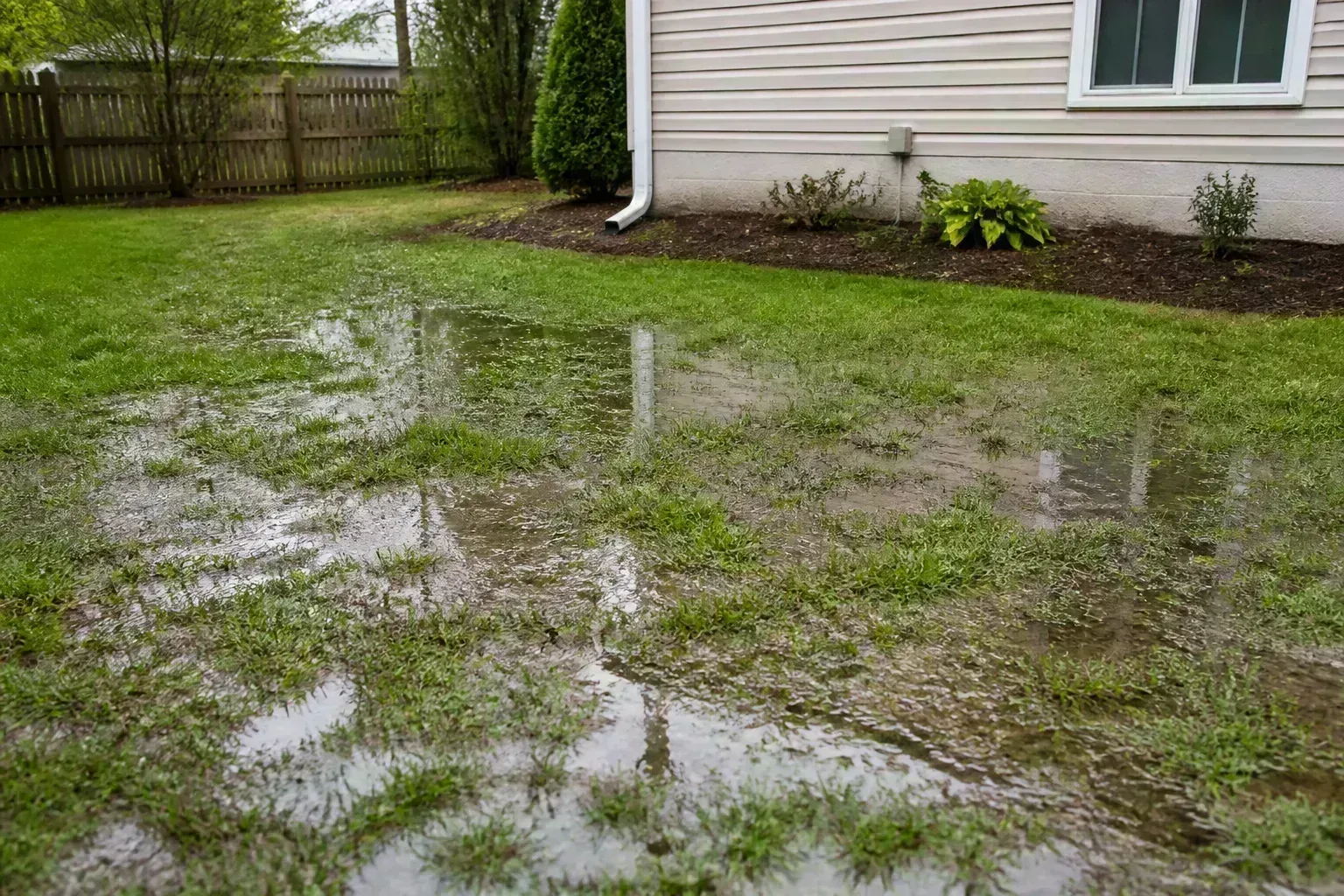
If water still stands after the lawn around it has dried, do not start by spreading gravel over the mud. First find out whether the water is coming from the roof, moving across the surface, trapped in compacted soil, or rising from below. The right fix depends on that answer.
Use this order: observe a real storm, protect the foundation with positive grade and controlled downspouts, improve infiltration where compaction is the problem, then add a swale, French drain, rain garden, or other feature that has a safe outlet. Plants and mulch can slow runoff and hold soil, but they cannot compensate for a missing flow path or a saturated water table.
Diagnose the water before changing the yard
A wet spring or an unusually intense storm can leave almost any yard damp for a while. A soggy yard is a pattern: the same spot pools repeatedly, stays soft for a day or more, develops a muddy or algae-prone surface, or receives a concentrated stream from a gutter. Penn State Extension notes that runoff can carry sediment and nutrients from bare soil, lawns, roofs, and paved areas, so the issue is bigger than whether the grass looks untidy (Penn State Extension explains stormwater quality).
Track the source, path, and duration
Go outside during rain if it is safe, then return when the rain stops. Use small stakes or washable landscape flags to mark where water enters, the direction it travels, every place it spreads or cuts a channel, and the final place it sits. Photographing the same area at one hour, six hours, and the next day gives you more useful evidence than guessing from a dry afternoon.
Look uphill before you look at the puddle. Roof valleys, downspout elbows, driveway edges, neighboring slopes, overflowing window wells, and a patio that pitches toward the lawn can all deliver water to one low spot. Also check for a leaking hose bib, irrigation line, pool line, or broken buried pipe if the area stays wet during a dry spell.
The duration matters. A shallow puddle that disappears the same day may need only a minor grade adjustment or a better turf surface. Water that remains for several days, bubbles from the soil, or appears without recent rain suggests slow infiltration, a high water table, groundwater seepage, or a damaged line; those conditions deserve a more careful design.
| What you see | Likely first question | First sensible move |
|---|---|---|
| Water directly below a downspout | Is roof water being dumped in one place? | Clean the gutter and extend or redirect the downspout |
| A broad shallow sheet across the lawn | Where should the surface flow go? | Check grade, then shape a swale or regrade if a safe outlet exists |
| One bowl-shaped low spot | Can the area infiltrate or overflow? | Run a soil test and consider a rain garden, catch basin, or controlled fill |
| Wet soil beside the foundation | Is grade or roof runoff pointing at the house? | Correct the near-foundation grade and call a professional if water enters |
| Mud and a small gully on a slope | Is velocity stripping the soil? | Slow and spread the flow with planting, stone, a swale, or engineered work |
The practical distinction is surface water versus subsurface water. Surface water can often be intercepted by grading, swales, channel drains, or catch basins. Subsurface seepage may need a French drain or underdrain, but only if the pipe can discharge somewhere lower and permitted; a perforated pipe installed in a flat, saturated bowl is not a magic escape hatch.
Fix the grade around the house first
The soil immediately beside a house has one job before it supports ornamental plants: it must shed water away from the structure. A low planting bed, thick mulch layer, or settled trench can reverse the slope and send roof water toward siding, window wells, basement walls, and crawl spaces.
Use the six-inch-in-10-feet benchmark carefully
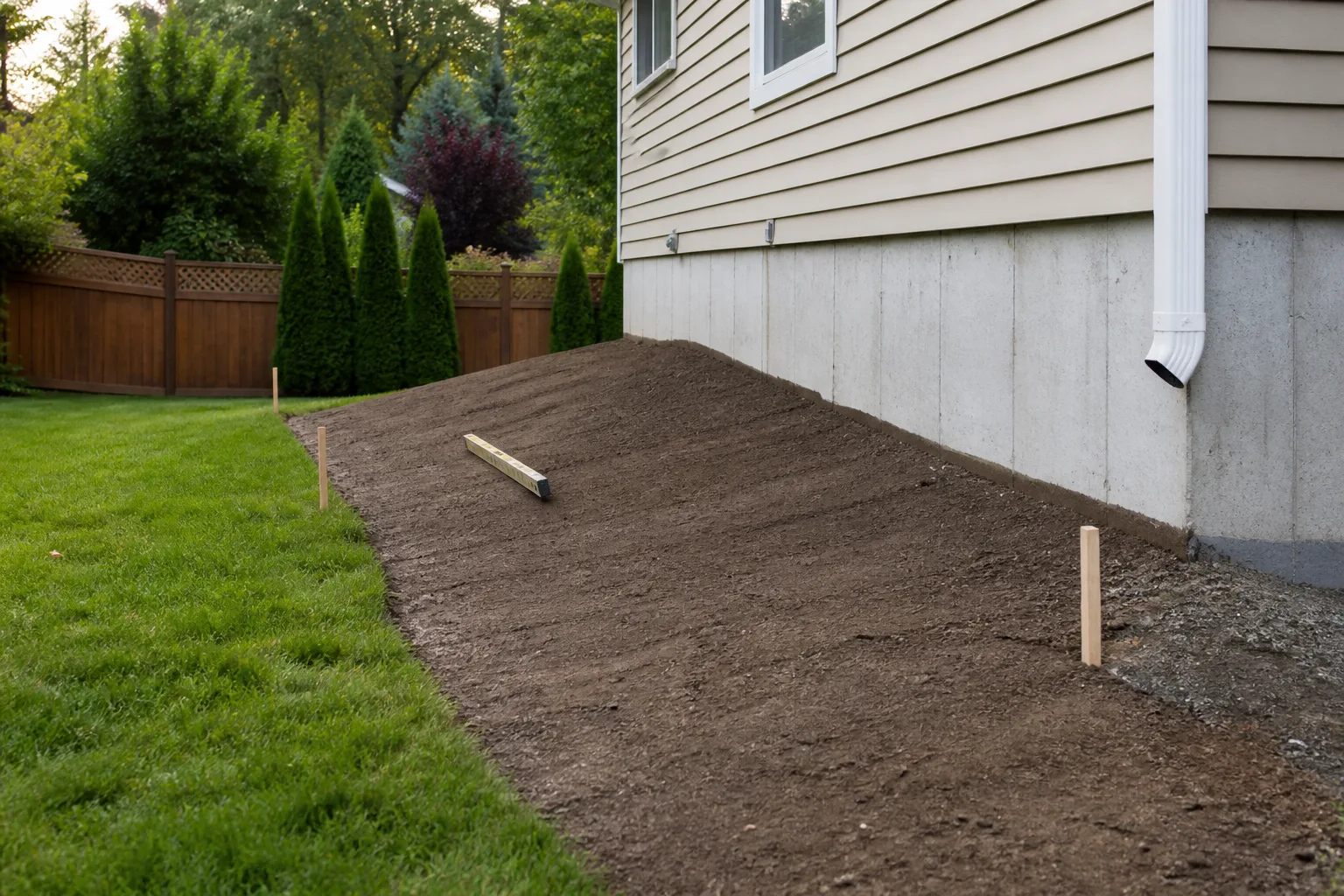
Many residential drainage rules use a fall of about 6 inches in the first 10 feet away from a foundation, or roughly a 5% slope. The eCFR gives that minimum for manufactured-home sites and explains that drains or swales are needed where walls, slopes, property lines, or other conditions prevent it (read the site-drainage rule). A municipal building department’s drainage guidance likewise repeats the six-inch-in-10-feet benchmark and the need for an alternate approved route when the geometry makes it impossible (see the Herriman grading guidance). Treat this as a useful benchmark, not permission to ignore your local code or bury the siding.
Set stakes at the foundation and at the outer edge of the 10-foot zone, then use a long level, string level, or laser level to compare elevations. The finished soil should remain below the bottom edge of siding and below vulnerable vents or window openings. Compact fill in thin lifts rather than dumping a tall, loose mound against the wall; loose soil settles, mulch floats, and both can recreate the low spot.
Regrading can solve a shallow low spot, but it cannot create an outlet where a neighboring wall, property line, road, or higher land blocks the route. Do not raise your yard so water leaves your property faster toward a neighbor, sidewalk, or basement. If the grade change is large, stabilize it as a slope or retaining-wall project with drainage behind the wall, not as a pile of topsoil.
Capture and redirect roof runoff
Treat downspouts and outlets as one system
Gutters collect water from a large roof area and concentrate it into a few downspouts. That is efficient for the roof but intense for the soil. A short elbow that releases water beside the foundation can create a soggy strip, wash mulch downhill, and overwhelm a lawn that would otherwise drain normally.
Clean the gutters, confirm that every downspout is connected, and watch each outlet in a storm. Add a rigid or flexible extension, splash block, or solid underground pipe that sends water toward a stable lawn, planting bed, rain garden, dry well, swale, or approved stormwater connection. The receiving area must be large and permeable enough for the flow, and it must slope away from the house.
Penn State Extension recommends disconnecting roof runoff from sanitary sewer systems where appropriate and redirecting it to a large enough lawn or landscape area, rain barrel, or cistern—but specifically warns that the destination must not cause pooling at the foundation (guidance on downspouts and home landscapes). Check local rules before tying into a public storm sewer or discharging near a street.
Do not bury pipe until you know where it ends. A line that has no daylight outlet, no functioning dry well, and no permitted connection simply stores water underground until it backs up. Keep cleanouts accessible, protect the outlet from erosion, and provide a safe overflow path for storms larger than the system was designed to handle.
Rain barrels are useful for reducing the first rush of water from one downspout and supplying irrigation later. They do not fix negative grade, a wet basement, or a saturated yard by themselves. Install a screened, covered barrel with a real overflow route; a full barrel that spills against the foundation recreates the original problem.
Improve compacted or clay soil
A lawn can behave like pavement when years of foot traffic, construction equipment, parked cars, or mowing in wet conditions squeeze the air spaces out of the soil. Penn State Extension points out that compacted lawn soil may act like an impervious surface because water cannot penetrate it (lawn and landscape runoff guidance). Clay adds another challenge: its fine particles hold together tightly, so water can move slowly even when the surface looks cracked and dry.
Know when soil improvement is not enough
Test compacted turf only when the soil is moist enough to work but not wet enough to smear. A core aerator removes plugs and opens temporary channels; it is most helpful where the top layer is compacted and the underlying soil can accept more water. Aerate during the active recovery period for your grass type, and keep traffic off the area while it heals.
In planting beds, use a digging fork or broadfork to loosen without pulverizing the soil, then add finished compost or other locally recommended organic matter across the root zone. Organic matter improves aggregation over time and supports roots and soil organisms. Fine Gardening’s clay-soil guidance also describes using a French drain, a dry creek bed, berms, and plants adapted to wet locations rather than expecting one amendment to change an entire heavy-clay subsoil (drainage strategies for heavy clay soil).
Avoid the common impulse to mix a thin layer of sand into a large clay problem. It rarely changes the drainage of the deeper soil and can create a dense, difficult layer when the proportions are wrong. Do not work clay while it is sticky; kneading wet soil destroys the pore spaces you are trying to restore.
Soil improvement is the right scale when the problem is shallow compaction and water has somewhere to go. It will not correct a house-facing slope, a downspout that delivers roof water faster than the lawn can absorb it, a high water table, or a low spot enclosed by hardscape. If a percolation hole stays full, stop adding amendments and reassess the design.
Choose a drainage improvement that fits the flow
Drainage improvements work when they match the kind of water you observed and end at a safe destination. The most dependable projects often combine a roof-water control at the top, a visible or buried conveyance route in the middle, and a planted, armored, or approved outlet at the bottom.
Use swales and dry creek beds for surface runoff
A swale is a broad, shallow depression that guides water without looking like a ditch. It works for sheet flow from an uphill lawn, driveway, or neighboring grade when you have enough space to shape a gentle channel and a place for the water to go. Keep the sides stable and vegetated; a swale that is too steep becomes an erosion chute.
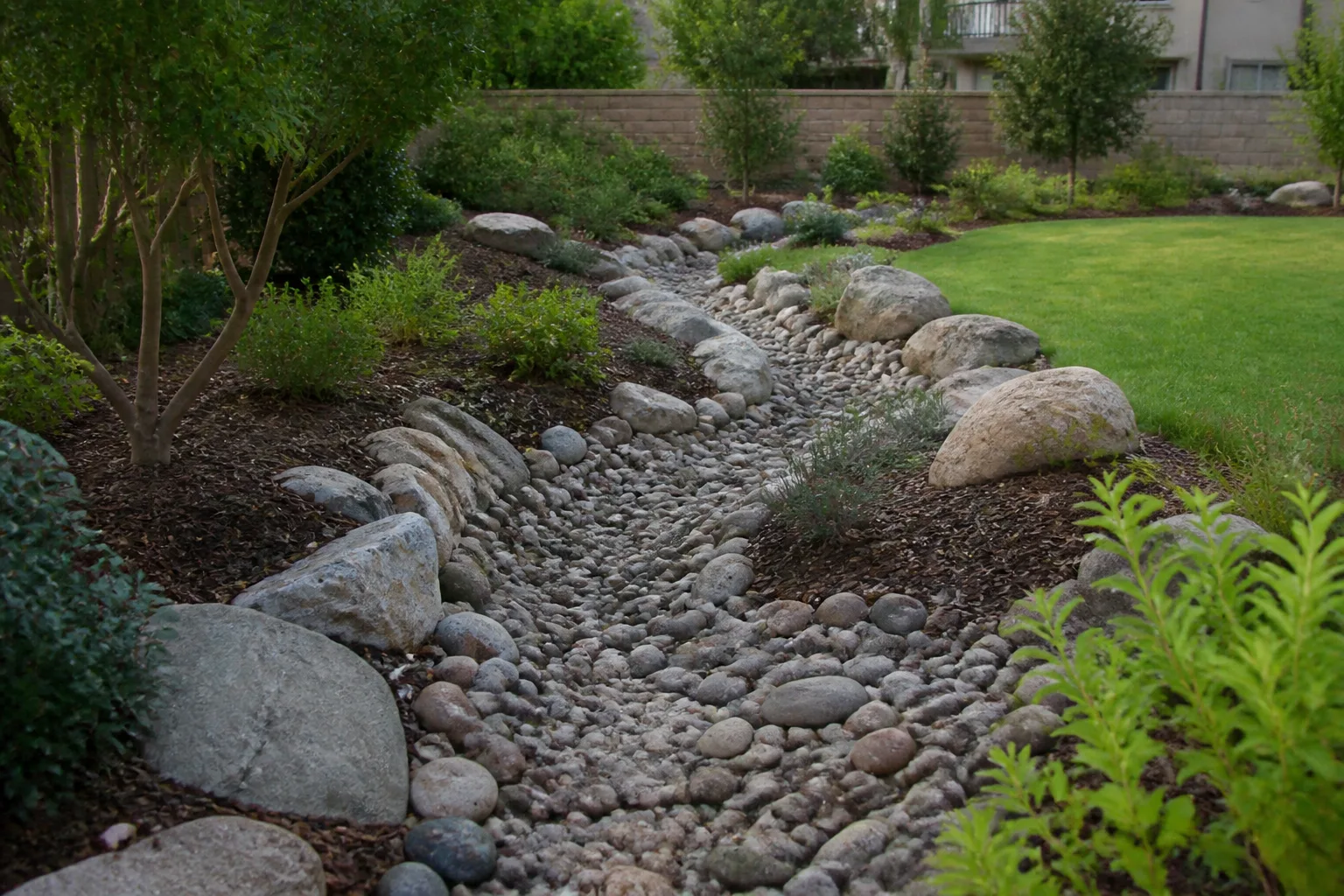
A dry creek bed uses rounded stone, larger edge rocks, and planting to make a temporary watercourse visible and durable. Fine Gardening describes dry creek beds as a way to move downspout water, slow flow on a slope, and reduce erosion while adding a landscape feature (rainwater-management design ideas). Stone alone does not fix a bad grade; shape the channel first, then armor the places where water accelerates or changes direction.
Use French drains for subsurface seepage
A French drain is a gravel-filled trench, often with perforated pipe, that collects water moving through soil and carries it downslope. It makes sense for persistent seepage along a slope, a wet band beside a foundation, or dispersed subsurface water that cannot be solved by surface grading. It is a poor first choice for a single puddle caused by a short downspout or a bowl-shaped lawn with no outlet.
Before digging, establish the pipe’s fall, outlet, cleanouts, and overflow. Use clean, appropriately sized aggregate and follow the pipe manufacturer’s instructions for perforation orientation and filter fabric; fine sediment, roots, and poorly selected fabric can reduce flow. Most importantly, do not assume that a gravel trench will drain into heavy clay or a high water table. The University of Minnesota Extension explains that drainage performance depends on soil characteristics, restrictive layers, topography, and the receiving body—not only on the pipe’s size or pitch (soil and water basics for drainage).
Use rain gardens and dry wells for infiltration
A rain garden is a shallow planted depression that temporarily receives runoff and lets it filter and infiltrate. Penn State Extension describes most residential rain gardens as bowl-shaped areas that are usually less than 12 inches deep and designed to drain rather than hold permanent water (rain gardens at a glance). Place one well away from the foundation, septic systems, wells, and steep unstable slopes; size it for the roof or pavement feeding it, and test how quickly the native soil drains.
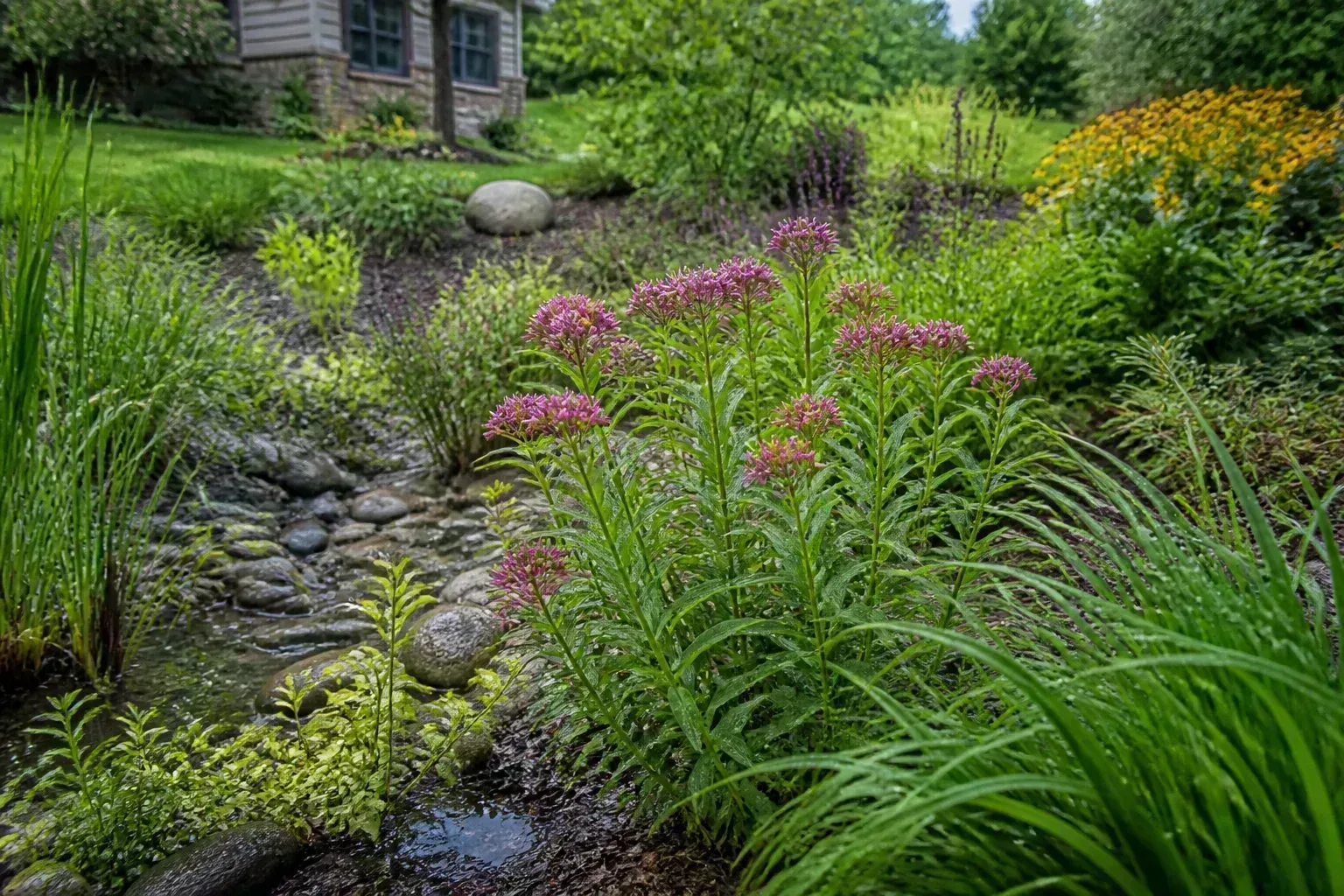
Rain gardens are not ponds and are not a cure for a basement leak. Build a defined overflow route so a cloudburst does not cut through the planting bed or send water toward the home. Penn State’s stormwater guidance also emphasizes that systems need continued inspection: inlets, outlets, overflow structures, filter media, and vegetation can clog, erode, or decline (stormwater-system maintenance and performance).
A dry well stores water underground so it can infiltrate into surrounding soil. It can be useful for a small, isolated roof catchment where the soil percolates well and groundwater is deep. In heavy clay, shallow bedrock, or a high water table, the well can fill quickly and back up; do not use it as an underground dumping ground for a large roof without sizing and testing.
Use plants to slow water and hold soil
Plants are a drainage layer, not a drainage system. A dense canopy intercepts some rainfall, roots create channels and bind soil, and leaf litter helps the surface resist raindrop impact. Deep-rooted native trees and shrubs can also reduce runoff over time, but newly planted specimens need establishment water and will not instantly dry a flooded yard.
Choose plants for the whole moisture cycle
Match plants to the site’s wettest and driest conditions, not just the day you buy them. The bottom of a rain garden may be briefly inundated, the middle may stay moist, and the edge may dry between storms. Choose species that tolerate that cycle, the available sun, your climate, and their mature size; “water-loving” does not mean “will thrive in stagnant water forever.”
For a sunny, periodically wet low spot, examples to investigate with your local extension office or native-plant society include swamp milkweed, cardinal flower, sedges, buttonbush, river birch, and bald cypress. Fine Gardening lists several of these as options for poorly drained soil, while Gardening Know How notes that plants from marshes, floodplains, stream edges, and bogs are the logical candidates for wet conditions (wet-site plants from Fine Gardening; full-sun plants for wet soil). Verify invasiveness, hardiness, mature height, and availability for your region before planting.
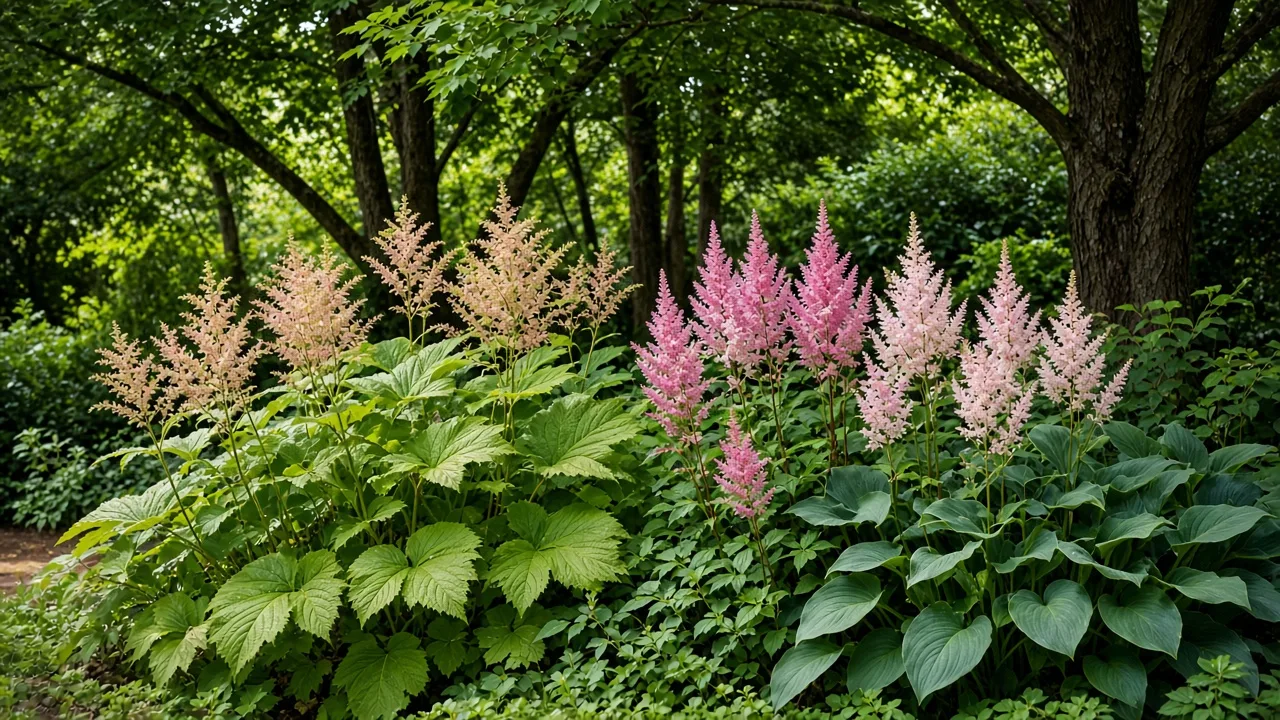
On a slope, combine groundcovers, ornamental grasses, shrubs, and temporary erosion-control matting instead of leaving bare soil between widely spaced plants. Fibrous roots and overlapping foliage slow water better than a single row of shrubs. Keep aggressive roots away from drainage pipes, foundations, septic systems, and retaining walls unless the installation has been designed for them.
Prevent erosion and protect structures
Erosion is a speed problem. If water arrives faster than soil can absorb it, it detaches particles, carries mulch, undercuts turf, and deposits sediment at the bottom of the yard. Penn State Extension identifies sediment from eroding soil as a major stormwater pollutant, so keeping bare slopes covered protects both the landscape and downstream water (home-landscape runoff guidance).
Slow runoff before you try to absorb it. Use dense vegetation, a level or gently sloped transition, stones at an outlet, a stabilized swale, or a dry creek bed where water needs a visible route. At a downspout outlet, spread the discharge with a splash basin or connect it to a designed system; do not let a narrow jet hit bare soil.
Retaining walls deserve special caution. Water pressure behind a wall can push, bow, or overturn it, especially when the backfill is saturated and drainage outlets are missing or blocked. A wall that is tall, close to a home, supporting a driveway, or showing cracks, leaning, bulging, or wet staining is not a casual landscaping repair.
Floodwater has limits that landscaping cannot erase. If a creek overtops, groundwater rises, storm drains surcharge, or water arrives from a watershed larger than your lot, a few plants and a short trench will not guarantee a dry yard. Focus on safe evacuation of water, protect openings and equipment, and have the site evaluated rather than building a barrier that redirects floodwater into a neighbor’s property.
Know the limits of DIY drainage work
Small fixes are reasonable when you can see the cause, the digging is shallow, the grade is simple, and the outlet is on your property and allowed. Extending a downspout, cleaning a gutter, aerating compacted turf, filling a shallow depression with compatible soil, or planting a moisture-tolerant bed can be useful first steps.
Call 811 before any trenching, even for a garden project. Buried utilities may be surprisingly shallow, and the official 811 guidance says to contact the service whenever you dig, including for flowers or small shrubs (Call 811 before you dig). Marking utilities is not the same as designing the drainage: you still need a stable trench, a permitted outlet, and protection against erosion and freezing where relevant.
When to call a drainage or waterproofing professional
Call a qualified drainage or waterproofing professional when any of these apply:
- Water enters a basement, crawl space, window well, or foundation joint.
- The soil stays saturated without recent rain, or you suspect groundwater, a broken water line, or a sewer leak.
- The solution needs an interior footing drain, sump pump, foundation excavation, or waterproofing membrane.
- A steep slope, retaining wall, driveway, pool, or structure will be altered.
- You cannot identify a legal, stable place to discharge the water.
- The work may connect to a public storm sewer, cross a property line, affect an easement, or change neighborhood runoff.
- A previous French drain, dry well, or regrading project failed.
- Flooding is widespread, fast-moving, contaminated, or threatening electrical equipment.
A good site assessment starts with the whole watershed on your lot: roof areas, hardscape, grade, soil layers, utilities, structures, and outlet. Be wary of anyone who recommends the same drain for every puddle without asking where water comes from and where it will end. Ask for the proposed flow path, maintenance access, overflow behavior, permits, and what happens during a storm larger than the design event.
Conclusion
To prevent a soggy yard, fix the path before you fix the appearance. Observe water in a real storm, correct the grade closest to the house, extend and redirect downspouts, relieve shallow compaction, then choose a swale, dry creek bed, French drain, rain garden, or dry well based on the kind of water and the soil’s ability to accept it.
Use plants to hold soil and make wet areas functional, but keep foundation moisture, erosion, flood volume, retaining-wall pressure, utilities, and safe discharge in view. If the water threatens the structure or the cause and outlet are uncertain, a drainage or waterproofing professional is part of the solution—not a sign that you failed at gardening.