How to Remove Tomato Sauce Stains From Clothes
Remove tomato sauce stains from clothing: lift solids, rinse from the back, treat oil and pigment, wash by the care label, and skip the dryer until clean.
If tomato sauce just landed on a shirt, start at the sink: lift off the solids, rinse the back of the fabric with cool water, and keep the garment out of the dryer until you have inspected it. That sequence removes loose sauce without driving it deeper or spreading a small spot into a larger one.
Tomato sauce is a combination stain. The red tomato pigment is joined by oil, sugars, starches, and sometimes meat or cheese, so one rinse may remove the food particles while leaving an oily ring or pink shadow. The safest home approach is to handle those parts in order, then adjust the wash for the garment’s care label and fiber.
The 10-Minute First-Aid Plan
For a fresh, washable garment, use this short sequence before the sauce dries:
- Read the care label and move the garment away from other laundry.
- Lift away sauce with a spoon or dull edge; do not scrub.
- Rinse from the back of the stain with cool running water.
- Work a small amount of liquid laundry detergent or dishwashing detergent into the oily area.
- Rinse the detergent out, then apply a label-approved color-safe stain remover if red color remains.
- Wash at the warmest temperature allowed by the care label, inspect while damp, and air-dry if any color remains.
The order matters more than the brand of cleaner. A care-label check prevents an aggressive treatment on a delicate fiber, and the inspection step prevents a dryer from turning a partly removed mark into a much harder repair.
Check the Care Label Before Adding Cleaner
Before wetting the garment, look for the fiber content and cleaning instructions. “Machine wash” does not mean every stain product is safe: a shirt may be washable but still contain spandex, a delicate dye, a coating, or trim that reacts poorly to bleach or strong solvents.
The University of Georgia’s textile-care guidance recommends following the care label and testing cleaning agents on an inconspicuous area first. Treat that advice as a hard boundary, especially for dark colors, printed fabric, stretch garments, and anything marked dry clean only.
If the label says dry clean only, gently scrape away excess sauce, blot without rubbing, and take the garment to a cleaner as soon as practical. Do not saturate silk, wool, leather, structured tailoring, or a garment with a fragile finish just because the stain is small.
Remove Solids Without Spreading Them
Hold a spoon, dull butter knife, or old plastic card nearly parallel to the fabric and lift the sauce toward the center of the spot. Wipe the tool between passes. This removes the thickest material before water turns it into a larger red smear.
Do not rub a fresh tomato stain with a paper towel, brush, or napkin. Pressure can push sauce between fibers, while a colored napkin can transfer dye. If the sauce is oily, place a clean white cloth behind the stained area so the loosened residue has somewhere to go instead of soaking into the next layer of the garment.
Flush From the Back With Cool Water
Turn the garment inside out or hold the reverse side of the stained panel under the faucet. Let cool water move through the fabric from behind the mark for several minutes, using enough flow to carry loosened sauce away from the garment rather than through its clean face.
This is the best moment for cool water, not because every later wash must be cold, but because a fresh rinse should remove loose pigment and food without adding unnecessary heat. If the garment cannot be turned inside out, place the stained face down on a clean white towel and rinse the back of the fabric in short bursts.
Do not start with hot water. Heat can make oily food residue harder to release and can set whatever color remains, particularly when the stain is already partly dry. You can choose a warmer wash later if the care label allows it and the oily residue has been treated.
Treat the Stain in the Right Order
Once the loose sauce is gone, look at the mark under bright light. A glossy or darker halo usually signals oil; a flat orange-red or pink area is mostly residual color. If you see both, treat the oily film first and the color second.
This two-part approach is supported by Clorox’s guidance for tomato-based combination stains, which separates the oily component from the colored component. The practical payoff is simple: a color treatment cannot work as well while a greasy film is still coating the fibers.
Tomato pigment can look different as the fabric dries. A wet mark may seem brown or nearly invisible, then turn pink-orange once the water evaporates. Judge progress by how the fabric feels as well as how it looks: a stain that has lost its slickness but keeps a faint tint needs a different next step from one that still feels greasy.
Also check the area around the original spot. Sauce can wick outward in a ring, especially on smooth synthetics or a tightly woven shirt. Treat slightly beyond the visible edge, but keep the garment supported on a towel so you are not making a large wet circle around a small stain.
Break Up the Oily Sauce Film
Put a small amount of liquid laundry detergent on the damp stain. If the sauce included olive oil, cheese, or meat fat, a few drops of ordinary liquid dishwashing detergent can help with the greasy portion because it is designed to emulsify kitchen oils. Use only enough to cover the mark; a thick puddle of dish soap creates extra rinsing work and excessive suds in a washing machine.
Gently press and massage the detergent from the outside edge toward the center with your fingertips or a soft white cloth. Leave it for about five minutes, then rinse thoroughly from the back. Clorox’s step sequence likewise gives the dish detergent a short dwell time and calls for rinsing it out before the garment enters the washer.
Test first on an inside hem if the garment is dyed, printed, or made from a blend. If the fabric becomes lighter, rougher, or sticky, rinse immediately and switch to a product listed for that garment rather than repeating the treatment.
Lift the Red Food Color
After the oily feel is gone, apply a liquid laundry detergent or a commercial stain remover labeled for the fiber and color. Follow the product’s directions for amount and dwell time; “more” is not a reliable shortcut and can leave residue or cause uneven color.
For colorfast cotton, linen, polyester, and many blends, an oxygen-based or color-safe stain remover may be a useful next step. Use it only when the label permits, pretest it, and never assume that a product marketed as color-safe is safe for every dye, finish, or fiber. Chlorine bleach is a separate chemical choice and should be reserved for bleach-safe whites after the care label and product label both allow it.
White clothing can still be damaged by the wrong bleach. Clorox specifically cautions against bleaching wool, silk, leather, mohair, and spandex, and those cautions apply even when the tomato stain is on a white garment.
Rinse Before the Washer
Rinse until the fabric no longer feels slick and the water runs clear enough that you are not carrying a visible cloud of red or detergent into the machine. Leaving dish soap in the garment can produce excess foam, and leaving a solvent or stain remover in place longer than its directions allow can damage color or finish.
At this point, pause for a quick decision: if only a pale shadow remains, go to the wash; if the stain is still bright, repeat the targeted pretreatment once; if the fabric is delicate or the color shifted during testing, stop and use a professional cleaner. Repeating a controlled step is safer than piling several unrelated chemicals on top of one another.
For a shirt with a front and back panel, place a folded white towel inside the garment before spot-treating. The towel absorbs loosened sauce and keeps the cleaner from transferring through to the opposite side. Replace or refold the towel when it picks up color, and rinse the treated area from the back rather than dragging the towel across the mark.
Wash, Inspect, and Air-Dry
The washing machine is the removal stage, not the place to hide an untreated stain. Put the pretreated garment in the washer only after excess spot cleaner has been rinsed away, and keep it separate from items that could be stained by loose red color.
Choose Water Temperature by the Label
Use the warmest water the care label permits once the stain has been pretreated. For some washable cottons and sturdy synthetics, warm water can help detergent work on remaining oil; for dark colors, stretch fabrics, delicate blends, or garments with a cold-wash instruction, use the label’s lower temperature.
The important distinction is cool water for the initial flush versus label-approved water for the wash. Tide’s tomato-sauce instructions also direct readers to rinse from the back with cold water and then use the care label to choose the wash setting.
Use your normal detergent dose unless the detergent label says otherwise. Do not add vinegar, lemon juice, ammonia, chlorine bleach, and an oxygen product together. Mixing cleaners can create dangerous fumes or cancel out the chemistry you actually need; the University of Georgia guidance also emphasizes caution, ventilation, and testing when using commercial cleaning solutions.
Use a Stain-Safe Drying Check
When the cycle ends, inspect the garment in daylight before it goes near a dryer. Check the original spot and the area around it for a pink cast, a dark ring, stiffness, or a greasy sheen. Wet fabric can make a faint mark hard to see, so hold the panel flat and compare it with an unstained section.
If any trace remains, repeat pretreatment and washing. Do not tumble-dry it yet. Both Tide’s laundry guidance and OxiClean’s tomato-stain instructions warn that dryer heat makes remaining stains more difficult to remove.
Air-dry the garment on a rack or hanger while you are still checking it. Air-drying is not a magic bleach treatment, but it gives you time to reassess without adding the high heat that can set an oily or pigmented residue. Once the fabric is clean and the color is even, dry it according to the care label.
Dried, Washed, or Dryer-Set Tomato Stains
An old stain deserves patience, not a stronger random chemical. First determine what happened: a stain that dried naturally can often be rehydrated, one that survived a wash may need a longer pretreatment, and one that went through a hot dryer may be permanently altered even if some color can still be reduced.
Rehydrate and Pretreat a Dried Spot
Brush away any brittle surface flakes with a soft, dry cloth, then wet the reverse side with cool water. Apply liquid detergent or a labeled stain remover to the spot, work it in gently, and allow the product to dwell for the time on its label. Keep the treatment damp if the label says not to let it dry.
After the dwell time, rinse from the back and inspect. If the mark has softened or lightened, wash at the warmest care-label temperature and inspect again. If it has not changed at all, do not keep scrubbing; move to a compatible soak or a professional cleaner.
Escalate to a Soak Carefully
For a colorfast, washable garment that still has a red shadow, use a color-safe oxygen stain remover according to its product directions. OxiClean’s dried-tomato guidance recommends pretreatment or soaking and specifically says to test first and avoid wool, silk, leather, and dry-clean-only fabrics.
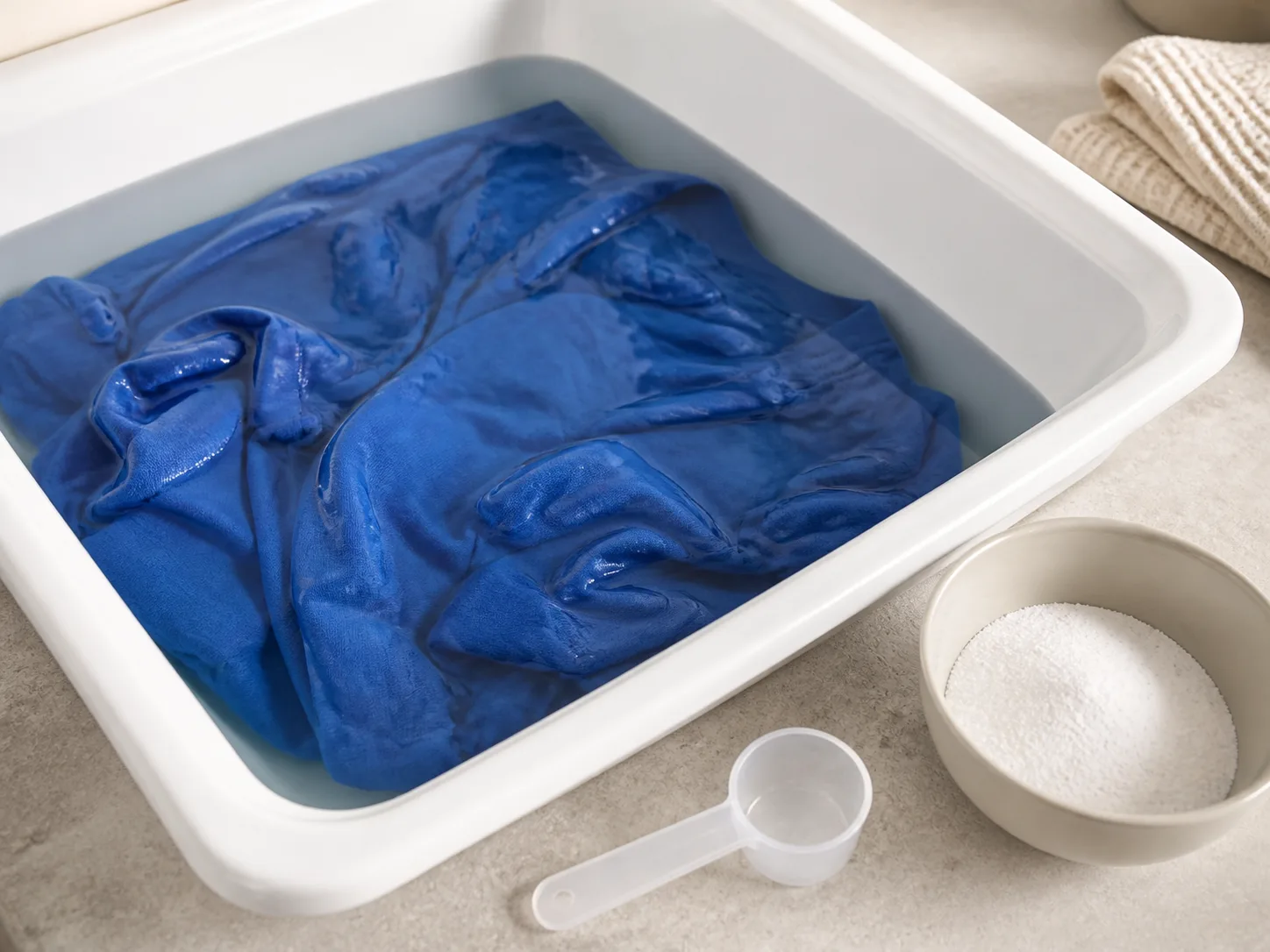
Use a clean basin, dissolve the product completely, and keep the garment submerged only for the label’s stated time. Do not guess at powder-to-water ratios, heat a product that says not to heat, or seal a container holding an active solution. Rinse thoroughly, wash, and repeat only if the fabric still looks and feels normal.
If the stain was baked in by a dryer, set expectations honestly: several gentle cycles may fade it without fully removing it, and an aggressive treatment can create a light patch that is more noticeable than the original mark. A valuable garment, tailored piece, or sentimental textile is a good candidate for a textile professional before experimentation.
Do not assume that a stain which survived one wash is permanently bonded. Detergent, mechanical action, and water can remove some components while leaving behind the part that is most visible. A second, better-targeted treatment may work, but leave the garment dry between attempts so you can identify the remaining problem and so you do not layer an unknown wet mixture onto the fabric.
If the stain is on a child’s uniform, a work shirt, or another garment with a finish such as water repellency, wash-in sizing, or a printed graphic, preserve the garment’s function as well as its appearance. Strong spot cleaners can alter coatings, soften adhesive, or make a print crack. When the label provides a specific restriction, that restriction outranks a general stain-removal recipe.
Adjust the Method for Fabric and Color
The same red sauce does not behave the same way on every textile. Absorbency, surface finish, dye stability, stretch fibers, and the presence of coatings all change the risk of a home treatment.
White, Colorfast Cotton and Synthetics
White cotton and linen usually give you the most room to work, provided the label permits the treatment and the fabric is not a special finish. Start with the fresh-stain sequence, then consider an oxygen product or a bleach-safe laundry additive only after testing and following the product label.
Polyester and cotton-polyester blends may release the sauce well after detergent pretreatment, but the oily halo can linger if you skip that step. Spandex-containing garments need extra caution: avoid chlorine bleach, high heat, and aggressive rubbing, and use the lowest-risk product that the label permits.
Dark or brightly dyed clothing should be treated as color-sensitive even when it is made from sturdy cotton. Test a hidden seam, rinse completely, and stop if the dye transfers to a white cloth. A slightly lighter stain is not a reason to keep escalating if the treatment is also lightening the garment.
Printed shirts need an additional check: apply cleaner from the reverse side when the care label allows, and keep solvent or bleach away from the graphic unless the manufacturer specifically approves it. For denim, canvas, uniforms, and towels, treat a seam or hem first because the fabric may be durable while the dye is not. When in doubt, use detergent and repeat the wash rather than jumping to a whitening product.
Wool, Silk, Rayon, and Dry-Clean-Only Pieces
Silk, wool, leather, and dry-clean-only garments are poor candidates for a kitchen-sink experiment. Scrape off the excess, blot with a clean white cloth, and tell the cleaner exactly what spilled and what, if anything, touched the fabric. OxiClean’s product directions also exclude wool, silk, leather, and dry-clean-only items from the stain treatments described for washable clothing.
Rayon and viscose can weaken, distort, or develop water marks when saturated, especially if the label calls for dry cleaning. Even a rayon blouse with a small tomato spot may need controlled professional treatment rather than a long soak.
Embellished, coated, pleated, lined, and vintage garments deserve the same conservative approach. Water rings, adhesive trims, unstable dyes, and hidden interlinings can turn a removable food stain into a larger restoration job.
Common Mistakes That Make Red Sauce Worse
Most failed tomato-sauce treatments come from a reasonable instinct applied at the wrong time. Avoid these shortcuts:
The biggest mistake is treating urgency as a reason to use force. A fresh spill usually responds to removal of solids, water flow, and a measured pretreatment; a dried stain usually needs time and repetition. Harsh rubbing, boiling water, or an improvised cocktail can damage the textile faster than the tomato sauce does.
- Rubbing the fresh spot: Scrubbing spreads the sauce and pushes solids into the weave. Lift and flush instead.
- Rinsing from the front: Water should carry residue out through the back, not drive it through the clean side.
- Starting with hot water: Cool water is the safer first flush; choose warmer wash water only when the care label allows it.
- Using too much dish soap: A thin, targeted application is enough. Rinse it out before machine washing.
- Mixing cleaners: Never combine bleach, vinegar, ammonia, oxygen products, or other stain chemicals unless the product label explicitly instructs you to do so.
- Skipping the hidden-seam test: A cleaner can remove red color and garment dye at the same time.
- Drying on autopilot: A stain that looks “almost gone” is still a stain. Inspect in daylight and air-dry until you are sure.
- Treating every fabric alike: Wool, silk, leather, rayon, spandex, coated fabrics, and dry-clean-only clothing need a different risk calculation.
- Chasing a kitchen remedy: Baking soda, vinegar, lemon juice, and salt may be familiar, but familiar does not mean fabric-safe or effective for every combination stain. Use a product labeled for the garment instead of improvising a stronger mixture.
Conclusion
To remove tomato sauce stains from clothing, lift the solids, flush cool water from the back, dissolve the oily portion with a small amount of suitable detergent, then treat remaining red color with a label-approved stain remover. Wash at the garment’s permitted temperature, inspect before drying, and repeat gently if necessary.
The safest method is not the most aggressive one. It is the method that matches the stain’s age and ingredients to the garment’s fiber, dye, and care label—and stops before a stain becomes fabric damage.