How to Revive Lucky Bamboo: Causes and Fixes
Revive lucky bamboo by checking its leaves, stalks, and roots first. Follow safe steps for water or soil, root rot, water quality, pruning, and recovery.
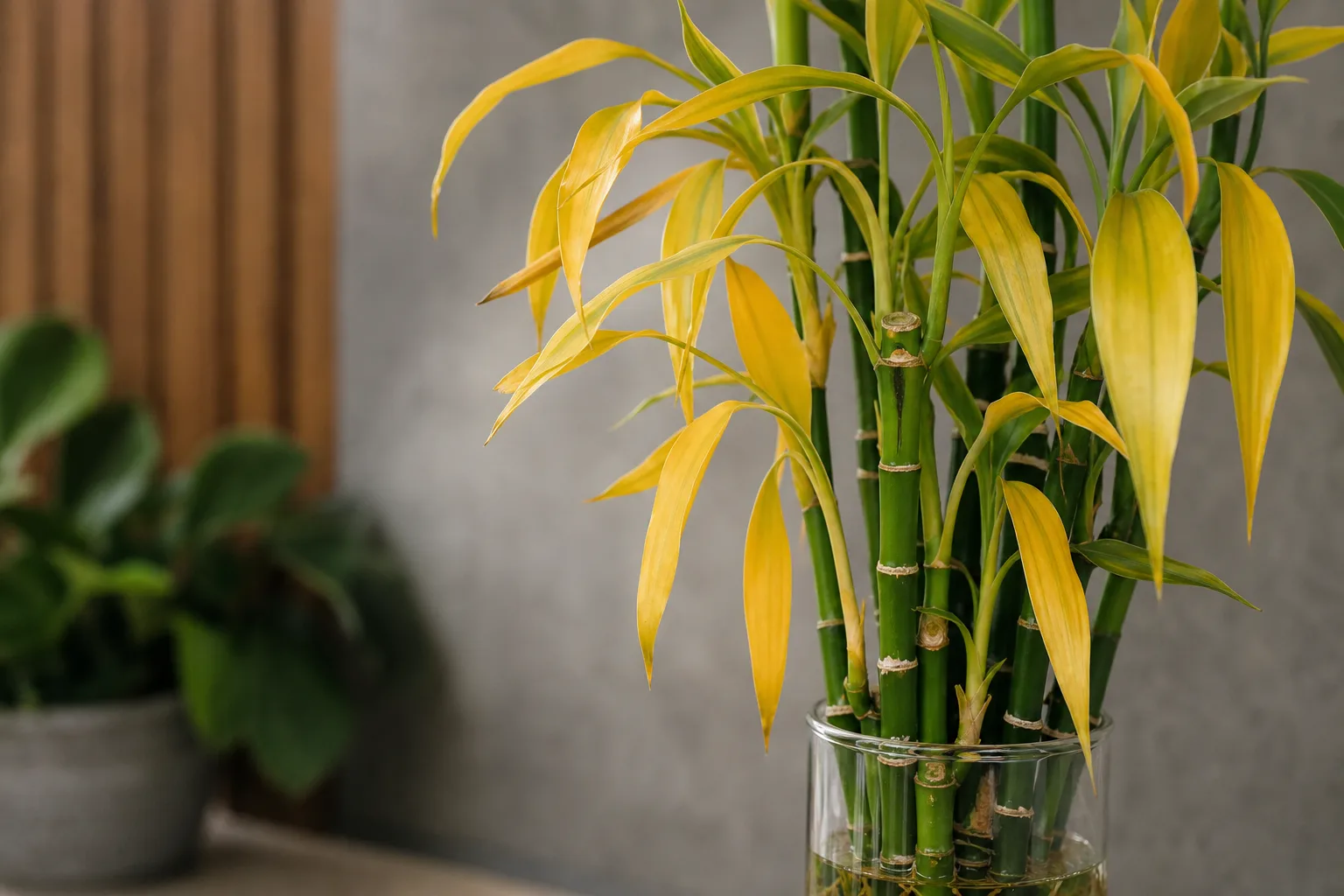
If your lucky bamboo is yellowing, drooping, or developing a soft stalk, resist the urge to add more water or fertilizer right away. First check whether the trouble is in the leaves, the cane, the roots, or the water itself. Each points to a different problem, and treating the wrong one can turn a stressed plant into an unrecoverable one.
Lucky bamboo is Dracaena sanderiana, not a true bamboo. It can grow with its roots in water or in a potting mix, but the rescue steps are not interchangeable. The NC State Extension plant profile notes that it can grow in chlorine-free water or a moist potting mix and that overwatering can yellow foliage and rot stems. Start with the growing method you already have, then change only what the evidence supports.
Start with a 10-minute triage, not another dose of water
Move the plant out of direct sun and away from a cold window, heater, or air-conditioning vent while you inspect it. Put it somewhere warm with bright, indirect light. This is a safe temporary setting whether the plant is in water or soil; it avoids adding sun scorch or temperature swings to a problem that may already involve roots.
Look at the whole plant before pruning. Note whether yellowing is limited to one old lower leaf, appearing across many leaves, or moving down a cane. Gently press the cane near its base: a firm, green cane may still support recovery, while a soft, collapsing, or extensively yellow cane is unlikely to regain its color. If the plant is soil-grown, feel the mix below the surface and check the pot for drainage holes and standing runoff. If it is water-grown, smell the water and look at root texture and clarity.
For a quick first pass:
- Keep firm green canes and healthy shoots, even if some leaves are damaged.
- Pause fertilizer and stop making repeated care changes while you identify the cause.
- Remove a plant from a container only when the roots or cane show signs of decay, or the soil is staying waterlogged.
- Separate the plant from nearby houseplants if you see webbing, scale-like bumps, or cottony insects.
Do not cut every yellow leaf off immediately. Yellow tissue will not become green again, but it can help you track how far the decline has progressed. Remove a leaf once it is mostly dry or detaches easily; leave partly green leaves in place unless they are diseased or infested.
Read the symptoms before choosing a fix
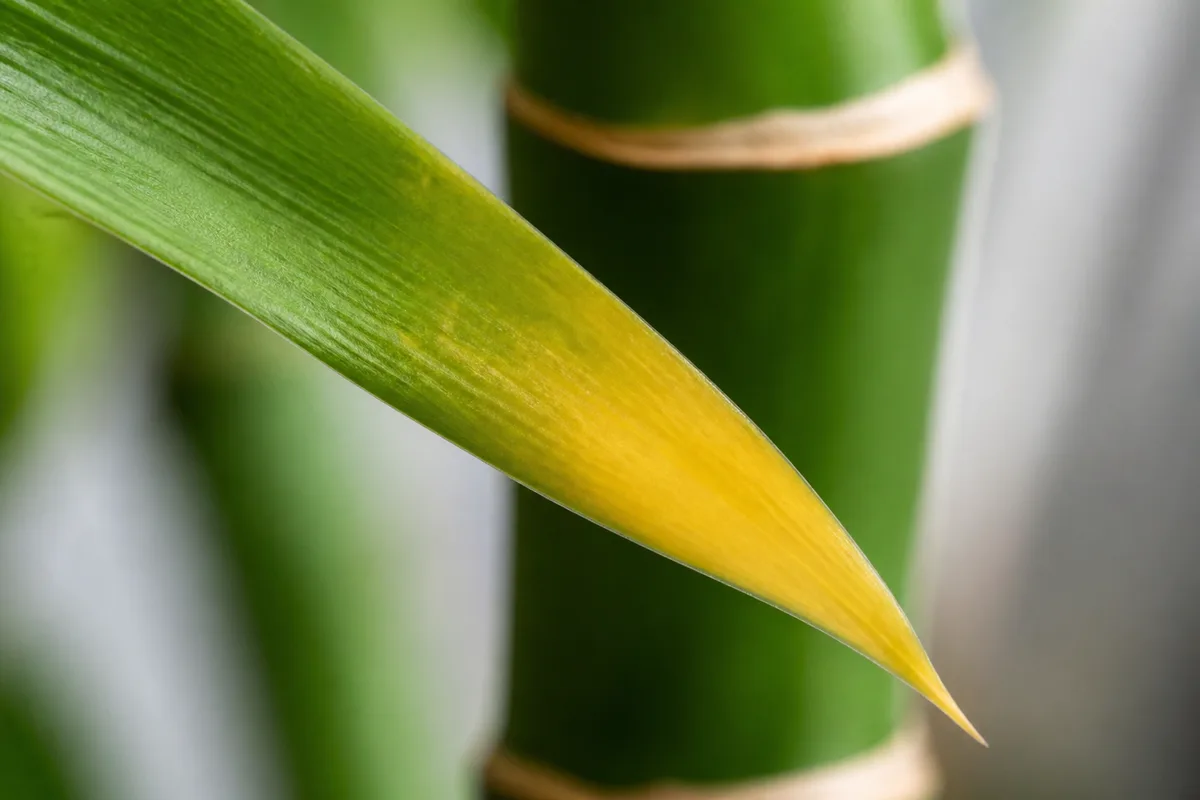
Color alone is a weak diagnosis. A leaf turning yellow from its tip is different from a cane turning yellow at the base, and an underwatered plant can droop just like a plant with rotten roots. Look for a second clue—soil moisture, root texture, the location of the damage, water quality, or recent changes in light—before you act.
What common warning signs can mean
| What you see | What it may indicate | First check |
|---|---|---|
| One lower leaf slowly yellows while the rest stays green | Normal aging or mild stress | Is the cane firm and new growth healthy? |
| Many leaves yellow after moving the plant | A light or temperature change, or water stress | Was it placed in direct sun, a draft, or colder air? |
| Brown tips or edges but a green center | Water chemistry, fertilizer salts, dry air, or sun | Check water source, feeding history, and window exposure |
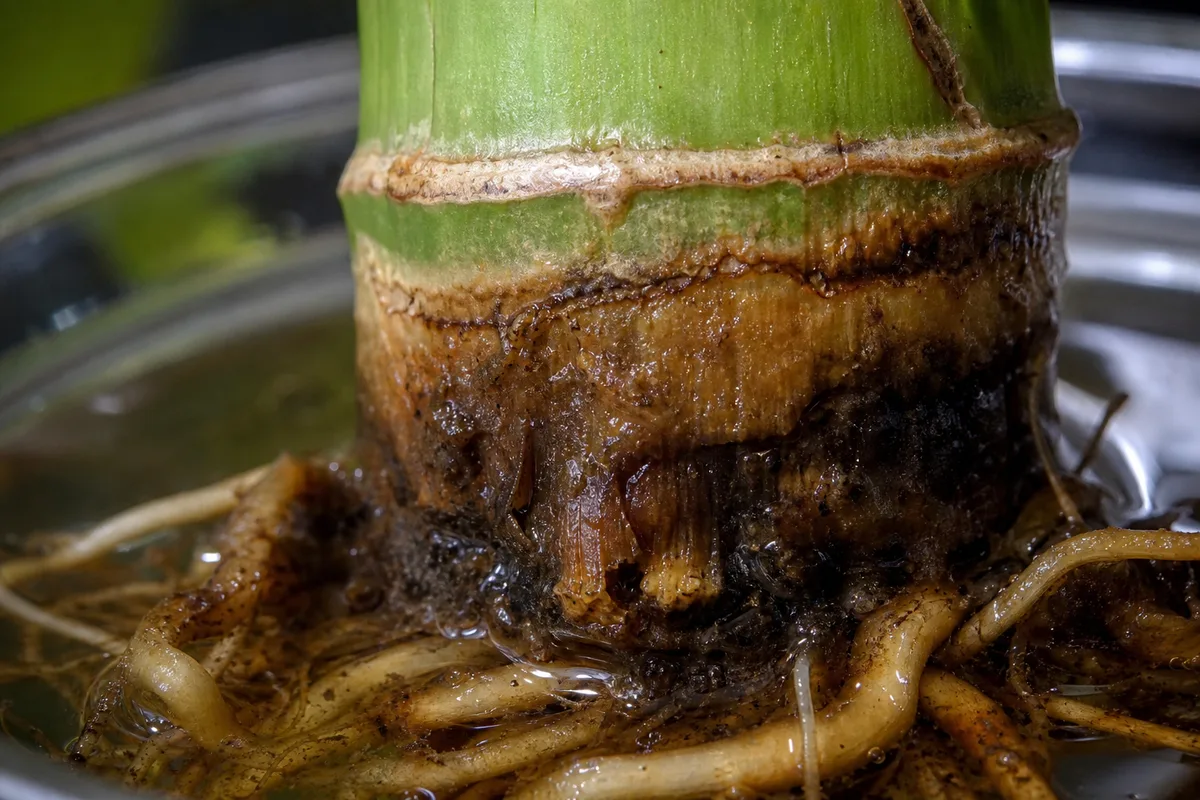
| Roots are soft, slimy, or slough off when touched | Root decay is likely | Is water stagnant or soil persistently wet? |
| A cane is yellow and soft from the base upward | Advanced cane or root damage | Is any part of the cane still green and firm? |
| Leaves have sticky residue, fine webbing, or cottony spots | Scale, spider mites, or mealybugs | Inspect leaf undersides and cane joints |
Healthy lucky bamboo roots may be cream, tan, or even reddish; color by itself does not prove rot. Firmness and smell are more useful: healthy roots hold their shape, while decaying roots feel mushy or hollow and may smell sour. The BBC Gardeners’ World guide also notes that red roots can be normal and that yellow stems are much more serious than isolated yellow leaves.
The current troubleshooting guide from Gardening Know How likewise groups hard water, lighting, excess fertilizer, and root or stalk damage among recurring yellowing causes. Use that as a shortlist, not a diagnosis: the same symptom can have more than one cause, so check the roots and growing conditions before choosing a treatment.
How to revive lucky bamboo growing in water
Water-grown lucky bamboo is not a bowl of cut flowers: its roots need to stay hydrated, but the entire cane should not sit underwater. Stagnant water, algae, mineral buildup, or a container that traps debris can undermine roots over time. If the plant is declining, a clean reset is usually a better first step than adding a splash of fertilizer to old water.
Reset the vase without drowning the cane
Lift the canes out carefully and set them on a clean towel. Pour away the old water, remove loose pebbles, and wash the vase and stones with ordinary dish soap; rinse them thoroughly so no soap remains. If the roots are crowded or tangled, ease the stones away rather than pulling hard on the stems. Look for slimy, hollow, or foul-smelling roots and trim only those with clean, sharp scissors.
Refill the container with room-temperature rainwater, distilled water, or reverse-osmosis water. If those are unavailable, use a filtered source only when its label says it removes the mineral or chemical you are concerned about; filters vary. Add just enough water to cover the roots, keeping most of each cane above the waterline. A shallow layer of clean pebbles can stabilize the stems, but pebbles are not a substitute for rinsing the container.
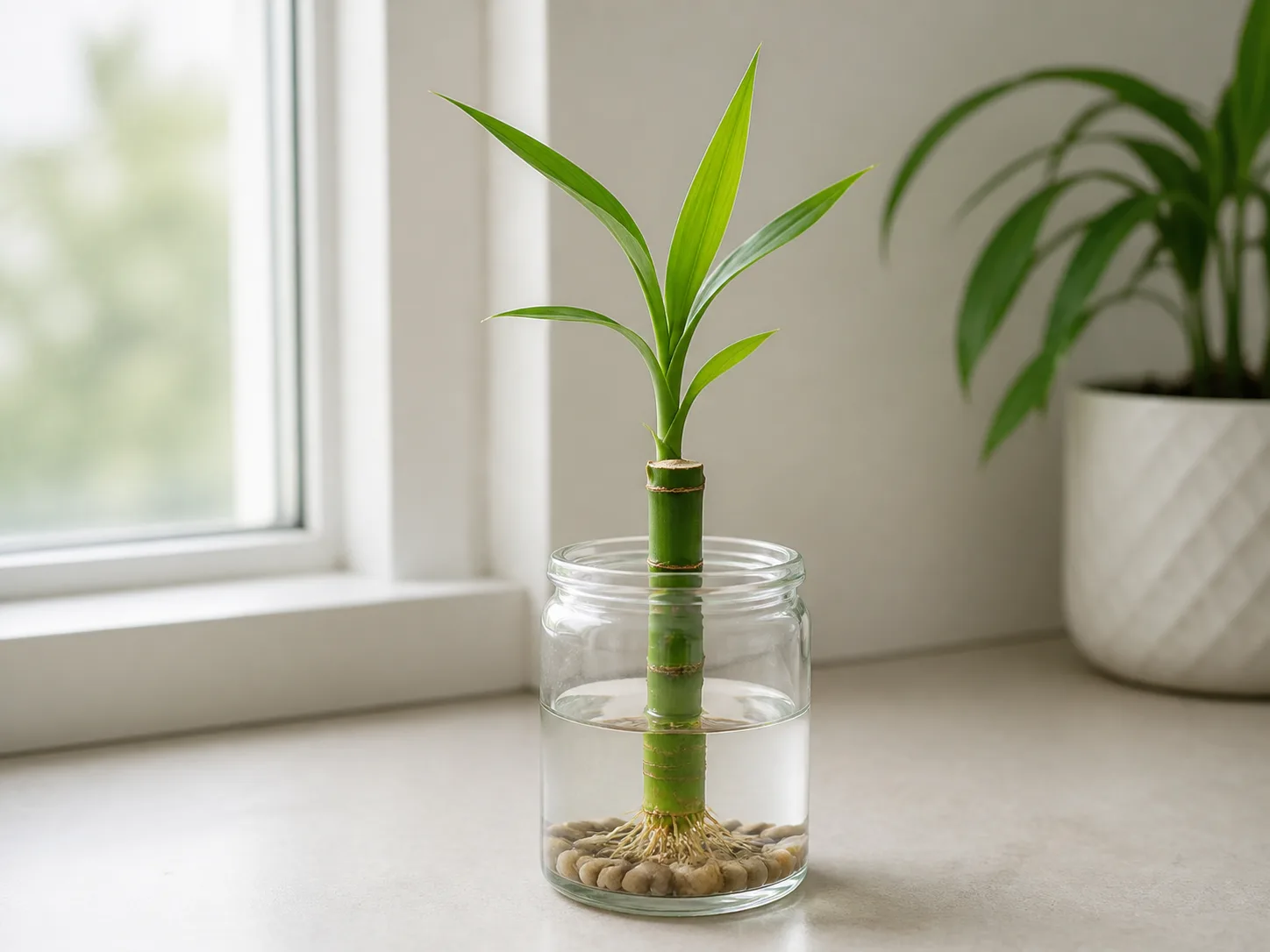
Set the vase in bright, indirect light, not in a sunbeam. Direct light warms the water and encourages algae; an opaque outer sleeve can limit light reaching the vessel without blocking light from the leaves. During the recovery period, check the water every few days and change it at least weekly, or sooner if it turns cloudy, smells off, or develops a film. NC State Extension and BBC Gardeners’ World recommend weekly changes; Epic Gardening’s lucky-bamboo guide puts more emphasis on changing water when it looks stagnant or dirty. For a stressed plant, a weekly refresh is a simple conservative reset, not a guarantee that every healthy arrangement needs the same calendar year-round.
If a cane is green and firm but its leaves are yellow, do not cut the cane just because the foliage looks poor. Let the roots settle in clean water and watch for fresh roots or shoots. If the cane itself is yellowing and soft, isolate it from healthy canes in the same arrangement so rot does not go unnoticed.
How to revive lucky bamboo growing in soil
For a soil-grown plant, check moisture several centimeters below the surface rather than watering because the top looks dry. If the soil is damp or wet, adding more water is the wrong rescue. If it is bone dry and pulling away from the pot, a slow, thorough watering may be all the plant needs.
When a careful dry-down is enough
If the mix is wet but the cane remains firm and there is no foul odor, stop watering and let excess moisture drain. Empty the saucer or decorative cachepot, confirm that the inner pot has open drainage holes, and give the plant brighter indirect light if it has been in a dim corner. Do not leave the root ball standing in runoff, and do not put the pot in direct sun to make it dry faster; a sudden hot location can scorch leaves before the roots recover.
If the soil is very dry, water slowly over the surface until a little drains from the bottom. Wait a few minutes and repeat if the mix has shrunk away from the pot and water runs down the sides without wetting the root ball. Empty the saucer afterward. Return to checking the soil before each watering instead of following a fixed weekly schedule: room temperature, light, pot size, and mix all change how fast it dries.
When root inspection and repotting are justified
Unpotting creates extra stress, so do it only when there is stronger evidence than yellow leaves alone: the soil stays wet for many days, the cane base is soft, the mix smells sour, or the plant continues to droop while its soil is wet. Slide out the root ball gently and remove loose, foul, mushy roots with a clean blade. Keep firm roots, even if they are not bright white.
Choose a container with drainage holes that is only slightly larger than the remaining root mass. Use a loose, well-draining indoor potting mix rather than dense garden soil. Set the cane at the same depth it was growing before, water lightly to settle the mix, and pour away runoff. Keep the soil evenly moist but not soggy while the plant stabilizes. Do not move a water-grown plant into soil just because it has one yellow leaf; switching growing systems during a crisis adds another adjustment and is not automatically a cure.
Fix the cause that matches the evidence
Once the root zone is stable, correct the most likely stressor. Avoid changing water, light, fertilizer, location, and pot size all at once. If the plant improves, you will know which adjustment mattered; if it worsens, you can reassess without having created several new variables.
Water quality can affect leaves and roots
Lucky bamboo can react to the mineral content of its water. Some Dracaena are sensitive to fluoride, and the Pacific Northwest Plant Disease Management Handbooks describe fluoride injury as accumulating in foliage, often beginning at leaf tips or margins. That pattern is not proof of fluoride: dry air, salts, and drought can create similar marks. Treat water quality as one possibility, especially if tip damage repeats on new leaves or the plant has long received the same tap water.
Try rainwater, distilled water, or reverse-osmosis water for several weeks and compare new growth. Leaving tap water in an open jug may help some free chlorine dissipate, but it does not remove fluoride. A filter is useful only if its specifications match the concern. Do not pour softened household water into the vase without checking how it is treated; some softeners replace minerals with sodium, which can add another stress.
Light, drafts, and temperature changes
Give lucky bamboo bright light that is filtered or indirect. A position near an east-facing window or several feet back from a brighter window may work, but the distance depends on the glass, shade, and season. If the plant has been in deep shade, move it closer to useful light gradually. If it has been in direct sun, use a sheer curtain or move it away from the beam rather than placing it in a dark room.
Look for sudden exposure changes: a plant moved outdoors, placed against cold glass, or left under an air-conditioning vent may respond with drooping or yellowing. Keep it in a stable warm room and away from cold drafts or hot, dry airflow. University of Georgia Extension’s indoor-plant guide emphasizes light, temperature, water, nutrition, and soil as interacting factors in indoor plant health; changing one condition at a time makes it easier to identify the stressor.
Fertilizer salts: pause before feeding again
Fertilizer does not cure yellow leaves. In a water arrangement, excess feed can accumulate directly around the roots; in soil, salts can build up when the plant is fed too often or the pot does not drain. If you recently fertilized and the plant is declining, stop feeding. For water-grown plants, replace the solution and rinse the roots and vessel; for a soil pot with good drainage, water through once and discard the runoff.
Wait until the plant produces new roots or leaves before considering food again. Lucky bamboo is a light feeder, and a weak liquid houseplant fertilizer used sparingly is safer than a full-strength dose or fertilizer spikes. BBC Gardeners’ World suggests occasional dilute feeding for water culture and limited feeding during the growing season for compost-grown plants. Follow your product label, use less rather than more, and do not fertilize a plant whose roots are still soft or damaged.
Pests and look-alike problems
Check leaf undersides, the joints where shoots meet the cane, and the base of the plant for webbing, cottony clusters, or hard bumps. NC State Extension lists mealybugs, mites, and scale among pests to monitor on lucky bamboo. A pest problem is more likely when damage appears in scattered specks or patches and you can see insects; it is less likely to explain a uniformly yellow cane by itself.
Keep an infested plant separate while you identify the pest. Rinse foliage gently and wipe visible insects away; if you use insecticidal soap, choose a product labeled for indoor plants and follow its label exactly. Do not use dish soap as a pesticide or apply oil mixtures to a plant in direct sun. If no pests or distinct spots are present, return to the water, root, light, and fertilizer checks instead of spraying preventively.
When to prune and propagate a healthy section
Pruning is useful when tissue is dead or when a green offshoot can be saved; it is not a way to make a yellow cane green again. Remove fully dry leaves close to the stem. If a cane is completely yellow, soft, or foul-smelling, it will not recover. If part of the cane or an attached side shoot remains green and firm, you may be able to preserve that living section while discarding the decayed part.
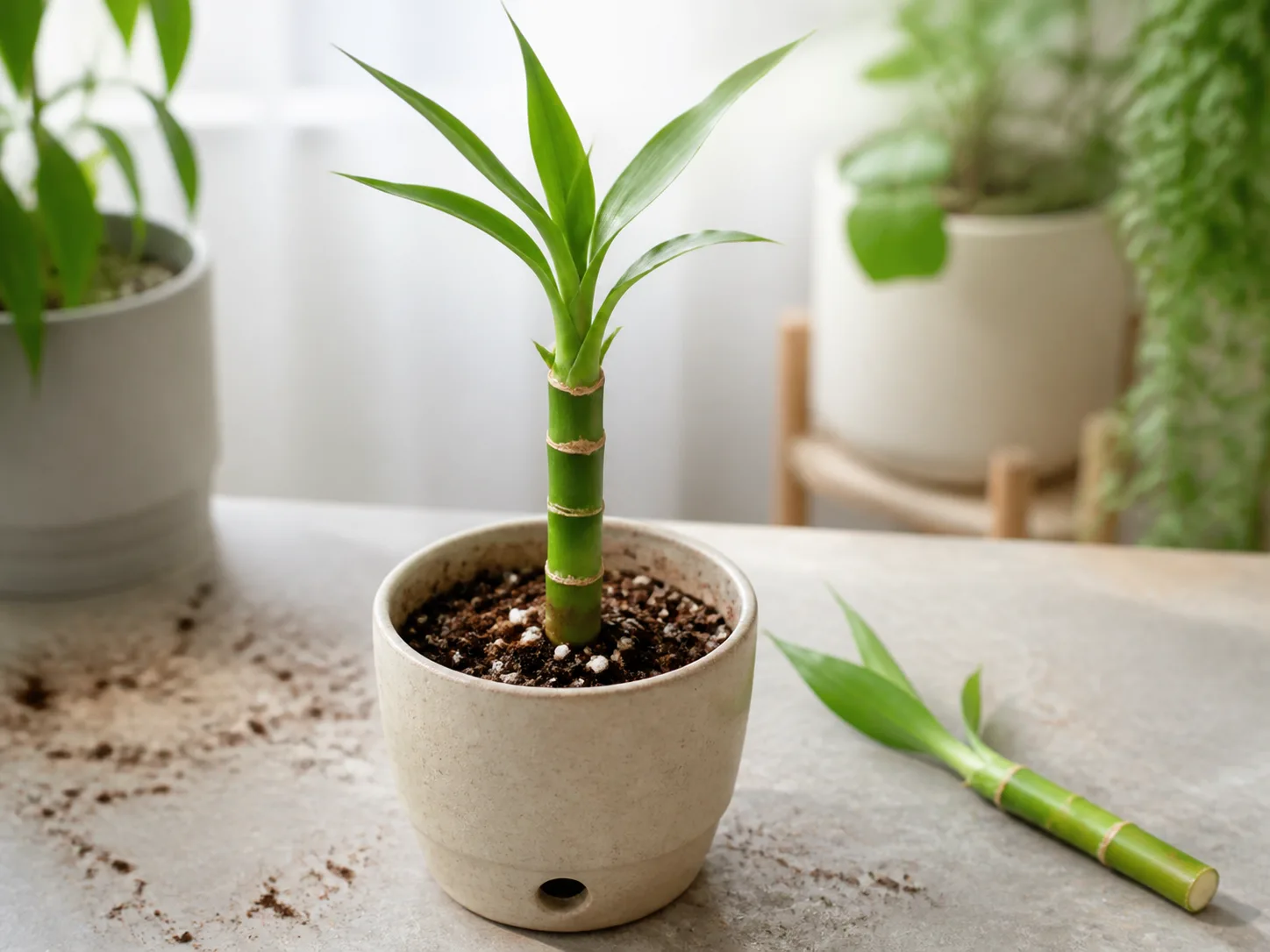
Use sharp scissors or a knife cleaned before and after the cut. Take a healthy green offshoot just below a node, the raised ring on the cane where roots or shoots can emerge. Keep at least one node on the cutting and avoid crushing the stem. If the entire cane is soft or yellow, do not attempt to root it; choose a genuinely firm green shoot from another cane instead.
Root a green cutting in water
Place the cutting in a clean glass with low-mineral water so one or two lower nodes are submerged and the leaves remain dry. Keep it warm in bright, indirect light, refresh the water regularly, and wait for roots to develop before moving it. The exact timing varies with warmth and the cutting’s condition, so use visible root growth rather than a promised number of days as your signal.
Once a small network of roots has formed, you can keep the cutting in water or pot it into a free-draining mix. The BBC Gardeners’ World propagation guide describes rooting an offshoot in water before planting it in compost. For a fuller step-by-step propagation method, use our lucky bamboo cutting guide. Treat propagation as a backup: it may save healthy tissue even when the original roots or cane cannot be restored.
What recovery looks like—and when to stop trying
Do not judge recovery by the old yellow leaves. Yellowed leaves and canes generally stay yellow; remove them for appearance once the remaining tissue is dry or the cane is beyond saving. Better signs are firm green canes, roots that stop becoming slimy, clear water or a soil mix that drains and dries normally, and new leaves or roots emerging from healthy nodes.
After a correction, avoid making another major change for a short observation period unless decay is continuing. Check the plant every few days, but do not pull it out repeatedly to inspect it. New growth may take weeks, depending on season, light, and how much healthy tissue remains. A lack of immediate greening is not a reason to add fertilizer; it may simply take time for the plant to resume growth.
If every cane is yellow or soft, the roots are largely mushy, and no green shoot remains, there may be nothing viable left to rescue. Discard the diseased plant material, wash the vessel, and start with a healthy cutting or plant. If only one cane in a bundle has declined, remove that cane and monitor the remaining firm green ones before deciding the whole arrangement has failed.
Keep lucky bamboo from declining again
Choose the growing method you can maintain consistently. In water, keep roots covered but canes mostly dry, refresh the water regularly, and rinse a dirty vase or pebbles. In soil, use a pot with drainage, water thoroughly only when the upper layer has begun to dry, and empty runoff. NC State Extension recommends weekly water changes; other horticulture guidance makes frequency depend more on visible stagnation. During recovery, weekly changes are a practical baseline, while a healthy plant still needs clear, clean water and periodic checks.
Place the plant in bright, indirect light and keep it away from direct hot sun, cold windows, and heating or cooling vents. Inspect the leaves and cane joints occasionally, and loosen or remove any tie that is cutting into the stems. Feed lightly only after healthy growth resumes. These simple checks catch a problem while it is still a leaf or root issue, before rot reaches the cane.
Keep lucky bamboo beyond the reach of cats and dogs. NC State Extension identifies the plant as low-severity poisonous if ingested and lists saponins among its toxic principles. If a pet chews it, contact a veterinarian for advice rather than waiting to see whether symptoms appear.
Conclusion
To revive lucky bamboo, match the fix to the tissue that is failing. Check whether the leaves or cane are yellow, assess root firmness and water or soil condition, then correct one likely cause at a time. Clean water, good drainage, indirect light, and restraint with fertilizer give surviving roots and green shoots a better chance.
Yellow tissue will not turn green again, but a plant with firm green canes or a healthy offshoot may still recover. Preserve that living growth, prune only dead or rotting tissue, and judge success by stable roots and new growth—not by whether damaged leaves return to their former color.