How to Use Juniper in Landscaping: A Practical Guide
Use juniper for slopes, screens, foundation beds, and containers. Match its mature width, sun, drainage, and growth habit before you plant.
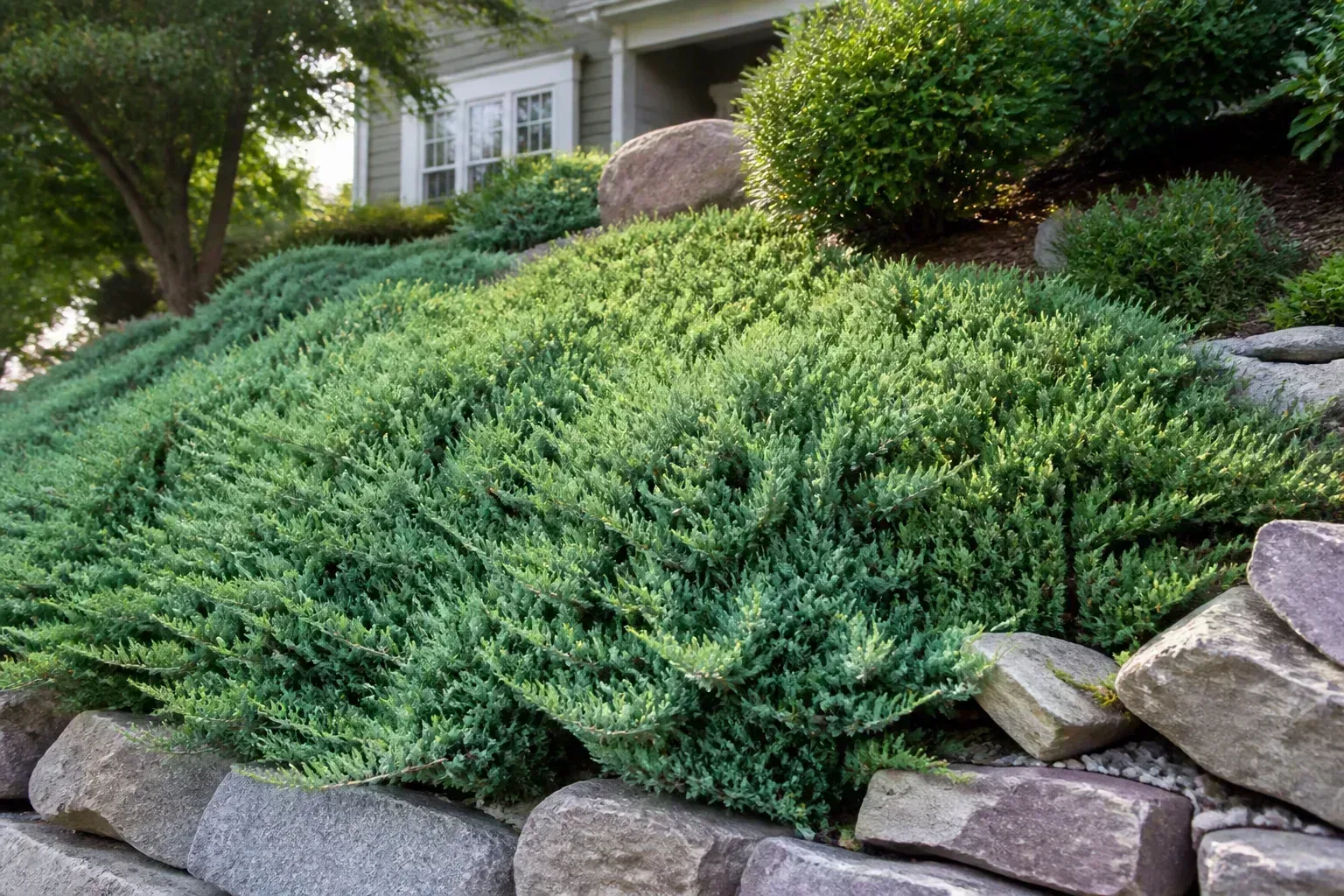
Juniper works best when its mature shape solves a specific landscape problem: a low blanket for a sunny bank, a narrow evergreen screen, a blue-green accent in a gravel bed, or a durable structure plant beside a foundation. It works poorly when the only selection criteria are “evergreen” or “drought-tolerant,” because the genus includes plants that stay ankle-high and others that eventually become large trees.
Before buying, write down the job, the light and drainage at the site, and the maximum space the plant can occupy. Then match a cultivar to that footprint. This order keeps you from trying to shear a sprawling shrub into a small mound or waiting years for a tiny dwarf to become a privacy screen.
Begin With the Job, Then the Site
Start by naming the role you need: cover bare soil, soften a wall, create year-round screening, anchor a mixed border, or provide a focal point. Next, check the conditions where the plant will actually grow—hours of direct sun, whether water sits after rain, the width available at maturity, and what will be beside it. A juniper on a sunny, fast-draining slope faces a different job from one planted between a shaded house and a narrow walkway.
Junipers are not one uniform landscape plant. University of Georgia Extension describes forms ranging from low groundcovers to conical and pyramidal plants, with foliage in green, blue, silver, and yellow; it lists screens, hedges, windbreaks, foundation plants, groundcovers, and specimen plants among their uses. That range is an advantage only when you shop by botanical name and cultivar, not by “juniper” alone. (University of Georgia Extension)
The scale difference is visible in the Missouri Botanical Garden’s Plant Finder: its juniper records include a Chinese juniper species entry listed at 40 to 50 feet tall and a named compact selection listed at roughly 1.5 to 2 feet. A genus-level label is not a planting plan; use the exact cultivar’s expected mature dimensions. (Missouri Botanical Garden Plant Finder)
Treat hardiness-zone information as one filter, not a complete climate verdict. A cultivar that survives winter in a region may still struggle with local summer humidity, poorly drained soil, reflected heat, or disease pressure. Use the nursery tag and regional extension advice for the exact cultivar; the size and performance of a species-level description may not match the named selection you are buying.
Match Juniper’s Growth Form to the Role
The most useful first distinction is height and direction of growth. A spreading plant occupies ground horizontally; a mounded or arching shrub adds rounded volume; an upright cultivar contributes vertical structure; and a sculptural form is best used as a deliberate focal point. These habits are not interchangeable, even when their needles have similar color.
Low, Spreading Forms
Low junipers such as creeping juniper (Juniperus horizontalis) spread outward rather than upward. ‘Wiltonii,’ often sold as Blue Rug, is especially flat and silver-blue; UGA Extension gives it a mature height around 6 inches and spread around 6 to 8 feet, while ‘Sargentii’ is taller—about 18 inches to 2 feet—with a spread around 7 feet. Those dimensions make them useful along a sunny bank, over a broad gravel edge, or as a low evergreen layer in a rock garden, but a poor fit for a tiny bed that cannot accept several feet of growth. (University of Georgia Extension)
The cultivar name matters as much as the species. ‘Blue Pacific’ shore juniper (J. conferta) forms a low trailing mat with blue-green foliage; it suits a groundcover role where the local climate and soil fit. A useful rule is to measure the available width first, then compare it with the plant’s expected spread—not to assume that a “dwarf” label means a plant will stay small in every direction.
Mounded and Arching Shrubs
Mounded junipers fill the middle layer between groundcover and taller shrubs. Some Chinese junipers, including ‘Sea Green,’ form a broader, arching shape; UGA lists ‘Sea Green’ at roughly 4 to 6 feet tall and 6 to 8 feet wide. A mound can soften the corner of a foundation bed or bridge a low edging plant and a taller evergreen, but that mature width needs room to show its natural outline.
Choose a mound when you want volume without a rigid vertical wall. For a tidy, small garden, use one well-sized specimen as punctuation rather than repeating several large shrubs so closely that their branches merge into an unventilated mass. If the label gives a range, plan around the larger end when the plant will be difficult to move later.
Upright and Columnar Forms
Upright junipers create a visual column, screen, or strong vertical accent in a narrow space. UGA describes ‘Spartan’ Chinese juniper as a dense, pyramidal or columnar plant that can reach about 20 feet; ‘Blue Point’ is a denser, blue-green pyramidal form listed around 7 to 10 feet. They can frame an entry, mark the end of a view, or provide an evergreen backdrop, but the difference in eventual height is large enough to change the whole composition.
For a screen, check both width and height on the exact tag and decide whether you need an opaque barrier or simply a sequence of evergreen accents. A row of narrow plants takes time to fill in, and spacing too tightly to get instant coverage can create the dense foliage and poor air movement that extension guidance warns against. If privacy is urgent, combine junipers with a fence or a temporary screen rather than crowding the plants.
Sculptural Specimens
Some junipers have twisted or unusually architectural branches that make them natural focal points. ‘Kaizuka,’ also sold as ‘Torulosa’ Hollywood juniper, develops a distinctive irregular outline and can become a substantial shrub or small tree; it needs enough open space for its shape to read clearly. Treat it as a specimen rather than a plant to tuck beneath an eave or keep clipped to an arbitrary height.
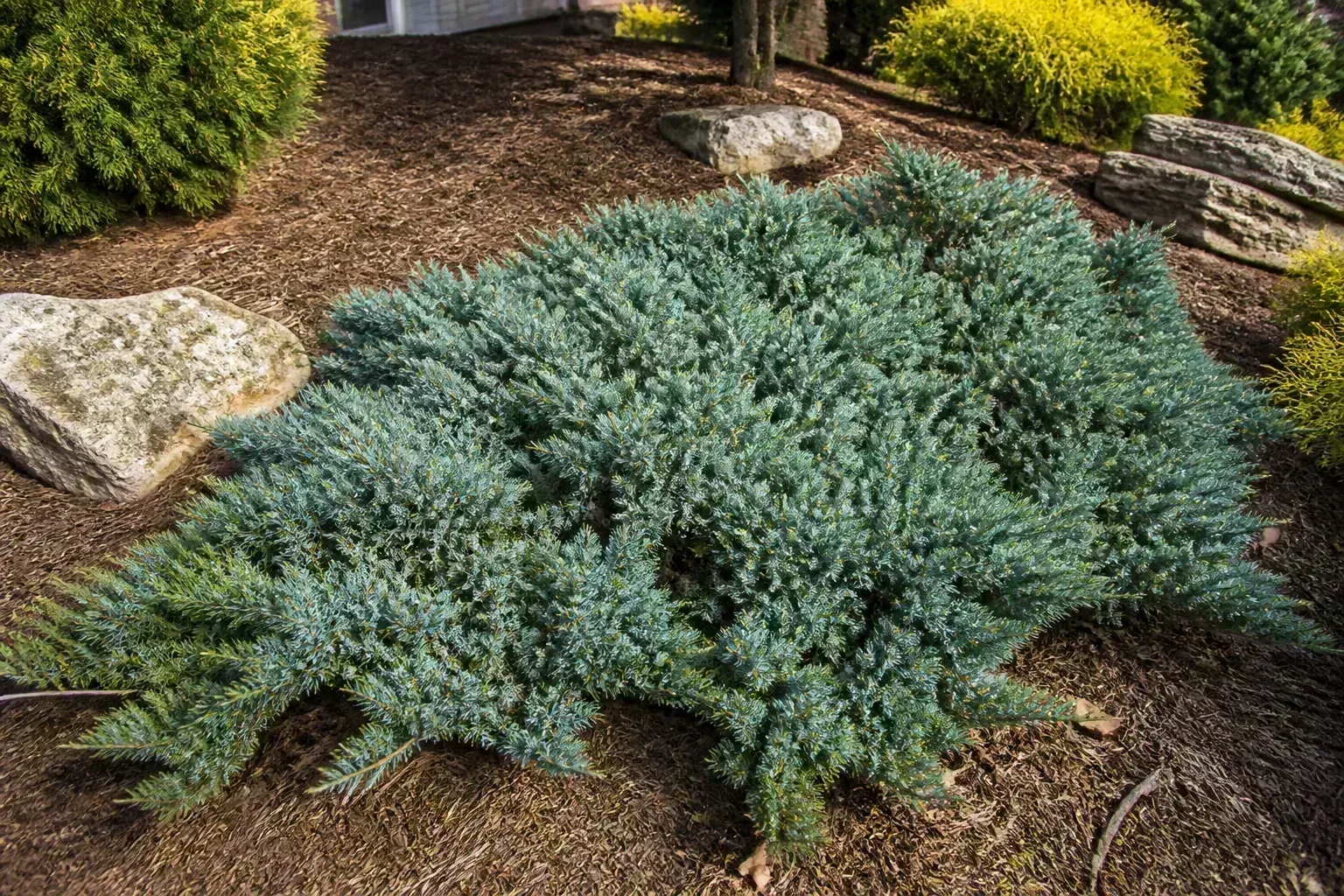
Blue Star juniper (J. squamata ‘Blue Star’) is a more compact accent, with steely blue foliage and a rounded habit. BBC Gardeners’ World lists it at about 45 centimeters tall and 1 meter wide and recommends it for rock gardens or containers; it also notes that the foliage is prickly. That texture can be effective beside smooth stone or broad-leaved perennials, but inspect the plant before placing it where people brush past. (BBC Gardeners’ World)
Let Groundcover Do More Than Fill Space
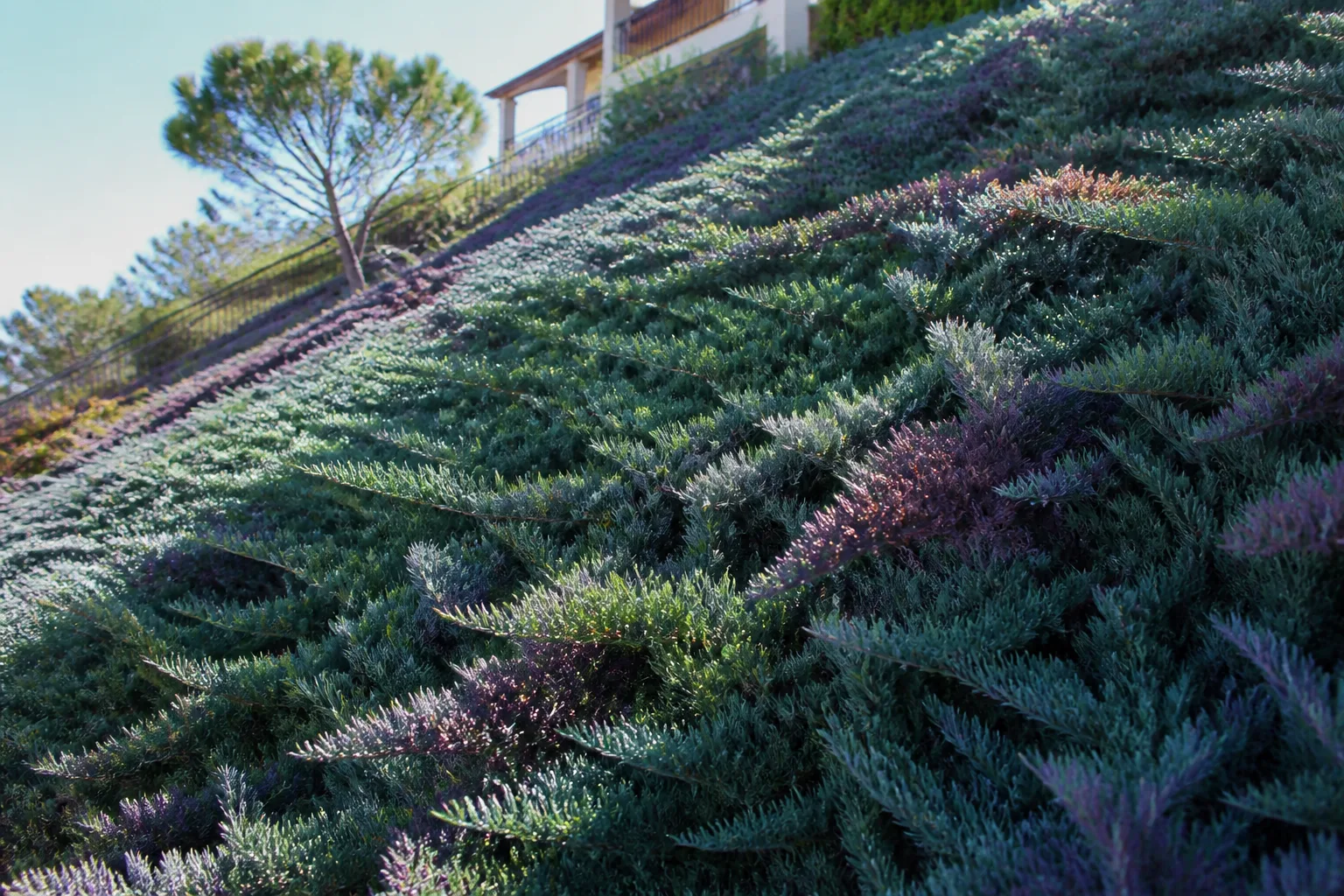
Use spreading junipers where their low evergreen mass contributes to the design: sunny slopes that are awkward to mow, a wide strip between a drive and path, a gravel garden, or the foreground of a mixed shrub border. Their foliage gives a site structure in winter, and the horizontal lines can make a steep bank look more settled than a row of isolated upright shrubs. Gardenista includes creeping juniper among low-maintenance groundcovers for hillsides and places where mowing is impractical. (Gardenista, “Ground Covers for Every Landscape”)
Groundcover is not an instant erosion-control fabric. Newly planted roots need time to occupy soil, and runoff on a steep or actively eroding slope may need professional grading, erosion-control matting, or other stabilization before plants can help. On a modest bank, arrange plants in a staggered pattern and leave practical access for watering and weeding during establishment; then allow the cultivar to expand toward its intended footprint.
Avoid using creeping juniper as a narrow border beside a path unless you can trim the edge selectively and tolerate its texture. A vigorous mat can cross a bed line, cover small perennials, or reach beneath adjacent shrubs. Mark the intended boundary before planting and choose a cultivar whose mature spread can be contained without repeatedly cutting back into old, bare wood.
Use Upright Junipers for Privacy Without a Wall Effect
Upright junipers can screen a window, define a property edge, or block an unattractive view while keeping evergreen structure through winter. The best choices are cultivars whose expected mature height and width align with the view you need to screen. If the target is a second-story window, a five-foot shrub will not solve it; if the strip is only a few feet wide, a broad, fast-growing tree form can become a maintenance problem.
Before planting a row, mark the centerline and the mature width of each plant on the ground with stakes or a hose. Use the label’s recommended spacing for that cultivar and local growing conditions; avoid the tempting “plants touching now” approach. A screen with modest gaps at first is easier to maintain than a dense hedge that stays wet inside, hides dead branches, and requires constant shearing.
Junipers are not the only way to create privacy. If the site is shady, wet, or too narrow for the mature footprint, use a fence, trellis, or shade-tolerant screen plant instead. A mixed screen—with junipers as vertical anchors and other shrubs or a structure filling the remaining view—can look more natural and reduce the pressure to make every plant grow into a solid green wall.
Give Foundations, Borders, and Paths the Right Scale
For a foundation bed, choose a juniper that will remain below windows, clear vents and siding, and leave room to reach the building for maintenance. Low-spreading and compact mounded cultivars are usually easier to place than large upright types, but the label’s mature width still matters. Measure from the planting point to the wall, walkway, and neighboring plants; do not plan to solve a tight fit with routine pruning.
In a mixed border, use juniper as the evergreen framework rather than filling every gap with conifers. One upright plant can punctuate a long bed, while a low cultivar can connect boulders or edge a path. Repeat a foliage color or form once or twice to make the composition feel intentional, then contrast it with plants that differ in leaf size, height, or seasonal display.
Keep low, spreading forms away from places where their branches will cover path edges, drains, utility access, or young perennials. Near a walkway, leave enough clearance for the plant’s mature spread and for people to pass without touching sharp foliage. A bed can look open at planting and feel crowded a few years later; draw the mature circles on a quick site plan before ordering multiple shrubs.
Bring Dwarf Junipers to Patios and Rock Gardens
Dwarf junipers can bring year-round structure to a patio, entry, or rock garden when the selected cultivar stays in proportion to the container or surrounding stones. Blue Star’s compact size and cool blue color make it a good example, but not every juniper marketed as “dwarf” is a true miniature. Confirm both mature height and spread, and choose a container with drainage holes and enough weight to resist tipping as the plant grows.
Container culture changes the care equation. A pot has less soil volume than a garden bed, so it can dry faster in summer and expose roots to stronger temperature swings in winter; check moisture rather than assuming an established landscape juniper can be ignored. Use a free-draining potting mix and never let the container sit in a saucer of standing water. In cold regions, protect the pot or move it to a sheltered outdoor location appropriate for the cultivar rather than bringing a hardy evergreen into a warm room for the season.
In a rock garden, let the juniper spill around stones or hold a low visual plane rather than planting it in every opening. The stone and foliage contrast is most legible when each plant has room to develop its outline. Add a few lower-growing perennials or seasonal bulbs only where their water and light needs match the juniper’s sunny, well-drained site.
Build a Palette Around Foliage Color and Texture
Juniper foliage ranges from green through blue and silver to yellow, and some cultivars shift tone as the weather changes. ‘Wiltonii’ may take on a purplish cast in winter, while UGA Extension describes ‘Plumosa Compacta’ as gray-green in summer and bronze-purple in winter. Treat those seasonal shifts as part of the planting design, not as an unexpected flaw, and check regional photographs or a local nursery display if winter color is important to you.
Use blue or gold foliage as an accent that repeats, not a color that competes everywhere. A single gold juniper can brighten a dark evergreen bed; repeating that color at a second point can connect two sides of a path. If every plant is a distinct color or shape, the bed may feel busy, so let a small number of forms carry the structure and use perennials or grasses for seasonal movement.
Texture can be as useful as color. Fine, scale-like foliage pairs well with broad leaves, loose grasses, or rounded stone, while a tight blue mound can sharpen the edge of a soft perennial border. Some cultivars have awl-like, pointed foliage that feels prickly; keep those forms away from seating and narrow paths, or use a less abrasive neighbor between the plant and the route people take.
Space for the Mature Plant, Not the Nursery Pot
Spacing is where otherwise good juniper plans often go wrong. A one-gallon plant may look small beside a wide bed, but a groundcover cultivar can eventually spread several feet; conversely, a hedge plan may demand a tall form that will outgrow its allotted width. Write the mature height and spread beside each plant on your sketch, and check whether branches will collide with walls, steps, windows, other shrubs, or neighboring property.
Do not use one universal distance for all junipers. Spacing depends on cultivar, initial plant size, the speed at which you want coverage, airflow, and whether you prefer distinct individual forms or a continuous mass. Use the grower’s recommended on-center spacing for that named cultivar; when the label is vague, ask a local nursery or Extension office rather than borrowing a number from a different species.
For groundcover, decide whether you want the plants to meet in a relatively short time or keep visible mulch between them for a longer period. Closer spacing fills faster, but UGA Extension cautions that horizontal junipers are often planted too close together, creating a dense foliage layer with poor air circulation and greater pest or disease vulnerability. Resist the urge to buy extra plants just to hide every patch of soil in year one.
For screens, remember that a row of narrow plants still needs room for each branch system to mature. If the exact cultivar grows wider than the space allows, choose a narrower cultivar or a different screening method; don’t count on regular clipping to keep an oversized juniper narrow. Correct spacing is a permanent design decision that reduces pruning, protects airflow, and lets the foliage show its natural form.
Plant Correctly and Water While Roots Establish
Choose an open, sunny location with good drainage. Junipers tolerate a range of soil reactions, and some cultivars handle dry or sandy soils well, but “tough” does not mean they thrive with roots standing in water. If a test hole remains saturated after rain or irrigation, address drainage or choose a better-suited plant before planting; adding rich soil to the surface will not fix a persistently wet planting pocket.
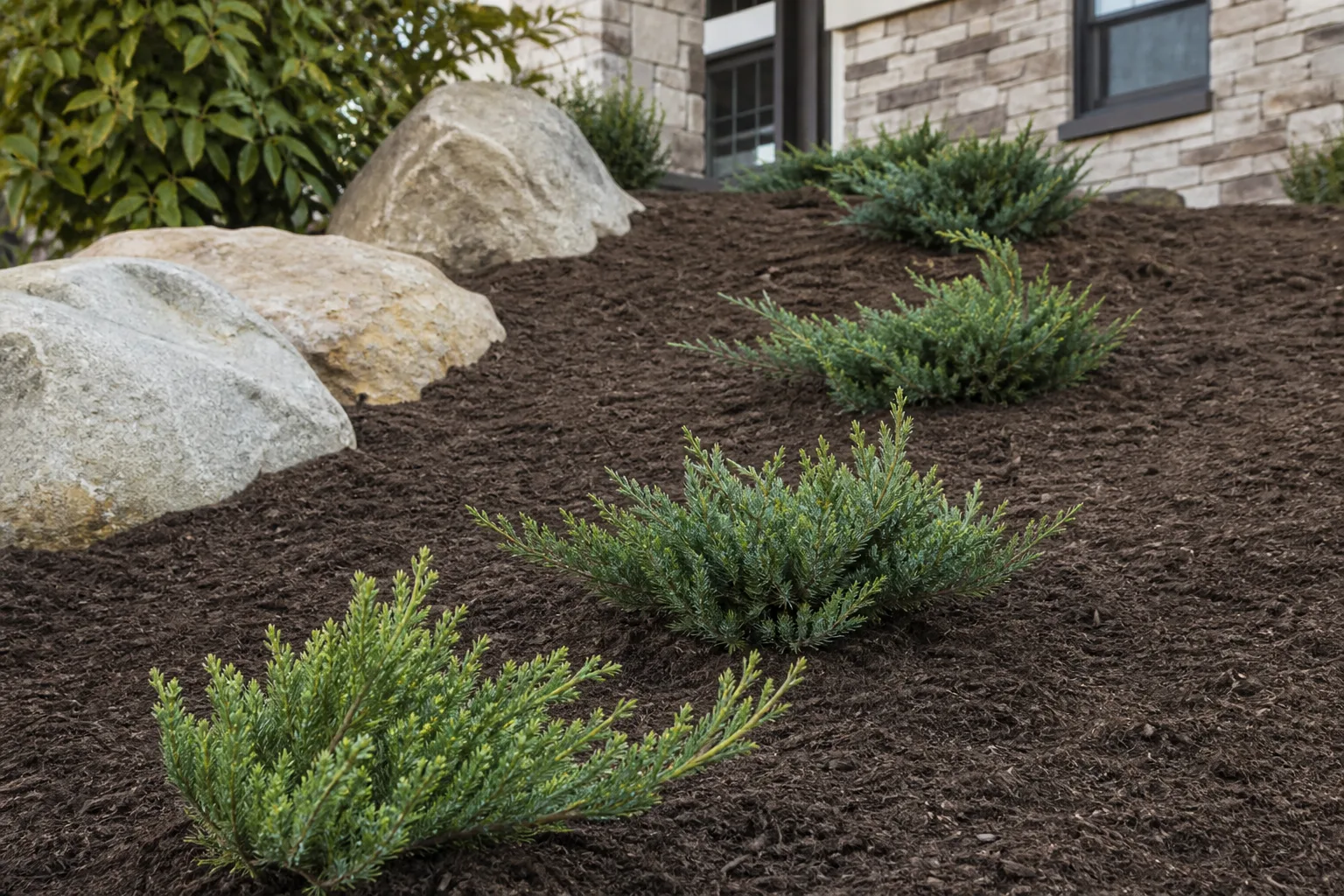
Set the plant at the same depth it grew in its nursery container, with the top of the root ball level with the surrounding soil. Loosen circling or tightly packed roots gently so they can grow outward, backfill with the site soil, and water the entire root ball and adjacent soil thoroughly. Avoid burying the stem or piling mulch against the trunk; a thin, even mulch layer can help conserve moisture while leaving the crown clear.
During establishment, check the root ball itself because it can dry out even when nearby soil looks damp. Water deeply when the root zone begins to dry, adjusting for rainfall, soil texture, temperature, and container versus in-ground planting; do not follow a fixed schedule if the soil is already wet. UGA Extension advises thorough watering after planting and frequent watering during the first month, then notes that established junipers need little supplemental irrigation and can suffer from overwatering. (University of Georgia Extension)
Keep weeds and tall grass from competing with young plants, especially beneath a future groundcover mat. Do not pile fertilizer into the planting hole or feed automatically because the plant looks slow in its first season; junipers are not usually landscape plants that need heavy feeding, and excessive fertilizer can encourage growth that the site cannot support. If growth is poor, check light, drainage, roots, and cultivar suitability before reaching for a product.
Keep Maintenance Light, but Do Not Ignore It
The lowest-maintenance juniper is the one whose mature form already fits its site. Most landscape uses need little routine shaping once the plant is established, but the planting still benefits from occasional inspection: remove weeds before the canopy closes, clear dead foliage trapped beneath spreading branches, and look for branches that are crossing a path or blocking access. A quick annual check is easier than untangling an overgrown bed years later.
Prune selectively, not by shearing every plant into the same green outline. UGA Extension notes that junipers do not readily produce new growth from old wood, so cutting a branch back to a large bare section can leave a permanent hole rather than trigger fresh foliage. Tip-prune or thin individual branches when needed, and remove dead or damaged material; for a plant that needs repeated severe reduction, replace it with a cultivar that fits the space.
Water established in-ground junipers only when conditions call for it, such as an extended dry spell, and avoid keeping the soil continuously wet. Container plants are the exception to the “set and forget” impression: their limited soil volume means moisture checks and winter protection may be needed. If foliage browns or branches die, diagnose the site and the pattern first—poor drainage, shade, winter injury, pests, and disease can require different responses.
Know When Juniper Is the Wrong Plant
Choose another plant if the site is persistently shaded, remains waterlogged, or is too narrow for the cultivar’s mature width. Shade can leave junipers thin and open rather than dense, while poorly drained soil raises the risk of root problems; neither issue is reliably corrected by extra fertilizer or repeated pruning. For a damp shade bed, use a species adapted to those conditions instead of forcing a sunny-site conifer to fit.
Also reconsider juniper when a soft, touch-safe edge is important. Some popular cultivars have stiff, sharp foliage that can be unpleasant next to a narrow walkway, play area, or seating spot. If you like the color but not the texture, place the plant behind a buffer of broad-leaved perennials or choose a cultivar after handling a sample at a local nursery.
If you grow apples or crabapples, ask whether cedar-apple rust is a concern in your area before choosing a juniper species. NC State Extension explains that the disease needs both susceptible apple and juniper or red cedar hosts to complete its cycle and that management may be relevant when apple trees are within 2 to 5 miles of an alternate host. That figure is a disease-management radius, not a universal rule that every homeowner must remove or avoid every juniper; local species, apple cultivars, and disease pressure matter. (NC State Extension, “Cedar Apple Rust”)
Common Juniper Landscaping Mistakes to Avoid
The first mistake is buying by color or common name before checking the botanical name and mature size. “Blue juniper” can describe more than one growth habit, and “dwarf” does not mean the plant will stay narrow; compare the tag with your actual site measurements. If a seller cannot provide a credible mature range for the cultivar, look up a regional botanical garden or extension profile before you commit.
The second is planting too densely for instant coverage. That can hide the soil quickly but may create an overgrown, poorly ventilated mass and force constant edge trimming. Plan for the plant’s natural spread, accept some mulch or open ground while it establishes, and choose the right number of plants for your intended final look.
The third is treating drought tolerance as permission to neglect a new planting or a container. Roots need consistent attention while they extend beyond the original root ball, and a pot dries more rapidly than a bed; on the other hand, watering a poorly drained site every day can worsen the problem. Check the root zone and respond to its condition instead of using an unchanging calendar.
Finally, avoid planting first and pruning your way out of every mismatch. Junipers can be unforgiving when cut into bare old wood, and a mature screen can be expensive to replace. Before you dig, mark the mature footprint, confirm light and drainage, check nearby disease hosts where relevant, and ask whether you would still like the plant if it reached the size on its tag.
Conclusion
Use juniper as an evergreen design tool, not as a generic low-care shrub. Match a spreading, mounded, upright, or sculptural cultivar to the space it will occupy, then plan around mature dimensions, sun, drainage, and nearby plants.
For a sunny slope, a low cultivar may replace mowing; for a narrow view, a correctly sized columnar plant can add screening; for a small patio, a compact mound can supply year-round color. Give every plant room to establish and grow, and you will need less pruning to keep the landscape looking intentional.