Is Fall Lawn Overseeding Worth the Money?
Is fall lawn overseeding worth it? Learn which lawns benefit, when to seed, how to prep and water, and when more seed will only waste money.
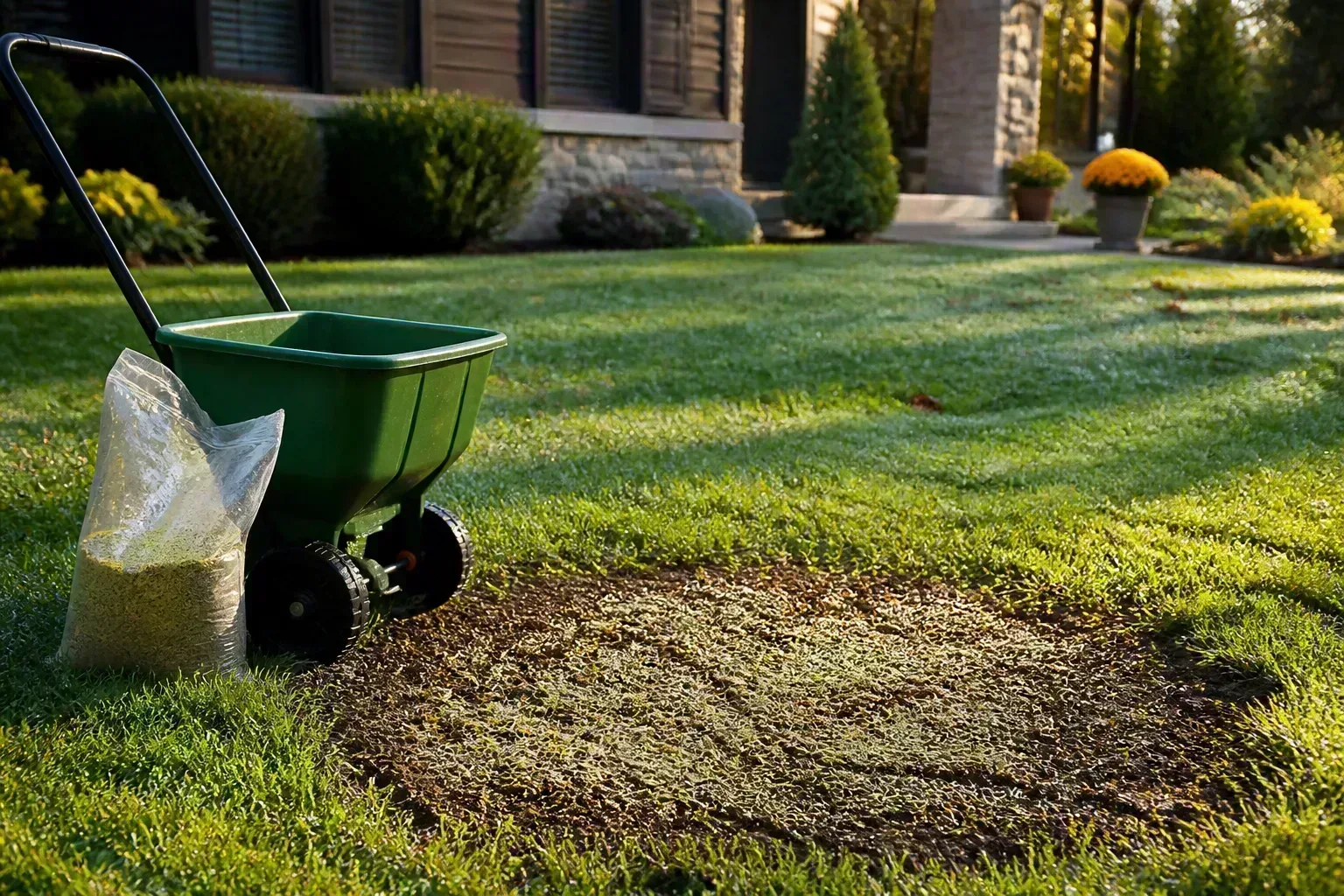
The short answer: when fall overseeding pays
Fall lawn overseeding is usually money well spent when you have a thin but living cool-season lawn, the seed matches the grass already growing there, and you can keep the seed zone evenly moist until the seedlings root. It is not a magic fix for a lawn that is mostly bare, planted with the wrong grass for its shade, compacted beyond what roots can use, or treated so late that seedlings have no time to establish before winter.
The word overseeding matters. You are adding seed into existing turf, not rebuilding the entire lawn. A good fall window gives new grass warm soil for germination, cooler air for reduced stress, and less weed competition than many spring attempts. Penn State Extension describes late summer to early fall as the usual best period for establishing cool-season turf, while cautioning that late seeding becomes less dependable as the season closes. Penn State’s lawn-management guide also emphasizes that seed must contact soil and have room to germinate.
The real waste is buying seed before answering four questions: What grass do I have? Is the lawn thin or failing? Is the soil still in the growth window? Can I water it consistently? If any answer is no, changing the plan may save more money than buying a larger bag.
First identify your grass and the problem
Cool-season versus warm-season grass
Most fall overseeding advice in the northern half of the United States assumes cool-season turf: Kentucky bluegrass, perennial ryegrass, tall fescue, or fine fescue. These grasses grow actively in cool weather, so fall can support both a quick start and root development before winter. K-State lists an optimum growth range of about 50–65°F soil temperature and 60–75°F air temperature for cool-season turf, a useful biological explanation for why “early fall” works better than a fixed date. K-State’s turfgrass selection guidance provides the species and temperature distinction.
Warm-season grasses behave differently. Bermudagrass, zoysiagrass, St. Augustinegrass, and centipedegrass prefer warm soil and naturally slow or go dormant as fall cools. Clemson notes that bermudagrass lawns are commonly overseeded with ryegrass in fall to keep color through winter, but that is a temporary winter-color project, not the same as thickening the permanent warm-season lawn. Clemson’s bermudagrass factsheet makes that distinction clear.
If you live in the transition zone, check the seed label and your existing lawn before spreading anything. Adding cool-season seed to a warm-season lawn can create a spring transition problem: the temporary grass may stay vigorous when the permanent grass is trying to wake up. University of Georgia Extension recommends choosing the seed and seeding rate for the intended winter appearance, then managing mowing and spring transition deliberately. Its guidance describes roughly 5 to 10 pounds of ryegrass per 1,000 square feet for warm-season lawn overseeding, with the lower rate giving less fall coverage and the higher rate making spring transition harder. UGA’s warm-season overseeding guidance is regional, so do not carry that rate into a cool-season lawn.
Thin turf, bare patches, or a failing lawn?
Overseeding makes sense when desirable grass is still distributed across the lawn but the canopy has opened after summer stress. You may see more soil between blades, worn lanes along a path, or a general loss of density without widespread dead turf. New seedlings can occupy those gaps while existing plants keep protecting the soil.
Large bare areas call for a repair or renovation plan instead. If most of a section is soil, weeds, moss, or dead thatch, seed scattered over the top has too little contact and too much competition. Remove the dead material, loosen the upper soil, level it, and seed it as a patch or renovation. BBC Gardeners’ World recommends removing perennial weeds and their roots before adding compost and seed to a bare spot, then watering and protecting the seed from birds. Its reseeding sequence is especially useful for small repairs.
Also ask why the lawn thinned. If shade from a tree or building has increased, the original grass may be the wrong species. If the ground stays wet, roots may be failing from poor drainage rather than a lack of seed. If a dog, mower traffic, grubs, or disease caused the damage, overseeding without correcting the cause simply creates another thin patch by spring.
Time the job by soil conditions, not a calendar
“September” is a useful reminder, not a universal appointment. Kansas City lawns may be ready for bluegrass and tall fescue in early to mid-September, according to K-State Extension Johnson County, while another region can reach the same growing conditions earlier or later. Penn State says most of its lawns should not be seeded later than mid-October, but that is a Pennsylvania guideline, not a rule for every climate.
Look for the combination that seedlings need: soil is still warm enough to germinate, nights are cooling, the lawn is not under summer heat stress, and several weeks of active growth remain. Air temperature can mislead you. A chilly morning does not mean the soil has stopped supporting roots, and a warm afternoon does not guarantee that a late-season seedling will have enough time.
Use soil temperature and the frost runway together
For cool-season turf, use the 50–65°F soil range as a practical target and check it a few inches below the surface in more than one part of the yard. K-State’s range describes optimum cool-season growth, not a single on/off switch; seed can germinate outside it, but conditions become less forgiving as soil cools or summer heat persists. A basic soil thermometer is enough. Avoid taking the only reading beside a warm foundation, pavement, or south-facing wall.
Then work backward from your usual first hard freeze. Germination is only the first checkpoint. A perennial ryegrass seedling may show in several days, fescue in roughly 10 days, and Kentucky bluegrass in two to three weeks, but a visible green thread is not a winter-ready root system. Savvy Gardening’s practical seeding guide gives those germination differences and stresses that watering must continue until young grass is established. Savvy Gardening’s grass-seed guide is a useful companion to extension timing guidance.
Treat a forecasted cold snap as a reason to pause, not a reason to rush. If the lawn is already near the bottom of the growth window and the calendar leaves only a short runway before regular freezing, your choices are to seed a small high-priority repair, wait for spring, or plan a full renovation at a better time. Spreading a full bag into a closing window can produce a few sprouts without the density you paid for.
Prepare for seed-to-soil contact
Seed lying on a mat of thatch or compressed blades is exposed to air, birds, and drying. The goal is not to bury the seed deeply; it is to create enough openings that seed rests against moist soil. Penn State specifically says overseeding is more successful when seed has contact with soil and space to germinate.
Start with a mowing pass while the lawn is dry. Lower the height modestly if your current grass can tolerate it, but do not scalp a heat-stressed lawn or remove so much leaf that the remaining turf cannot recover. Collect or mulch the clippings only if they would cover the seedbed; do not leave a thick mat across the surface.
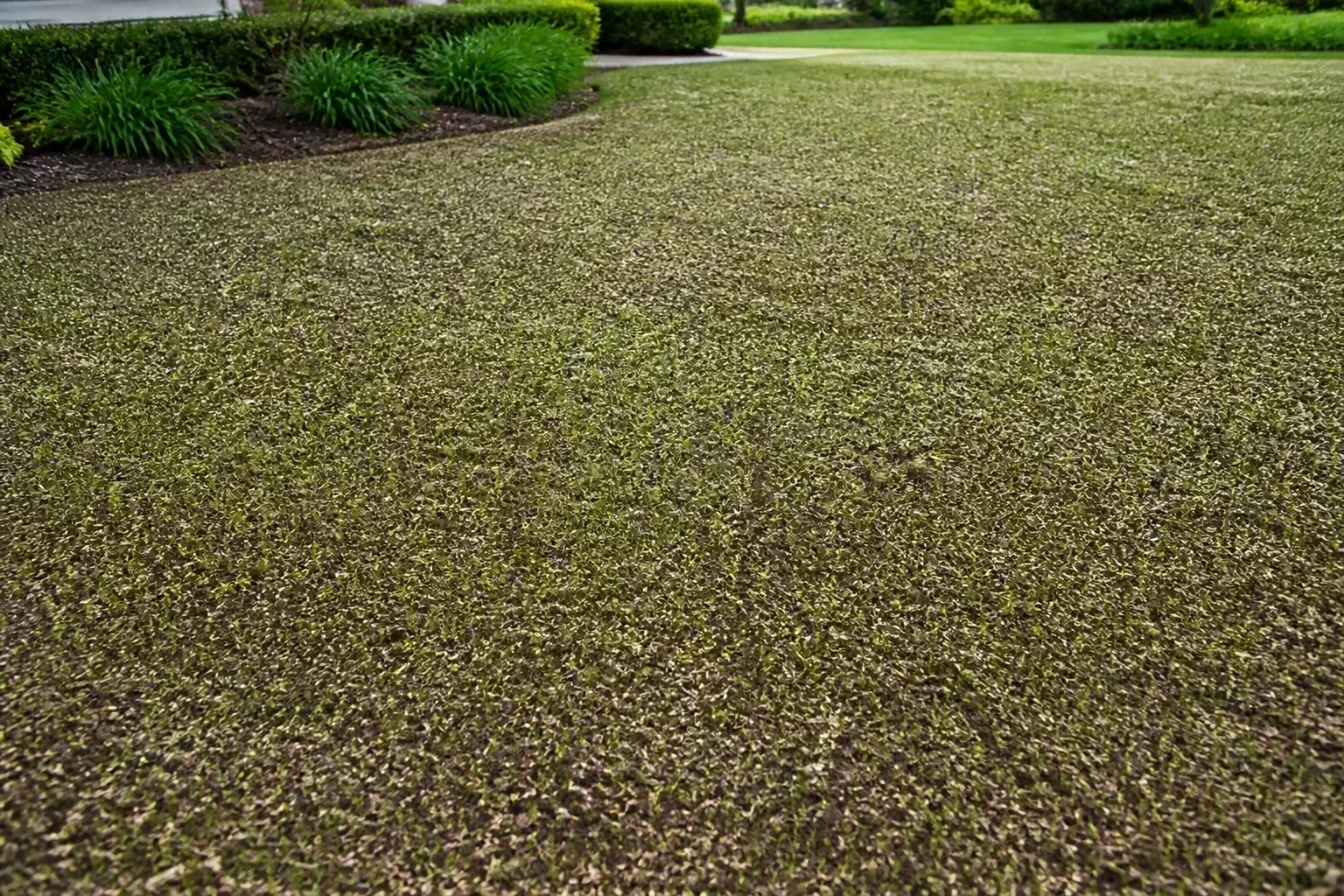
Mow, dethatch, aerate, and expose soil
If thatch is thick enough to hide the soil, remove it during cool weather when the lawn has adequate moisture. Penn State recommends mechanical dethatching when thatch reaches about an inch or more, but warns against doing it during heat, drought, or very late fall. A thin, decomposing layer is not automatically a problem; aggressive dethatching can injure living crowns and create more bare ground than the seed can cover.
Aeration is a tool for compaction, not a ritual that every overseeding job requires. If a screwdriver will not penetrate moist soil easily, if foot traffic has sealed the surface, or if water ponds and runs off, core aeration may improve the root zone. Use a core aerator when the soil is moist enough for the tines to remove plugs, then seed soon after. Penn State describes core aeration as a way to create large pores for air, water, lime, and nutrients.
K-State Extension Johnson County points out an important trade-off: verticutting creates grooves that catch small seed and can produce a more uniform stand, while core aeration is valuable for general lawn health but can lengthen the time needed for bare areas to fill. A slit seeder or verticutter may be a better fit for a thin lawn that needs even contact; a core aerator is more useful when compaction is the limiting problem. Do not rent the loudest machine just because it is available.
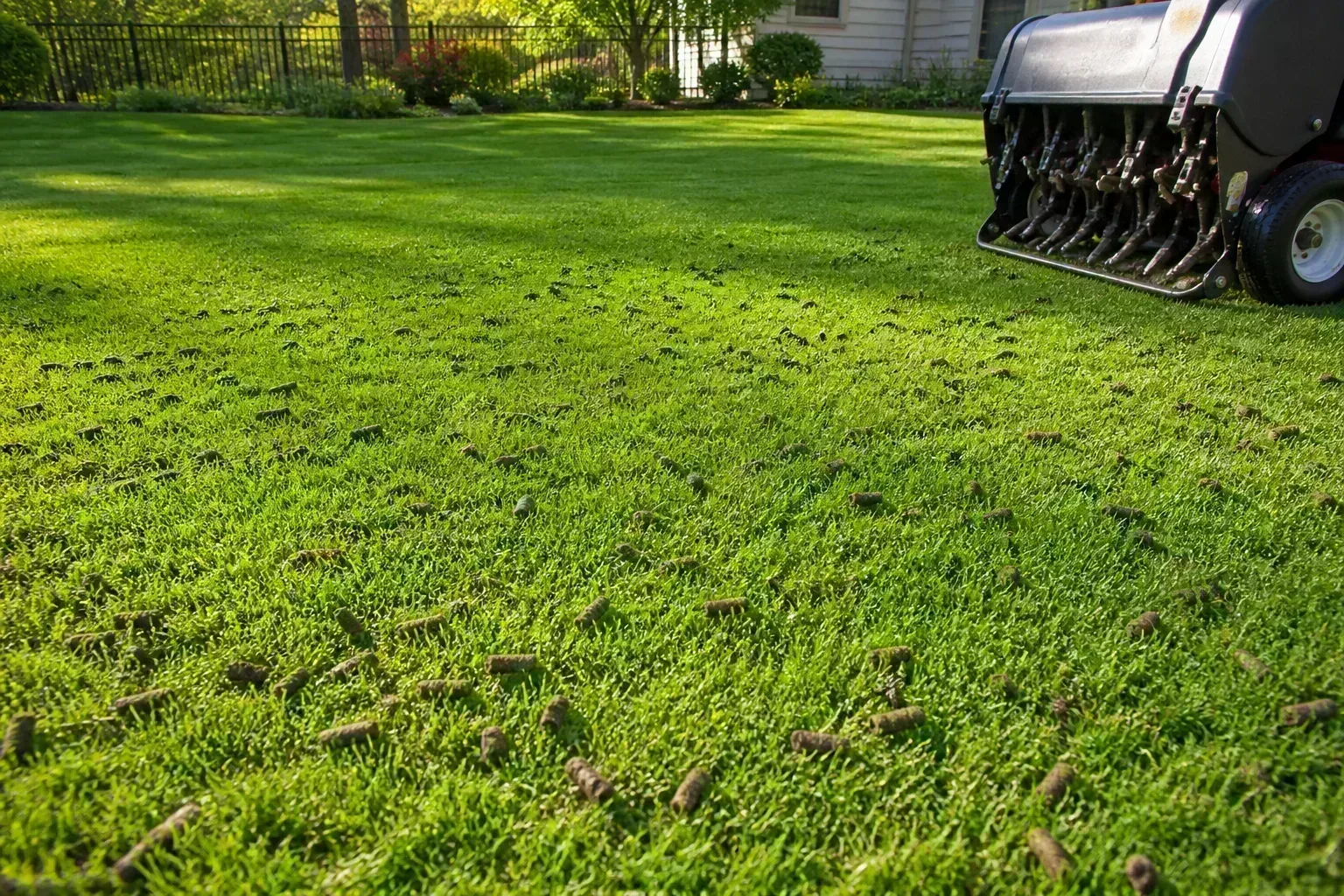
If the problem is uneven soil rather than compaction, rake out low spots and thinly top-dress with screened compost or soil appropriate for turf. Avoid covering existing grass with a deep layer that smothers it. Savvy Gardening recommends a light cover for seed—about a quarter inch—rather than burying it under a heavy blanket. On a small patch, loosen the surface, rake it fine, spread seed, and press or rake lightly so the seed settles into contact without disappearing.
Choose compatible seed, rate, and spread pattern
Seed is not interchangeable just because every bag says “lawn.” Match the species and cultivar to the climate, sun, soil, traffic, and the grass that will remain. A shade-tolerant fine fescue can be a better choice for a dry, lightly used shady edge than a sun-loving bluegrass, while tall fescue is often a more practical fit for heat and drought in a transition-zone yard. K-State notes that poor turf selection can lead to repeated reseeding, fertilizer, and pesticide costs—the opposite of saving money.
Match seed to climate, sunlight, and traffic
Read the analysis and species list on the label, not only the large marketing name. Avoid mixes that contain a large amount of a grass unsuited to your site or a weed-control additive that conflicts with new seedlings. If the existing lawn is a blend, choose a compatible blend rather than introducing a visibly different texture or color unless you are intentionally changing the stand.
For cool-season overseeding, K-State Extension Johnson County gives practical examples: 3–4 pounds of tall fescue seed per 1,000 square feet and about 2 pounds of Kentucky bluegrass seed per 1,000 square feet when overseeding, roughly half the rate used for a new lawn on bare soil. These are regional examples, not permission to ignore the label; cultivar, purity, germination percentage, and the amount of existing turf all change the correct rate.
Measure the lawn before buying seed. A 20-by-50-foot area is 1,000 square feet; a 10-by-20-foot patch is 200 square feet. Calibrate the spreader with a small amount on a driveway or tarp, then sweep the area in two directions, using half the planned amount on each pass. This reduces the stripes and thin bands that happen when one pass runs out of seed early.
Do not overcorrect a poor spread by doubling the rate. Crowded seedlings compete for light, water, and nutrients, and dense, constantly wet growth can increase disease pressure. Thin coverage is wasteful, but excessive coverage is not automatically insurance.
Water the seed bed through establishment
New seed needs a different irrigation pattern from an established lawn. Before germination, keep the upper seed zone consistently moist without creating puddles or moving the seed downhill. That may require brief, frequent cycles, especially on a sunny slope or a sandy soil, but the right frequency depends on sprinkler output, wind, rainfall, and texture.
University of Georgia Extension recommends irrigating warm-season overseeding three to five times daily at first, with total daily water seldom exceeding half an inch, and warns that puddling encourages disease. The principle applies broadly: short applications that maintain surface moisture are safer than one heavy blast that floats the seed away. Adjust the schedule after watching the soil, not after following a timer blindly.
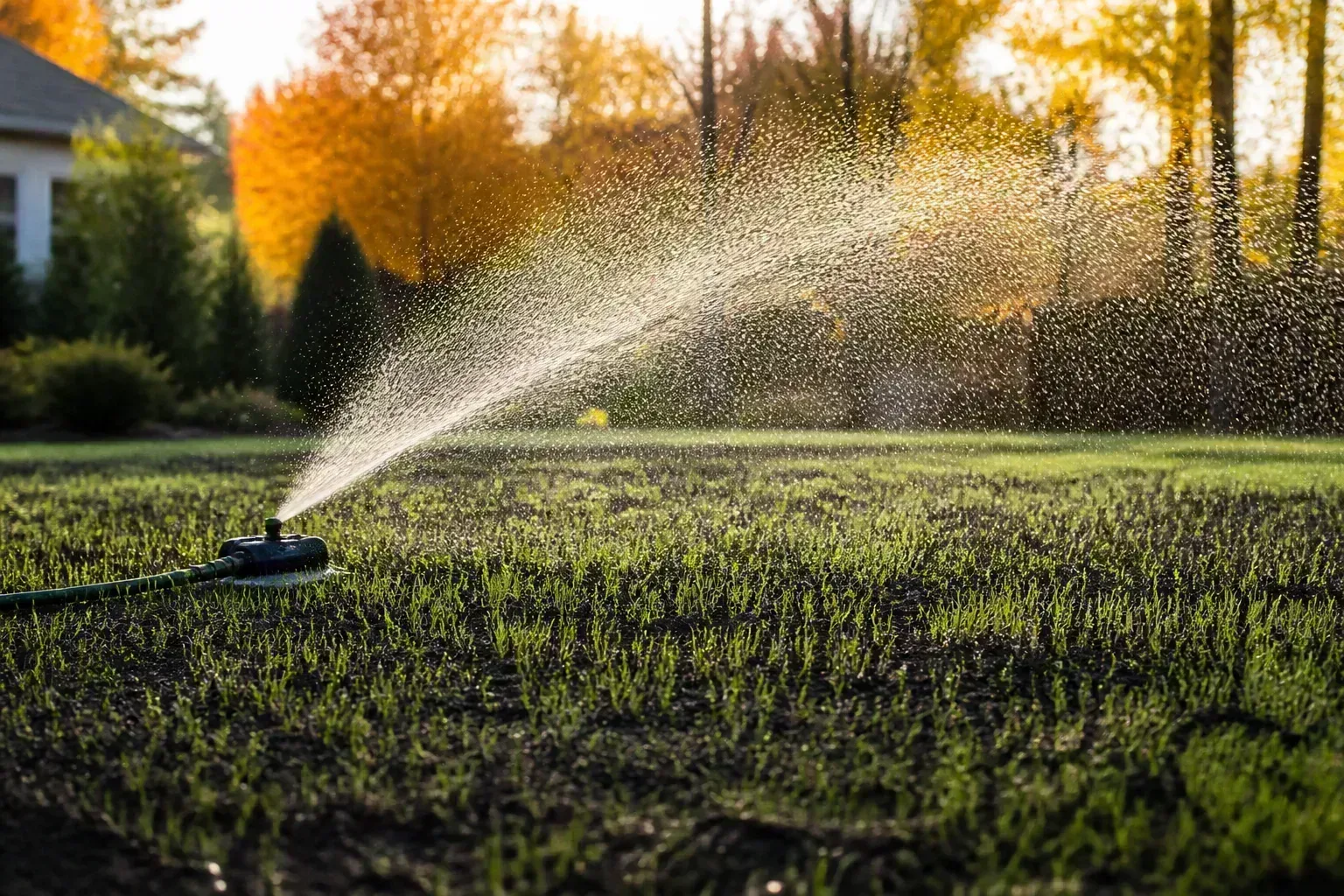
Check the seedbed each day during the germination period. The surface should not form a hard crust, and water should not run across the lawn. A light straw or screened compost cover can slow evaporation and reduce bird disturbance on exposed patches, but a heavy cover can block light and hold too much moisture. Savvy Gardening advises about a quarter inch of cover and cautions that more is not better.
Shift from shallow moisture to deeper roots
Once seedlings emerge evenly, gradually reduce the number of watering cycles and increase the depth of each application. The exact changeover is not a birthday; it is a response to roots reaching below the surface and the soil drying slightly between waterings. If you keep the top film constantly wet for weeks, roots have little reason to explore deeper soil.
Germination speed varies. Perennial ryegrass may appear in three to five days, fescue in about 10 days, and Kentucky bluegrass can take two to three weeks. Mixed bags will not green up all at once, so do not reseed a slow bluegrass section simply because the rye is already visible. Continue careful moisture for the slower species, then move toward deeper, less frequent watering as the stand fills in.
Keep traffic light while roots are shallow. Children, dogs, wheelbarrows, and repeated hose movement can displace seed or break new crowns. When seedlings reach roughly 3 inches, or are tall enough that you can mow without removing more than one-third of the blade, make the first cut with a sharp mower on dry turf. A clean cut reduces tearing and keeps the new stand from becoming a mat.
Fertilizer, weed control, and fall cleanup
Fertilizer can help a seeding, but it cannot rescue seed that is in the wrong season or sitting on thatch. For cool-season lawns, a starter fertilizer may be appropriate at seeding when the label allows it and a soil test supports the nutrients; K-State lists balanced or higher-phosphorus starter products as options for its regional lawns. Phosphorus rules differ by state, and applying extra phosphorus without a soil-test need adds cost and runoff risk, so follow the product label and local regulations.
Warm-season lawns overseeded with ryegrass need a different transition plan. UGA Extension recommends waiting until after seedlings emerge—usually about three weeks after seeding—before fertilizing that temporary stand, because earlier feeding can encourage competition from the warm-season grass. That advice is for its regional winter overseeding system, not a universal cool-season schedule.
Avoid applying a crabgrass pre-emergent over a newly overseeded cool-season lawn unless the product label specifically permits the combination. The same barrier that stops crabgrass can stop desirable grass seed. Plan the spring weed strategy before you seed: Penn State places annual grass pre-emergent applications in spring before germination and recommends identifying broadleaf weeds before selecting a treatment. If a lawn needs herbicide, read the re-seeding interval on the label instead of guessing from the weather.
Control weeds that are already occupying a bare patch before sowing, but do not turn a seedbed into a chemical experiment. Hand-pull small weeds, remove roots, or use only a product and interval compatible with your grass seed. Once you seed, the safest investment is usually consistent moisture, light traffic, and patience rather than repeated sprays.
Keep fall leaves from forming a wet blanket over the new stand. Mulch them finely with a mower if the layer stays light enough for grass to show through, or remove them with a gentle rake or blower. Leaving thick leaves on tender seedlings can block light and airflow; raking aggressively can pull up the same seedlings you paid to establish.
Know when dormant seeding is a bad bet
Dormant seeding means placing cool-season seed after conditions are too cold for immediate germination, hoping it remains inactive until spring. It can be useful when a site is difficult to reach during the normal window, but it is not simply “late fall overseeding” with guaranteed results.
The risk is a warm spell. If the seed germinates during a brief thaw and the next freeze arrives before roots develop, the new seedlings can die. Heavy rain can also move seed, and winter traffic can bury or expose it. A long, stable cold period can make dormant seeding workable; a season of repeated freeze-thaw swings makes it a gamble.
If your lawn has already missed the reliable fall window, compare the cost of dormant seed with a planned spring repair. Spring brings more weed competition and a coming summer stress period, but a deliberate spring seeding with irrigation may still outperform a late fall application made after the soil has cooled too far. If you choose dormant seeding, use a site where you can accept uneven emergence and plan to fill gaps when conditions become favorable.
Diagnose failure before buying more seed
Sparse emergence is a diagnosis, not an instruction to spread more seed immediately. Wait long enough for the slowest species on the label, then inspect the pattern. A uniform lack of growth often points to temperature, old seed, or a watering problem; lines, stripes, and isolated bare bands point more strongly to spreader coverage or soil contact.
Use these clues:
- Seed is still visible on the surface: rake lightly or press it into exposed soil if the timing window remains open. Seed above soil dries quickly and is easy for birds or wind to remove.
- Seedlings appeared, then vanished: check for a dry-out event, washout, foot traffic, disease-favoring puddles, or a sudden heat or freeze event. Germination proves the seed was viable; it does not prove the site supported roots.
- One grass is visible but another is not: check the species’ expected germination time before changing anything. Ryegrass often appears first, while Kentucky bluegrass can take two to three weeks.
- The same shaded or wet area fails every time: stop buying seed until you address the light, drainage, compaction, or thatch. The site is the limiting factor.
- Weeds dominate the new openings: the surface was disturbed but the desirable grass did not occupy it quickly enough. Improve contact and timing, then review the seed blend and future weed-control intervals.
- New seedlings are yellow or matted: inspect drainage, fertility, and mowing rather than assuming the answer is more fertilizer. A waterlogged seedbed can look hungry while the roots are actually oxygen-starved.
If damage is circular, spreads rapidly, pulls up like loose carpet, or returns despite good establishment practices, investigate insects or turf disease. Penn State recommends accurate diagnosis for turf disease because management depends on the actual cause. Overseeding is a recovery step, not a substitute for finding a persistent pest or pathogen.
A low-waste fall overseeding checklist
Use this sequence before you open the seed bag:
- Name the existing grass. Confirm cool-season versus warm-season turf and check whether the product is intended for that lawn.
- Define the job. Overseed a thin living canopy; repair or renovate broad bare areas; correct shade, drainage, compaction, or pests first.
- Check the window. Measure soil in several places, use the 50–65°F cool-season range as a guide, and leave enough cool growth before the usual first hard freeze.
- Prepare the surface. Mow modestly short, remove heavy leaves and thatch, and expose soil with raking, verticutting, slit seeding, or core aeration when compaction actually needs it.
- Measure seed and calibrate. Follow the label, use regional examples only as a cross-check, and spread in two directions at half-rate per pass.
- Water lightly and often at first. Keep the upper seed zone damp, never ponded or running off; inspect daily and adjust for rain, wind, soil, and slope.
- Protect the seedlings. Limit traffic, keep leaves from matting, and wait for enough height to mow without scalping.
- Plan the next decision. If emergence is slow, diagnose timing, contact, moisture, seed, and site before buying more. If the window has closed, choose a deliberate spring or dormant-seeding plan instead of reacting to a bare spot.
The cost-saving step is not using the cheapest seed. It is aligning the seed, site, weather, and aftercare so the seed has a fair chance to become turf. Good seed spread into a dry, compacted, shaded lawn is still expensive; a smaller quantity spread into prepared soil at the right time can do more.
Conclusion: make the timing earn the money
Fall lawn overseeding is worth the money when it is aimed at the right lawn: living but thin cool-season turf, compatible seed, exposed soil, reliable moisture, and enough cool weather left for roots to develop. It becomes wasteful when the grass type is wrong, the site problem is untreated, the seed is too late, or watering and contact are treated as optional.
Use the calendar to start checking, then let the lawn’s grass type, soil temperature, moisture, and frost runway make the decision. If those conditions line up, overseeding can turn summer-thinned turf into a denser stand with less spring competition. If they do not, keeping the seed in the bag until a better window is the more professional choice.



