How to Grow and Care for Stone Pine (Umbrella Pine)
Learn stone pine care, from climate and mature size to planting, watering, pruning, and pine nuts, so you can decide if this Mediterranean tree fits your yard.
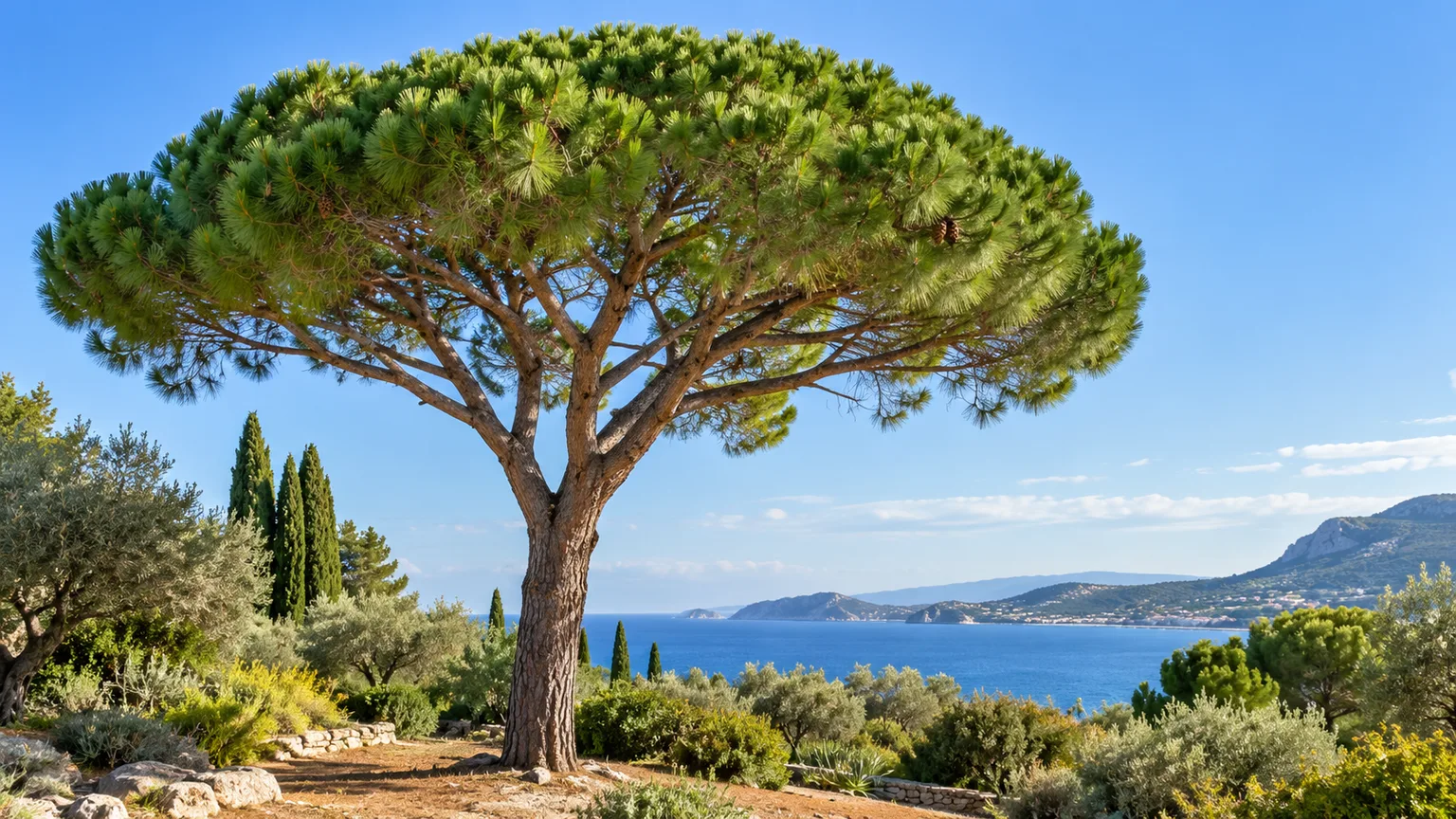
Stone pine (Pinus pinea) earns its name from a mature crown that spreads into a broad, flat-topped umbrella. It is an evergreen Mediterranean tree, not a compact ornamental that can be kept small with regular trimming. Before you buy one, check your climate, drainage, and the room available for a tree that can eventually be as wide as it is tall.
“Umbrella pine” can also be used for unrelated conifers, so confirm the nursery label says Pinus pinea. The Japanese umbrella pine, Sciadopitys verticillata, is a different species with a different care profile. If you are comparing edible and ornamental pines, see our guide to pine trees from around the world.
Stone Pine at a Glance
| Feature | What to expect |
|---|---|
| Botanical name | Pinus pinea |
| Other common names | Italian stone pine, umbrella pine, parasol pine, Roman pine |
| Mature size | Often 40–60 feet tall; broad crowns can approach 40 feet or more across |
| Light | Full sun, ideally six or more hours of direct light |
| Soil | Sandy or loamy soil with good drainage; pH tolerance varies by reference |
| Water | Regular deep watering while young; drought tolerant after establishment |
| Best fit | A spacious, sunny landscape in a mild-winter climate |
These are planning ranges, not guarantees. NC State Extension lists a typical height of 40–60 feet and width of 20–40 feet, while Oregon State University describes plants reaching 40–80 feet tall and a similar width. The mature spread is the detail most likely to change where you can safely plant one.
A young tree may look bushy or rounded for years before the trunk lengthens and the signature crown develops. Its paired, stiff needles, large rounded cones, and orange-brown mature bark help distinguish it from other pines, but its eventual form is the reason most people choose it.
Is Stone Pine Right for Your Site?
Stone pine works best where it can become a permanent landscape feature: an open lawn, large garden, coastal property, or park-like yard with a sunny, well-drained planting area. It is a poor match for a narrow foundation bed, a small courtyard, a waterlogged hollow, or a spot under wires. If a mature crown would conflict with a roof, utility line, neighboring property, driveway, or high-use play area, choose a smaller species before planting.
The tree’s drought tolerance is useful once roots are established, but it does not make it suitable for every hot, dry landscape. The Mediterranean climate combines bright sun and dry summers with relatively mild winters; prolonged frost, humid heat, standing water, and exposure to strong wind can all change the outcome. In the United States, it is especially familiar in coastal parts of California, but the local site still matters more than a broad regional label.
Read the Hardiness Zone Carefully
NC State Extension lists P. pinea for USDA Zones 7a through 11b, but a zone rating only summarizes average annual extreme minimum temperature. It does not predict summer humidity, soil drainage, wind exposure, or how long a cold snap lasts. A tree may technically fall within a listed zone and still struggle in a wet, humid, storm-prone garden.
Use the zone as an initial screen, then ask a local nursery, extension office, or municipal arborist whether Italian stone pine is a dependable landscape tree in your area. Favor a site with a long sunny season, moderate winters, and soil that drains promptly after rain. Where winters are colder than the tree tolerates, do not try to solve the mismatch by moving an increasingly large tree indoors each year; select a pine rated for your climate instead.
There is some variation in references about soil reaction. NC State describes a slightly acidic preference, while the Royal Horticultural Society’s profile lists a wider pH range from acid to alkaline. That difference is a reason not to acidify soil by default. For a home planting, reliable drainage and full sun are clearer priorities than chasing a particular pH number.
Reserve Space for the Mature Crown
Allow for the tree’s mature width, not the nursery pot’s current footprint. A spread of 20–40 feet means a mature crown can extend 10–20 feet or more from the trunk in every direction; warmer, favorable sites can produce larger specimens. Keep the future canopy away from overhead utility lines, buildings, property boundaries, driveways, and paved surfaces that would make branch clearance or root conflicts difficult.
Stone pine is also a poor choice for a planting location where large cones or brittle branches could fall onto a busy path, parked car, or play area. The tree can take decades to reach its full shape, which makes it tempting to crowd it between smaller plantings. Sketch the full mature canopy on the ground before digging, then leave room for neighboring trees and structures rather than planning to prune away the space problem later.
Choose and Plant a Stone Pine
Buy a nursery-grown tree with a healthy, evenly distributed root system and no obvious stem injuries, dead leaders, or insects under the bark. A smaller specimen is often easier to establish than a tall, root-bound one, and it usually has more time to adapt before its canopy becomes difficult to manage. If edible seeds are important, confirm the plant is P. pinea; “pine nut pine” can refer to other species, including pinyon pines.
Plant in fall or early spring when the soil is workable and temperatures are mild. Avoid planting into saturated ground or during a heat wave, when the root ball can dry faster than new roots can spread. Before buying, check local planting restrictions and call the local utility-marking service before digging.
Plant for a Shallow, Stable Root Zone
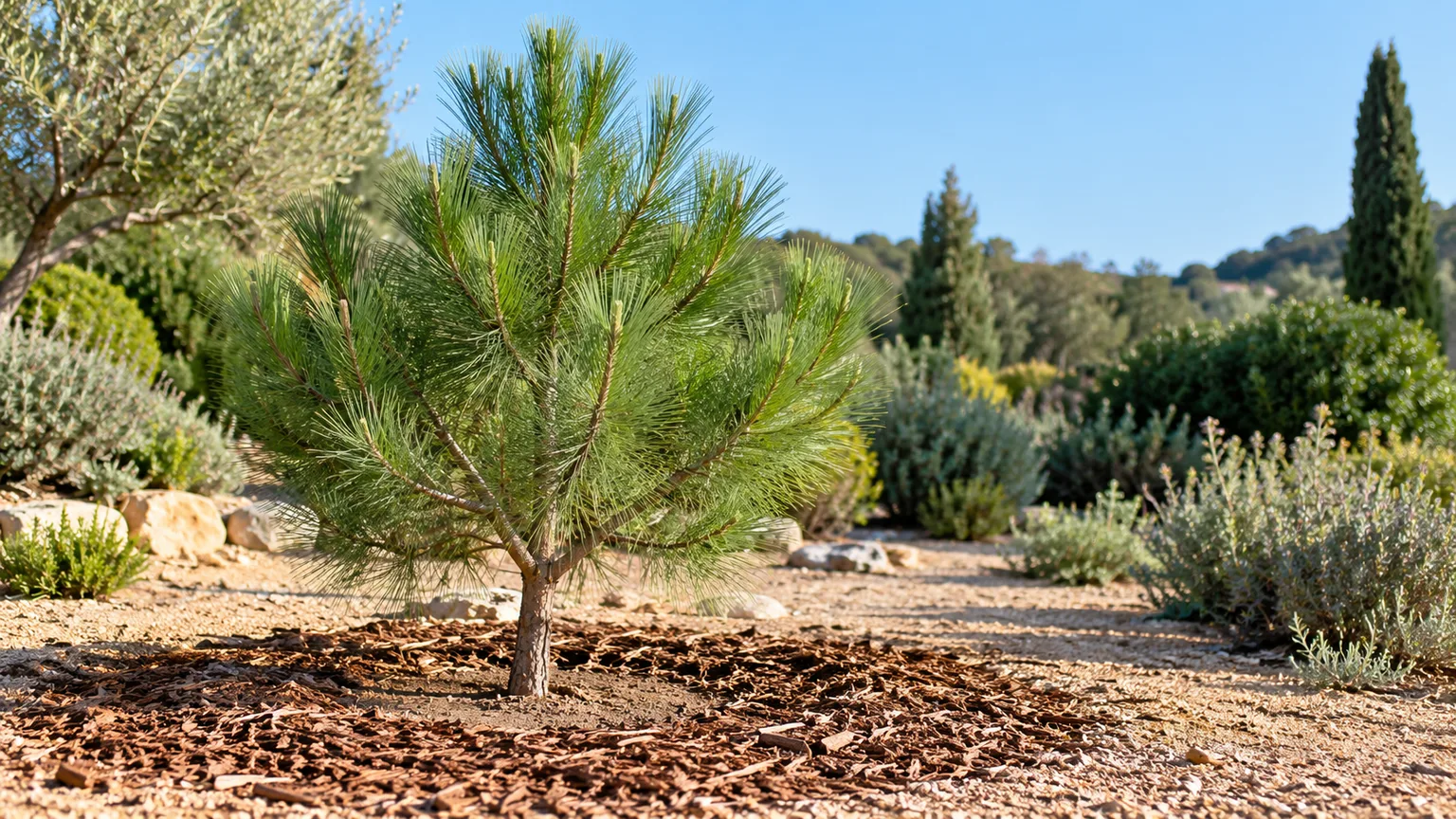
Set the root ball on firm, undisturbed soil rather than digging a deep hole and backfilling beneath it. The root flare—the widening point where the trunk transitions to the first main roots—should sit at or slightly above finished grade. A flare buried under nursery mix or soil is easy to miss, so gently remove loose material from the top of the root ball until you can see where the trunk begins to widen.
Dig a wide, shallow saucer-shaped hole, generally two to three times the root ball’s width, with sloped or roughened sides that roots can cross. Colorado State University Extension stresses that planting too deeply can contribute to later decline and that the root ball should sit on undisturbed soil; its exact above-grade measurements are calibrated to local conditions, so use your local extension’s planting standard if it differs. Backfill with the native soil, water to settle it, and keep the root flare visible.
Finish with a broad mulch ring over the root zone, but leave an open gap around the trunk. Mulch moderates soil temperature and slows moisture loss; piled against the trunk, it can keep the bark damp and hide the flare. Stake only if the root ball shifts or the site is unusually exposed, and remove temporary support once the tree is stable.
Give It Sun, Drainage, and Deep Water
Give stone pine an open position with at least six hours of direct sun. It tolerates sandy or loamy soils and may cope with a wider pH range than some gardeners assume, but it does not handle persistently wet, poorly drained soil. NC State Extension notes both its drought tolerance once established and its intolerance of poor drainage; Fine Gardening’s Pinus profile similarly identifies full sun and well-drained soil as general pine requirements.
If the planting area stays wet long after a storm, observe it before you plant rather than trying to fix the entire site with gravel at the bottom of the hole. A gravel layer can create a perched wet zone instead of improving drainage. Choose a naturally better-drained spot, plant on a broad raised area if local conditions support that approach, or select a species adapted to wet soil.
Water Differently While It Establishes
A newly planted stone pine needs closer attention than a mature tree. In its first growing season, check the root ball and nearby soil regularly; when the upper few inches begin to dry, water slowly and deeply so moisture reaches the full root zone. The interval changes with rainfall, temperature, soil texture, and root-ball size, so a fixed weekly schedule can either leave the tree thirsty or keep it too wet.
During the next one or two growing seasons, keep checking rather than stopping as soon as new needles appear. Water deeply during extended dry weather if the root zone is drying, then let excess moisture drain before watering again. Gardener’s Path’s general pine-growing guidance also emphasizes deep irrigation for younger trees rather than frequent, shallow sprinkling; that is a useful principle, but species and site conditions determine the actual interval.
Once the tree is established, it can withstand dry spells better than a newly planted tree. Supplemental watering during prolonged drought may still help, especially in shallow, sandy soil or in a confined urban site where roots cannot explore widely. Do not interpret drought tolerance as a reason to leave a recently planted tree dry, and do not water just because the surface looks dusty if the root zone below is still damp.
Feed and Mulch Lightly
Stone pine does not need a routine fertilizer calendar. If it is growing normally in suitable soil, extra feeding is unlikely to improve its eventual form and can push soft growth or create a nutrient imbalance. When a tree is pale, stunted, or losing needles, check drainage, root-ball moisture, planting depth, and pest signs before reaching for fertilizer.
A soil test is more useful than applying an “acid-loving plant” product based on a generic pine rule. Extension recommendations and plant profiles describe species preferences differently, and a fertilizer cannot correct standing water, root damage, shade, or climate stress. Add only the nutrient a test identifies, at the rate recommended for the product and your region.
Maintain a wide mulch ring, replenishing it as it decomposes and keeping it several inches clear of the trunk. Pine needles that fall naturally can stay under the tree as light mulch if they do not smother turf or desired groundcover. Keep heavy organic material away from the stem and do not build a volcano of mulch that hides the root flare.
Growing Stone Pine in a Container or Indoors
A small stone pine can be sold as a seasonal indoor tree, but that does not make it a long-term houseplant. NC State Extension notes that young trees may be used indoors for a season but will eventually grow out of that role. Stone pine needs outdoor sun, air movement, and room for roots and canopy that a living room cannot provide.
If you bring a young tree indoors briefly for a holiday, keep it away from hot vents and fireplaces, give it the brightest cool location available, and keep the root ball lightly moist without letting it stand in water. Return it outdoors as soon as conditions allow, transitioning it gradually to prevent sudden sun exposure. Use ordinary watering rather than ice cubes; cold pockets of meltwater do not substitute for evenly moist soil and good drainage.
Container culture can buy time in a climate where a small tree needs temporary protection, but it is not a way to keep P. pinea permanently miniature. If you do grow it in a pot, choose a deep, stable container with unobstructed drainage and expect to move up in size as roots fill the soil. A large container also exposes roots to greater cold and heat swings than the ground does, so container winter care is less forgiving than the zone rating for an in-ground tree.
Prune Only for a Clear Reason
Pruning is usually minimal. The tree gradually lifts its crown as lower branches lose light, while the upper branches spread outward to create the umbrella form. RHS guidance says no pruning is required; removing healthy lower branches to reveal the trunk is a design choice, not a care necessity.
Do not top the leader or shear the canopy to force an umbrella shape. Topping does not control the mature size and can leave poor structure, while heavy cuts into old, needle-free wood may not produce the compact regrowth a gardener expects. If the tree is too large for its site, consult a qualified arborist about options; no pruning technique can make a mature stone pine fit indefinitely into a space that is too small.
Remove a dead, broken, or clearly diseased branch with a clean cut back to the branch collar, without flush cutting into the trunk. For large limbs, high branches, or suspected structural defects, hire an insured arborist rather than climbing into the canopy. Gardener’s Path’s guide to growing pines discusses pine pruning as selective work, not routine shearing; that distinction matters on a tree whose natural architecture is its main landscape feature.
Grow Stone Pine from Seed
Seed is the most straightforward way to raise a stone pine if you can obtain fresh, correctly identified seed and have patience. Cones are large and slow to mature, and a seed-grown tree will not necessarily have the same early shape or vigor as a selected nursery specimen. If you want a reliable landscape tree quickly, buying a healthy young plant is the better route.
Sow fresh seed in a deep pot of free-draining seed mix, cover it lightly, and keep the medium evenly moist rather than saturated. RHS describes spring propagation from seed after cones ripen over three years and notes that three weeks of chilling may aid germination. General advice for pines can call for longer chilling, so do not assume every seed lot needs the same refrigerator schedule; follow the seed supplier’s species-specific directions when available.
After germination, grow seedlings in bright light and protect them from drying out while their root systems are small. Pot them on before roots circle tightly, and harden them off gradually before planting outside. Stone pine is a long-lived landscape tree, so a seedling is a long-term project rather than a fast way to create shade or harvest pine nuts.
When Can a Stone Pine Produce Pine Nuts?
Stone pine seeds are the edible kernels sold as pine nuts, also called pignoli. The cones themselves take about three years to mature, according to NC State Extension and the RHS profile, but that is the cone-development period—not a promise that a newly planted seedling will produce a crop in three years. A young tree needs to mature before it can bear cones, and that can take many years.
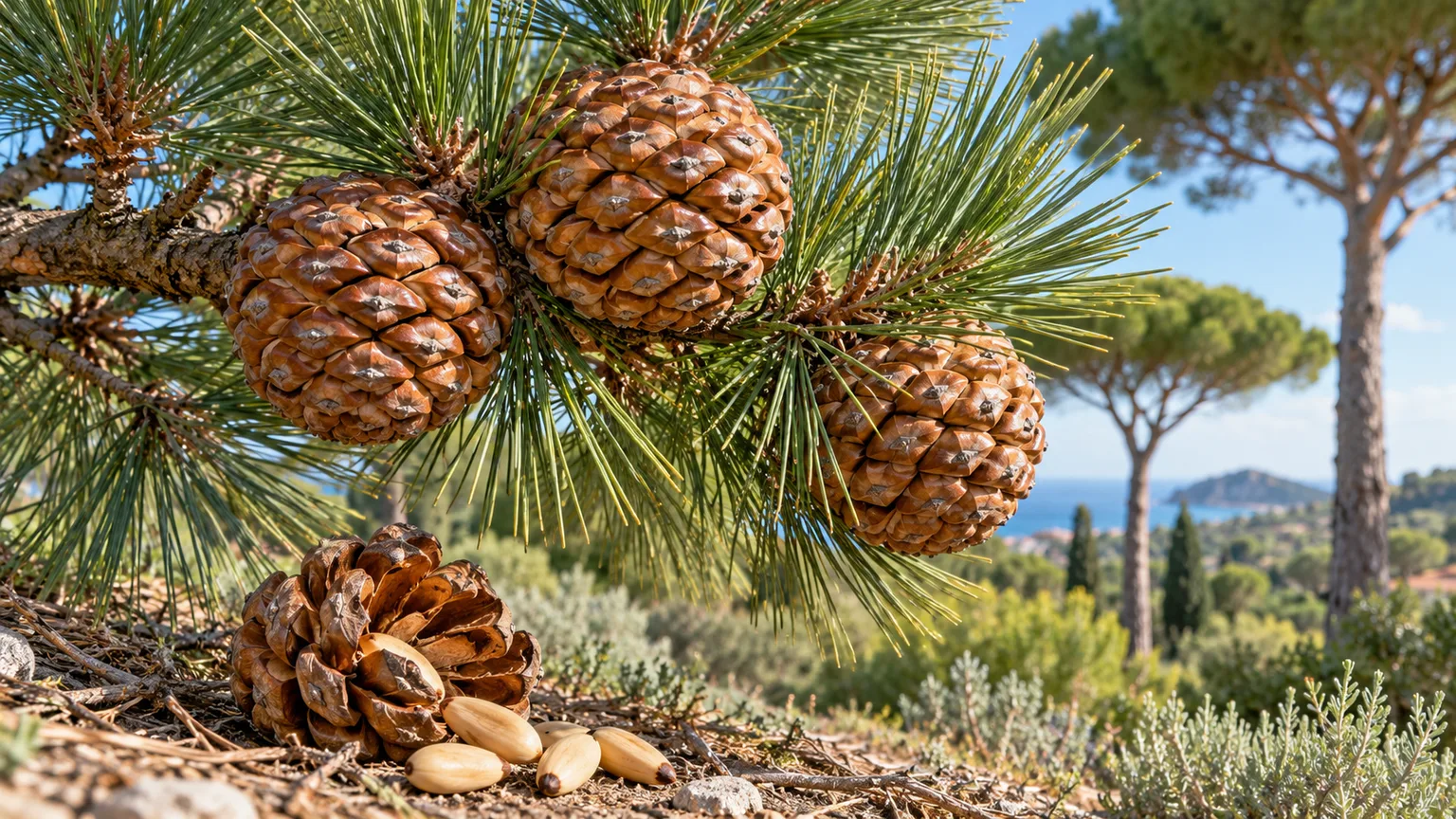
Virginia Tech Dendrology describes stone pine as a tree with both male and female cones and large edible seeds; NC State Extension also notes that the seeds are eaten raw or roasted. Even when a tree produces cones, expect an occasional home-garden harvest rather than a quick or dependable food crop. Do not climb onto the tree or cut healthy branches to reach cones; collect only cones that can be reached safely after they have matured and opened.
Diagnose Common Stone Pine Problems
A healthy stone pine can still develop problems when the planting site is too wet, too cold, too windy, or too cramped. NC State lists wind damage, borers, pine needle scale, sawflies, and fungal diseases among possible issues, while the RHS profile notes susceptibility to needle-cast diseases and several conifer pests. The presence of a pest in a reference list does not mean every tree needs preventive spraying.
Start with the pattern and timing of damage. Browning limited to a small amount of older inner foliage has a different urgency from rapid browning on new outer needles, whole branches dying at once, or a crown turning red-brown across the tree. Record which branches are affected, when symptoms started, recent watering and weather, and any visible insects, holes, resin, or sawdust before you decide what action to take.
Browning Needles: Normal Shed or Stress?
Conifers shed older needles as part of normal growth, so a few yellowing or brown inner needles do not automatically signal disease. Look at where the color change starts: if it is mostly older needles close to the trunk while branch tips remain green and new growth looks normal, monitor the pattern and clean up fallen needles if needed. If browning appears on current-season growth, spreads outward, or affects whole branches, investigate rather than assuming it is seasonal shedding.
Check soil moisture several inches below the surface. A dry root ball after planting points toward insufficient establishment water; soil that stays soggy points toward poor drainage or overwatering. Then inspect the tree for scale-like insects, sawfly feeding, small holes, resin, or sawdust, and compare damaged and healthy branches. Needle cast and blights can look similar to stress at a glance, so use a local extension diagnostic service or arborist when symptoms progress or the diagnosis is unclear.
Avoid treating brown needles with neem, copper, or another fungicide before identifying the cause. Products labeled for one disease may not help another, and pesticide labels and permitted uses vary by location. Correct site or watering problems first when those are evident; for suspected disease or a valuable mature tree, get a diagnosis before applying a treatment.
Wind, Ice, Pests, and Diseases
Stone pine can be vulnerable to wind damage, especially in an exposed site where the broad crown catches gusts. Choose a protected but sunny location if your property regularly experiences strong winds, and avoid planting near a high-use path where broken limbs could cause injury or damage. Ice can also load long branches; do not shake or climb a tree to remove ice, and have a professional assess major breaks or a suddenly leaning tree.
Keep an eye out for pests such as pine needle scale, sawfly larvae, moths, and borers. A few insects do not necessarily justify treatment, but a branch that is declining with holes in the bark, resin, or fine boring dust deserves closer inspection. Bark beetles and other wood-boring insects can be difficult to manage once they are established, so diagnosis and removal decisions should come from a local extension specialist or arborist rather than a broad home spray.
Disease risk rises in situations that keep foliage or roots persistently wet. Improve air movement by giving the tree its full spacing, water at the root zone rather than over the crown when practical, and avoid planting where runoff pools. If multiple branches develop progressive needle loss or the tree declines despite correcting moisture, document the damage and seek a diagnosis; there is no single fungicide that cures every pine needle disease.
Conclusion
Stone pine is a striking evergreen when its Mediterranean needs and eventual size fit the site. Give Pinus pinea full sun, fast-draining soil, generous crown clearance, and deep establishment watering; after it is rooted in, care is mostly restrained. The most important choice is made before planting: if your winters, summer humidity, drainage, wind exposure, or available space are a poor match, choose another pine instead.