25 Low-Maintenance Evergreen Shrubs for Any Garden
Choose from 25 low-maintenance evergreen shrubs by sun, shade, soil, size, privacy needs, pruning habit, and pet-safety concerns.
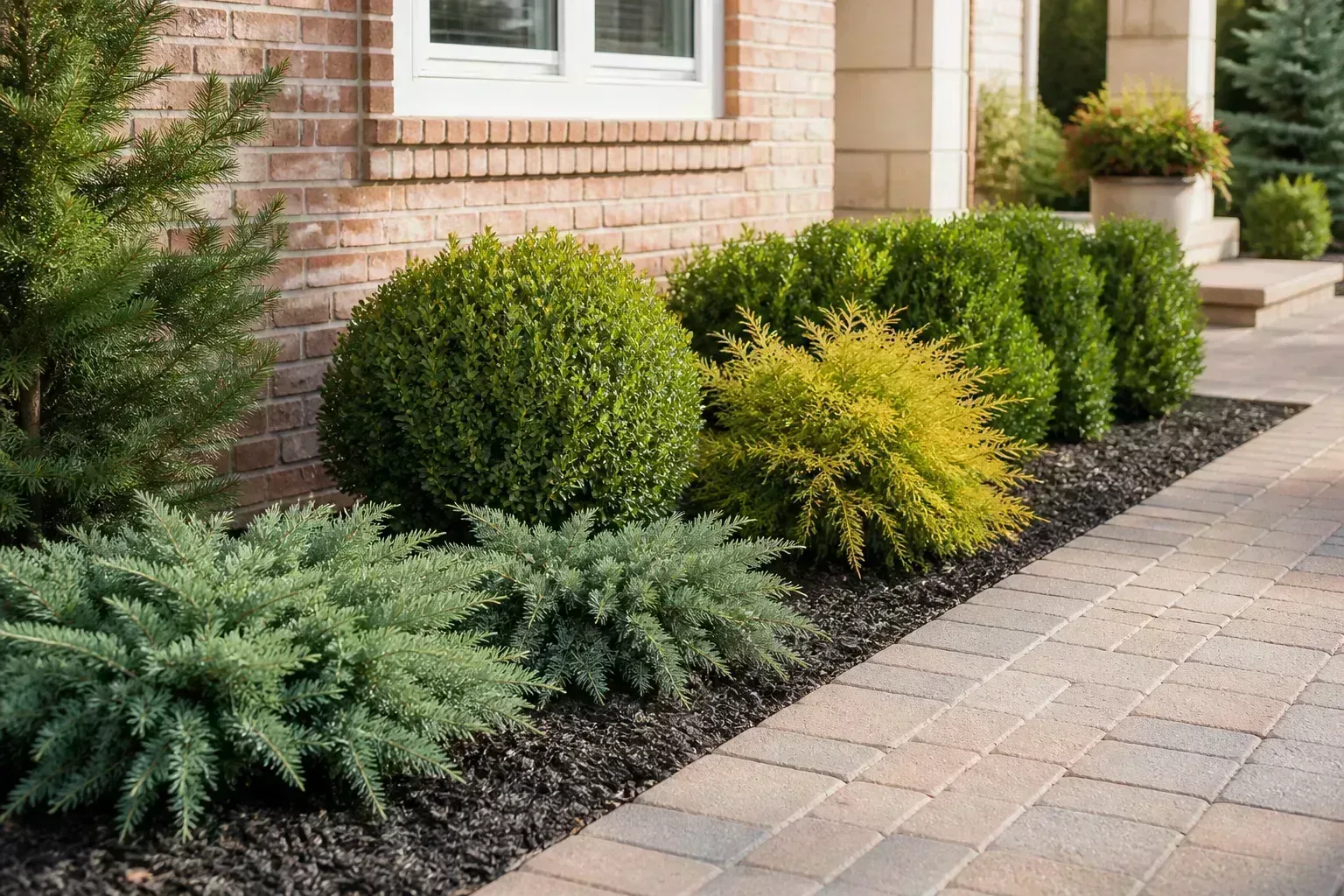
The easiest evergreen shrub is not the one with the boldest “tough plant” label. It is the one whose mature size, light, soil, moisture, and climate already match the place where you plan to grow it.
Evergreen shrubs provide year-round structure, privacy, wind protection, winter shelter, and a steady green backdrop for flowers. They can also become some of the hardest-working plants in a yard when they are planted too close to a foundation, sheared into a shape they cannot hold, or kept wet when they need drainage. This list gives you 25 useful choices, but the selection rules at the top are what keep the work low.
What “low maintenance” should mean in a shrub
A low-maintenance shrub still needs watering during establishment, occasional inspection, and some response to weather or pests. “Low maintenance” means those jobs stay predictable and modest after the plant is established; it does not mean the shrub can be planted anywhere and ignored.
The strongest candidates usually have a naturally good shape, slow or moderate growth, few recurring pest problems in the right climate, and foliage that does not demand constant deadheading. A shrub that grows quickly enough to fill a privacy gap may be useful, but it will not be the lowest-work option if you must shear it several times each year.
Evergreens are also not interchangeable. Needled plants such as junipers, yews, and arborvitae tend to give reliable structure but have different responses to shade, wet soil, deer, and hard pruning. Broadleaf evergreens such as mahonia, camellia, pieris, and holly can offer flowers or berries, but many are particular about drainage or soil pH. The University of Wisconsin’s landscape overview makes the same practical distinction: junipers prefer sun, yews tolerate shade but dislike wet ground, and arborvitae are valuable screens but can be heavily browsed by deer. (Wisconsin Horticulture’s evergreen-shrub guidance is a useful regional example.)
Match the shrub to the site before you buy
Plant selection is the maintenance plan. A shrub that fits the site can spend its energy making roots and foliage; a shrub that does not fit spends yours compensating for stress. Penn State Extension’s plant-selection guidance puts the issue plainly: plants in suitable locations usually need less attention, while a poor site can leave them stressed and more vulnerable to pests and disease. (Its choosing-plants guidance is especially useful when comparing attractive shrubs with very different cultural needs.)
The six checks that prevent future work
Before choosing a variety, answer six questions:
- How much direct light reaches the planting bed? Full sun, bright shade, and deep shade are not interchangeable. A juniper that becomes dense in sun may become open and weak in shade, while mahonia or aucuba can be much happier with protection from harsh afternoon light.
- What happens to water after rain? Dig a trial hole and watch whether it drains or stays saturated. “Likes moisture” does not mean “likes standing water,” and many shrubs fail from poor drainage rather than lack of fertilizer.
- Is the soil acidic, neutral, or alkaline? Camellia, gardenia, azalea, rhododendron, pieris, leucothoe, and mountain laurel are acid-loving choices. Do not try to force one into alkaline soil year after year without a soil test and a realistic amendment plan.
- What is the plant’s mature width, not its nursery-pot width? A two-foot shrub in a container may become a ten-foot shrub. Measure the bed and leave room for air circulation, mowing, paths, windows, and rooflines.
- What kind of maintenance do you actually want? A natural shrub border and a clipped hedge are different projects. If you dislike pruning, choose a cultivar that reaches the desired size without shearing.
- Are children, dogs, cats, or grazing animals likely to chew it? Foliage and berries are not automatically safe because a plant is common in landscaping. Check the exact botanical name before planting.
Natural form versus formal hedge
Natural-form shrubs usually create the lowest long-term workload. They can be thinned selectively when a branch is dead, crossing, or blocking a path, but they do not need their whole surface clipped to stay presentable. A formal hedge is a design choice that carries a recurring maintenance cost, even when the shrub itself is easy to grow.
If you want a clipped hedge, plant for the finished width and keep the base slightly wider than the top. That taper allows light to reach lower branches and helps prevent a hedge that is green only on its outer shell. The RHS notes that established evergreen shrubs often need little or no regular pruning, while hedges, topiary, and foliage plants are the exceptions because their shape is being imposed by the gardener. (RHS pruning guidance for evergreen shrubs explains the distinction.)
Quick picks by garden job
| If you need… | Start with… | The catch to plan for |
|---|---|---|
| A low formal border | Boxwood or Japanese holly | Slow growth still needs occasional shaping; both need good drainage |
| Sunny, dry-site coverage | Juniper | Shade can make it thin, and some forms spread farther than expected |
| A tall privacy screen | Arborvitae or yew | Measure mature width; deer favor arborvitae and yew can become huge |
| A shade shrub with flowers | Mahonia, daphne, pieris, or mountain laurel | Most prefer dependable moisture and drainage rather than soggy soil |
| A native-friendly wet-site option | Inkberry holly | Berry production needs compatible male and female plants |
| Fragrance in a small garden | Daphne or gardenia | Daphne dislikes disturbance; gardenia needs warmth and acidic soil |
| A warm-climate flowering evergreen | Camellia, bottlebrush, or Indian hawthorn | Hardiness and summer water decide whether it is truly easy |
| A colorful foundation planting | Aucuba, Chinese fringe flower, or a compact cultivar | Confirm mature size and local winter performance |
25 low-maintenance shrubs, grouped by growing conditions
The profiles below are intentionally practical rather than absolute. Cultivars can differ dramatically in height, hardiness, disease resistance, and pruning needs, so use the botanical name and cultivar on the nursery label as the final check.
Sun, dry soil, and structured shapes
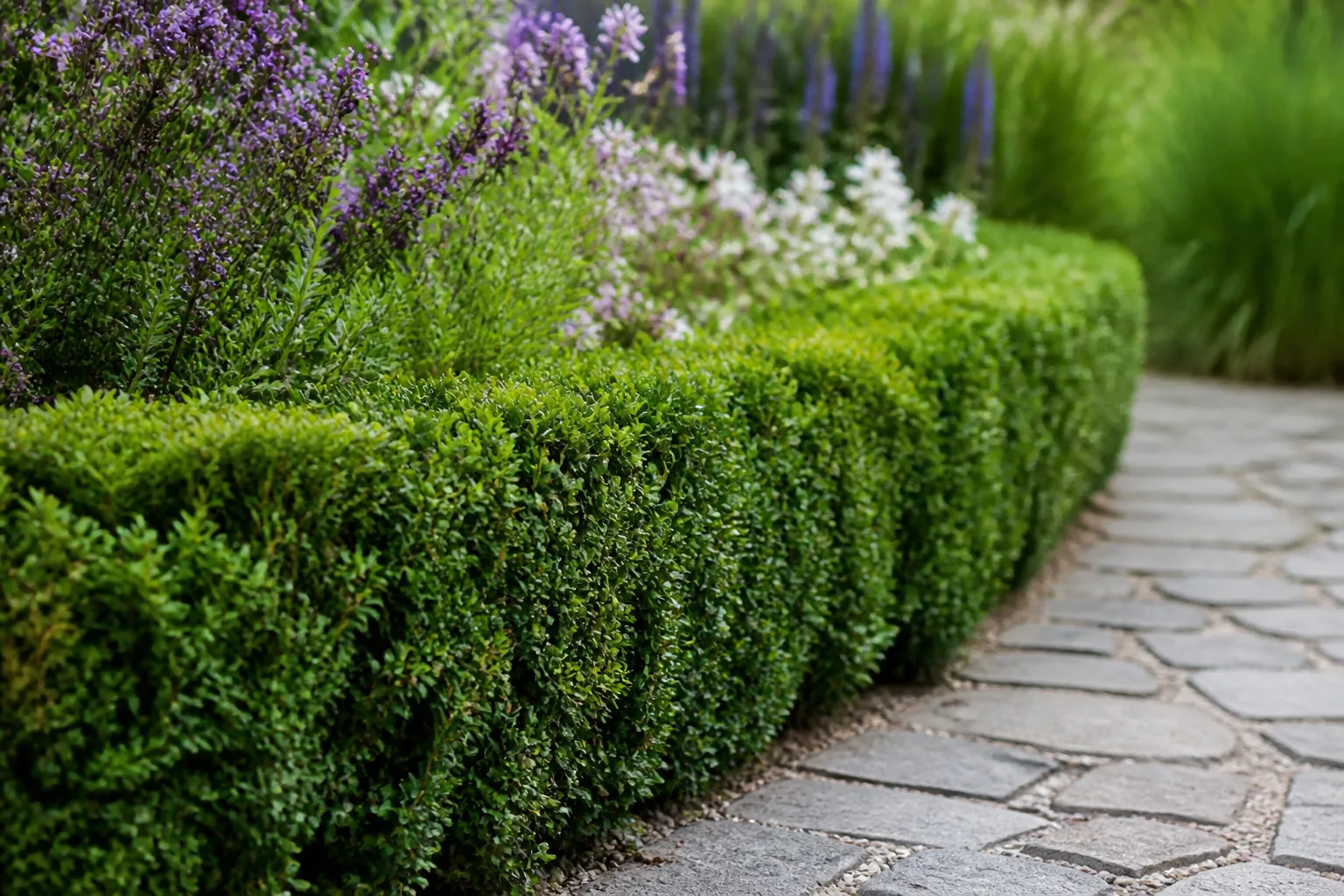
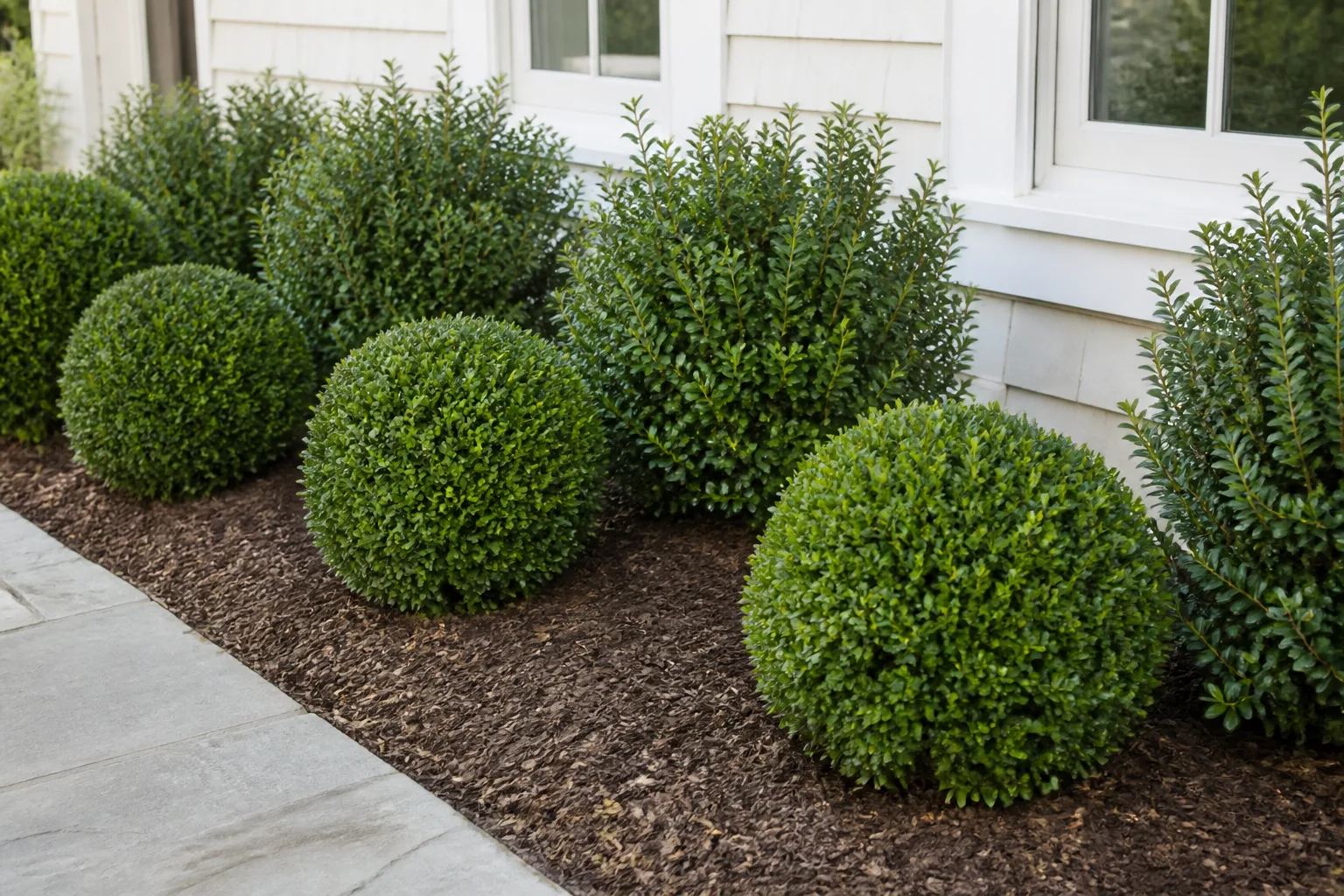
1. Boxwood (Buxus spp.) — Boxwood is a classic for edging, low hedges, containers, and geometric forms because its small leaves and dense branching tolerate careful shaping. Choose a cultivar for the space rather than assuming every boxwood stays compact. Give it well-drained soil, protect it from drying winter wind where needed, and avoid turning a naturally rounded plant into a high-frequency shearing project. It is best for gardeners who want structure and accept light, deliberate pruning.
2. Juniper (Juniperus spp.) — Junipers cover an unusually wide range of habits: creeping mats, low mounds, spreading shrubs, and narrow upright forms. They are among the best options for a sunny, dry, well-drained slope or difficult bank, and their prickly foliage is often less appealing to deer. Select the form carefully; a groundcover juniper and a tall screening juniper are not interchangeable. Do not plant juniper in deep shade or in a permanently wet bed.
3. Yew (Taxus spp.) — Yews are adaptable, shade-tolerant evergreens with soft, dark-green needles and excellent tolerance of pruning. They work as hedges, foundation shrubs, and large anchors, but “easy” does not mean “small.” Many become substantial plants, and they dislike waterlogged soil and exposed winter wind. Yew is also poisonous to dogs, cats, and horses according to the ASPCA, so avoid it where animals can chew foliage or fallen plant material. (ASPCA’s Japanese yew profile lists the toxic principles and clinical signs.)
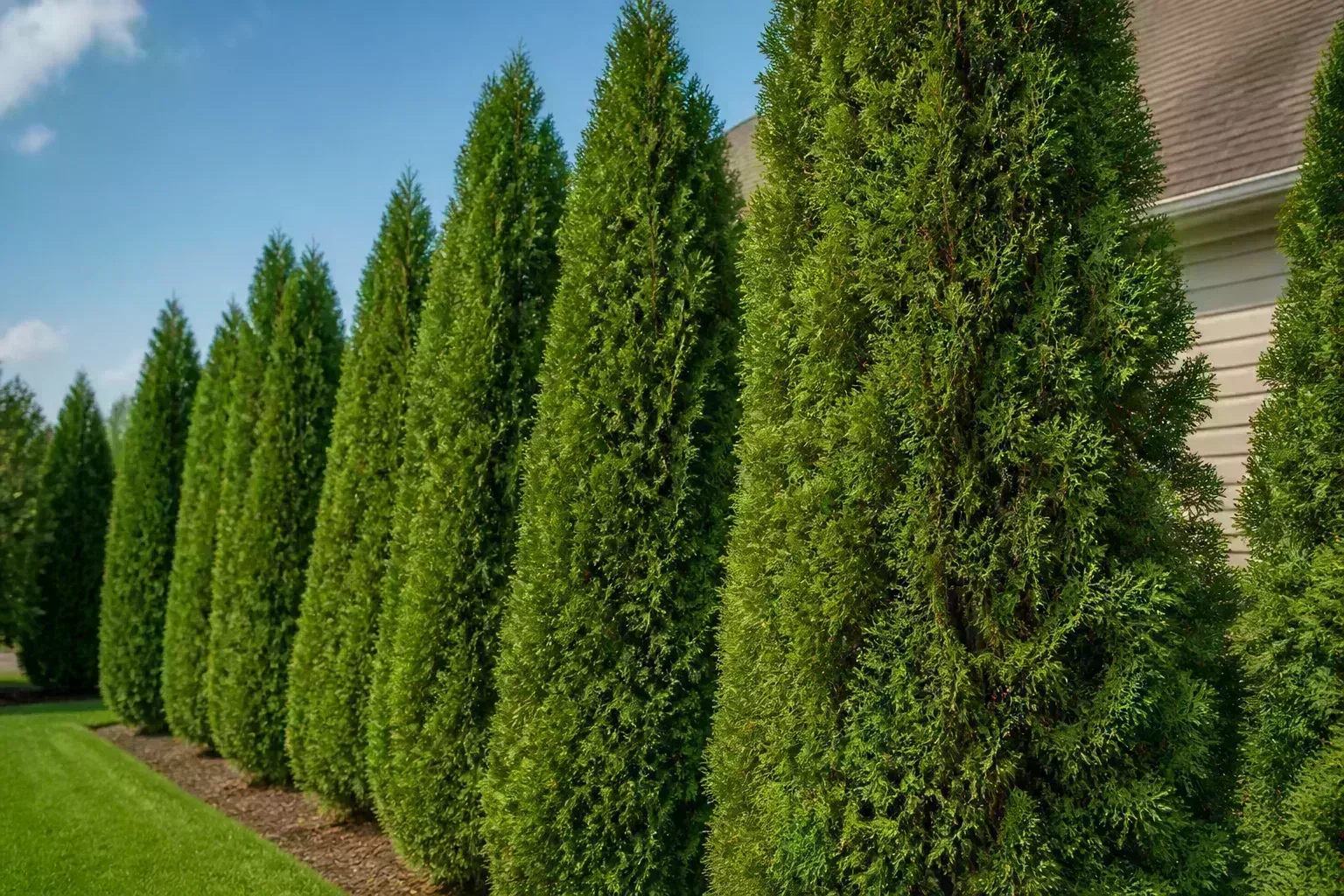
4. Arborvitae (Thuja spp.) — Arborvitae supplies dense vertical screening without needing to be carved into a narrow column. The most common mistake is choosing a fast-growing or full-sized type for a bed that can only hold a dwarf cultivar. Leave enough room for the mature width, water deeply during the first growing season, and inspect for deer browsing before assuming the plant has a disease. For a low-work screen, the correct cultivar and spacing matter more than speed.
5. Mirror bush (Coprosma repens) — Mirror bush is a warm-climate evergreen with glossy leaves that may be edged in lime, yellow, or pink depending on the cultivar. It is particularly useful in coastal gardens and mild climates where salt exposure makes some shrubs struggle. Give it sun to partial shade and drainage, and expect occasional shaping if you want a compact outline. In colder regions it may be damaged or lost over winter, so it is not a universal low-maintenance choice.
6. Bottlebrush (Callistemon spp.) — Bottlebrush brings red, pink, or yellow brush-like flowers to sunny, warm gardens and can support nectar-seeking wildlife. Once established, many types handle heat and sandy soil well, but they still need deep watering through prolonged drought and space for their mature size. Prune lightly after flowering if a tidy form is important; avoid repeatedly cutting into old, leafless wood. Choose a species or cultivar proven for your winter temperatures.
7. Hebe (Hebe spp., often sold within Veronica) — Hebes offer compact mounds, small leaves, and spikes of flowers, making them useful in borders and containers in mild climates. Their maintenance is mostly light shaping and removal of damaged growth. Cold, wet winters, exposed wind, and poor drainage can shorten their life, so they are easiest in a sheltered site with sharp drainage. Read the label carefully because the genus includes both compact edging plants and much larger shrubs.
Shade, moisture, and acidic soil
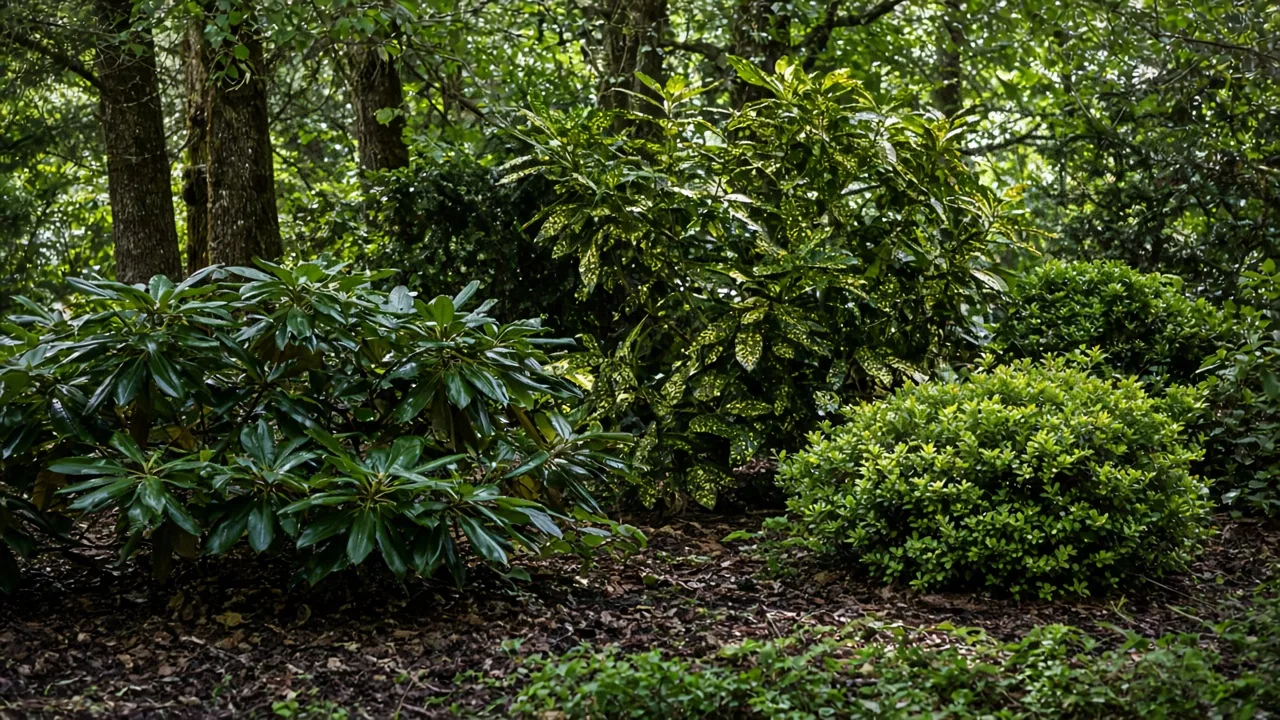
8. Mahonia (Mahonia spp.) — Mahonia is one of the strongest choices for a shaded bed that needs winter foliage, architectural leaves, yellow flowers, and sometimes blue-black berries. It tolerates shade and generally needs little pruning once established. Keep larger types away from drying wind, and remember that the leaf edges can be spiny. The RHS describes mahonias as tough, versatile evergreens for shade, with winter-to-early-spring flowers when many gardens are quiet. (RHS’s mahonia guide covers moisture, shade, wind exposure, and rejuvenation.)
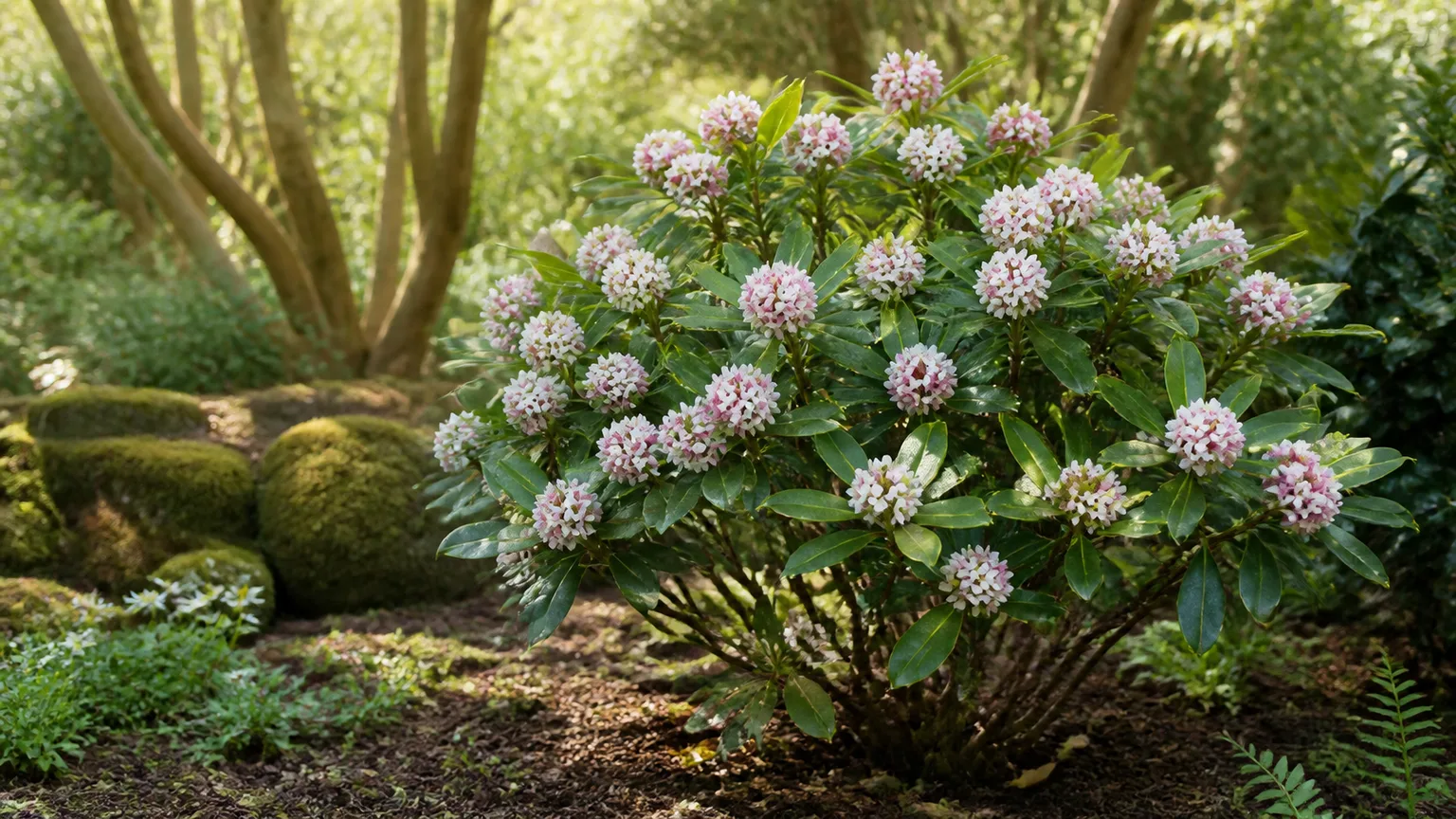
9. Daphne (Daphne spp. and hybrids) — Daphne earns its place for fragrance rather than speed or toughness. Many types are compact, evergreen or semi-evergreen, and bloom in late winter or spring, but they resent soggy soil, severe drought, root disturbance, and hard pruning. Plant one in a sheltered, well-drained spot near a path where the scent can be enjoyed, then leave it mostly alone. (The RHS daphne guide specifically warns against pruning because dieback can follow.)
10. Gardenia (Gardenia jasminoides) — Gardenia is low maintenance only where the climate and soil cooperate. In warm areas it rewards partial shade, acidic well-drained soil, glossy foliage, and regular moisture with intensely fragrant white flowers. It is not a good “set it and forget it” choice for cold winters, alkaline soil, or a bed that dries completely. Feed according to a soil test or a product labeled for acid-loving plants, and prune only to remove damage or lightly shape after flowering.
11. Mountain laurel (Kalmia latifolia) — Mountain laurel is a beautiful woodland shrub for acidic, well-drained soil and dappled or partial shade. Its evergreen leaves and geometric flower clusters provide more than one season of interest, while its slow growth helps keep pruning modest. Do not plant it in compacted clay or a constantly wet depression. Give it room to develop its natural multi-stemmed form instead of trying to maintain a tight geometric outline.
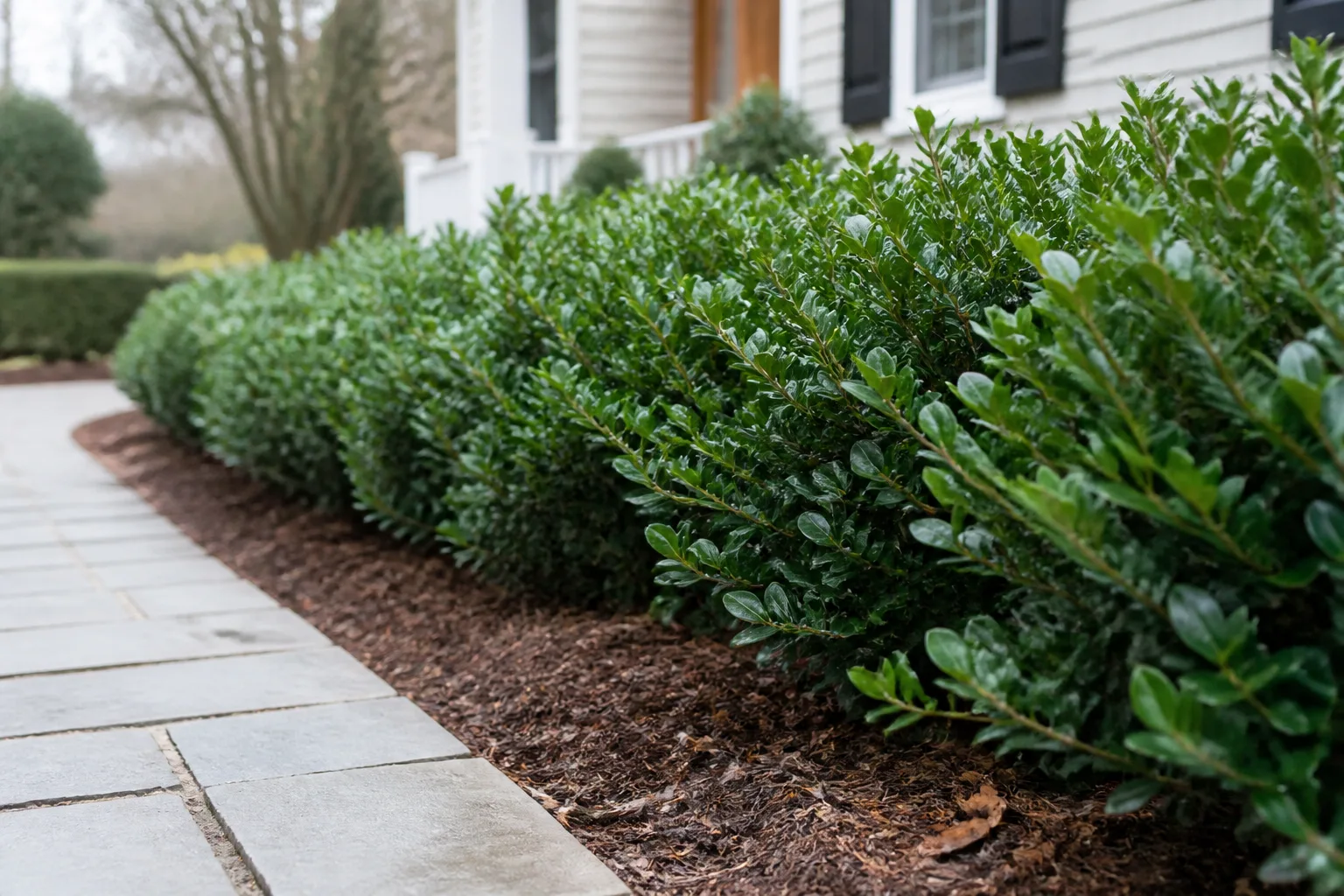
12. Japanese holly (Ilex crenata) — Japanese holly resembles boxwood but offers a useful alternative for many formal borders and topiary shapes. It prefers acidic, well-drained soil, tolerates full sun to partial shade, and can be pruned when necessary. NC State Extension notes that it tolerates drought, shade, pollution, and clay in many settings but can struggle in high heat and humidity; a protected site is especially helpful in cold-wind areas. (NC State’s Japanese holly profile also explains its separate male and female plants and black fruit.)
13. Inkberry holly (Ilex glabra) — Inkberry is a North American native broadleaf evergreen that is useful for hedges, rain gardens, windbreaks, and naturalistic foundation beds. It handles full sun to partial shade and can tolerate moist soil better than many broadleaf evergreens, although drainage still matters. Its natural shape often needs little pruning, while hedge forms need more. Male and female plants are needed for reliable berries, and NC State flags the species as a low-severity poison plant, so use care around children and animals that chew shrubs. A practical cultivar-level overview from Savvy Gardening’s low-maintenance shrub guide likewise points out that compact inkberry forms can reduce pruning while preserving hedge utility.
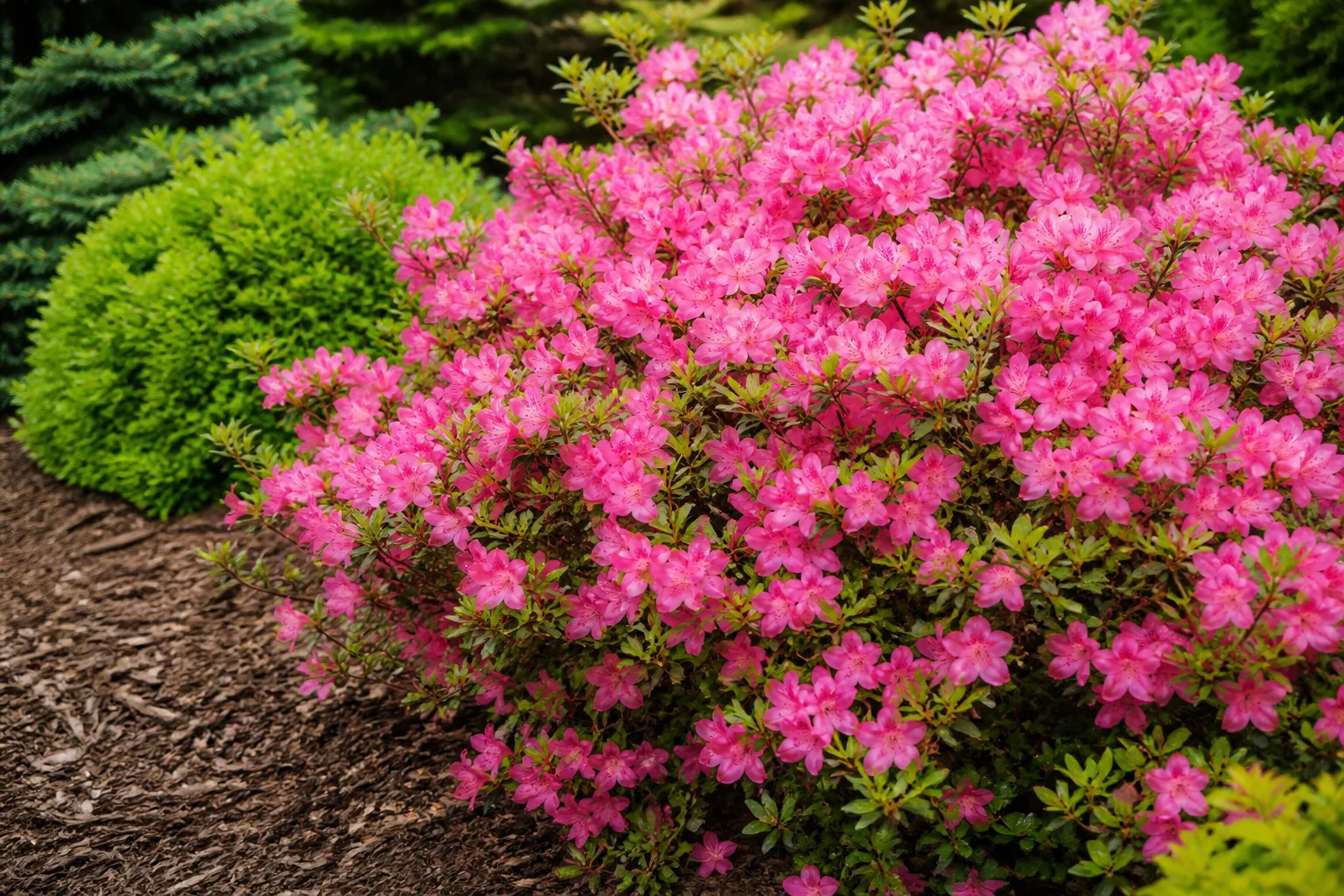
14. Evergreen azalea (Rhododendron spp.) — Evergreen azaleas are compact, colorful, and often easier to maintain than their mature size suggests when they are planted in acidic soil with morning sun or filtered light. They need consistent moisture while establishing and can suffer when shallow roots dry out. Choose a cultivar for mature dimensions and bloom timing, then prune immediately after flowering if shaping is necessary. Azaleas are also toxic if eaten; do not let children or pets chew leaves, flowers, or pruned material.
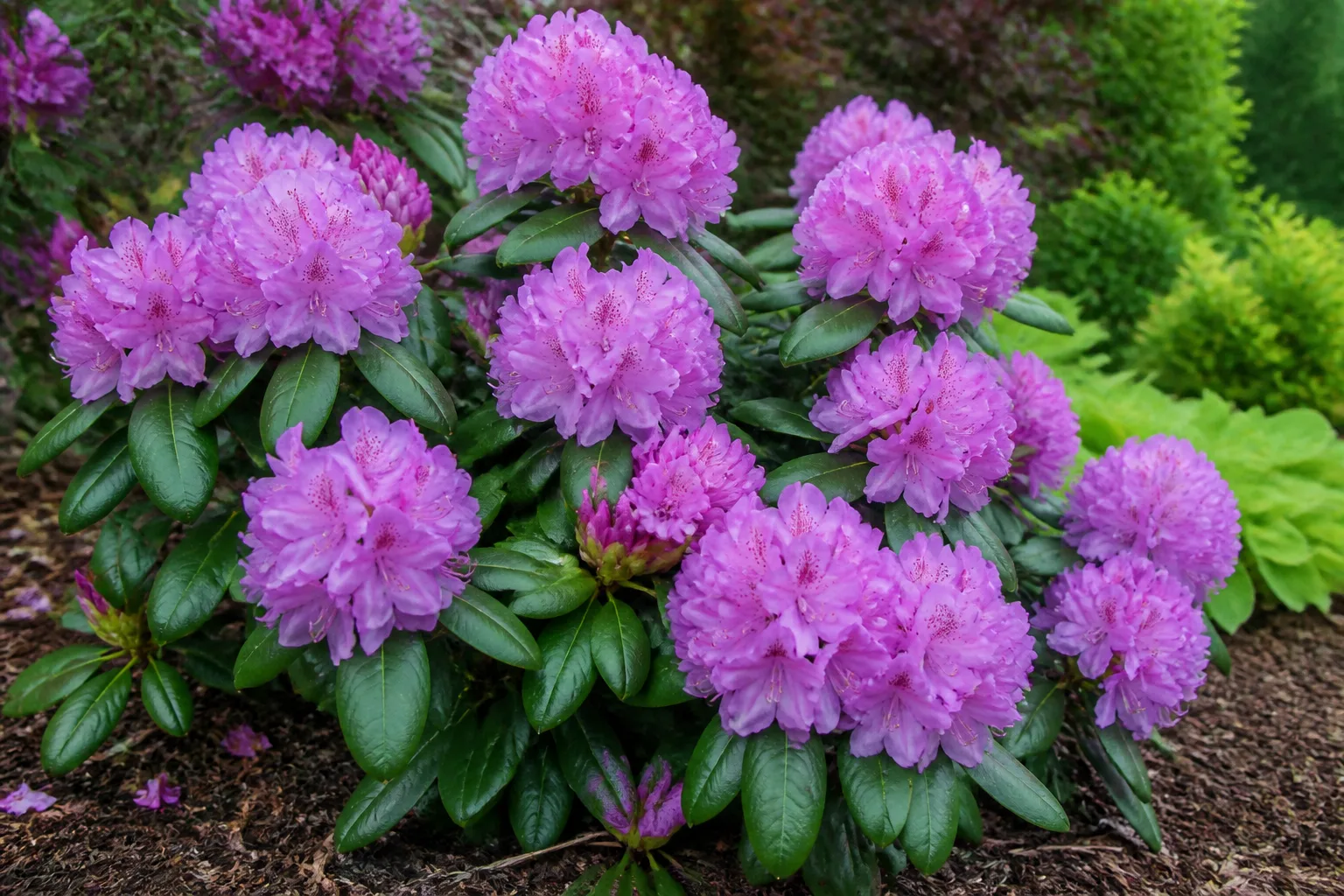
15. Rhododendron (Rhododendron spp.) — Rhododendrons make excellent low-work specimen shrubs when the site provides acidic, well-drained soil, partial shade, and protection from harsh afternoon sun. Their mature size ranges from compact cultivars to large foundation-dominating plants, so the label matters. Most established plants need little routine pruning beyond dead, damaged, or badly placed branches. Poison Control explains that azaleas are a subgenus of Rhododendron and that ingestion can cause problems, so keep them away from browsing children and pets. (Poison Control’s azalea and rhododendron overview gives practical exposure guidance.)
16. Japanese pieris (Pieris japonica) — Japanese pieris is a graceful shade-to-partial-shade shrub with evergreen foliage, colorful new growth, and pendant flower clusters in spring. It is a good fit for a woodland or cottage-style border where the soil is moist, acidic, and well drained. Avoid a hot, dry foundation bed and do not bury the shallow root zone under deep mulch. Because it flowers on older growth, heavy or poorly timed pruning can remove the next display; light correction after flowering is usually enough.
17. Coast leucothoe (Leucothoe axillaris) — Coast leucothoe is a compact, arching broadleaf evergreen for shade and acidic soil. Its foliage can shift from green to bronze or purple in cooler seasons, and small flowers add spring interest without requiring a formal pruning routine. It is most useful in a moist woodland bed, under taller shrubs, or along a sheltered foundation. Give it enough room to drape naturally and avoid a hot, exposed location where the leaves can scorch.
18. Aucuba (Aucuba japonica) — Aucuba, sometimes called gold-dust plant, is a dependable option for low-light spaces where many flowering shrubs become thin. Glossy green or spotted leaves hold their color through winter, and female plants can produce red berries when a male pollinator is nearby. It tolerates shade and urban conditions, but harsh afternoon sun can scorch the foliage. Use it as a naturally rounded shrub rather than a plant to shear tightly, and confirm its winter hardiness for your site.
Warm-climate broadleaf evergreens
19. Camellia (Camellia spp.) — Camellias combine glossy foliage with flowers in white, pink, or red, and different groups bloom from autumn through spring. They are easiest in partial shade, acidic soil, and a planting bed that stays evenly moist without becoming waterlogged. Protect them from strong winter wind and avoid unnecessary pruning; if shaping is needed, do it after flowering. The RHS recommends keeping camellias well watered in summer because that is when next year’s flower buds develop. (Its camellia growing guide covers flowering groups, soil, watering, pruning, and containers.)
20. Cleyera (Cleyera japonica) — Cleyera is a glossy, upright evergreen that can form a clean informal hedge or privacy screen in mild climates. It prefers moisture-retentive but well-drained soil, and its natural silhouette means you can often use selective cuts instead of shearing. Give it room to expand and protect young plants from severe cold. Because the common name may be used loosely in garden centers, verify the botanical name and cultivar before assuming the mature height is modest.
21. Indian hawthorn (Rhaphiolepis indica) — Indian hawthorn is a useful small evergreen for warm climates, with rounded foliage and clusters of white or pink flowers. It tolerates a range of soils as long as drainage is good and becomes more drought-tolerant after establishment. Use it for borders, low hedges, or a specimen near a patio, but do not expect the same performance in cold or humid regions where leaf diseases may be more common. Water consistently during its first season and prune lightly after flowering if needed.
22. Chinese fringe flower (Loropetalum chinense) — Chinese fringe flower supplies evergreen or near-evergreen foliage in green, burgundy, or purple tones, plus spring flowers with a soft fringe-like shape. It is most dependable in warm climates with acidic, well-drained soil and regular moisture during dry weather. Many cultivars become larger than their tags suggest, so choose a compact form for a foundation bed. Its natural shape is attractive; use selective cuts rather than repeatedly shearing the entire plant.
23. Distylium (Distylium spp.) — Distylium is a useful low-maintenance evergreen for warm regions, especially when you want a dense mound for borders, mass plantings, or foundation beds. It tolerates heat, occasional wet soil, and a range of light conditions better than many broadleaf evergreens, while its small late-winter flowers are a bonus rather than the main event. Let it fill out naturally, check the mature spread, and prune only when a path or structure requires clearance.
Seasonal shrubs that need a taxonomy correction
Two popular entries often appear in evergreen lists even though they are deciduous. They are still low-maintenance shrubs worth considering, but they will not provide winter foliage.
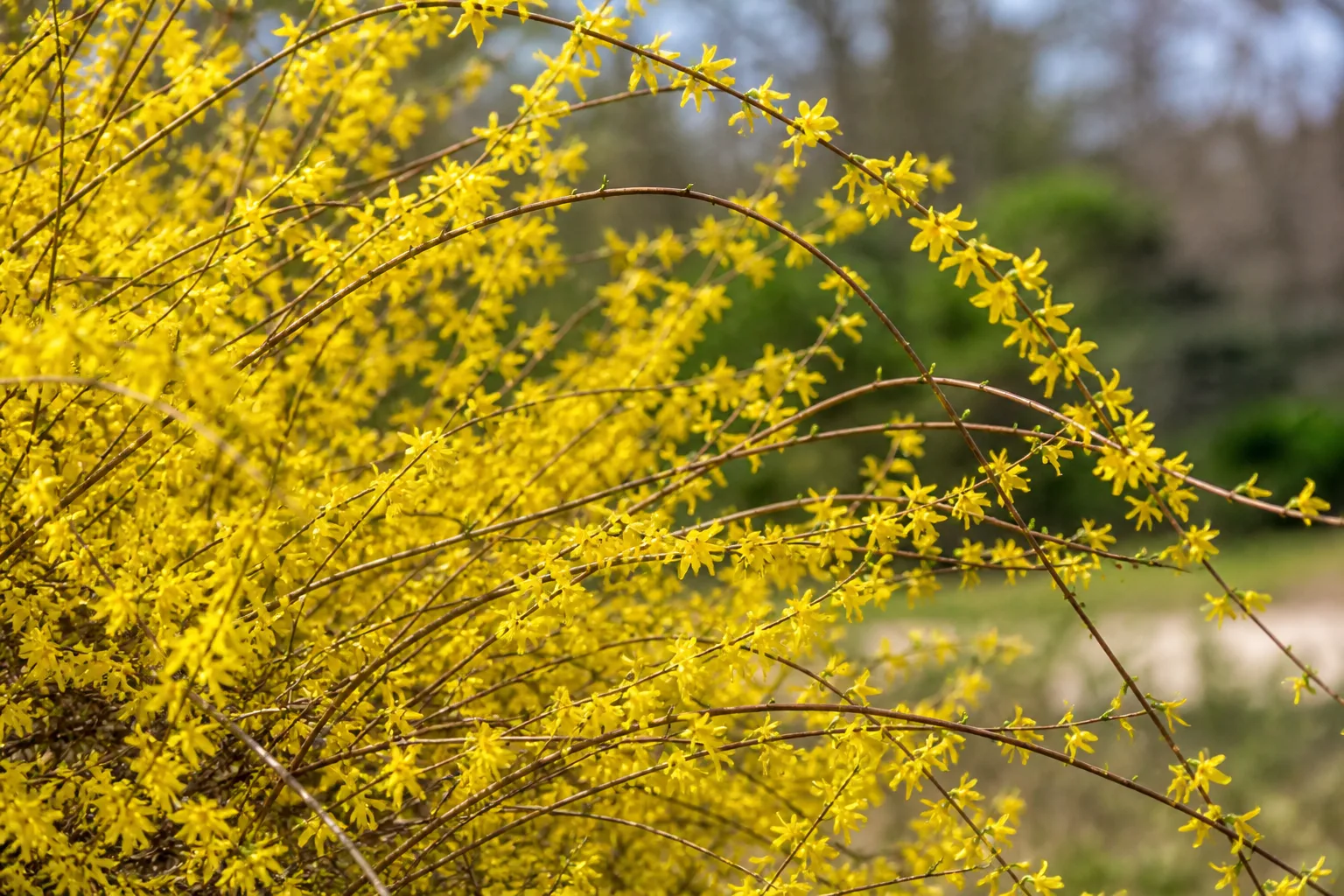
24. Forsythia (Forsythia spp.) — Forsythia is a vigorous, easy-care deciduous shrub valued for bright yellow flowers on bare branches in early spring. It can form a loose hedge or mass planting with little intervention, but it needs room and looks better when allowed to arch naturally. Prune soon after flowering, removing some of the oldest stems at the base rather than clipping the entire outside. That timing protects next year’s flower buds.
25. Fothergilla (Fothergilla spp.) — Fothergilla is also deciduous, but it earns a place in a low-maintenance shrub plan through fragrant bottlebrush flowers, blue-green summer foliage, and reliable red, orange, and yellow fall color. It prefers moist, acidic, well-drained soil and usually needs little pruning because its natural form is attractive. Choose it when seasonal interest matters more than winter screening; do not buy it expecting evergreen foliage.
Planting plan for the first year
The first year is when a supposedly easy shrub needs the most attention. A nursery plant has a limited root system, so even a drought-tolerant species needs help while it expands into the surrounding soil. Watering deeply and consistently is more useful than frequent shallow sprinkles, which encourage roots to remain close to the surface.
Water deeply while roots establish
After planting, soak the root zone slowly so the entire original root ball is moist. Check the soil several inches down before watering again; the interval depends on soil type, temperature, wind, rainfall, and plant size. Sandy soil may need more frequent attention, while heavy clay may stay wet longer than expected.
Evergreen shrubs can lose water from foliage during winter as well as summer. In cold or windy climates, water thoroughly before the ground freezes if the soil is dry, and protect exposed shrubs with site-appropriate wind protection rather than wrapping them tightly in plastic. A plant that enters winter dehydrated is more vulnerable to winter burn.
Mulch without burying the crown
Spread a two- to three-inch layer of organic mulch over the root zone, keeping it a few inches away from stems and trunks. Mulch reduces evaporation, buffers soil temperature, and limits competition from grass. It should look like a shallow blanket, not a volcano pressed against the plant.
Do not use mulch to hide a drainage problem. If water remains around the root ball after ordinary rain, improve the site or move the shrub before the roots decline. Adding fertilizer to a stressed, waterlogged plant rarely solves the underlying issue.
Pruning and maintenance rules that keep work low
Start with a simple annual inspection. Remove dead, broken, diseased, and rubbing branches, then step back before making optional shaping cuts. If a shrub needs large reductions every season to fit its location, replace it with a cultivar that belongs there rather than treating repeated hard pruning as normal care.
Prune for health before you prune for shape
Flowering evergreens such as camellia, daphne, azalea, pieris, rhododendron, and mahonia often set buds before they bloom. If you prune at the wrong time, the plant may stay healthy but flower poorly. In most cases, wait until after flowering for light shaping, and remove only what the plant needs.
Needled evergreens deserve extra caution. Juniper and arborvitae may not push new growth from old, leafless wood, so cutting deeply into a bare interior can leave permanent holes. Yew is more forgiving and can tolerate stronger renovation, but its mature size and toxicity still make thoughtful placement essential.
Watch for winter burn, deer, and drainage problems
Brown foliage on the exposed side of an evergreen after a cold, dry, windy winter may be winter injury rather than a disease. Wait until live growth is clear before cutting extensively. Remove dead portions back to healthy tissue, correct moisture and wind stress, and avoid fertilizing a damaged plant into tender new growth.
Deer pressure changes the shortlist. Junipers and boxwoods are often less appealing to deer than arborvitae, yew, or some hollies, but no plant is universally deer-proof. Use physical protection when browsing is severe, and choose a plant whose natural habit reduces the need for repeated replacement.
Safety and regional cautions
Treat every shrub as a botanical identification problem before assuming it is safe. Yew is a serious pet hazard, and Poison Control lists azalea and rhododendron among plants that can cause poisoning if eaten. Hollies can also have toxic characteristics, and berries are especially tempting to children and animals. Keep labels, learn the botanical name, and contact a poison center or veterinarian promptly after a suspected ingestion.
Climate claims also need context. A shrub that is low maintenance in a humid coastal garden may fail in a dry inland yard; a plant that thrives in a mild winter may not survive an exposed cold site. Hardiness zones are a starting point, not a guarantee: soil drainage, wind, reflected heat, snow cover, summer humidity, and cultivar genetics can matter just as much.
Finally, check regional invasive-plant lists before buying a fast-growing screen or groundcover. A plant that spreads beyond its bed can create more work for you and ecological problems for nearby habitats. Choose a locally adapted cultivar or native alternative when it meets the same landscape job.
Conclusion: choose the shrub that fits the job
For the lowest-maintenance result, begin with the site instead of the plant name. Pick juniper for a sunny, dry slope; mahonia or aucuba for shade; inkberry for a moist, naturalistic screen; boxwood or Japanese holly for a tidy low border; arborvitae for properly spaced privacy; and daphne or camellia when fragrance and flowers justify more specific soil and climate requirements.
Plant for mature size, water carefully through the first year, mulch correctly, and prune with the shrub’s growth habit in mind. The best evergreen is not the one that survives neglect for a season—it is the one that stays healthy and attractive without asking you to correct the same mistake every year.