How to Avoid Utility Lines When Digging in Your Yard
Avoid utility lines when digging in your yard: learn when to call 811, how to find private irrigation or lighting lines, and how to work safely around marks.

Call 811 before you put a shovel in the ground, then wait until every affected utility has responded and its marks make sense. That first call is essential, but it is not the whole safety plan: the public locate may not include irrigation, landscape lighting, or other owner-installed lines, and paint or flags show an approximate route rather than a guaranteed depth. A safer yard project accounts for both kinds of systems before excavation starts.
If the proposed hole, trench, post, or bed crosses a marked route, move the project when practical. If the marks are unclear, a utility has not responded, or you suspect a private line, pause and get the gap resolved; do not test the soil with a probe or start digging “just a little” to see what is there.
Start With One Rule: No Digging Until Every Response Is Clear
Treat a locate request as a required first phase, not a courtesy call you can make while the project is underway. Submit it through 811 or your state’s one-call center, give locators the exact work area, and wait for each affected operator to mark its facilities or report a valid no-conflict response. If a response is missing, ambiguous, or asks for more information, the site is not ready for excavation.
“Clear” does not mean that no buried infrastructure exists. It means the operator’s response says it has no facility in the requested area, or explains why it will not mark; it does not clear private systems, a different project footprint, or something outside the ticket. Keep the ticket number, response record, and any written instructions with the project notes so everyone who will dig can check the same scope.
Why Even a Small Garden Hole Needs a Locate Request
A tree, shrub, mailbox, fence post, or short irrigation trench can cross a service line even when the project looks minor. The 811 Before You Dig program says to contact 811 even for a small flower bed or shrub, and a Nature Hills Nursery guide to safe digging lists trees, shrubs, fences, and water features among common projects that deserve a locate. There is no dependable “safe depth” you can use to skip the check: utility lines can be shallow, and owners may not know when the yard was altered.
A strike can interrupt internet, water, electricity, or gas to the property or neighbors. A damaged electrical line can shock or burn someone; damage to a gas pipe can create a fire or explosion hazard. Even a nick or scrape that does not cause an obvious outage can need a utility’s inspection, so avoiding visible damage is not the same as confirming a line is safe.
Use 811 for any planned ground disturbance—planting a tree, setting a post, installing a pond, digging a French drain, or trenching for lighting or irrigation. The exact legal trigger, notice period, ticket life, and required digging method vary by state and local rules. The 811 Before You Dig state directory routes you to the local center, where you can confirm the current process instead of relying on a neighbor’s old ticket or a rule from another state.
What 811 Locates—and What It Does Not
The one-call center routes your request to participating utility operators whose underground facilities may be affected. The operators or their contracted locators then mark the approximate horizontal route of the public systems they own or maintain in the area—often electric, gas, communications, water, sewer, or other regulated services. The mix of participating operators and the boundary of their responsibility depend on the location and the facility.
A locate request is not a full survey of every buried object on a residential lot. Utility-owned service may end at a meter, building, or another ownership point; a line continuing from the house to a detached garage may be private. The University of Minnesota’s Upper Midwest Agricultural Safety and Health Center explains that private facilities such as outbuilding power, pool systems, septic components, and other owner-installed infrastructure are not marked by public utility locators. A local utility’s service-boundary rules may differ, so confirm rather than assuming a particular connection is included.
Private lines to identify separately
Before you submit the ticket, make an inventory of systems that a homeowner or contractor may have added: lawn sprinklers, drip irrigation, low-voltage path lights, an invisible pet fence, wiring to a shed or gate, a pool pump, a private well, septic piping, and cables or pipes installed by a prior owner. Look for invoices, permits, as-built drawings, irrigation plans, labels in a controller cabinet, and records from the installer. A meter, cleanout, sprinkler head, or light gives you a clue about a system, not a reliable route or depth.
Do not trace a suspected line by pushing a rod into the ground, following a straight line between two visible points, or relying on old paint. Routes may bend around foundations and roots, be rerouted during repairs, or have been installed without a plan. If a private system is in the proposed footprint and its route is unknown, contact the installer or system owner, hire a qualified private utility locator, or move the project to a known-clear area. A public 811 ticket cannot make an unknown private line safe.

How to Request a Locate for a Yard Project
Start a few business days before you want to excavate; the exact lead time is local, and a complicated request or weather delay can take longer. Call 811 or use the state center’s online request portal. A call center does not necessarily locate every line itself: it coordinates the notice so the affected operators can respond. Follow the local instructions for marking, timing, and how to check the ticket’s status.
Have the job details ready: the property address, county and nearest cross street, a working contact number, the type of project, the planned start date, and a precise description of where soil will be disturbed. If the work is a fence, mark every post run and gate opening; for a new bed, outline its full dimensions; for a drain, describe the complete route and endpoints. A broad phrase such as “landscaping in backyard” can be too vague for a locator to identify the actual conflict area.
Premark the exact work area
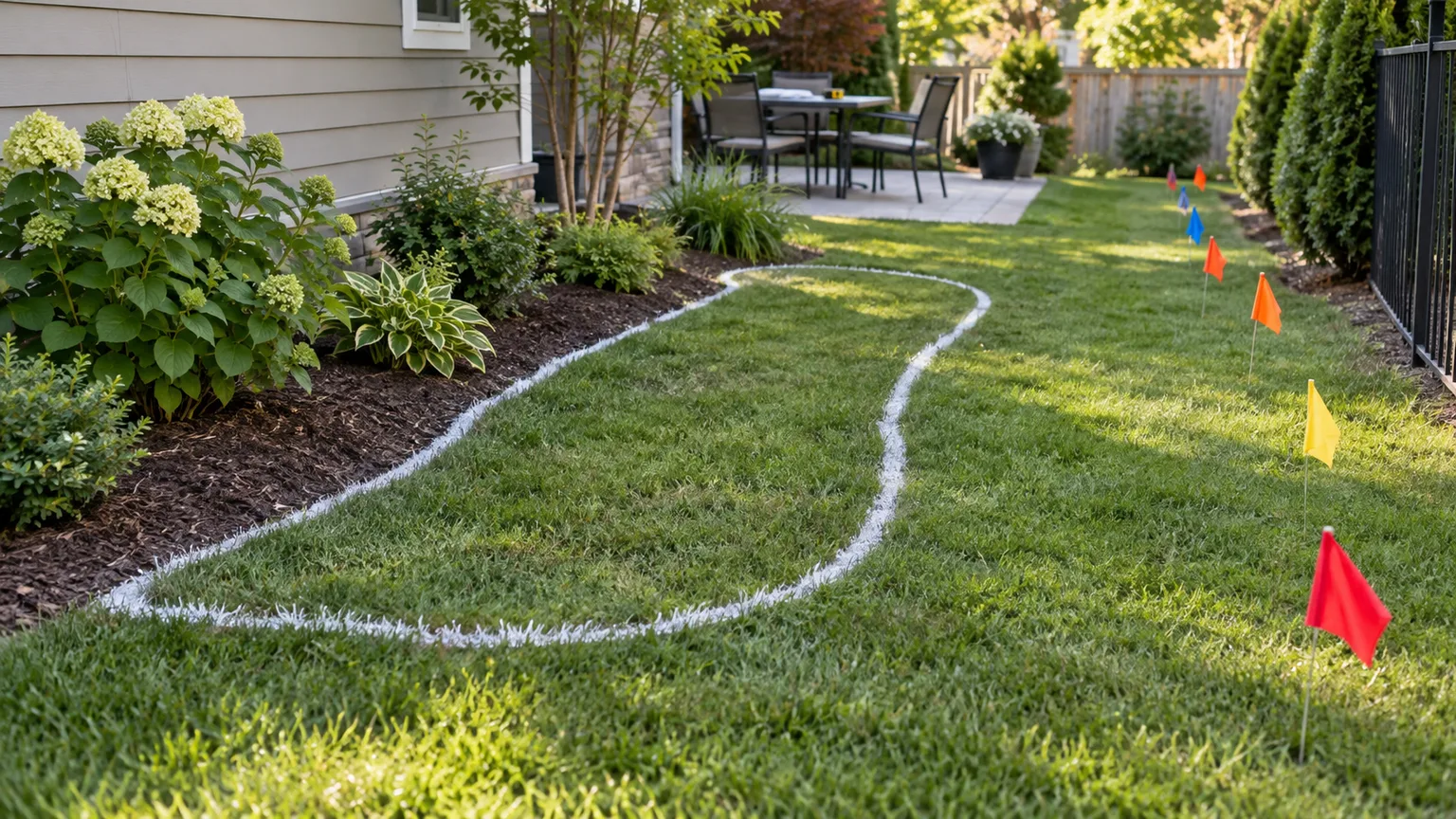
If the state center asks for a premark, use the local method—often white flags or white, water-based paint—to show the limits of the proposed excavation. Premarking does not identify a utility. It tells locators where you intend to work, which helps them mark the relevant part of the property and avoid confusing the project with future work elsewhere in the yard. The 811 Before You Dig homeowner guidance recommends outlining a small dig area and giving the center clear information about that footprint.
Draw or photograph the planned area before the locators arrive, and note changes while the ticket is being processed. Do not premark an entire property if the project is only one corner; a tight, accurate outline is more useful. Keep pets secured and provide access to the yard, gate, meter, or other area the center’s instructions identify as necessary.
Track the ticket and every utility response
Save the ticket number and use the local positive-response system, email, or call center instructions to verify the status of each notified operator. Depending on the state, an operator may mark a line, report no conflict, or state that it needs access or more information. Do not infer that an unmarked utility has no line; verify that the operator responded and understand what its status means.
The ticket is tied to a specific address, work area, activity, and time window. If your plan expands from a single tree to a long fence, moves to another side of the property, or runs past the ticket’s validity period, ask the one-call center whether you need a new request or updated marks. Treat faded, disturbed, or removed paint and flags as a reason to pause and contact the center. National Fuel’s homeowner guidance is one example of a utility explaining its own notice period and contractor requirements; those details are not a nationwide rule.
Read Paint and Flag Marks Without Treating Them as a Map
Paint, stakes, and flags communicate that an underground facility is believed to follow a route in the area. They do not show its exact depth, condition, ownership boundary, or precise edges, and a line can be only inches below the surface. A flag planted at one point does not guarantee the same depth or position several feet away. Keep marks visible throughout the project and compare them with the locate responses before laying out the final bed, trench, or post line.
What common utility colors mean
In the common U.S. public-works convention, colors are used to identify the type of facility. A utility may use paint, flags, or both, and local center instructions take priority if a marking is confusing. Okaloosa Gas District’s marking guide shows this widely used color key:
| Mark color | Common facility type |
|---|---|
| White | Proposed excavation area |
| Pink | Temporary survey markings |
| Red | Electric power lines, cables, or conduit |
| Yellow | Natural gas, oil, steam, or other fuel lines |
| Orange | Communications, telephone, cable, or alarm lines |
| Blue | Potable water |
| Purple | Reclaimed water, irrigation, or nonpotable water |
| Green | Sewer or drain lines |
Use the color as a clue, not permission to dig beside it. Paint can fade, flags can be moved by mowing or weather, and multiple utilities can share a corridor. If a mark’s color or route appears to conflict with the response, or a mark lies outside the white premark, stop and ask the one-call center or utility to explain it before work begins. Never remove a flag because it is inconvenient; it may be serving another project or identifying a line someone else will need to protect.
Draw a Safe Plan Around the Marks
Lay the proposed planting or construction line on a simple sketch, then compare it with every utility response and visible mark. If a marked route crosses the project, first consider shifting the tree, shortening the bed, moving a post, or routing a shallow landscape feature around the utility. A small design change is usually easier than working in a constrained strip, repairing a line, or returning after a paused excavation.
Do not choose an offset from a memorized national number. The tolerance zone is the locally defined area around a marked facility where extra precautions apply; its width, measurement method, and permitted tools can vary by state and facility. Check the ticket, state 811 website, and operator instructions for the rule that applies to your site. A Washington Utilities and Transportation Commission call-before-you-dig guide and the University of Minnesota safety guidance show why one state’s tolerance-zone figure should not be repeated as a rule for every yard.
Treat the tolerance zone as a local rule
A marked line’s tolerance zone is not a “safe lane” where ordinary digging can continue as usual. Depending on local law, you may need to hand dig, use an approved soft-dig method, expose the line carefully, or have the utility present. Keep powered augers, trencher teeth, tractor buckets, and other forceful equipment outside the restricted area unless the utility and local rules specifically permit the method you plan to use.
If you are permitted to hand excavate near a mark, work slowly from the side and remove soil in small amounts with a tool appropriate for the material. Do not thrust a sharp tool downward toward an unexposed line, pry against a pipe or cable, or use water or vacuum equipment unless the operator and local rules allow it. Stop once the line is exposed or if its direction, depth, material, or condition is not what you expected; ask the utility or a qualified excavator for the next safe step.
A locate mark also does not grant permission to build over a utility easement or restrict the operator’s access to a meter or facility. Before planting a large tree, installing a permanent wall, or adding a structure near a marked route or service equipment, ask the facility owner about required clearance, access, root concerns, or permit limits. For a small ornamental plant, relocation may be simpler than trying to fit roots and future maintenance around an important line.
A Careful Order for Digging After Clearance
Once every response is complete, the marks are current, and public and private systems have been considered, check that the actual job still matches the ticket. Set tools down outside the markings, keep children and pets away from the work zone, and make sure the flags or paint are visible in good light. If heavy rain, mowing, landscaping, or another contractor has disturbed the site since it was marked, pause for refreshed instructions rather than guessing where a line continues.
Dig only in the cleared footprint, use the method required by local rules near each mark, and examine exposed soil as you go. If you find an unexpected conduit, pipe, cable, tracer wire, warning tape, or buried structure, stop instead of assuming it is abandoned or harmless. Do not cut, pull, bend, puncture, or cover it; contact the utility or a private locator to identify it before continuing.
Soil condition is a separate reason to postpone a nonurgent garden job. Royal Horticultural Society soil-cultivation guidance advises against cultivating waterlogged or frozen soil; waiting also avoids forcing tools through hard ground near a marked route. Weather does not change what 811 has located, but rain, frost, or site work can make marks harder to see or alter the surface you planned against.
Yard Projects That Need Extra Planning
A planting hole can be narrow while its mature plant becomes a long-term access problem. Before placing a tree or large shrub, use the locate map to move the planting site away from marked utilities, meters, cleanouts, and access paths; then ask the utility about easement or maintenance restrictions. A root ball is only the beginning of the tree’s footprint, so do not treat a mark just outside today’s hole as a guarantee that the mature tree will be a good neighbor to the line.
Fence and mailbox jobs deserve a route-level check because repeated posts can intersect several services even if the first hole is clear. Mark the whole fence line, including gates and corner posts, before submitting the request. If you shift the route after locators have visited, check with the center about the revised footprint instead of assuming the original ticket covers it.
Irrigation and low-voltage lighting are a special case: a locate request may identify existing public utilities, but the new work itself often creates private lines that will not be part of future public tickets. Photograph and measure the installed route before backfilling, make a simple durable map with distances from fixed features, and keep it with the house records. The same recordkeeping applies to outbuilding power, pool equipment, invisible fences, wells, and septic components; a later owner should not have to guess where the lines run.
For patios, decks, ponds, drainage trenches, retaining walls, and other broad projects, widen the request to include footings, drains, electrical conduit, lighting, and temporary access routes that will disturb soil. Check permits and utility easements before choosing a final layout. If a professional will do the excavation, confirm in writing who will submit the locate request and verify the ticket is active for the exact scope; the person operating the digging equipment should not begin on the assumption that someone else called.
If You Suspect You Hit or Exposed a Line
Stop work immediately and move away from the line without touching it. Keep other people and pets out of the area, do not cover or repair the damage, and notify the utility owner and the 811 center—even if the line looks intact or service has not stopped. A scratch, dent, nick, or pulled coating can require professional inspection; only the operator can determine whether it is safe to return to the area.
If you smell rotten-egg gas, hear a hiss or roar, see blowing dirt, bubbling, or an unusual vapor, leave the area and warn others only if you can do so safely. Do not light a match, start a vehicle or engine, operate electrical switches, or use a phone near the suspected leak. From a safe location well away from the area, call 911 and the gas utility; the PHMSA pipeline-emergency guidance recommends leaving and making the emergency call from a neighbor’s home or another location away from the leak.
For an exposed or damaged electrical line, do not touch the cable, equipment, or anyone in contact with it. Keep back and call 911 and the electric utility from a safe location. If water, sewage, or a communications cable is damaged, stay out of the excavation and contact the responsible utility; if there is immediate danger, flooding, fire, or risk to a person, call emergency services first. The important step is to stop and let the operator or emergency responders assess it—not to finish the hole or attempt a repair.
Conclusion
To avoid utility lines when digging in your yard, submit an 811 request for the exact project area, wait for every utility response, and confirm the marks are current before breaking ground. Separately identify owner-installed systems such as irrigation, landscape lighting, and outbuilding lines, because a public locate may not include them. Then follow the tolerance-zone and tool rules for your state, keep the marks visible, and relocate the project or stop for help whenever a line or response is uncertain.