How to Grow 5 Mock Orange Varieties
Compare five mock orange varieties by mature size, hardiness, fragrance, flowers, and pruning, then plant and care for the right shrub for your garden.
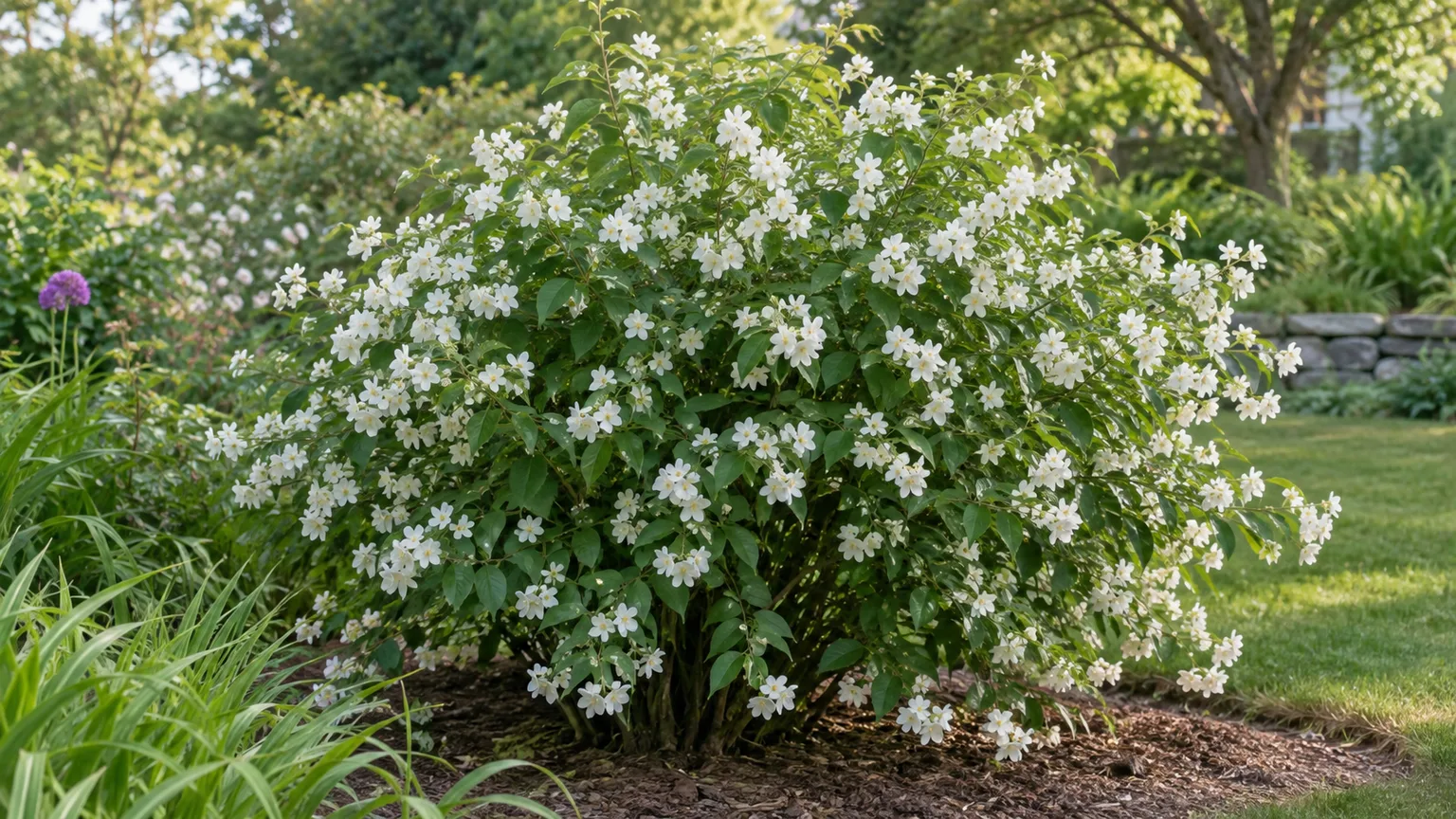
Mock orange is a common name for deciduous shrubs in the genus Philadelphus, grown for white flowers that often carry a sweet, orange-blossom-like fragrance. The name can mislead new gardeners: these shrubs are not citrus trees, and they do not bear edible oranges. What matters when choosing one is the exact species or cultivar, because a compact ‘Miniature Snowflake’ and a wide, cold-tolerant ‘Blizzard’ have very different space and winter needs.
The five shrubs below share a spring-to-early-summer flower season and a preference for reasonably bright light and soil that drains. They differ in mature spread, flower form, foliage color, and hardiness references. Compare the plant label with your local conditions before buying; a cultivar name is more useful than a generic “mock orange” tag.
Choose by space, winter climate, and the feature you value
Start with the planting site, not the flower photograph. Measure the open bed width and decide whether the shrub can arch naturally or must fit a tight foundation strip. Mature mock oranges may be substantially wider than the pot or taller than the picture suggests, and repeatedly shearing a plant to make it fit can remove flower-bearing growth and leave a dense shell over bare stems.
Then decide what you want beyond white flowers. ‘Aureus’ adds golden foliage, ‘Variegatus’ has cream-edged leaves, ‘Blizzard’ is known for cold tolerance, and ‘Miniature Snowflake’ and ‘Snowbelle’ fit smaller spaces. If fragrance is the reason you are planting one, place it near a path, patio, or open window where you will pass it during bloom; scent descriptions range from pleasant to powerful, and a plant’s age, weather, and individual cultivar affect how strongly you notice it.
Treat zone numbers as a starting point rather than a guarantee. They summarize average winter minimums, but do not account for wind exposure, drainage, snow cover, sudden freeze-thaw cycles, or whether a newly planted shrub has established. Where reference listings disagree, use the more cautious rating unless a reputable local nursery or extension service has grown that exact selection successfully in your area.
Compare five mock orange cultivars at a glance
| Variety | Approximate mature size | Hardiness reference | Bloom, form, and fragrance | Pruning need |
|---|---|---|---|---|
| ‘Aureus’ (‘Aurea’ in some listings) | About 5–8 ft tall; 3–5 ft wide in RHS listing | Species-based references commonly span zones 4–9; verify cultivar label | Single white, scented flowers in early summer | Optional light trim after bloom for fresh gold growth |
| ‘Blizzard’ (P. lewisii) | About 4–5 ft tall; spread may reach 8–10 ft | Purdue Arboretum lists zone 4 and calls it more cold-hardy than the species; a western wholesale grower lists zone 2 | Single white flowers, described by Purdue as very fragrant; spring to early summer | Selectively thin after flowering; let it keep its arching form |
| ‘Miniature Snowflake’ | About 2–3 ft tall; 1–2 ft wide | Zones 4–8 in a cultivar-specific gardening reference | Fragrant double white flowers in late spring | Low pruning demand; remove misplaced growth after bloom |
| ‘Snowbelle’ | About 3–4 ft tall and wide | Zones 4–8 in Missouri Botanical Garden’s Plant Finder | Citrus-scented double white flowers in late spring to early summer; May–June in that garden | Light shaping after bloom; renew old canes occasionally |
| ‘Variegatus’ | Roughly 5–8 ft in many references; confirm local stock | Variegated mock orange references list zones 4–7 | Scented white flowers in late spring to early summer; green leaves edged in cream | Shape after bloom; remove solid-green reversions at their origin |
These are planning ranges, not promises that every plant will stop at a precise line. The Royal Horticultural Society’s Philadelphus guide lists ‘Aureus’ at roughly 1.5–2.5 meters tall and ‘Variegatus’ at 1.5–2.5 meters tall and wide; North American garden references use feet and may describe different growing conditions. Gardener’s Path’s mock orange guide gives P. coronarius a broad zone 4–9 range, which is useful context for ‘Aureus’ but not a substitute for a cultivar-specific local label. Likewise, the Arboretum Explorer at Purdue University lists ‘Blizzard’ at zone 4 and 4–5 feet tall by 8–10 feet wide, while Boething Treeland Farms’ listing gives a much colder zone figure. Do not use that unusually low listing as a promise for an untested site; ask the nursery which stock it sells and how it performs locally.
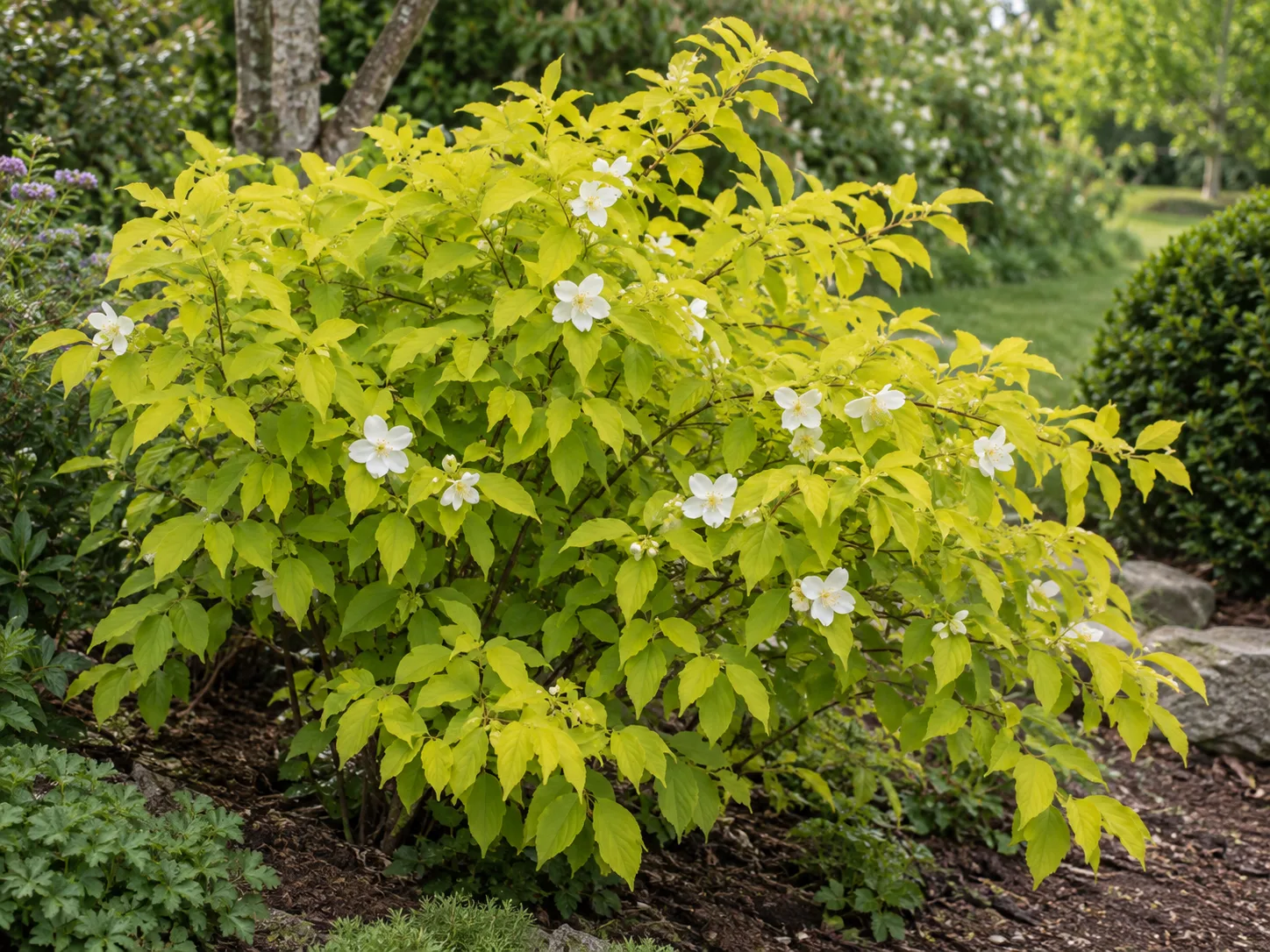
Golden mock orange ‘Aureus’ (sometimes sold as ‘Aurea’)
Choose ‘Aureus’ when you want a foliage shrub that also flowers, not just a white spring display. Its new leaves emerge gold to yellow-green and can become greener as the season advances. The RHS notes that strong sun may scorch this golden-leaved form and that clipping immediately after flowering can encourage fresh golden growth, so a site with bright morning sun and some protection from harsh afternoon heat is a useful compromise.
Plan for a medium shrub rather than a miniature. RHS lists a broad mature-height range of about 1.5–2.5 meters and a narrower spread of about 1–1.5 meters; actual size depends on climate, pruning, and the nursery’s stock. Its white, scented flowers arrive in the genus’s early-summer flowering window. A light trim after the flowers fade is optional if you want a fresh flush of gold, but do not keep shearing it through the season: new growth needs time to mature, and repeated clipping turns a loose flowering shrub into a formal hedge that may bloom less freely.
If a plant sold as ‘Aurea’ catches your eye, check the botanical tag and ask whether it is the golden-leaved Philadelphus coronarius ‘Aureus’. Cultivar names are sometimes shortened or displayed inconsistently in retail listings. Buying while it is in leaf makes it easier to confirm the foliage color, while buying in flower lets you assess the actual scent rather than relying on a label’s intensity claim.
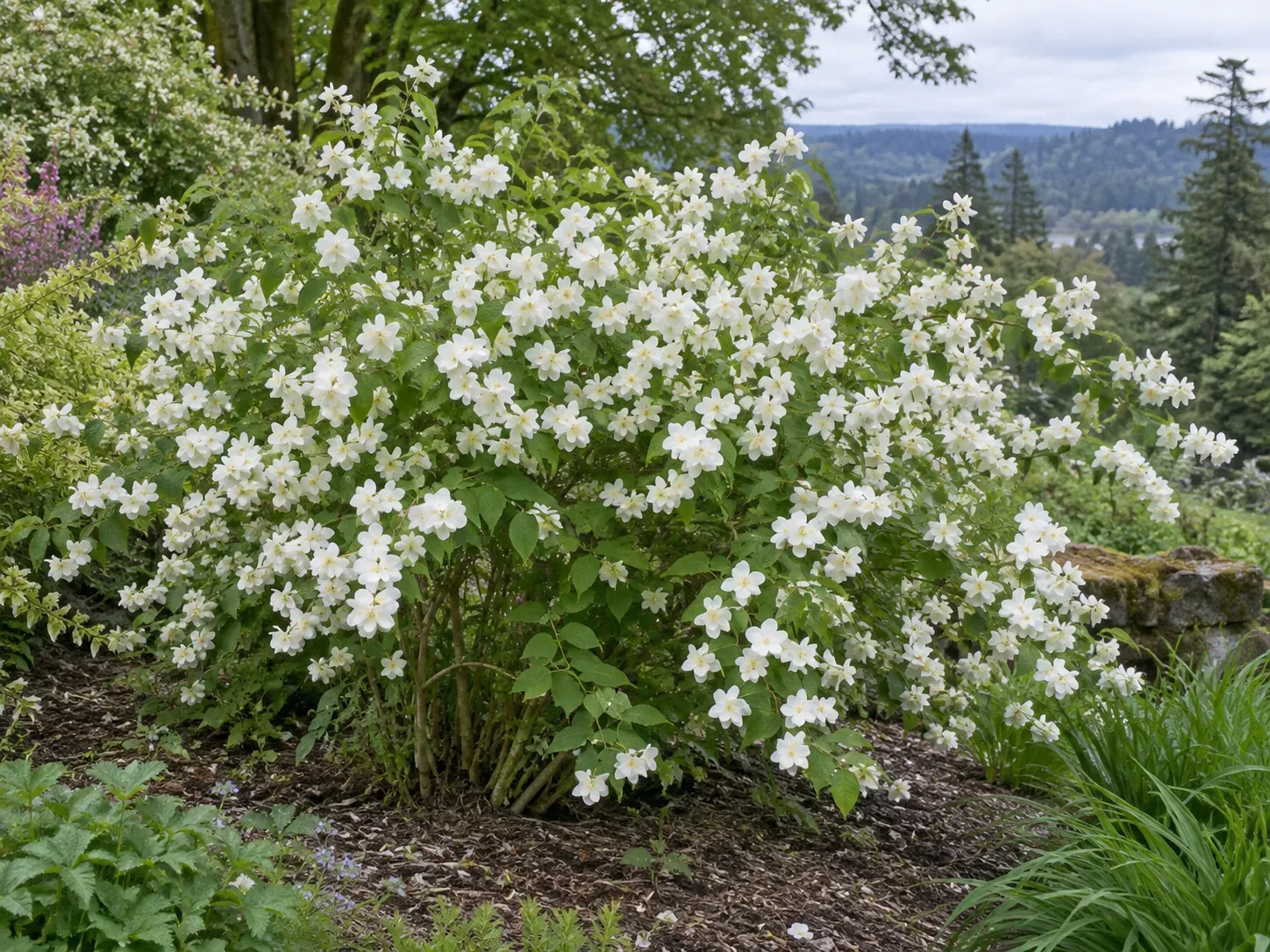
Cold-tolerant Lewis’s mock orange ‘Blizzard’
‘Blizzard’ is the choice to investigate first for a cold-winter site, but do not choose it without checking its breadth. Purdue Arboretum Explorer lists Philadelphus lewisii ‘Blizzard’ at 4–5 feet tall and 8–10 feet wide, in zone 4, and notes that it is more cold-hardy than the straight species. Another wholesale listing gives a more extreme zone rating. The difference is a reason to ask a local grower, not to assume a universal zone boundary; stock source, regional selection, and catalog conventions can all affect what a label means.
Its single white flowers are reported as very fragrant, and the shrub’s open, arching outline suits a naturalized border or a roomy mixed planting better than a narrow clipped hedge. Leave enough clearance for branches to widen, especially near a walk where flower-laden stems may arch outward. If you have only a narrow strip, a genuinely compact cultivar will be easier to manage than repeatedly cutting ‘Blizzard’ back to fit.
Prune ‘Blizzard’ only after its flowers finish. Thin a few old or crossing stems at the base if the center becomes congested, but do not top the whole plant into a tight rectangle. The wider natural habit is part of why it works as an informal shrub; annual shaping is not necessary when the site gives it room.
Dwarf ‘Miniature Snowflake’ for tight spaces
‘Miniature Snowflake’ is the smallest of the five selections covered here. The Morton Arboretum describes it at roughly 2–3 feet high and 1–2 feet wide, with fragrant, double white flowers. The Gardener’s Path mock orange guide independently lists it at about 2–3 feet tall and in zones 4–8, which makes it a more realistic choice for a small border or the front of a shrub bed than a full-size mock orange. Its mature width still matters when arranging edging or neighboring perennials.
The double blossoms give the shrub a fuller, layered look than a single-flowered type. Its flowering window is still a spring-to-early-summer flush, not a repeat-blooming summer display. Use the flower period as a seasonal highlight, then let the green mound blend into the border for the rest of the year.
Because it is naturally compact, ‘Miniature Snowflake’ generally needs less pruning than a large, vigorous shrub. After flowering, remove dead or misplaced shoots and lightly shorten a branch only when it disrupts the outline. It can be grown in a container in a climate where the pot can be kept from drying or freezing too abruptly, but a pot makes irrigation and winter root protection more demanding; a small plant is not automatically an easy container plant.
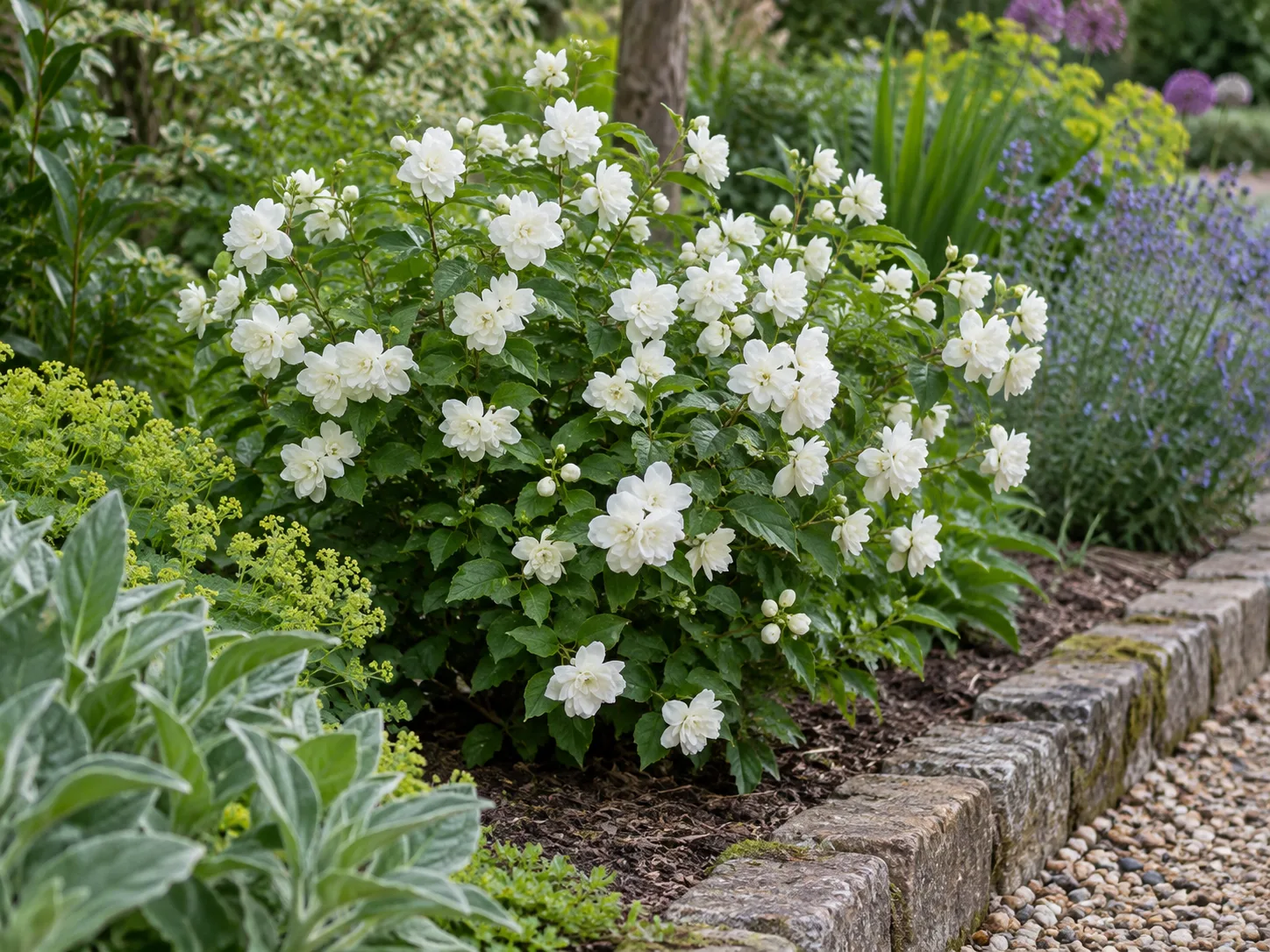
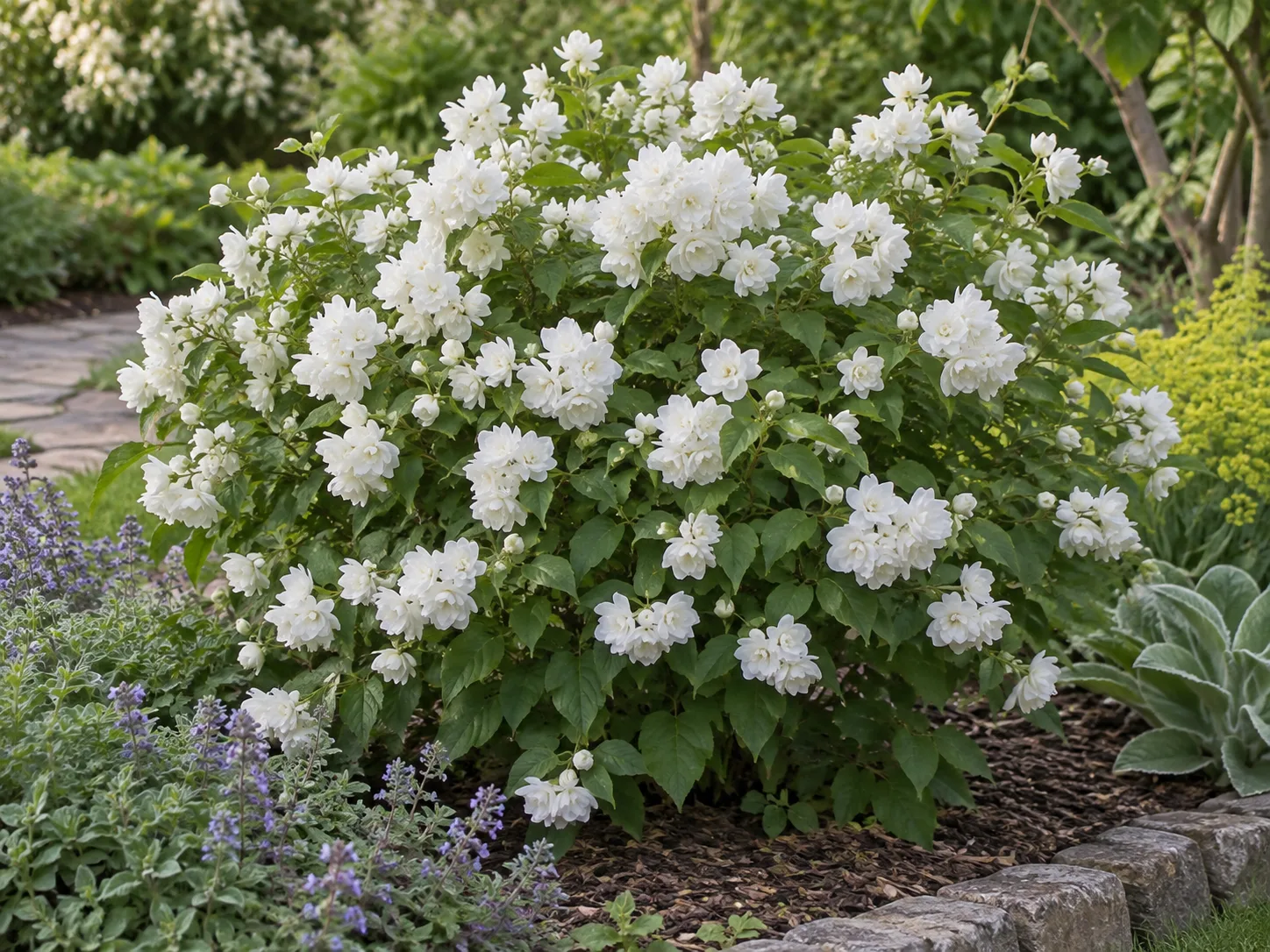
Rounded ‘Snowbelle’ for double flowers
‘Snowbelle’ is a compact, rounded option for gardeners who want double blooms without the extra-small scale of ‘Miniature Snowflake’. The Missouri Botanical Garden Plant Finder lists it at 3–4 feet high and wide, zones 4–8, with fragrant double white flowers. Its plant profile describes the flowers as citrus-scented and places the main show in late spring to early summer; its May-to-June dates reflect the garden’s conditions, not a fixed calendar for every region.
Use ‘Snowbelle’ as a low specimen, in a small mixed border, or where a rounded shrub can soften a corner. The mature width is still several feet, so do not plant it directly against a wall simply because the tag says “compact.” Give branches airflow and a little room to arch instead of keeping them pressed between a walkway and a foundation.
The cultivar’s tidy habit usually calls for minimal intervention. After flowering, remove damaged stems and take out a small number of the oldest canes at ground level if the center becomes crowded. As with other mock oranges, an aggressive spring haircut sacrifices some of the current season’s flowers because buds are carried on growth made the previous year.
‘Variegatus’ for cream-edged foliage
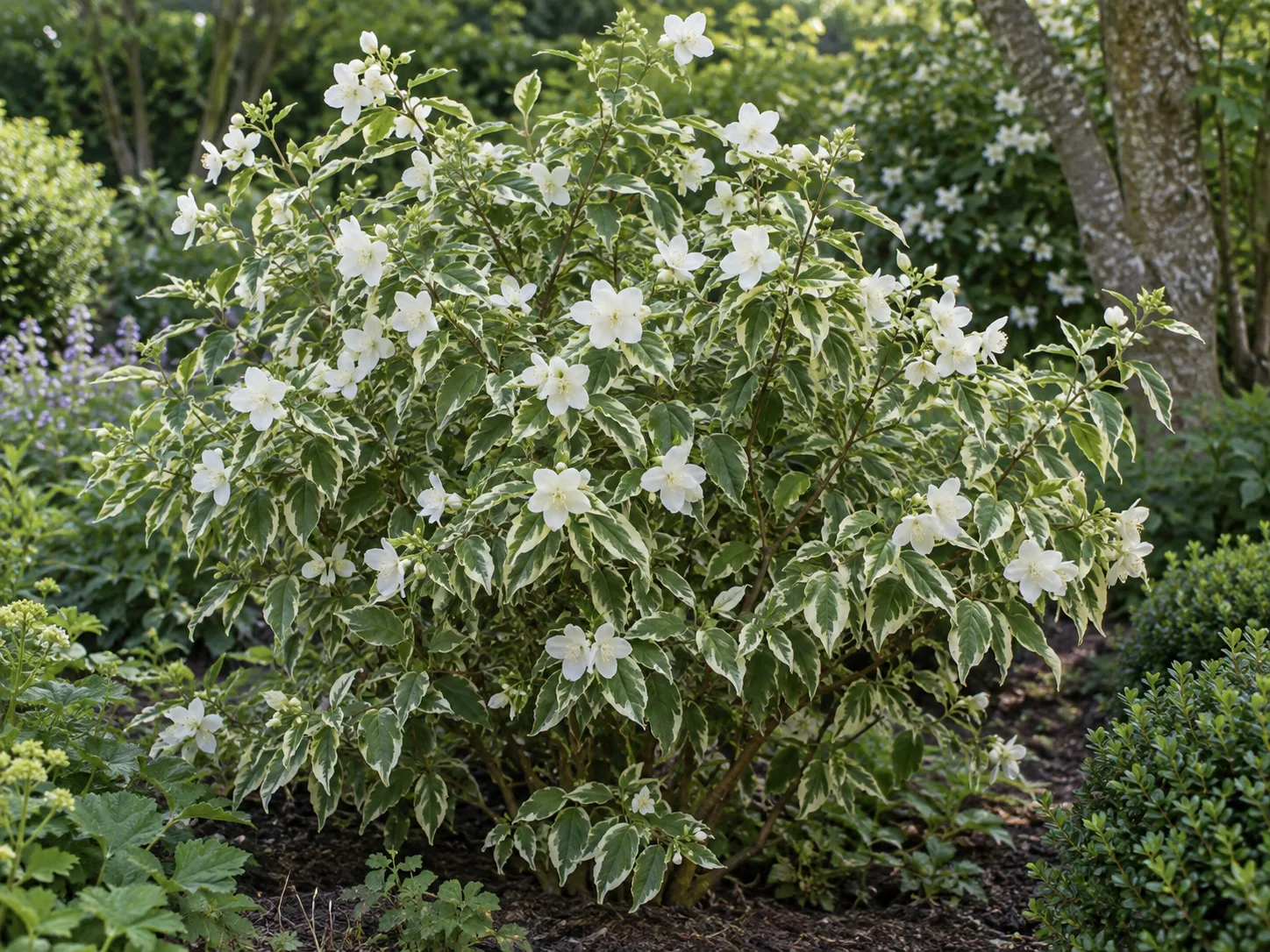
‘Variegatus’ earns its place through leaf pattern. Its green leaves are edged with cream or white, so the plant keeps more visual interest outside its short flowering window than a plain green mock orange. Fine Gardening notes that variegated mock orange has fragrant late-spring flowers and cites hardiness zones 4–7 for variegated cultivars; the RHS lists a broad mature range of about 1.5–2.5 meters tall and wide for ‘Variegatus’.
Expect a medium shrub, not a dwarf. Its single white flowers are scented, while the cream margins make the foliage the more persistent feature. In strong heat or intense afternoon sun, pale leaf edges can look scorched; bright light with some afternoon protection can preserve the leaf pattern while still allowing enough sun for flowering.
Watch for solid-green shoots growing from below the graft or from the base. These reverted stems can grow more vigorously than the variegated branches, so remove them at their point of origin rather than trimming only their tips. This is targeted maintenance, not a reason to shear the entire shrub. Prune for shape immediately after bloom and keep the cream-edged foliage as the plant’s main design feature.
Set the shrub up for dependable flowering
The Morton Arboretum’s care notes for virginal mock orange and Fine Gardening’s Philadelphus growing guide agree on the practical basics: full sun to partial shade, fertile but well-drained soil, and pruning after flowering. Those recommendations fit many garden mock oranges, but gold- and cream-leaved cultivars need extra attention to the balance between bloom and foliage protection.
Choose sun that supports flowers without scorching foliage
For the heaviest flowering, give the shrub a sunny site with about six hours of direct light when your climate allows it. Light shade is usually tolerated, especially in a hot region, but a deep-shade position is likely to produce leaves and long stems at the expense of flowers. If an established mock orange blooms poorly, check its actual sunlight through the day before buying fertilizer or pruning harder.
Golden ‘Aureus’ and cream-edged ‘Variegatus’ are the exceptions to a simple “more sun is better” rule. Morning sun with light afternoon shade can retain enough energy for bloom while reducing scorching on their paler leaves. Observe the planting area in summer, because shade from a deciduous tree may be light in early spring and much heavier once the tree leafs out.
Aim for drainage and steady moisture, not a special soil recipe
Mock orange grows in a range of garden soils if excess water can escape. Improve a compacted bed broadly with organic matter and correct drainage before planting, rather than filling one small planting hole with a different, spongy mix. A sharply amended pocket can hold water around the root ball or create a boundary that roots are reluctant to cross.
Do not chase a pH number unless a soil test identifies a problem. The RHS and Missouri Botanical Garden describe these shrubs as adaptable to different soils, while consistently wet ground is the clearer risk. If water remains in the planting area long after rain, choose another location or address drainage before installing the shrub; regular watering cannot compensate for roots sitting in saturated soil.
Plant to the mature spread, not the nursery-pot width
Plant in early spring or fall when temperatures are moderate and the soil is workable; avoid a heat wave or frozen ground. Set the shrub where its full mature width can fit, leaving room for air to pass through the branching structure and for a person to reach it for pruning. This is especially important for ‘Blizzard,’ whose recorded spread can be much wider than its height.
Dig a hole about as deep as the root ball and wider than it, loosen circling roots gently, and set the top of the root ball level with the surrounding soil. Backfill with the excavated soil, firm it without compacting it hard, and water slowly so the root zone settles. Add a modest organic mulch layer to reduce moisture swings, but keep mulch away from the stems to discourage persistent dampness against the crown.
For a hedge or screen, calculate spacing from expected mature width, not the desire for an instant wall. Closely spaced plants may fill faster but also compete for light and moisture, become harder to prune individually, and develop a crowded interior. A mock orange is deciduous and has a concentrated flowering period, so use evergreen or staggered-flowering companions if year-round screening is the actual goal.
Water by establishment and soil condition
For the first growing season, check the root ball and nearby soil regularly. Water deeply when the root zone begins to dry, then allow excess water to drain; short daily sprinkles wet the surface without encouraging roots to establish through the surrounding bed. Hot wind, sandy soil, and a small nursery root ball can dry quickly, while clay soil and a cool shaded site may stay damp much longer.
Once established, mock orange can tolerate occasional dry spells, but drought tolerance is not a reason to ignore a newly planted shrub or a prolonged dry summer. Water slowly at the base when the soil is dry several inches down or foliage wilts in the heat and does not recover by evening. If yellow leaves appear while the soil remains wet, pause irrigation and inspect drainage before adding more water.
Skip routine fertilizer when the shrub has healthy leaves and steady growth. If growth is weak, first check light, moisture, root competition, and whether the plant is still establishing; feeding cannot correct deep shade or waterlogged soil. A soil test is a better basis for fertilizer than an annual calendar application, especially near a lawn that may already receive nutrients.
Prune after bloom so you preserve next year’s flowers
Mock orange flowers on older, previous-season growth. The Fine Gardening guide and Missouri Botanical Garden’s ‘Snowbelle’ profile both recommend pruning after flowering; once the shrub has set its next stems, a late fall or early spring haircut can remove many of the buds you were waiting to see.
Use clean, sharp bypass pruners for selective cuts. First remove dead, broken, diseased, or rubbing stems at their origin. Then shorten only the branches that extend into a path or spoil the shrub’s outline, cutting just above a healthy outward-facing side branch rather than clipping every stem to the same height.
After a strong bloom, you can thin a modest number of the oldest canes at ground level to open the center and encourage younger growth. The RHS notes that some golden mock orange foliage responds to a post-flowering trim, but routine shearing is unnecessary for most varieties. Compact cultivars such as ‘Miniature Snowflake’ and ‘Snowbelle’ often need little more than cleanup, while a vigorous, broad plant may benefit from periodic thinning.
Renew an overgrown shrub gradually
If a mock orange has become a tangled mass, avoid cutting every stem to the ground unless you are willing to lose the next bloom and accept a period of bare space. A lower-risk renovation is to remove roughly one-third of the oldest stems at ground level immediately after flowering, repeating the process over three years. That sequence keeps some flowering wood while gradually replacing tired canes with younger shoots.
If the shrub is so congested that only a hard cut will restore it, choose the timing deliberately and expect little or no flowering the following season. Keep the strongest new shoots, remove weak or crossing growth as it develops, and do not repeatedly top the regrowth. Renewal pruning is a reset, not an annual substitute for matching the plant to the space.
Diagnose weak bloom, yellow leaves, and poor growth
When a mock orange stays leafy but produces few flowers, work through causes in order rather than adding fertilizer. First, check pruning time. If you cut it in fall, winter, or before bloom, you may have removed buds on older wood. Wait through the current season, then move any shaping to right after flowers fade.
Next, check light and age. A shrub under an increasingly dense tree canopy can lose bloom gradually, and a recently planted shrub may need time to establish before it reaches its full display. If the site is deeply shaded, consider whether careful relocation or selective canopy management is possible; severe pruning will not make up for inadequate light.
Then consider frost and vigor. A late freeze can damage exposed buds even when the shrub survives winter. If it flowers well in some years and not in others, weather may be a bigger factor than care. If the plant is growing excessively leafy and soft, check for lawn fertilizer drift or excess feeding; do not respond with more fertilizer until a soil test or clear deficiency supports it.
Yellow foliage needs context. Golden ‘Aureus’ is meant to have yellow-gold leaves, and ‘Variegatus’ naturally has pale margins. On other stems, widespread yellowing in wet soil points toward poor drainage or overwatering, while crisp pale edges after hot afternoon sun are more consistent with scorch; dry, drooping foliage suggests water stress. Compare the affected leaves with the cultivar’s normal pattern and inspect moisture before changing the watering routine.
Mock orange is generally regarded as a low-problem shrub, but dense, stressed growth can be vulnerable to issues such as scale, leaf spot, powdery mildew, or rust. Remove badly affected debris, improve airflow by selective thinning, and avoid overhead watering late in the day. Identify the pest or disease before choosing a treatment; a broad pesticide is rarely the right first response to a shrub whose main problem may be shade, poor drainage, or crowding.
Put a short-lived bloom where its fragrance matters
Mock orange is at its most memorable when it is flowering, but the display does not last all summer. The RHS describes one main early-summer flowering spell, and after the petals fall the shrub’s value depends more on its shape and foliage. That seasonal rhythm makes placement part of the selection decision: use gold or cream-variegated leaves to extend foliage interest, or place a green-leaved fragrant cultivar close to a route you use during bloom.
Near a path, patio, or open window, even a short flowering period can be enjoyed at close range. In a mixed border, pair it with shrubs or perennials that flower at another time, and use evergreen plants if winter screening matters. Do not plant a large form as a tight foundation hedge unless you are prepared to manage its width and accept that constant cutting can reduce flowers.
For a small yard, ‘Miniature Snowflake’ is the narrowest starting point, while ‘Snowbelle’ gives a slightly larger rounded mound with double blossoms. For a larger informal border, ‘Blizzard’ can provide a broad outline and strong fragrance if the climate and available space suit it. ‘Aureus’ and ‘Variegatus’ are better choices when leaf color should contribute to the design beyond bloom season.
Conclusion
The right mock orange is the one whose mature shape, flower form, foliage, and hardiness match the site you actually have. ‘Miniature Snowflake’ is the smallest, ‘Snowbelle’ is a compact double-flowered mound, ‘Blizzard’ is cold-tolerant but may spread widely, and ‘Aureus’ and ‘Variegatus’ add golden or cream-edged leaves.
Plant in sun or light shade in soil that drains, keep a new shrub watered while it establishes, and prune just after flowering. Check the tag for the cultivar’s local hardiness and mature width, then give the shrub enough space to keep its natural form. Those choices make it easier to enjoy the fragrant spring bloom without forcing the plant to fit the wrong spot.



