Modern Landscape Design: Plan a Clean, Livable Yard
See what makes a landscape feel modern, then map your yard, choose durable hardscape and climate-fit plants, and keep useful lawn where it earns its place.
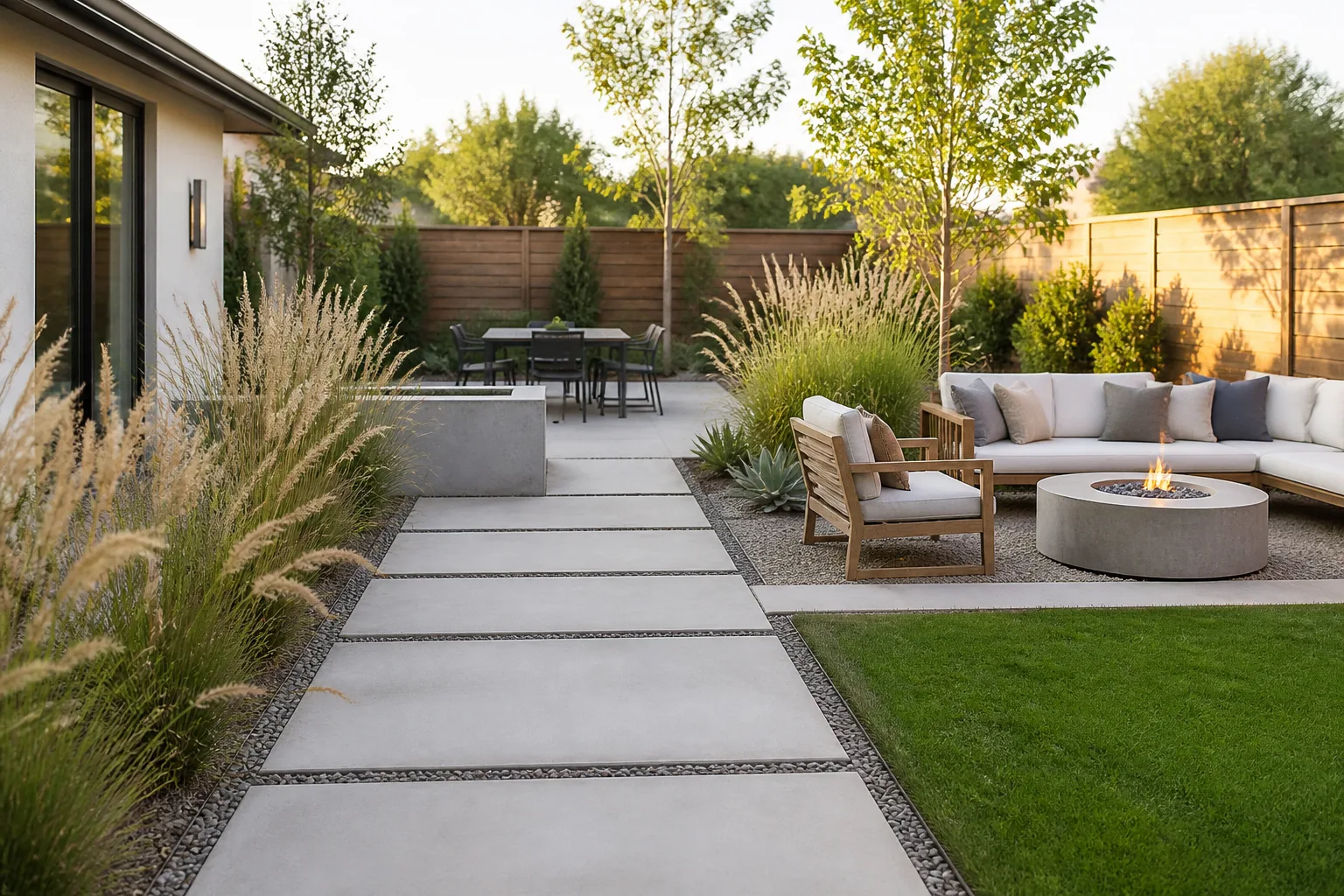
Modern landscape design is a way of organizing an outdoor space with clear geometry, intentional repetition, restrained materials, and plants chosen for both their form and function. The result should feel connected to the house and comfortable to use, not like a patio showroom or a yard stripped of life.
The look is flexible. A modern yard might pair a straight path with a loose drift of native grasses, or frame a small rectangle of turf with crisp beds and warm timber. The useful question is not whether every feature is modern; it is whether the layout feels coherent, suits the site, and makes daily life outside easier.
What modern landscape design actually means
Modern landscape design treats the yard as an extension of the home’s architecture. It relies on legible edges and a simple spatial plan, then uses planting, texture, and light to keep that structure from feeling severe. UF/IFAS describes common modern features as clean lines, geometric forms, repeated elements, sculptural plants, subtle color, and open space (UF/IFAS modern landscape guidance). Those are useful cues, not a checklist that every property must satisfy.
Think of the style as edited rather than empty. A straight path can clarify where to walk; a repeated shrub can link the front entry to the side yard; an open patch of lawn can leave room for play or a view. Each feature earns its place through use, visual structure, or a job such as shade or privacy. If a yard has many unrelated borders, materials, pots, and ornaments, simplifying the plan usually changes the look more than buying a new feature.
The house offers a starting point, not a script. Pull a line from its porch, window grid, roof edge, or siding into the garden, and repeat one or two exterior materials outdoors. A traditional home can still have a modern landscape; warmer brick, wood, or local stone may bridge the styles more naturally than importing a stark black-and-concrete palette.
Modern, contemporary, and minimalist: how the terms differ
Garden writing often uses modern and contemporary interchangeably, so there is no universal boundary that homeowners must police. In practice, “modern” usually points to an ordered visual language—strong lines, clean geometry, simple planting masses—while “contemporary” can describe current combinations that mix those lines with softer, more naturalistic planting. A minimalist garden is more specifically about reduction: fewer visual elements and less ornament. A contemporary landscape can be modern in structure without being minimal in plant variety.
That distinction matters because restraint does not require bare gravel or a single row of clipped shrubs. Fine Gardening’s modern-garden examples show how a strong layout can make a richer mix of plants read clearly, and how textured foliage can soften bold architecture (Fine Gardening’s modern-garden designs). You can keep pollinator-friendly flowers, seasonal color, or a vegetable bed while using a repeating edge or material to tie them into the whole.
The design signals that make a yard feel modern
The style comes from relationships among features more than from any single object. Large pavers do not make a yard modern by themselves; they become part of a modern composition when their direction, scale, and joints connect to the house and the route people actually use. Similarly, a sculptural plant makes a useful focal point when it has breathing room instead of competing with several other specimens.
Use geometry and disciplined edges
Start with one dominant shape language: rectangles and straight runs, broad arcs, or a controlled combination. Align a path with the front door or a house wall; let a bed edge echo a patio corner; repeat the same spacing in a fence or paver grid. University of Florida landscape-design guidance explains that lines can organize beds and hardscape, direct movement, and connect the planting to the home (UF/IFAS design principles). A line is doing design work when it helps the eye understand where a space begins, where it leads, or what it frames.
Symmetry is one option, not a requirement. Matching planters at an entry or beds on both sides of a walk create formal balance, while an asymmetrical arrangement can feel modern if the visual weight is considered: one small tree on one side might balance a low, broader planting mass on the other. Avoid making every bed a sharp rectangle just because the house has right angles; a single curved boundary or soft planting edge can provide relief without dissolving the overall order.
Repeat forms, then leave room for the eye
Repetition builds rhythm. Echo a material at the entry and patio, repeat a grass form along a path, or use the same evergreen in two separate beds. The eye recognizes the link and reads the yard as one composition. UF/IFAS recommends arranging plants in connected masses and repeating selected forms or textures; it also cautions that plant group size should suit the scale of the site (UF/IFAS plant-arrangement guidance). That is more dependable than scattering single examples of many species across the lawn.
Negative space—the open area around a focal point, path, or planting mass—is part of the design, not a gap that must be filled. Keep a clear landing beside a door, preserve a view through a small courtyard, or leave one uncluttered lawn panel. A helpful starting exercise is to pick one focal point for each main view from the street or house, then edit competing objects nearby. Open space makes the retained features easier to notice and gives people somewhere to move or gather.
Audit the property before drawing a plan
Take a few days to observe the yard before shopping. Sketch the house, drive, doors, windows, existing trees, fences, steps, and property boundaries, then note where the sun falls at morning, midday, and late afternoon. Record areas that stay wet, dry quickly, collect roof runoff, or feel unusually windy. Light and exposure can vary within one garden and across seasons; the RHS recommends considering aspect, shade, climate, and microclimate when planning a border (RHS border-planning advice).
Next, map how water moves after rain. A beautiful paved terrace can become a nuisance if it sends runoff toward a foundation or into a neighbor’s lot. Hard surfaces reduce the ground’s ability to absorb rain, while green-infrastructure features such as rain gardens and permeable pavement can slow, spread, and infiltrate some runoff (U.S. EPA stormwater guidance). Whether a specific feature works depends on soil, slope, local drainage rules, and the volume of water; persistent drainage or steep-grade problems deserve a qualified local professional.
Check what must remain, what can move, and what you cannot safely or legally change: mature tree roots, easements, septic components, retaining walls, fences, and local restrictions. In the United States, contact 811 or the applicable local one-call service before excavation for paths, trees, posts, irrigation, or bed regrading; PHMSA says the service coordinates marking of underground utilities and that timing varies by state (PHMSA safe-digging guidance). In other countries, use the local utility-location service. A plant or hardscape choice that conflicts with an underground line is easier to fix on paper than after installation.
Plan around the way you use the yard
Write down the activities the landscape needs to support: arriving at the door, walking a dog, playing, dining, relaxing, growing food, or screening a neighbor’s window. Rank them. The first plan should protect the important routes and usable spaces; decorative features can fill in once the circulation works. For a front yard, the sequence from driveway to entry usually matters more than a water feature. In a backyard, a flat place to sit and a direct path from the kitchen may be the first priorities.
Draw simple zones as bubbles before you settle on precise shapes. A seating zone needs enough clear space for people to pull out chairs and pass behind them; a play zone should not be bisected by a path; a privacy screen should block the actual sightline without shading a sunny bed. The zone does not have to be a built patio. A mulched sitting nook or a compact lawn area can perform the same job if the ground is stable and the route to it feels natural.
Sketch circulation before planting
Mark the route people already walk and make it a path instead of asking them to take a less convenient one. A main path should feel generous enough for the household’s use, while a secondary garden path can be narrower. Align paving with a strong house or gate line when that makes movement clearer, and include a landing where people turn, carry groceries, or step from a door. For broader backyard layout ideas, see our modern backyard design guide.
Before building, trace your proposed bed edges and patio with a garden hose, rope, or stakes. View the shapes from the street, kitchen, and windows, then walk the routes carrying a basket or chair. This inexpensive test reveals whether a path is awkward, a bed pinches a doorway, or a focal point is hidden. Measure the zones after you like the flow; then check that plant beds are wide enough for mature shrubs and layers rather than narrow ribbons that demand constant pruning.
Choose a restrained palette that still feels warm
Choose materials and colors together, then repeat them instead of adding a new finish for every feature. A practical starter palette might use one paving material, one contrasting edge or gravel, and one warm material such as timber. Plant foliage can supply most of the color: green, silver, bronze, or burgundy leaves can create contrast without relying on a brief flowering display. UF/IFAS notes that warmer material colors can keep a modern landscape from feeling sterile, and RHS design guidance emphasizes uncluttered geometry and natural materials such as stone, slate, and wood (RHS modern and minimal design).
Scale matters as much as finish. A large-format paver may look calm in a broad yard but overwhelm a narrow entry; small paving units can make a compact space feel busy. Take a sample outside and view it in sun, shade, and beside the home’s existing exterior. Remember that pale surfaces can glare, dark ones can absorb heat, and any surface gets visually stronger when repeated over a large area. If you want a bright accent, use it once—on a door, pot, or chair—rather than sprinkling several competing colors around the property.
Select hardscape for use, climate, and water
Hardscape should solve a job before it supplies a look. Use paving for a stable route or seating area; use a retaining edge only where a grade change needs definition or support; use a screen where privacy is genuinely needed. Concrete, natural stone, brick, gravel, wood, and metal can all suit modern landscapes, but each has different installation, upkeep, and temperature behavior. Large expanses of rock or concrete can raise surface heat in hot climates, a limitation UF/IFAS flags in its modern-design guidance.
Where rainwater matters, compare permeable options with solid paving, and check how each is constructed. “Permeable” does not mean water automatically disappears: the base, underlying soil, slope, and maintenance affect performance. Gravel can be useful on a low-traffic path or as a material joint, but it can migrate onto lawns, trap leaves, and be uncomfortable for wheeled furniture. EPA recommends regionally appropriate plants, useful turf placement, and care with rock mulch because it can radiate heat and increase water loss in sunny sites (EPA WaterSense landscaping tips).
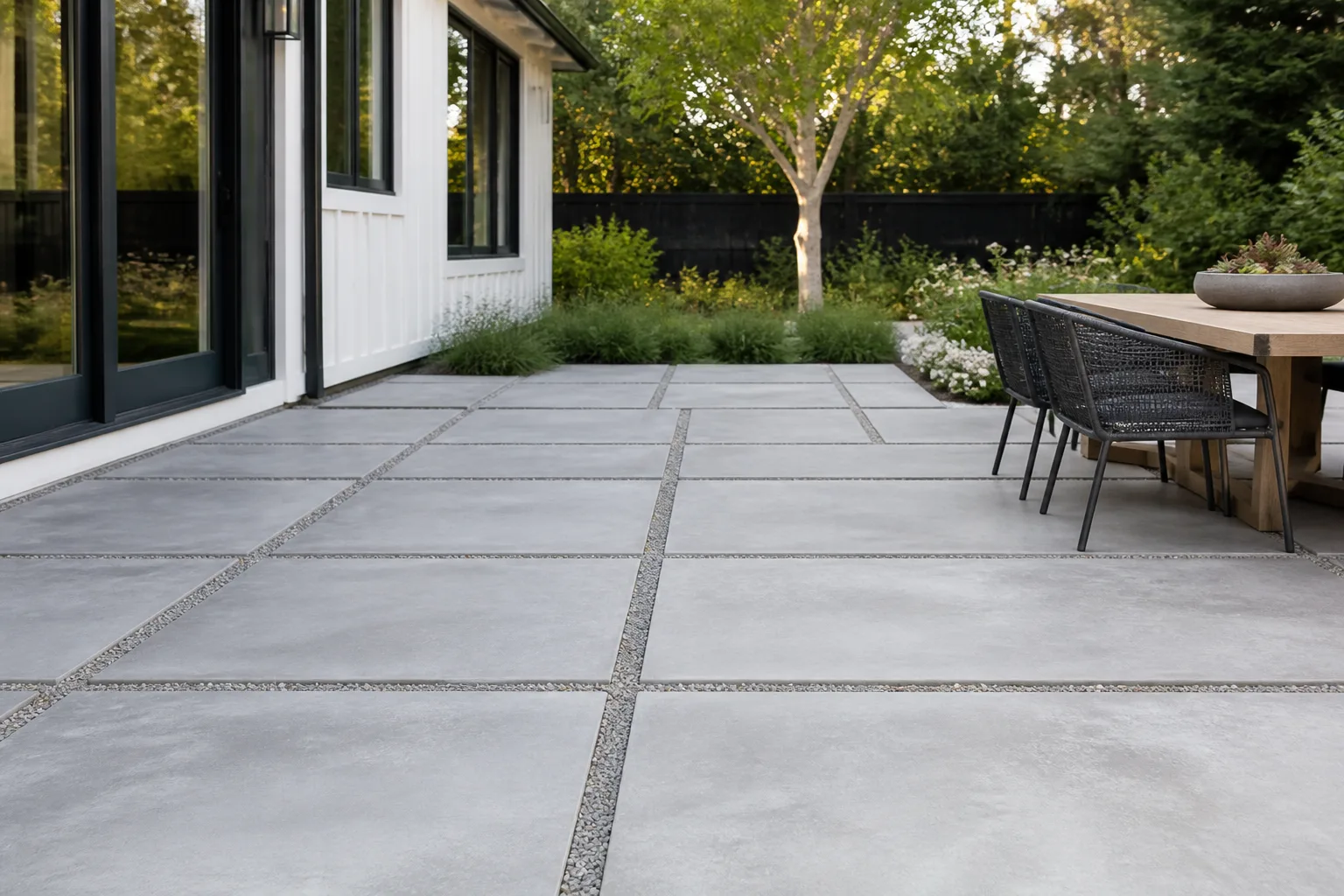
Set a hardscape boundary around the usable footprint before deciding on a decorative border. The outdoor dining area should fit the table and chairs when occupied, not only when everything is pushed in; the walk should stay clear after plants mature. If the project includes major grading, a tall retaining wall, steps, drainage infrastructure, or a structure attached to the house, ask a licensed local designer or contractor about code, engineering, permits, and water management before construction.
Choose plants by role and growing conditions
Modern planting uses form and foliage to support the layout. Instead of asking only which plant looks sculptural, assign each plant a job: anchor a corner, screen a view, frame an entry, soften a wall, shade a sitting area, stabilize a slope, or attract pollinators. Then check whether it can do that job in the site’s light, soil, drainage, heat, wind, and winter conditions. UF/IFAS’s “right plant, right place” framework explicitly considers function, aesthetics, and environmental requirements together (UF/IFAS plant-siting guidance).
Select plants for mature size, not nursery-pot size. A tight row of shrubs against a window can look clean for one season and become a shearing chore later; a tree planted too near paving can distort the intended geometry as it grows. Use your local extension service or botanical garden to identify native and regionally adapted plants that fit the role. Native does not mean no care, and drought-tolerant does not mean no establishment watering; group plants with similar needs and avoid species that are invasive in your region. In the United States, the USDA hardiness map helps assess average winter cold, but it does not replace checking summer heat, moisture, soil, or microclimate (USDA Plant Hardiness Zone Map).
Build planting layers that look composed year-round
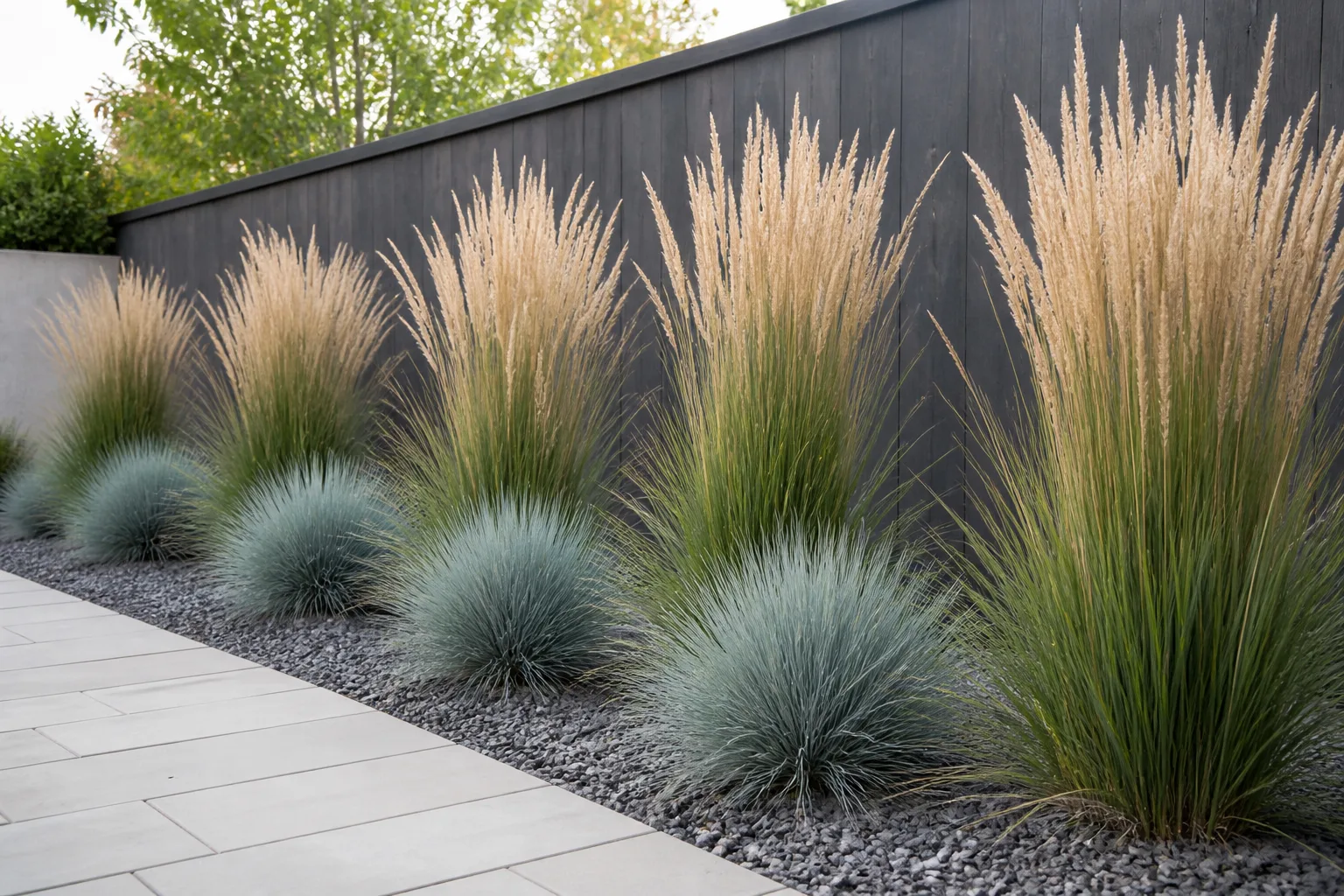
Start with the durable “bones”: a small tree, evergreen shrubs, or structural grasses that hold shape outside peak bloom. Add medium-height flowering perennials or shrubs where they will not obstruct paths and windows, then use groundcover or a clean mulch edge to close gaps. This sequence gives the garden depth without requiring a different plant at every step. Repeat a few species across multiple beds, but leave enough variety for season, habitat, and site differences.
Plant in groups large enough to read as a mass from the place people will view it. At the nursery, arrange potted plants on the ground before planting and step back to assess spacing and sightlines. Follow each plant’s recommended mature spacing rather than packing it for instant fullness; a modern design still changes over time, and crowding can undo its outline. Foliage texture is a useful counterweight: fine grasses beside a broad-leaved shrub or soft groundcover beside a hard wall helps the composition feel inviting. A Fine Gardening case study shows how repeated plants and varied textures can soften modern architecture while serving privacy and drainage needs (Fine Gardening modern landscape case study).
Keep the lawn where it serves a purpose
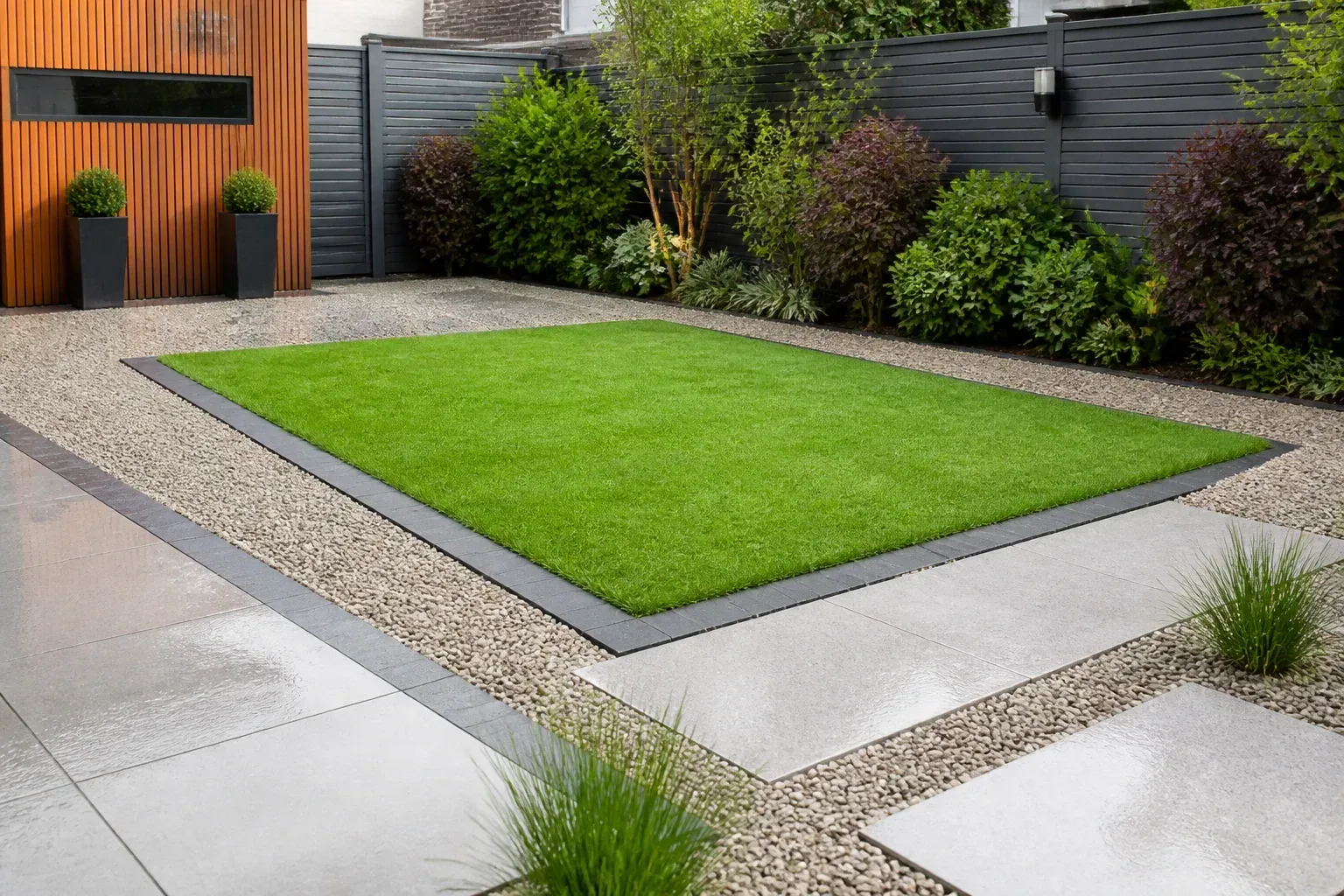
A modern landscape does not have to remove every square foot of turf. Keep grass where it supports play, pets, a clear view, or an easy connection between outdoor rooms. EPA WaterSense recommends locating turf where it has a practical function and choosing a type suited to the local climate (EPA WaterSense landscape design). A deliberate rectangle or broad, simple panel often looks more intentional than small islands of lawn trapped between winding beds.
If grass is hard to maintain in a narrow, shaded strip or steep slope, consider a locally appropriate groundcover, planting mass, or permeable path instead. Do not replace turf with gravel by default: gravel can heat the ground, shift underfoot, and make leaf cleanup difficult. Likewise, a lawn substitute may need weeding or establishment care before it becomes lower effort. Change one section first, observe how it drains and gets used, and use that result to guide the next phase.
Install in an order that prevents rework
Once the plan works on paper and on the ground, build from the least movable decisions to the most flexible. Confirm property lines, utility locations, drainage, permits, and any contractor requirements first. Then handle major grading and drainage, followed by structural hardscape and paths. Protect existing trees during construction; heavy equipment and material storage can compact the soil or damage roots, so get local arborist guidance if work falls near a valuable tree.
Next, prepare beds, install irrigation if needed, and plant the larger structural pieces before smaller layers. Set plants in their containers and inspect the composition from the real viewing points before digging. Finish with mulch, lighting, and furniture only after the paths and beds are in place. A phased project can begin with one entry walk and its planting bed, then extend a repeated material and plant form into the next zone; it does not need to transform the whole property in one season.
To keep the budget under control, make a simple materials and quantity list from measured areas and obtain more than one estimate for complex work. Spend first on safe access, drainage, durable surfaces, soil preparation, and plants that fit the site. Delay expensive focal objects and large plant purchases until the circulation and scale are clear. A small, well-finished first phase reads more deliberately than several half-completed features competing for attention.
Mistakes that make modern yards harder to live with
Using too much hardscape is a common shortcut to a modern look, but large hot surfaces can make the yard uncomfortable and send more rainwater into runoff. Balance paving with planting and shade; where water must be managed, get site-specific advice instead of assuming that a gravel border or decorative dry creek will solve the problem. A modern plan should work during a heat wave and after a storm, not only in a sunny photo.
Treating low maintenance as no maintenance creates disappointment. Clipped hedges need pruning; gravel needs weeding and leaf cleanup; young trees and shrubs need establishment care; and a simple layout still needs crisp edges. Set the design according to the time and equipment you will realistically use. A loosely shaped native planting may fit one household better than a formal hedge even if both have clean geometry.
Other common missteps are choosing plants before mapping sun, buying one of every interesting species, copying a symmetrical layout that does not suit the house, and filling every open area with decoration. Avoid narrow foundation beds that cannot hold mature plantings, and do not direct roof or patio runoff toward the foundation. If one part of a plan feels busy, remove or consolidate elements before adding more. A clear line repeated in the right places is usually more effective than a collection of matching accessories.
Conclusion
Modern landscape design is not a fixed palette of gray stone, clipped shrubs, and empty lawn. It is a practical way to compose a yard: relate its lines to the home, give every zone a job, repeat a small set of forms and materials, and choose plants that fit the actual climate and soil. Symmetry, lawn, flowers, gravel, and sculptural accents are all optional tools.
Begin by observing the site and sketching routes, views, drainage, and activity zones. Test the outline with a hose, choose one focal point per important view, and plan hardscape and planting together. When the basic arrangement feels comfortable and the maintenance matches your life, build it in phases. That process creates a yard that looks considered while remaining a place people can walk, play, sit, and grow things.



