Monstera Leaves Curling: 5 Causes and How to Fix Them
Find out why Monstera leaves curl, what to check first, and how to correct water, light, humidity, soil, or pest problems without risking more stress.
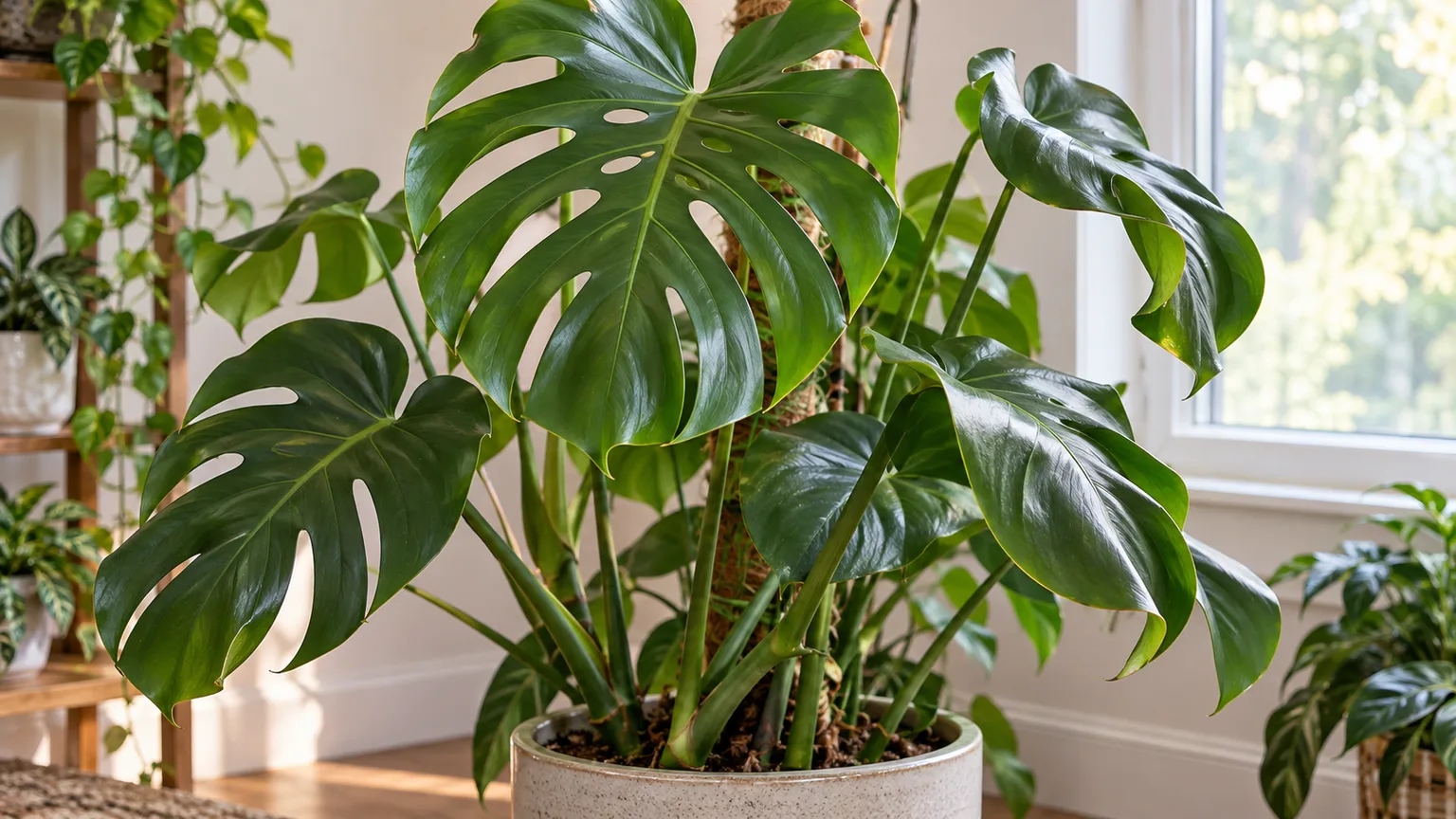
A Monstera leaf that curls inward can signal thirst, roots that have stayed too wet, dry air, heat or light stress, or sap-feeding pests. The shape alone cannot tell you which one; check the soil and the leaf’s age before reaching for the watering can, humidifier, or spray.
This guide focuses on the common large-leaf Monstera deliciosa, often sold as a Swiss cheese plant. Other Monstera species have different leaf thickness and light tolerance, so treat the checks as a starting point if your plant is a smaller, thin-leaved type such as M. adansonii.
Is the Curl Normal New Growth or a Distress Signal?
A new Monstera leaf normally emerges tightly rolled, then opens as it expands. That rolled spear is attached to the newest growth point and is usually lighter green than mature leaves; it is not a mature leaf folding up because something is wrong. Leave it alone while it opens rather than pulling the edges apart, which can tear the tender blade.
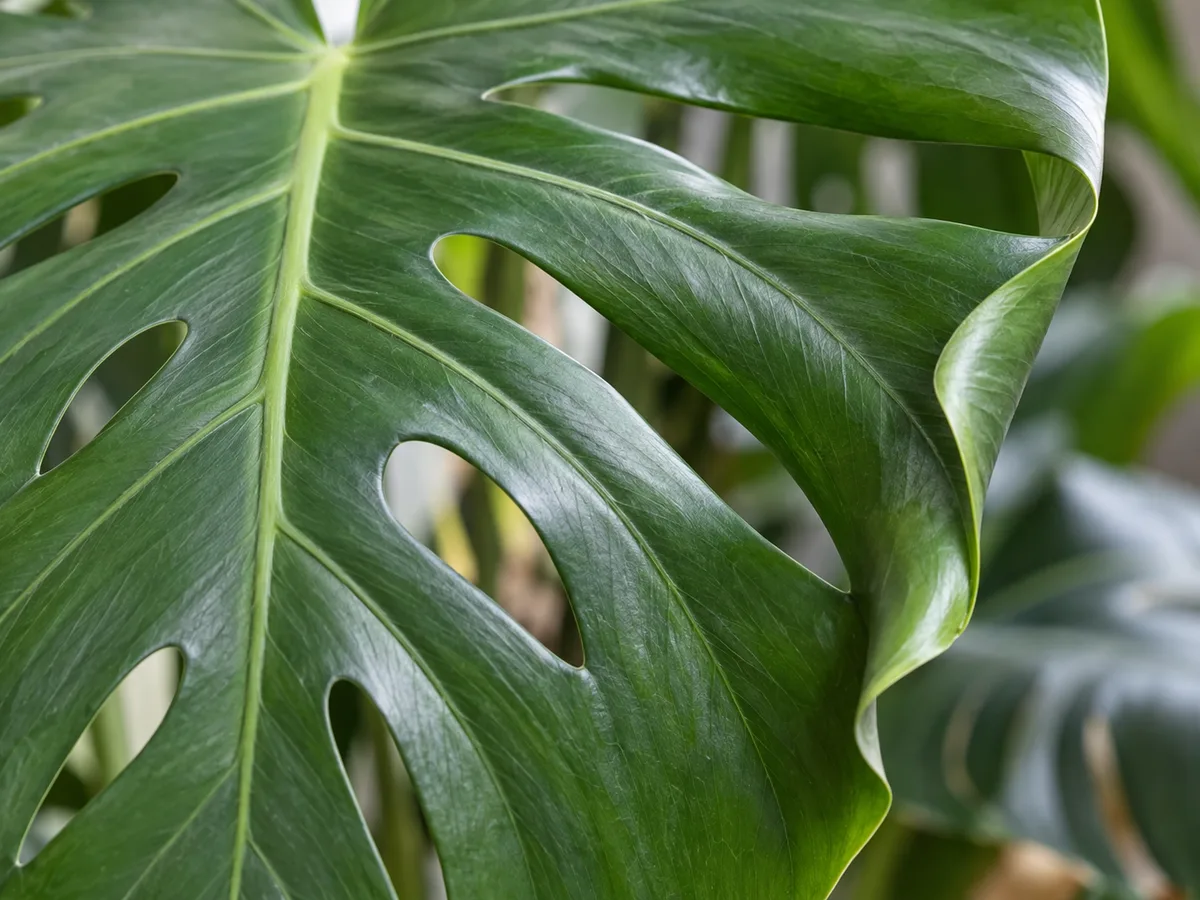
This mature leaf shows the kind of edge curl to investigate; its shape alone cannot identify the cause.
Stress is more likely when a leaf that had already opened begins to cup inward or roll along its margins, especially when several mature leaves change at once. Brown, crispy edges, yellowing, limp petioles, or a plant that worsens over days add useful clues, but none of them on their own identify the cause. Compare today’s leaves with older photos if you have them; a leaf that has always been slightly wavy may simply have grown that way.
A new leaf that remains tightly stuck can still be a problem, but do not force it open. Dry air, inconsistent root moisture, or a rough move can slow expansion, while a leaf that is still pale and supple may simply need more time. The NC State Extension Plant Toolbox profile and Penn State Extension’s Monstera guide describe the warm, humid, indirect-light conditions that support steady growth; neither makes curl a stand-alone diagnosis.
Start With Three Checks Before You Change Care
Make the first inspection before changing several conditions at once. If you water, repot, move the plant, and add humidity on the same day, you will not know which clue mattered, and you may turn a dry-root problem into a wet-root one. Note which leaves curl, where the plant sits, and what you did during the previous week.
Feel the Root Zone, Not Just the Surface
Push a finger about 1 to 2 inches into the potting mix, or use a clean wooden skewer if the pot is too deep for your hand. Feel whether the mix at that depth is dry, lightly moist, or wet; also lift the pot to compare its weight with how it feels after watering. The Fine Gardening Monstera guide recommends checking the soil rather than watering to a calendar, while NC State says to let roughly the top quarter to third of the medium dry between thorough waterings.
The surface can mislead in both directions. A crusty top may cover damp mix below, and a peat-heavy root ball can stay wet in its center even when the top feels dry. If the soil is still wet, do not add water because the leaves look thirsty; check drainage and watch whether the pot gets lighter over the next few days.
Compare Mature Leaves With New Growth
Look for a pattern, not one dramatic leaf. If a new spear is the only rolled part and the older leaves stay flat and firm, wait; if several mature leaves begin curling together, investigate roots, air, temperature, and pests. If only the leaf nearest a window or heater is affected, the local conditions may matter more than the whole room.
Check whether the curl is paired with other symptoms. A dry, light pot and limp leaves support water deficit; a persistently heavy pot with yellowing or soft lower growth points toward roots that are not functioning normally. Silvery scarring, tiny pale stipples, sticky residue, fine webbing, or black specks shift attention toward insects rather than watering.
Read the Damage and the Plant’s Setting
Map the affected leaf to its environment. A side facing hot afternoon sun, pressed against cold glass, or sitting in the stream of an air-conditioning or heating vent can show stress while leaves elsewhere remain normal. New damage on the exposed side, especially with bleached or crispy patches, supports a light or temperature issue more than a shortage of fertilizer.
Think about recent changes: a new room, an open window on cold nights, a move from a shaded shop to a sunny window, or a repot can all alter how quickly the plant loses or absorbs water. Check the room temperature and relative humidity at plant height if you have a thermometer or hygrometer, but do not buy instruments before using the simpler evidence of soil feel, leaf pattern, and the plant’s position.
Use these clues to choose the first low-risk response:
| What you find | What it supports | First response |
|---|---|---|
| Dry mix below the surface and a noticeably light pot | Root ball too dry | Water slowly until the mix is evenly wet, then drain fully. |
| Heavy pot, wet mix for days, or water in the cachepot | Poor drainage or roots under stress | Empty standing water and pause watering while you check drainage. |
| Curl limited to the window-facing side with pale or crisp patches | Strong sun or heat exposure | Move a little farther from the glass while keeping bright filtered light. |
| Distorted tender growth plus honeydew, stippling, scars, or webbing | Sap-feeding pests | Isolate and confirm the insect before choosing a treatment. |
These are clues rather than one-to-one tests. Low humidity can occur at the same time as wet soil, and an older leaf may have permanent damage from a past event. Choose the response that matches the strongest current evidence, then see whether new damage stops before adding another intervention.
Reason 1: The Root Ball Is Too Dry
When the root ball dries too far, the leaves can lose firmness and fold or curl inward as the plant struggles to replace water leaving the foliage. Supporting clues include mix that is dry well below the surface, a much lighter pot, soil pulling away from the pot wall, and leaves that droop along with the curl. A single missed watering is less important than repeated dry-downs that leave the root mass parched.
If the mix is dry at root depth, water the pot thoroughly until water runs from the drainage holes, then empty the saucer or cachepot. Do not give a small splash every day: it can wet only the top layer while the center stays dry, especially if the mix has become difficult to rewet. If water runs straight down the sides, pause and water slowly in two passes so the medium has time to absorb it, then allow the excess to drain.
Recheck the plant after watering rather than immediately adding more. A leaf that has only lost turgor may firm up as the root ball rehydrates, but a fully rolled or browned edge may not return to a smooth shape. Going forward, wait until the top layer has dried to the depth appropriate for the pot and season, then water deeply; winter growth and dim rooms usually use water more slowly than a warm, bright growing period.
Reason 2: Wet Roots Cannot Supply Water
Overwatering is not simply “too much water at once”; it is a root zone that stays oxygen-poor because the mix drains slowly, the pot lacks drainage, or watering repeats before the plant has used what it received. Roots deprived of air can decline and stop absorbing water efficiently, so a plant in wet soil may wilt or curl even though the pot contains plenty of moisture. Watering again because the leaves look limp can worsen the root problem.
Look for wet mix that stays heavy for days, water collected in an outer pot, yellowing leaves, or a sour smell near the root ball. If the plant is declining while the mix remains wet, slide it from the pot only if needed to inspect the roots: healthy roots are generally firm, while rotting roots are soft, dark, and may shed their outer layer. A root problem is more likely when those root changes occur alongside persistent wet soil; curl alone does not prove root rot.
First, empty standing water and make sure the inner pot has open drainage holes. Let the root zone dry to the normal Monstera threshold before watering again, and keep the plant in bright indirect light with ordinary warmth while it recovers. If inspection confirms substantial rot, trim only the soft damaged roots with clean shears and repot into a clean container with drainage and fresh, airy mix; do not bare-root a healthy plant or repot simply because one leaf curled. The RHS guide to Swiss cheese plants and Fine Gardening both caution against leaving Monstera roots in persistently wet compost.
Reason 3: Dry Air or a Hot Vent Speeds Water Loss
Monstera deliciosa prefers warm conditions and humid air, but ordinary indoor air does not automatically mean the humidity is low enough to cause trouble. Dry-air stress becomes more plausible when a hygrometer shows consistently low humidity and the leaf margins are crisping or a new leaf is struggling to open, while the soil moisture and drainage are otherwise reasonable. It is especially worth checking during a heating season or when the plant sits over a radiator or near a forced-air vent.
The Royal Horticultural Society notes that very dry air or proximity to a radiator can brown Monstera leaf edges, while Penn State Extension recommends humidity above about 50 percent for this tropical plant. Treat that as a helpful growing condition, not a threshold that diagnoses every curled leaf. If room humidity is persistently low, move the plant away from the vent and use a clean humidifier nearby; measure again at leaf height rather than guessing.
Misting is not a lasting humidity treatment because the droplets evaporate quickly and do not hold the room at a stable level. Grouping plants may create a slightly more humid pocket, but the effect depends on airflow and room size. Do not set the pot in standing water or try to compensate for dry air by keeping the soil constantly wet; wet roots cannot replace moisture safely.
Reason 4: Light or Temperature Is Stressing the Leaf
Bright indirect light is a reliable indoor position for M. deliciosa. A little gentle morning or late-day sun can be tolerated by an acclimated plant, but strong afternoon sun through glass may overheat or scorch the blade. Look for curl concentrated on the window-facing side, pale or bleached patches, or dry brown areas that appeared after a move; those clues make sun stress more likely than a general watering problem.
Heat near a radiator or cold near a drafty window can also increase stress, especially when the change is sudden. NC State lists a typical preferred range of about 60 to 85°F for indoor Monstera; cold air below a window sill, a direct HVAC stream, or repeated day-night swings can push the plant outside a steady growing environment. If exposure fits the damage, shift the pot a short distance at a time to bright filtered light and keep it away from vents and cold glass.
Avoid the opposite overcorrection: do not move a sun-stressed Monstera into a dim corner. Low light slows water use and can keep the pot wet longer, which creates a different root risk. Adjust exposure gradually, then track whether fresh leaves open normally; already bleached or scorched areas will remain marked even after the plant is moved.
Reason 5: Pests Are Distorting New Growth
Sap-feeding pests are more convincing when curl is concentrated on tender growth and you can find insects or their feeding marks. Aphids often cluster around soft tips and folded leaves; they leave sticky honeydew and pale shed skins. Thrips can cause silvery scars, distorted growth, and tiny black specks, while spider mites are more likely to produce fine stippling and, in heavier infestations, delicate webbing underneath leaves. The UC Integrated Pest Management guide to houseplant problems and Iowa State University Extension’s pest diagnosis guide explain why those signs are more diagnostic than curl alone.
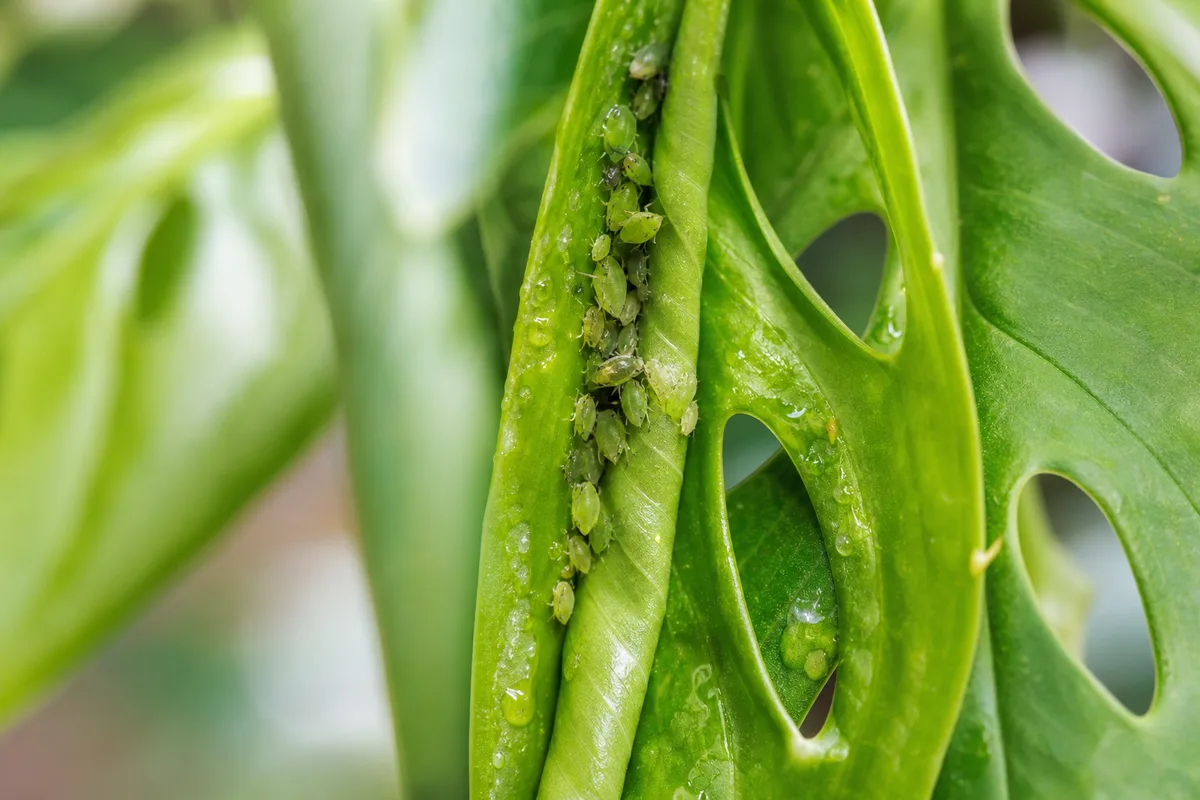
Look for aphids and their sticky honeydew on tender growth; this image illustrates a pest clue, not a cause that can be inferred from curl alone.
Inspect the undersides of mature leaves, the folds around petioles, and the newest leaf. For mites, tap a suspect leaf over white paper and look for tiny moving specks; use a hand lens if needed. For aphids, look for clusters, sticky residue, and cast skins. For thrips, inspect for silvery scars and black fecal dots inside folds. Isolate the Monstera from nearby plants while you confirm an infestation, because insects move more easily than a pot’s leaf symptoms suggest.
If pests are present, rinse the foliage thoroughly and repeat inspections over the next week. Remove a badly damaged leaf only when the remaining plant has plenty of healthy foliage; removing every curled leaf will not remove insects hidden in new growth. If water alone is not enough, use an insecticidal soap or horticultural oil labeled for indoor houseplants and follow its label, including repeat timing and a small-area test. The University of Minnesota Extension’s indoor-plant guidance recommends isolation and proper plant care as part of pest management; do not spray a stressed plant in strong sun or apply an unlabeled home mixture.
When Soil or Pot Size Is the Underlying Problem
A dense mix, blocked drainage holes, or a pot much larger than the root ball can keep the center wet longer than the surface suggests. At the other extreme, a root-bound plant may dry unusually fast because little mix remains to hold moisture. A drainage issue is supported by water sitting in the cachepot, a soggy center, or soil that remains wet long after the top dries; root restriction is more plausible when roots circle tightly, push through drainage holes, and the pot dries quickly after a full watering.
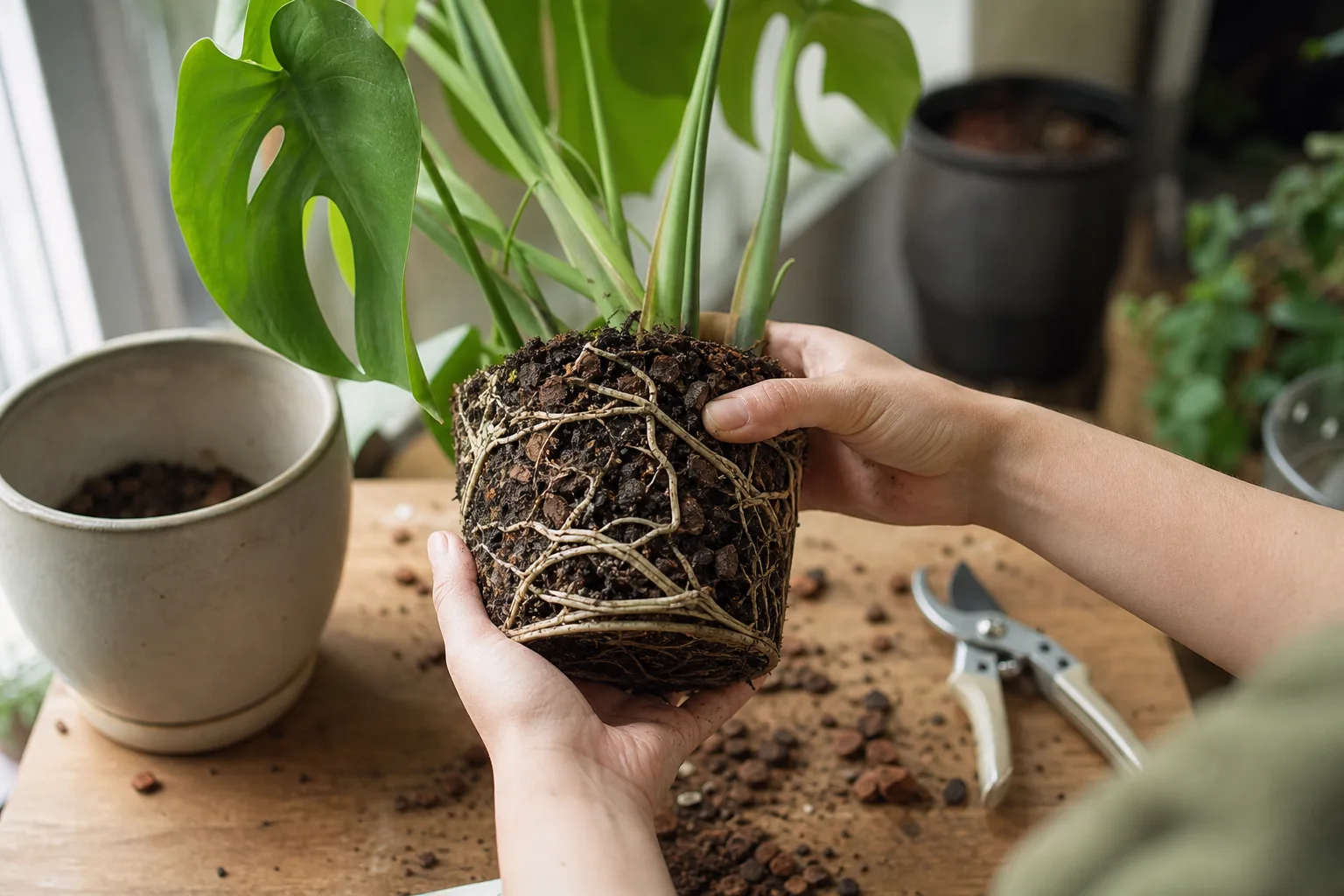
Root crowding is one reason to consider repotting, but inspect only when wet mix, fast dry-down, or decline gives you a reason.
Do not repot on a calendar or because a leaf is curled. Repot only when you can see tight roots, the mix has broken down or no longer drains, or a diagnosed root problem requires fresh medium. Move up just one pot size, choose a container with drainage, and use a loose mix that holds some moisture but lets excess water pass; Monstera is an aroid, so bark and coarse components can help keep the mix open. The University of Minnesota’s repotting guidance likewise advises avoiding oversized pots, which can retain excess moisture.
Avoid fertilizing as a first response to curl. Fertilizer cannot restore roots that are rotting or correct a plant that is too dry, too hot, or under pest attack; excess salts can create another leaf-margin problem. If the Monstera has not been fed during active growth for a long time, resume a balanced houseplant fertilizer at the label rate only after the roots and watering pattern are stable.
Follow a One-Change Recovery Plan
Use the evidence to make one correction, then give the plant time to respond. A simple sequence prevents a well-intentioned rescue from turning into a pile of treatments.
- Rule out normal unfurling. If one new spear is rolled and the mature leaves look healthy, leave it in place and wait for it to open.
- Check moisture at root depth. If the mix is dry, water thoroughly and drain it; if it is wet, stop watering and check drainage before deciding whether roots need inspection.
- Match the pattern to the room. If damage is limited to one exposed side, reduce direct sun or move the plant from a vent; if the whole plant is affected, check the root zone and room conditions together.
- Search for pests before treating. Isolate only when insects or their characteristic feeding signs are present, then rinse and use an appropriate labeled product if needed.
- Change humidity or potting mix only when evidence points there. Measure dry room air before adding a humidifier, and repot only for a drainage, root, or pot-size reason.
Keep a brief note of the change and date. If the plant’s condition does not stop worsening after you correct the confirmed cause, repeat the inspection rather than adding a fertilizer, changing the soil, and spraying for insects all at once.
What Can Recover, and How Long It Takes
A leaf that is only temporarily limp or curled from a dry root ball may regain firmness after it is watered correctly, but damaged tissue does not heal like skin. Brown, papery, scorched, or torn areas stay visible; a leaf that expanded with a crease or warped edge may keep that shape even after conditions improve. A slow response does not automatically mean the fix failed, especially if the roots were stressed. A plant can also keep a mild curve from the way a leaf expanded, so do not use perfect symmetry as the test for recovery. Keep light and temperature steady while you observe it; frequent moves make it harder to tell whether the correction helped.
Judge recovery by the whole plant. The curl should stop spreading, the remaining mature leaves should stay firm, and the next leaf should open without new distortion. If a new leaf is growing during a cool or dim season, it may take longer to expand; avoid tugging on it or repeatedly changing humidity to force it open. Root recovery and healthy new growth can take weeks or a growing cycle, so look for a stable trend rather than a same-day cosmetic change. Take a dated photo and compare it after the next normal watering-and-dry-down cycle instead of checking the same leaf repeatedly through the day. A useful improvement is no new curling, no new pests or discoloration, and a pot that dries at a more predictable pace. If one old leaf remains cupped while the rest of the plant is stable, leave it unless it is mostly dead or obstructs care.
Escalate your inspection if more leaves yellow while the mix stays wet, the stem base softens, or the plant continues to decline despite corrected conditions. Recheck drainage and root health, then look for pests you may have missed on leaf undersides and in growth folds. A Monstera that has a few permanently curled leaves but produces firm, normally opening new growth is recovering even if the older foliage never looks pristine again.
Prevent Curl From Returning
Keep the plant in bright, filtered light and away from heater, air-conditioner, and cold-window drafts. Use a pot with working drainage, empty its saucer after watering, and avoid a container that leaves a large volume of wet mix around a small root ball. These setup choices make watering easier to judge than a strict weekly schedule.
Before watering, check the upper layer of mix and learn how long the pot takes to dry in its current light and temperature. Water deeply when the mix has reached the appropriate dry-down, then let the pot drain fully; expect the interval to change with season, plant size, and room conditions. A hygrometer is useful if winter air is very dry, and a nearby humidifier can stabilize humidity without keeping the roots wetter.
Inspect the plant as you wipe dust from the leaves. Check new growth for aphids or thrips and the leaf undersides for stippling or webbing, particularly after bringing home a new plant. Small, early corrections—watering based on the mix, gradual changes in light, and prompt pest isolation—usually prevent more stress than treating every curled edge as an emergency.
Conclusion: Fix the Evidence, Not the Shape
Monstera leaves curl for several reasons, so the first step is to decide whether you are seeing a normal new leaf or a mature leaf reacting to stress. Check the soil, compare affected leaves, and look for exposure or pest evidence before choosing one correction. The most reliable sign that the plant is improving is healthy, undistorted new growth—not whether an old leaf becomes perfectly flat.



