How to Grow and Care for Mountain Laurel Successfully
Grow mountain laurel successfully with the right shade, acidic soil, steady moisture, careful pruning, and cultivar choices suited to your garden and climate.
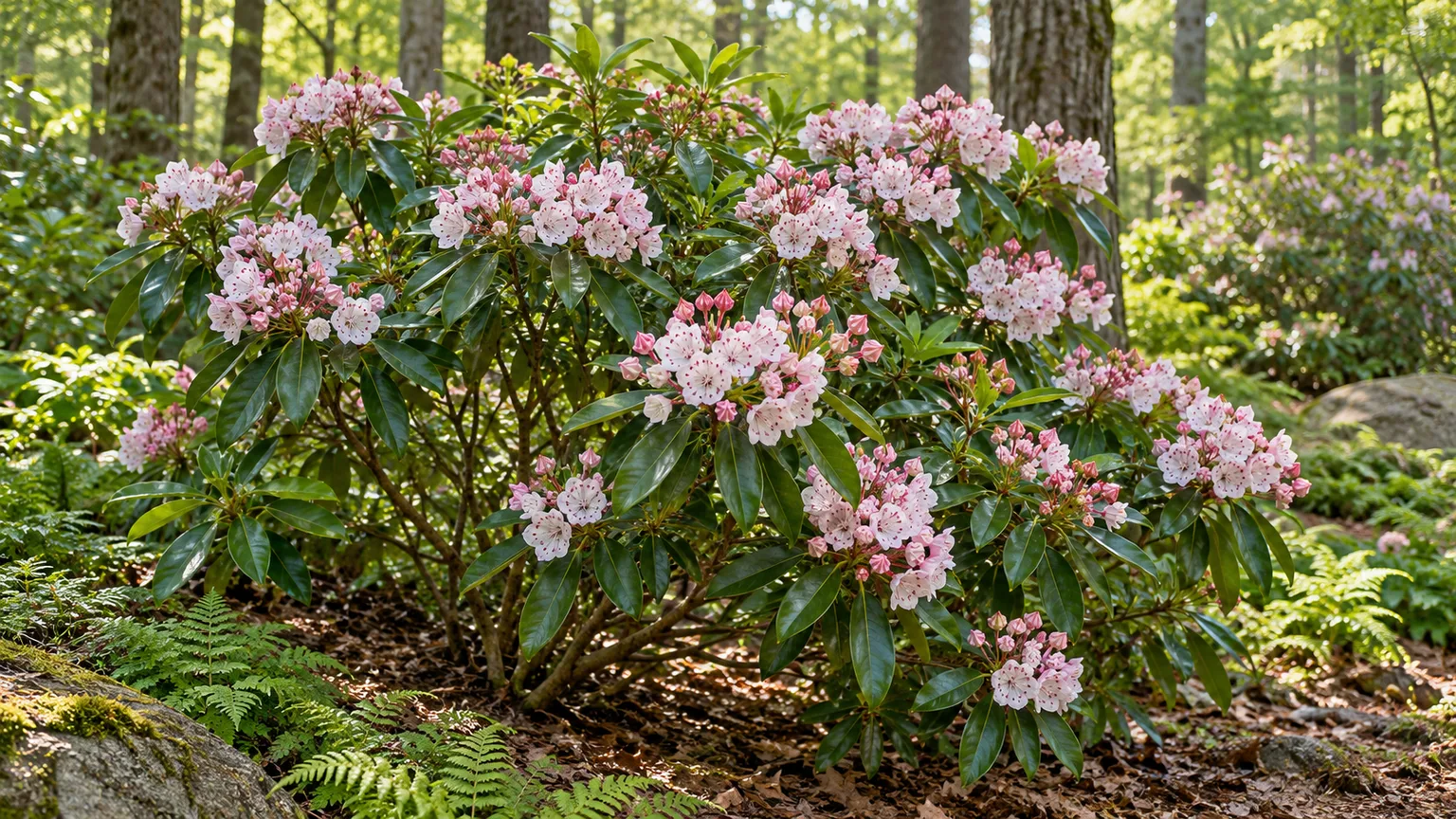
Mountain laurel can be a beautiful evergreen shrub, but it is not a universal “plant it anywhere and forget it” choice. It flowers best where roots stay cool and moist without sitting in water, the soil is acidic, and the light is bright but not punishing. If your garden has those conditions, Kalmia latifolia rewards patience with leathery leaves, sculptural buds, and clusters of intricate spring flowers.
The site matters more than a complicated care schedule. Before buying one, check the plant’s mature size, your soil pH and drainage, summer exposure, winter wind, and whether children, pets, or grazing animals can reach it. The guidance below covers mountain laurel as a landscape shrub, including how to plant it, preserve next year’s flower buds, and diagnose the problems that often trace back to a poor site.
Is Mountain Laurel Right for Your Garden?
What “mountain laurel” means
This guide covers Kalmia latifolia, a broadleaf evergreen in the heath family, Ericaceae. It has glossy, elliptical leaves and terminal clusters of small, five-sided flowers that open from pink or red-tinged buds. The markings inside each cup-shaped flower give the shrub its distinctive calico look, and a bee landing on a flower can trigger its spring-loaded anthers to release pollen. NC State Extension describes the species’ touch-sensitive flowers and its eastern woodland and rocky-slope habitats. (NC State Extension Plant Toolbox)
Common names are confusing. Texas mountain laurel is a different species, Dermatophyllum secundiflorum, with fragrant purple flower clusters and compound leaves; it does not share the same appearance or care profile. Bay laurel, Laurus nobilis, is a culinary Mediterranean tree and is unrelated. Check the botanical name on the nursery tag before following advice: a label that says only “laurel” is not enough to identify the plant.
Native range, hardiness, and mature size
Mountain laurel is native to eastern North America, where it grows along woodland margins, mountain slopes, acidic forests, and open rocky or sandy sites. In cultivation, an average plant may reach roughly 6 to 12 feet tall and wide, although slow growth and named compact cultivars make the range broad. On favorable Appalachian sites, wild plants can become much larger than the landscape shrubs most gardeners buy. Virginia Cooperative Extension lists the species for USDA Zones 4–9, while university references sometimes use a narrower range; local exposure, provenance, and cultivar all affect winter performance. (Virginia Cooperative Extension; University of Connecticut Plant Database)
The plant is a better fit for a cool, partly shaded garden with acidic soil than for a hot, reflected-heat corner or a low, wet planting bed. It is slow-growing, so it can take years to fill the space shown on a mature-size label; buy for the eventual width rather than tucking a large-growing selection beside a path or window. In regions with frequent wildfires, check local defensible-space guidance before planting near a home: NC State Extension assigns mountain laurel a high flammability rating and advises keeping it outside the defensible space closest to the house. (NC State Extension Plant Toolbox)
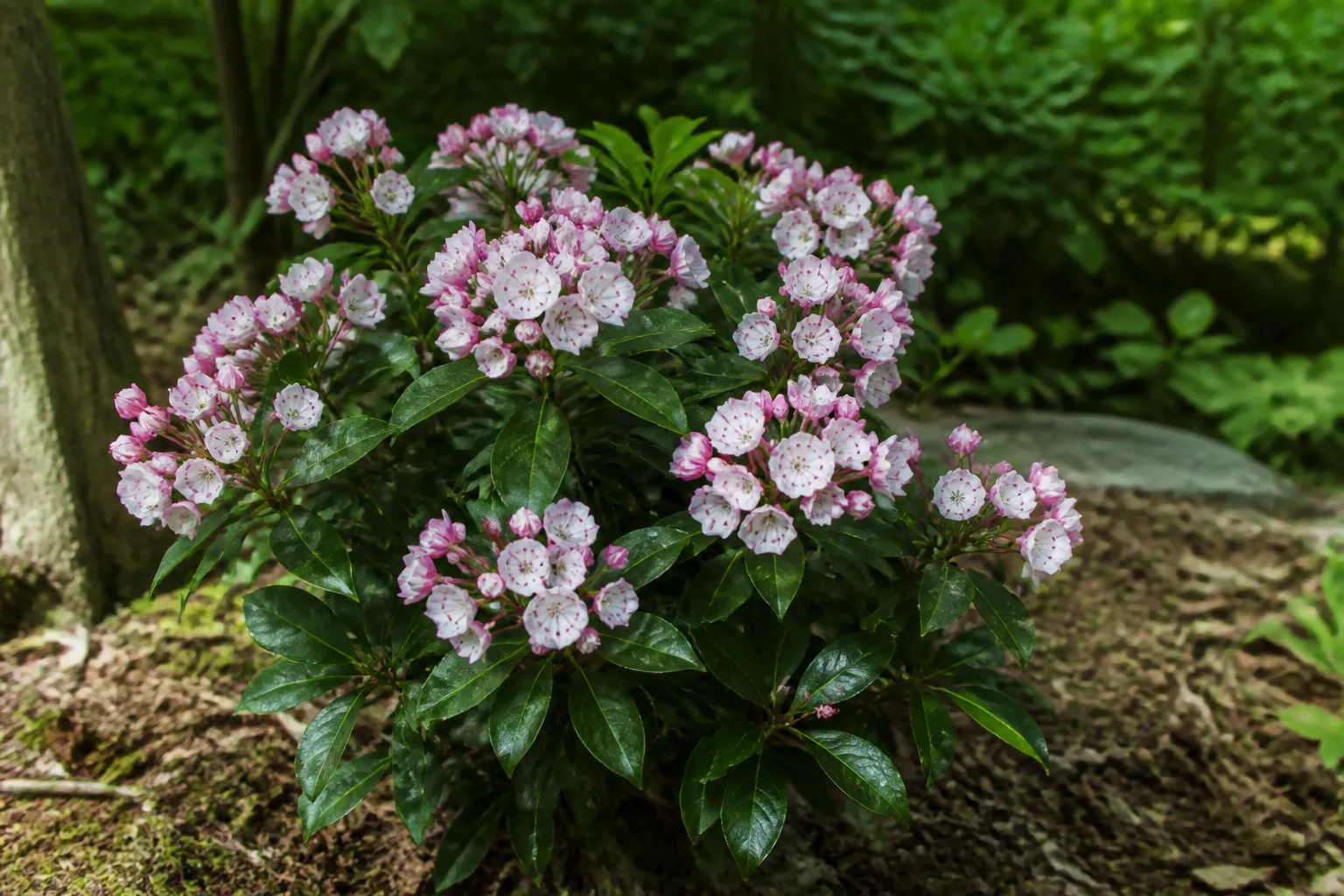
A mature mountain laurel combines year-round foliage with a late-spring flower display; allow enough room for its eventual width.
Choose the Right Light and Exposure
Partial shade is the most reliable starting point: aim for morning sun and protection from the hottest afternoon rays, especially in the Mid-Atlantic and South. The leaves stay darker and roots remain cooler when the plant is sheltered from intense heat. Virginia Tech and NC State both describe part shade as the preferred exposure, though the shrub can tolerate a wider range when soil moisture and temperature are favorable. (Virginia Cooperative Extension; NC State Extension Plant Toolbox)
In cooler northern gardens or at higher elevations, mountain laurel can grow and flower in more sun if the soil stays evenly moist and the root zone does not overheat. Deep shade is not the same as protective shade: under dense canopy, the shrub may become open and sparse, with fewer flowers. Watch the site through a full day rather than judging it from one midday visit. Dappled light beneath high tree branches is often a better match than dense shade under a low evergreen canopy.
Wind exposure matters too. Evergreen leaves continue losing water during winter, while frozen soil limits replacement; drying winds and bright winter sun can scorch foliage even when summer care is good. Choose a sheltered site where practical, but do not crowd the shrub against a hot wall or place it in a pocket with poor air movement and persistently wet soil. The best location balances filtered light, drainage, and protection from extremes.
Start With Acidic, Well-Drained Soil
Mountain laurel needs more than “moist soil.” The root zone should be acidic, rich in organic matter, and able to drain after rain. Virginia Cooperative Extension calls well-drained soil an absolute requirement, and NC State warns that the plant performs poorly in heavy clay or wet ground. A naturally acidic woodland edge is usually easier to manage than trying to convert a compacted, alkaline lawn bed after planting. (Virginia Cooperative Extension; NC State Extension Plant Toolbox)
Test the soil before trying to change it
Mountain laurel is often given a target around pH 4.5–5.5. Some references use a slightly different range, which is a reminder to treat the number as a soil-test goal rather than a magic cutoff. University of Maryland Extension groups mountain laurel with acid-loving evergreens and lists pH 4.5–5.5; the University of Illinois’ mountain-laurel disease guidance describes an ideal acidic range of about 4.2–5.2. A lab test can report pH and nutrient levels together, helping you avoid adding acidifiers or fertilizer the site does not need. (University of Maryland Extension; University of Illinois Extension Plant Disease Clinic)

Use a representative soil sample to check pH before adding sulfur, iron, or an acid-forming fertilizer.
Collect soil from several points around the future planting area at the depth specified by your Extension laboratory, then mix the samples and submit them according to its instructions. If the soil is alkaline, do not pour vinegar into the bed or guess at a sulfur rate; the amount needed depends on texture, starting pH, and other conditions. A small planting hole filled with an acidic mix can also become an isolated pocket, while nearby soil and irrigation water continue pushing pH upward. Test first and decide whether maintaining an acidic bed is realistic before buying the plant.
Fix drainage across the planting area
If rainwater stands in the intended location or the soil remains slick and saturated, solve the drainage problem before planting. A raised bed or broad, gently raised berm can improve drainage more effectively than a deep pocket of loose material. In heavy clay, do not create a hole that acts like a bathtub; prepare a wider planting area or choose a different shrub for that site. Mountain laurel tolerates moisture but not waterlogged roots.
Work in a modest amount of leaf mold or other well-rotted organic matter when it suits the existing soil, then mulch the surface. Avoid making the backfill dramatically different from the surrounding ground: a sharp soil-texture boundary can hold or redirect water around the root ball. A 2- to 3-inch layer of organic mulch helps conserve moisture and buffer root temperature; pine needles, leaf mold, or finely shredded bark are options. Keep mulch a few inches away from stems so the crown stays airy and visible.
Plant Mountain Laurel With a Shallow Root Zone in Mind
Mountain laurel can be slow to establish, so a good planting day is one part of the job; careful root-ball handling and reliable aftercare matter just as much. Choose a healthy container-grown shrub with even foliage and a root ball that holds together. Avoid a plant with extensive dieback, badly circling roots, or a root ball that is either bone-dry or sour and waterlogged.
Time the planting and plan spacing
Plant in spring or early fall, when temperatures are moderate and the soil is workable. In hot climates, early fall gives roots time to grow before summer heat; in cold regions, spring planting allows a full season of establishment before winter. Avoid planting during a heat wave, drought, or period when the soil is saturated or frozen. Water the nursery pot before planting so the root ball is evenly moist, not dripping.
Use the cultivar’s expected mature width to set spacing. Species-sized plants commonly need about 6 to 10 feet of room, while dwarf forms can be much smaller; use the nursery’s cultivar-specific dimensions rather than assuming every mountain laurel should be 4 feet apart. For a screen, closer spacing makes a faster visual barrier but can reduce airflow and make future pruning harder. Place plants where their branches can reach their natural shape without blocking a walkway or pressing against siding.
Set the root ball at grade
Dig a planting hole two to three times as wide as the root ball but no deeper than its height. Loosen the sides of the hole, remove the container, and inspect the roots. If a few roots circle the outside, tease them outward gently; do not wash away all the growing medium or pull apart a fragile root ball. Set the top of the root ball level with the surrounding soil, or just slightly above grade where drainage is marginal. Never bury the crown under a deep layer of amended soil or mulch.
Backfill with the soil you removed, firm it gently to eliminate large air pockets, and water slowly to settle it. Create a shallow watering basin beyond the root ball, not against the stems. Apply mulch over the root zone while leaving the trunk area clear. Newly planted shrubs can wilt before roots reach surrounding soil, so check the original root ball itself; the garden around it may be damp while the nursery mix has dried out.
Water and Mulch for Even Moisture
The practical goal is consistent moisture with oxygen still reaching the roots. Water slowly at the base so the root ball and the surrounding soil both absorb moisture, then let excess drain. A sprinkler that wets the foliage but barely reaches the root zone can create the illusion that the shrub has been watered. A soaker hose or drip line is easier to direct and can reduce unnecessary wetting of leaves.
First-season watering versus established care
During the first growing season, check the soil every few days in warm or windy weather and water when the upper few inches begin to dry. The interval will be shorter in sandy soil, heat, and small root zones, and longer in cool weather or moisture-retentive soil. Do not follow a fixed calendar regardless of rainfall. A slow, thorough watering is more useful than frequent splashes that wet only the surface.
Once established, mountain laurel can tolerate some dry periods, but it is not a drought-proof shrub. Give it a deep drink during a prolonged dry spell, particularly in summer heat or before the ground freezes in a dry autumn. If leaves curl, become dull, or develop marginal scorch, check moisture at the root zone before assuming the plant needs more water; saturated soil can produce similar stress symptoms. The roots need both moisture and drainage.
Refresh mulch when it thins, but do not heap it into a volcano around the stems. Too much mulch can hold the crown wet and hide planting too deeply. In colder regions, a sheltered site and a breathable layer over the root zone help buffer temperature swings; water before winter only when the soil is dry and unfrozen. Containers are more demanding: use a large pot with drainage, an acidic mix intended for ericaceous plants, and a plan for frequent summer checks and winter root protection. For many gardeners, an in-ground planting is easier to keep evenly moist.
Fertilize Only When a Soil Test Calls for It
Do not fertilize mountain laurel automatically every spring. A slow-growing shrub in an organic woodland-style bed may not need added nutrients, and excess fertilizer can injure shallow roots or push soft leafy growth at the expense of a balanced form. University of Maryland Extension advises fertilizing evergreens when a soil-test report recommends it, and cautions that repeated acid-forming fertilizer applications can drive the pH too low. (University of Maryland Extension)
If a test identifies a need, choose a product appropriate for acid-loving shrubs and use the label rate. Spread it over the active root area rather than piling it against stems, and do not use a high-phosphorus “bloom booster” just to try to force flowers. If leaves are yellow, diagnose the pattern and inspect drainage before feeding. Adding iron without correcting high pH or wet roots can mask a symptom for a short time while the real problem continues.
Prune After Bloom and Protect Next Year’s Buds
Mountain laurel forms its next spring’s flower buds on older growth, so prune soon after the flowers fade if shaping is needed. Remove dead, damaged, or crossing stems with clean pruners, and shorten only as much as needed to improve the shrub’s structure. NC State Extension also recommends light post-bloom pruning and notes that next year’s flowers appear on old growth. (NC State Extension Plant Toolbox)
You do not have to deadhead every flower cluster. Removing spent blooms can make the shrub look tidier and limits seed capsules; leaving some clusters preserves the natural seed display and saves time. On a mature shrub with many branches, hand-deadheading every cluster can be a tedious task with little landscape benefit. If you do deadhead, avoid cutting far down the stem and removing the new shoots that carry next year’s buds.
Do not shear mountain laurel into a tight hedge unless you accept fewer flowers and a more artificial outline. Avoid late-summer or fall shaping because new cuts can remove buds already set for spring. A very old, overgrown shrub may need more than light pruning, but drastic renovation is slow to recover and can expose bare branches; consult a local Extension horticulturist or a knowledgeable native-plant nursery before cutting a valued specimen nearly to the ground.
Choose a Cultivar for Your Site, Not Just Its Flowers
Cultivar labels can describe flower color, bud color, plant habit, and disease resistance, but the name alone does not tell you whether a selection suits your bed. Compact forms such as ‘Elf’ and ‘Minuet’ are useful where a full-size species plant would crowd a path. ‘Olympic Fire’ and ‘Sarah’ are known for colored buds and pink flowers, while white selections such as ‘Pristine’ suit a quieter palette. Extension and horticultural references list many more named selections, including forms chosen for size or leaf-spot resistance. (NC State Extension Plant Toolbox; Virginia Cooperative Extension; Fine Gardening)
Ask the nursery for the mature width, not just the height of the plant in its pot, and confirm the local hardiness recommendation for that cultivar. A compact plant can still be wider than expected, and a cultivar bred in a cooler region may respond differently in a hot, humid site. Cultivars do not eliminate the species’ need for acidic soil, moisture, and drainage. Choose a color you like only after the location can support healthy growth.
Propagate by Cuttings or Seed
Growing from seed is possible, but it is a long project rather than a quick way to make a flowering hedge. Seed-grown plants vary and may not keep the traits of a named cultivar. The seeds are tiny, germination can be uneven, and a seedling needs years of growth before it resembles a landscape shrub. If the aim is one attractive specimen or a known flower color, buying a correctly labeled nursery plant is usually more dependable.
Semi-ripe cuttings taken during summer are a practical route to cloning a plant, though success is not guaranteed. Use healthy current-season shoots, remove leaves from the lower portion, and place the cuttings in a sterile, free-draining propagation mix. Keep them humid but ventilated, warm, and out of direct sun while they form roots; this can take several months. The Royal Horticultural Society lists semi-ripe cuttings as a propagation method, and Fine Gardening recommends greenwood cuttings in late spring or semi-ripe cuttings in midsummer. (Royal Horticultural Society; Fine Gardening)
Rooting varies by cultivar and cutting maturity. Do not tug on a cutting every few days to check for roots; wait for new growth or resistance to a gentle test, then pot it on and protect it while it establishes. Keep any propagation away from children and pets: the leaves and other plant parts should not be eaten, and seeds or trimmings should not be used in food or craft projects that invite chewing.
Troubleshoot Yellow Leaves, Spots, and Pests
Start with the pattern, not a bottle of fertilizer or fungicide. Yellowing between green veins on new leaves can point to iron chlorosis, often made worse when soil pH is too high; Illinois Extension also notes that poor drainage, restricted roots, and other nutrient conditions can create similar symptoms. A soil test and root-zone check are more useful than assuming every yellow leaf means “add acid.” (University of Illinois Extension Plant Disease Clinic; University of Illinois Extension on iron chlorosis)
Brown margins or scorched leaves may follow drought, hot reflected light, strong winter wind, or freeze exposure. If the damage is mostly on the exposed side after winter, improve shelter and maintain root-zone moisture before winter rather than feeding the plant. Dark spots, leaf blight, or repeated premature leaf drop can be linked to fungal problems favored by wet foliage and poor air circulation. Give the shrub room, water at soil level, and remove fallen diseased leaves. If symptoms spread or branches die back, take a sample or clear photos to your local Extension office for diagnosis; different diseases need different responses. (University of Illinois Extension Plant Disease Clinic; Gardener’s Path)
NC State lists lace bugs, scale, whiteflies, and borers among potential pests. Look beneath leaves and along stems for insects, stippling, sticky residue, or localized dieback before treating. A pesticide is not a diagnosis, and a product that harms beneficial insects may do little for a root problem or leaf disease. Identify the pest, check local Extension advice, and follow the product label and local rules if treatment is justified. (NC State Extension Plant Toolbox)
Keep It Away From Pets, Children, and Livestock
Mountain laurel is poisonous if eaten. NC State Extension flags high-severity poison characteristics, and the ASPCA lists Kalmia latifolia as toxic to dogs, cats, and horses because of grayanotoxins. Do not plant it where a child is likely to taste leaves or flowers, where a dog chews shrubs, or where livestock can browse it. Keep prunings and seed capsules out of animal feed and accessible compost. (NC State Extension Plant Toolbox; ASPCA Poison Control)
If a person may have eaten any part of the shrub, contact Poison Control in the United States at 1-800-222-1222 rather than waiting for symptoms; outside the U.S., use your local poison service or emergency system. If a pet or horse may have chewed it, call a veterinarian or animal poison service and identify the plant as Kalmia latifolia. NC State also notes that honey from bees feeding heavily on mountain laurel may be toxic to people; the practical point is not to use the shrub as a food plant or assume that every plant product is safe. Its nectar can still be used by pollinators. (Poison Control; ASPCA Poison Control; NC State Extension Plant Toolbox)
Conclusion
The best way to grow mountain laurel is to give it the right site before asking it to thrive: partial shade, acidic soil, steady moisture, and excellent drainage. Plant it shallowly, keep mulch off the stems, water carefully while it establishes, and prune only after flowering so you do not remove next year’s buds.
Choose a cultivar whose mature size and hardiness fit your area, and check soil pH before adding fertilizer or acidifiers. If your ground is wet clay, alkaline, exposed to harsh heat, or close to defensible space around a home, a different shrub may be the more reliable choice. When the site fits and ingestion risks are managed, mountain laurel can become a long-lived evergreen centerpiece with a distinctive spring bloom.



