Peperomia Ginny Care: Light, Water, Soil and More Indoors
Learn how to grow Peperomia Ginny with the right light, watering, soil, and seasonal care. Get propagation steps and clear fixes for common leaf problems.
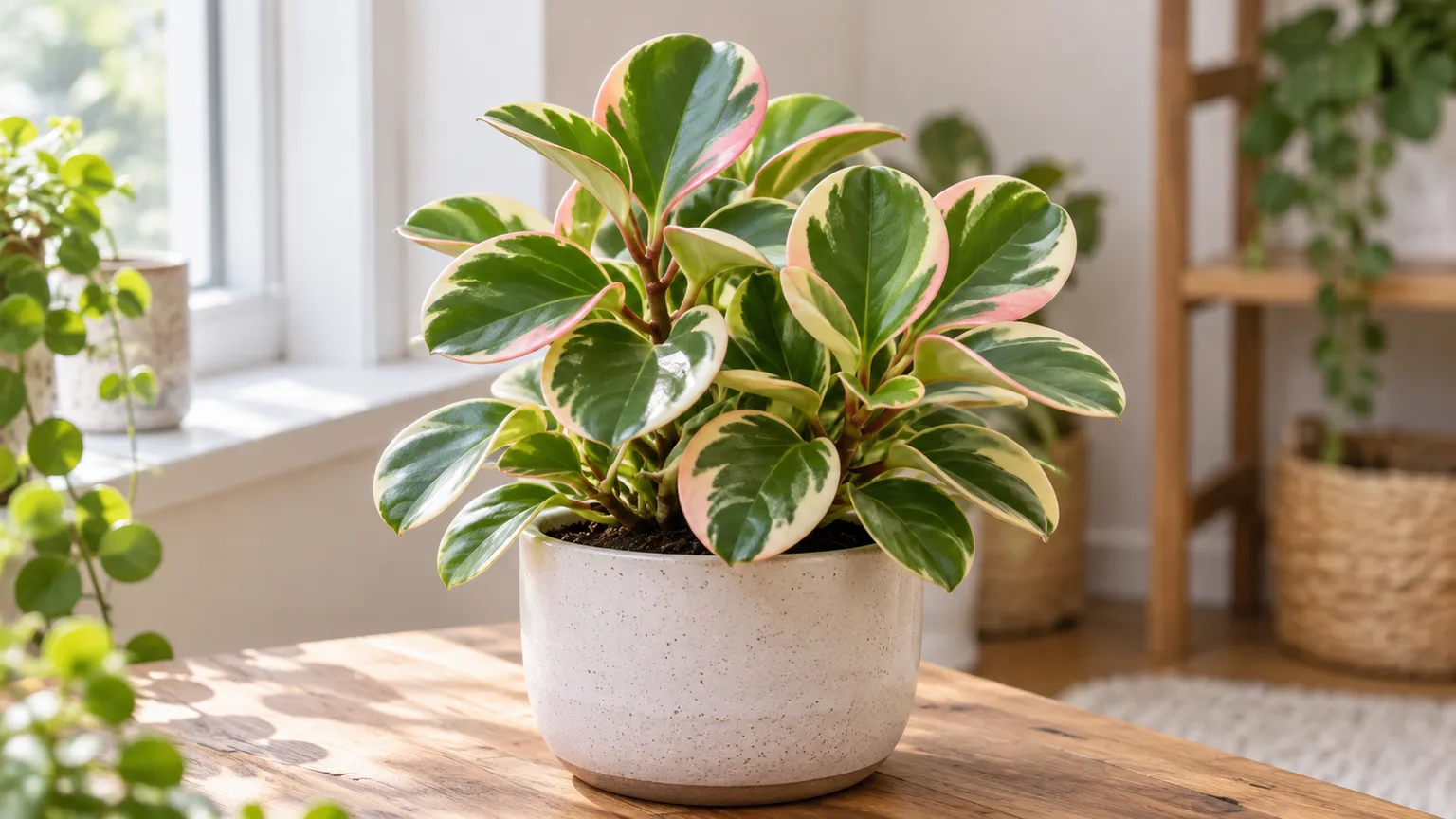
Peperomia Ginny is a compact, upright Peperomia clusiifolia cultivar with fleshy green leaves edged in cream and pink. Give it bright filtered light, a potting mix that drains freely, and a thorough drink only after the mix has partly dried; the leaves hold some moisture, but the roots still need air. Those three choices do more for a healthy, colorful plant than a rigid weekly schedule.
Ginny is forgiving of ordinary indoor conditions, but it is not indestructible. A heavy pot that stays wet, deep shade, or a cold draft can undo its easy-care reputation. A single leaf is not a diagnosis; check the growing conditions first and change one thing at a time so you can tell whether the adjustment helped.
What Peperomia Ginny Is—and What Its Color Tells You
Ginny is a selected form of Peperomia clusiifolia, commonly called red-edge peperomia or baby rubber plant. NC State describes the species as an erect, mounding plant with stiff, glossy, succulent-like leaves and lists ‘Ginny’ among its cultivars, with green leaves edged in yellow and pink. The RHS profile gives the species a mature size around 30 centimeters, or about one foot, which explains why it suits a desk, shelf, or small plant stand. (NC State Extension; Royal Horticultural Society)
Retailers may call it Rainbow, Tricolor, or Jelly Peperomia, and labels are not always consistent. Use the botanical name and the leaf pattern together: Ginny has firm, oval leaves with a green center and cream-to-pink margins, while other Peperomia species may trail, ripple, or carry very different markings. The colors also vary with light, maturity, and the particular plant, so a young leaf can look less saturated than established foliage.
This plant is often described as a succulent or semi-succulent because its leaves and stems are fleshy. That means it can tolerate a short dry spell better than a plant with thin leaves; it does not mean the roots want to sit in dry, hard-packed soil for weeks. Think “let the surface dry, then water fully,” not “treat it like a desert cactus.”
Peperomia Ginny Care at a Glance
| Need | Practical starting point |
|---|---|
| Light | Bright, indirect or filtered light; protect from strong afternoon sun |
| Water | Let the upper layer of mix dry, then water through and empty the saucer |
| Soil | Loose, airy houseplant mix with added perlite, pumice, or fine bark |
| Pot | Drainage hole; only a little wider than the root ball |
| Temperature | Normal warm indoor conditions; avoid cold drafts and sudden swings |
| Humidity | Average home humidity is usually adequate |
| Feeding | Diluted, balanced fertilizer during active spring and summer growth |
| Growth habit | Slow-growing, compact, upright to mounding |
Use this as a starting point, not a calendar. A small plastic pot in a warm bright room dries at a different rate from a larger ceramic pot in a cool room. Check the mix and the plant itself before repeating a care task.
Choose Light That Preserves the Pink Edges
Bright, indirect light is the best compromise between compact growth and vivid variegation. An east-facing window is often an easy fit; near a west or south window, sheer curtains or a position slightly back from the glass can soften the strongest rays. A north-facing room may keep Ginny alive, but if the plant stays dim for months, the stems can stretch and the colored margins may look less pronounced. (The Sill; RHS)
Let the plant tell you whether the position is working. New growth should stay reasonably close together, and the leaves should remain firm and patterned. If stems lean toward the window or new leaves are smaller and greener, move the pot closer to filtered daylight over several days, or rotate it a quarter turn weekly so one side does not do all the reaching.
Too much direct sun causes a different pattern: bleached or tan patches on the window-facing leaves, often after a sudden move outdoors or into a hot window. Damaged tissue will not turn pink again, so move the plant out of the harsh beam and let later growth show whether the new position is better. Do not move it from deep shade straight into hours of direct sun to fix faded color; that trades a slow light problem for a fast scorch.
Artificial light can help if the brightest available window is still gloomy. Place a full-spectrum grow light above or beside the plant according to the fixture’s instructions and use a timer for a consistent day length. Keep enough distance to prevent leaf heating, then assess new growth over several weeks rather than judging the old leaves.
Water by Soil Condition, Not by the Calendar
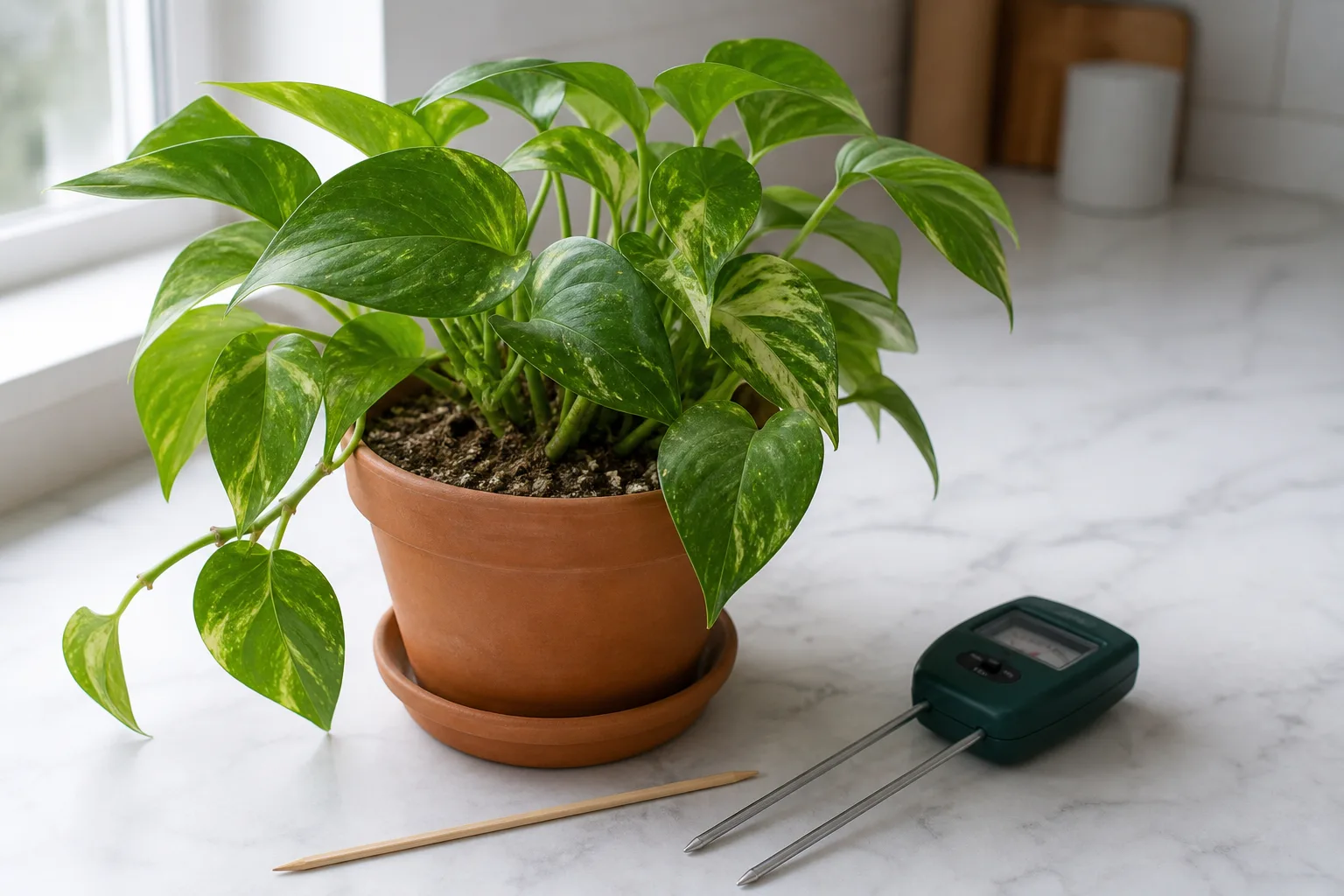
Water when the top layer of potting mix has dried and the pot feels noticeably lighter, then soak the root ball evenly until water exits the drainage hole. Pour away what collects in the saucer after the pot has drained. This cycle wets the whole root zone while giving it time to regain air; frequent small splashes can leave some roots dry and others constantly wet.
For a small Ginny in a typical indoor pot, checking the upper inch or two with a finger is a useful first test. The exact interval changes with pot size, mix, temperature, window exposure, and season, so “every seven days” is only a reminder to inspect, not an instruction to water. The RHS likewise recommends letting the compost partly dry and checking it rather than watering to a fixed routine. (RHS growing guide; The Sill)
In spring and summer, brighter light and active growth often mean the pot dries sooner. In winter, shorter days and slower growth usually mean longer gaps between drinks. Do not compensate for winter leaf drop by watering more until you have checked the soil: a cold, wet root ball is a common reason a Peperomia declines indoors.
If the mix has pulled away from the pot or water races down the sides, it may have become too dry to rewet evenly. Apply water slowly in two passes, letting the first pass soak in, or briefly stand the pot in shallow water until the surface begins to feel damp; then let it drain fully. Avoid leaving the plant in a cachepot or decorative sleeve full of runoff.
Soft, yellowing leaves together with damp soil point toward excess moisture or poor drainage more than thirst. Shriveled or slightly curled leaves with a very dry mix suggest the plant has been left dry too long. Neither clue is conclusive by itself, so pair the leaf feel with the moisture and weight of the pot before changing the routine.
Give the Roots an Airy Mix and a Right-Sized Pot
Ginny needs a mix that holds enough moisture for roots to take it up but does not stay saturated after watering. A practical home blend is two parts quality indoor potting mix to one part perlite or pumice, with a smaller amount of fine orchid bark if the mix feels dense. If you buy a ready-made houseplant mix, loosen it with perlite rather than assuming a bag labeled “succulent” is automatically right; some cactus mixes dry too quickly in a warm, bright room.
Use a pot with at least one unobstructed drainage hole. Terracotta can dry faster than plastic, which helps a grower who tends to overwater but may require closer checks in a hot or dry home. Plastic or glazed ceramic can also work if you use an airy mix and do not let water stand in the bottom of an outer pot.
Avoid sizing up by several inches “for room to grow.” A large volume of unused mix stays wet longer than the roots can use, especially when Ginny is growing slowly. Move up only when roots form a dense coil, the root ball dries unusually fast despite a sound mix, or the plant has outgrown its current container; choose the next pot just a little wider than the root ball. RHS recommends modest pot increases for Peperomia because excess compost around a small root system can remain wet and contribute to root problems. (RHS growing guide)
Spring is a convenient time to repot, but a healthy plant does not need a calendar-based repot every year. Ease it from the pot, loosen only circling outer roots, remove clearly dead or mushy roots, and settle it at the same depth in fresh mix. Water once to settle the mix, let the pot drain, and wait for the usual partial dry-down before watering again.
Keep Temperature Steady; Treat Humidity as Optional
A comfortable, warm room is generally suitable. Keep Ginny away from cold drafts, open winter windows, air-conditioning blasts, and heat vents that rapidly dry one side of the plant. If the room is comfortable for people and the plant is not touching cold glass, temperature usually needs no special equipment.
Peperomia Ginny does not need a greenhouse-level humidity setup to grow well in a home. The Sill notes that its thick leaves help it tolerate moderate household humidity, while RHS describes Peperomias as adaptable to normal indoor air. A humidifier may help if your whole room is persistently very dry, but raising humidity is not the first fix for leaves that are yellowing in wet soil. (The Sill; RHS growing guide)
Misting is brief and does little to change room humidity, so it should not be treated as a daily care requirement. If you use a pebble tray, keep the pot above the waterline and empty stagnant water; the tray is optional and cannot compensate for dry roots, poor light, or a hot draft. Grouping plants can modestly change the air immediately around them, but good placement and sensible watering matter more.
Feed Lightly While It Is Growing
A slow-growing Ginny does not need heavy feeding. During active growth in spring and summer, apply a balanced liquid houseplant fertilizer diluted to the label’s lower recommended strength, roughly every four to six weeks if the plant is producing new leaves. If the potting mix already contains fertilizer or the plant is barely growing, feed less often rather than layering products.
Do not fertilize a dry, stressed, recently repotted, or root-rotted plant in the hope of forcing recovery. Fertilizer does not replace light or healthy roots, and extra salts can injure roots and leaf edges. Pause feeding during the darker months when growth slows, then resume cautiously when new growth returns.
Prune for Shape and Repot Only When Needed
Ginny naturally forms a compact mound, but one-sided light or long periods in a dim spot can leave it lopsided. Rotate the pot periodically and use clean scissors to remove dead leaves or trim an overly long stem just above a leaf joint. New side shoots may branch from below the cut, although pruning cannot make a plant bushy if the underlying light is still inadequate.
It may produce slender, pale flower spikes rather than showy blooms. You can leave them in place or snip them off at the base if you prefer the foliage; removing a flower spike is cosmetic, not a required health treatment. Avoid repeatedly pinching every new tip on a small plant, since the lost leaf area can slow an already modest grower.
Repot for a reason, not because a fixed number of months has passed. Roots emerging from a few drainage holes alone do not necessarily mean the plant is in trouble; dense circling roots, unstable growth, or a mix that dries almost immediately are stronger signs. After repotting, give the plant steady light and leave it alone while it settles instead of pruning, fertilizing, and changing its location all at once.
Propagate Peperomia Ginny from Cuttings
Stem cuttings are the most straightforward way to make another Ginny while keeping the parent plant’s compact, colorful form. NC State lists both stem and leaf cuttings for Peperomia clusiifolia, and RHS describes softwood cuttings rooted either directly in a free-draining mix or first in water. Choose a healthy, actively growing stem and work with clean scissors, a small pot, and a loose propagation mix. (NC State Extension; RHS growing guide; Gardening Know How)
Take a cutting during spring or summer if possible, when the parent plant is making new growth. Cut a few inches of stem with at least one node—the point where a leaf joins the stem—and keep one or two healthy leaves near the top. Remove leaves that would sit underwater or under the mix; do not strip the cutting completely, since remaining leaves supply energy as it roots.
Root a Stem Cutting in Water
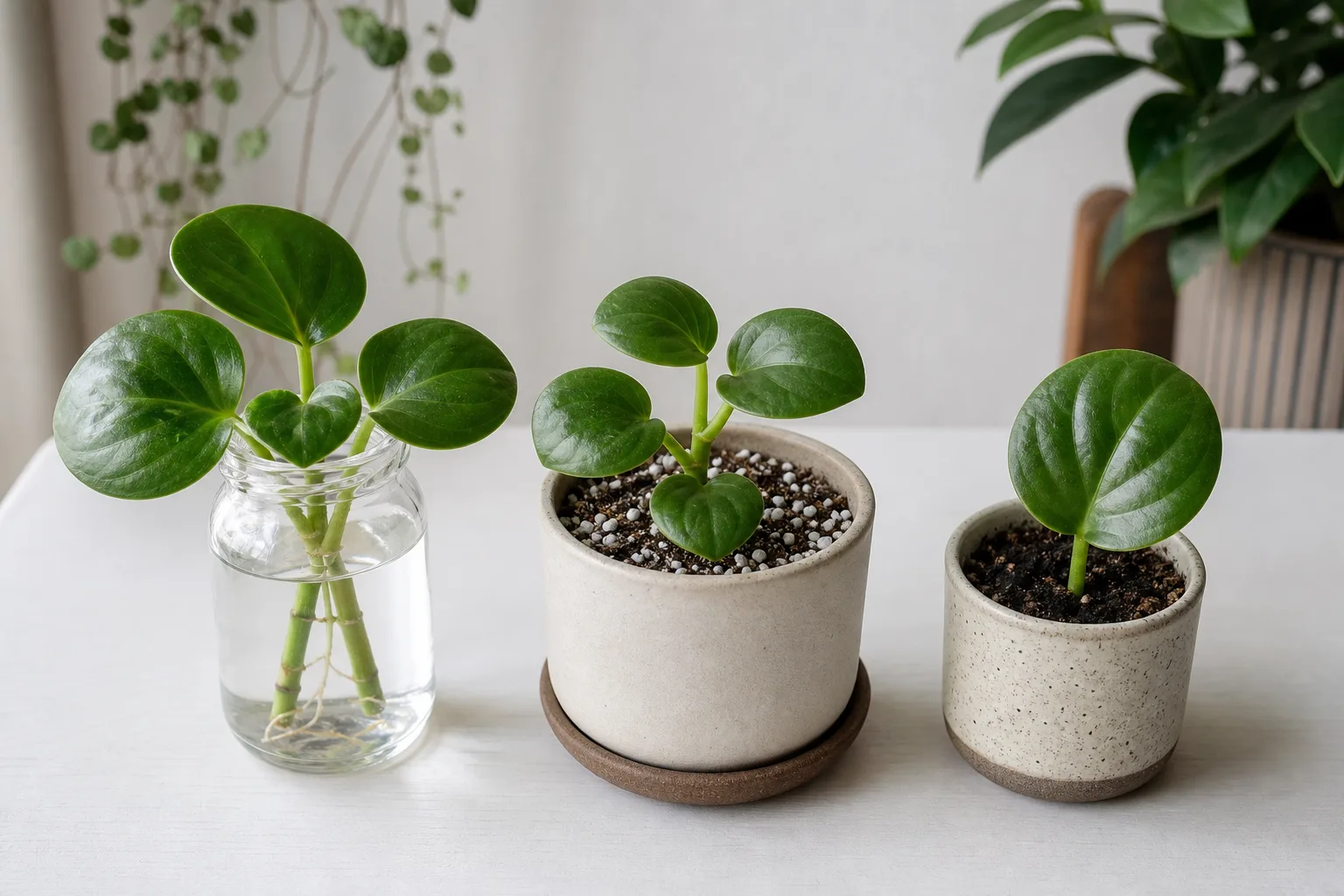
Place the lower node in a narrow, clean glass of room-temperature water, with the leaves held above the surface. Set it in bright, indirect light and refresh the water when it becomes cloudy or the level drops; the node should stay submerged, but the foliage should not sit in water. A clear vessel lets you watch for roots without tugging at the cutting.
When several roots have formed and are a few centimeters long, transfer the cutting to a small pot of lightly moistened, airy mix. Settle the mix around the roots without packing it hard, then keep it lightly and evenly moist while the cutting adjusts. Water-grown roots are delicate, so avoid letting the pot dry completely in the first stretch after planting, but do not leave it soggy.
Root a Stem Cutting in Potting Mix
Insert the cutting’s lower node into a small pot of pre-moistened propagation mix. A blend of potting mix and perlite gives the new roots both moisture and air; the pot should be only large enough to hold the cutting, with a drainage hole. Press gently around the stem so it stands upright, without burying its leaves.
Cover the pot loosely with a clear bag or propagation dome if the room is dry, leaving a gap for air exchange and keeping plastic from touching the leaves. Place it in warm, bright filtered light and check the mix regularly: it should feel lightly moist, not shiny, muddy, or waterlogged. Remove the cover gradually once you see sustained new growth or the cutting resists a very gentle tug; do not pull it up repeatedly to look for roots.
Either method can work. Water is easy to monitor, while soil avoids the later transfer from water roots to potting mix. Choose the one you can keep consistently clean and lightly moist; a decaying cutting usually points to stale water, excessive wetness, or a cutting that was already damaged, not a need for more fertilizer.
Diagnose Leaf and Growth Changes Before You React
A leaf symptom is a clue, not a diagnosis. Check three things together: whether the mix is wet or dry, whether the affected leaves are firm or soft, and whether the change appeared after a move, repot, cold night, or watering shift. Make one correction and give new growth time to respond; changing light, pot, water, and fertilizer at the same time makes it harder to learn what the plant needed.
Yellow, Soft, or Dropping Leaves
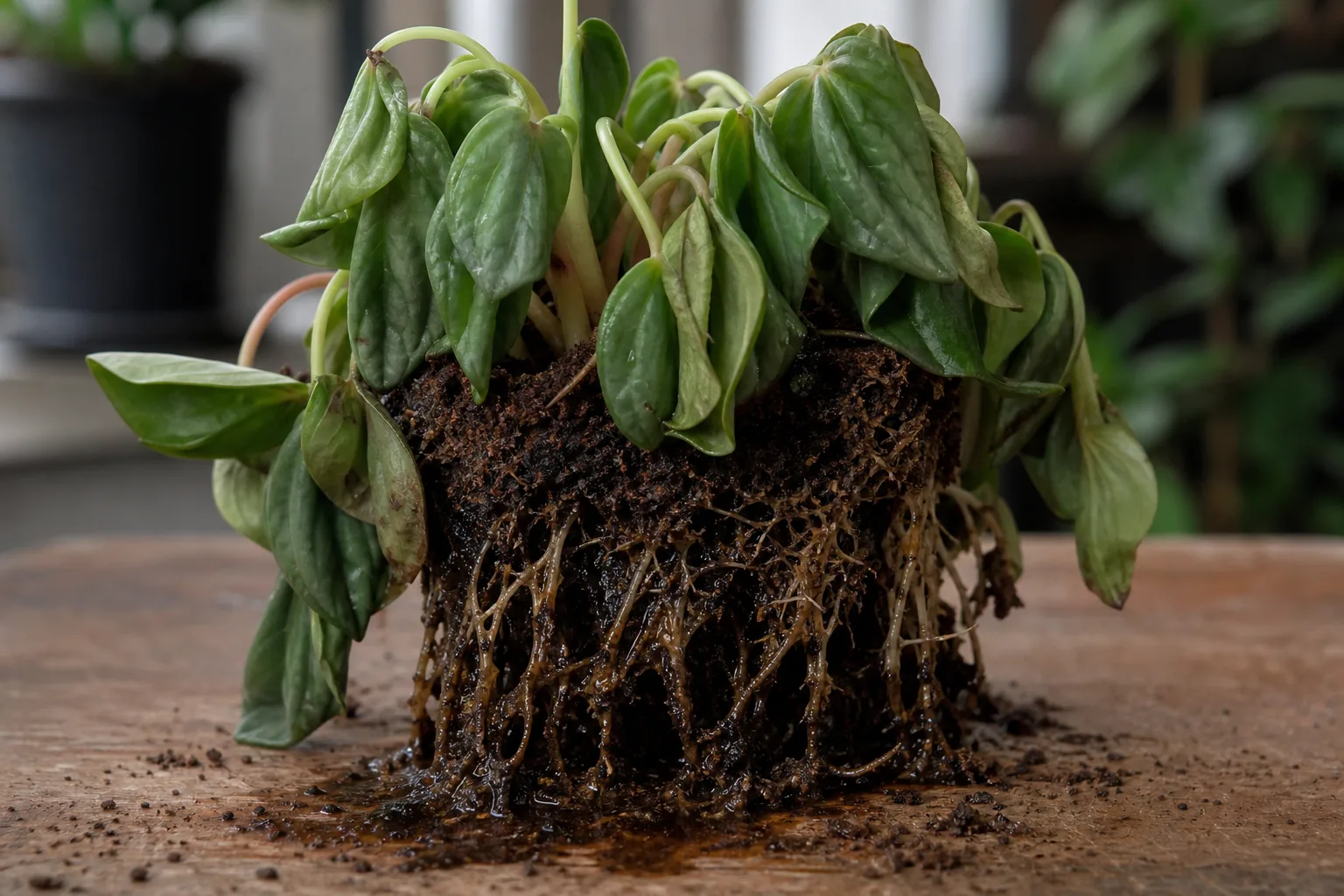
If leaves yellow and feel soft while the mix is still wet several days after watering, suspect that the roots are staying short of oxygen. First confirm the drainage hole is open and that the pot is not sitting in runoff. Let the mix dry partly before watering again; if the stem base is mushy, the soil smells sour, or several leaves collapse quickly, slide the root ball out and inspect it for dark, soft roots.
Trim only roots that are clearly mushy or dead with clean scissors, then repot into fresh, airy mix in a clean pot that is not oversized. If rot has reached most of the stem base, recovery is uncertain; take healthy upper cuttings before discarding a badly damaged parent. Do not keep watering because the wilted leaves look thirsty—a plant with failed roots can droop while surrounded by wet soil.
If the mix is bone dry and the leaves are limp, wrinkled, or curling, water thoroughly and allow excess to drain. A very dry mix may need water applied slowly so it can reabsorb rather than channeling straight past the root ball. Remove only leaves that are fully yellow or damaged; wait to see whether firm new growth resumes before changing the pot or adding feed.
An occasional older leaf at the base can yellow and drop as the plant grows. A sudden cluster of yellow leaves, a soft stem, or continuing leaf loss deserves investigation; one old leaf by itself usually does not justify an emergency repot.
Faded Color or Long, Sparse Stems
When new leaves appear greener or the pink margins become less distinct, first ask whether the plant has been in dimmer light than before. Move it to brighter filtered light gradually, and compare the next few leaves rather than expecting already mature leaves to recolor. A grow light is an option in a dark room, but fertilizer is not a substitute for enough light.
Long spaces between leaves, stems bending toward a window, and smaller new leaves all suggest the plant is reaching for light. Improve the light and rotate the pot; once new growth is stronger, trim leggy sections above a node if you want to encourage a fuller outline. Pruning alone will not solve ongoing stretching if the plant stays in the same dim position.
Pale or bleached patches on the side facing a window suggest too much direct sun, especially if the plant was recently moved. Pull it back behind a sheer curtain or farther from the glass, and let it acclimate before increasing exposure again. Pink edges are a cultivar trait, but their exact shade varies; do not chase a vivid color by exposing leaves to harsh midday sun.
Brown Edges, Spots, or Crispy Leaves
Brown tips can have several causes: a mix that dries too far, strong sun, low room humidity, fertilizer salts, or sensitivity to fluoride in some tap water. Check the pot and recent care first; if the plant is otherwise firm and only tips repeatedly brown, trying rainwater or filtered water is a reasonable low-risk adjustment. RHS notes fluoride sensitivity in Peperomia, but a brown tip alone cannot identify the cause. (RHS growing guide)
Crisp, pale patches on the window side fit sun scorch better than a watering problem. Small dark spots that spread, especially when leaves stay wet or crowded, are different from a dry tip: remove affected leaves, keep foliage dry when watering, improve gentle airflow, and isolate the plant if new spots continue to appear. NC State notes that wet foliage can contribute to leaf spots on this species. (NC State Extension)
Do not remove every leaf with a minor blemish. Trim tissue that is dead or spreading, then correct the likely condition and observe the next growth. If damage continues despite stable care, inspect both sides of the leaves and the stem joints for pests before assuming a disease.
Check for Pests and Root Problems
Look over Ginny whenever you water, especially along the leaf undersides, stem joints, and where leaves meet the crown. Mealybugs look like small white cottony patches; scale appears as fixed tan or brown bumps; spider mites may leave fine webbing or pale stippling. A few pests are easier to manage than a population that has spread to nearby plants, so isolate an affected pot while you inspect it.
For a small infestation, remove visible insects with a damp cloth or cotton swab and rinse the foliage carefully, keeping excess water out of the pot’s center. Recheck every few days because eggs or hidden insects may survive the first cleanup. If you use a soap or other pest-control product, confirm that its label covers the pest and indoor ornamental plants, and follow all directions; test a small area first because fleshy leaves can react differently to sprays.
Fungus gnats usually indicate that the potting mix is staying wet for too long, though the adult flies themselves are more annoying than dangerous to a mature plant. Let the upper mix dry more between waterings, remove fallen leaves, and use a sticky trap to monitor adults while correcting the moisture issue. Repeated insecticide use without fixing wet soil tends to leave the conditions that supported the problem in place.
Root rot is a root-zone problem, not a condition cured by wiping leaves. If the base is soft or the plant continues to collapse in wet mix, inspect the roots and remove only tissue that is clearly black, mushy, and dead. Healthy roots should be firm; if most roots are damaged, save sound stem tips for propagation and treat any recovery as uncertain.
Pet Safety and Warm-Weather Outdoor Care
The ASPCA lists red-edge Peperomia, scientifically identified as Peperomia clusiifolia, as non-toxic to cats, dogs, and horses. That classification makes Ginny a more suitable choice around pets than many common houseplants, but it does not make the plant food; keep it out of reach if an animal chews foliage, and contact a veterinarian if your pet becomes unwell. (ASPCA Animal Poison Control)
Ginny is usually grown as a houseplant outside tropical climates. NC State lists the species for USDA hardiness zones 10a through 12b, so gardeners elsewhere should protect it from cold and frost rather than treating it as a year-round outdoor perennial. In a warm season, it can spend time outdoors in bright shade if nights remain mild, but introduce it gradually and shield it from driving rain, wind, and direct afternoon sun. Bring it back inside before cool weather returns and inspect for hitchhiking pests.
Conclusion
Peperomia Ginny stays colorful and compact when you give it bright filtered light, airy soil, and a watering routine based on the pot’s actual dry-down. Let the plant’s leaves and mix guide small adjustments instead of reacting to a calendar or a single blemish.
When growth changes, check moisture, light, temperature, and pests in that order before making several changes at once. With a drained pot, steady warmth, and occasional pruning, this slow-growing Peperomia can remain an easy, long-lived indoor plant.